
Stories That Heal: 5 Books for Mental Health Awareness Month
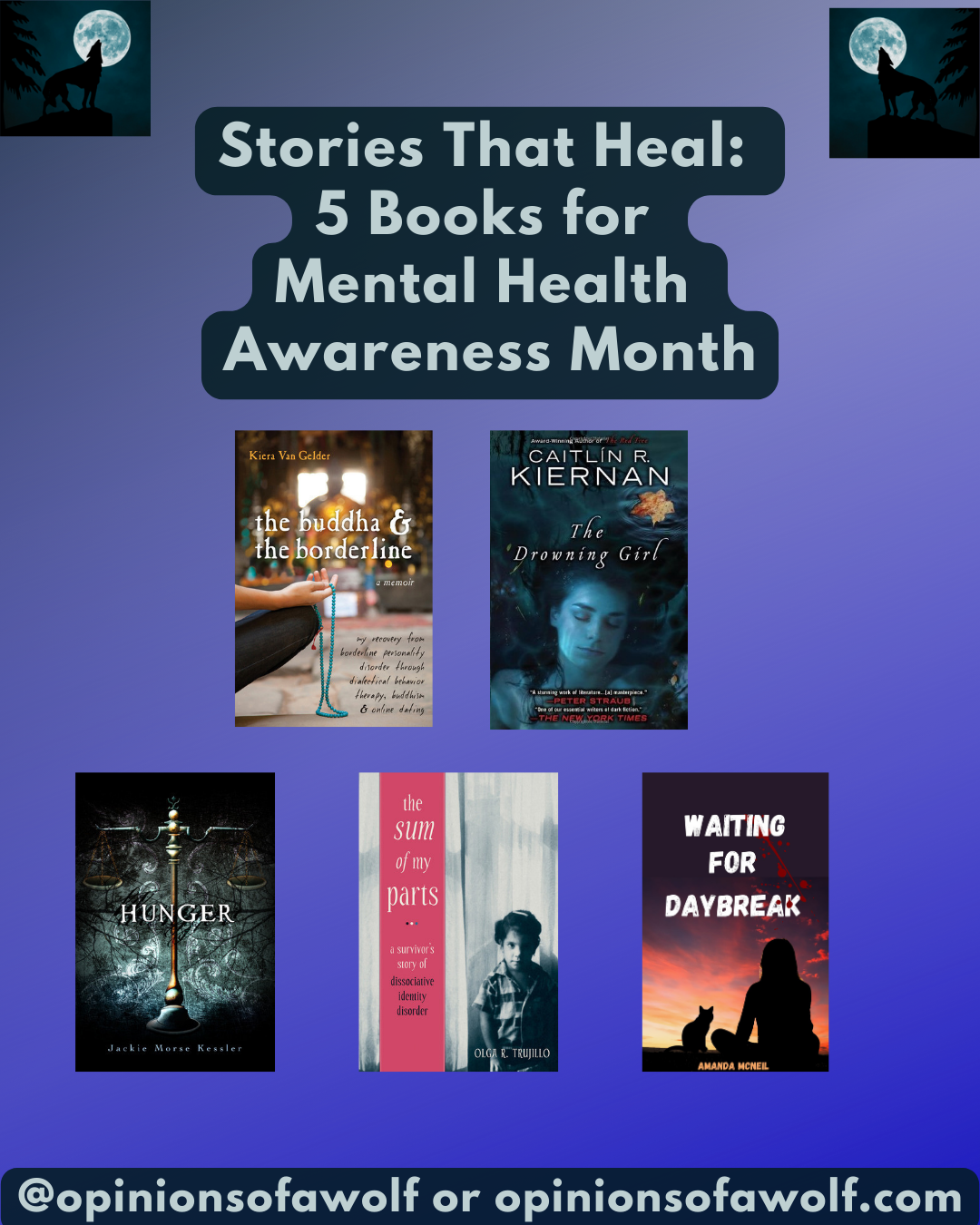
May is Mental Health Awareness Month—an annual observance founded by Mental Health America in 1949 to highlight the importance of mental wellbeing, educate the public, reduce stigma, and promote support for those affected by mental health conditions.
As someone who believes in the power of books to change lives, I thought this was the perfect time to share a mental health–focused reading list. Whether you frequently read books centered on mental health or are exploring this space for the first time, I hope you’ll find something here that resonates. This list includes a mix of fiction and nonfiction across genres—something for every reader.
The Buddha and the Borderline: My Recovery from Borderline Personality Disorder through Dialectical Behavior Therapy, Buddhism, and Online Dating by Kiera Van Gelder
(Amazon, Bookshop.org)
memoir
In this candid memoir set largely in Boston, Kiera Van Gelder traces her journey through Borderline Personality Disorder—from self-harm and addiction to healing through Dialectical Behavior Therapy and Buddhism. It’s an honest, hopeful account of finding stability and meaning after years of chaos.
(Read full review)
The Drowning Girl by Caitlin R. Kiernan
(Amazon, Bookshop.org)
literary fantasy, LGBTQIA+
In this haunting literary mystery, India Morgan Phelps—Imp to her friends—tries to untangle what really happened the summer she met Eva Canning. Was Eva a mermaid? A werewolf? Or is Imp’s memory altered by her schizophrenia? Told in lyrical, first-person prose, The Drowning Girl explores mental illness, identity, and unreliable memory, with nuanced queer representation and a mystery that unfolds entirely from within.
(Read full review)
Hunger by Jackie Morse Kessler
(Amazon, not available on Bookshop.org)
fantasy, YA
In this early 2010s YA standout, Hunger blends biting fantasy with raw realism to explore anorexia through a supernatural lens. When teen Lisabeth Lewis is visited by Death and becomes Famine—one of the Four Horsemen of the Apocalypse—she’s forced to confront the eating disorder that controls her life. With Buffy the Vampire Slayer-style humor and emotional honesty, this novel offers a powerful, metaphor-rich take on the inner voice of anorexia and the path to healing.
(Read full review)
The Sum of My Parts: A Survivor’s Story of Dissociative Identity Disorder by Olga Trujillo, JD
(Amazon, Bookshop.org)
memoir
In this powerful memoir, Olga Trujillo—once a successful attorney in D.C.—recounts their journey through the diagnosis, treatment, and recovery process of Dissociative Identity Disorder. As long-repressed memories of childhood abuse begin to surface, Olga works to integrate their parts and reclaim their life. With compassion, clarity, and survivor-centered care, this memoir offers both insight and hope to anyone seeking to understand trauma, dissociation, or the long path to healing.
(Read full review)
(Note: At the time I wrote my original review, Trujillo had not yet come out as nonbinary, so older references use previous pronouns.)
Waiting for Daybreak by Amanda McNeil
(Amazon, Bookshop.org)
zombie horror
In my own novel, Waiting for Daybreak, a young woman with Borderline Personality Disorder unexpectedly finds sobriety from alcoholism and strength when a zombie outbreak turns Boston upside down. Frieda has spent years battling emotional chaos and isolation—but when a mysterious virus brings society to a halt, she discovers survival suits her better than daily life ever did. As she sets out to save her sick cat, her solitary routine shatters, and she’s forced to reengage with a world that no longer plays by the rules. A character-driven post-apocalypse, Waiting for Daybreak explores mental illness, addiction recovery, and the fragile resilience that can grow in even the bleakest moments.
(See what readers are saying)
I hope you’ve found something here that speaks to you. If you have a favorite book that explores mental health—fiction or nonfiction—I’d love to hear about it in the comments!
 Support my work with a tip or browse my shop for curated book club guides, how to guides, cross-stitch patterns, and more!


This work by Amanda Nevius is licensed under a Creative Commons Attribution-Noncommercial-No Derivative Works 3.0 United States License.
 Opinions of a Wolf