
Archive
Book Review: Thieftaker by D. B. Jackson (Series, #1)
 Summary:
After spending over a decade serving hard labor in the Caribbean for mutiny and conjuring, Ethan has finally made it back to Boston. He now makes his living as a thieftaker, essentially a private investigator who hunts down stolen items, using his conjuring where necessary to help him out. But the year is 1767 and trouble is starting to brew in Boston. The Stamp Tax has been enacted, and the people don’t like it. There are even riots in the street. Against this back-drop, Ethan is asked to find a brooch that was stolen–from the body of a dead girl. He doesn’t usually take on cases involving murder, but this one is different.
Review:
It’s probably hard to tell from this blog, because they’re hard to find, but I am a real sucker for a good Boston during the American Revolution story. So when this title showed up I snapped it up. I’m glad I did because it’s an interesting take on the Stamp Act Riots.
This is an interesting piece of historic fiction, because it’s more like urban fantasy historic fiction. Is that a genre? Can it be? What on earth would we call it? In any case, I was in heaven, because I love BOTH urban fantasy and history so having both in one book was heaven. I mean first it’s breeches and three corner hats then it’s look at this illusion of a creepy little girl. Brilliant.
I struggled a bit with Ethan, which in retrospect wasn’t a bad thing. That shows he’s a realistic, well-rounded character. But let’s be honest. I’m more of a Sam Adams revolutionary type. Ethan served in the British Navy and is all “oh these hooligans.” This bothered me a lot! Especially when I got suspicious that the book as a whole would lean Tory. But! This all ends up being part of the character development, which in the end is what makes the book stronger. Ethan isn’t sure about protesting and fighting the aristocracy at first. But he changes his mind with time. This makes for a great plot-line. I like it. I do hope in the sequel we will get less of this hemming and hawing about owing things to the crown and yadda yadda. DOWN WITH THE KING. Ahem.
As a Bostonian, can I just say, I haven’t seen a book so intent on giving actual street names and buildings before, but it worked. They are totally accurate. I could completely visualize not just the streets but the entire routes Ethan was walking along. Granted, it was as if through a looking glass, since when I walk them they’re a bit different than in 1767, but still. It was very cool. I also really appreciated the depiction of the South Enders, since I spend quite a bit of time in Southie. Seeing the historical versions was really fun.
The magic portion of the book was also unique. Ethan has to cut himself to get blood to work the more powerful spells. The less powerful ones he can work with surrounding grasses, plants, etc… This makes the interesting problem that people struggle in fist-fighting him because if he bleeds he just uses it to work spells. It’s a nice touch.
So with all this glowing, why not five stars? Well, honestly, Ethan bugged me so much for the first 2/3 of the book that I kept almost stopping in spite of all the good things. He’s just such a…a…Tory. For most of the book. Instead of being angry at the man for putting him in prison for conjuring, he blames himself. Instead of being angry that the rich just keep getting richer while he struggles to pay his rent, he blames himself. You get the picture. Being irritated almost constantly by Ethan kind of pulled me out of the world and the story, which I wish hadn’t happened, because it really is such a cool world. I get what Jackson was trying to do, character development wise, but the payoff in the end was almost missed because I kept stopping reading due to being irritated with Ethan. Perhaps if his change of heart had started to show up a bit sooner it would have worked better for me.
Overall, though, this is well-researched and thought out version of Boston during the Stamp Act Riots. Fans of historic fiction and urban fantasy will get a kick out of seeing the latter glamoring up the former.
4 out of 5 stars
Source: NetGalley

Book Review: The Bay of Foxes by Sheila Kohler
 Summary:
Dawit is a twenty year old Ethiopian refugee hiding out illegally in Paris and barely surviving. One day he runs into the elderly, famous French writer, M., in a cafe. Utterly charmed by him and how he reminds her of her long-lost lover she had growing up in Africa, she invites him to come live with her. But Dawit is unable to give M. what she wants, leading to dangerous conflict between them.
Review:
This starts out with an interesting chance meeting in a cafe but proceeds to meander through horror without much of a point.
Although in the third person, we only get Dawit’s perspective, and although he is a sympathetic character, he sometimes seems not entirely well-rounded. Through flashbacks we learn that he grew up as some sort of nobility (like a duke, as he explains to the Romans). His family is killed and imprisoned, and he is eventually helped to escape by an ex-lover and makes it to Paris. This is clearly a painful story, but something about Dawit in his current state keeps the reader from entirely empathizing with him. He was raised noble and privileged, including boarding schools and learning many languages, but he looks down his nose at the French bourgeois, who, let’s be honest, are basically the equivalent of nobility. He judges M. for spending all her money on him instead of sending it to Ethiopia to feed people, but he also accepts the lavish gifts and money himself. Admittedly, he sends some to his friends, but he just seems a bit hypocritical throughout the whole thing. He never really reflects on the toppling of the Emperor in Ethiopia or precisely how society should be ordered to be better. He just essentially says, “Oh, the Emperor wasn’t all that bad, crazy rebels, by the way, M., why aren’t you donating this money to charity instead of spending it on me? But I will tooootally take that cashmere scarf.” Ugh.
That said, Dawit is still more sympathetic than M., who besides being a stuck-up, lazy, self-centered hack also repeatedly rapes Dawit. Yeah. That happened. Quite a few times. And while I get the point that Kohler is making (evil old colonialists raping Ethiopians), well, I suppose I just don’t think it was a very clever allegory. I’d rather read about that actually happening.
In spite of being thoroughly disturbed and squicked out by everyone in the story, I kept reading because Kohler’s prose is so pretty, and I honestly couldn’t figure out how she’d manage to wrap everything up. What point was she going to make? Well, I got to the ending, and honestly the ending didn’t do it for me. I found it a bit convenient and simplistic after the rest of the novel, and it left me kind of wondering what the heck I just spent my time reading.
So, clearly this book rubbed me the wrong way, except for the fact that certain passages are beautifully written. Will it work for other readers? Maybe. Although the readers I know with a vested interest in the effects of colonialism would probably find the allegory as simplistic as I did.
2 out of 5 stars
Source: Netgalley
Counts For:
Specific country? Ethiopia. South African author.

Book Review: The Value of Rain by Brandon Shire
 Summary:
Charles hasn’t been home since his mother and uncle sent him away to an insane asylum at the age of fourteen after he was found in the embrace of his first love–Robert. Now, ten years later, his mother, Charlotte, is dying, and he comes back to take his revenge.
Review:
This is one of those genre-defying books. Although classified as LGBTQIA+, it is so much more than a genre. Shire explores the devastating effects of prejudice, hate, secrets, and lies throughout family generations, and that is something that is simultaneously universal and tragic.
The book constantly takes the reader by surprise. At first it seems an expected my-family-didn’t-love-me-because-I’m-gay story, but Charles does *not* get a free pass simply because he is hurt by his family. He is given chances at new life and redemption from a hate-enshrouded existence, but he doesn’t choose that path. It is painful to watch, and yet simultaneously understandable. I applaud Shire for not taking the easy way and by making Charles an easy hero.
The writing is particularly eloquent and strong in description, especially when describing painful topics. For instance:
She had lived in the maze of Charlotte’s thumbprint and she had not survived. (location 1349)
On the other hand, the dialogue sometimes struggles in comparison to the lyrical descriptions. For instance, characters often say people’s names more frequently than is natural. This is a kink that I am sure will be ironed out with time and experience.
I also loved and was totally shocked by the ending. That is not an easy thing to do to this reader.
Overall this book represents all that can be great about indie publishing. It is a deep, dark story with a minority, tragic hero that most likely would not be told at a traditional publishing house due to the fact that it does not easily fit into any one genre or marketing scheme. Of course, that is also why I love it.
Recommended to those with an interest in LGBTQIA+ main characters and multi-generational family dramas.
4 out of 5 stars
Source: Kindle copy from author in exchange for my honest review

Note: Half of all proceeds donated to LGBT Youth Charities.
Book Review: The Far Side of the Sky by Daniel Kalla
 Summary:
After Kristallnacht, Franz Adler, a secular Austrian Jew, is desperate to save the remaining members of his family–his daughter Hannah and sister-in-law Esther. The only place they’re able to find letting in refugees is the relatively border-lax Shanghai.
Meanwhile, Mah Soon Yi, aka Sunny, the daughter of a Chinese doctor and American missionary, is trying to deal with the partial Japanese occupation of her home city of Shanghai while working as a nurse in one of the large hospitals and volunteering in the Jewish Refugee Hospital.
Review:
It’s difficult to review a book that the author obviously put a lot of research effort into, as well as passion for social justice, but that I just personally didn’t end up liking. The story itself isn’t bad, if a bit far-fetched. Clearly based in fact and solid research. I believe the problem lies a bit in the writing.
When I read historic fiction, I like seeing history through the eyes of one person (possibly two). It brings the huge picture you get otherwise down to a personable level. The problem with this book is that it kind of fails to keep things at that personal level. There’s far too much contact with actual big movers and shakers from the historic events. How the heck is this Dr. Adler in so much contact with the Japanese and Nazi elite? One scene like that can be quite powerful in a book, but not multiple ones. It takes it from the realm of historic fiction to that of fantasy.
Additionally, I feel that a bit too often Kalla tells instead of shows. Two characters will be talking about something the reader doesn’t yet know about, such as how the city of Shanghai is set up politically, and instead of putting it into the dialogue, the book just says “And then he told him about thus and such.” That makes for dull reading.
So, really, to me, the plot itself is unique in choosing a population and area of WWII that is not written about that much. The author clearly did his research and has a passion for the time period and issues faced by the people, but the story would be better served if it was made more about the everyman and dialogue and action were used more effectively.
Overall, this is a unique piece of historic fiction that will mainly appeal to fans of the genre looking for a new area of WWII to read about.
3 out of 5 stars
Source: Netgalley

Book Review: The Story of Beautiful Girl by Rachel Simon
 Summary:
Martha, a retired, widowed schoolteacher, thought her life was pretty much over until one night when a young intellectually disabled white woman and a deaf black man show up on her doorstop in the rain holding a newborn baby. Soon people from a nearby mental institution show up to take them back away. The young woman, Linny, seems terrified and asks Martha to hide the baby. The man, Homan, escapes. Martha goes on the lam to keep the baby girl out of the institution, and Linny and Homan fight against all odds attempting to reunite their family.
Review:
I received the audiobook version of this as a gift for one of the holiday swaps I participated in in December. It was my first time reading the audiobook version of a modern story, as I’m a cheapskate and usually just get ones for free that are out of copyright. It was thus an entirely different experience to be forced to slow down when reading this piece of historic fiction about a very dark secret in American history–mental institutions. The amount of time that Linny and Homan are forced to spend simply waiting for their lives to get better. Waiting for people to recognize their humanity. It hit me much harder than if I had been able to read this in a couple of hours. (Each disc is about 1 hour long, and there are 10 discs). The wrongness of it all. The amount of time and lives wasted simply because the able-minded and able-bodied didn’t seek to understand or to grant these people the basic human right of self-direction.
The story itself is told from multiple viewpoints–Linny, Homan, Martha, Kate (a caregiver at the institution), and later Julia (the baby daughter when she grows up). Mostly Simon does a great job switching among the different voices, particularly representing Linny. She does not overinflate her internal dialogue to be that of a person with an average IQ, but she still clearly represents Linny’s humanity. I am a bit skeptical of the voice given to Homan though, mostly his tendency to give people bizarre nicknames like “roof giver.” I know that neither
Simon nor I know a deaf person who is unable to communicate with those around him, so really it is all guess-work as to what his internal dialogue would be like. But I can’t help but feel like it’s not quite there. On the other hand, his confusion and frustration at people talking around him, over him, and treating him like he’s stupid just because he’s deaf is very well done.
In retrospect, I’m not quite sure why so much time was devoted to Martha and Julia when Julia was a baby. Her story doesn’t end up being nearly as important as the Homan/Linny romance, so this focus feels a bit like a red herring. I would definitely shorten those chapters.
The use of artwork and items of visual significance to the characters is gorgeous though. Lighthouses are a central feature, and I don’t even like lighthouses myself, but I still found myself moved by how important the visual arts can be to people. This is a book that, surprisingly, winds up being almost a battle cry for the arts. For their value in helping us connect with each other and hold on to our humanity. I think any artist or someone who is a fan of the arts would appreciate this book for that reason.
On the other hand, Simon is clearly a person of some sort of faith, with a belief in god and the tendency for things to all work out right in the end. I’m…not that type of person. So when characters wax eloquent about god or an overall plan or the ability of evil people to repent and turn good, well, it all feels a bit more like fantasy than historic fiction to me. I probably would have been irritated by this less if I had had the ability to skim over those parts though.
In the end, though, I came away from this book appreciating its uniqueness and all the good qualities it had to offer. It demonstrates through a beautiful story why it’s so important not to institutionalize the mentally ill or mentally challenged. It shows the power of love to overcome race and disabilities. It is the story of the power and beauty of resiliency.
Overall, I recommend this work of historic fiction to fans of historic and contemporary fiction, advocates of the mentally ill or mentally challenged, and those just simply looking for a unique love story.
4 out of 5 stars
Source: Gift

Counts For:

Book Review: The Baker’s Daughter by Sarah McCoy
 Summary:
It’s 2007, and Reba is a journalist living in El Paso, Texas, with her fiance, border patrol guard, Riki. She hasn’t been able to bring herself to be fully honest with him about her dark childhood overshadowed by her Vietnam Vet father’s struggle with depression and PTSD. Christmas is coming up, and she is interviewing Elsie, the owner of the local German bakery. Elsie has some intense secrets of her own that show it’s not always easy to know what’s right when your country and family go wrong.
Review:
I have an intense love for WWII stories, and I immediately was drawn to the idea of intergenerational similarities and learning from an older generation innate in this book’s plot. It is a complex tale that McCoy expertly weaves, managing to show how people are the same, yet different, across race, time, and gender.
Reba’s and Elsie’s tales are about two very different kinds of bravery. Reba has a wounded soul that she must be brave enough to reveal to the man she loves. She lives in fear of turning into her father or losing herself entirely in the love for another, the way her mother did. She faces a struggle that I have heard voiced by many in my generation–do I risk myself and my career for love or do I continue on alone? To this end, then, the most memorable parts of Reba’s story, for me, are when Elsie advises her on love in real life, as opposed to the love you see in movies and fairy tales.
I’ve never been fooled by the romantic, grand gestures. Love is all about the little things, the everyday considerations, kindnesses, and pardons. (location 482)
The truth is, everyone has a dark side. If you can see and forgive his dark side and he can see and forgive yours, then you have something. (location 844)
One issue I had with the book, though, is that although we see Elsie’s two relationships before her husband in stark clarity and reality, we never really see what it is that made her ultimately choose her own husband. We see their meeting and first “date,” yes, but that’s kind of it. I felt the book was building up to what ultimately made Elsie choose her American husband and move to Texas, but we only see snippets of this, whereas we see a lot of Elsie’s interactions with her prior two boyfriends. That was a big disappointment to me, because I wanted to know how Elsie knew he was the one, and how she herself was brave enough to take the leap she encourages Reba to make.
I am sure most people will most intensely react to the story of Elsie’s actions to attempt to save a Jewish boy during WWII and may even wish that was the only real story told. Elsie’s life during wartime Germany. It is definitely the stronger of the two stories, but I so enjoyed the lesson in valuing and listening to those older than you that we see through Reba meeting and learning from Elsie that I must say I like the book just the way it is. Is it different? Yes. But that’s part of what makes it stand out in a slew of WWII fiction. Elsie did this brave thing, and her whole life she never knew if it really made much of a difference. She just lived her life, married, had a daughter, was kind to a journalist. In a sense, it makes her story seem more realistic. Less like something from “The Greatest Generation” and more like something possible to accomplish for anyone with a strong will and willingness to make up her own mind.
One critique I have that slowed the book down for me and made it less enjoyable are the insertion of letters between Elsie and her sister, Hazel, who is in the Lebensborn program. Compared to the rest of the book, the letters were slow-moving and only moderately interesting. I can’t help but feel shorter letters would have gotten the same message across without slowing down the story quite so much. Yes, the inclusion of the sister was necessary to the story, but I feel like she got too much stage time, as it were.
I also have to say that I really hate the cover. It reflects none of the spirit or warmth of the book itself. The story is wrapped in warm ovens, scents of cinnamon, and bravery, and yet we get the back of a woman’s head with an inexplicable gingham strip at the bottom? Yeesh.
Overall, this is a life-affirming story that teaches the value of connecting with the older generations and cautions against thoughtless nationalism. I highly recommend it to fans of literary and WWII fiction alike.
4 out of 5 stars
Source: NetGalley

Book Review: Beast Saves the Brothers and Sisters of the Cosmic I Am by G. W. Davies
 Summary:
Lisa Miller can’t believe she’s off chasing after her fraternal twin sister, Millie, yet again. After her sister ran away to join the hippie commune, Lovestock, she thought it was out of her system. But a hippie named Beast from Millie’s past shows up in town, and together they head off for Montana following The Two who claim to be in contact with the Twellorasians who will soon arrive to whisk away their followers. Along the way, they pick up a junkie jazz trumpeter and his drummer and get tailed by the drug dealer the junkie stole heroin from.
Review:
I kept reading this book thinking, “I should be finding this funny. I should be enjoying this story. I should be lost in this world,” but I never once laughed and glanced at the clock more times than I can count. I think I’m really just not the intended audience for this book.
The storyline is definitely unique and zany without being unbelievable. The split of the camp into the hippies who follow The Two and the hippies who follow the jazz trumpeter was a great move and added depth to the story. The characters are easily differentiated and fairly well-rounded. There are two bisexual characters presented in a positive light, which was nice. The dialogue is snappy.
There is a serial rapist element to the story that some might find triggering. I, personally, don’t think it’s played for laughs and Davies handles both male and female rape well. But readers wary of that content should be aware it is in the book.
I think three elements really made the book a miss for me. The humor is not my style. It’s composed of a lot of similes and tongue-in-cheek references to 1960s culture (like the Beatles and stoners) that I just personally don’t find funny. Second, the story is set in the 1960s in the middle of hippie culture, and that’s the sort of setting that takes an amazing storyline to leave me satisfied. Third, I disliked the ending, but I know some people will love it.
Overall, although this book didn’t do it for me, it is well-written, and I believe it will appeal to those with a vested interest in the 1960s and hippie culture.
3 out of 5 stars
Source: Kindle copy from the author in exchange for my honest review

Book Review: Like One of the Family by Alice Childress (The Real Help Reading Project)
 Summary:
Originally published as a serial in African-American papers in the 1950s this series of monologue-style short stories are all in the voice of Mildred–a daytime maid for white families in New York City. The monologues are all addressed to her best friend and downstairs neighbor, Marge, who is also a maid. The stories range from encounters with southern relatives of moderately minded employers to picnics threatened by the Ku Klux Klan to more everyday occurrences such as a dance that went bad and missing your boyfriend. Mildred’s spitfire personality comes through clearly throughout each entry.
Review:
With completion of this book, Amy and I are officially halfway through our The Real Help Reading Project! This book is our first piece of fiction to directly foray into the time era and relationships depicted in The Help, whereas the rest have shown the slave culture and racial issues leading up to that time period. I’m glad we got the historical context from our previous reads before tackling this one written during the Civil Rights era by an author who periodically worked as a maid herself.
The introduction by Trudier Harris is not to be missed. She provides excellent biographical details of Alice Childress, who was not only a black writer of fiction, but also wrote and performed in plays. I am very glad I took the time to read the introduction and get some context to the author. Harris points out that in real life some of the things the character Mildred says to her employers would at the very least have gotten her fired, so to a certain extent the situations are a bit of fantasy relief for black domestic workers. Mildred says what they wish they could say. Since we know Childress was a domestic worker herself, this certainly makes sense. I would hazard a guess that at least a few of the stories were real life situations that happened to her reworked so she got to actually say her mind without risking her livelihood. I love the concept of this for the basis of a series of short stories.
More than any other work we’ve read, Like One of the Family demonstrates the complexities of living in a forcibly segregated society. Mildred on the one hand works in close contact with white people and subway signs encourage everyone in New York City to respect everyone else, and yet her personal life is segregated. Mildred frequently points out how she can come into someone else’s home to work, but it wouldn’t be acceptable in society for that person to visit her as a friend or vice versa.
Another issue that Childress demonstrates with skill is how a segregated, racist society causes both black and white people to regard each other with undue suspicion. In one story Mildred’s employer asks her if it’s too hot for a dress Mildred already ironed for her and ponders another one. Mildred assumes that if she agrees with her employer that it’s too hot for the first dress, she’ll have to stay late to iron. Her employer instead of getting angry realizes that Mildred has been mistreated this way before and takes it upon herself to reassure Mildred that she herself is perfectly capable of ironing her own dresses and will not keep Mildred longer than their agreed upon quitting time. Of course, Mildred sometimes is the one who must hold her temper and calm irrational fears. In one particularly moving section she encounters a white maid in their respective employers’ shared washroom. The woman is afraid to touch Mildred, and it takes Mildred holding her temper and carefully explaining that they are more similar than different before the woman realizes how much more she has in common with Mildred than with her white employer. These types of scenes show that the Civil Rights movement required bravery in close, one-on-one settings in addition to the more obvious street demonstrations and sit-ins.
Of course the stories also highlight the active attempts at exploitation domestics often encountered. Mildred herself won’t put up for it, but Childress manages to also make it evident that some people might have to simply to get by. An example of this sort of exploitation is the woman who upon interviewing Mildred informs her that she will pay her the second and fourth week of every month for two weeks, regardless of whether that month had five weeks in it or not. What hits home reading these serials all at once that perhaps wouldn’t otherwise is how frequent such a slight was in a domestic’s life during this time period. Mildred does not just have one story like this. She has many.
Of course sometimes reading Mildred’s life all at once instead of periodically as it was intended was a bit desensitizing. Although Mildred had every right to be upset in each situation related, I found myself noticing more and more that Mildred was simply a character for Childress to espouse her views upon the world with. I quickly checked myself from getting bugged by that, though. Of course Childress had every right to be upset and did not originally intend this to be a book of Mildred’s life. Mildred was a vehicle through which to discuss current issues highly relevant to the readers of the paper. It is important in reading historic work to always keep context in mind.
Taking the stories as a whole, I believe they show what must have been one of the prime frustrations for those who cared about Civil Rights during that era, whether black or white. Mildred puts it perfectly:
I’m not upset about what anybody said or did but I’m hoppin’ mad about what they didn’t say or do either! (page 167)
Passivity in changing the system is nearly as bad as actively working to keep the system, and Mildred sees that. Of course what Mildred highlights is a key conundrum for the black domestic worker of the time–speak up and risk your job or stay silent at a cost to the overall condition of those stuck in the system? A very tough situation, and I, for one, am glad that many strong men and women of all races took the risk to stand up and change it.
Source: Copies graciously provided to both Amy and myself by the publisher in support of the project (Be sure to sign up for the giveaway. US only and International).

Discussion Questions:
- How do you think domestics decided where to draw the line in what they would and would not put up with in employment in white people’s homes?
- Some of Mildred’s employers seem to be sensitive to the racial and inequality issues and are very kind to Mildred. Be that as it may, do you think it is/was possible to hire a maid for your home and not have a racist mind-set?
- Do you think the employers Childress depicts attempting to exploit Mildred were doing so out of racism, a power-trip, or greediness or some combination or all three?
- Mildred points out multiple times that she feels that the public ads encouraging people to accept each other “in spite of” their differences are still racist. Do you think this is true?
Book Review: The Book of Night Women by Marlon James (The Real Help Reading Project)
 Summary:
This is the story of Lilith. A mulatto with green eyes born on a plantation in Jamaica to a mama who was raped at 14 by the overseer as punishment to her brother. Raised by a whore and a crazy man, all Lilith has ever wanted was to improve her status on the plantation. And maybe to understand why her green eyes seem to freak out slave and master alike. Assigned to be a house slave, Lilith finds herself in direct contact with the most powerful slave on the plantation–Homer, who is in charge of the household. Homer brings her into a secret meeting of the night women in a cave on the grounds and attempts to bring Lilith into a rebellion plot, insisting upon the darkness innate in Lilith’s soul. But Lilith isn’t really sure what exactly will get her what she truly wants–to feel safe and be with the man she cares for.
Discussion:
This is the third book and second fictional work for The Real Help reading project I’m co-hosting with Amy, and it totally blew me away. A reading experience like this is what makes reading projects/challenges such a pleasure to participate in. I never would have picked up this book off the shelf by myself, but having it on the list for the project had me seek it out and determined to read it within a set length of time. Reading the blurb, there’s no way I would imagine identifying with the protagonist so strongly, but I did, and that’s what made for such a powerful experience for me. The more I read literature set in a variety of times and places, the more I see what we as people have in common, instead of our differences.
There is so much subtle commentary within this book to ponder that I’m finding it difficult to unpack and lay out for you all. Part of me wants to just say, “Go read this book. Just trust me on this one,” but then I wouldn’t be doing my job as a book blogger, would I?
Depicted much more clearly here than in any of our reads so far is how detrimental a society based upon racism is for all involved. There is not a single happy story contained here. Everyone’s lives are ruined from the master all the way down to the smallest slave girl. It is a circle of misery begetting misery begetting misery.
Homer was the mistress’ personal slave and many of the evil things that happen to her was because the mistress was so miserable that she make it her mission to make everybody round her miserable as well. (page 415)
Nobody is happy. Everyone lives in misery and fear. The whites are afraid of a black revolt. The blacks are afraid of being whipped or hung. Everyone is afraid of Obeah (an evil witchcraft similar to voodoo). People start to lash out at each other in an attempt to better themselves. For instance, the Johnny-jumpers are male slaves who are pseudo-overseers given power over the other slaves to beat them. It is simply a system exploiting everyone and for what? From the book it appears to be to maintain Britain’s position of power in the world. The system is evil, and it does not simply beget misery, but despair as well. It brings out the worst in everyone.
A strong theme in this book is that of race being a construct rather than an innate true difference in people. Since Lilith is bi-racial, she has trouble simply aligning herself with one side or the other. Although at first she hates white people, she comes to deeply care for a white man. She comes to see people as individuals and not their race, but alas that thought process is far too advanced for the time she is living in, and she senses this.
She not black, she mulatto. Mulatto, mulatto, mulatto. Maybe she be family to both and to hurt white man just as bad as hurting black man…..Maybe if she start to think that she not black or white, then she won’t have to care about neither man’s affairs. Maybe if she don’t care what other people think she be and start think about what she think she be, maybe she can rise over backra and nigger business, since neither ever mean her any good. Since the blood that run through her both black and white, maybe she be her own thing. But what thing she be? (page 277-8)
It’s impossible not to have your heart break for Lilith, a woman whose whole life revolves around race when all she ever wants is to feel happy and safe, an impossible dream represented for her by a picture from a child’s book that her foster slave father let her take from him. The picture is of a sleeping princess with a prince near her, and Lilith’s obsession with this image follows her throughout her life, until she finally tells herself:
She not no fool, Lilith tell herself. She not a sleeping princess and Robert Quinn is not no king or prince. He just a man with broad shoulders and black hair who call her lovey and she like that more than her own name. She don’t want the man to deliver her, she just want to climb in the bed and feel he wrap himself around her. (page 335)
I found myself wishing I could scoop Lilith and Robert up and place them on an island where they could just be together and raise their mixed race babies and just be happy, but that’s not what happened then, and that’s the dream we must keep fighting for, isn’t it? A world where people can just love each other and be happy and not be forced into misery for economic gain of a person or a business or a nation.
I know it sounds like wishful thinking, but that’s really what I got out of this book. If we don’t want to live in a world that dark, we must embrace love in all its forms. Love begets love, but hate begets hate. Don’t like corporate greed or nationalism overtake your capacity to see the humanity in everyone–the capability for powerful good or powerful evil present in us all. Perhaps this is a bit off-topic for The Real Help Reading Project, but that is the old passion from a youthful me in undergraduate classes that this book reignited, and that is what makes me want everyone to read it.
Source: Public Library
Buy It

Please head over to Amy’s post to discuss this book!
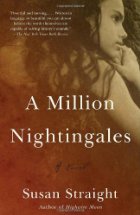
Book Review: A Million Nightingales by Susan Straight (The Real Help Reading Project)
 Summary:
Moinette is born south of New Orleans to a slave mother as a mulatresse–she is half white and half black. Since her mother’s slave labor consists largely of laundry and also due to her looks, Moinette spends her life serving predominantly within the white homes instead of the fields, which is a dangerous location. She also spends her life striving to be free and to save her family.
Discussion:
This is the first book for the The Real Help reading project I’m co-hosting with Amy (intro post). I do apologize for the late time in the day that my hosting post is arriving. It was raining this week, so I was afraid to bring my kindle with me most places. Anyway. On to discussing Moinette’s life as The Real Help.
The two things that stuck out the most to me were how desperate Moinette was to love no one but her mother (not even her son at first) and also the mental impact being treated as less than human had on her. Moinette repeatedly degrades herself in her mind because of how others treat her. This is what I want to discuss first.
There’s the fact that Moinette is half-white and half-black. She is evidence of the fact that the white males find the black slaves desirable, and that is offensive to everyone involved. For this reason, Moinette faces racism from both black and white people. Early on she is informed that she is different, but not in a human way.
He said he was a horse, at least pure in blood and a useful animal. He said I was a mule, half-breed, and even a mule worked hard. He said I was nothing more than a foolish peacock. (page 5)
Moinette’s identity is always in peril throughout her whole life, because no one wants to admit that sex between the races really happens, even though Moinette’s own existence is evidence of that fact. Additionally, she constantly struggles to feel that she is worth more than an animal. She sees that elderly slaves are literally valued as less than a dish. Imagine what that would do to the self-esteem? We talk a lot in classes in the US about how bad it would be to be owned by someone, but we never talk about the reality of being treated as an animal, as an object. It feels abstract to say, “Oh, imagine what it would feel to be owned by someone.” It is far less abstract to see the mental and emotional strife Moinette goes through in attempting to hold on to her sense of humanity.
Moinette also constantly struggles with the concept of love and who to love and when to love. Something that stuck out to me was how at first she did not love her son. She did not even want her son. This is understandable given that he was the result of rape. Later, though, much of her life focus comes to be on freeing him and saving him. She loves him, yes, but personally I can’t help but notice that her focus on him only comes when she discovers that her mother is missing/gone. It is almost as if she transfers her love for her mother to Jean-Paul and then to the little girls she buys in order to free them at 21. Moinette’s experience with this demonstrates how slavery and inequality is so dehumanizing because it rips apart one of the key aspects that makes for humanity–the ability to make families, whether by blood or by choice. Moinette knows the danger of loving someone. She quite simply states:
I knew my heart was only meat for another animal. (page 107)
Moinette spends the first half of her life striving to be back with her mother where she feels safe and loved. She spends the second half of her life striving to save younger slaves and give them a place where they feel save and loved. In Maslow’s Hierarchy of Needs (link) safety is almost at the very bottom. Only the very luckiest slaves even had the first level of physiological needs met. Most never truly felt safe as there was no security of family, which is key to psychiatric stability and sense of self. Even if we ignore the tragedy of Moinette being born a slave, her life is still tragic because she was never given the chance to self-actualize and become the truly amazing person that is clearly inside her throughout the novel because she must spend all her time struggling for the basic needs.
Obviously we also should discuss Moinette’s relationships with white women as we are reading this project to answer to The Help. Moinette has an interesting relationship with white women. She does not love the ones she serves, but she also does not hate them. Moinette is clearly confused as to how to react to these women. The first white woman she served was Cephaline, who was nearly her age and died young. After she dies, Moinette says:
I missed her voice. Her words like embroidery in the air. She didn’t love me. But I had heard her voice all my life. (page 98)
How odd to spend so much of your time near someone, in often intimate situations, to know them truly thoroughly, but to feel no sense of love or camaraderie. Moinette can see some similarities between herself and the white women she serves. Their bodies are somewhat different, yet they both have two breasts and a vagina. Although Moinette recognizes that white women have a bit more freedom, she still sees them as essentially used and hunted by men.
The Men hunted money and sex. The women were hunted and captured, even the white women. (page 230)
Truly with the marriage contracts of the time, a married white woman was not exactly free. Moinette recognizes this, and I believe it adds to her despair. What chance is there for women of any color in this society?
Another theme in the book is how dangerous working in the house is. Working in the cane, no one notices the slave women, but working in the house, suddenly the women get noticed by the men and get used for their bodies sexually. Even if a woman managed to escape being raped, she still felt inferior since she was living in the house and working in the house as a wife, but was not a wife.
Sophia said, “Safer in the cane. Do your work, nobody look. Dangerous in the house.” (page 235)
In close quarters, such as serving in a white household, another whole level of fear and intimidation comes in to play. Although the work is technically easier, the women actually had less control over what happened to their bodies.
Overall I think this book gives an excellent look into the sheer despair of being born a slave in the American south, particularly as a female. Although Moinette strives constantly throughout her life, the things about herself she cannot change–that she was born a slave and biracial–truly largely determine her life path. Although she helps improve the lives of some of those around her, she never truly finds happiness for herself, even when freed. This is something that revisionist narratives of the time often overlook. Simply because someone was freed did not mean that the prejudices and injustices of the society they lived within ceased to exist. Moinette did her best within her world, but even her best and most determined acts were not enough to save her from a life of pain.

Discussion Questions:
- Compare Moinette’s relationship with Cephaline to her relationship with Pelagie. What were the similarities and differences?
- How do you perceive Cephaline and Pelagie? Although they were technically free, do you think they were truly free?
- Why do you believe Moinette had such a close bond with her mother but her son, Jean-Paul, seems to have only had a close bond with Francine?
- How much different do you think Moinette’s life would have been if she’d been born 100% black instead of biracial?
- Do you think Moinette’s life would have been better if she’d managed to stay in the fields instead of working within the house?
- Why do you think the Native Americans were willing to participate in the return of fellow minorities to the ownership of white men?
- Why do you think Moinette never pursued a real relationship with a man?
- How do you see the slave/master relationship within the household reflected in modern households that pay for a live-in maid?
- What do you think the title of the book means/alludes to?
 Support my work with a tip or browse my shop for curated book club guides, how to guides, cross-stitch patterns, and more!


This work by Amanda Nevius is licensed under a Creative Commons Attribution-Noncommercial-No Derivative Works 3.0 United States License.
 Opinions of a Wolf