
Archive
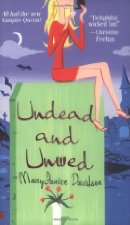
Book Review: Undead and Unwed by MaryJanice Davidson (Series, #1)
 Summary:
Betsy was a 30 year old secretary (previously a model, previously a college drop-out) living in Minneapolis, and she was quite content with her life. Oh, a good date would have been nice, but at least she got to drool over the hot detective assigned to figure out who assaulted her a few weeks ago outside an Italian restaurant. Everything was fine. Until she got hit by a car one slippery night in front of her house and woke up undead in the morgue the next day. Even that would have been fine, but the local vampires keep insisting she get involved in vampire politics. True, a lot of the vampire rules don’t seem to apply to her. For instance, holy water only makes her sneeze, but why should she bother with vampire politics when she could be doing more important things like getting her designer shoes back from her stepmother?
Review:
This is not paranormal romance. I repeat. This is not paranormal romance! It is, however, what I have chosen to dub paranormal chick lit. Undead and Unwed reads like a Sophie Kinsella novel if it was set in the frigid midwest and had a pleasant back-drop of vampires.
Betsy is one of those main characters who you really think you would hate in real life. In fact, I hated her so much in the first bit of the book that I almost stopped reading it. Statuesque blonde who used to be a model who was too good for college and is illogically obsessed with designer shoes? Blergh. The thing is, though, when she gets turned into a vampire we see the happy-go-lucky, humorous, good souled person underneath. What a flip from typical vampire books, eh? But it works. Betsy is a flawed main character. What a nice change of pace! But she isn’t so flawed that we can’t sympathize with her and enjoy her presence.
Choosing to make Betsy a prophesied mighty vampire puts an interesting twist on the typical paranormal trope. She’s not a non-vampire with interesting powers who shakes up the vampire community, and she’s also not some regular newbie vamp learning the ropes. She’s a vampire who the typical rules don’t apply to, but on top of that, she calls it like she sees it. She laughs at the ridiculous names, pomp, and circumstance the vampires in the area have chosen to burden themselves with. She’s a breath of fresh air, if you will. These combine to make a truly amusing read.
Of course, there is sex, and it’s not badly written at all. The vampire elements are played up more here than they are in series like the Sookie Stackhouse series. Additionally, some readers might be turned off by the revelation that when a vampire feeds on a human, they must also have sex with them so the human gets a similar release. I found this to be a call-back to the grittier vampires such as the type Anne Rice wrote, but I get it that some readers might be a bit skeeved out by that.
Overall, Undead and Unwed is a delightful northern piece of paranormal chick lit that will have you laughing or at least smiling in a wittily bemused fashion. I recommend it to lovers of paranormal and chick lit alike, and I plan on reading the rest of the series.
4 out of 5 stars
Source: PaperBackSwap

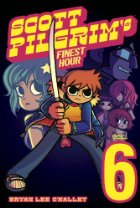
Book Review: Scott Pilgrim’s Finest Hour by Bryan Lee O’Malley (Graphic Novel) (Series, #6)
 Summary:
Ramona Flowers disappeared,and Scott Pilgrim has spent the last four months of his life wallowing in depression in an apartment his parents paid for playing videogames and avoiding fighting the last evil ex, Gideon. His friends have got on with their lives, and they finally get around to trying to get Scott to face up to his past. Will he fight Gideon? Will he have casual sex with any of his exes? Will Ramona show back up?
Review:
I loved this book so much. It’s one of those endings to a series that makes you like the previous entries in the series even more. I’m going to have a hard time writing this review without devolving into a bunch of random squeeing, so please bare with me.
O’Malley successfully ties up all the ends without being too cute. The answer to what the subspace is makes sense and fits in with the story well. It also doesn’t talk down to the reader’s intelligence at all. Similarly, why Scott likes Ramona so much gets answered. Them dating just makes a lot more sense after reading this book.
The action and the gaming and pop culture shout-outs that fans loved in the first five books are still present here. I’m particularly fond of O’Malley’s choice to use 8-bit type drawing to depict characters’ overly idealistic memories of past relationships. All of the other gaming references are still there as well, such as where characters get their weapons from.
O’Malley’s drawing has noticeably improved this time around. My main complaint in previous books of the female characters being hard to tell apart has been addressed. I had no issue telling them apart this time around. Plus, O’Malley still pays attention to background details that make it worth looking closely at the scenes, such as setting one scene in a bookstore that’s going out of business with signs that say “Please Help Oh God” in the background.
I know some people won’t like how little attention is paid to secondary characters in this volume. That didn’t bother me, because I was so caught up in Scott’s storyline, and it is called Scott Pilgrim after all. It’s not like the secondary characters aren’t there. It’s just that their personal storylines get tied up quickly. It didn’t bother me, but it might bother some.
The only thing that bothered me at all was that there is one section of the book where the pages go blank for a bit. I’ve always felt that’s a trite story-telling mechanism, and I don’t like the message it sends. However, I just flipped past them and continued on my way instead of taking the dramatic pause I assume we are supposed to take.
These are really minor flaws when it comes to a series like this. It could have easily fallen apart or failed to tie up the important questions in the end. Instead, O’Malley addresses what is a common issue for a lot of 20-somethings in a creative manner, fleshed out with gaming and pop culture references and humor that makes it entertaining while simultaneously being touching. I highly recommend the entire series to 20-something lovers of graphic novels or older graphic novel enthusiasts who can still relate to what it is to be in your 20s.
5 out of 5 stars
Source: Amazon

Previous Books in Series:
Volume 1: Scott Pilgrim’s Precious Little Life
Volume 2: Scott Pilgrim vs. the World
Volume 3: Scott Pilgrim and the Infinite Sadness
Volume 4: Scott Pilgrim Gets It Together
Volume 5: Scott Pilgrim vs. the Universe
Review of first 5 books
Book Review: Mostly Harmless by Douglas Adams (Series, #5)
 Summary:
Arthur Dent thought his zany days earth-less days were over. The whole Earth-being-blown-up was undone, and he found a woman to love. But when they’re traveling through the universe together, she suddenly disappears and Arthur finds himself in a parallel universe where the exact Earth he once knew doesn’t exist. Meanwhile, Ford Prefect pays a visit to the Guide offices and finds that something just isn’t quite right.
Review:
Thank goodness I didn’t let the flop of the fourth book So Long, and Thanks for All the Fish deter me from finishing the series. Adams returns to his strengths in this entry–outerspace adventures of Ford and Arthur, not to mention zany robots and odd cultures on other planets that manage to reflect the oddities of our own. Plus, the storyline actually moves the original plot of the Earth being destroyed by the Vogons forward.
Some of the jokes rank right up there with The Restaurant at the End of the Universe. One that sticks out in my mind is when Ford messes with a robot’s circuitry making it endlessly joyful. It was a delightful flipping of the endlessly miserable robot, Marvin, featured earlier in the series. It was quite enjoyable to see how hilarious both extremes are. Also of note is the village religious man on a planet Arthur winds up on, who is quite clearly making the village’s religion up as he goes along, and the villagers are semi-aware of this, but shrug and let him. That said, at least half of the jokes, while they tickled my funny-bone in a pleasant way, didn’t have me actually laughing like the first couple of books did. It was a pleasant read, but not uproariously funny.
Entire essays and theses could be written (and probably have been) on the themes in the Hitchhiker series. Excuse me. Trilogy. From belonging to homelessness to the purpose of life, Adams’ work has it all, which is what makes it good humor, actually. It’s humor pointing out the most basic questions of life in a setting that removes it from our own experiences enough to make us see it in a different light.
Some readers will probably be unhappy with the ending. I enjoyed it and saw the humor in it, in spite of it being rather dark. I know that Adams expressed some discontent with it and was in the middle of writing a sequel, The Salmon of Doubt, when he died, which has now been posthumously published, as well as a sixth entry written by Adams’ widow and Eoin Colfer. I don’t cotton to posthumously published works assembled by people who are not the author, nor continuations based on what people “think the author would have wanted.” For all we know, Adams could have changed his mind yet again. I prefer to view Mostly Harmless as the end of the series, as it was the last book truly finished by Adams.
Mostly Harmless is a wonderful closing chapter to the series that contains delightful meta jokes, as well as new territory, and neatly ties up the experiences of the characters. Fans of the series won’t be disappointed with this entry, which is a delightful jump up from the fourth book, but they may be left a bit sad to see the end.
4 out of 5 stars
Source: Raven Used Books
Previous Books in Series:
The Hitchhiker’s Guide to the Galaxy
The Restaurant at the End of the Universe
Life, the Universe, and Everything
So Long, and Thanks for All the Fish, review

Book Review: Love Among the Chickens by P. G. Wodehouse
 Summary:
Jeremy Garnet, a novelist, is living a relatively quiet bachelor life in London when his old school friend Stanley Ukridge shows up. Ukridge is starting a chicken farm with his wife, Millie, and wants “Garnie old boy” to come stay with them. He’ll get to write in the country in exchange for a few hours of work a day. In spite of the fact that Ukridge is planning to run the chicken farm without any prior knowledge or studying “the better for innovation, my boy,” Garnie takes him up on it. Of course, life with the eccentric Ukridge surrounded by chickens isn’t quite the quiet writing environment Garnie was planning on. Not to mention the Irish professor neighbor’s lovely daughter that Garnie can’t quite get out of his head.
Review:
There’s no doubt about it. Wodehouse is pleasantly droll. It was, however, necessary for me to remind myself a few times of the time period this was written in as certain portions had the feminist in me going “Whaaaat?!”
Ukridge and Millie are a delightful couple. He’s got zany ideas; she’s endlessly supportive. He clearly is madly in love with her and vice versa. They’re exactly the sort of people I would want as neighbors, because you’d never get bored with them around. Ukridge doesn’t mean to do wrong by anybody. He just doesn’t get how society thinks it should function. He does everything his own way, and Millie is along for the ride.
Wodehouse also manages to actually create personalities in the animals that are around from Bob the dog to Edwin the cat to Aunt Elizabeth the evil chicken (named after the aunt that didn’t want Millie to marry Ukridge). The animals are a part of everything that is going on. The characters actually talk to them, interact with them, and the animals respond. It’s something that happens in my own life, but that I don’t usually see in books, so I was delighted to see it here.
On the other hand, chickens are only half of the title, and I must say, I was not fond of the love half. Garnie’s relationship with Phyllis just hit all the wrong notes for me. First, Garnie claims to have fallen in love with her at first sight upon seeing her on the train, yet at that portion of the book all he talks about is how lovely her eyes are. Sounds more like lust to me. Then there’s the fact that Phyllis’s personality stinks. She’s dull, boring, and frankly rude. She’s square under her egotistical father’s thumb too. I don’t see what Garnie sees in her. Then of course there’s the fact that Garnie pretty much stalks her for a portion of the book. He goes to her father’s farm every night after dusk, sits in the bushes, and listens to her sing. That’s creepy, but when he tells her later, she laughs and is delighted. People! Stalking is not romantic. Gah!
I wish Wodehouse had simply written about Ukridge and Millie, as they are clearly the couple that is actually interesting. In spite of the fact that he didn’t do that though, I really liked this book. People who appreciate a book for the scenes in it and not the overarching plot will like it as well.
4 out of 5 stars
Source: Librivox recording by Mark Nelson via the Audible app for the iTouch and iPhone

Book Review: Scott Pilgrim By Bryan Lee O’Malley (Graphic Novel) (Series, #1-5)
 Summary:
Canadian Scott Pilgrim is 23 years old and has a case of what to do with myself quarter life crisis. He’s living in a studio apartment with Wallace (who is very gay), dating a 17 year old, and doesn’t have a job, but at least he’s got his band. Then he meets American Ramona Flowers and falls for her. Dating her comes with a catch, though. He’s got to defeat her 7 evil exes who really seem to enjoy jumping him when he least expects it.
Review:
Scott Pilgrim takes typical 20-something ennui and spices it up with a heavy dose of ninja fighting and videogame references, hitting its target audience dead-on. It’s the perfect mix of connection over real life issues and over generational references. It’s more than just a day in the life of Scott mixed with fighting evil exes, though. There’s a mystery to the whole situation. Why is Scott such a good fighter? Why does he fall so quickly for Ramona when nothing seems that special about her? What is up with Ramona anyway? It had me wishing that the sixth volume was out already so I could find out. (It comes out this summer).
The art is relatively average. Some of the characters and scenes are really well-drawn, but some of the minor characters blend together, particularly the women. I was left really confused about some of the women until later in the series where O’Malley put together a listing of all the characters. Even then, I thought they looked a bit too much alike. On the other hand, the art handles delicate scenes like sex and fighting really well, so it all balances out.
What really makes the series, though, is the creativity of the exes and the battles. They range from skateboarding to evil robots at concerts to races through value warehouse stores to (my absolute favorite) vegans with superpowers. Seriously, they have superpowers because they’re vegans. It’s the most awesome idea! Plus, there is a recipe for vegan shepherd’s pie given in the context of the story that I absolutely must try.
I definitely recommend this series to all 20-somethings, videogamers, and ninja-lovers. Plus, the movie version starring Michael Cera is coming out this summer, so you may as well whet your appetite for it by reading the books first.
4 out of 5 stars
Source: Borrowed
Books in Series:
Volume 1: Scott Pilgrim’s Precious Little Life
Volume 2: Scott Pilgrim vs. the World
Volume 3: Scott Pilgrim and the Infinite Sadness
Volume 4: Scott Pilgrim Gets It Together
Volume 5: Scott Pilgrim vs. the Universe
Volume 6: Scott Pilgrim’s Finest Hour (release date: July 20, 2010)

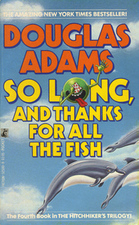
Book Review: So Long, and Thanks for All the Fish by Douglas Adams (Series, #4)
 Summary:
Although the planet Earth definitely blew up, Arthur Dent has found himself back on it again, and not in the prehistoric past like before. Everything seems about the same, except that the dolphins all have disappeared and apparently there was a mass hallucination of the planet blowing up caused by a CIA experiment. You’d think this would require all of Arthur’s attention, but instead he’s rather highly focused on a woman named Fenchurch who claims the Earth really did blow up and insists something has felt off ever since.
Review:
It’s no secret that one of my favorite comedic books is The Restaurant at the End of the Universe, the second book in this series. While I felt that the third book suffered a bit, it was still pretty damn funny in my opinion. I really wish I could say the same about this.
I still enjoy Adams’ writing style. It’s tongue in cheek, snarky, and self-referencing. It is a pure pleasure to read. This still holds true here, but the problem is that it’s just not laugh out loud funny. Oh, there are bemusing moments, but mostly it’s a case of jokes falling flat. I think the reason for this is that what makes the books funny is Arthur Dent–average British dude–stuck into the bizarre situations that are the rest of the universe with only the equally bizarre Ford Prefect as a true companion. Indeed, my favorite bit of this book is when Arthur and Ford are reunited. Without that Arthur stuck in outerspace element, you wind up with a rather run-of-the-mill, “huh, something odd is going on on planet Earth” book. It’s cute, but it’s not surprising, and the element of surprise is what makes the rest of the series so funny.
I also wasn’t fond of Adams’ obvious response to the fan question, “Does Arthur ever have sex?!” with the addition of the love interest, Fenchurch. He may think it is witty to reference this and answer it, but I was disappointed. I enjoyed wondering if poor Arthur spent 8 years devoid of sex. It added a certain element of mystery to him. This whole part felt kind of like a cop-out.
I don’t want to sound like I hated the book, because I didn’t. When compared to books not written by Adams, it actually holds up quite well. It’s enjoyable and has some unique scenes. It’s just, in comparison to the rest of the series, I was left a bit disappointed. I still plan on finishing reading the series, though.
3 out of 5 stars
Source: PaperBackSwap
Previous Books in Series:
The Hitchhiker’s Guide to the Galaxy
The Restaurant at the End of the Universe
Life, the Universe, and Everything

Book Review: Breathers By S. G. Browne

Summary:
Billing itself as a rom-zom-com (romantic zombie comedy), Breathers looks to get into the psyche of those reanimated corpses out to eat your brains, not to mention deep-fry your fingers. Andy is in his 30s and living in his parents’ basement after reanimating from a car crash that left his wife permanently dead. Andy is depressed and slowly decaying, but all that changes when he starts attending Undead Anonymous weekly meetings. There he meets Rita, and together with other members, they stumble upon southern zombie Ray who gives them jars of his venison that tastes remarkably good to Andy and has some interesting affects on him.
Review [spoiler warning]:
Breathers starts out with a bang. Nothing sucks you in quite like a main character waking up from an alcohol-induced blackout to discover he’s killed his parents and stuffed their dismembered bodies in the fridge and freezer. Browne’s dark humor serves the storyline well. It’s not easy to take a repulsive, cannibalistic, walking corpse and make him a sympathetic character instead of the terrifying other, and Browne achieves this…..to a certain extent.
At first Andy and the reader don’t know that the “venison” he’s eating is actually people. Both the reader and Andy see the positive effects of eating humans before they fully realize that’s what he’s eating. (Although, come on, I had my definite suspicions, even in a world where vampires are “vegetarians” and have Tru Blood.) Andy stops decaying and starts protesting for his civil rights to be reinstated, for zombies to be recognized as equal and valid. This is a popular, obvious analogy for various human rights fights going on around the globe. Awesome. It’s great for people who aren’t ordinarily treated as an other to get a first-person account of what that’s like.
This analogy though is why I have a bit of a problem with the twist toward the end whereby we see that eating humans leads to cravings for more humans and eventually we have a full-out blood bash eating a house full of frat boys. Aesthetically, as a horror fan, I love the blood bash. Nothing quite like reading a first-person account of what it’s like to eat another human being alive. However, the lesson learned here is that while the other may seem cute and cuddly, all your suspicions about them are true. Don’t trust them for a minute or they’ll turn full evil on you.
Browne doesn’t seem to have an issue demonizing select groups. The whole frat boys stealing limbs from zombies as pledges followed by the zombies eating the frat boys and their various one-night stands and girlfriends reeks of a weak, geeky boy’s wet dream. Revenge of the nerds zombie-style.
It’s unfortunate that Browne lets his bitterness undermine his enjoyable writing style–a wonderful mix of humor and horror. Hopefully his next effort leaves the personal grudges behind and just gives us the humorous horror we want.
If you found this review helpful, please consider tipping me on ko-fi, checking out my digital items available in my ko-fi shop, buying one of my publications, or using one of my referral/coupon codes. Thank you for your support!
3.5 out of 5 stars
Length: 310 pages – average but on the longer side
Source: Library
Buy It (Amazon or Bookshop.org)
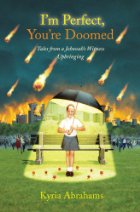
Book Review: I’m Perfect; You’re Doomed By Kyria Abrahams
 Summary:
Kyria Abrahams is rising in visibility in comic circles. She originally wanted to tell her memoir as a one-woman show, but instead ended up writing it down as a book. Kyria’s memoir takes the reader from an inside look at what it was like to be raised a Jehovah’s Witness in Rhode Island in the late 1980s and early 1990s to her marriage at 16 to her eventual disfellowship. Not your typical serious-toned memoir, Kyria approaches her heavy material with a comic’s graceful tongue-in-cheek snark.
Review:
Anyone who had a fundamentalist upbringing will find the first half of Kyria’s book incredibly relatable and will be relieved at being granted permission to laugh at the absurd concerns fundie kids get saddled with. Kyria was encompassed in a conservative world continually seeing demons lurking around every corner, or even in that plate you stupidly bought at a yardsale from that old woman who is probably a witch. A typical example of her writing style can be found in the first chapter, “The succession of power was this: Jesus was the head over man; man was the head over woman; and woman was the head over cooking peach cobbler and shutting up.” It’s rare to find a laugh out loud memoir dealing with something as intense as being raised in a cult, and Kyria handles it well.
This style holds out through Kyria’s early teen years and her rebellion of marrying a Witness eight years older than her. It starts to fall apart after the wedding though. The writing becomes fuzzy. It’s unclear exactly how much time has passed or why she suddenly stopped going to the Meetings (the Witness version of church services). This, to me, should have been one of the most compelling parts of the book. Why did she leave? Why was she so incredibly desperate to be disfellowshipped that she actually asked for it at the meeting about her adultery? Although earlier in the book, Kyria demonstrates remarkable acumen at analyzing herself and her behavior, at the end of the book she loses this. I am certain, as an ex-fundie myself, that Kyria spent a lot of time analyzing why she left, yet none of this introspection is written into the book.
Similarly, the reader is left really wondering about Kyria’s OCD. While it was excruciatingly debilitating in her mid to late teens, it seems to suddenly mostly disappear, or at least disappear enough so that she can live in a crappy apartment in a bad neighborhood by herself. I’m not discrediting Kyria, but what happened in that interim?
The seemingly sudden decision to get disfellowshipped and the lack of information on her OCD are the two most glaring examples of the disjointedness of the second half of the book. Of greater concern to me, though, is the fact that Kyria really does seem worse off at the end of the memoir than at the beginning. She ends up in a crappy apartment, drinking and doing drugs fairly consistently, screwing random poets, having given herself permission to “fuck up.” This is a stereotype of the ex-fundie woman, and I have to say it’s a fairly accurate one. Normally though, this is a phase the person goes through before finding her own new footing using morals she has chosen for herself. I’m a bit concerned that ending on the rebelling and going crazy note rather than the finding the new footing note will make fundamentalists feelvindicated. They will point to this as evidence that they are correct that apostates really are worse off. What concerns me more though is the general population reading this book, the ones raised normally who are not apostates, were given no guides by Kyria to understand why she behaved the way she behaved. There are very good reasons why ex-fundies go crazy for a little bit. They weren’t given the tools to deal with the world. The lack of introspection in the second half of the book will leave people who haven’t experienced it thinking the problem is Kyria’s inherent nature and not the way she was nurtured.
The book still does provide good insight into the world of those people who knock on your door in pairs. Additionally, it is refreshing to read a funny memoir about a serious topic.
3.5 out of 5 stars
Source: Library

 Support my work with a tip or browse my shop for curated book club guides, how to guides, cross-stitch patterns, and more!


This work by Amanda Nevius is licensed under a Creative Commons Attribution-Noncommercial-No Derivative Works 3.0 United States License.
 Opinions of a Wolf