
Archive
Book Review: Prisoners of the Castle: An Epic Story of Survival and Escape from Colditz, the Nazis’ Fortress Prison by Ben Macintyre

The true story of the Allied Prisoners of War in Colditz, a German fortress turned into a prison.
Summary:
During World War II, the German army used the towering Colditz Castle to hold the most defiant Allied prisoners. For four years, these prisoners of the castle tested its walls and its guards with ingenious escape attempts that would become legend.
Review:
This is a rare combination for historic nonfiction. Well-researched and engagingly written. As easy to read as a well-paced thriller. Yet chock-full of fascinating facts.
The book is organized into sub-sections chronologically by year. Each year then has however many chapters it needs to tell the story. This made it quite easy to keep track of what was going on. There are two insets of wonderful photographs, clearly labeled. This allows the reader to easily put a face to the name of the person being discussed at various points.
Here are just a few of my favorite things that I learned in reading this book.
- An Indian officer was a prisoner at Colditz – and Indian soldiers were prisoners of war in general. Indians fought in WWII on the British side. The Germans tried to get them to come over to their side by appealing to the desire to be free of British rule. This appeal worked for some but not for others.
- A real person inspired the character Q from James Bond. He was responsible for some very creative methods of getting supplies through to the Allied POWs. (For a read about spies in WWII, check out this other book review.)
- The demographic with the most successful escape attempts were the French.
- It’s not so much that officers had a duty to escape as that the Germans would treat them with the courtesy “due an officer” so it was safer for them to attempt escape than for enlisted soldiers to do so.
- The British had a fighter ace who was a double amputee. He was missing part of both legs. He was an excellent flyer but, by all accounts, a real jerk to other people.
- Class structure existed within POW camps. Officers were sent to Colditz with enlisted men who acted as their servants. These men were called orderlies. These men even had their escape attempts denied to continue serving the officers. In one case, a man was given the chance to go home with German consent, but his officer blocked it, insisting he couldn’t go home until the officer did.
My one complaint about the book is this. There were some POWs who the Germans called “Prominente.” They were men with prestigious ties in the West. (For example: a relative of Winston Churchill.) The Germans oversaw them much more closely as they thought they might be valuable as a bargaining ticket. When the Allies were approaching Colditz, these Prominente were sent deeper into German territory, along with their orderlies. Given how attentive to detail this book is, I found it jarring that the two Maori orderlies who accompanied the Prominente were left nameless in the book. (They were Ben McLean and Reginald Mitai.) There were also no details provided on if they escaped the war with their lives. This in spite of the book providing a very detailed run-down at the end of what happened to most of the named prisoners and Germans in the book.
Overall, this is a well-written and enjoyable read on a specific area of WWII. Anyone with an interest in the experience of Allied prisoners in WWII will enjoy this one.
If you found this review helpful, please consider tipping me on ko-fi, checking out my digital items available in my ko-fi shop, buying one of my publications, using one of my referral/coupon codes, or signing up for my free microfiction monthly newsletter. Thank you for your support!
4 out of 5 stars
Length: 368 pages – average but on the longer side
Source: Library
Buy It (Amazon or Bookshop.org)
Book Review: Who? by Algis Budrys
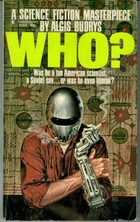 Summary:
In an alternate late 20th century, the Allies are still at a cold war with the Soviets. The Allies’ best scientist, Martino, is working on a secret project called K-88 when there is an explosion. The first rescuers to him are Soviet. The norm is for Allied prisoners to ultimately be returned across the line. But the Soviets claim that Martino’s skull and arm were badly damaged and return him with a metal, robotic head and arm. Is this man really Martino, or is he a Soviet plant?
Review:
I was excited to read this book because the idea of a transhumanist/cyborg American made that way by the Soviets has a James Bond like appeal. Unfortunately, it feels a bit more dated than I was anticipating, as well as compared to other older scifi, and doesn’t fully address some questions it raises.
Immediately, there are a couple of plot holes that aren’t addressed until close to the end of the book, which made it a bit frustrating to read. First, why did the Allies put their best scientist in a lab on the border with the Soviets? The answer to this, given at the end of the book, is pretty flimsy, and only works if you are willing to believe the Allies are very stupid. Second, it makes sense that they can’t verify Martino’s identity with his fingerprints, because the Soviets could have taken off his remaining arm and put it on someone else. However, why can’t they verify who he is with DNA? Presumably, he has some living relatives somewhere they could compare to. DNA was discovered in the 1860s (source) so to never even address why they don’t use it is a bit bizarre. The book mentions toward the end that Martino’s parents and uncle are dead, but you can conduct kinship tests using dead bodies. It still baffles me that the government in the book didn’t simply dig up Martino’s father and run a DNA test. Even if DNA testing wasn’t widely known of when the book was published, one would hope a scifi writer could see its future implications, imagine the applicability, and address the scenario. The fact that DNA wasn’t addressed at all, and Martino’s place near the Soviet border wasn’t satisfactorily addressed really removed a lot of the intensity and interest one should feel from the situation.
Another way Budrys showed a lack of imagination for the future is in the strict gender roles and lack of women in the military or the sciences in the future he has envisioned. Women are only seen in the book in strict 1950s gender roles. As wives and mothers and not once in the military or in the sciences. People in the sciences are referred to as the “men” not even leaving room for the idea of a woman in science. I know this is a symptom of the times, but I also know that more progressive and forward-thinking scifi was written in the same decade. It was a bit jarring to me to read a scifi that excluded women so much, when I’m so used to women being present, at least nominally, in scifi.
All of that said, the writing of individual scenes was quite lovely. Budrys evokes setting and tensity well. I particularly enjoyed the scene of Maybe-Martino running through the streets of New York City, which reminded me of an old noir film. Budrys also shows a good understanding of what it is like for people who are incredibly highly intelligent. He writes Martino at a young age as both brilliant in science but also dumb in interpersonal relations. The fact that he got this and demonstrated it in the 1950s is to be commended. There is also some solid commentary on the American education system and a desire for it to encourage more independent thought.
Look–these guys aren’t morons. They’re pretty damned bright, or they wouldn’t be here. But the only way they’ve ever been taught to learn something is to memorize it. If you throw a lot of new stuff at them in a hurry, they’ll still memorize it–but they haven’t got time to think. (loc 9163)
Overall, this is an interesting concept that wasn’t fully fleshed out nor the possible weaknesses fully addressed. It is definitely a scifi of its time, with its hyper-focus on the Soviets and the Cold War that could almost feel kitschy today. A short read with an interesting premise, albeit a lack of female scientists, soldiers, or government workers. Recommended to scifi fans who enjoy some old-fashioned red scare in their reads and don’t need the science to be perfect.
3 out of 5 stars
Source: Netgalley

 Support my work with a tip or browse my shop for curated book club guides, how to guides, cross-stitch patterns, and more!


This work by Amanda Nevius is licensed under a Creative Commons Attribution-Noncommercial-No Derivative Works 3.0 United States License.
 Opinions of a Wolf