
Archive
Book Review: Ender’s Game by Orson Scott Card
 Summary:
Humanity survived the second Bugger invasion by pure luck. Now they’re determined to be prepared for a third invasion and actively train children in Battle School, seeking the child who could be the commander to save humanity. They think Ender, with his ability to perceive and understand null gravity spaces, just might be that commander, but Ender isn’t so sure.
Review:
Card has created a rich, complex, entirely believable future where individual sacrifice is vital to the survival of the human species. This goal makes the adults’ treatment of the children in Battle School justifiable and allows Card to create a story where children are simultaneously treated as adults and misled by them. Adults will recognize the feeling of being pawns to those in control of society. Children and young adults will appreciate that the children characters are treated as adults in smaller bodies. It’s a fun narrative set-up.
The world-building is excellent. The complex scenes of the Battle School, Battle Room, and videogames the children play are all so clearly drawn that the reader truly feels as if she is there. Readers who also enjoy videogames will particularly enjoy the multiple videogame sequences in which the narrative action switches focus to the videogame. This isn’t just for fun, either. It’s an important feature that comes to play later in the book. In fact, it’s really nice to see videogaming being featured in a future as something important to society and not just recreational. It’s a logical choice to make in scifi too, as the military is moving increasingly toward using weapons that are manned by soldiers behind the lines with videogame-like controls.
These fantastic scenes are all set against a well-thought-out human society reaction to multiple alien invasions. In spite of the threat of a third invasion, there is still violent nationalism brewing under the surface. Politicians must worry about their image. Dissenting voices can be heard on the internet. The teachers of the Battle School must worry about the retributions for their actions, even as they make the choices that will hopefully save humanity. The people in this future are still people. They act in the sometimes stupid and sometimes brilliant ways people act. They don’t miraculously become super-human in the face of an alien threat. I really enjoyed this narrative choice, as I get really sick of the super-human trope often found in scifi.
The ending….I don’t know if I’ll ever be able to make up my mind on how I feel about the ending. I definitely didn’t guess it ahead of time, which is a nice change, but I can’t decide how I feel about it. The fact is, I liked part of it, and I didn’t like another part of it. I think I may have found the ultimate message a bit too idealistic, and Ender too gullible.
*spoiler warning*
Here’s the thing. The Bugger queen claims that the Buggers didn’t know that humans were sentient creatures, and Ender believes her, but I call bullshit. Humans and Buggers built cities that were similar enough so that humans could live in Bugger buildings. In spite of being drastically different from an evolutionary stand-point, it’s still obvious that humans were sentient enough to build cities and spaceships. That should have been a warning sign. So ultimately, I view the queen larva and message to Ender as a last-ditch effort to come back from the brink of extinction and beat humanity, and Ender fell for it. Of course I don’t want to argue for the extinction of an entire species. I’m a vegetarian. I’m pretty much against the killing of species of any kind, but the fact remains that the Buggers attacked humans twice. What were they supposed to do? Sit back and let themselves get wiped out? I’m not one of these nutters who says don’t kill the polar bear attacking you, and in this case, the polar bear had already attacked twice. I like the message of a possible peaceful coexistence, but I don’t think it was very realistic in that world, and I was left feeling that Ender didn’t really learn anything from his experience.
*end spoilers*
Overall, however, Card has achieved near perfection in telling a unique, scifi story. The world is entrancing and draws the reader in, and the reader is left with multiple philosophical questions to ponder long after finishing reading the book. It is a book I definitely plan on re-reading, and I highly recommend it to scifi and videogaming fans.
5 out of 5 stars
Source: Amazon

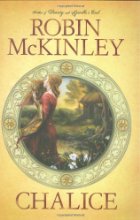
Guest Book Review: Chalice by Robin McKinley
Please give a warm welcome to my first guest book review participant, Chellie!
Meet the Guest!
My name is Michelle Oleson, and I’m currently the Web/Digital Services Librarian at an academic library. During a normal day, I coax printers into working properly, manage the library’s website content, help students find articles/books/staplers, and read a lot of blogs/tweetage. Outside work, I travel near and far, and enjoy keeping up my mediocre skills at playing flute, Latin, and online gaming.
 Summary:
Robin McKinley’s short novel Chalice follows McKinley’s other novels on the Beauty and the Beast theme. Mirasol, a solitary twenty-something, bee-keeping enthusiast, finds herself out her depth as the newly appointed Chalice of her demesne (feudal styled village). The previous Master and Chalice both died under tragic and mysterious circumstances leaving the Willowlands demesne in both political and spiritual chaos. Mirasol must find a balance in her old and new life, in addition to solving the mystery of the Old Master and Chalice’s demise if she’s to successfully serve the new Master: an enigma in and of himself.
Review:
Much of this short novel is devoted to describing an overly complex feudal system with a Druid-esque relationship to land. The story itself could have been concluded inside of 30 pages.
Mirasol leads the narration and all of the movement within the story. While she represents a strong female character (like any Belle), she also lets herself be caught up in forces deemed beyond her control. Fans of Hermione Granger will love her proclivity to spend most days holed away in the library trying to teach herself all the laws and mysticism of being the Chalice.
Mirasol spends most of her internal dialogue puzzling over the new Master. Like any good feudal system, the old Master died leaving an elder son and a younger son. The elder son, being a spoiled brat drunk with power, sends his brother off never to be heard from again. Lucky for the demesne, the older brother manages to get himself killed before completely destroying his people. The leaders of the village have a tough choice to make: bring in an outsider to rule or try to restore the younger brother.
The younger brother has been living his life as a monk in service to Fire Elementals. He returns to lead his people as something of a Fire Element himself. His first act as Master is to burn Chalice/Mirasol to the bone by barely touching her.
Then nothing happens for a long time while Mirasol goes to the library, thinks about how awesome her bees and honey are, how neat being a Chalice is, and wouldn’t the new Master be just dreamy if he was anything at all resembling human. She has two or three conversations with the Master concerning how the land is holding up under all the strain of political upheaval. Neither of them thinks they’re doing a very good job, but hey, at least we’re not getting drunk and dying horribly in a fire…
At some point the higher ups of the realm decide having a Fire Elemental as Master of a demesne is a Bad Plan. These interlopers are only Bad Guys for the sake of moving the story forward. Mirasol, however, comes up with a pretty spectacular plan. The interlopers want to put their own guy on the throne and remove the current Master so he can go back to being a Fire Elemental. Mirasol is already showing signs of being completely smitten with the new Master and feels that the land/people couldn’t survive another change.
McKinley takes Mirasol on a tour of the village blessing every inch and corner of Willowlands with her cup o’ honey. Having successfully done this, she returns to watch the Fire Elemental Master duel it out with swords with the would-be Master. The new guy is obviously a puppet, and wouldn’t even be a threat if the current Master was more corporeal. Cue Fairy Tale Ending: Mirasol has her awesome bees attack the interloper in the middle of the duel. Somehow this is not seen as cheating. All of her bees die; it’s very sad. But from the bodies of thousands of bees, arises the Master returned in the flesh of his enemy. The fallen man lies on the ground burnt to a crisp.
Quick resolution: Mirasol and the Master wed, as it’s obviously the only sensical thing to do.
I loved the fairy tale elements of this story. I think the world could have been more simply explained, but maybe it’s just McKinley’s style to announce something significant, spend pages explicating the history of these circumstances, to return to the conversation once you’re ready to scream Get On With the Story Already.
I’m looking forward to reading McKinley’s Sunshine book, as I’ve heard it’s highly recommended. I would recommend Chalice to fans of overly complex high fantasy, such as Marion Zimmer Bradley’s books.
3 out of 5 stars
Source:
This book was a gift.
 Support my work with a tip or browse my shop for curated book club guides, how to guides, cross-stitch patterns, and more!

This work by Amanda Nevius is licensed under a Creative Commons Attribution-Noncommercial-No Derivative Works 3.0 United States License.

