
Archive
Book Review: The Cause by Clint Stoker
 Summary:
In an overpopulated future, a city stands where there are not familial or close relationships, but everyone celebrates every night. Air was recently relocated to a new position as a purger, and he slowly discovers the sinister side of the city.
Review:
This is an interesting concept that is poorly executed, badly edited, and takes a turn for the worse at the end.
Anyone who follows this blog knows that I love an overpopulation scifi story. Stoker has an interesting take on it–the world is overpopulated so constantly at war. A city arises where the residents can stay young forever but must follow a series of articles that removes the true joy of living from them. The problem is that I just stated that more succinctly than Stoker does at any point in the novel.
What we have here is the classic example of a good idea poorly executed. The basic concept is great. But the main character’s flashbacks and current thoughts are difficult to read. I found myself constantly skimming the flashbacks, because they were so confusing to read and lent so little to the story.
More upsetting though were the constant errors that had less to do with typos or difficult grammar and more to do with poor understanding of the English language. Examples:
A golden metal sat at the top of his desk. (location 2879)
Won’t even know your there (location 3148)
I thought we we’re in this together (location 4225)
He put Air to sleep so he could remain innocent in the cities eyes (location 4509)
A transport past by (location 4588)
You can’t bring people back once their dead. (location 5050)
I am ti sro and you are the villain. (location 5083)
Anybody, understandably, would be frustrated with this amount of errors.
Perhaps more distressing is the “surprise” ending, which to me was just confusing. Essentially, five infants are killed every 50 years to keep the city of 30 million people alive, yet the science of that is never explained. The key to scifi is plausible science, yet Stoker ignores that entirely. It’s a good idea, but without plausible explanations and good writing, it falls flat. I’d recommend he gets a solid editor before his next attempt.
2 out of 5 stars
Source: Kindle copy from the author in exchange for my honest review

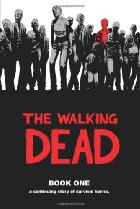
Book Review: The Walking Dead, Book 1 by Robert Kirkman (Series, #1) (Graphic Novel)
 Summary:
When cop Rick wakes up from a coma brought on by a gun shot wound, he discovers a post-apocalyptic mess and zombies everywhere. He sets off for Atlanta in search of his wife, Lori, and son, Carl, and soon teams up with a rag-tag group of survivors camped just outside of Atlanta.
Review:
I just want to point out that this review is purely focused on the graphic novel, not the tv series. I haven’t even seen more than 10 minutes of the tv show, so remember this is about the books not the show. Thanks! Moving along….
I almost gave up on this within the first few pages, because COME ON. Can we PLEASE get over the whole oh I had a coma and then woke up to a zombie apocalypse trope, please? First, it is so highly statistically unlikely that it was laughable the first few times it was used in my beloved dystopian novels, but at this point it just looks lazy. Come up with some other way to start the apocalypse, ok? I don’t care if your main character is out of touch with reality for a few days because he’s on a drug-fueled sex streak. At least it would be different! Also, a cop, really? You want me to root for a cop? And everyone trusts him because he’s a cop? A cop is the last person I would put in charge if I was a member of a rag-tag bunch of survivors; I’m just saying.
Once we move on beyond the initial set-up though to the group of survivors caravaning their way across America, the story vastly improves. The people are real. They’re scared. They’re angry. The snap easily. They hook up with whoever is convenient (and not necessarily young and hot). They teach the kids to use guns. It’s everything we know and love about post-apocalypse stories.
The artwork is good. Scenes are easy to interpret; characters are easy to tell apart. The zombies are deliciously grotesque, although I did find myself giggling at them saying “guk.” Guk? Really? Ok….
The best part, though, is the people that in your everyday life you are just like, come on, god, bolt of lighting, right here? They’re the ones who get eaten by zombies! It is excellent. So that really annoying chick in camp? Totally gets her head bit by a zombie. It’s cathartic and awesome.
The cast is diverse, and no, the black guy is not the first to be eaten (or the red shirt guy for that matter). It wouldn’t kill Kirkman to be a little less heteronormative, but he’s still got time and more survivors to add.
Overall, this is a good first entry in a zombie apocalypse series. Kirkman needs to be more careful to stay away from expected tropes in the genre and bring more of the creativity it is apparent he is capable of. I recommend it to fans of zombies, obviously. ;-)
4 out of 5 stars
Source: Public Library

If you found this review helpful, please consider tipping me on ko-fi, checking out my digital items available in my ko-fi shop, buying one of my publications, or using one of my referral/coupon codes. Thank you for your support!
Book Review: Stand on Zanzibar by John Brunner
 Summary:
In the near-future humanity is increasingly facing over-population and all its consequences. In reaction to this, most world governments have established population laws and eugenics boards. In this overly crowded, information overloaded, perpetually on the brink of war society exist Donald and Norman, healthy bachelors who must live as roommates due to the housing crisis. Donald is a dilettante, an information specialist on reserve to be activated as a spy when needed for the US government. Norman is a Muslim African-American working his way up the corporate ladder of the most important technology firm in the world–GT. GT houses the world’s most brilliant computer named Shalmaneser. The intertwining lives of these two oddly well-suited roommates gradually unfold amid digressions into the lives of those they come into contact with and information from the modern-day philosophies and advertizing.
Review:
What is most memorable and striking about this book is not so much the story, although that is fairly unique, but the way in which it is told. Brunner does not simply tell the main storyline, he also immerses the reader into the world the characters live within. To that end, the main storyline (continuity) is interspersed with chapters focusing in on minor characters (tracking with close-ups, essentially short stories), plunging the reader into the middle of the advertizing of the time (the happening world), and works of importance to the world (context). The result is that, although it takes a bit of work to get into the book, in the end the world these characters exist in is much more vivid and clear in the reader’s mind, thus allowing her to more fully understand the characters.
Sometimes this method of writing is a bit difficult to read, of course. For instance, one chapter takes place at a party, and Brunner simply streams all of the conversation together as you would hear it if you were at the party yourself. You catch snippets of bits of different conversations taking place, but never an entire one all at once. It’s the most immersive party scene I’ve ever read, but also took me an inordinate amount of time to get through.
It was also refreshing to have one of the main characters in a futuristic scifi book be a minority. This in and of itself made Stand on Zanzibar a unique, interesting read, and I believe Brunner did a good job portraying both Norman’s struggles with still prevalent racism and presenting him as a well-rounded character.
The major themes of the book, beyond the incredibly meta presentation style, are the very real threat of the loss of privacy and the dehumanization of dependence upon artificial intelligence.
The dehumanizing affect of overpopulation is evident in the language employed by the characters early on in the book.
Not cities in the old sense of grouped buildings occupied by families, but swarming antheaps collapsing into ruin beneath the sledgehammer blows of riot, armed robbery and pure directionless vandalism. (page 52)
These are no longer human cities. They are crawling ant-piles. The vision of piles of swarming ants is simply not a pleasant one. This concept of humanity as a pest is carried even further in a poem from one of the context chapters entitled “Citizen Bacillus,” which begins:
Take stock, citizen bacillus,
Now that there are so many billions of you,
Bleeding through your opened veins,
Into your bathtub, or into the Pacific
Of that by which they may remember you. (page 115)
Not only is this poem taking into account the increasingly suicidal tendencies of the human population in this future society (something that is seen in the animal kingdom when a population becomes overcrowded), but it also is blatantly calling humans a bacteria (bacillus).
The book repeatedly addresses through vignettes, samples of books of the time period, and the lives of the main characters that overpopulation leaves people without enough room to think and figure themselves out in.
True, you’re not a slave. You’re worse off than that by a long, long way. You’re a predatory beast shut up in a cage of which the bars aren’t fixed, solid objects you can gnaw at or in despair batter against with your head until you get punch-drunk and stop worrying. No, those bars are the competing members of your own species, at least as cunning as you on average, forever shifting around so you can’t pin them down, liable to get in your way without the least warning, disorienting your personal environment until you want to grab a gun or an axe and turn mucker. (page 77-8)
In the book “turning mucker” is when a person inexplicably loses their mind and attacks strangers near them. This happens increasingly throughout the book. Thus Brunner’s main point that humans are our own worst enemy is repeated throughout the book.
Added on top of this is the fact that artificial intelligence is outpacing humans. The characters literally cannot keep up with the information overload. They have nightmares about it. They simultaneously depend on the computers and dread them. When one goes awry, they hardly know how to continue on, but simply flounder around. Chad Mulligan (one of my new favorite literary characters) sums it up eloquently:
What in God’s name is it worth to be human, if we have to be saved from ourselves by a machine? (page 645)
Thus, Stand on Zanzibar through postulating an overpopulated future that is overly dependent on technology demonstrates the very real dangers humans pose to ourselves if we outpace either our own minds or our environment’s ability to house us. It is a brilliant read for the meta-literature aspect alone, but the content is also challenging and thought-provoking. I highly recommend it to scifi fans.
4 out of 5 stars
Source: PaperBackSwap

Book Review: How I Live Now by Meg Rosoff
 Summary:
Daisy’s stepmother has convinced her father to send her off to England to live with her aunt and cousins, and Daisy really doesn’t mind. She hates her life in NYC anyway, and life in the countryside seems like a welcome change. Her cousins are quirky and fun, and Aunt Penn is sweet and practices a relaxed parenting style. When Aunt Penn goes away for a work trip, terrorist acts occur in London effectively leaving the kids on their own. On their own to explore feelings and actions they might not otherwise have felt free to.
Review:
The big rumblings about this YA book is that there is incest in it. In the grand scheme of shocking incest though, this incest is just….not that shocking. It’s between two cousins who’ve never met until they’re teenagers. *shrug* Plus, the incestuous relationship is really not the main focus of the story at all. It holds center stage for maybe two chapters. Two very chaste chapters. Oh sure, an astute reader knows what’s going on, but there are no lengthy sexual passages. The most we get to witness is a kiss. So, this book is really just really not about incest, ok? If that was keeping you from reading it, don’t let it. If that’s why you wanted to read it, go read Flowers in the Attic
So what is the story about? Quite simply, it’s about the impact living in an age of world-wide terrorism has on young people. On their perceptions, decisions, morals, and more. As someone who was only a sophomore in highschool when 9/11 happened, I feel safe in saying that Rosoff depicts the experience of a young person growing up in this world very well. The mixture of relaxing and having fun while the adults panic around you with nights of fear are perfectly woven.
Daisy’s voice is wonderful to listen to. She’s an appealing, funny narrator with an acute wit. She is truly someone to like and root for. Similarly, her female cousin, Piper, who she becomes a pseudo-parent to, is extraordinarily interesting and appealing. In fact, I’m hard-pressed to name a character who isn’t well-rounded.
Unfortunately, all of these positives about the book come to a crashing halt at the end. All I can tell you without spoiling the ending is that Rosoff did not take her themes as far as I was hoping she would take them. In my opinion, she copped out, and I was sorely disappointed. The ending reads almost like the beginning of the Beauty and the Beast fairy tale, and I was just left feeling as if Daisy and her cousins had let me down. What could have been an extraordinary book became just average.
Thus, if you are looking for a YA take on the impact life with terrorism has had on the younger generation, but aren’t expecting anything mind-blowing, you’ll enjoy this book. If what you’re after is shocking YA, however, look elsewhere.
3.5 out of 5 stars
Source: PaperBackSwap

Book Review: The Unit by Ninni Holmqvist
 Summary:
In the Sweden of the near future women who reach the age of 50 and men who reach the age of 60 without having successfully acquired a partner or had children are deemed “dispensable” and sent to live in “a unit.” These units appear at first glance to be like a high-class retirement home, and indeed they have all the amenities. The residents, however, are required both to participate in medical experiments and to donate various organs and body parts up until their “final donation” of their heart anywhere from a year or a few years after their arrival in the unit. Dorrit arrives at the unit depressed, but accepting of her fate as the result of her independent nature, but when she falls in love, she starts to question everything.
Review:
The entire concept of this book intrigued me as it is clearly a dystopia whose focus is on the older generations instead of teenagers and young people. The concept itself is of course frightening to any of us who have come to grips with the fact that some day we will be elderly too. This dystopia is also unique though in that it examines the possible future movement of Swedish society, which is vastly different from American society.
The writing is entirely from the perspective of Dorrit. Although it is clear she is writing from some point after the events occurred, Holmqvist eloquently allows her voice to change to reflect her changing ideas on society, her friends, her family, and her own life. When Dorrit first arrives in the unit, she attempts to defend herself saying that women used to be raised to be independent instead of with such a high focus on producing children that will add product to the GNP. It’s not as if she didn’t want a partner, she did, but it didn’t happen. So why is that her fault? Deeper issues are addressed too such as why does only a new family unit count and not siblings? What about pets? Don’t they need us? The vast implications of such a focus on interpersonal relationships found in the traditional family unit are subtly addressed. What type of people tend to be alone family-less by the age of 50 or 60? One resident in the unit’s library, for instance, points out that
“People who read books…tend to be dispensable. Extremely.” (Page 26)
Of course the setting of this dystopia also brings up other interesting issues that Holmqvist handles quite well. The dystopian setting allows the author to address the perpetual loss of friends that the elderly face as well as seeing themselves and their friends sicken mentally and physically. Placing it in a society in which this is exacerbated by science naturally gives it another level as well as a welcome distance for the elderly reader. This of course is a large part of what makes this dystopia different from the typical YA version. Instead of dramatizing the challenges young people typically face such as their world widening and new knowledge being imparted, this one shows how the world becomes smaller and acceptance that it’s too late to change the world becomes the norm.
Perhaps the most universally interesting issue this dystopia addresses is how much the individual should be willing to sacrifice for the greater good. The residents in the unit are constantly being told that their discomfort in an experiment could improve the lives of hundreds of needed people. Or that they should be perfectly fine with “donating” one of their corneas and going half-blind if it means that a nurse with three children can remain a contributing member of society. While some of the residents grow resentful of this concept, referring to the unit as a free-range organ farm, Dorrit finds leaning on this perceived value helps her with her depression in the unit.
“Otherwise I would feel powerless, which I essentially am, but I can cope with that as long as it doesn’t feel that way too.” (Page 71)
Clearly this book makes one think not just about the issues the elderly face but also about how society as a whole treats them and makes them feel. It also firmly addresses just how much individuality and choice it is justifiable to give up for the greater good. The ending completely shocked me and has left me with even more to ponder than the points given above, but I want to leave those for the future reader to discover.
I am incredibly glad this work was translated into English, and I highly recommend it to everyone, but especially to dystopia and scifi lovers, as well as those interested in sociology and psychology.
5 out of 5 stars
Source: Amazon

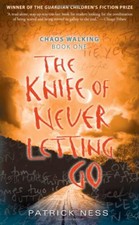
Book Review: The Knife of Never Letting Go by Patrick Ness (Series, #1)
 Summary:
Todd grew up on New World knowing only the constant Noise of other men’s thoughts all around him. He’s never known a world where a boy couldn’t hear his dog talk or where women weren’t all killed off by a horrible plague. Now, mere days before his 13th birthday when he will become a man, his world is turned upside down when his adoptive parents, Ben and Cillian, tell him to run. Run past the swamp. Run and find another settlement. A settlement he never knew existed on New World. He runs with his dog, Manchee, and on the way, they find a creature. A creature whose thoughts they cannot hear.
Review:
This book came recommended to me by three different friends, and I can see based on the summary why they would do so. It’s a dystopia on another planet with talking animals and a narrator who speaks in a mix of rural Americana and British English. The fact is though, I wound up not enjoying this book, and it probably would have been a “did not finish” if I’d had a print copy I could re-sell instead of an ebook I couldn’t. So what’s wrong with it?
Not the world-building. That was truly excellent. The wordle-like clouds of Noise that Todd can hear really bring that aspect of New World to life. Similarly, what the animals say are appropriate to their various evolutionary levels, from Manchee’s partial toddler-like sentences to the herd of elephants who simply say “here” over and over to keep the herd together. Every single scene on New World is easily imaginable in spite of it being quite a foreign location from the buildings to the presence of Noise.
The plot itself isn’t bad but also isn’t amazing. There’s a secret in Todd’s village that we discover at the end of the book that, frankly, did not live up to the build-up. However, that in and of itself doesn’t make me dislike a book. The plot was enough to keep me intrigued, which is the important part, even if in the end it is a bit disappointing.
After much thought I’ve realized that it’s the characters that kept me from enjoying the book, particularly Todd who is also the narrator. I just cannot relate to him at all. I’ve managed to relate to first person narrators ranging from lunatics to serial killers to girly girls to devout Catholics, but Todd is utterly unrelatable to me. He is just so incredibly fucking stupid. Not stupid in the mentally handicapped way. Stupid in the willfully ignorant way that makes me just want to slap him upside the head. For instance, he has this book the whole journey that Ben tells him will explain everything, yet he never sits down to read it. He takes forever to admit he struggles with reading and ask someone else to read it. This is information he needs, and yet he persists in willfully ignoring it. He reminds me of the kids in highschool who wouldn’t do their homework because it wasn’t “cool.” Similarly, I’m sorry, but he’s kind of a pussy, and that irks me. He is fighting not just for himself but for the safety of his dog and another person, but he refuses to man up. I found myself siding with the villains in this regard, and I’m sure that’s not what the author wanted. Similarly, I do not understand why it takes him so long to come around to appreciating Manchee even though he can hear his thoughts from day one and knows that Manchee loves him unconditionally. What the hell, Todd? How are you such an unfeeling idiot, eh? In the end, I simply could not enjoy the book, because although I felt appropriate loathing for the villains, I also loathed the hero and just could not bring myself to care about his plight. The only character I was rooting for at all was Manchee, and that’s not enough to carry a dystopian adventure.
I’m sure there are people out there who can either identify with Todd or empathize with him. For those people who can do so and also enjoy a dystopian adventure, I recommend this book. Anyone who thinks they’ll be even remotely irritated by Todd should stay far away though.
3 out of 5 stars
Source: Amazon

Book Review: Eva by Peter Dickinson
 Summary:
Eva wakes up from a car accident to discover that her scientist, chimp researcher parents have allowed for her to be part of a new experiment. Her brain patterns have been implanted into a chimp’s brain. She is a human brain trapped in a chimp’s body. What will this mean for Eva? For the chimps? For the world?
Review:
This a truly horrifying concept. What would it be like to wake up from a car accident in a body that is not your own? There is much potential for exploration here, but the direction Dickinson took it in fell flat for me.
The setting is a near future in which the world is vastly overpopulated and nearly all animal species have died out except for chimps, who are all kept in captivity. It’s odd in a world that is so overpopulated that the vast majority of people never leave their apartments that scientists have made such an ethically questionable move to save human lives. As Eva herself points out, not only is there the problem of what it means to be a human in a chimp’s body, but also there’s the fact that the chimp essentially had to die for Eva to live. How is that right or fair?
I appreciate that Dickinson has Eva start to identify with the animals and fight for animal rights, yet I simultaneously did not appreciate his depiction of the inner workings of animals and their social groups. In spite of Eva being one of and among them, Dickinson persists in presenting them from a largely disconnected human perspective. I’ve read more sympathetic passages on the inner workings of animal groups on vegetarian websites than I got from Eva’s perspective as, essentially, one of the chimps herself.
*spoiler warning* Some readers will also be disturbed by the fact that Eva goes on to mate with one of the chimps. Although this is not shown, it is shown that a male is interested in Eva when she is in estrus, and it is later shown that she has had multiple chimp babies. Although I am highly sympathetic to animal rights, this is far too close to beastiality for my own comfort. Perhaps if Dickinson had addressed the issue and made it a thought-provoking issue instead of glossing over it I would feel differently. But he truly just makes it happen and tries to skip over the issue. I found this disturbing and was disappointed that this overshadowed the more interesting questions of animal rights versus human welfare. *end spoiler*
Overall, the book is well-written and thought-provoking, but falls far short of what it could have been. I’m sure there must be better YA books out there that address the issue of animal rights in a clearer, less disturbing manner.
2 out of 5 stars
Source: Swap.com

Book Review: The Windup Girl by Paolo Bacigalupi
 Summary:
In this steampunk vision of a possible dystopian future, carbon usage and genetic engineering caused the world to nearly collapse. Whole nations have been lost to starvation due to exorbitant prices charged by the genetic engineering calorie companies and also due to the rising seas from global warming caused by carbon usage. Domestic cats have been wiped out by cheshires–genetically engineered cats that can appear and disappear, just like the cat in Alice in Wonderland. Thailand, through strict military enforcement of calorie and carbon consumption, has managed to hold back both the sea with a sea wall and starvation. The Thai work diligently to rid their nation of windups–genetically engineered living creatures. As Buddhists, they believe these windups have no souls. Within this world we see glimpses of five very different lives. There’s Anderson, a foreigner from Detroit who claims to be running a factory but is actually a calorie company spy. His manager, Hock Seng, is a survivor of the Malaysian civil war where Muslim fundamentalists attempted to kill all the Chinese immigrants. Jaidee and Kanya work for the Environment Ministry, also known as white shirts. They are the military enforcers of all the environmental laws, but they are struggling against the Trade Ministry that wants to open their borders back up to foreign trade. Finally, there’s Emiko. She is a Japanese windup girl. The Japanese created windups due to a severe lack of young people to care for the old. She came over both as a secretary and lover of her owner who had to do business in Thailand, but he then decided it would be cheaper to leave her behind than to take her on the return trip. She now is a spectacle in sex shows in the ghetto of Krung Thep. These lives slowly intertwine, and through them, Bacigalupi shows how easily civil war can erupt.
Review:
I fully admit that this book was out of my comfort zone. I don’t normally read books on political intrigue and intertwining lives. I tend to stick to ones that talk about one individual person, and that’s what I was expecting from a book called The Windup Girl. That’s why I took the time to write a detailed summary, so you all would have a clearer picture of what this book is about than I did. This is another one of those books that I almost gave up on early in. Bacigalupi doesn’t take the time to truly set up the world. Things have names and are briefly or not at all described, so you have to fill in the gaps yourself. I think if I hadn’t read steampunk before, I would have been at a loss. For instance, he never explains exactly what a dirigible is, although we know they are sky ships. It is not until the end of the book when one gets blown up and a character refers to it as a creature that it becomes apparent that they are living creatures used as sky ships. This is just one example of many ways in which the world building is sloppy. It takes until solidly halfway through the book for a clear picture of Krung Thep to emerge. Additionally, this is one of those books that tosses around non-English words where English ones would entirely suffice. For example, all of the foreigners are called farang, not foreigners. It makes sense to use a Thai word where there is no English equivalent, but it’s just superfluous to toss them around when there is one. Technically these characters are supposedly speaking entirely in Thai. We know that. Bacigalupi doesn’t need to throw Thai words in periodically just to remind us. Still, though, I kept reading beyond the first couple of chapters, mainly because I bought the book on my Kindle app, and I don’t tend to waste money. In the end, I’m glad I kept reading.
Although the setting and world building is rough, the story itself is quite interesting. Many perspectives are offered on these issues that potentially could become issues in real life. What are the rights and roles of genetically engineered living beings? Is nature the way it’s always been better or genetic engineering the next step in evolution? One of the pro-genetic engineering characters states:
We are nature. Our every tinkering is nature, our every biological striving. We are what we are, and the world is ours. We are its gods. Your only difficulty is your unwillingness to unleash your potential fully upon it. (Location 6347-6350)
It is an interesting question. Will our next phase of evolution happen in the traditional manner, or is the next phase actually us using our brains to improve?
The Buddhist concepts sprinkled throughout the text are also quite enjoyable. The characters struggle to maintain their belief in karma and reincarnation in spite of the issues of windups. It clearly depicts how religion must struggle to adapt to change. Additionally, the concepts of fate and karma and how much one can actually do to improve one’s lot in life are explored in an excellent manner through multiple characters. It reminded me a lot of how the Dark Tower series explores the similar idea of ka (fate). One sentence that really struck me on this theme was:
He wonders if his karma is so broken that he cannot every truly hope to succeed. (Location 8388-8393)
I was just discussing a similar concept with a friend the other day, so it really struck me to see it in print.
Additionally, the ending truly surprised me, even though it’s evident throughout most of the book that a civil war is coming. I always enjoy it when a book manages to surprise me, and this one definitely did.
Overall, although Bacigalupi struggles with world building, his intertwined characters and themes are thought-provoking to read. I’m glad I went out of my comfort zone to read this book, and I would recommend it to anyone who enjoys the themes of fate, evolution, nature, karma, or political intrigue.
3.5 out of 5 stars
Source: Amazon

Book Review: Parable of the Sower by Octavia E. Butler
 Summary:
Lauren is an empath. She feels other people’s pain as intensely as they do. She lives near Los Angeles in the near future in a walled community. The gap between rich and poor has increased to an extent that being street poor is the norm. Lauren’s community is one of the few “middle-class” ones left. In the confines of the walls, this preacher’s daughter starts to come up with her own religion that she calls Earthseed. She gets the chance to put it to the test when their walled community is destroyed, and she a few survivors strike north, hoping to find better land and jobs.
Review:
A lot of dystopian novels clearly establish a believable dystopian society, but struggle with characterization. This was interesting in that it was the opposite. Butler establishes multiple, easily distinguished characters, both sympathetic and non-sympathetic. Lauren in particular is believable and understandable in spite of the fact that she’s essentially starting a cult. Lauren’s inner life is eloquently drawn out in such a way that her actions are almost entirely understandable to the reader, even when they aren’t to the people around her.
On the other hand, the dystopian society was not well drawn-out. In spite of the fact that the older generations were all around when the shit hit the fan in American society, not a single one of them even attempts to explain why everything started to go wrong. We get one glimpse of the world between the early 1990s and the US 30 years later in which the book takes place, and that isn’t really enough to establish how the dystopia occurred. The how isn’t necessarily necessary for stories that take place far into the future, but 30 years isn’t very far off. It’s reasonable to expect a bit of an explanation for how society fell so drastically apart.
The sections where Lauren discusses her Earthseed beliefs are pleasant to read, but there’s nothing earth-shattering about them. They’re basically The Secret mixed with Buddhism mixed with Deism. There was nothing that made me stop and think about my own world-view. A character does address a similar criticism to Lauren about Earthseed, but she only admits to being “influenced” by eastern philosophy. Similarly, she won’t admit to creating her own religion. She insists she just found it. Whether Butler sides with the critical character or Lauren, I still would rather that the reader saw something appealing in Earthseed, since so many characters do end up clinging to it. It makes the whole situation a bit less believable.
There is a relationship in the book between a teenage girl and a man old enough to be her father. It is presented as a bit odd, yet positive. Honestly, the whole thing made me squeamish. It might not have if I hadn’t found the older male character creepy from the instant he was introduced. I’m really not sure why Butler chose to go there. It certainly has no point in this book, although it might in the sequel, Parable of the Talents
Overall, Parable of the Sower is a pleasant read, but not one that makes much of an impact. If character studies are more up your alley, and you don’t mind dystopian settings, you’ll probably enjoy this book. If you want a solidly established dystopia, you should look elsewhere, such as Brave New World
3 out of 5 stars
Source: SwapTree

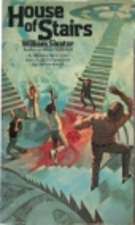
Book Review: House of Stairs by William Sleator
 Summary:
Five sixteen year old orphans living in state institutions are called to their respective offices, blindfolded, and dropped off in a building that consists entirely of stairs and landings. There appears to be no way out. The toilet is precariously perched in the middle of a bridge, and they must drink from it as well. To eat they must bow to the whims of a machine with odd voices and flashing lights. It is starting to change them. Will any of them fight it, or will they all give in?
Review:
This book was enthralling from the first scene, featuring Peter awakening on a landing intensely disoriented and frightened. Showing a bunch of teenagers obviously in an experiment opens itself up to caricature and stereotype, but Sleator skillfully weaves depthves and intricacies to them.
The writing is beautiful, smoothly switching viewpoints in various chapters from character to character. Hints are dropped about the outside world, presumably future America, that indicate the teens are from a land ravaged by war and intense morality rules. For instance, their state institutions were segregated by gender. Sleator weaves these tiny details into the story in subtle ways that still manage to paint a clear framework for the type of cultural situation that would allow such an experiment to take place.
It is abundantly clear throughout the book that the teens are facing an inhumane experiment. Yet what is not clear at first is what a beautiful allegory for the dangerous direction society could take this story is. Not in the sense that a group of teens will be forcibly placed in a house of stairs, but that some more powerful person could mold our surroundings to make us do what they want us to do. To remove our most basic humanity. This is what makes for such a powerful story.
It’s also nice that friendship in lieu of romance is central to the plot. Modern day YA often focuses intensely on romance. Personally, my teen years were much more focused on friendship, and I enjoyed seeing that in this YA book. I also like how much this humanizes the animals facing animal testing, and Sleator even dedicates the book to “the rats and pigeons who have already been there.”
House of Stairs, quite simply, beautifully weaves multiple social commentaries into one. It is a fast-paced, engrossing read, and I highly recommend it to everyone.
5 out of 5 stars
Source: PaperBackSwap

 Support my work with a tip or browse my shop for curated book club guides, how to guides, cross-stitch patterns, and more!


This work by Amanda Nevius is licensed under a Creative Commons Attribution-Noncommercial-No Derivative Works 3.0 United States License.
 Opinions of a Wolf