
Archive
Book Review: How to Say Babylon: A Memoir by Safiya Sinclair
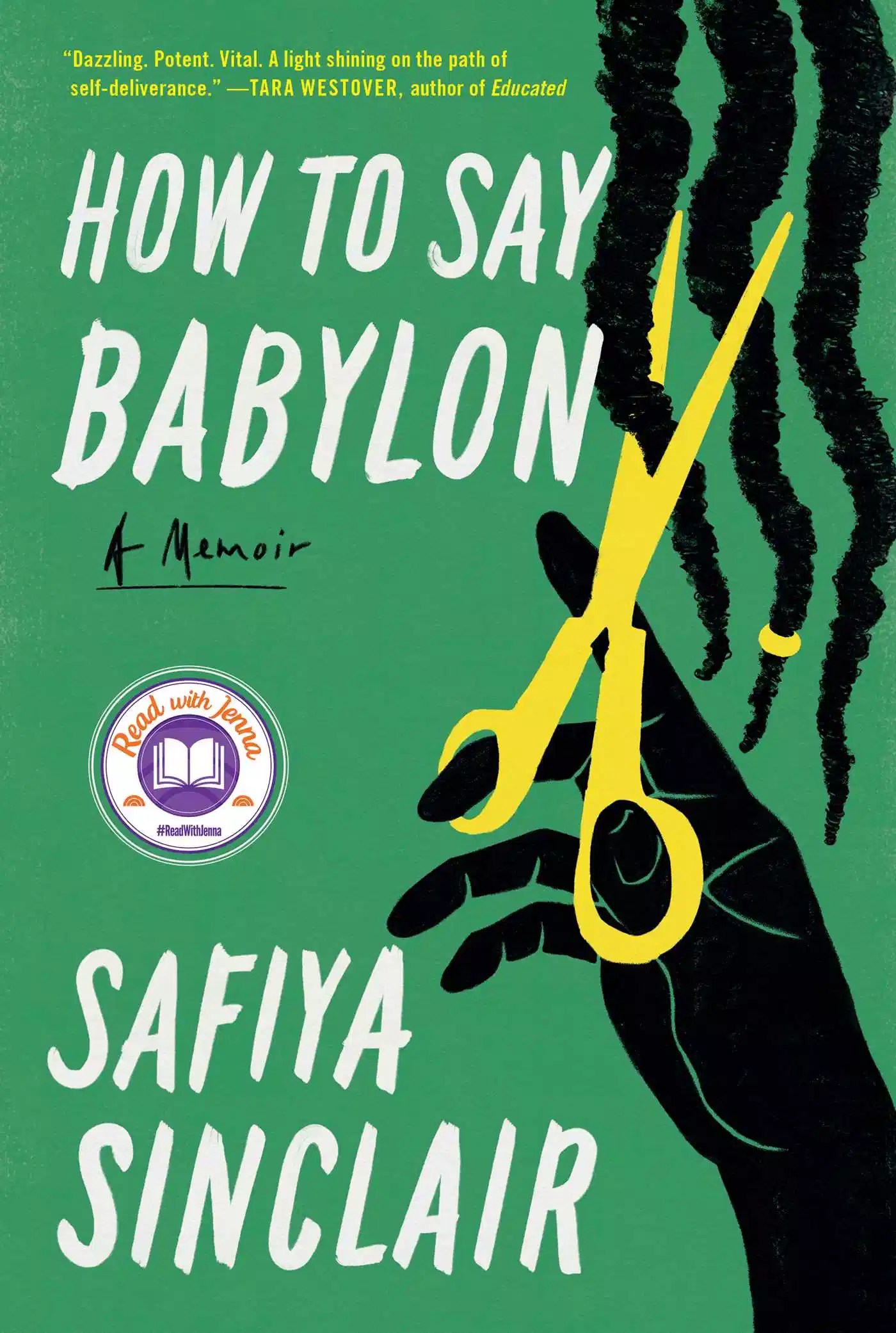
A poet recalls her childhood growing up as a minoritized Rastafarian in Jamaica with an abusive father.
Summary:
Throughout her childhood, Safiya Sinclair’s father, a volatile reggae musician and militant adherent to a strict sect of Rastafari, became obsessed with her purity, in particular, with the threat of what Rastas call Babylon, the immoral and corrupting influences of the Western world outside their home. He worried that womanhood would make Safiya and her sisters morally weak and impure, and believed a woman’s highest virtue was her obedience.
In an effort to keep Babylon outside the gate, he forbade almost everything. In place of pants, the women in her family were made to wear long skirts and dresses to cover their arms and legs, head wraps to cover their hair, no make-up, no jewelry, no opinions, no friends. Safiya’s mother, while loyal to her father, nonetheless gave Safiya and her siblings the gift of books, including poetry, to which Safiya latched on for dear life. And as Safiya watched her mother struggle voicelessly for years under housework and the rigidity of her father’s beliefs, she increasingly used her education as a sharp tool with which to find her voice and break free. Inevitably, with her rebellion comes clashes with her father, whose rage and paranoia explodes in increasing violence. As Safiya’s voice grows, lyrically and poetically, a collision course is set between them.
Review:
I picked this memoir up because I was interested in learning more about Rastafarianism. I was a religious studies minor in university, but Rastafarianism wasn’t something we’d touched on. The beginning of this book really delivered on educating me about the faith.
The memoir starts with a little introduction to Rastafarianism along with a brief history of Safiya’s father’s childhood and her mother’s childhood and what led each of them to convert to Rastafarianism. The religion sprang up in the 1930s as a faith of the most oppressed peoples in Jamaica. There is some disagreement as to whether Rastafarianism is a sect of Christianity or a separate faith entirely. Most Rastas believe that the Ethiopian Emperor Ras Tafari was the second coming of Christ. (In spite of him directly telling Rastas when he visited Jamaica that he was not Christ. Rastas felt that’s something Christ would say.) Just as with all faiths, there is a spectrum of beliefs and observances among Rastas. But there are three that are common.
First that the hair should not be cut, instead left in its natural state, leading them to dreadlocking it. Second, reggae as spiritual music. Third, smoking marijuana for spiritual experiences. Many Rastas are vegetarian, some are strict vegans. (Read more.) Something I found really beautiful was how Rastas adjust their speech, specifically how they will say “the I-and-I” as a reminder that God is indwelling in them. Safiya’s father will sometimes say “the I-man” to clarify when it was something limited to just him, and not him and God. The only thing I knew about Rastafarianism before I read this book was that it was common in Jamaica, so I learned a lot in an easy, beautiful way. The author didn’t just rely on her own childhood understanding of the faith but also interviewed Rasta elders and did some additional reading for the book. And it shows. To me, this was the strongest part of the book.
I thought when I picked this up it was a memoir of religion, but I think after reading it would be more accurate to say it was a memoir about an abusive father/daughter relationship that was at least a bit entwined with religion. So the focus was the abuse, not the religion. But it was necessary to understand the religion in order to understand some of where her father was coming from. Safiya’s father was on the more conservative end of the spectrum with regards to Rastafarianism. (He was also a reggae musician who kept running up against bad luck.) The family were strict vegans. He was more patriarchal and quite concerned about keeping his daughters safe from “Babylon” (the outside influence and dangers) in a way he wasn’t so much about his son.
But there are things that surprised me given the clear conservative lean of the family. The children all go to school. The daughters are encouraged to excel just as much as the son is. (The author even gets into an elite private school on scholarship, something that makes her parents very proud.) The children are allowed to continue living at home, even when they do things that go against the Rastafarian way. For example, the author models and cuts off her dreadlocks. I also was surprised to learn that Rastas were treated poorly in Jamaica while the author was growing up. She’s ridiculed due to being Rasta, and it wasn’t possible for her to pass as no one else seemed to have dreadlocks.
The abuse, though, is quite brutal. I was expecting from the book’s description emotional/spiritual abuse. Those do exist. But serious physical abuse does as well. One chapter titled “The Red Belt” made my chest ache to read. Any reader going into the book should be aware of this. I think some readers will relate to how Safiya deals with her father, and others will struggle to understand it.
The author is primarily a poet. Her work in poetry is what helped her achieve her goal of emigrating from Jamaica. Her poetic skills are evident in this book. I’m sure a reader who loves poetry will connect with this more than I did. I struggle to connect with poetry and so, even though I saw the beauty in the words, I struggled for them to move me. Similarly, while I always love to hear people talk about what they love doing, I didn’t connect with the author’s connection to poetry the way I would if I loved it similarly.
Overall, this is a book that will mean a lot to a reader who loves poetry and is able to read passages about physical and emotional abuse. Readers who like to root for someone to pivot into a life entirely different from how they grew up.
If you found this review helpful, please consider tipping me on ko-fi, checking out my digital items available in my ko-fi shop, buying one of my publications, using one of my referral/coupon codes, or signing up for my free microfiction monthly newsletter. Thank you for your support!
3 out of 5 stars
Length: 352 pages – average but on the longer side
Source: Library
Buy It (Amazon or Bookshop.org)
Book Review: The Book of Night Women by Marlon James (The Real Help Reading Project)
 Summary:
This is the story of Lilith. A mulatto with green eyes born on a plantation in Jamaica to a mama who was raped at 14 by the overseer as punishment to her brother. Raised by a whore and a crazy man, all Lilith has ever wanted was to improve her status on the plantation. And maybe to understand why her green eyes seem to freak out slave and master alike. Assigned to be a house slave, Lilith finds herself in direct contact with the most powerful slave on the plantation–Homer, who is in charge of the household. Homer brings her into a secret meeting of the night women in a cave on the grounds and attempts to bring Lilith into a rebellion plot, insisting upon the darkness innate in Lilith’s soul. But Lilith isn’t really sure what exactly will get her what she truly wants–to feel safe and be with the man she cares for.
Discussion:
This is the third book and second fictional work for The Real Help reading project I’m co-hosting with Amy, and it totally blew me away. A reading experience like this is what makes reading projects/challenges such a pleasure to participate in. I never would have picked up this book off the shelf by myself, but having it on the list for the project had me seek it out and determined to read it within a set length of time. Reading the blurb, there’s no way I would imagine identifying with the protagonist so strongly, but I did, and that’s what made for such a powerful experience for me. The more I read literature set in a variety of times and places, the more I see what we as people have in common, instead of our differences.
There is so much subtle commentary within this book to ponder that I’m finding it difficult to unpack and lay out for you all. Part of me wants to just say, “Go read this book. Just trust me on this one,” but then I wouldn’t be doing my job as a book blogger, would I?
Depicted much more clearly here than in any of our reads so far is how detrimental a society based upon racism is for all involved. There is not a single happy story contained here. Everyone’s lives are ruined from the master all the way down to the smallest slave girl. It is a circle of misery begetting misery begetting misery.
Homer was the mistress’ personal slave and many of the evil things that happen to her was because the mistress was so miserable that she make it her mission to make everybody round her miserable as well. (page 415)
Nobody is happy. Everyone lives in misery and fear. The whites are afraid of a black revolt. The blacks are afraid of being whipped or hung. Everyone is afraid of Obeah (an evil witchcraft similar to voodoo). People start to lash out at each other in an attempt to better themselves. For instance, the Johnny-jumpers are male slaves who are pseudo-overseers given power over the other slaves to beat them. It is simply a system exploiting everyone and for what? From the book it appears to be to maintain Britain’s position of power in the world. The system is evil, and it does not simply beget misery, but despair as well. It brings out the worst in everyone.
A strong theme in this book is that of race being a construct rather than an innate true difference in people. Since Lilith is bi-racial, she has trouble simply aligning herself with one side or the other. Although at first she hates white people, she comes to deeply care for a white man. She comes to see people as individuals and not their race, but alas that thought process is far too advanced for the time she is living in, and she senses this.
She not black, she mulatto. Mulatto, mulatto, mulatto. Maybe she be family to both and to hurt white man just as bad as hurting black man…..Maybe if she start to think that she not black or white, then she won’t have to care about neither man’s affairs. Maybe if she don’t care what other people think she be and start think about what she think she be, maybe she can rise over backra and nigger business, since neither ever mean her any good. Since the blood that run through her both black and white, maybe she be her own thing. But what thing she be? (page 277-8)
It’s impossible not to have your heart break for Lilith, a woman whose whole life revolves around race when all she ever wants is to feel happy and safe, an impossible dream represented for her by a picture from a child’s book that her foster slave father let her take from him. The picture is of a sleeping princess with a prince near her, and Lilith’s obsession with this image follows her throughout her life, until she finally tells herself:
She not no fool, Lilith tell herself. She not a sleeping princess and Robert Quinn is not no king or prince. He just a man with broad shoulders and black hair who call her lovey and she like that more than her own name. She don’t want the man to deliver her, she just want to climb in the bed and feel he wrap himself around her. (page 335)
I found myself wishing I could scoop Lilith and Robert up and place them on an island where they could just be together and raise their mixed race babies and just be happy, but that’s not what happened then, and that’s the dream we must keep fighting for, isn’t it? A world where people can just love each other and be happy and not be forced into misery for economic gain of a person or a business or a nation.
I know it sounds like wishful thinking, but that’s really what I got out of this book. If we don’t want to live in a world that dark, we must embrace love in all its forms. Love begets love, but hate begets hate. Don’t like corporate greed or nationalism overtake your capacity to see the humanity in everyone–the capability for powerful good or powerful evil present in us all. Perhaps this is a bit off-topic for The Real Help Reading Project, but that is the old passion from a youthful me in undergraduate classes that this book reignited, and that is what makes me want everyone to read it.
Source: Public Library
Buy It

Please head over to Amy’s post to discuss this book!
 Support my work with a tip or browse my shop for curated book club guides, how to guides, cross-stitch patterns, and more!


This work by Amanda Nevius is licensed under a Creative Commons Attribution-Noncommercial-No Derivative Works 3.0 United States License.
 Opinions of a Wolf