
Archive
Cookbook Review: 130 New Winemaking Recipes by C. J. J. Berry
 Summary:
A recipe book for making your own wine at home. Geared toward those who already have winemaking skills.
Review:
I requested this via Netgalley um *coughs* last year when I had the dream of making my own wine. People in my family have done this for years, so I thought I might. Well….the start-up and learning curve are a bit more than I anticipated or had time for, so I wasn’t able to make any of the recipes. I did, however, still want to provide a review, particularly since I sent my dad a few of the recipes. (He has his own winemaking set-up). So, let me put on my librarian uniform and get to it!
Given that making your own wine is kind of a down-home skill, the tone of this book is perfect. Berry takes on an older relative giving you the low-down on secret family recipes tone to his writing, and it works beautifully.
The wine recipes are primarily organized alphabetically, although a few that are similar (elderberry wines, for instance) are clumped together that way. It sounds odd, but it makes sense when reading through the book. The book ends with some holiday punch recipes (including wassail) and, oddly, some beer brewing ones.
The recipes themselves are easy to understand, but I would suggest in the future that Berry either numbers the steps, bullet points, or splits up into a few paragraphs. They are basically one huge paragraph, which can be less easy to use. Another suggestion I would make is that the wines for the most part don’t say if they are red or white, and I’m sure that is something the reader would like to know before getting going in the making.
Overall, this is a nice collection of wine making recipes. It feels as if your uncle handed you a book of secret family recipes, just the alcohol variety. A working knowledge of winemaking is assumed, so this is recommended to those who already have a wine making setup and want to try out some new, unique recipes.
4 out of 5 stars
Source: Netgalley

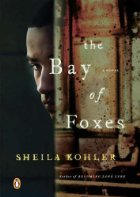
Book Review: The Bay of Foxes by Sheila Kohler
 Summary:
Dawit is a twenty year old Ethiopian refugee hiding out illegally in Paris and barely surviving. One day he runs into the elderly, famous French writer, M., in a cafe. Utterly charmed by him and how he reminds her of her long-lost lover she had growing up in Africa, she invites him to come live with her. But Dawit is unable to give M. what she wants, leading to dangerous conflict between them.
Review:
This starts out with an interesting chance meeting in a cafe but proceeds to meander through horror without much of a point.
Although in the third person, we only get Dawit’s perspective, and although he is a sympathetic character, he sometimes seems not entirely well-rounded. Through flashbacks we learn that he grew up as some sort of nobility (like a duke, as he explains to the Romans). His family is killed and imprisoned, and he is eventually helped to escape by an ex-lover and makes it to Paris. This is clearly a painful story, but something about Dawit in his current state keeps the reader from entirely empathizing with him. He was raised noble and privileged, including boarding schools and learning many languages, but he looks down his nose at the French bourgeois, who, let’s be honest, are basically the equivalent of nobility. He judges M. for spending all her money on him instead of sending it to Ethiopia to feed people, but he also accepts the lavish gifts and money himself. Admittedly, he sends some to his friends, but he just seems a bit hypocritical throughout the whole thing. He never really reflects on the toppling of the Emperor in Ethiopia or precisely how society should be ordered to be better. He just essentially says, “Oh, the Emperor wasn’t all that bad, crazy rebels, by the way, M., why aren’t you donating this money to charity instead of spending it on me? But I will tooootally take that cashmere scarf.” Ugh.
That said, Dawit is still more sympathetic than M., who besides being a stuck-up, lazy, self-centered hack also repeatedly rapes Dawit. Yeah. That happened. Quite a few times. And while I get the point that Kohler is making (evil old colonialists raping Ethiopians), well, I suppose I just don’t think it was a very clever allegory. I’d rather read about that actually happening.
In spite of being thoroughly disturbed and squicked out by everyone in the story, I kept reading because Kohler’s prose is so pretty, and I honestly couldn’t figure out how she’d manage to wrap everything up. What point was she going to make? Well, I got to the ending, and honestly the ending didn’t do it for me. I found it a bit convenient and simplistic after the rest of the novel, and it left me kind of wondering what the heck I just spent my time reading.
So, clearly this book rubbed me the wrong way, except for the fact that certain passages are beautifully written. Will it work for other readers? Maybe. Although the readers I know with a vested interest in the effects of colonialism would probably find the allegory as simplistic as I did.
2 out of 5 stars
Source: Netgalley
Counts For:
Specific country? Ethiopia. South African author.

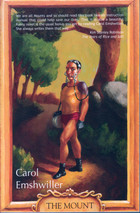
Book Review: The Mount by Carol Emshwiller (Bottom of TBR Pile Challenge)
 Summary:
Charley is an 11 year old Seattle and wants to be the best mount there is for his owner, Little Master. He eats his dry cakes, practices on the go-round, and behaves well. Little Master mostly likes their lessons. His ears wiggle, so Charley knows he’s giggling. But one day Wilds attack the village. They say that people are meant to be people, not mounts for Hoots. But the Hoots say the mounts were made for them, see how the primate species are perfectly designed for riding? It’s all very confusing for Charley.
Review:
It doesn’t take much guess-work to figure out how this wound up on my TBR pile. It’s a rather obvious allegory for animal rights, although instead of apes enslaving people like in Planet of the Apes, it’s an alien species with cat-like ears and weak legs enslaving humans. The concept is a good one, but the execution fell short for me, which is sad, because I wanted to love it.
The structure of the book is problematic. The first chapter is from the perspective of an entirely random Hoot who we never see again. Ever. We also never see his mount again. This is just weird. The rest of the book is told from the first person perspective of Charley, except for one random chapter narrated by his father. I don’t mind switching perspectives, but there should be some sort of consistency about it, and we should have at least a vague idea who the character in the new perspective is.
I also found myself completely baffled by Charley. In spite of being enslaved by the Hoots, he still wishes to use a bit one day and other things that drive his father nuts, and one cannot help but agree with his father. He never seems to really learn better through the book either. He persists in loving his Hoot and being a mount for his Hoot. That doesn’t work as an allegory for animal rights or slavery.
Emshwiller does show how teenage boys clash with their fathers very well, however. Charley’s relationship with his dad, Heron, is well fleshed-out and intriguing. They want to connect and love each other but struggle with how, exactly, to do that when they are so different yet so similar. Looking back, this relationship is what kept me reading. It shines in spite of the other oddities in the book.
I won’t spoil it, but the ending bothered me as well, and I found it profoundly confusing. In fact, I’d say for the book as a whole I am simply left perplexed by it. I feel like I missed something or didn’t quite get an accurate picture of the world they are living in or something.
Overall, it’s a very different take on humans being enslaved by another species, but its execution is rather disappointing. Recommended to readers with a marked interest in scifi depictions of human slavery.
3 out of 5 stars
Source: PaperBackSwap

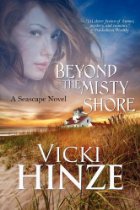
Book Review: Beyond the Misty Shore by Vicki Hinze (Series, #1)
 Summary:
Maggie Wright comes to the cozy Maine bed and breakfast, Seascape, not for a vacation, but to investigate the mysterious death of her cousin, Carolyn. Carolyn’s artist fiancee, TJ MacGregor, just so happens to be staying at Seascape, but a mysterious force is preventing him from leaving. Despite the tragedy standing between them, they start to fall for each other.
Review:
This is obviously a romance with a dash of mystery and a touch of ghosts. Maine is a wonderful setting, particularly for a paranormal romance. This one just didn’t work for me, although I can clearly see how it will be able to find an audience.
I found the writing, particularly the romance, to ring a bit….old-fashioned and conservative. The characters all seem to speak in the same speaking style as the elderly woman who manages the inn. That works for her, and she is definitely my favorite character in the book, but it doesn’t work so well for TJ and Maggie who are both young and from New Orleans. I’m sure some readers would find the clean, conservative manner in which they talk a bit of fresh air, but to me it was dull and felt like a book my grandma gave me to get started out in romances when I was in middle school.
Similarly, the way the entire town is willing to appease the local pastor when it comes to things like alcohol and condoms kind of enraged me. For instance, the convenience store will only sell condoms to married couples upon the request of the pastor. I mean WHAT?! That is just not even LEGAL. But. As a book reviewer, I can definitely see that a more conservative crowd would appreciate the idea of a town where that sort of understanding could exist.
So, ignoring the fact that this book is far too conservative for me, there is one other issue that bothered me. I found the mystery of Carolyn’s death entirely confusing. At first I thought that Maggie came to Seascape to investigate the death because Carolyn died up there, but toward the end of the book, it sounds like she died in New Orleans. Which was it? And if she did die in New Orleans, then why did Maggie go to Seascape in the first place? Also, people think the car crash was mysterious because the painting she had with her was undamaged, but then toward the end of the book they say no the undamaged painting wasn’t found at the car, it’s just that it had disappeared and reappeared. Or something. I’m still very confused about everything about Carolyn, which is problematic given that this is the central conflict keeping our romantic couple apart. The mystery should be mysterious but not illogical.
Overall, this is a romance novel that was not for me, but will appeal to more conservative romance readers. People looking for an old-timey style romance with a touch of ghosts will appreciate it.
3 out of 5 stars
Source: Netgalley

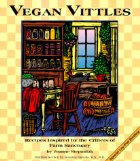
Cookbook Review: Vegan Vittles by Joanne Stepaniak
 Summary:
A farm sanctuary is a farm whose sole purpose is to save animals from farm factories and slaughter. The Farm Sanctuary in upstate New York was started in 1986. In this cookbook, one of the proprietors has gathered vegan recipes inspired by farm life. Think down-home cooking that is cruelty-free.
Review:
As a country girl, I was delighted to find a down-home cookbook free of animal products. Everything about the cookbook hearkens back to classic American cookbooks from the layout to the simple black and white pictures at the beginning of each section to the layout of each of the recipes themselves to the sayings peppered throughout the book. (The sayings are veganized versions of classic American ones).
The cookbook starts with an intro to the Farm Sanctuary, followed by a very personal explanation for her veganism by Stepaniak. This is followed by the more scientific explanations for eating vegan and how to do it properly. Substitutes and special ingredients are explained, and the intro is rounded out by a sample weekly menu.
The recipes themselves are divided into: tips and tails (hints and basics), beverages, breakfasts and breads, uncheeses butters and spreads, hearty soups and stews, salads and dressings, sandwiches, the main dish, sauces gravies and condiments, and happy endings (desserts). Each section starts with a photo of one of the rescue animals and their story. It’s a sweet, light-handed approach to veganism that I appreciate.
So what about the recipes? They are definitely geared toward beginner plant-based cooks with a desire to replace their animal-based recipes with similar tasting ones. There’s a plethora of traditional American recipes with the animal products simply switched out. As a long-time vegetarian, I found this focus not quite my style, but I can see it being enjoyed by newbies or when hosting omni friends and family or to find that one thing you still really miss like bacon or meatloaf. Personally, I found the dairy substitutes far more useful and interesting, since these can be expensive to buy, but are far healthier for you then the dairy norm.
I was able to find quite a few recipes of interest to me that I copied out. So far I’ve only been able to try one, but it was amazing! I tried Chuckwagon Stew on page 89. Seeking to replicate a hearty, country stew without the meat, the stew is built around tempeh. The ingredients were easy to find (I got everything at Trader Joe’s), cheap, and the recipe was a quick one to make. I fully admit I inhaled half of it that very evening. I am eager to try the rest of the recipes, particularly the Crock Cheeze on page 74 and the Seitan Salami/Pepperoni on page 40.
Overall, this is a country style, omni-friendly vegan cookbook that lets the animals and recipes shine for themselves. The recipes predominantly use grocery store ingredients, the exceptions being vital wheat gluten and nutritional yeast, which are easily ordered via Amazon. They are also simple enough that any moderately skilled cook should be able to follow them with ease. I highly recommend it to omnis and veg*ns alike, as the recipes are happy, healthy, and friendly. Personally, this is definitely going on my to own wishlist.
5 out of 5 stars
Source: Public Library
Buy It
Note that the second edition has a different subtitle and more recipes.

Book Review: Sisterhood Everlasting by Ann Brashares (Series, #5)
 Summary:
The Septembers are all 29 years old now and spread out all over the globe. Bee is expending her energy biking up and down the hills of San Francisco while Eric works as a lawyer. Carmen has a recurring role on a tv show filming in NYC and is engaged to Jones, an ABC producer. Lena teaches art at RISD and lives a quiet life in her studio apartment, except for the one day a week she practices Greek with an elderly woman. Tibby took off to Australia with Brian months ago, and everyone else is in limbo waiting for her to get back. They all feel a bit disconnected until Tibby sends Bee, Carmen, and Lena tickets to come to Greece for a reunion. What they find when they arrive is not what anyone expected.
Review:
You guys. You guys. This book shattered me. I am not a crier, and I actually had tears fall while reading this book. I read it in one day. I could not put it down. As someone who grew up with The Sisterhood of the Traveling Pants, I found the sudden jump forward in age (we used to be about the same age, and now they are older than me) a bit disconcerting and unexpected, but nowhere near as unexpected as the rest of the book.
I complained to anyone who would listen at the beginning that I hated it. That I hated what Brashares was doing, and omg why would she do this. But as the story progressed, she swept me along, and suddenly I realized that yes this is tougher by far than the earlier books. It’s not the light girl power read the first or even the second one was. But it shouldn’t be. They’re 29. They’re older. Their problems should be bigger and more adult, and the lessons here hurt more to read because they’re tougher ones to learn. It’s precisely the direction the books should have taken. The girls change and, dare I say it, actually grow the fuck up unlike a certain other foursome that have a tv show.
I won’t tell you what made the book so powerful, because that’d spoil it. But I will tell you, my fellow fans, to push past the first quarter of the book where you’re angry and want to throw it across the room in a Carmen-like rage. Give Brashares the chance she earned with the first three to gradually show you what she’s doing. It’s an emotional journey that’s well worth taken. Fans might be frustrated at first, but those who stick it out and love the series for what it really is will love this entry. I don’t doubt it at all. Plus, Brashares hinted that there might be still more to come.
5 out of 5 stars
Source: Netgalley

Previous Books in Series
Sisterhood of the Traveling Pants
The Second Summer of the Sisterhood
Girls in Pants: The Third Summer of the Sisterhood
Forever in Blue: The Fourth Summer of the Sisterhood


Book Review: Claws and Saucers by David Ellroy Goldweber
 Summary:
An alphabetical guide to scifi, horror, and fantasy movies made between 1902 and 1982.
Review:
One thing I have learned from the two movie reference guides I’ve received for review since starting this book blog is that movie reference guides are not for me. Frankly with things like, oh, the internet, they’re just not useful the way they were back when I was in undergrad and professors wouldn’t accept IMDB as a reference in your English paper comparing books to their movie versions. But I digress.
Putting on my librarian cap then why does this reference guide get 2 and not 3 stars? (3 indicating not for me but maybe for others). It frankly bothers me how not academic it is. It essentially reads as a list randomly assembled by some random dude down the road, not a professor of the history of film or a film critic or anything like that really. This would be great for a blog, but not for a serious reference book. Additionally, maybe the print edition is better, but the ebook version is badly formatted and contains none of the pictures promised in the blurb.
The book basically then is your neighbor yammering in alphabetical order about random movies he selected from the early 1900s with all of the natural individual prejudices and caveats that go along with that. There’s nothing academic about it, and when push comes to shove, it’s something that would be better off as a blog than a book. I will give it this though: the title and cover are excellent.
2 out of 5 stars
Source: Netgalley

Book Reread Review: Strawberry Girl by Lois Lenski
 Summary:
Birdie’s just moved to Floridy from Caroliny to farm strawberries with her family. But their neighbors, squatters headed by a mean drunk of a dad, won’t make life easy for them.
Review:
Rereading a childhood favorite is a dangerous endeavor. However, last year rereading Reddy Fox went well, so when the ebook version of this Lois Lenski classic showed up on Netgalley, I just had to try it out. I can see why I enjoyed it as a child, but I can’t really imagine adding it to the collection if I was a public librarian or, in the realm of more possibility, giving it to my nephew.
This is part of a series that Lenski wrote and illustrated in the 1940s about children living in different regions of America. The thought process was that kids saw children around the world in literature but not the vastly different ways of growing up all over America. A good idea, for sure. I can totally see why these books, written in painstaking vernacular to boot, were popular back then. They just didn’t age as well as they could have. Or, at least, this one didn’t.
Unlike the Little House series where the problems and dramas and joys are relatable, Birdie’s family basically repeatedly lets the neighbors walk all over them. There are also odd conundrums, such as how is Birdie’s family so working class and yet mysteriously has money? Most bothersome, though, is the fact that the central conflict of neighbor worthless father is wrapped up overnight when he gets saved at a revival meeting. Only the most evangelical of children will accept that as a fix. Plus, it gives an unrealistic expectation to children that the serious problem of an addicted parent can be solved with some yelling from a preacher. Not the most useful of message to be giving to children.
Although it’s not an unenjoyable read and the details of life in rural Florida in the 1940s are painstakingly accurate, it just simply hasn’t aged as well as other classics. It is still well-written, researched, and illustrated, however. I’d recommend it to adults with an interest in the history of American children’s literature.
3 out of 5 stars
Source: Netgalley

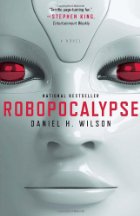
Book Review: Robopocalypse by Daniel H. Wilson (Audiobook narrated by Mike Chamberlain)
 Summary:
Cormac Wallace reviews the surveillance tape taken by Rob (robots) during the New War–the war between humans and robots. He thus recounts the history of the war to the reader.
Review:
Basically this is supposed to be World War Z only with robots. It falls incredibly short.
What makes World War Z such an awesome book (beyond the fact that zombies are better than robots) is that it is a mock oral history of a war. This is a thing that actually happens after a war in real life. Oral historians go around and gather real information from the survivors about the war. Although the NPR style narrator frames the chapters, they are all given by different survivors from their own perspectives.
The problem with Robopocalypse is that it tries to use the same method for a very different story. Much as Wilson may want a robot war to be like a zombie war, it ISN’T. And it shouldn’t be recounted in the same way. Wilson sort of realizes this, because he has Wallace recount the war by watching the “black box” surveillance of Rob. The thing is, though, that really doesn’t work in book form.
A) Why would Cormac write down something that is already available visually? Why wouldn’t he just copy/pasta the videotape and send it out?
B) The chapters swing wildly between Cormac describing what he’s seeing on screen (insanely boring) and random first hand accounts from everyone from himself to dead people. Yeah. Dead people have first-person accounts in this book. THAT MAKES NO SENSE.
Also, the pacing is off. The build up to Rob attacking is painfully slow, but Rob taking over misses a lot of the details that would be interesting. Similarly, details as to how people all over the world start collaborating and beat the brilliant Rob is sped up and glossed over too much. Essentially, things that should have more space in the book have too little, and things that should have very little space have too much.
I have to say that the narration by Mike Chamberlain did not help matters any. His voice is practically monotone, and he adds nothing to the story.
The concept of a robot war is a good one, although I admit to having more loyalty to zombies. However, the format used in World War Z just will not work in a robot war. Wilson should have focused on one small group of people or actually tried out the whole oral history thing. This bouncing around between perspectives and verbally recounting surveillance footage simply does not work. I cannot recommend this book. There is simply far better plotted scifi out there.
2 out of 5 stars
Source: Audible

Book Review: The Value of Rain by Brandon Shire
 Summary:
Charles hasn’t been home since his mother and uncle sent him away to an insane asylum at the age of fourteen after he was found in the embrace of his first love–Robert. Now, ten years later, his mother, Charlotte, is dying, and he comes back to take his revenge.
Review:
This is one of those genre-defying books. Although classified as LGBTQIA+, it is so much more than a genre. Shire explores the devastating effects of prejudice, hate, secrets, and lies throughout family generations, and that is something that is simultaneously universal and tragic.
The book constantly takes the reader by surprise. At first it seems an expected my-family-didn’t-love-me-because-I’m-gay story, but Charles does *not* get a free pass simply because he is hurt by his family. He is given chances at new life and redemption from a hate-enshrouded existence, but he doesn’t choose that path. It is painful to watch, and yet simultaneously understandable. I applaud Shire for not taking the easy way and by making Charles an easy hero.
The writing is particularly eloquent and strong in description, especially when describing painful topics. For instance:
She had lived in the maze of Charlotte’s thumbprint and she had not survived. (location 1349)
On the other hand, the dialogue sometimes struggles in comparison to the lyrical descriptions. For instance, characters often say people’s names more frequently than is natural. This is a kink that I am sure will be ironed out with time and experience.
I also loved and was totally shocked by the ending. That is not an easy thing to do to this reader.
Overall this book represents all that can be great about indie publishing. It is a deep, dark story with a minority, tragic hero that most likely would not be told at a traditional publishing house due to the fact that it does not easily fit into any one genre or marketing scheme. Of course, that is also why I love it.
Recommended to those with an interest in LGBTQIA+ main characters and multi-generational family dramas.
4 out of 5 stars
Source: Kindle copy from author in exchange for my honest review

Note: Half of all proceeds donated to LGBT Youth Charities.
 Support my work with a tip or browse my shop for curated book club guides, how to guides, cross-stitch patterns, and more!


This work by Amanda Nevius is licensed under a Creative Commons Attribution-Noncommercial-No Derivative Works 3.0 United States License.
 Opinions of a Wolf