
Archive
Book Review: In the Lives of Puppets by T.J. Klune
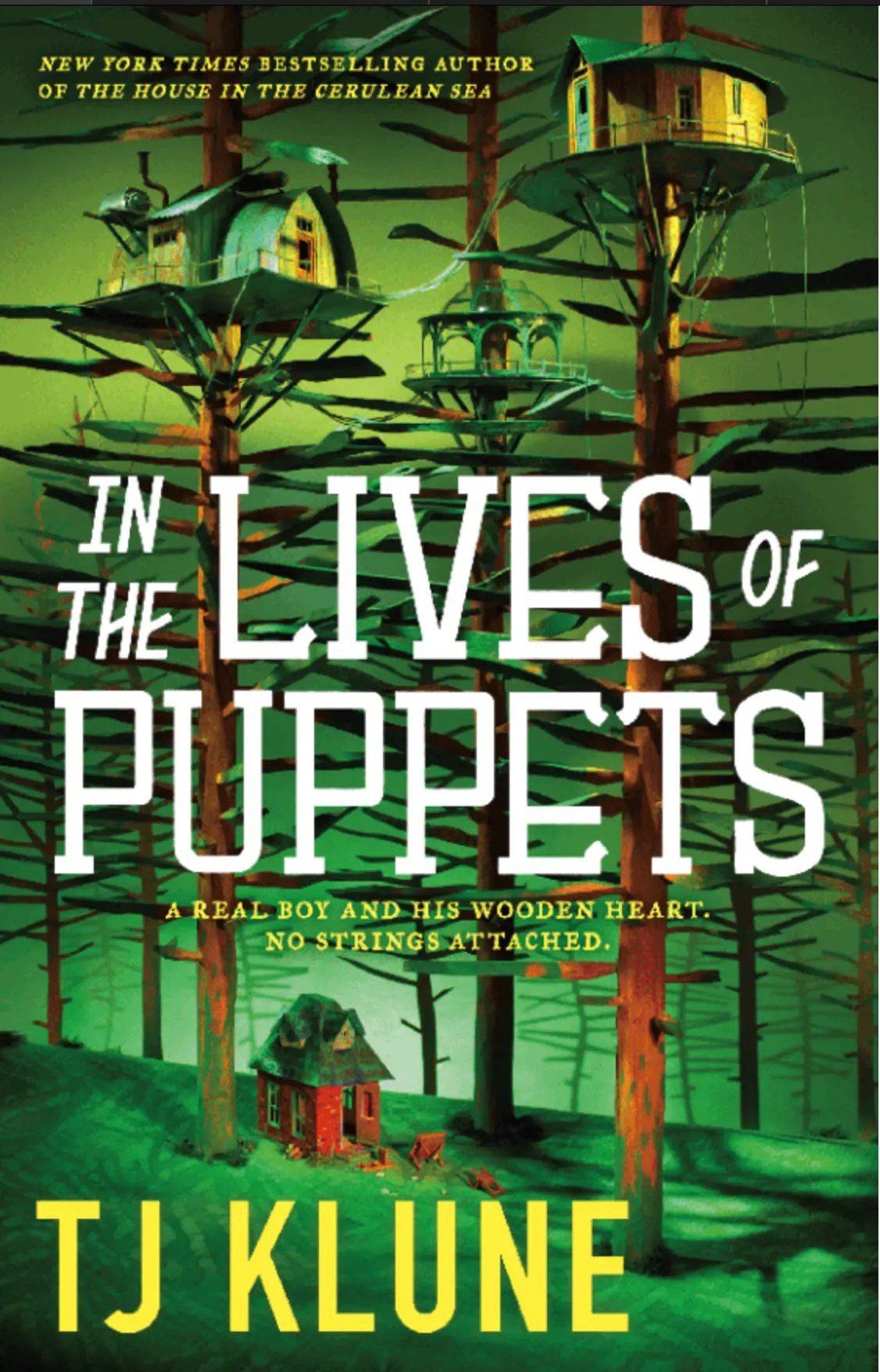
A science fantasy reimagining of Pinocchio where Pinocchio is a “real boy” surrounded by robots (puppets) with a m/m (or, rather, male, male robot) romance added in.
Summary:
In a strange little home built into the branches of a grove of trees, live three robots–fatherly inventor android Giovanni Lawson, a pleasantly sadistic nurse machine, and a small vacuum desperate for love and attention. Victor Lawson, a human, lives there too. They’re a family, hidden and safe.
The day Vic salvages and repairs an unfamiliar android labelled “HAP,” he learns of a shared dark past between Hap and Gio-a past spent hunting humans.
When Hap unwittingly alerts robots from Gio’s former life to their whereabouts, the family is no longer hidden and safe. Gio is captured and taken back to his old laboratory in the City of Electric Dreams. So together, the rest of Vic’s assembled family must journey across an unforgiving and otherworldly country to rescue Gio from decommission, or worse, reprogramming.
Along the way to save Gio, amid conflicted feelings of betrayal and affection for Hap, Vic must decide for himself: Can he accept love with strings attached?
Review:
This is a loving and detailed send-up to Pinocchio. I hadn’t seen the movie in years, and it still stirred up memories for me. When I went to look up the original book version’s plot to compare to this retelling, I found even more details I hadn’t realized or remembered. It’s obvious the author loves Pinocchio, and if you do too, I’m expecting you’ll likely love this retelling. For me, the problem is, I was so excited about a new T.J. Klune book that I sort of…forgot I don’t like Pinocchio. (“Don’t like” is a gentle remembrance. In fact, the movie absolutely terrified me as a child.) Even so, I found myself able to appreciate this loving rendition of the story.
I absolutely adored the character of Rambo – the tiny robot vacuum who’s clearly supposed to be a later generation of roombas. As always, I liked the narrative style the author uses – it reads as sing-songy in my head and feels like someone telling me a fairy tale, which is perfect for this book. I liked the wide variety of robots inhabiting the world, and I really enjoyed the robot substitute for the traveling circus character. I also appreciated that this isn’t an exact retelling of Pinocchio. The story is sometimes restrained, with simple allusions to the original. For example, Victor is never turned into a donkey, but he does stay the night in a hotel like room that is decorated with donkeys at about the right point in the story.
I appreciated the flipping of Pinocchio (Victor in this telling) as being human with his father being a “puppet” (a robot). But I felt like the ending really lets that inversion down, not taking it to its full and complete conclusion. I think there’s supposed to be humor in this book, but it wasn’t funny to me. You will know within the first few chapters if it’s tickling your funny bone or not.
I also found myself unable to root for anyone in this book, save for the small, innocent Rambo. Everyone else has something so wrong with them that it soured me to like them. The one I can talk about without spoilers, as the episode happens in the first chapter, is Nurse Ratched. She is a robot companion of Victor’s who was designed to nurse humans. She’s described as sociopathic, in a way that I think is supposed to read as comedic. As in, she acts like she enjoys inflicting pain but doesn’t really. Yet in the first chapter she chases down a squirrel (off-screen) and kills it by rolling over it again and again. I almost stopped reading the book, I was so horrified. But it was an advanced copy, so I decided to give it another chance. She never does anything like this ever again, but it is actually not uncommon for characters in this book to have something they have done in the past that is truly horrific that is brushed off as their programming. I’m all for plots where characters have to overcome their own tendency toward being bad, and redemption and forgiveness are both very important. But I need for that not to be the plot for almost every single character. It, at the very least, is distressing to read about.
The romance did not move me, which was surprising given what strong feelings I had for the couple in The House in the Cerulean Sea! I also have complicated feelings about how the book depicts what freedom means, how robots pursue freedom, the offerings of the “freedom fighter” character, etc… This, in fact, is a reflection of how I feel the overarching messages tended to get muddled. The only message that I felt was clear and consistent was “be brave!” but no clear reason as to why was ever given. To borrow from an American fairy tale – the overarching story needed a heart. I think, perhaps, the romance was supposed to be the heart, but it didn’t work as one for me.
This is also an incredibly sad book. It’s not uplifting in the slightest. There’s nothing wrong with sad books, but it is a departure from the author’s other books, and so I think the warning is warranted.
Overall, this is an imaginative and loving retelling of Pinocchio that should appeal to fans of that fairy tale. Readers should be aware that the darkness of the original story remains in this retelling.
If you found this review helpful, please consider tipping me on ko-fi, checking out my digital items available in my ko-fi shop, buying one of my publications, or using one of my referral/coupon codes. Thank you for your support!
3 out of 5 stars
Length: 432 pages – average but on the longer side
Source: NetGalley
Buy It (Amazon or Bookshop.org)
Book Review: The House in the Cerulean Sea by T.J. Klune

Summary:
Linus leads a solitary life with his cat and his records and an ethical commitment to his job as a Case Worker for the Department in Charge of the Magical Youth in the UK. When his long-time commitment to investigating cases precisely according to the book by Extremely Upper Management with a highly classified case, he finds himself Marsyas Island Orphanage. Here six dangerous children reside: a gnome, a sprite, a wyvern, an unidentifiable green blob, a were-Pomeranian, and the Antichrist. Linus must put aside his own fears and decide if they’re likely to bring about the end-times, all while keeping a particularly special eye on their mysterious caretaker, Arthur Parnassus.
Review:
When I picked this up, I expected to read a cheery tongue-in-cheek book about the end times. What I got instead was a cheery book, yes, but one about taking the risks that allow you to actually live your life in a fulfilling way. It inspired me and made me teary-eyed.
Klune simultaneously depicts the soul-crushing horror of working for a bureaucratic organization and makes it funny. This is evident just by the name Extremely Upper Management. It is just so relatable to see Linus working for a government organization that clearly has some nefarious tendencies and, at the very least, creates a terrible work environment, yet that Linus has convinced himself is him doing an ethical job. He clasps to the idea that he is making a good impact on the world, and therefore allows his life to be the horrible and depressing way it is. It takes going to Marsyas Island to snap him out of it.
Just as Linus’s depressing London life is drawn (the depiction of his commute alone is just so on point to a city commute), Maryas Island is depicted to beautifully that even now, weeks after finishing the book, I can send my mind back there for a mini-break. It’s not that it’s perfect, there are, of course, infuriating aspects to small town life (like the ferry) but! Linus can see the sun again. And he can see what can happen when people are encouraged that there is good in them they just need to draw out. My favorite of the children is the gnome, a little girl with a beard who loves her garden and threatens to kill with her shovel anyone who seems like a danger to it. But instead of focusing on the negative (the shovel threatening) Arthur focuses on encouraging her to show people her garden and guide them through what there is to appreciate about it and how to appreciate it respectfully.
I was surprised but thrilled by the blooming attraction between Linus and another adult male at the island (I somehow didn’t know that Klune is a Lambda Literary Award winning author). When I realized that a potential change for Linus might include finding love after 40 as well, I was thrilled. I would be hesitant to call this a romance, because I felt like it was really a book about living your life in a way that is authentic to who you really are and makes you happy, Loving someone who loves you back is part of that for Linus. But it’s not the focus. His life calling is the focus.
I want to encourage readers who might be distressed by Linus’s initial disappointment in his own body size and commitment to dieting that this is not a story where pounds magically fall away on an island and only then can our character find love. No, this set-up is part of making room for Linus to learn to love his body and care about other markers of health (like having a healthy glow).
This is a delightful fantasy about breaking out of your routine to find the life you really want to live. About helping children and adults find the good in themselves and draw it out. About a gay man learning to love his body and finding love in his 40s. It was so beautifully written it left me speechless, and I pre-ordered Klune’s next book. Recommended to those wanting to find inspiration to living a life that brings joy.
5 out of 5 stars
Length: 394 pages – average but on the longer side
Source: Library
Buy It (Amazon or Bookshop.org)
If you found this review helpful, please consider tipping me on ko-fi, checking out my digital items available in my ko-fi shop, buying one of my publications, or using one of my referral/coupon codes. Thank you for your support!
 Support my work with a tip or browse my shop for curated book club guides, how to guides, cross-stitch patterns, and more!


This work by Amanda Nevius is licensed under a Creative Commons Attribution-Noncommercial-No Derivative Works 3.0 United States License.
 Opinions of a Wolf