
Book Review: Daniel Boone’s Own Story & The Adventures of Daniel Boone by Daniel Boone and Francis L. Hawks
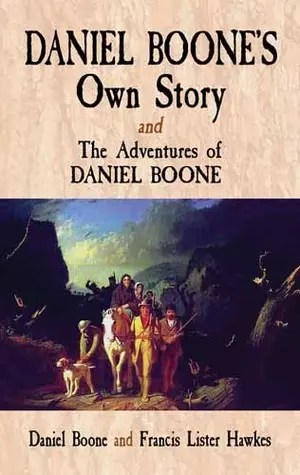
This book presents Daniel Boone’s summary of his adventures in the late 1700s and early 1800s plus a biography of his life first published in 1844.
Summary:
Daniel Boone blazed the Wilderness Road through the Cumberland Gap. Thousands followed, settling in Boonesborough, Kentucky, to form one of the first English-speaking communities west of the Appalachians. This two-part tale of the legendary frontiersman’s life begins with a brief profile by Boone himself, covering his exploits in the Kentucky wilderness from 1769 to 1784. The second part chronicles Boone’s life from cradle to grave, with exciting accounts of his capture and adoption by the Shawnee and his service as a militiaman during the Revolutionary War.
Review:
Growing up, I’d heard the legends of Daniel Boone and saw a few episodes of the (wildly historically inaccurate) tv show. I was raised with the mainstream US belief that westward expansion and colonization was great. It wasn’t until I was in college that I started to really learn about the true history of colonization. So I wasn’t too surprised when I read these period accounts to find that things were not the glowing hero account I’d heard. Not even when you take what happened at face value from the mouth of the man who lived it or from the biography that came shortly after his death.
Let’s start with what was true. Daniel Boone was, by all accounts, a talented hunter. He didn’t like to have many people around him, so he was constantly on the lookout for land that appeared to him to be empty (more on that later). He was taken captive by the Shawnee and adopted by them, living with them for two years before escaping. He was a critical tipping point person in the settlement (and stealing) of Kentucky by white Americans.
Here’s what stuck out to me when reading these accounts, though, with my twenty-first century eye. Daniel Boone and the other settlers considered Kentucky to be open space and fair game. However, even the early 1800s biographer pointed out that this land was being used as hunting grounds by multiple different Indigenous nations. So even folks of the time realized that the land was in use, just not in the same way as how white people would use it. When I dug into this more, though, I found this fascinating article about the idea of Kentucky being a “dark and bloody ground” aka land that was being fought over and contested by Indigenous nations with no one really living on it the way European settlers viewed living on land, as a myth propagated to be able to view the land as “free game” to then sell to settlers without even the pretense of a treaty with or purchasing from the Indigenous folks.
Reader should be aware that these period pieces use multiple slurs to refer to Indigenous peoples. Beyond the slurs, there’s this odd depiction of Indigenous peoples. On the one hand, they’re depicted as backwards and not very bright. But on the other hand they’re depicted as terrifying enemies difficult to overcome.
It’s interesting to me how both authors consistently view white folks as superior and more “civilized,” in spite of telling stories that make it look very much the contrary. For example, there’s a scene in which an Indigenous group of warriors takes a bunch of white women captive. They are in a boat and they line the women around the edges of the boat. The narrator says that they did such a thing to ensure safe passage for themselves, assuming the white men would never fire on the white women. But the white men do, and the narrator defends this, saying it’s better for the white women to be dead than to be held captive by the Indigenous people. This statement is extra confusing as we had just seen earlier in the book that Daniel Boone was taken captive and then adopted and treated as one of the tribe. Now, of course, not all captives were adopted. Some were murdered and, yes, some were tortured. (How captives were treated varied wildly.) But the point remains that the men fired on their own women and considered that to be a “civilized” act.
As it is women’s history month, I wanted to draw out some information on Daniel Boone’s wife, Rebecca. He brought her out to Kentucky, and on the trip there, one of their children is killed by Indigenous folks defending their land. (Because it WAS their land.) Then later her daughter is kidnapped. (Daniel retrieves her.) Ultimately, six of their ten children died early deaths, largely in the war between the Indigenous and the settlers. We also can’t forget when Daniel was captured and adopted. He was gone for so long that Rebecca gave up hope and went home to North Carolina, only to have Daniel show up, back from what she thought was the dead, and bring her back to the frontier. I can’t imagine living my life that way. I realize she had her own agency, and we must acknowledge the complicity of white women in the theft of the land. But I do wonder what it must have felt like to give birth to ten children, only to have six of them die in the bloody battle for land. Did she think it was worth it? What made her go back with Daniel when he showed up after being missing for two years? These are things we’ll never know because women’s stories simply were not recorded for us.
I would not call this a fun or easy read. It was an informative one. There’s a lot of value in reading firsthand accounts of history. Of course we’ll never get the whole truth from any one such account. But it is informative into how people in that time period thought and behaved. How they perceived it then and how we perceive it now.
Recommended to those with an interest in primary resources from the colonization of the US.
If you found this review helpful, please consider tipping me on ko-fi, checking out my digital items available in my ko-fi shop, buying one of my publications, using one of my referral/coupon codes, or signing up for my free microfiction monthly newsletter. Thank you for your support!
3 out of 5 stars
Length: 128 pages – short nonfiction
Source: Gift
Buy It (Amazon or Bookshop.org)
 Support my work with a tip or browse my shop for curated book club guides, how to guides, cross-stitch patterns, and more!


This work by Amanda Nevius is licensed under a Creative Commons Attribution-Noncommercial-No Derivative Works 3.0 United States License.
 Opinions of a Wolf