
Archive
Announcement: Special FREE Newsletter Exclusives

Hello, my lovely readers! If you enjoy my writing, do I have some special news for you. This year, my Microfiction Monthly Newsletter is getting an exciting new feature, and I’m thrilled to share it with you!
What’s New?
Starting this year, I’m launching a special series within the newsletter that will feature exclusive background stories about the characters you already know and love from Ecstatic Evil, the first book in the Tova Gallagher series. Why am I doing this? Because—drumroll, please…
The sequel is coming out this year!
Yayyyyyyy!
But that’s not all! Newsletter subscribers will also get a sneak peek at new characters with scenes not featured in either of the books. Plus, you’ll be the first to know the title, see the cover reveal, and more! This is your chance to dive deeper into Tova’s world and get to know the characters on a whole new level before the next book drops.
Not familiar with Tova Gallagher’s world?
You’re in luck! You can get the ebook version of Ecstatic Evil, the first book in the series, for FREE through the end of January. Get it using the buttons below.


By subscribing to my newsletter, you’ll get:
- Exclusive Microfiction: Each month, enjoy a new piece of microfiction, under 1,000 words, that explores Tova’s world and gives you fresh content to keep you hooked.
- Sneak Peeks and Updates: Be the first to hear about new releases, upcoming events, and special announcements—like when the sequel to Ecstatic Evil is officially coming out!
- Exclusive Background Stories: This year, I’m delving into the backstories of your favorite characters and introducing new ones, giving you more insight into the world of demons, angels, and romance that Tova navigates.
- Quarterly Free Book Events and Sales: Every quarter, you’ll get notifications about free book events and sales, so you can snag some of my work at a great price.
- One Microfiction a Month: No spam! You’ll only get one microfiction a month, a confirmation email, and quarterly notes about free book events and sales. I promise I’ll never overwhelm your inbox.
Ready for Your First Piece of Microfiction?
By signing up for the newsletter, you’ll get instant access to your first piece of exclusive microfiction right away! I can’t wait for you to join the fun, and I’m so excited to share Tova’s continuing journey with you.
Sign up below and get ready to dive into even more of Tova Gallagher’s world!
Book Review: The Serviceberry: Abundance and Reciprocity in the Natural World by Robin Wall Kimmerer
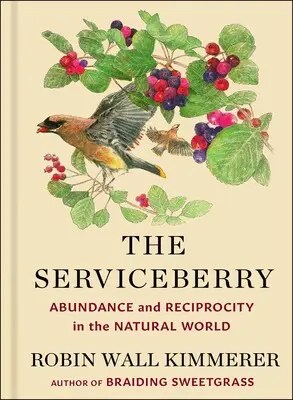
A Potawatomi author and botanist explores the concept of gift economies through the author’s reflections on nature, reciprocity, and the lessons of the serviceberry tree.
Summary:
As indigenous scientist and author of Braiding Sweetgrass Robin Wall Kimmerer harvests serviceberries alongside the birds, she considers the ethic of reciprocity that lies at the heart of the gift economy. How, she asks, can we learn from indigenous wisdom and the plant world to reimagine what we value most? Our economy is rooted in scarcity, competition, and the hoarding of resources, and we have surrendered our values to a system that actively harms what we love.
Meanwhile, the serviceberry’s relationship with the natural world is an embodiment of reciprocity, interconnectedness, and gratitude. The tree distributes its wealth—its abundance of sweet, juicy berries—to meet the needs of its natural community. And this distribution insures its own survival. As Kimmerer explains, “Serviceberries show us another model, one based upon reciprocity, where wealth comes from the quality of your relationships, not from the illusion of self-sufficiency.”
Review:
I was incredibly moved by Robin Wall Kimmerer’s Braiding Sweetgrass, which beautifully wove together the spiritual and the scientific. So, I was excited to dive into her new book, The Serviceberry, which blends natural biology with economics—yes, you read that right.
This short book is gorgeously illustrated by John Burgoyne with thematic line drawings that complement Kimmerer’s reflections. The story centers on her harvesting serviceberries, and this simple activity becomes the starting point for a profound exploration of economic systems.
I’ll admit, before reading this book, I didn’t know much about serviceberries, even though I spent my childhood picking wild berries. After reading Kimmerer’s description and researching more, I’m still not sure I’ve encountered them in the wild myself. I wonder if having a personal connection to the plant would have deepened my connection to the book, much like it did with many of the plants discussed in Braiding Sweetgrass.
The core of the book discusses gift economies—systems of mutual support that thrive on sharing abundance. Kimmerer writes:
Gift economies arise from an understanding of earthly abundance and the gratitude it generates. A perception of abundance, based on the notion that there is enough if we share it, underlies economies of mutual support. (page 75)
Kimmerer uses her own harvest of serviceberries as a metaphor: after gathering more than enough berries, she shares them with her neighbors, who might then return the generosity by baking a pie to share. She connects this to examples like Little Free Libraries and free stands giving away zucchini, offering a hopeful vision of a world where wealth is measured not by money, but by the relationships we build.
However, I struggled to fully embrace this vision. While I appreciate Kimmerer’s focus on the power of sharing, I was reading this book during a time of travel frustration—waiting overnight for a massively delayed airplane—and found myself questioning the likelihood of these ideas. The concept of abundance feels hard to grasp when faced with the reality of scarcity—especially when airlines don’t have enough seats for stranded travelers.
I also hear the idealistic rebuttal: in a gift economy, I wouldn’t need to travel far to see family because we’d all be close by, sharing our abundance. But my personal experience with things like Little Free Libraries, where people dump books in condition too bad for anyone to use, makes me question the idealism of this system. While Serviceberry presents a beautiful vision of generosity, it doesn’t address the real challenges of maintaining such systems at scale.
Despite this, I still value Kimmerer’s generosity in donating all her advance payments to support land protection, restoration, and justice. Her actions speak louder than words, and that’s something I deeply respect.
Overall, this is a quick read that challenges readers to think about economics, abundance, and reciprocity in new ways. While it didn’t convince me of the feasibility of the gift economy, it certainly provided food for thought. I recommend it to those who are interested in reimagining our current economic systems through a natural lens.
If you found this review helpful, please consider tipping me on ko-fi, checking out my digital items available in my ko-fi shop, buying one of my publications, using one of my referral/coupon codes, or signing up for my free microfiction monthly newsletter. Thank you for your support!
4 out of 5 stars
Length: 128 pages – novella/short nonfiction
Source: Library
Buy It (Amazon or Bookshop.org)
Book Review: My Body Is Not a Prayer Request: Disability Justice in the Church by Amy Kenny

A disabled Christian woman shares her experiences with ableism in the church and offers solutions and actionable steps for fostering disability justice and inclusion.
Summary:
Much of the church has forgotten that we worship a disabled God whose wounds survived resurrection, says Amy Kenny. It is time for the church to start treating disabled people as full members of the body of Christ who have much more to offer than a miraculous cure narrative and to learn from their embodied experiences. Written by a disabled Christian, this book shows that the church is missing out on the prophetic witness and blessing of disability. Kenny reflects on her experiences inside the church to expose unintentional ableism and cast a new vision for Christian communities to engage disability justice. She shows that until we cultivate church spaces where people with disabilities can fully belong, flourish, and lead, we are not valuing the diverse members of the body of Christ. Offering a unique blend of personal storytelling, fresh and compelling writing, biblical exegesis, and practical application, this book invites listeners to participate in disability justice and create a more inclusive community in church and parachurch spaces. Engaging content such as reflection questions and top-ten lists are included.
Review:
Intertwining memoir, Biblical commentary, and disability justice scholarship, the author explores disability within the US American Christian church.I picked this book up as research for the second book in my closed-door paranormal romance series, which uses werewolfism as a metaphor for disability (look for it this year!). You can grab the first book on Amazon, Bookshop.org, or other retailers, or request an advanced copy of the sequel.
The book is organized into ten chapters—seven of which start with the title “disability” and three with “disabled.” Each chapter begins with a memoir vignette and delves into the theme of the chapter. One chapter I particularly resonated with is “Disability Blessings.” It opens with the author singing a pop song during a medical procedure, before discussing the societal pressure to “fix” disabled bodies rather than support them. She then brings the conversation to the Bible, exploring the story of Jacob, who becomes disabled after wrestling with God. This disability, Kenny argues, is a sign of blessing, not something to be eradicated.
Faith, then looks like wrestling–all night long–and emerging with a healing limp….I treasure this image, because it allows me to envision my limp as part of my healing instead of something that must be cured or killed off in hopes of inspiring nondisabled people. (page 51)
She ends each chapter with bullet-point listed calls to action for disability justice. For example, in this chapter, the reader is invited to re-explore disability narratives in the Bible and view them through a lens of celebrating disabled people. After this, she features a “top ten” list of things people have actually said to her as a disabled person with each chapter on a theme. The theme of this chapter is “I know how you feel,” with the message being, of course, no one really knows how anyone else actually feels to live in their body.
The themes of the rest of the chapters are curatives, discrimination, doubters, justice, mosquitoes, lessons, disabled foundations, disabled God, and disabled church. The most controversial seems to be that of disabled God, but I found it rather inspiring. For example, the resurrected Christ, God incarnate, has the marks of the nails on his hands and a hole in his side. He invites Thomas to touch these places. Jesus was not resurrected with a “perfect” body, so why is there so much pressure on disabled Christians to “faith their way” to one?
Sometimes the author’s writing challenged me, but I viewed it as an invitation to sit with the discomfort. Why was what the author was saying making me uncomfortable? Was it really how she was saying it or was it just an entirely new perspective being brought to me? For example, I didn’t like that she didn’t disclose exactly what condition she has. But I sat with that and wondered why I felt the right to know?
As someone who is writing about disability through metaphor myself, this book encouraged me to consider my character viewing his werewolfism as a blessing, not a curse. Of course, there is nuance to this. For example, Kenny points out that of course she would prefer to not be in pain. But it’s possible to both dislike the negatives of a disability while also seeing the blessings that come with it. This is a perspective I’m striving to bring to my own book.
Overall, this is an interesting mix of memoir, Christian exegesis, and disability justice. Recommended to Christian readers looking to become better disability justice advocates and disability justice advocates looking to understand the Christian perspective.
If you found this review helpful, please consider tipping me on ko-fi, checking out my digital items available in my ko-fi shop, buying one of my publications, using one of my referral/coupon codes, or signing up for my free microfiction monthly newsletter. Thank you for your support!
4 out of 5 stars
Length: 208 pages – average but on the shorter side
Source: Library
Buy It (Amazon or Bookshop.org)
Book Review: Monsterland: Encounters with UFOS, Bigfoot, and Orange Orbs by Ronny Le Blanc

Explore the Bigfoot sightings, UFO encounters, and mysterious phenomena of Leominster, Massachusetts—dubbed ‘Monsterland’—through the eyes of author and researcher Ronny Le Blanc.
Summary:
There is an area known to the locals of Leominster, Massachusetts as MONSTERLAND. There are sightings of UFOS, Bigfoot and Orange Orbs. They have been coming and going for years. But where are they coming from? Why are they here? It seems that the state of Massachusetts has had a long history of sightings and encounters with these mysterious entities and they are occurring in the present day. Could all of these events somehow be connected? What is so special about Leominster that they have plagued the area for so long? Author and Researcher Ronny Le Blanc of Leominster thinks that he might have the answers to some of these questions. But the answers received lead to a whole new understanding of the unknown…. Welcome to MONSTERLAND.
Review:
Believe it or not, I picked up Monsterland as research for the second book in my paranormal romance series (Get the first book here). Paranormal romance thrives on supernatural creatures, and I wanted to infuse more local flavor by diving into the biggest tall tales of the area. Ronny Le Blanc is something of a local celebrity here in Massachusetts. While reading this at a coffee shop, people literally pointed and said, “Is that Monsterland?!” with wide eyes. I don’t share Ronny’s true believer status, but I do approach these topics with an open mind.
Ronny grew up in Leominster and opens the book with his own childhood encounter with Bigfoot in the Leominster State Forest. This personal connection sets a relatable tone and serves as a thread he frequently returns to. From there, he dives into local legends, including those rooted in the histories of the Nipmuc – the people Indigenous to the area.
One of the most interesting parts of the book is Ronny’s breakdown of commonalities in Bigfoot sightings. He highlights recurring details: the eerie silence of wildlife right before a sighting, tracks appearing and vanishing mysteriously (sometimes even under rocks), and witnesses reporting immobilization, intense fear, and disorientation. According to Ronny, these phenomena are a defense mechanism of Bigfoot—which, he argues, explains the lack of high-quality footage. (Although he also talks about a Canadian man who’s allegedly been consistently communicating with Bigfeet on YouTube.)
The book takes a turn into the mysterious world of orange orbs. Admittedly, these chapters dragged for me, but they’re crucial to Ronny’s overarching theory: Bigfoot are not mere animals—they’re aliens or interdimensional beings. The orange orbs, he believes, represent an intermediary phase of Bigfoot, explaining the disappearing footprints. He also connects this idea to Choctaw and Yaqui cultural beliefs about spirit beings and orbs.
At one point, Ronny recounts speaking aloud to Bigfoot, asking for proof in the form of a marble—and later finding one inexplicably placed in the middle of his home.
My favorite chapters were the tighter, more focused ones. Some of the longer sections could have benefited from more editing to maintain pacing and clarity. That said, there’s something undeniably special about reading folklore rooted in places I know so well. Ronny does an excellent job drawing connections between stories and theories.
However, I noticed a slight anti-yeti bias—Ronny briefly mentions them as the “least intelligent” of Bigfoot species and then essentially drops the subject. I also think the book would have been stronger with an Indigenous co-author for the chapters exploring Native folklore.
Overall, this is an enjoyable read for both cryptid enthusiasts and open-minded skeptics. Ronny’s storytelling style is engaging, and the included photos add a nice visual layer to the experience. If you’re curious about Massachusetts’s Bigfoot sightings, UFO lore, and the unique believer culture of Leominster, this one’s worth picking up.
If you found this review helpful, please consider tipping me on ko-fi, checking out my digital items available in my ko-fi shop, buying one of my publications, using one of my referral/coupon codes, or signing up for my free microfiction monthly newsletter. Thank you for your support!
4 out of 5 stars
Length: 275 pages – average but on the shorter side
Source: Library
Buy It (Amazon or Bookshop.org)
 Support my work with a tip or browse my shop for curated book club guides, how to guides, cross-stitch patterns, and more!


This work by Amanda Nevius is licensed under a Creative Commons Attribution-Noncommercial-No Derivative Works 3.0 United States License.
 Opinions of a Wolf