
Archive
Book Review: Eva by Peter Dickinson
 Summary:
Eva wakes up from a car accident to discover that her scientist, chimp researcher parents have allowed for her to be part of a new experiment. Her brain patterns have been implanted into a chimp’s brain. She is a human brain trapped in a chimp’s body. What will this mean for Eva? For the chimps? For the world?
Review:
This a truly horrifying concept. What would it be like to wake up from a car accident in a body that is not your own? There is much potential for exploration here, but the direction Dickinson took it in fell flat for me.
The setting is a near future in which the world is vastly overpopulated and nearly all animal species have died out except for chimps, who are all kept in captivity. It’s odd in a world that is so overpopulated that the vast majority of people never leave their apartments that scientists have made such an ethically questionable move to save human lives. As Eva herself points out, not only is there the problem of what it means to be a human in a chimp’s body, but also there’s the fact that the chimp essentially had to die for Eva to live. How is that right or fair?
I appreciate that Dickinson has Eva start to identify with the animals and fight for animal rights, yet I simultaneously did not appreciate his depiction of the inner workings of animals and their social groups. In spite of Eva being one of and among them, Dickinson persists in presenting them from a largely disconnected human perspective. I’ve read more sympathetic passages on the inner workings of animal groups on vegetarian websites than I got from Eva’s perspective as, essentially, one of the chimps herself.
*spoiler warning* Some readers will also be disturbed by the fact that Eva goes on to mate with one of the chimps. Although this is not shown, it is shown that a male is interested in Eva when she is in estrus, and it is later shown that she has had multiple chimp babies. Although I am highly sympathetic to animal rights, this is far too close to beastiality for my own comfort. Perhaps if Dickinson had addressed the issue and made it a thought-provoking issue instead of glossing over it I would feel differently. But he truly just makes it happen and tries to skip over the issue. I found this disturbing and was disappointed that this overshadowed the more interesting questions of animal rights versus human welfare. *end spoiler*
Overall, the book is well-written and thought-provoking, but falls far short of what it could have been. I’m sure there must be better YA books out there that address the issue of animal rights in a clearer, less disturbing manner.
2 out of 5 stars
Source: Swap.com

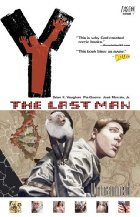
Book Review: Y: The Last Man: Unmanned by Brian K. Vaughan (Graphic Novel) (Series, #1)
 Summary:
The world is changed overnight when all the men and boys in the world mysteriously drop dead. Factions quickly develop among the women between those who want the world to remain all female and those who would like to restore the former gender balance. One man is mysteriously left alive though–Yorick. A 20-something, underachieving magician with a girlfriend in Australia. He desperately wants to find her, but the US government and the man-hating Amazons have other ideas.
Review:
As soon as I heard the concept for this series, I knew I had to read it. Plenty of scifi books have explored other planets consisting entirely of women or an Earth of just women decades after the men died out, but very few go to the immediate after-math of the loss of men. I like that one man is left alive. It lends a scientific mystery to the social aspects of a planet suddenly full of just women. Yorick’s characterization is perfect. He’s laid back enough that there’s not constant angst over the situation, but intelligent enough that he gives the different factions a run for their money. I also appreciate that Vaughan didn’t have all the women suddenly singing kumbaya and holding hands. The fighting, violence, and disagreements among the women are honestly a far more accurate representation of how things work. Women are people, and people fight and disagree. That certainly isn’t a realm that belongs to just men. Vaughan gives an even-handed, fair representation of women covering everyone from women mourning the loss of rock stars to women set world domination and everything in between. I commend Vaughan for that.
The art work is full-color and impactful. Periodically there are full-page illustrations instead of panels. This apocalytpic world isn’t dark. It’s full of light, passion, and energy. Everyone is drawn consistently, and it is not at all difficult to tell people apart. One of the most impactful pages features a close-up of one of the Amazon women with one of her breasts cut (or burnt) off. It’s a very powerful image.
I also appreciated that around 1/4 of this issue takes place in Boston, and Boston is accurately drawn and represented. I love that Boston is key to the story for the scientific community here. It’s tiring always seeing us represented as just the center of the Irish-American mafia. I hope Boston pops up again in future installments. It’s nice seeing my city in print.
Unmanned does an excellent job of quickly setting up the dystopian world where only one man is left alive. The artwork is compelling, and the storyline fairly represents the broad spectrum of female personalities. If the basic concept of this dystopia intrigues you at all, I highly encourage you to try it out.
4 out of 5 stars
Source: Amazon

Book Review: The Windup Girl by Paolo Bacigalupi
 Summary:
In this steampunk vision of a possible dystopian future, carbon usage and genetic engineering caused the world to nearly collapse. Whole nations have been lost to starvation due to exorbitant prices charged by the genetic engineering calorie companies and also due to the rising seas from global warming caused by carbon usage. Domestic cats have been wiped out by cheshires–genetically engineered cats that can appear and disappear, just like the cat in Alice in Wonderland. Thailand, through strict military enforcement of calorie and carbon consumption, has managed to hold back both the sea with a sea wall and starvation. The Thai work diligently to rid their nation of windups–genetically engineered living creatures. As Buddhists, they believe these windups have no souls. Within this world we see glimpses of five very different lives. There’s Anderson, a foreigner from Detroit who claims to be running a factory but is actually a calorie company spy. His manager, Hock Seng, is a survivor of the Malaysian civil war where Muslim fundamentalists attempted to kill all the Chinese immigrants. Jaidee and Kanya work for the Environment Ministry, also known as white shirts. They are the military enforcers of all the environmental laws, but they are struggling against the Trade Ministry that wants to open their borders back up to foreign trade. Finally, there’s Emiko. She is a Japanese windup girl. The Japanese created windups due to a severe lack of young people to care for the old. She came over both as a secretary and lover of her owner who had to do business in Thailand, but he then decided it would be cheaper to leave her behind than to take her on the return trip. She now is a spectacle in sex shows in the ghetto of Krung Thep. These lives slowly intertwine, and through them, Bacigalupi shows how easily civil war can erupt.
Review:
I fully admit that this book was out of my comfort zone. I don’t normally read books on political intrigue and intertwining lives. I tend to stick to ones that talk about one individual person, and that’s what I was expecting from a book called The Windup Girl. That’s why I took the time to write a detailed summary, so you all would have a clearer picture of what this book is about than I did. This is another one of those books that I almost gave up on early in. Bacigalupi doesn’t take the time to truly set up the world. Things have names and are briefly or not at all described, so you have to fill in the gaps yourself. I think if I hadn’t read steampunk before, I would have been at a loss. For instance, he never explains exactly what a dirigible is, although we know they are sky ships. It is not until the end of the book when one gets blown up and a character refers to it as a creature that it becomes apparent that they are living creatures used as sky ships. This is just one example of many ways in which the world building is sloppy. It takes until solidly halfway through the book for a clear picture of Krung Thep to emerge. Additionally, this is one of those books that tosses around non-English words where English ones would entirely suffice. For example, all of the foreigners are called farang, not foreigners. It makes sense to use a Thai word where there is no English equivalent, but it’s just superfluous to toss them around when there is one. Technically these characters are supposedly speaking entirely in Thai. We know that. Bacigalupi doesn’t need to throw Thai words in periodically just to remind us. Still, though, I kept reading beyond the first couple of chapters, mainly because I bought the book on my Kindle app, and I don’t tend to waste money. In the end, I’m glad I kept reading.
Although the setting and world building is rough, the story itself is quite interesting. Many perspectives are offered on these issues that potentially could become issues in real life. What are the rights and roles of genetically engineered living beings? Is nature the way it’s always been better or genetic engineering the next step in evolution? One of the pro-genetic engineering characters states:
We are nature. Our every tinkering is nature, our every biological striving. We are what we are, and the world is ours. We are its gods. Your only difficulty is your unwillingness to unleash your potential fully upon it. (Location 6347-6350)
It is an interesting question. Will our next phase of evolution happen in the traditional manner, or is the next phase actually us using our brains to improve?
The Buddhist concepts sprinkled throughout the text are also quite enjoyable. The characters struggle to maintain their belief in karma and reincarnation in spite of the issues of windups. It clearly depicts how religion must struggle to adapt to change. Additionally, the concepts of fate and karma and how much one can actually do to improve one’s lot in life are explored in an excellent manner through multiple characters. It reminded me a lot of how the Dark Tower series explores the similar idea of ka (fate). One sentence that really struck me on this theme was:
He wonders if his karma is so broken that he cannot every truly hope to succeed. (Location 8388-8393)
I was just discussing a similar concept with a friend the other day, so it really struck me to see it in print.
Additionally, the ending truly surprised me, even though it’s evident throughout most of the book that a civil war is coming. I always enjoy it when a book manages to surprise me, and this one definitely did.
Overall, although Bacigalupi struggles with world building, his intertwined characters and themes are thought-provoking to read. I’m glad I went out of my comfort zone to read this book, and I would recommend it to anyone who enjoys the themes of fate, evolution, nature, karma, or political intrigue.
3.5 out of 5 stars
Source: Amazon

Series Review: The Hunger Games Trilogy by Suzanne Collins (spoiler warning)
Introduction:
Since I’m starting to finish up a bunch of series I’ve been reading for quite some time, I decided it’d be nice to reflect on the series as a whole after finishing. I tend to do this in my head anyway, and it’ll be nice to get it out in writing. Needless to say, there will be spoilers for every entry in the series. This is about analysis and reflection and conversation with others who have read the series. If you’re the type who likes spoilers before reading a series, you’re of course welcome as well.
 Summary:
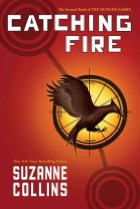
The Hunger Games trilogy is a post-apocalyptic dystopia set in the small nation of Panem, which we assume is what is left of livable land in what used to be the USA. Panem is divided into 12 districts. It is a dictatorship that faced a rebellion previously by the 13th district. Every year each district, except the Capitol, must send one girl and one boy, chosen by lottery, to participate in the Hunger Games–a reality show in which they must fight to the death until only one survivor is left. Katniss lives in District 12 and volunteers to go in place of her younger sister, Prim. She forms an alliance with the boy from her district, Peeta. When they are left the only ones standing, they grab poisonous berries, planning to thwart the Capitol by leaving no survivors. They, of course, are stopped and are paraded around as engaged lovers for a year. The President is angry at them, but they believe themselves to be relatively safe from his wrath as national heroes. The next year, however, it is announced that this year’s Hunger Game will consist of the victors from the previous games. It is believed that this act of violence will help squash the rebellion that is brewing. Some of the victors plot with the rebels, however, and Katniss and some other victors escape with their aid and join in on the revolution, with Katniss the symbol of the rebellion.
Review:
I first stumbled upon this series last summer. I’m not sure how exactly, but given that I love dystopias, and it is one, it’s not too surprising. I loved that for once in YA lit there was a main female character who was interested in something besides the mysterious new boy at school or make-up. She is focused on survival and caring for her family. I also enjoyed how she is presented as powerful, strong, and deadly. It’s a nice change of pace from what generally is out there for teens to read. I thought the teens fighting to death as punishment concept was unique, and was ranting about it one day to someone else who said, “That sounds a lot like Battle Royale.” And that’s when my entire view of the series started to change.
I watched the Battle Royale movie, which is based on the manga series of the same name, and I was flabbergasted to discover the exact same basic concept of a corrupt government forcing teens to battle each other to the death once a year. There was less backstory on the characters, and Battle Royale has the teens actually behaving as sexual beings and is more violent, but the basic driving plot is the same. Battle Royale, the manga and the movie, was released in 2000. The first book of the Hunger Games was released in 2008. I immediately investigated to see if Collins admits an influence or even discusses a similarity between her trilogy and the Japanese series. She does not. She claims her influences were purely from watching reality tv and war coverage, as well as from Greek myths. She never discusses the similarity between her own books and Battle Royale. This is disrespectful at best. Most writers are influenced by other writers, and there’s nothing wrong with that as long as it is acknowledged. Yet Collins refuses to even acknowledge the similarities between her own books and Battle Royale. She doesn’t have to admit to swiping the idea and Americanizing it (although, I personally believe that is what happened). She doesn’t even have to say she was influenced by it (this is what I believe she should do). She should at least talk about how the two are similar and recommend the Battle Royale series to fans of her own series. It’s the only respectful thing to do. Now that that’s out of the way, let’s ignore for the moment the questionable origins of the story and focus on the content.
 Katniss spends the entire series struggling against forces that are bigger than herself. She sides with the rebels only to find herself questioning them as well, and in the end, she causes the death of both President Snow (inadvertently) and President Coin (directly by shooting her). Katniss claims she wants things to be different, yet all she sees is power hungry people all around her. She winds up doubting in humanity as a species, wondering at a species that repeatedly sacrifices its children for their own amusement and gain. I agree that humanity is pretty fucked, although for different reasons than Katniss’, so I enjoyed seeing this viewpoint in print. I was therefore a bit saddened to see in the epilogue that Katniss winds up settling down with Peeta and having babies in District 12 (and apparently doing nothing for the rest of her life?). This sounds to me like she didn’t know what to do with her depression or her accurate viewpoint of the world, so she just decided to hunker down and live it out as quietly as possible. You would think that someone who had seen what she had seen would find comfort and solace in working to improve things for others who suffer instead of living in luxury in the victor’s village. Of course, Collins doesn’t have to provide a positive ending, but the thing is, I believe that she thinks she did. Katniss goes through all of this and winds up with the “American Dream”–the white picket fence, husband, and babies. It feels like a serious cop-out to the critics of her much more realistic first two books to me.
I was similarly disappointed to see a love triangle introduced in the second book. Why must every YA author include a love triangle? What is up with that? I was enjoying Katniss falling for Peeta and realizing Gale might just be her childhood best friend/crush, but then she whips around changing her mind constantly between the two of them. Peeta and Katniss have the bond of the arena, an experience Gale cannot possibly share or understand. Katniss continually behaves in a disloyal manner to Peeta in a way that seriously makes me doubt the quality of her character. She acknowledges this in the third book when Peeta, upon returning from being tortured, tells her all the ways in which she has been cruel to him and to others, and they are true. Gale knows it too, as he tells Peeta in the third book that Katniss will choose whoever helps her survive better. In the end that’s pretty much what she does. Gale failed her by designing the bombs that killed her sister. Peeta is the only one who understands her pain, so Peeta is the one she “falls in love with,” yet everything about Katniss is so self-centered that I was left wondering why she should wind up with anybody at all. That said, I did enjoy that Katniss recognized that herself and Gale were too similar to be together. They both had too many violent tendencies to make a healthy couple, so she went with her opposite–the calm, peaceful Peeta. They balance each other, and that aspect of the romance made me smile.
Katniss’ original selfless love of her sister Prim gradually disappears over the course of the trilogy. When the bombers are coming to District 13, she forgets about her sister entirely, and it is Gale who ensures she gets to the lower levels safely. By the end of the series, Katniss has lost all the beauty of her personality found in the first book. She went from a selfless love to a self-centered, revenge-driven person who will sacrifice almost anyone in her quest to kill Snow. Even though she periodically has glimmers of recognition that everyone has been wronged by the Capitol, and indeed, some people more than herself. Finnick who was forced to give his body away to anyone he was told to in the Capitol. Johanna and Annie who were tortured. Peeta who was brainwashed. She has glimmers of sympathy, but overall she has essentially turned into an automaton, a Terminator, if you will. Yet Collins still writes her with a sympathetic tone. Why?
I have no issue with blood, violence, graphicness, or battle scenes used in the context of a story. That’s not what bothers me about the trajectory of the Hunger Games. What bothers me is that Katniss realizes the hopeless situation the human species is in, something I entirely agree with. She then proceeds to let it turn her into the worst humanity has to offer. She then realizes this and instead of working to change things, she just gives up. She gives up and bows her head and succumbs to a submissive life. The Katniss of the first book would do anything to defy the expectations and mores of society, but in the end, she sees that society has not really changed with the change of rule. Indeed, the most active thing she does is also one of the worst. She votes in favor of having another Hunger Game featuring the children of the Capitol. Maybe this is realistic and most people would either join the evil or give up, but I’d hoped for more in a series so beloved by so many teenage girls. Yes, the world sucks. Yes, it’s a constant struggle. Yes, it hurts and you may never succeed, but never stop trying. That was the message of the first two books, and yet it was entirely tromped on by the final entry in the series. Perhaps I shouldn’t be surprised by that, given the ethics of the author.
3.5 out of 5 stars
Source: library, borrowed, and Amazon
Buy It (Amazon or Bookshop.org)
Books in Series:
The Hunger Games, review
Catching Fire
Mockingjay, review
ETA Note: I wrote this post before the series was a hit or popular and long before a movie was on the horizon. Before most of America had read the books. I didn’t read them or write about them to get blog hits or because they are popular. I read them because they happened to be in my public library. I long ago stopped responding to comments on this post, because I don’t want to spend my time discussing a trilogy that I didn’t even like that much. Note that I made this decision long ago, as I haven’t responded to anything since May of 2011. When leaving a comment, please be sure to see my comment policy.
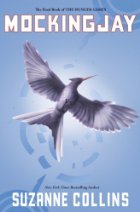
Book Review: Mockingjay by Suzanne Collins (series, #3) (spoiler-free)
 Summary:
Katniss has been rescued by the rebels and is living in District 13 along with refugees from District 12, Haymitch, Johanna, and Finnick. Peeta and Annie are still in the clutches of the Capitol, and every day Katniss is plagued with thoughts of what torture they must be suffering at the hands of President Snow. The rebellion is sweeping across Panem, and the leader of the rebels, President Coin, wants Katniss to be the symbol of the revolution–the Mockingjay. It is as if the arena has consumed all of Panem, and there is no escape for Katniss.
Review:
This is a better wrap-up to a story than in other trilogies I have seen, but compared to the first two books, it is definitely found a bit wanting. Without the structure of the Hunger Games or the Quarter Quell, Collins struggles a bit at maintaining a consistent storyline and action. She additionally seems to have suffered a bit of a guilt complex over the delicious gore in the first two books, and here spends many pages dwelling on the emotional impact of the violence to the extent that Katniss winds up sounding a lot like Harry Potter in book 5 of that series, and we all know how annoying everyone found him. Granted, Katniss has more reason to be upset than Harry ever did, but one can only take so many emotional breakdowns before it starts to seem as if Katniss is weak, rather than the strong heroine we grew to love in the first two books.
There is a war on, so of course action scenes do exist. They are a bit hit or miss, however. Interestingly, the ones that work the best are the ones that read like battles and are the least similar to the games in the first two books. I believe this is because the battle scenes allow us to see Katniss developing from a victim of traps set by the Capitol to a soldier. The ones that read more like traps feel like a step back from a character development point of view. However, fans will find enough fast-paced action scenes to keep them happy.
The writing continues to be painfully sophomoric, only with the starting and stopping of the action, it is far more noticeable. I know this is being told from Katniss’ point of view, but it could really stand to have at least a few less cliche metaphors and sentence fragments. Challenge the minds of your YA readers at least a little, please, Collins.
Those interested in the series for the love triangle, or who enjoy the love triangle a lot will not be disappointed, no matter whether they are Team Peeta or Team Gale. Although personally I still don’t understand just what is so irresistible about Katniss, beyond that, the emotions are handled in a realistic manner. What impacts the final choice is more than just the emotions of Katniss, and I actually enjoy the final message Collins leaves her teen readers with about relationships in general. Whichever fella you’re in favor of, the moment the final choice is realized is still a tear-jerking one.
Overall, Mockingjay is a satisfying end to the series, but does not live up to the power of the first two books. Fans will by no means regret having started the series, however.
3.5 out of 5 stars
Source: Amazon

Book Review: Parable of the Sower by Octavia E. Butler
 Summary:
Lauren is an empath. She feels other people’s pain as intensely as they do. She lives near Los Angeles in the near future in a walled community. The gap between rich and poor has increased to an extent that being street poor is the norm. Lauren’s community is one of the few “middle-class” ones left. In the confines of the walls, this preacher’s daughter starts to come up with her own religion that she calls Earthseed. She gets the chance to put it to the test when their walled community is destroyed, and she a few survivors strike north, hoping to find better land and jobs.
Review:
A lot of dystopian novels clearly establish a believable dystopian society, but struggle with characterization. This was interesting in that it was the opposite. Butler establishes multiple, easily distinguished characters, both sympathetic and non-sympathetic. Lauren in particular is believable and understandable in spite of the fact that she’s essentially starting a cult. Lauren’s inner life is eloquently drawn out in such a way that her actions are almost entirely understandable to the reader, even when they aren’t to the people around her.
On the other hand, the dystopian society was not well drawn-out. In spite of the fact that the older generations were all around when the shit hit the fan in American society, not a single one of them even attempts to explain why everything started to go wrong. We get one glimpse of the world between the early 1990s and the US 30 years later in which the book takes place, and that isn’t really enough to establish how the dystopia occurred. The how isn’t necessarily necessary for stories that take place far into the future, but 30 years isn’t very far off. It’s reasonable to expect a bit of an explanation for how society fell so drastically apart.
The sections where Lauren discusses her Earthseed beliefs are pleasant to read, but there’s nothing earth-shattering about them. They’re basically The Secret mixed with Buddhism mixed with Deism. There was nothing that made me stop and think about my own world-view. A character does address a similar criticism to Lauren about Earthseed, but she only admits to being “influenced” by eastern philosophy. Similarly, she won’t admit to creating her own religion. She insists she just found it. Whether Butler sides with the critical character or Lauren, I still would rather that the reader saw something appealing in Earthseed, since so many characters do end up clinging to it. It makes the whole situation a bit less believable.
There is a relationship in the book between a teenage girl and a man old enough to be her father. It is presented as a bit odd, yet positive. Honestly, the whole thing made me squeamish. It might not have if I hadn’t found the older male character creepy from the instant he was introduced. I’m really not sure why Butler chose to go there. It certainly has no point in this book, although it might in the sequel, Parable of the Talents
Overall, Parable of the Sower is a pleasant read, but not one that makes much of an impact. If character studies are more up your alley, and you don’t mind dystopian settings, you’ll probably enjoy this book. If you want a solidly established dystopia, you should look elsewhere, such as Brave New World
3 out of 5 stars
Source: SwapTree

Book Review: The Forest of Hands and Teeth by Carrie Ryan (Series, #1)
 Summary:
Mary’s world is tightly controlled by the Sisters and the Guardians. The Sisters show the village how to find favor with God via the yearly and daily rituals. The Guardians check and maintain the fence that keeps the Unconsecrated out. The Sisters says the Unconsecrated came with the Return as a punishment to the people. This is why they must maintain God’s favor. But Mary dreams of the tales of the ocean and tall buildings her mother told her about, and her mother’s mother for generations back. She will need those dreams when her world is turned upside down with a breach of the fence. They’ve happened before, but never like this.
Review:
This is an interesting take on the traditional zombie tale. In lieu of starting with the outbreak or just after the outbreak, Ryan envisions what life would be like for the descendants of the few who’ve managed to survive. Of course the sheer number of zombies in the world means it’s impossible for the few survivors left to kill them all, so they must live with constant vigilance. In the case of Mary’s village, they’ve turned to religion to maintain the level of control required to keep them all safe. This is the strongest portion of the book as it leads to interesting questions. The threat outside the fence is indeed real. Mary’s questions are making it difficult for the Sisters to maintain the control needed and prevent panic in the village. On the other hand, the Sisters aren’t exactly being honest with the population or giving them a happy life. They’re just giving them a life.
Where the action supposedly picks up with the breach of the fence is where the book sort of left me behind. The fact of the matter is, I wound up caring more about the village than Mary, and I don’t think I was supposed to. Where I was supposed to be rooting for Mary, I found myself rooting for the community, the group of survivors. Mary’s individualism rings as starkly selfish to me in light of the very real threat around them. This is odd because generally I’m in favor of people being themselves and not necessarily following the group, but that’s different when a crisis is being faced. I found myself wishing it had read more like Elizabeth Gaskell’s classic Cranford, which is a study of a town and not an individual.
Of course, that’s not the type of book Ryan set out to write. She set out to write a book about a girl in a future where zombies are a fact of life. She writes beautifully, with exquisite sentences that read more like an 18th century novel than a 21st century one. I also am certain that the teenage audience this YA book is aimed at will be rooting for Mary in her quest to find herself and her dreams.
If you are a teen or a teen at heart looking for an adventure tale with a touch of romance, you will enjoy this book. If traditional zombies are what you are after, however, you should look elsewhere.
3.5 out of 5 stars
Source: PaperBackSwap

Book Review: House of Stairs by William Sleator
 Summary:
Five sixteen year old orphans living in state institutions are called to their respective offices, blindfolded, and dropped off in a building that consists entirely of stairs and landings. There appears to be no way out. The toilet is precariously perched in the middle of a bridge, and they must drink from it as well. To eat they must bow to the whims of a machine with odd voices and flashing lights. It is starting to change them. Will any of them fight it, or will they all give in?
Review:
This book was enthralling from the first scene, featuring Peter awakening on a landing intensely disoriented and frightened. Showing a bunch of teenagers obviously in an experiment opens itself up to caricature and stereotype, but Sleator skillfully weaves depthves and intricacies to them.
The writing is beautiful, smoothly switching viewpoints in various chapters from character to character. Hints are dropped about the outside world, presumably future America, that indicate the teens are from a land ravaged by war and intense morality rules. For instance, their state institutions were segregated by gender. Sleator weaves these tiny details into the story in subtle ways that still manage to paint a clear framework for the type of cultural situation that would allow such an experiment to take place.
It is abundantly clear throughout the book that the teens are facing an inhumane experiment. Yet what is not clear at first is what a beautiful allegory for the dangerous direction society could take this story is. Not in the sense that a group of teens will be forcibly placed in a house of stairs, but that some more powerful person could mold our surroundings to make us do what they want us to do. To remove our most basic humanity. This is what makes for such a powerful story.
It’s also nice that friendship in lieu of romance is central to the plot. Modern day YA often focuses intensely on romance. Personally, my teen years were much more focused on friendship, and I enjoyed seeing that in this YA book. I also like how much this humanizes the animals facing animal testing, and Sleator even dedicates the book to “the rats and pigeons who have already been there.”
House of Stairs, quite simply, beautifully weaves multiple social commentaries into one. It is a fast-paced, engrossing read, and I highly recommend it to everyone.
5 out of 5 stars
Source: PaperBackSwap

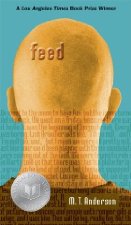
Book Review: Feed by M. T. Anderson
 Summary:
Titus is your typical teenager of future America. He lives in a suburb where his parents program the weather. He drives an upcar. He’s got a feed–a microchip in his brain that allows him to chat silently with people, shop, look up anything he wants to know more about, etc… He’s also got a lesion, but a lot of people have those now. He is quite ordinary. But he meets a girl on a trip to the moon who is anything but ordinary. A girl who got the feed late and dares to question it.
Review:
This book has a great concept, essentially exploring what the world would be like if twitter was implanted into our brains. This is rather extraordinary given that twitter didn’t even exist yet when Anderson wrote it. It explores losing our individuality to machines and consumerism. Ceasing to care about important information due to being bombarded by inane information at all hours of the day. I just wish Anderson had taken this concept a different direction.
I immediately connected with Violet, the girl Titus meets on the moon. She’s quirky, is homeschooled, and really is a bit of a nerd who just wants a chance to try out hanging out with the popular kids and doing what they do. Titus is a complete and total asshole to her. I suppose I could forgive him for that if he showed that he learned anything from coming into contact with a person as powerful as Violet, but he doesn’t. He ditches her when she needs him most because she’s making him uncomfortable. He wants to stay in the cocoon of his feed-driven life, and nothing she does or says can change that. He clearly goes from girl to girl, using them up like paper towels or tissues, and then on to the next one. Maybe that was Anderson’s point–that the feed has dehumanized the people who have it–but it made for a less powerful book than if Titus had learned something. Anything.
Similarly some questions just aren’t answered simply because Titus doesn’t care, so we aren’t allowed to know. In particular the lesions are set up as some sinister mystery, but then we never find out why they are occurring. Nobody even really speculates as to why they’re showing up. They’re just there. I seriously doubt there’d be zero speculation over such a phenomenon, even in a future where people are obsessed with consumerism.
Overall, the concept and writing on a sentence level are good, but the story as a whole left me feeling empty and disappointed. There’s telling a bleak story, and then there’s telling a story that’s sympathetic to a jerkwad. This is the latter. If that type of story is something you enjoy, you will enjoy this book. Everyone else should look elsewhere, perhaps to The Hunger Games if you’re looking for a YA dystopia.
3 out of 5 stars
Source: Swaptree

Book Review: The World Inside by Robert Silverberg
 Summary:
Hundreds of years in the future, Earth society has dealt with the population crisis by discovering the ability to build Urban Monads (urbmons). Each building is 1,000 stories and houses around 880,000 people. This vertical hive living has allowed for most of the land to be farmland, managed by communes still living in the traditional horizontal style. It’s a beautiful day in Urbmon 116, and we’ll get to meet people from each level of the city from artistic San Francisco to academic Shanghai to ruling Louisville. Their lives of enforced zero privacy, no locked doors, mandatory acceptance of sexual requests from anyone of age, and a reverence for fertility resulting in uncontrolled population growth present a unique social situation. An academic wonders if humanity has forcibly evolved itself to naturally enjoy the Urbmon lifestyle or if it is a cultural influence forced upon them. Maybe these next few days will help him tell.
Review:
This book is such a creative imagining of a possible future, one I certainly never had thought of. Silverberg approaches his storytelling by at first making it seem as if we will be exposed to a series of vignettes about the inhabitants of Urbmon 116, but then their interconnection suddenly becomes apparent as the dual climaxes approach. I was certainly not bored with the vignette portion as the society of the Urbmon is so interesting, but the interconnection moved it from being an interesting book to a powerful book.
The World Inside is a look at what would happen if the most fundamentalist pro-lifers were to win the majority and gain great power. There is no birth control, every fetus conceived is brought to childhood (although the gender may be manipulated to maintain a balance). Interestingly, in order for this pro-life construct to gain power, they also had to make concessions to the free love folks. Everyone gets married at a very young age, but there is no such thing as sexual loyalty. People are encouraged to nightwalk–leave their own abode at some point after midnight and enter another apartment and have sex with one of the adults there. Often the husband or wife will stay in the room in spite of the sex going on in the same bed as them with their spouse. This is explained as a necessary way to maintain harmony in the building. It is intriguing to see such a lack of regard for parental loyalty to each other in a society that encourages so much procreation, yet it all makes sense.
That is really what makes this such a strong book. It’s such a plausible future, given the proper circumstances, that it gives chills, and yet Silverberg still shows the basic humanity in these people, stuck in a culture, a society that they have little to no control over. If they fail to fit into the social constructs at all, they are simply put down the chute–killed and used as fuel for the building. There is no room for real discourse or exploration of where they may have gone wrong. It’s a social construct that happened out of necessity due to humanity’s refusal to stop procreating so much. They gave up all their other freedoms for that one. Even the freedom to chose to be monogamous if you want. It is such an emotional, thought-provoking warning gong. It’s definitely a book I will hold onto and re-read.
If you enjoy scifi, dystopias, or philosophical explorations of the human condition, you will definitely enjoy this book. I highly recommend it.
5 out of 5 stars
Source: PaperBackSwap

 Support my work with a tip or browse my shop for curated book club guides, how to guides, cross-stitch patterns, and more!


This work by Amanda Nevius is licensed under a Creative Commons Attribution-Noncommercial-No Derivative Works 3.0 United States License.
 Opinions of a Wolf