
Archive
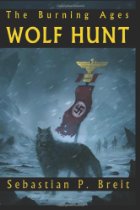
Book Review: Wolf Hunt: The Burning Ages by Sebastian P. Breit (series, #1)
 Summary:
It’s the future, and the world is in another semi-cold war between NATO and BRIC (Brazil, Russia, India, China). A NATO group of British, American, and German naval ships is being sent to Brazil on a mission, but part-way there they are all zapped back in time to 1940. With the chance to change history for the better, what will they decide to do?
Review:
I first want to point out that Breit is German and wrote this in English himself; it is not a translation. I have to say that I wonder why he made that choice as the plot certainly seems to have more of a European than an American appeal, but I am impressed at his effort to write in his second language.
The summary of the book makes the plot sound fast-paced, but in fact it is actually distressingly slow-moving. It takes about 1/3 of the book for the all-important time-traveling event to happen. I spent the whole first part of the book just waiting and wondering when it was going to happen, because once the basic politics of the world and character traits were set up, it’s just a waiting game. The naval mumbo-jumbo filling up the rest of the space just wasn’t necessary. This issue carries on throughout the book with half of the sailors spending a solid amount of their time stranded on an island, for instance. Since this is marketed as a fast-paced historical thriller, perhaps somewhat like the style of The Da Vinci Code it quite simply needs to move along faster. Intense naval specifics and codes are not necessary. Fast-moving plot is.
Breit also needs to invest in a British and American editor each, as the British and American characters say and do things that are just flat-out wrong in British and American English respectively. One that really slapped me across the face is that one of the characters is from Boston, but everyone refers to him as a “Bostoner.” People from Boston are called “Bostonians.” I have never once in my life heard anyone say “Bostoner,” and I live in Boston. Another example is at one point one of the Americans reads another American’s birthdate from off an id and says it the European way “11 September 2001,” instead of the American way “September 11th, 2001.” This is one of those instances where the author needs to have his facts straight in order for the story to be believable. Nothing makes me not believe a character is American quite like having him get a bunch of American English wrong.
Additionally, as a woman and an author, the way the female characters are handled is distressing to me. Just one example is that a bunch of the stranded female sailors are attacked on the island by some of the locals in an attempt at rape. These women who had the exact same training as their male counter-parts are apparently completely incapable of saving themselves, but instead have to be rescued by their male comrades. But it gets worse. Later when the captain of the ship is relating the event to another man, he asks if the women were alright. The captain responds by saying that the doctor said they were fine. The doctor. Apparently nobody bothered to ask these women if they were raped (HINT: I’m pretty sure women can tell if they’ve been raped or not). Plus no one seems to care that these women are clearly not going to be emotionally ok after almost getting raped, and not once do any of the female characters who were attacked say anything about it with their own voices. This is just completely inexcusable. It’s a removal of women’s voices from ourselves, and it’s insulting to a female reader.
There’s the issue of European bias expressed through the American characters. For instance, one American character expresses shame at how Americans only speak one language. First of all, the rate of bilingualism in the US is actually rising, so following the arc of the future, there should be more bilingual Americans, not less. Second, I’ve never once heard an American express woe in an all-encompassing way like that by saying something like “It’s so sad Americans aren’t bilingual.” People say, “I wish I was fluent in another language,” or “I wish I was fluent in Japanese,” but they just don’t put it that way. That whole paragraph sounded like a European using an American character as a puppet to say what Europeans think of Americans. Yeesh.
I also have problems with the German characters though. A bunch of them express the desire to stop the Holocaust not to save lives but to save the German people from harboring the shame and guilt for generations to come. Um, what? That’s your concern oh time-traveling Germans? Having been to Germany myself on a student exchange and visited Dachau, etc… I can say that I have a hard time imagining any of the kids my age at the time (15ish in the early 2000’s) focusing in on that as opposed to stopping a bad thing from happening because it’s evil and wrong. I can only imagine that generations even further along would be even more focused in on stopping a genocide as opposed to saving some broad idea of German honor. It’d be like having a time-traveling modern American decide to stop the Trail of Tears to save us from shame as opposed to doing it to save innocent Cherokees. The whole thought just makes my brain hurt.
To sum up, Breit shows ability as a writer that needs to be worked on and honed. I’d recommend either getting a good editor who can handle both British and American English or switching to writing in German. He also needs to work on tightening up his plot. Normally I’d say, nice first effort keep trying, but due to the opinions and biases and presentation of women present in this first attempt, I’m afraid I can’t say that. It’s readable, but why would you want to read it anyway?
2 out of 5 stars
Source: Ebook from author in exchange for my honest review

Book Review: Hetalia: Axis Powers by Hidekaz Himaruya (series, #1) (manga)
 Summary:
The nations involved in WWII and the events leading up to it are personified as over-the-top manga characters and through manga-style scenarios the historic events leading up to WWII are explored.
Review:
One of my good friends loaned this to me informing me that I would love it. I DID. I REALLY DID. I haven’t seen WWII this funny since Hogan’s Heroes was a mild obsession of mine in middle school, only this is historically accurate.
Each nation’s stereotypes (that are partly true) are blown over the top for the manga characters. France is proud and snobby but pathetically weak. The UK acts like a put-upon uncle who really just wants everyone to start acting their age. Japan is impatient with Germany for including Italy in their alliance. Italy is really short and loves pasta. The US can’t stop eating hamburgers long enough to speak with his mouth empty. It just goes on and on from there. Every page or two depicts a different historic event that set the scene for WWII to explode across the globe, complete with footnotes to clarify anything that might not be entirely clear from the manga-style interaction.
I was a History major in undergrad, and WWII was “my war.” (Every History major has a favorite war. My close second was the Revolutionary War, but I digress). In any case, I have a lot of knowledge about WWII, and Himaruya clearly knows his stuff, but he also gets the irony and funny aspects of different cultures clashing, and that’s what makes Hetalia so incredible. It felt like reading nonfiction in an incredibly entertaining way. It reminds me of back when the History Channel was amazingly cool.
I can’t wait to swap this for the next book in the series from my friend. I’m incredibly curious as to how Himaruya will handle the more serious topics such as the Bataan Death March and the Holocaust in the future entries.
While I loved this book, I primarily recommend it to fans of humorous manga and WWII buffs primarily. I have the feeling others might not “get it.”
5 out of 5 stars
Source: Borrowed

Book Review: The Birth House by Ami McKay
 Summary:
Dora Rare is rare indeed. She is the first female born to the Rare family Scots Bay, Canada in generations. Her dark hair and brownish skin reflecting the family’s Micmac heritage make her stick out like a sore thumb in the area. However, Scots Bay’s midwife, Miss B., has always taken a shining to Dorrie, and she trains her in the ways of midwifery. The early 1900s are a tough time for midwives and women, though. Soon the area is threatened by World War I and male obstetricians, not to mention all the obstacles rural women have always had to face from violent, drunk husbands to too many children.
Review:
This book was quite honestly painful to read, for it lays out so clearly what it is that makes being a woman difficult in society. Although some things in modern day have improved, for instance we western women have the right to birth control, in other ways things have remained painfully the same. There are still areas of the world where men have more control over women’s bodies than they do. It is often still expected for women to be pure when men are not. Women often feel that they must put up with the wrongdoings of their husband simply to keep the home and family life that they so desperately desire, and on and on.
The book itself is told as a mix of third person narrative and Dora’s journal with clippings from the various newspapers. This style suits the story well, as we are allowed to see Dora from both outside and inside her own head. The characters are fairly well-rounded, although the motivations of those who are not Dora are not always the clearest or the most sympathetic, but as most things are from her perspective, that is understandable.
Of particular interest to me, especially with my knowledge of psychology, was the portions of the book dealing with how women are often accused of being insane simply for reacting to the injustices foisted upon them. I discussed this topic at length in multiple women’s studies and feminism classes. The idea that the just rage of the trodden upon is often depicted by the rulers as insanity. This is beautifully depicted in this book for Dora, struggling against many injustices and feeling rightfully irritated and angry, is informed by a male doctor that she is suffering from hysteria–a peculiarly female ailment resulting from female organs. Her anger and fighting back is thus tagged with a name that let’s others dismiss it as an illness, rather than a just reaction. McKay eloquently depicts this entire issue without being too heavy-handed.
I was also surprised and delighted to see a portion of the story take place in Boston during the women’s suffrage movement in the United States. I’m assuming McKay must have visited my city, for she perfectly describes the North End from the buildings to the atmosphere of walking those streets. This accuracy allowed me to travel back in time to a period of injustices in my own city, not to mention the molasses flood. It was indeed a delight to read of Boston from a women’s rights perspective for once instead of always reading of the Irish mafia.
The main point of the book comes across throughout it in a gentle way. The idea that we must continue to struggle and give but not give up or the oppressors will win.
Never let someone take what’s rightfully yours. You can give all you want in life, but don’t give up. (page 337)
It is simultaneously encouraging, uplifting, and depressing to realize that women throughout time have struggled with similar issues. Yet things are gradually improving, and thus we must not give up for the sake of future generations of women.
This book beautifully depicts the history of women’s rights in the early 1900s. It is a painfully beautiful read that I recommend all women, as well as men sympathetic to the cause, read.
4 out of 5 stars
Source: PaperBackSwap


Book Review: The Land of Painted Caves by Jean M. Auel (Series, #6)

Summary:
All of Ayla’s unique life situations–from being adopted by the Clan to living in a valley by herself to her long Journey with Jondalar–have been combining to make her into a great, powerful woman. In this final entry in the Earth’s Children series we witness her transformation from Ayla to Zelandoni shaman of the Zelandonii.
Review:
As a fan of the Earth’s Children series since the age of 15, there is just no way I can review this epically disappointing, long-awaited finale to the series without spoilers. So, be warned, this whole post is going to contain spoilers, because there is just no way I can possibly not talk about everything that went horribly awry here.
First there is the incredibly huge issue of plot. The book is divided into three sections. The first section is entirely Ayla wandering around looking at caves with Zelandoni. Which would be fine. If the caves had anything particularly unique about them or anything exciting happened in the caves or if we weren’t told repeatedly “here’s a horse painting, here’s a cave lion painting, here are dots that mean something to the Zelandoni but I won’t ever tell you what they mean because where would the fun in that be?” Oh sure, there are hints that something more exciting might happen, but nothing ever does. It’s like Auel thought about putting action in, but then decided it’d be way easier to talk more about the badly painted and scratched in horses in these caves that for some reason the Zelandonii think are so incredibly sacred. Oh yeah. I remember why. Because they’re supposedly the vagina of the Earth Mother. Think about that for a second. These people are worshiping in sacred vaginas.
Then we have the second section which mysteriously jumps forward four years in Ayla’s acolyte training because for some reason we couldn’t possibly be interested in that, oh no, there’s nothing interesting about ceremonies or studies. Instead, we get to jump ahead four years and go on Ayla’s Donier tour. Do you know what Ayla’s Donier tour is? Going around Zelandonii territory to look at MORE CAVES. This traveling could possibly be interesting. We have foreshadowing multiple times that something bad is going to happen to Ayla, particularly that a band of evil bad rapist men are going to kidnap her and drag her off. But no. They grab her and Jondalar somehow miraculously goes from in front of the evil band of rapist men to behind them, breaks the leather-thong assisted choke-hold the dude has on Ayla, and saves her from them. Then the Zelandoni beat them to death in an instance of mob justice. Well. At least something sort of happened?
The third section jumps ahead two more years (skipping almost all the rest of Ayla’s acolyte training) to yet another summer meeting, which Ayla has to come to part-way through because she had to stay back to complete her final assignment of training. Ayla has a vision in a cave (oh, we’ll get to that in a minute) and then goes to the summer meeting where she walks in on Jondalar getting naked sexy head from the one woman in the Ninth Cave of the Zelandonii immune to liking Ayla. No, I am not joking. Jondalar, the oh I am Ayla’s soulmate and we will be together forever and I love her so much has totally been cheating on her for almost the entire last two years of her acolyte training. Because she was busy. Because a man has needs. Because the ho offered herself to him and why on earth would Jondalar say no? I am not joking, that is the tone of the book in the whole revelation of cheating thing. PLUS, the whole cave knew about it and hid it from Ayla to protect her feelings. Ayla, naturally, knows jealousy is taboo in Zelandonii society, so instead of confronting the cheating bastard she first has sex at a Mother Ceremony (ahem, orgy) with the dude Jondalar hates most in the Ninth Cave, and then she decides life isn’t worth living and tries to kill herself with the Clan root. This from a woman who has three horses, a wolf, and a freaking 6 year old daughter to look after. The only thing that saves her, naturally, is Jondalar’s undying love. It took all of my self-control not to throw my kindle across the room. Well, and also my intense love for my kindle.
So for two-thirds of the book nothing really happens, and then in the last third our two heroes both turn into loathsome people. Good. Times.
Ok, so, the plot takes a complete nose-dive off Niagara Falls without a barrel while holding your beloved kitten. What about the supposedly key element of the book and series? What world-changing thing does this special woman, this powerful shaman, bring about? Allow me to quote the new verse of the Earth Mother’s Song that is revealed to Ayla at the climax:
Her last Gift, the Knowledge that man has his part.
His need must be spent before new life can start.
It honors the Mother when the couple is paired,
Because woman conceives when Pleasures are shared.
Earth’s Children were blessed.
The Mother could rest. (page 540)
Yes. That is right, people. The reason for this woman existing is to reveal to these dim-wits that sex, not the Earth Mother mixing spirits, causes babies. Allow me to repeat that. Ayla’s big contribution to pre-historic society is to teach these people the birds and the bees.
I wish I could say it gets better from there, but it doesn’t. First Ayla has to convince the other shamans (Zelandoni) that this is true. They, naturally, don’t want to believe it. The lead Zelandoni convinces them that they must tell the people in a huge ceremony, because this will be life-changing. Then we have, quite possibly, the most eyeball-widening, face-palming, head:desk inducing passage I have ever read. The ceremony, meetings, and Mother’s Celebration that go along with it. I won’t put you through the pain of all of it, but allow me to show you a good sample. The passage in which the lead Zelandoni explains what to call the men who are also parents:
He is a far-mother, a fa-ther. It was also chosen to indicate that while women are the Blessed of Doni, men may now think of themselves as the Favored of Doni. It is similar to ‘mother,’ but the fa sound was chosen to make it clear that it is a name for a man, just as ‘fa’lodge’ is the name for the men’s place. (page 676-7)
I just…..there are no words for the inanity of it all.
Then, of course, all the men overnight turn into possessive, abusive, over-aggressive douchebags since now they know that their sperm has magical powers. The book ends with the very heavy-handed suggestion that this revelation is what caused the move from matriarchy to patriarchy.
Oh, but it gets better. To put one final touch of absurdity on the whole thing, we also finally get to find out what happened to the Neanderthals (Clan). Ayla still has the black stone that contains a piece of every Clan member’s spirit in it from when she was a medicine woman for them. A vision reveals to her that when Broud cast her out with the death curse, she forgot to leave the stone behind and thus caused the death of the entire Clan. Yeah. Really. That’s what happens. All of this build-up, and we find out that Ayla reveals the birds and the bees, kills matriarchy, and kills the Neanderthals. What. The. Fuck.
As if the meandering plot and completely inane and horrifying huge reveals weren’t bad enough, something happened to Auel’s writing style. I like to call it “let me give everything really long names and repeat myself a lot” Just one example of the plethora of overly long names is “Zelandoni Who Was First Among Those Who Served The Great Earth Mother.” That would be less painful, maybe, if Auel didn’t also repeat herself all the time. Almost every time the lead Zelandoni shows up, we are reminded that she is a very large woman. Almost every time Ayla speaks, someone notices her foreign accent. Almost every time someone sees Jonayla (kill me now with that name), someone notices that she has Jondalar’s eyes. Enough already! We know! Stop telling us!
Between the meandering plot, completely what the fuck ending, and simply bad writing, I can’t recommend this book to anyone. My best advice to fans of the series, or those interested in it, is to pretend that it ends with The Mammoth Hunters and Jondalar riding off into the sunset with Ayla. Just pretend it stops there. Ignore his people. Ignore Ayla’s calling. Ignore the Journey. Just ignore the whole thing. Take the characters and world back from Auel who completely mistreated them and let them exist in your mind the way they were at the end of The Mammoth Hunters. Do not waste your time or hurt your brain reading this book. Just…..don’t.
1 out of 5 stars
Source: Amazon

Previous Books in Series:
The Clan of the Cave Bear
The Valley of the Horses
The Mammoth Hunters
The Plains of Passage
The Shelters of Stone
If you found this review helpful, please consider tipping me on ko-fi, checking out my digital items available in my ko-fi shop, buying one of my publications, or using one of my referral/coupon codes. Thank you for your support!
Book Review: The Group by Mary McCarthy
 Summary:
A collection of women graduate from Vassar in the 1930s. Their friendship is known collectively as “The Group,” and their distinctive Vassar education has given them a distinctly liberal view on the world. How this changes with time as they repeatedly encounter societal expectations and relationship problems are told through a series of vignettes that focus in on moments in their lives over the seven years after graduation.
Review:
I am so glad that Nymeth’s review made me add this to my wishlist. This piece of historical fiction told entirely through women’s lives looks at women’s issues in an oft-ignored time period–1930s America. Particular issues that impact these women’s lives and dreams include birth control, gender norms, violence against women, and social justice.
Moving smoothly through the seven years but changing perspectives by spending a chapter or two on each woman in turn, we get a glimpse of their lives. For instance, early in the book we see Kay’s life in detail, but later we only catch glimpses of it through her friends’ eyes. This lends a greater sense of depth and mystery to these women’s lives. What happened to change them? How drastic of an impact did certain events have on their lives? Are they truly happy now? Much like real life, the reader can only speculate based on the limited information she has.
The style of looking at women’s issues in history through the lives of multiple women lends a depth to the story that would not be there if it was told in the traditional manner of focusing in on one single woman. The, essentially, cluster-fuck of circumstances, expectations, and personality that come together to create the different lives they end up leading is endlessly fascinating to study and ponder.
This book humanizes women’s issues in the 1930s and brings them to light in an engrossing manner. I highly recommend this book to anyone with a love of historic fiction or an interest in women’s issues.
5 out of 5 stars
Source: PaperBackSwap

Movie Review: The Happiest Millionaire (1967)
 Summary:
This live-action Disney musical tells the story of the Biddle family through the eyes of their recent Irish immigrant butler, John Lawless. Anthony Biddle is independently wealthy and a bit eccentric doing everything from keeping alligators to running a Bible study group that includes learning boxing. He must not only face it that his beloved daughter, Cordy, is growing up, but also come to accept her choice of husband.
Review:
I added this to my queue after calling my dad up to pester him to help me remember a movie I used to watch with him when I was little. All I could remember was “there were alligators in the house.” Based on that, he guess The Happiest Millionaire, and he was right!
It’s an odd experience watching a movie that resides in your subconscious. What really stuck out in my memory was the songs. Two in particular “Bye-Yum-Pum-Pum,” which is all about how to flirt with boys and “Let’s Have a Drink On It,” which is essentially John trying to get the young groom to be wasted to keep him in town for the night. It’s your classic Disney musical numbers, and they’re all fun.
I was at first surprised and then not surprised at all to see that this movie is really about the father/daughter relationship. Suddenly why my dad used to watch it with me made sense. Mr. Biddle is trying to protect his daughter while simultaneously letting her go live her own life. Similarly, Cordy loves her papa and is trying to learn how to be herself while still being his daughter. It’s really quite touching and gently handles a relationship that isn’t talked about very much.
I also was pleased to see that this was Lesley Ann Warren’s first big screen role. I love her in pretty much everything I’ve ever seen her in. I think she’s under-recognized among fans of musicals, and that’s sad. Her voice is so unique, and she really emotes with her eyes. Also, Fred MacMurray plays the role of Mr. Biddle, which was fun to see.
Overall, I recommend this to fans of Disney movies and musicals alike, but especially to those who enjoy a film about the father/daughter relationship.
4 out of 5 stars
Source: Netflix

Book Review: The Call of the Wild by Jack London
 Summary:
Buck is a spoiled southern dog enjoying a posh life when one of the family’s servants steals him and sells him away to be a sled dog for the Alaska gold rush. Buck soon goes from an easy life to one of trials and tribulations as the result of humans fawning over a golden metal, but it might not be all bad for him in the wild Alaskan north.
Review:
How did I make it to be 24 years old without having read this American classic? My shame was somewhat alleviated when my dad told me he was in his 20s too when he read it for the first time. Honestly, I can see why this book is talked about so much.
Jack London understands animals. He doesn’t present them as talking to each other the way humans speak, but he does present them as sentient beings with unique personalities and ways of interacting. It’s not easy for them to understand what humans want, and yet humans expect them to figure it out. Of course, London also highlights the wildness at the heart of every tamed animal. That is part of what makes them amazing, beautiful creatures.
I can’t say too much more without spoiling the book. I can say that I rarely cry for a book, but I cried for this one. Animal advocates would do well to simply encourage people to read this book. I have a hard time imagining anyone not sympathizing with animals more after reading it.
Beyond that, London’s writing is vivid, the story complex and engrossing. I highly recommend it to everyone.
5 out of 5 stores
Source: Audiobooks app for the iTouch, iPhone, and iPad

Book Review: To Say Nothing of the Dog by Connie Willis
 Summary:
Ned Henry is a time-traveling historian at Oxford, who has unfortunately been assigned to Lady Shrapnell’s quest to recreate an historic church. For the last…god knows how long, he’s been searching for the bishop’s bird stump in the 1940s. He finds himself suffering from time-lag and is promised a vacation in Victorian England where Lady Shrapnell can’t find him. Of course, the Oxford historians need him to take care of one teeny tiny little incongruity caused by fellow time-traveling historian, Verity, who just so happens to be as beautiful as a naiad. Of course, that could just be the time-lag talking.
Review:
Wow. Wow. I literally hugged this book multiple times as I was reading it. I love it that much. You know that old Looney Tunes cartoon with the abominable snowman who finds Bugs Bunny and then scoops him up and rocks him saying, “I will hug him and love him and squeeze him and call him George” ? If I was the abominable snowman, this book would be my Bugs Bunny.
It is incredibly witty in that highly intelligent manner that expects you to be educated to get the joke. Multiple references to classic literature, historic events, and more tossed around as quips and comparisons to events characters are currently going through. It also features the put-upon hero, Ned, who maintains a good sense of humor about the whole thing in that lovely self-deprecating way that makes me wish the character could pop out of the book and be my best friend.
Additionally, I love history as long-time readers of this blog know. History was one of my two majors in university. I was the 7 year old girl who sat around watching war movies and PBS documentaries. I also love scifi. Hence, the entire concept of time-travel is one of my all-time favorite things, and Willis handles it so intelligently and beautifully! I love that time travel is something only the academics do since everyone else finds it dull once it’s discovered they can’t loot from the past. It makes so much sense! I love the implication that non-academics are quite happy with shopping malls while Ned and Verity go traipsing around through the past navigating a world distantly related to our own. One of my favorite moments is when Ned discovers that Victorians actually used exclamations like “pshaw” that are found in Victorian novels. It’s a historian’s dream come true!
Finally, a significant portion of the storyline revolves around cats. Adding an extra layer of awesome to this is the fact that cats are extinct in the future, so Ned has never encountered one before. He makes the initial mistake of thinking cats are like dogs. Any cat lovers, I’m sure, can envision the hilarity that ensues from this little thought process. Also, seriously, Willis clearly understands animals perfectly. The mannerisms of the cats and the bull dog, Cyril, are written to a T.
Put together humor, time travel, history, and animals, and this is the perfect read. If you enjoy any one of those things, but definitely if you enjoy more than one of them, you absolutely must give this book a chance. I haven’t loved a book this much in years, and I just….I just want to spread the love. I also want to go re-read it right now.
5 out of 5 stars
Source: PaperBackSwap

Book Review: How To Be An American Housewife by Margaret Dilloway
 Summary:
Shoko dealt with the consequences of her decision to acquiesce to her father’s wishes and marry an occupying American soldier and return with him to America in the 1940s. She did her best to hold onto the best parts of being a Japanese woman and meet the expectations of being an American housewife. But now she is sick from an enlarged heart, possibly the result of radiation from the bombs dropped on Nagasaki, and the consequences of her multiple decisions made in the war and occupation years are coming back to haunt her. Although her relationship with her biracial daughter, Suiko, is strained, Suiko still does her best to assist her mother, and in the process, learns something about herself.
Review:
I came into this book expecting it to be your typical book about an immigrant adapting herself to the surrounding culture. That’s really not what this book is about, and that actually is a good thing. It subtly addresses how complex not only family can be but inter-cultural relations as well. The world no longer consists of the simple, straight-forward rules that Shoko grew up with. Since the world is a smaller place, the concepts of what one should or should not do slowly change throughout her life.
Of course, I find everything about Japan completely fascinating, so I enjoyed getting to see it not only through Shoko’s eyes, but through her daughter Suiko’s as well. Japan truly has changed drastically in the last 70 or so years, and showing the difference in experience simply from Grandmother Shoko to graddaughter Helena is astounding. Often in America we only think about how our own nation has changed, but this is true for others as well. Reading about it is a mind-broadening experience.
Dilloway also handles the delicate situation of dealing not only with your parents’ immortality but also their fallibility and essential humanness in a gentle manner. It is there, but it is not preachy. It simply reflects the experience of realizing as an adult that your parents are people too, and they’ve had their own life experiences that they regret or have dealt with in their own way.
Still, although I found the story enjoyable to read, it fell short of being deeply moving or memorable. It felt as if it ended too soon, or we didn’t find out enough about everyone’s stories. In particular although I understood and felt for Shoko at the beginning of the story, by the end I felt distanced from her, wheras I was still rooting for Suiko. I think some of the choices Dilloway made for Shoko did not fit with the tone of the rest of the story.
Overall, I recommend this enjoyable read to fans of contemporary or historical realistic fiction with themes of inter-generational and inter-cultural conflicts.
4 out of 5 stars
Source: Amazon

Book Review: S by John Updike
 Summary:
Letters, both hand-written and recorded onto tapes, tell the story of Sarah, a North Shore housewife of a wealthy Massachusetts General Hospital doctor who one day in 1986 decides to go and join a commune in the Arizona desert. Gradually through the letters both her past and her experiences in the commune are revealed.
Review:
I was intrigued by this book for multiple reasons. I’ve always enjoyed epistolary novels. I found Updike’s more famous novel, The Three Witches of Eastwick, endlessly entertaining. Also, I’ve always been fascinated by communes and cults. This book certainly contains all three elements. Sarah’s letters compel the reader to get through them as quickly as possible. Whether she’s discussing the commune or her past life on the North Shore, the letters are truly fascinating. Perhaps this is partly because there’s a Stepford-wife like quality to Sarah’s past life, and her current life is so over the top from anything most modern Americans experience. It provides a fascinating contrast.
The book therefore starts out strong, but falters more and more the further toward the end it gets. The more about Sarah is revealed, the less sympathetic she becomes. Additionally, due to the nature of the epistolary novel, some of her actions are not entirely revealed, thus leaving the ending a bit confusing. Frankly, the ending simultaneously surprised and disappointed me. I was left wondering what on earth Updike’s point had been. Was it a feminist stance? Was it misogynistic? Was it just a portrait of a person? The great variety between all these possibilities should demonstrate how confusing the ending is.
It’s interesting to note that Sarah is depicted as a descendant of Hester Prynne of The Scarlet Letter. I’m sure this plays into the interpretation of the book a great deal, although personally, I am not sure how.
Overall, this epistolary novel starts out strong and engaging, but the ending leaves the reader a bit confused and let down. If you’re a big Updike or epistolary novel fan, you will still enjoy the book enough to make it worth your while to read, but all others should probably give it a pass.
3 out of 5 stars
Source: Swap.com

 Support my work with a tip or browse my shop for curated book club guides, how to guides, cross-stitch patterns, and more!


This work by Amanda Nevius is licensed under a Creative Commons Attribution-Noncommercial-No Derivative Works 3.0 United States License.
 Opinions of a Wolf