
Archive
Book Review: Brothers (and Me): A Memoir of Loving and Giving by Donna Britt
 Summary:
Now in her fifties, Donna Britt, an award-winning and ground-breaking black, female journalist, takes a look back at her life to see what has influenced her the most. She is unsurprised to find that her life has largely been affected by loving and giving to brothers–black men she’s both related to and not. From growing up surrounded by three blood brothers, to loving brothers, to raising them, Britt discusses the universal influence heterosexual women’s love for men has on their lives, as well as the unique aspect of loving a race of men persecuted in the United States and raising her three boys in the face of the odds stacked against them.
Review:
Britt’s career as a writer shows in her memoir. It is the most well put-together memoir I’ve read in quite some time. Each chapter looks at a key event in her life in order of it being lived, but also looks at the impact those events had on her as a person. She does this by starting with a photograph and an anecdote related to the event, then moves on to describing the event in detail. Everything in her life, though, is impacted by her brother, Darrell’s, death at the hands of two policemen in his early 20s. This terribly unjust incident and how it flavors the rest of her life is the simplest and most effective anti police brutality message I’ve ever read. Was her brother threatening the officers? Maybe. But all it would have taken was for those two men to aim to stop rather than to kill to prevent the loss of someone’s loved one. Britt says later in her memoir that she knows that those officers just saw “a crazy black man” and not a person, and it is now her goal to always see the person, not the stereotype.
Britt, like other memoirists I’ve enjoyed, never takes a “poor me” attitude or tone, in spite of the fact that she really could given the loss of her brother, being raped, and a first marriage to a man who soon got lost in cocaine addiction. Not to mention her second husband’s affair. Yet, through all of this, Britt’s resilience is evident. She constantly tries to improve not just the world but herself. Britt has an ability to look at herself without rose-tinted glasses. She knows her own faults, primarily that she’s a perfectionist and expects too much from people. I think that’s what makes her so relatable and sympathetic. She’s an imperfect person struggling in an imperfect world, but that doesn’t mean she isn’t right about the injustices she’s seen throughout her life.
I think any female reader who has a brother can understand the other central question in Britt’s memoir–How exactly did these boys who were our brothers who loved us and pranked us and guarded us with their fists when we were young grow up into these baffling men? Boys are easy to understand. Men, not so much. That’s even the case with Britt’s own brothers, one of whom grew from a rebel into a religious man who changes his name from Steve to Melech and whom she barely speaks to anymore. Why is it when boys become men and we go from girls to women that communication becomes so hard? Hard, but rewarding and not impossible. Sure, no answers are offered, but it’s nice to see this experience through someone else’s eyes.
Beyond social justice and the universal communication difficulties between men and women, Britt’s memoir also clearly demonstrates an issue that is sometimes hard to explain–that of privilege. Those born with privilege sometimes have a hard time understanding what, exactly, it is those without it are speaking about. I sometimes wonder myself if I’d understand privilege if I’d been born a white MAN instead of a white WOMAN. Britt with a gift of subtlety makes this clear. She talks about needing to be extra perfect, extra good in order to combat the stereotype of the useless black children. Of feeling like she’s representing the entire race when she’s the only black student in her graduate class. Of the fact that maybe if her brother had been white and acting crazy the cops might not have shot him. Of being extra concerned when her son shoplifts because he probably wouldn’t get away with just a slap on the wrist if he got caught. Instead of talking loudly about privilege, it’s simply evident throughout her entire life and the lives of those around her. I would hope that anyone reading this would start to see how inequality survives today, even if it’s not as institutionalized as it once was.
Overall, this is a powerful memoir by a humble woman that again demonstrates why it’s important to listen to the life stories of those older than us. There is always something to learn or to relate to from their life journey. I, naturally, don’t always agree with Britt or her choices, but I respect her commitment to living the best life she can.
I recommend this memoir to fans of the genre, especially, but also to those with an interest in racism in 20th century America and relationships between men and women.
4 out of 5 stars
Source: NetGalley

Book Review: For a Dancer: The Memoir by Emma J. Stephens
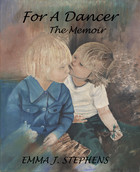 Summary:
Emma recounts her childhood growing up with an outgoing older sister, a permissive father, and an addict stepfather in rural America. She then relates attending college as a single mother, her failed marriage, and studying abroad in Paris.
Review:
Imagine the most whiny, entitled, immature person you know. Now imagine that person perceives herself as simultaneously awesome, intelligent, and put-upon. Now imagine that person wrote a memoir and couldn’t even maintain the same tense throughout. That’s Stephens’ memoir. To a T.
Yes, a few things in Emma’s childhood weren’t perfect, but most people don’t have life handed to them on a silver platter. Her sister overshadowed her a bit. Her stepfather was an addict who had to go to rehab. Interestingly, though, Emma and her sister were unaware of his addiction until her mother and stepfather sat them down to explain why he was going into rehab. It seemed to me that they actually handled the situation quite well. When Emma’s stepfather returns from rehab, he and her sister clash a bit in the typical teenage angst style, but since the girls also have a father, Emma’s sister moves in with him and their stepmother. It is at this point that Emma starts making the series of dumb decisions that really mess up her life for….well for forever.
Emma ditches her mother and stepfather who had just made over her room for her and goes to live with her absentee father and stepmother who really aren’t behaving like parents at all. Emma proceeds to whine about this situation, when she did it to herself. She whines about everything about living there, when all she had to do was go back to the healthy household with her mom and stepfather. Why didn’t she? Dare I to suggest that she actually liked the freedom, no responsibilities, slacking off in school, getting drunk, having sex, etc…? Why, yes I do. She then proceeds to run away from home multiple times, scaring the crap out of her mother, who appears to be the only one who goes looking for her. It’s the typical what do we do with this horrible out of control teenager story only told from the teenager’s perspective. Aka, it’s terrible. It’s horrible to read about. There is no remorse, no chagrin. Everyone else is always at fault but Emma.
Perhaps teenage angst can be forgivable, but what occurs later was simply horrifying to read about, partially because at first it seems that Emma is straightening her life out. She gets pregnant, keeps the baby, and still completes her pre-med courses and graduates with her BS. This is admirable. I’m sure it was difficult, and she seems to be focused on providing a good life for her son. That all quickly ceases though when she gives up on becoming a doctor, gets married, moves to LA, gets a boob job, and then starts shopping herself and her son around for movie roles. You claim you want to give your son a better life, so you throw him to the wolves in Hollywood? Really?
Naturally, the marriage doesn’t work out, and we then see a series of men coming into and out of her son, Gabriel’s, life. He is routinely left with friends or family so Emma can gallyvant around with these various men, oh, not to mention go do a semester abroad in France without her son when he’s only 11 years old. All she can seem to think about or focus on is money. Not creating satisfying relationships. Not broadening her horizons. Not anything but money. Think I’m exaggerating? She ends up ditching her son for weekends so she can fly across the country to be a high-class hooker. Meanwhile, her mother has settled in the mountains and become an addiction specialist. If you’ve ever needed proof goodness isn’t genetic, there it is. In fact, I’d love to read her mother’s memoir. I bet she has a lot more valuable things to say.
Perhaps all of that could be bearable if she simply wrote well, but she doesn’t. She talks in circles and constantly changes tenses to the point where following the story is incredibly difficult.
Overall, this is a badly written memoir by a person who is a bad daughter and irresponsible mother who has seemingly learned nothing from her mistakes. I cannot in good faith recommend it to anyone.
1 out of 5 stars
Source: Print copy via LibraryThing’s EarlyReviewers

Book Review: Born Wild by Tony Fitzjohn
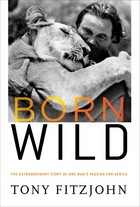 Summary:
Tony Fitzjohn never quite fit in in England or the middle class existence he was adopted into at a young age. By his early 20s, he was roaming around Africa, and eventually found a job with George–the elderly Englishman famous for his belief in reintroducing lions into the wild whose efforts were chronicled in Born Free. In his biography, Tony accounts the steps in his life that led up to his assistantship with George, the two decades he spent learning from him in Kenya, and the efforts he himself has made in Tanzania’s parks.
Review:
This autobiography (memoir?) is an example of how you can not particularly like a person but still admire and respect the work they do. I know I would never in a million years get along with Tony. He’s hard-headed, stubborn, a womanizer (prior to getting married in his 40s), matured very late in his life, and can be remarkably short-sighted in how his actions affect others. And yet.
And yet he has an incredible passion for animals and the environment. He’s faced down poachers, corrupt government employees, and charging rhinos with frankly, balls of iron. All for the love of not just the big cats like lions and leopards, but rhinos and wild dogs as well. I find it fascinating how his love of adventure gradually showed him that animals are not ours to use and abuse. I wish I had had the time to copy the quote exactly from the book before I had to return it to the library, but essentially he says that we are meant to be stewards of the land that all the rest of the non-human animals need to survive and do what they’re meant to do. He talks at length about how rhinos often don’t get as much attention because they don’t form a bond, really, with their caretakers the way orphaned big cats do, but that’s not who they are! Rhinos are aggressive, love fighting each other. They fight and they mate and that’s what they do and that’s beautiful because that’s who they are. Letting animals be who they are and do what they do–that’s our real role as humans.
Of course, the animal rights message doesn’t really come out until the end of the memoir. The beginning is Tony reflecting on his childhood and early years in Africa. He traveled all over the continent a lot, never really sticking to one country until he met George and stayed put in Kenya for quite a while at the Kora reserve. At times the writing when he’s recounting his life can be a bit dull. He seems more focused on naming everyone he ever came across than in telling a story. This holds true up until the trust sends him to AA and after that he meets his now-wife Lucy. From then on it is as if a haze is lifted and his passion for everyone around him, the animals, and his family comes through. I have no doubt that this is at least in part due to his no longer drinking. It is clear that there are swaths of the prior years that he does not recall. He even recounts one story that a friend told him when staging his intervention of him getting into a bar fight that he doesn’t even remember happening. All this is to say, the first half or so of the book is fun bits of lions mixed in between rather dull sections of him just getting the information through to the reader that will be important later.
But the elements with the lions that hold us over in the meantime are absolutely worth it. It is evident that through all of Tony’s flaws, he has a natural ability to work with big cats and an innate understanding and love of them. He does not doubt their ability to feel emotions or communicate with people.
Sheba [lioness] had been so fond of her brother that when he died, she had led George to the spot, watched him bury Suleiman [her brother], and then sat on the grave for days, refusing to leave him alone. (page 112)
He also has an understanding of human society and mores and how they affect the animal world that comes through abundantly clearly:
By pushing up the price of oil, Sheikh Yamani and his cohorts had multiplied the Yemeni GDP sevenfold. A rhino-horn dagger is a symbol of manhood in Yemen, so an entire species was all but wiped out in order that a load of newly oil-rich Yemenis could have fancy dagger handles. (page 76)
When he writes of the poachers and big game hunters fighting with the environmentalists for control of the land, I was aghast at the methods both groups used. They often would kill a big cat, cut off its head and paws, then skin it and leave it right in the environmentalists’ path. This level of cold-heartedness and cruelty baffles me. Although one could possibly argue that the poachers saw this atrocity as the only way out of poverty, there is zero excuse for the wealthy, white big game hunters who just callously view it as sport.
I suppose some people may see Tony’s and other western people’s work in Africa for the animals as neocolonialist. I don’t see it that way at all. Tony by nature of his upbringing had the wealthy connections needed to fund projects working with the animals. When Kenya and Tanzania were caught up in civil wars and reestablishing their nations, even wealthy Africans would most likely donate that money toward people, not animals. Plus, Tony’s work has provided stable employment to Tanzanians and Kenyans for over 20 years, as well as bringing in more tourism. Tony himself points out that a lot of the big animals were gone due to colonial big game hunters, and he views his work as a sort of retribution for the colonial period. I perhaps wouldn’t take it that far, but I do see his point.
One thing I will say, though, is I do view it very hypocritical that Tony sends his own children away to a wealthy boarding school in Kenya rather then sending them to the school located in the park in Tanzania that his trust set up and runs. If it’s good enough for the Tanzanian kids, why isn’t it good enough for his own? That stung of elitism to me.
Although the book can be slow-moving at times, the good bits make up for it. Tony and his work for animal rights are inspirational. His life shows how much one person can accomplish by taking it one step at a time.
I pulled myself together and thought about what George would do. Of course I knew already. George would put his head down and keep going, one step at a time. It was the way he approached everything. (page 184)
Overall, I recommend this memoir to nonfiction lovers with a passion for Africa, environmentalism, or animal rights.
4 out of 5 stars
Source: Public Library

Book Review: The Sum of My Parts: A Survivor’s Story of Dissociative Identity Disorder by Olga Trujillo, JD
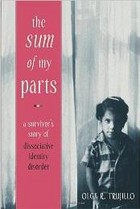 Summary:
Olga was a young, successful lawyer in DC when she suddenly started having inexplicable panic attacks and episodes of blank stares or rapidly moving eyes. She sees a psychiatrist and is diagnosed with a moderate case on DID. On the spectrum, she has multiple parts but not exclusive personalities and still has a central core. These parts have kept the memories of her extraordinarily violent, abusive childhood from her consciousness thereby allowing her to function, but just barely. In her memoir, Olga tells what she has now remembered of her childhood and how she has now discovered she managed to function and be surprisingly resilient. She then delves into her long-term therapy and how she has come together into mostly one part and usually no longer dissociates.
Review:
I always find memoirs by those with DID or dissociation completely fascinating. Even just the ability to write the book and explain the disorder from the insider’s perspective is a remarkable achievement. I previously read When Rabbit Howls
Olga offers up a very precise trigger warning of which chapters could be dangerous for fellow trauma survivors. That said, I found her reporting of what occurred to her to be respectful of herself as a person. She never shirks from what happened to her, but is sure to couch it in concise, clinical language. I respect this decision on her part, and again believe it will make her book more accessible to a wider audience. People can see the results of the trauma without finding themselves witnesses to the trauma itself.
The book right up through about halfway through her therapy is clear and detailed, but then starts to feel rushed and more vague. Perhaps this is out of respect for the people currently in her life, but personally I wanted to know more. For instance, how was she able to make a drastic move from DC to the middle of the country without upsetting her healing process? How do the phone sessions with her therapist work? I think many advocates of those with mental illness would appreciate more detail on how she is able to have a healthy, happy relationship now, especially since we witness the dissolution of her first marriage. Similarly, I wanted to know more about her coming out process. She states that she knew at 12 she was a lesbian, but pretty much leaves it at that. I’m sure it was easier to embrace her sexuality the more integrated her parts became, but I am still interested in the process. She was so brave recounting her early life that I wonder at the exclusion of these details.
Overall this is a well-written memoir of both childhood abuse, therapy for DID, and living with DID. Olga is an inspirational person, overcoming so much to achieve both acclaim in her career and a happy home life. I recommend it to a wide range of people from those interested in the immigrant experience to those interested in living with a mental illness.
4 out of 5 stars
Length: 258 pages – average but on the shorter side
Source: NetGalley
Buy It (Amazon or Bookshop.org)
If you found this review helpful, please consider tipping me on ko-fi, checking out my digital items available in my ko-fi shop, buying one of my publications, or using one of my referral/coupon codes. Thank you for your support!
Book Review: From This Moment On by Shania Twain
 Summary:
Shania Twain shot to fame on the country music charts in 1995 with her second album The Woman in Me. Her music was part of the new generation of 90s country, featuring such artists as Toby Keith, Tim McGraw, Faith Hill, etc…, that would blend country and pop for a new sound. In her memoir Shani recounts her life from her childhood in the northern part of Ontario, Canada to her sudden fame to the heartbreaking realization that her husband was cheating on her with her best friend to her recovery and new life.
Review:
While other girls of the 90s were obsessed with The Spice Girls and Britney Spears, I fan girled out over Shania Twain. My family was a country music household to begin with, so getting my parents to be cool with me listening to pop was always a creative act. (I remember I got away with listening to Britney Spears by getting my mother to listen to Hit Me Baby One More Time and like it and then revealed that it was Britney Spears. I’ve always been a wily lady.) In any case, I needed to employ none of this trickery to listen to Shania. As country music she had the stamp of approval, plus my big brother had bought her cd. I was 8 years old when The Woman in Me came out, and I remember being completely blown away by “Any Man of Mine.” (Go watch the video. I can wait.) I was blown out of the water. Whereas most country I’d heard prior was all about love and heartbreak and cheating husbands, here was a woman saying loud and proud that she deserves to be treated right, dammit! Let’s just say it really appealed to the feminist inside me. When I found out she was from “the bush” of Canada and a poor family closely tied to Native culture, well, I was insanely curious, but Shania has always kept her private life private, so I was left to wonder. Needless to say, when I heard at the beginning of this year that Shania would be publishing a memoir, I pre-ordered it. I had to know more about this woman whose music so spoke to lonely little rural girl of the 90s.
Shania’s memoir is very different from any others I have read. She does not involve many storytelling tropes. She only quotes people twice in the entire book. She reflects a lot, similar to, perhaps, if you’ve ever had the chance to listen to an older relative think out loud about her life. It does not read like a story, but it does feel as if you were granted a couple hours of private access to one of the more private country stars.
The strongest part of the book is without a doubt when she is reflecting on her family and upbringing in Canada. It becomes abundantly clear that perhaps Shania’s reclusiveness has more to do with the fact that while she loved music she had no dreams of being a star. Her mother decided her daughter would be a star and pushed her into it.
Imagine what a burden that is for a young girl. I just wanted music, not necessarily a music career. But because I felt obligated by her dedication to me her singer, I never had the heart to consider anything else in life, even though I’d dreamed of maybe becoming a veterinarian. I also developed a passion for design and architecture that continues to this day. In fact, that’s probably what I would have pursued had my mother not been so forceful about music. (location 1634)
I find it fascinating how often famous people were pushed into that career path as a child. What makes parents do this? I remember when I was a kid I wanted to “be a star,” and my father sat me down and told me to think really hard about it, because I’d lose all privacy and normalcy. I gave up on the idea and decided to be a reclusive writer instead. So what makes other parents push their kids into it?
Well, it’s obvious Shania’s mother had an incredibly rough life. Her family was below the poverty line with young mouths to feed. Her mother’s relationship was abusive, and she struggled with depression.
The perpetual undertow of financial instability took its tool in other ways, as it usually does, compromising my parents’ love for each other at times and no doubt feeding my mother’s recurrent bouts of depression. (location 189)
Ah. I can only guess that Shania’s mother saw a chance for financial stability for her daughter’s future in her talent, pinpointing most of her life’s troubles on a lack of money. Funny how Shania then succeeded and went on to have similar problems simply on the opposite end of the financial spectrum.
The section of the book dealing with fame, recording, making music videos, etc… is frankly disappointing. Shania barely brushes the surface of what actually went on behind the scenes, instead focusing in on how drained and dissatisfied her newfound fame made her feel. Passages largely read like this:
I was starting to feel as if I’d lost my chops at life’s fundamentals—and I’d been someone who could survive on my own in a cabin in the woods with no running water or electricity in subzero temperatures and snow up to my butt. Now, with a skilled full-time staff at home to handle every domestic and personal chore for me, I felt…useless and inept. (location 4905)
An interesting reflection, no doubt, but I really wanted to know what happened during the, at the time controversial, “The Woman in Me” video shoot in Egypt, for example. Details like this combined with the reflections on the dissatisfaction of fame would have made for a more powerful book, in my opinion.
The last section of the book addresses Shania’s time off from music, the birth of her son Eja, and the dissolution of her marriage to music producer Mutt Lange. This part is hard to read, because it is so abundantly clear that those around her have used and abused Shania (her husband cheated on her with her best friend in Switzerland). This is a woman for whom for her whole life family and being in touch with nature have mattered to her far more than anything else, and yet these things seem to be denied her. It saddens me that the woman who sang such strong music has in fact spent most of her life trying to make other people happy. This memoir was written as a way to deal with the end of her marriage, and I hope that through it Shania has found some peace and starts listening to her heart about what she really values and needs. It is so evident in the last third of the book that she is trying to buy happiness with more and more property and perfectly built homes. If only there was some way for the peace and quiet loving singer/songwriters of the world to get their music to others without suffering from the entrapment of fame. Maybe the internet will help with that.
Overall, I found this to be a moving memoir, if a bit flawed. It meanders sometimes and skips over some things that fans would definitely want to know about, but it is an interesting insight into the mind and life of a famous country singer and gives an interesting look at the negative effects of fame, even if they aren’t as huge as drug overdoses.
4 out of 5 stars
Source: Amazon

Book Review: Coming of Age in Mississippi by Anne Moody (The Real Help Reading Project)
 Summary:
Anne Moody in her memoir recounts growing up in the Jim Crow law south, as well as her involvement in the Civil Rights movement as a young adult. She was one of the women at the famous Woolworth’s lunch counter sit-in. Here we get to see her first-hand thoughts and memories of the struggle growing up surrounded by institutionalized racism, as well as the difficulties in fighting it.
Discussion:
This project I am co-hosting with Amy truly seems to be flying by! We are already on our fourth read. I was excited that it was my turn to host the discussion, because memoirs are one of my favorite genres (as my followers know). Plus this is a memoir set just before and during the Civil Rights era, which is a time period I must say I don’t know as much about as I should. History classes in the US have a tendency to run out of time in the semester right around the end of WWII.
Throughout the book there is personal, anecdotal evidence of the statistics we read about in Labor of Love, Labor of Sorrow. The harsh life as sharecroppers produces anxiety and stress in the family structure. Anne is left alone all day with an uncle who is only eight years old to watch her and who treats her badly because he resents being stuck with this responsibility. Similarly, early in her life, Anne’s father and mother divorce. The strain on the family of poverty is abundantly clear.
Similarly what we read about black women taking nowhere near enough time off of work to recover after pregnancy and birth is evident in Anne’s observations of her own mother:
She didn’t stop workin until a week before the baby was born, and she was out of work only three weeks. She went right back to the cafe. (page 26)
Although Anne’s mother tried to stay out of serving in white homes as a maid, before long she ended up taking on that kind of work. She and her children would generally live in a two-room shanty out back. At first Anne didn’t notice the difference in privilege, until her mother brought home food for her children:
Sometimes Mama would bring us the white family’s leftovers. It was the best food I had ever eaten. That was when I discovered that white folks ate different from us. (page 29)
Anne was clearly an intelligent child and picked up on the subtle situations going on around her. Early on she remembers wondering about race and what makes someone white versus black, when there were some “high yellow” black people she knew who could easily pass for white.
Now I was more confused than before. If it wasn’t the straight hair and the white skin that made you white, then what was it? (page 35)
In fact, this issue of levels of color in black communities impacted Anne’s early life a great deal. Her mother’s second significant relationship was with a man from a “high yellow” family who didn’t want him with her because she was “too dark.” Anne’s mother put up with Raymond trying to decide between her and another “high yellow” woman that his family did approve of for years. Later when he does choose her, she must put up with the snobbery of his family who refused to even speak to her. Anne cannot understand how black people can be so cruel to each other when the white people in Mississippi are cruel to them all. It is evident that the racism and oppression of the South caused those oppressed to seek out others to oppress, and the easiest way to do so was to be prejudiced against those with a darker skin tone. Anne is right that it’s sad and confusing, but it also seems to be a natural result of such an oppressive system. It’s like we learned from The Book of Night Women: misery begets misery.
Before she is even in middle school, Anne has her first job working for a white woman. She sweeps her porches in exchange for milk and a quarter. This is when she starts contributing to the family economy. It’s interesting how Anne never expresses any resentment about needing to contribute to keeping the family going at a young age. She does not view it as her parents’ fault. It is just the way it is, and she’ll do what it takes to help her family.
This is the part of the book where we truly see through the eyes of “the help.” There are families that Anne works for her treat her like an equal, have her eat dinner with them, and encourage her to go to college. Then there is the family that is an active member of “the guild” (aka the KKK) where Anne is constantly in terror that they are going to try to frame her for a false wrong-doing. Anne shows many signs of constant stress during this time, both in her body (headaches and losing weight) and in her mind (feeling trapped). Being stuck working for someone who you know is going around organizing the murder of people of your own skin tone purely for their skin tone must have been horribly traumatizing.
It is in high school when the activity of the KKK in her hometown ramps up that Anne starts to develop her fighting spirit that will carry her out of white people’s homes and into the Civil Rights movement. She is angry and fed up with the system, with white people, but with black people too.
But I also hated Negroes. I hated them for not standing up and doing something about the murders. In fact, I think I had a stronger resentment toward Negroes for letting the whites kill them than toward the whites. Anyway, it was at this stage in my life that I began to look upon Negro men as cowards. (page 136)
Anne’s passion for doing what is right in the face of terrible danger and pain is remarkable and admirable. She would rather die fighting the system than live under the system. She does not seem to realize it, but this is an unusual level of strength and courage. It takes people like her to make change happen. People like her become the leaders that get people to act in spite of their fear. I understand her frustration, but her lack of understanding of other black people’s viewpoints can be a bit frustrating at times.
Her passion though does lead her to one of the historic black colleges, eventually, Tougaloo College. Tougaloo was at the center of a lot of the Civil Rights movement in the south, and I found this part of the book totally fascinating. It is here that Anne makes her first white friend, a fellow Civil Rights activist. It is here that her famous sit-in at Woolworth’s is organized.
But something happened to me as I got more and more involved in the Movement. It no longer seemed important to prove anything. I had found something outside myself that gave meaning to my life. (page 288)
Anne used her jobs in white people’s homes to get herself to college where she joined in the Civil Rights movement. It is a truly inspirational tale. One can’t help but wonder if the KKK household she worked in became aware of her significant achievements. The woman who once washed their dishes and ironed their clothes entered into history books. How anyone can find kitschy stories like The Help inspirational when there are real ones like Anne Moody’s is beyond me.
I was a bit surprised at the semi-dark ending, so I did a bit of googling and discovered that this book was first published in 1968, far before the drastic improvement in race relations in the United States. Moody at the time had no idea how things were going to turn out. It’s understandable she was feeling a bit down-trodden and wondering if anything good would ever happen.
I also learned through googling that this memoir ends before her involvement in the Black Power movement. There are rumblings that she will join with them, though, because she starts stating that peaceful protest will get them nowhere when they are constantly met with violence. I wish there was a follow-up memoir, but there is not, and Anne Moody has refused all media interview requests ever since the publication of this one. I suppose I will simply have to read one of the many famous Black Power books to satisfy my curiosity.
Source: Library
Length: 424 pages – average but on the longer side
Buy It (Amazon or Bookshop.org)
Discussion Questions:
- How do you think poverty and racism impacted Anne’s mother’s two significant relationships with men?
- Do you think those working in KKK households were at a greater physical risk than those working in regular white households?
- Anne’s employer has her tutor her son in Algebra, because he is failing. This would suggest that on some level the woman realized that black people are not inferior to white people. Why do you think she was than so insistent on the dominance of white people and a member of the KKK?
- What are your thoughts on the various southern whites in Anne’s life who actively helped her and protested and/or fought racism? What do you think made them act against a system that they were raised in when others like them were defending it?
- Anne ends the book waffling between peaceful protests and violent movement. Which do you think ultimately would lead to a better end result?
If you found this review helpful, please consider tipping me on ko-fi, checking out my digital items available in my ko-fi shop, buying one of my publications, or using one of my referral/coupon codes. Thank you for your support!
Book Review: A Stolen Life by Jaycee Dugard
 Summary:
On June 10, 1991, eleven year old Jaycee Lee Dugard was abducted from her school bus stop by Phillip and Nancy Garrido with the aid of a stun-gun. Jaycee was locked up in a backyard compound and repeatedly raped and abused by Phillip in a bid to satisfy his pedophilia. Over the course of her 18 year captivity, Jaycee gave birth to two daughters in the compound. Eventually with her increasing age, the sexual assaults stopped, but she was still held captive. Finally, on August 26, 2009, Phillip brought Jaycee and her daughters with him to the parole office in an attempt to explain away why he was spotted in public with the two girls. Jaycee, who hadn’t been allowed to speak her name for 18 years, was able to write it down for the police. This is the memoir of her experience and gradual recovery from the captivity.
Review:
Jaycee wrote this memoir without the assistance of a ghost writer, something very uncommon in memoirs by victims of abduction. She states in the beginning that her way of remembering things is a bit off because of the trauma, but that her way of telling her story will provide a genuine experience for the reader to truly see how the abduction affected her. She is correct that the memoir is not set up in a traditional way, but this tends to make for stronger books when discussing something as painful as this. It reminds me a bit of the very non-traditional story-telling methods used in another memoir When Rabbit Howls. Eliminating the ghost writer and letting the victim speak grants us, the readers, the opportunity to truly connect with a survivor. I humbly thank Jaycee for her bravery in this.
Most of the chapters start with Jaycee remembering the events from the perspective of her younger self. This absolutely makes scenes such as her first molestation by Phillip incredibly haunting. She then ends each chapter with a reflection from her adult, free perspective on the past. This structure is unique, but it provides an interesting perspective, showing both Jaycee the victim and Jaycee the survivor. Toward the end of the book this structure is lost a bit as we suddenly are shown many pages from the journal Jaycee carefully kept in captivity, as well as talking in a more present manner about the therapy she’s been going through. Her therapist sounds truly remarkable. She uses horses to help the survivors deal with problems, which seems to work incredibly well for Jaycee who often only had animals around to talk to during her 18 year ordeal.
Although Jaycee does recount her abuse and manipulation at the hands of Phillip, that is not at all what stands out in this memoir. What comes across is what a strong, sensitive, caring woman Jaycee is. She is not lost in woe is me. She does not even think she has it the worst of anyone in the world. The one thing she repeatedly states she’s learned is that she was not assertive enough as a little girl, and that personality trait backfired on her repeatedly throughout the ordeal. She states that she sees this as the reason abuse of all kinds are able to go on, because people don’t speak up.
There are moments in which all of us need to have a backbone and feel that we have the right to say no to adults if we believe they are doing the wrong thing. You must find your voice and not be afraid to speak up. (page 143)
This message of “speak up” is stated repeatedly throughout the book and leaves the reader feeling empowered rather than downtrodden at such a tale. If Jaycee could live through such a situation and come out of it stronger and as an advocate for victims and survivors of abuse to speak up, how can any of us do any less?
I recommend this book to those who enjoy memoirs and survival stories and can handle scenes of a disturbing nature.
4 out of 5 stars
Source: Amazon

Book Review: The Last Manchu: The Autobiography of Henry Pu Yi, Last Emperor of China by Henry Pu Yi, translated by Paul Kramer
 Summary:
Henry Pu Yi became the last emperor of China when he was almost three years old. During the chaos of a post-WWI China fighting between republics and war lords, he would periodically rule, be a figurehead, or be in hiding on foreign-held embassy land. Working with the Japanese in WWII he sought to refind his throne by ruling as the figure-head of the Japanese-held Manchuria region. He then was held prisoner by the Soviets for five years before being turned over to the communist Chinese for thought reform.
Review:
Although the translator states that Henry Pu Yi’s life is an excellent way to examine how China survived so many upheavals in the early 20th century, after reading the autobiography I simply cannot agree. Henry Pu Yi’s life was incredibly unique and absolutely not a reflection of what was really going on in China at the time. If anything, he seemed to operate from an oblivious perspective up until the communists kind of smacked him in the face with reality. For instance, during the time of chaos, civil wars, and famine in China prior to WWII, he states:
Just as food was cooked in huge quantities and not eaten, so was a vast amount of clothing made which was never worn. (location 544)
When reflecting on his past perspectives, it is evident that his past self did not understand why such wastefulness would infuriate China’s poor or make them push for a republic via Chiang Kai-shek. Of course, one cannot entirely blame Henry Pu Yi for this short-sightedness. He was raised from a young age being treated as a god by all those around him, being told it was his destiny to be the holy emperor. That would mess with anyone’s mind. However, as he became older he did have teachers and advisors who tried to enlighten him, he just refused to listen.
Eventually, Henry Pu Yi reached this odd mental compromise where he believed everything Western was good, except for their ruling system.
I also became far more convinced than I had ever been in the days when Johnston was with me that everything foreign was good and everything Chinese, except the Imperial System, was bad. (location 2184)
His selfish mindset saw everything good he himself could garner from the west, but didn’t seek out anything positive to change or do for his people. This self-centeredness in a ruler is disturbing at best.
This is even more evident during the time of his life when Pu Yi was puppet ruling for Japan in Manchukuo (Manchuria). Pu Yi increasingly came to fear more and more for his life as it became more evident that Japan would lose the war. The more afraid he was, the more he beat members of his household and staff. Yet he simultaneously claimed to be a good Buddhist who would not even harm a fly. It seems the only thing Pu Yi excelled at was compartmentalizing his actions. A former servant of Pu Yi summed up his personality quite eloquently during one of the criticism sessions of the communist thought reform:
Pu Yi is both cruel and afraid of death. He is suspicious, tricky and a hypocrite. When he beat or scolded his servants, it was not for mistakes they committed, but due to his own mood at the time. (location 4020)
Pu Yi, for most of his life, was incredibly selfish. He was obsessed with his own death and life and with maintaining his emperor status. He cared little to nothing for those around him or for the people of China. One must wonder how things may have been different if a strong, selfless man had been made emperor during the same time period.
Thus for most of the autobiography, we’re reading about a most unsympathetic man from his own perspective. That can become a bit tough to endure. The light of the autobiography comes in the last quarter of the book, though, when he recounts his time in thought reform.
The translator refers to this time period as Pu Yi being brainwashed. I can’t say that it appeared that way to me at all. Pu Yi was not tortured, made to starve, or beaten. He was simply placed in prison and reformed. Frankly, I think his time in communist prison did him a world of good. Suddenly he was having to fend for himself. Where before he never even had to open a door or mend a button, suddenly he did. Slowly the communists gave him more and more responsibilities so that eventually he was on the same cleaning and work rotation as the other men in the prison. Pu Yi says himself that he came to realize how truly useless he was at doing anything worthwhile. Although at first he blames those who raised him, he comes to acknowledge his own bad character eventually, being ashamed for how he behaved. When he is eventually deemed reformed by the communists, he enters society as an equal and works hard to do his fair part. Personally I think if American prison systems could have this kind of excellent 180 result, we would soon see a much smaller inmate population. For isn’t the purpose of prison supposed to be reform? And one cannot deny that Pu Yi came out a better man than he went in, even if communist China has made many other mistakes, it is evident with Pu Yi things were handled quite well. A man was reformed and made useful in society instead of senselessly killed off.
It is a bit of a wait to get to the interesting thought reform portion of the book, however. Pretty much everything before that makes you want to attack Pu Yi through the pages. His style is a bit rambling, although the translator claims that’s partly just Chinese culture versus Western culture. It is an interesting read, but I do think it will only really hold the attention of those with a strong interest in China.
3.5 out of 5 stars
Source: Amazon

Book Review: I Am Hutterite by Mary Ann Kirkby
 Summary:
Mary Ann Kirkby recounts her unique childhood in her memoir. She was born into a Hutterite family. The Hutterites are a religious sect similar to the Amish only they believe that living communally is a mandate for Christians. Mary Ann recounts her childhood both in the religious sect (her particular group was located in western Canada), as well as the journey and culture shock she went through when her parents left the Hutterites when she was nine years old.
Review:
I actually read this memoir because of the situation in which I first ran into Hutterites and have been fascinated with them ever since. For a couple of years, my father and brother lived in Montana. I went to visit them and was shopping in Victoria’s Secret at the mall and rounded the corner to discover traditionally-garbed Hutterite women buying thongs. I had no idea what a Hutterite was, but instantly hunted down my brother elsewhere in the mall to find out who these people were. All that the “English” seemed to know about them was that they lived in a commune, dressed kind of like the Amish but different, traveled all together to town in a few big vans, and the Hutterite women were always buying thongs at Victoria’s Secret. Hutterites are rather quiet about their lifestyle though, so when I stumbled across this on a new releases list, I knew I needed to read it to find out more about the community.
This is a completely fascinating memoir that I devoured in one day. Mary Ann is able to see both the faults and the beauty of various experiences in her childhood with the clear eye of an adult. Yet simultaneously she harbors no ill-well toward either the Hutterites or her parents or any of those who made her transition from a Hutterite girl to an “English” woman more difficult. Kirkby writes with a sympathetic ear to all those she encountered in her life, which is a refreshing change in the memoir genre.
Additionally Kirkby’s writing offers an immersion into the fascinating world of communal living with a religious belief system to hold it all in place. Kirkby recounts a childhood where no homes were kept locked, everyone was always welcome in everyone else’s home, and most meals of the day were eaten communally with your age-mates. In fact, one of the biggest changes for Kirkby when her family left the Hutterites was suddenly needing to interact with her siblings on a regular basis instead of her same-age female friends. She also had trouble understanding the English need for privacy in the home or the relative silence with which meals were eaten.
Another point of interest is that Kirkby’s father was from a Russian family that was persecuted in Europe and had to run to Canada to escape the Nazis. His father sought refuge and a sense of safety in the community of the Hutterites. Conversely, her father who grew up in this safety found himself craving more freedom than the strict rules and constructs of the commune would allow for. The book thus not only recounts a unique girlhood and insight into the Hutterite way of life, but also addresses the age-old question of freedom versus security.
Anyone interested in the Hutterite communities or unique childhoods will absolutely enjoy this memoir. It is well-written, intriguing, and contains not a trace of bitterness. I highly recommend it.
5 out of 5 stars
Source: Amazon

Book Review: Wild Swans: Three Daughters of China by Jung Chang
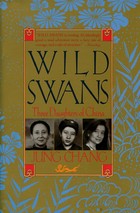
Summary:
In this memoir, Jung Chang recounts the lives of herself, her mother, and her grandmother growing up in pre-communist, revolutionary, and communist China. Mixing extensive historical facts with intensely personal remembrances, Jung Chang presents a vivid portrait of real life in China.
Review:
As an American, I was raised being told communism is bad, but not particularly taught much about it. So when Meghan blogged about this memoir, I was immediately intrigued. My history BA taught me to favor first-person accounts over academic ramblings, so a memoir of communist China from a woman’s perspective was frankly ideal.
It has been a very long time since I’ve learned so much from a memoir. Chang was extremely careful to verify the facts of the historical events surrounding her family’s various issues. Starting with her grandmother who had bound feet and was essentially sold by her family as a concubine, Change moves up through the drastic changes in China. From her mother who was part of the communist revolution to herself who ended up an ex-patriot in Britain.
My preconceived notions of communism were frankly tromped upon by this memoir. As a liberal person, I never quite understood what was so bad about communist China. Chang makes it clear throughout the book that the governing body of China never actually lived up to the communist ideals of her revolutionary parents. The passage where Chang best explains the warped version of communism enacted by Mao states:
The Cultural Revolution not only did nothing to modernize the medieval elements in China’s culture, it actually gave them political respectability. ‘Modern’ dictatorship and ancient intolerance fed on each other. Anyone who fell foul of the age-old conservative attitudes could now become a political victim. (page 413)
Thus, communism in China was and is not at all what many hippie Westerners believe and/or believed it to be.
Beyond opening up understanding of communist China, this memoir also distinctly demonstrates the human spirit under pressure. From Chang’s father who stood by his ideals at all costs to her grandmother who simply wanted everyone in her family to be comfortable and happy to neighbors with their own agendas, Chang demonstrates how an oppressive regime s bring out both the best and the worst in human nature.
This is a fascinating book both for its insider’s view of communist China as well as its female perspective on said regime. Similarly, it offers an intriguing commentary on human nature. I recommend it to anyone interested in the history of China as well as those with an interest in women’s studies or political science history.
5 out of 5 stars
Source: SwapTree (now defunct)

 Support my work with a tip or browse my shop for curated book club guides, how to guides, cross-stitch patterns, and more!


This work by Amanda Nevius is licensed under a Creative Commons Attribution-Noncommercial-No Derivative Works 3.0 United States License.
 Opinions of a Wolf