
Archive
Book Review: Quiet: The Power of Introverts in a World That Can’t Stop Talking by Susan Cain
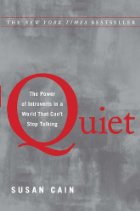 Summary:
Cain explains how the Extrovert Ideal became the norm in Western culture then proceeds to define the reality of the existence of both introverts and extroverts, not just among humans, but in the non-human animal kingdom as well. She explains the pluses and minuses of both personalities and provides advice for individuals, parents, and businesses in bringing out the best potential in both.
Review:
This book has been all the rage among book bloggers, which probably isn’t that surprising. Readers tend to be introverts, and the book’s title certainly implies that it’s all about us. In actuality though, although the book does have a focus on introverts, it also contains lots of information on extroverts and how we are all different but equally valuable to the world. Indeed, the Introduction features a statement that basically defines the point of the book as a whole:
Our lives are shaped as profoundly by personality as by gender or race. And the single most important aspect of personality—the “north and south of temperament,” as one scientist puts it—is where we fall on the introvert-extrovert spectrum. (page 2)
After the Introduction, the book is divided into four parts: The Extrovert Ideal, Your Biology Your Self, Do All Cultures Have an Extrovert Ideal, and How to Love How to Work. As someone who was a History major in undergrad, I found the first section completely fascinating. It explains how western culture, particularly American culture, went from an introvert ideal to an extrovert one. It, not surprisingly, was all tied up with the Industrial Revolution. Before the Industrial Revolution people mostly interacted with people they had known most of their lives or who they would have time to get to know. After, if you wanted to make it in the business world, you had to make an amazing first impression. This push to give off the aura of friendly and awesome edged out the prior expectation to develop a moral character. This section also talks about how Evangelical Protestants take the Extrovert Ideal to an even greater extreme:
If you don’t love Jesus out loud, then it must not be real love. It’s not enough to forge your own spiritual connection to the divine; it must be displayed publicly. (page 69)
I’ve taken the Meyers-Brigg personality test multiple times at various points in my life. I am always solidly an INTJ. The I is for introvert. I was also raised Evangelical (although I am now an Agnostic). This section rocked my world. I even mentioned on GoodReads that it basically explained my life to me. Cain talks about how difficult it can be to be an introverted child or young person being raised in a culture of Extrovert Ideal. I wasn’t just raised in the American one (who just so happen to be the most extroverted people on the planet, page 186), but I was also raised in the most Extrovert Ideal culture within that culture–Evangelical. It’s no wonder I had some issues figuring out who I am and being ok with that. I can barely fathom what a difference it would have made in loving and accepting myself if I’d even just been told it is just as ok to worship alone in the woods as to be loud and proud about it in public.
The next section is more sciencey and discusses the biology behind personality differences. This section can definitely be empowering as it lets people know precisely how you became an introvert or extrovert. The overarching philosophy is that more sensitive babies, as in ones who are more easily startled or frightened of strangers, are predispositioned to become introverts. Nurture also affects this, of course. Cain discusses the good qualities of both highly sensitive and less sensitive kids and how how they are raised can either bring out the good or the bad in either natural temperament. Of course this is a great area for parents and those who work with kids, but it also explains to the reader how they got this way and what false ideas they might have about themselves. For me, this is the section that explained to me why I’m so passionate about causes like vegetarianism and mental illness advocacy. Introverts tend to be oriented around causes. An example of an introvert/extrovert pair who both got things done in their own way that Cain uses is Eleanor and Franklin Roosevelt. This is a wisely chosen example because both are people to look up to who played to their own personality strengths.
Personally I wasn’t so into the next section. As compared to the other sections that are three chapters, this one consists of only one. It essentially compares Asian culture to Western culture since Asian culture tends to idealize introversion over extroversion. I felt that this chapter was a bit rushed and less in-depth. Cain tried to cover both the experiences of Asian-Americans and all Asian culture as a whole. I understand that she wanted to address multicultural understandings of personality, but it does seem that this topic could be a book in and of itself. It felt a bit similar to the instances when in my job as an education and reference librarian that I tell a student their topic is too broad to possibly cover in one paper (or one thesis). It seems that a quick chapter on introversion versus extroversion worldwide could have been mentioned in the first section as a comparison without devoting a whole section to it. Similarly, the issues specific to immigrants to America from nations with an Introvert Ideal would have worked well in a different section. This would have felt more integrated and flowed better.
The final section contains advice on using your personality to your advantage in your life and also on how to strike a compromise with someone you care about of a different personality type. Overall, this section was well-written, although I felt not enough attention was given to “pseudo-extroverts,” introverts who have learned to pass as extroverts. This is a fascinating topic, particularly to an introvert who is constantly mistaken for an extrovert. I think this is the reality for a lot of people, and it deserved a bit more attention and research. For instance, Cain says in passing:
Emotional labor, which is the effort we make to control and change our own emotions, is associated with stress, burnout, and even physical symptoms like an increase in cardiovascular disease. (page 223)
I really wanted to know more about this! Particularly since I care so much about health and wellness. It almost seemed as if pseudo-extroversion deserved its own chapter.
The rest of the section though was great and quite helpful. I think if everyone followed the advice in it on dealing with other personality types and creating a loving environment for kids on both ends of the introvert/extrovert spectrum that we would have a much more positive world. Perhaps her best piece of relationship advice is A Free Trait Agreement.
A Free Trait Agreement acknowledges that we’ll each act out of character some of the time—in exchange for being ourselves the rest of the time. (page 221)
So for a couple consisting of an introvert and an extrovert they will go out some Friday nights and stay in and snuggle and read others. Preferably about 50/50. Mutual compromise. It’d be good to keep this in mind more often.
Overall, this is a well-written, accessible book regarding personality psychology and the history of it. It does flounder in some places and could have used another once-over for structure and focus, but it is well worth your time to read.
4 out of 5 stars
Source: Amazon

Book Review: Rabid: A Cultural History of the World’s Most Diabolical Virus by Bill Wasik and Monica Murphy
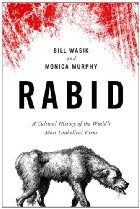 Summary:
Taking a cultural and public health perspective, husband/wife writing team, Wasik and Murphy, tell the history of the rabies virus through the present.
Review:
My new library (where I work as a librarian) serves a school of public health. Working with these students has opened up a whole new world of science to me. Public health is a fascinating combination of medicine, science, culture, and communication. So when I saw this public health book on Netgalley, I knew I needed to give it a shot.
This is a completely fascinating book. Prior to reading it, my main knowledge of rabies came from that episode of Dr. Quinn Medicine Woman where her adopted son’s dog gets rabies and bites her other adopted son’s fiancee. I didn’t really understand how much of a plague it used to be, but I did know that you’re required to get your pets vaccinated for it.
I learned SO MUCH from this book! And it wasn’t a struggle to read or absorb the information either. Wasik and Murphy strike that hard to find balance in writing science for the layman. They explain complex, scientific things without so much scientific terminology as to be a struggle for the average reader but with enough so that you’ve still learned something. For instance:
With most zoonotic leaps in disease, animal contact is the spark, but urbanization is the bone-dry tinder; a newly evolved pathogen can’t spread from person to person, after all, unless people run across one another in the first place. (location 453)
There are a few passages that use more scientific terminology than that, but they only use them after explaining them. You do not have to be a scientist to be able to read, enjoy, and learn from this book.
The basic structure of the book is typical of a history book. In fact, think of it kind of as a scientific history book. It starts with the earliest accounts of rabies and moves up through time to the present. The strongest passages are: Greco-Roman history of the disease, Dark Ages history of the disease, Pasteur’s creation of a vaccination, and the modern day outbreak in Bali. These strike the perfect balance of discussing the understanding and treatment of the disease and the reflections of rabies and fear of rabies in popular culture of that time period.
For instance, in the Greco-Roman period we learn:
Pliny’s thoughts tend to involve using the animal to treat the man. His best-known cure—to “insert in the wound ashes of hairs from the tail of the dog that inflicted the bite”—lives on today in our expression “hair of the dog,” referring to a not-quite-so-dubious hangover remedy. (location 473)
Or this fascinating bit of public health history in the Pasteur section:
Pasteur’s collaborator Roux believed that Pasteur selected rabies as a subject for research as a calculated bit of stagecraft, so that his ideas about vaccination would attract maximum public interest. (location 1714)
The other sections, particularly the era after the vaccine to about the 1980s, suffer a bit from a lack of focus and direction. There’s a part where the authors try to convince us that zombies are a reflection of a latent fear of rabies. Ok? But that’s rather speculative compared to the rest of the book. There are other elements of pop culture that are nowhere near as loosely connected that they discuss, such as the actual rabies books and movies that came out in the UK when the Chunnel was put in and people were afraid that rabid animals would come over to the island nation from France. That is a tight, interesting connection. The zombie one was a bit of a stretch. I was more interested in more information on things like Old Yeller and why the authors think that even with the vaccine in the US and very little threat at the time the public still was fascinated with the idea of a rabid dog.
The book also explores other zoonotic diseases (diseases that originate in non-human animals). Although this is also technically not rabies, this connection makes a lot more sense, particularly since more started cropping up in the 20th century after rabies was beaten down by vaccination. The knowledge we have from working against rabies and promoting vaccination of it via public health initiatives could really help with things like HIV/AIDS and H1N1. This is using past public health experience to aid in future endeavors, which helps give the book a certain umph and validity for modern readers.
So, although the book struggles a bit during the early 20th century time period, the rest of it is very well put-together. It is written at the appropriate level for a popular science history book. It is easy to learn from and includes lots of fascinating tid-bits in addition to the basic rabies history and information. It also demonstrates as a kind of side-story the history of public health. I recommend it to anyone with an interest in the history of rabies, the history of vaccination, and most especially to those with an interest in public health issues.
4 out of 5 stars
Source: Netgalley

Cookbook Review: Veggie Burgers Every Which Way by Lukas Volger
 Summary:
Far more than just your basic veggie burger, this cookbook offers up interesting varieties of veggie burgers plus veg*n versions of everything else you will need at your summer bbq.
Review:
This is such a pretty cookbook! Beyond gorgeous full-color photographs of the food, the recipes themselves are colorful with the numbers in blue and the headings in red or green. It’s not just readable and usable; it’s fun to do both.
This is a vegetarian cookbook, not a vegan one, but there are quite a few vegan recipes, and they are all clearly labeled with a green “V.” There are also some gluten free recipes labeled with a green “GF.” These labels are found in both the contents and on the recipes themselves.
The cookbook is divided into: Introduction, Veggie Burger Basics, Bean Grain and Nut Burgers, Vegetable Burgers, Tofu Seitan and TVP Burgers, Burger Buns, Sides: Salads and Fries, and Condiments and Toppings. I have to say while I was pleased with the inclusion of sides, I was most impressed by the inclusion of the section on burger buns. I also really appreciate the anti-processed food stance in the Introduction. It’s a nice touch, particularly for people who follow a diet that often leaves us wallowing in processed foods at friends’ bbqs, and we can’t complain because, well, they bought us veggie burgers, didn’t they?
One drawback to the cookbook is quite a few of the recipes call for ingredients that are kind of hard to find like: chickpea flour, bulgur, roasted chestnuts, Textured Vegetable Protein (TVP), or arame. If you’re pushing for people to do fresh, whole foods instead of processed, you shouldn’t make the ingredients list so complicated.
I found about three recipes that intrigued me enough to add to my “to try” collection. So far I’ve tried one, Beet and Brown Rice Burgers on page 59. It’s a fairly straight-forward recipe: combine shredded beets with cooked brown rice and mashed up beans, along with a few spices. I made them all at once then froze them. I also added in vital wheat gluten, which Volger oddly doesn’t use in a lot of his recipes in spite of its binding qualities and protein content. I’m glad I did because the burger still had some issues staying together even with it in there. However, the flavor and textures are different from other veggie burgers I’ve made, so it was definitely worth the effort. I still think the recipes in the book in general need a bit of tweaking, particularly for flavor and stay-togetherness (shhh that is so a word). The burger was good but not great. It’s almost there….I do intend to try it out again and tweak it a bit.
So….out of the whole book I found 3ish recipes, have made one, it was different and interesting but needs some tweaking. Not exactly a result that would make me encourage others to purchase. I do suggest you borrow it or check it out from a library if my review has intrigued you at all. You may find it more useful than I did or perhaps enjoy the flavor combinations more or even just have more easily accessible oddball ingredients in your town.
3 out of 5 stars
Source: Public Library

Cookbook Review: Eat Vegan on $4.00 a Day by Ellen Jaffe Jones
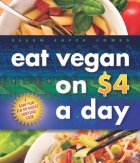 Summary:
This cookbook is a response to the myth that eating vegan must be expensive. Jones offers up recipes and a 7 day meal-plan where each day costs $4 or less.
Review:
The idea of this book is great, but the execution is poor, particularly compared to other eat cheap vegan cookbooks such as Vegan on the Cheap

The book features an interesting introduction on why veggies and fruits don’t get ad space, followed by chapters on financial planning for grocery shopping and veggie nutrition and cooking. Both of these chapters are kind of common sense, but I am fully aware a lot of adults, particularly young adults, are completely lacking in this common sense, so these chapters are good to have.
The recipes are divided into: breakfasts, soups, salads, salad dressings, entrees, spreads and sides, and desserts and snacks. Now, I have nothing against soups or salads, but to have three chapters really devoted to those two things (I mean, a whole chapter of salad dressings? Come on!) is not offering up much variety or doing anything to dispel the myth that vegans just eat salad. To top it off, the entree chapter starts with a chili and a stew, which are basically chunkier soups.
I also feel that a lot of the recipes are pure common sense. There is a recipe titled rice and beans. COME ON NOW. You make rice, stir-fry up some beans and veggies, boom, rice and beans. If you’re offering up a book on eating vegan on the cheap, don’t offer up recipes that we all already know anyway and that are commonly thought of as a poor man’s food. What a person looking at this cookbook wants is creative, cheap, delicious vegan recipes. What we are offered is basic stir fries, basic pasta and sauce, basic salad, etc… For instance, the salad “recipe” on page 50 just offers up a list of veggies and nuts then says “combine any five of these ingredients.” Gee, thanks, I had no idea that a salad is made up of a combination of veggies. What a help!
Now, I did try making a recipe in the cookbook, “Sweet Potato Muffins” on page 35. The pros: it was cheap and edible. The cons: it was barely edible and I felt like I was having hockey pucks for breakfast. There has got to be a better way to make vegan sweet potato muffins. There just has to be. And, side-note, I’ve been cooking long enough to know that when a recipe fails this badly, it is most likely not my fault. Particularly when I try it a second time, and it still fails.
So overall I suppose if you are an absolute complete beginner in cooking and wanting to eat plant-based, you might find this book moderately useful. I’d recommend to you that you get Vegetarian Cooking For Dummies
2 out of 5 stars
Source: Public Library

Mini Movie Reviews #1
I feel like I generally don’t have quite as much to say about movies as I do about books. Perhaps that’s because they only take an hour or two of my time, whereas books you live with for several hours, even days or weeks. In any case, although I really don’t watch much tv (and when I do, it tends to be nonfiction like cooking shows), I do periodically watch movies. Some of them popular, some of them older or documentaries you might not know about. After having seen mini reviews on other folks’ pages, I decided this format would be ideal for my movie reviews. A movie will periodically get a fully fleshed-out review if I have a lot to say about it.
So here we go, in the order in which I watched them.
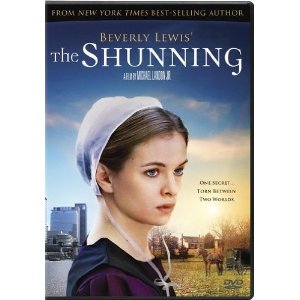 The Shunning
USA
2011
Not Rated
Contemporary Drama
4 out of 5 stars

I read the original bonnet books back when I was in middle school, which started with The Shunning. I was happy to see it pop up on my Netflix. (I believe it was a made for tv movie, possibly for the Hallmark channel?) This isn’t your typical bonnet romance. Katie Lapp is struggling with the idea of her marriage to a man she doesn’t love after the death of her first love. She also likes playing guitar and singing, which is frowned upon in the Amish community. When she learns that she is adopted, her whole world is rocked. It’s a great film both to see Amish life and to consider issues of identity and adoption. I can think of quite a few of my friends and followers who would enjoy it
Unspeakable Acts
USA
1990
Not Rated
Docudrama
3 out of 5 stars
It’s odd, I generally don’t go for courtroom drama books, but the movies sometimes work for me. This one from 1990 is about the daycare child abuse scare that happened in the 1980s and looks at the groundbreaking case that made certain aspects of children testifying easier in court. One fun thing, one of the mothers is Bebe Neuwirth (Lilith from Frasier), and it was pretty….odd seeing her in a loving mother role. This docudrama addresses the controversial methods of questioning toddlers about situations at daycares. The movie falls solidly on the pro-questioning side. I enjoyed it. It was a bit slow-moving and sometimes the acting was a bit over-the-top, but it does a good job encouraging parents to be communicative with each other and to actually bother to ask their kids questions like they are real people (which indeed they are). Some viewers might be disturbed by the graphic descriptions of child abuse.
 Creature From the Black Lagoon
USA
1954
Not Rated
Horror
4 out of 5 stars

I’ve been working my way through the 100 Horror Movies to See Before You Die, starting with the ones available on Netflix. This one is about a group of scientists who think they’ve discovered an artifact of the missing link in human evolution deep in the Amazon. They get there and of course discover that the missing link is actually a living creature. Let me just say upfront, yes it is abundantly obvious that this is one of those movies about white guys being scared of non-white guys stealing their women. Bare that in mind when watching this, and you will come away with a totally different viewing than those who don’t. It’s easy to see why it became a classic. The underwater shots are absolutely incredible. There are in particular these scenes wherein the woman is swimming in a gorgeous pure white swimsuit (I know, I know), and the creature is swimming underneath her in tandem. How they pulled that off in the 1950s, I don’t know. It is a highly watchable film and a great way to start a discussion of the racism in the 1950s. Perhaps even to try to convince those who would say otherwise that the good old days weren’t really so good. Side-note: there is a great scene where the woman scientist and the dude she’s dating are asked when they are gonna get married. It’s been a while. Only to find out they’ve been dating 6 months. o_O
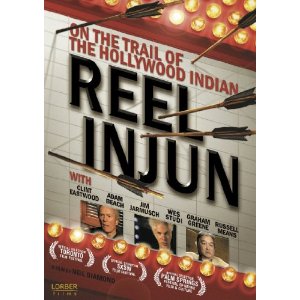 Reel Injun
USA
2009
Not Rated
Documentary
5 out of 5 stars

This documentary looks at the stereotypes and use of Native Americans in American cinema as a lens for considering Native identity and the American Indian Movement (AIM, the name for the Native American civil rights movement). The documentary eloquently moves decade by decade, presenting clips and interviewing actors, directors, and AIM activists. It completely blew my mind. For instance, I didn’t know that during the silent movie era there was a strong group of Native filmmakers who made their own, powerful movies. It was when the talkies came that the cowboy and Indian trope came about and also when every Native everywhere was re-written as a Plains Indian. For ease. Then in the 1970s and 1980s after the civil rights era, we started to get the ass-kicking Natives as a reflection of the anger in the movement. It’s impossible to come even close to telling you all everything I learned or how powerful the movie was for me. I will say, though, that I found the part about how Marlon Brando turned down his Oscar due to the treatment of Natives in cinema by sending Sacheen Littlefeather up in full Apache clothing to turn it down for him completely shocking. I had no idea that such a movement exists in Hollywood, but it does, as is also evidenced by Clint Eastwood’s involvement in this documentary. It’s encouraging to hear that not everyone in Hollywood sits by while this shit goes down. In any case, a powerful documentary and a great starting point for getting your feet wet in the Native American civil rights movement.
 The Invisible Man
USA
1933
Not Rated
Horror
2 out of 5 stars

Another entry in the 100 Horror Movies to See Before You Die. A scientist manages to make himself invisible but doesn’t have an antidote ready. Also he goes crazy. Allow me to say, yes I realize this is super-old and they still managed to do the slowly revealing the invisible dude scenes, which is an amazing achievement in cinema. Watch clips of those parts on youtube. The storyline itself is super boring and not well structured, and the science is rather shoddily done. It was good for a few laughs. For the first 55 minutes. The rest was suffering and wanting to rip my hair out. I think one of my live tweets from watching it sums it up best, “The best part of this movie is the knowledge that this dude is running around nekkid.” Because his clothes are visible, you see.
That’s about a month’s worth of movies. Stay tuned for more quick thoughts next month!
Source: Unless otherwise noted, all movies watched via Netflix.
Book Review: Claws and Saucers by David Ellroy Goldweber
 Summary:
An alphabetical guide to scifi, horror, and fantasy movies made between 1902 and 1982.
Review:
One thing I have learned from the two movie reference guides I’ve received for review since starting this book blog is that movie reference guides are not for me. Frankly with things like, oh, the internet, they’re just not useful the way they were back when I was in undergrad and professors wouldn’t accept IMDB as a reference in your English paper comparing books to their movie versions. But I digress.
Putting on my librarian cap then why does this reference guide get 2 and not 3 stars? (3 indicating not for me but maybe for others). It frankly bothers me how not academic it is. It essentially reads as a list randomly assembled by some random dude down the road, not a professor of the history of film or a film critic or anything like that really. This would be great for a blog, but not for a serious reference book. Additionally, maybe the print edition is better, but the ebook version is badly formatted and contains none of the pictures promised in the blurb.
The book basically then is your neighbor yammering in alphabetical order about random movies he selected from the early 1900s with all of the natural individual prejudices and caveats that go along with that. There’s nothing academic about it, and when push comes to shove, it’s something that would be better off as a blog than a book. I will give it this though: the title and cover are excellent.
2 out of 5 stars
Source: Netgalley

Book Review: Death By Petticoat: American History Myths Debunked by Mary Miley Theobald
 Summary:
This history book has assembled the most often-repeated myths of US History and one-by-one debunks them.
Review:
There is not much to say about a book that is so short. Listing only 63 myths, each summed up within one or two sentences and then “debunked” in under a page, it is possibly the shortest history book I’ve ever read.
The myths and debunking are interesting, but there’s far too few of them. Additionally, while images are given citations, the debunkments aren’t! Well, why should I believe what you’re saying, Theobald, as compared to anyone else? Just because you *claim* there aren’t any records of thus-and-such doesn’t mean that there aren’t unless you back it up with solid evidence. While I enjoyed the myths and the talk about them, I can’t take it seriously as an academic due to a complete lack of citations.
The cover is super-cute though.
Overall, recommended to people who want to know what the myths are, but not to anyone seeking serious history.
2 out of 5 stars
Source: Netgalley

Book Review: The Last Hunger Season: A Year in an African Farm Community on the Brink of Change by Roger Thurow
 Summary:
Smallholder farmers make up the majority of Kenya’s food production and yet they face multiple challenges from inefficient planting techniques to bad seed markets that lead to an annual wanjala–hunger season. One Acre Fund, an ngo, saw the gap and came in with a vision. Sell farmers high quality seeds and fertilizers on credit, delivered to their villages, on the condition they attend local farming classes. Roger Thurow follows four families as they try out becoming One Acre farmers.
Review:
Every once in a while there’s a book that you know will impact your entire life. I know this is one of those books.
Thurow strikes the perfect balance between narrating the farmers’ lives and knowledgeably discussing the global politics and environmental problems that also impact the hunger. The information he hands out would be riveting in any case, but how he narrates it kicks it up to another level.
Central to the book is this question:
Why were people still dying of hunger at the beginning of the twenty-first century when the world was producing—and wasting—more food than ever before? (location 202)
I know we all know there is hunger in the world, but it can be easy to ignore when it doesn’t have a face like David or Dorcas, two of the children featured whose mothers flat out do not have food to give them. During the wanjala, since it is most of the families’ first years using One Acre Fund, they do not have enough maize (their staple crop) from the year before. Thus while watching their fields grow, they don’t have enough food to feed their families. During the height of the wanjala the families routinely have tea for breakfast and lunch and maybe some boiled vegetables or bananas for dinner. And they still must farm and go to school. I can’t recall the last time I’ve been so humbled.
Don’t get me wrong. The families profiled in this book aren’t put on a pedestal or romanticized or distanced. They are very real. But their strength and wisdom in the face of so many challenges has no other option but to be inspirational. Because it is so real.
You don’t focus on the afflictions you have, on your poverty; you focus on where you are going. (location 1469)
Makes you feel bad for complaining about morning commutes, doesn’t it?
Beyond talking about the disgusting fact that there is still hunger in a world with so much plenty and demonstrating the resilience of the families, the book also discusses One Acre Fund’s poverty fighting ideas. Basically they operate on the teach a man to fish principle. Thurow talks about how Youn, the founder, believes that bringing in food aid to feed farmers is absurd. We should instead be helping them to farm better. Beyond it not being sustainable to feed everyone year after year, it robs the farmers of their dignity. This was the point I liked best. These people are not dumb or lazy. They are victims of a system that is not working. Helping them help themselves lets them retain their humanity and dignity. I think that’s something that is often missing in charity work and ngos, but it’s vital to truly changing the game.
Overall, if you want a book that will challenge your perceptions, humble you, broaden your horizons, and help you see how to truly fight global poverty, this is the book for you. In other words, this is recommended for everyone.
5 out of 5 stars
Source: Netgalley

Counts For:
Specific country? Kenya

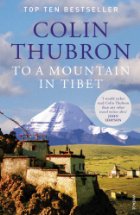
Book Review: To a Mountain in Tibet by Colin Thubron (Audiobook narrated by Steven Crossley)
 Summary:
After the death of his mother, who also was his last living family member, Colin set out on a journey to the mountain of Kailas in Tibet. The mountain is holy to both Hindus and Buddhists and is closely associated with the process of dying and crossing over. Through his eyes we see the people of Tibet and his emotional journey.
Review:
I am not sure if words can describe what an epic miss this book was for me. The combination of British western eyes othering Tibetans, an entire chapter dedicated to his father’s big game hunting, a surprising lack of emotional processing of death, and the *shudders* British accented narrator imitating Indian and Tibetan accents…..oh god. It was painful.
I see nothing wrong with a Western person traveling and appreciating something revered in another culture. If it is done right, it can be a beautiful thing. A lesson in how we are all different and yet the same. Yet through Colin’s eyes I felt as if I was very uncomfortably inhabiting the shoes of a colonizing douchebag. Perhaps part of it was the narration style of Crossley, but it felt as if Colin was judging and caricaturing all of the Tibetans and Indians he met. There was so little empathy from someone supposedly on this journey to deal with death of loved ones. You’d expect more from him. I could accept this perspective more if either Colin learned over the course of the trip or this was an older memoir, but neither is true! This is a recent memoir, and Colin is the exact same self-centered prick he was when he went in.
Similarly, Colin when he is not othering the Tibetans and Indians is either reminiscing joyfully on his father’s exploits as a big game hunter and basically colonizing douche in India or giving us a history lesson in Hinduism and Buddhism. Ok? But he’s not an expert in these religions and also that was not the point of the book? A few explanations here and there, sure, but if I wanted to learn about Buddhism or Hinduism, I sure wouldn’t be getting it from a travel memoir from an old British dude. I’m just saying.
Overall, this is an incredibly odd book. It is a book out of time that feels as if it should have been written by an understandably backward gentleman traveler in the early 1900s, not by a modern man. I honestly cannot recommend it to anyone.
2 out of 5 stars
Source: Audible

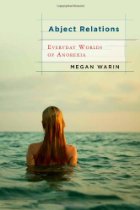
Book Review: Abject Relations: Everyday Worlds of Anorexia by Megan Warin
 Summary:
Warin, an anthropologist, takes an entirely new approach to anorexia, looking it from a purely cultural and anthropological perspective. She spends a couple of years interviewing women with anorexia at various points in the life of the illness from early treatment to recovery to relapse. In this way she analyzes not just the culture of women and men suffering from anorexia but also how anorexia is a response to the culture these people find themselves in.
Review:
This was my first read from the holdings of my new workplace. The instant I saw the title and book cover, I knew I needed to read it. The anthropology of anorexia? How fascinating!
It’s interesting that I feel I actually learned a bit more about anthropology than anorexia from this book, but perhaps that is because I am more familiar with the latter than the former. From my work in psychiatry and as a mental illness advocate, I was already aware that people suffering from anorexia have their own culture. I still highly valued seeing this presented in an academic fashion with a respect for the people involved. I commend Warin for her ability to interact with these women and glean a sense of how they came to be who they are now with a respect for them as people that is all too rare to see in this type of work.
So what of the anthropology then? What are abject relations? Over the course of the book I learned that abject relations are ambiguous relations.
What is abject is in between, ambiguous, and composite. Abjection is thus contrary to dualist concepts because it undermines and threatens that which is separate. As such, abjection is fundamentally concerned with the complexities and contradictions of relatedness. (page 184)
Whereas most books about eating disorders attempt to say THIS definitively caused it, this book’s premise is that the etiology is entirely ambiguous. What caused it, what makes it persist, what it is to suffer from anorexia. Nothing about it is clear-cut. That is the powerful statement of the book. There are no easy answers to anorexia, but we can do much more to understand it both as its own culture and as an aspect of our own.
This focus on anorexia as a response to the mainstream culture and a formation of a new culture leads Warin to question a lot of the inpatient treatment techniques. Warin sees anorexia as frequently about women attempting to assert a right to control over their own bodies that goes horribly awry, ripping the control out of society’s or tormentor’s hands, into their own, into ana’s hands, then into the hands of an authority figure again at treatment. Warin sees value in helping people suffering from anorexia recover in the context of society. Instead of feeding them alone in a single room have them cook and eat together in a group. This reenforces the cultural and connecting aspect of eating that they have been denying for so long.
It is an interesting idea to look at anorexia as an abject cultural response, but I don’t think it’s one that is quite as unique or revolutionary as Warin seems to think. Whereas there have always been those who think anorexia is the ultimate kowtowing to what society deems feminine, there have also been those who view it as women protecting themselves from being perceived as feminine, from having unwanted interactions with those who would objectify them. Perhaps it is really both, which is what makes it so hard to treat. I believe this is what Warin is trying to say, although she is often not as clear as she could be. She gets caught up in academic jargon. She is at her strongest when simply organizing her interactions with the women into themes and presenting them to the reader to do with what they will.
Overall, for an academic look at anorexia this is unique in that it is an anthropological study instead of a psychiatric one. Looking at a group of people who are a group simply because they share the same illness and studying their anthropology is a truly fascinating concept. The book is scientific, but it is social science and is thus easy enough for the mainstream reader to follow. It provides the human aspect of anorexia without sensationalizing. Anyone with an interest in eating disorders or anthropology will enjoy this book.
4 out of 5 stars
Source: Work Library

Counts For:

 Support my work with a tip or browse my shop for curated book club guides, how to guides, cross-stitch patterns, and more!


This work by Amanda Nevius is licensed under a Creative Commons Attribution-Noncommercial-No Derivative Works 3.0 United States License.
 Opinions of a Wolf