
Archive
Book Review: Evolution in a Toxic World: How Life Responds to Chemical Threats by Emily Monosson
 Summary:
Monosson attempts to explain both current and possible future impacts of chemical pollutants on humans by examining how life responded to toxic threats in the past.
Review:
Allow me to preface my review by saying that although I am not a scientist, my profession is that of a medical librarian, so scientific jargon is not new to me. I would therefore say my understanding of science is somewhere above average American but below actual scientist. I had the impression from the description that this book is written by a scientist for public consumption aka the average American. It misses the mark.
The content is great and informative, but it is couched in such an overload of scientific jargon and an assumption of an above average understanding of how the human body works that it was incredibly difficult to get through in order to glean out the interesting information. Thank goodness I had the kindle version and could look up words easily as I went, or I would have given up within the first chapter. Additionally, just when things were starting to get interesting, such as with how DDT impacts development in utero, Monosson would switch topics. Very frustrating!
That said, I did learn quite a bit from this book. It was just difficult to get to these understandable tidbits given the writing style and structure. Here are a few interesting things I learned:
Like some pervasive computer operating systems, p53 is an archetypical example of the unintelligent design and compromise that is inherent in evolution—a multifunctional, multipurpose transcriptional coordinator that has only lately been retasked to the job of tumor suppression in large, long-lived orgasms….At the end of the day p53, together with all our other suppressor mechanisms, fails half of humanity. (location 1314)
Though two species may share a common ancestor and hence a common ancestral receptor or enzyme, once they part ways on the family tree, the branches evolve independently. (location 1670)
For a genetically male mammal to come out looking and functioning male, he requires in utero exposure to hormones like testosterone and its more potent derivative, dihydrotestosterone, along with a functioning AR. An embryo lacking either hormones or a properly functioning AR (or exposed to chemicals that disrupt either receptor or hormone production) will take on a female appearance, despite possessing a Y chromosome….work by Kelce, Gray, and others revealed that a metabolite of the pesticide DDT was an even more potent inhibitor of the AR than was vinclozolin. Given the ubiquity of DDT and its metabolites, this was a potentially explosive finding. (location 1716)
If our CYP enzymes are increasingly metabolizing a variety of pharmaceuticals, what happens when we add one more, or change our diet, or breathe in chemicals like polyaromatics bound to micron-sized air pollution particulates? (location 2509)
Ultimately though, although I learned a lot, the reading experience itself was a bit daunting for the average American. I believe this book would best be enjoyed by a scientist for whom evolution is not their normal research area. They thus would have an easier time with the jargon, but also not already know what Monosson is talking about.
3 out of 5 stars
Source: NetGalley

Book Review: The China Study: The Most Comprehensive Study of Nutrition Ever Conducted And the Startling Implications for Diet, Weight Loss, And Long-term Health by T. Colin Campbell, PhD and Thomas M. Campbell II
 Summary:
Dr. Campbell spent the early part of his scientific career researching diseases of affluence such as cancer, heart disease, and diabetes. When a study in rat livers demonstrated that a greater percentage of protein in the diet led to greater disease, Campbell became intrigued. He designed the China Study to compare Chinese citizens with American citizens, since the Chinese have low rates of these diseases until they immigrate to the United States. Through this and other studies, he believes he has the proof that most diseases of affluence are caused by the Standard American Diet. In his book he presents these findings, as well as an insider’s look at the scientific, health, and government trifecta that vastly affects what Americans learn about health.
Review:
Clearly the most valuable part of this book is the chapter that explains Campbell’s China Study. Since it’s generally not considered ethical to study humans and disease by injecting them with various substances, one of the better methods available is population studies. You compare and contrast over a long period of time the differences between different populations and attempt to determine what aspects may cause bad health. It is undeniable that the traditional Chinese rural population compared to Americans eat less animal products and move more. Additionally they have less disease, particularly cancers, heart disease, and diabetes. Campbell’s study establishes this easily observed fact into something that has been scientifically proven. It is also interesting to note that those who emigrate to the US and adopt the Standard American Diet (SAD) change to the American rate of these diseases. This is ground-breaking information, of course, but it is easy to gather this all from one chapter. Campbell finds it necessary, for some reason, to devote a chapter to each illness, which frankly gets repetitive and tedious to read.
Beyond the study itself, which is interesting and good for people who aren’t already convinced of the health problems caused by animal products, I felt the rest of the presentation of these facts to be dull in comparison to Diet for a New America
He also eloquently shows why we have constantly conflicting news stories on health. Everyone knows the joke about how eggs were bad for you then good for you then bad for you (but only the yolks) all over again. Campbell shows how this is the direct result of the conflict within the science and health industry.
I have come to the conclusion that when it comes to health, government is not for the people; it is for the food industry and the pharmaceutical industry at the expense of the people. It is a systemic problem where industry, academia and government combine to determine the health of this country. (page 318)
I have worked in the health field myself for years now, and I can tell you, the vast majority of the people who do genuinely care about you and your health. But traditions are hard to break and even those within the system don’t know everything that goes on among the lobbyists and the top echelons. I mean, they are still teaching medical students to utilize BMI to determine health in their patients, when multiple studies have shown it is not a reliable tool. Why is this? People want to believe what they’ve first learned, and especially in medicine, if a new idea comes along many many many studies must be done and obstinate people push for it before the method utilized will be changed. This is meant to protect you from quacks, but unfortunately it can lead to the burying of ground-breaking information.
Plus, how would Americans react if tomorrow Mrs. Obama and her obesity prevention program came out and said everyone needs to go vegetarian or vegan? Hell, the woman is taking flak for daring to suggest children play outside. I think you can see my point.
Overall, this book definitely could have been shorter. I believe it would have worked better if Campbell had presented his study and his insider’s knowledge as to why the health care and science industries seem so confused and conflicting half the time. I hope this knowledge will convince more Americans to take direct control of their own health and conduct their own research to come to their own conclusions. It’s worth a read for this knowledge, but if you are not interested in the politics of science and health and simply want the information, then I suggest you go with the more reader-friendly Diet for a New America
4 out of 5 stars
Source: Public Library

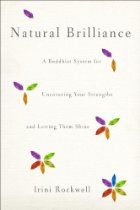
Book Review: Natural Brilliance: A Buddhist System for Uncovering Your Strengths and Letting Them Shine by Irini Rockwell
 Summary:
Utilizing the traditional Buddhist five wisdoms–presence, clarity, richness, passion, and action, Rockwell seeks to show readers their own personal strengths and possible weaknesses. Rockwell then seeks to demonstrate how to bring out the other three to four wisdoms within your personality to achieve more balance.
Review:
Before I had a book blog, I read quite a bit of Buddhist literature. My minor was Religious Studies, and I also had an interest in it from a psychiatric and personal perspective. Certain aspects of Buddhism are used in modern psychiatric treatments, for instance. In any case, this is not my first Buddhist read. I am familiar with a lot of the terminology and ideas. This book though was nearly impossible to follow. Quite possibly the worst book on Buddhism I’ve ever come across.
First, there’s how Rockwell talks about the five wisdoms. Instead of consistently calling them by either their English name, Sanskrit name, or a hyphenated version of the two like most Buddhist works do, Rockwell bafflingly switches back and forth between English and Sanskrit without any rhyme or reason. Particularly in an ebook where it’s difficult to flip back to the earlier pages where the wisdoms were introduced, this makes it really hard to follow the author’s thought-process.
Similarly, random information is inserted but then not fully explained. I wonder if in the print version these are set apart in boxes? Not sure. For instance, the section introducing the five wisdoms has a completely random blip about the colors Tibetan Buddhism associates with them inserted in the text between the fourth and fifth wisdoms. It’s just jarring and odd.
Finally, I didn’t really learn anything of value from the book. Rockwell talks at length about what a person who is mostly possessing the wisdom of passion might look, behave, and even dress like, but not much is discussed about how to put this knowledge to good use. It’s almost as if Rockwell got so caught up in describing the wisdoms that he forgot to talk to us about how to put this knowledge to much use. Besides, does it really help to know to label the person who is passionate as exhibiting the passion wisdom? We already know instinctively what they are like and how to deal with them. Labeling it doesn’t really help, does it?
Overall, I found this book to offer very little in a way of self-improvement or aid in dealing with people. It is confusingly organized without much valuable information within it. Although it is a readable book that is not at all offensive, it just doesn’t seem like reading it is worth the time.
2 out of 5 stars
Source: NetGalley

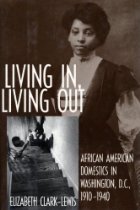
Book Review: Living In, Living Out: African American Domestics in Washington, D.C., 1910-1940 by Elizabeth Clark-Lewis (The Real Help Reading Project)
 Summary:
Clark-Lewis’ grandmother was part of the great migration of African-American women from the south to Washington, DC who then took on domestic work in the homes of the rich and powerful. Through her grandmother, Clark-Lewis was able to contact many of the elderly women who were part of this movement and assemble their oral histories. Utilizing their histories, she paints a picture of the typical life of the African-American women like her grandmother.
Review:
It’s hard to believe this is the final book in The Real Help Reading Project. I’ll be posting my wrap-up later this week, so be sure to check that out for reflections on the project overall. For right now, though, let’s talk about the last book.
In comparison to other pieces of nonfiction on the list, like Labor of Love, Labor of Sorrow
What I found most interesting was how these rural women were raised by their families specifically to do domestic labor.
Your people all trained you to do service work. It was what they all knew you had to learn—period. Now, maybe a teacher, aunt, or somebody would tell you that you could do other work, but you knew that you’d do service work. You knew, and sometimes you’d think about doing different work—but you knew it wasn’t to be. ‘Specially at home—service was all there was for you. They knew it. You knew it. (page 43-4)
I think if I hadn’t read and learned about the conditions in the south for African-Americans I would find this to be a very defeatist attitude, but really it was just practical. The girls’ families were just trying to give them the tools they needed to succeed as best they could in the culture they were in. Although the adult women look back on their hardworking childhoods with a bit of bitterness at the loss of the ability to be just a child, they also acknowledge that these tools helped them succeed in life.
Another interesting thing is that sending the women north had nothing to do with advancing their lives but everything to do with helping and saving the family and the family farm. The family unit was very strong for all of these women, even at a distance. They helped distant and close relatives in DC with childcare and other labor and sent all or the majority of their pay home to the family farm. This really fights the stereotype in American media about the weak or non-existent African-American family unit. I was, indeed, impressed at how these families managed to stick together across such a distance and among the different cultures of the north and south.
The other issue this book addresses that none of our other nonfiction reads really did was how dehumanizing it was for African-American women to “live in” aka to live within the house they were working as a servant for.
Living in you had nothing. They job was for them, not your life. [From the] time I could, I started to try to get something that let me have some rest. A rest at the end of the day. That’s why you try to live out. You’d be willing to take any chance to live out to just have some time that was yours. (page 124)
Personally I don’t find this surprising at all, since I feel a real need for personal space away from my job, and I think most, if not all, people do. However, the culture at the time seemed to think that African-Americans didn’t need that. I’m sure part of that thought process was due to racism.
If there is one thing that this book demonstrates above all else, though, as have many in this project, it’s that no matter what the family the domestic help labors for thinks, they themselves do not see themselves as “like one of the family.”
She [the domestic worker] was proud that they [the family she worked for] “didn’t even know where I lived.” She did not consider them nice people, friends, family, or even good employers. She worked for them strictly for the money. Period! Yet they insisted that she was “just like family. (page 188)
Things like this….they kind of give me the willies. What kind of a culture and society are we cultivating where this sort of disparity of perceptions of a working arrangement can exist? Employers shouldn’t be able to think an employee is “like one of the family” while that worker is simultaneously thinking the employers are bad people. I understand that we all fake it to survive, but it shouldn’t have to be that way. We should be able to do our jobs and be happy and have positive relationships with our employers. That, to me, is a basic human right, and I think one thing that this book demonstrates is that this is only possible in a job where the domestic help lives out. Where they come in, do the cleaning (in their own clothes, not a uniform), and leave. It is true that some people are frail and need help with those tasks or are so busy they can’t find the time to do it but can afford to pay someone else to. But it should be about getting the task done. Getting in and out. Not forcing uniforms and groveling upon people. That’s just evidence of classism at its worst.
Source: Public Library

Discussion Questions:
Note, originally Amy was going to host the discussion, but since she lost her book during all of the traveling she has to do for work, I thought I’d go ahead and post some questions for everyone. I am sure she will get her hands on another copy eventually. Alas, this book isn’t as readily available in Canadian libraries.
- The women in the book point out that their families wanted them to stay working with one family for their whole lives as “live ins.” Why do you think their parents wanted that?
- Clark-Lewis points out the value in gathering oral histories from the elderly. Have you ever gathered any oral histories and what did you learn from them?
- The women specifically point out how being in a city and exposed to other ways of doing things led them to defy their families, sometimes with bad consequences. What do you think about this sort of impact city life has on migrants from the countryside?
- One woman who grew up with the domestic worker quoted from page 188 working in her home referred to her as like one of the family, but the worker did not see it that way. What do you think leads children with domestic help in the home to see them like family when even the help does not see themselves that way?
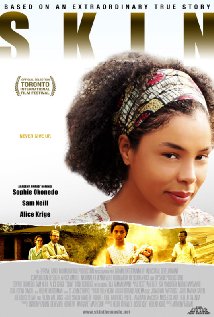
Movie Review: Skin (2008) South Africa
 Summary:
Based on a true story, Sandra Laing was born black to two white parents. Something that is an interesting anomaly of unacknowledged or unknown ancestors, but unfortunately for Sandra it was oh so much more than that. Sandra was born in South Africa during Apartheid, and her white Afrikaner parents were members of the National Party. This film chronicles her fascinating life from a young girl hidden from the sun in the hopes that her skin would lighten as she grew older to a young runaway marriage to striking out on her own with her children.
Review:
I know movie reviews have been scarce around here. That’s mostly because since I joined the gym my evening free time is spent either there or reading. This weekend though I had a cold and a bit of a fuzzy head from a fever so I randomly chose an interesting looking movie from my Netflix recommendations. I had no idea when I chose it that Sandra Laing’s story is a true one. I didn’t realize this bit of information until the end credits. I thought it was one of those “what if” scenarios and knowing that this actually happened makes the whole thing incredibly painful.
We know that innate parental unconditional love is a myth. And if there was ever a true story that should unequivocally dispel this myth once and for all, it’s Sandra’s. Is there anything more abusive, more unloving than raising your child in a culture that hates her and doing, really, nothing about it? Although her parents did fight to have her classified as white and not colored (so they could keep custody of her, because apparently children had to be raised by parents of the same race during Apartheid), they did little else to protect her. Indeed, by her teen years her father was pressuring her to behave for white boys who were being verbally cruel at best or attempting to rape her at worst on dates. It’s little wonder Sandra ran off to be with a black man she met. Your role as a parent should be to protect your child and prepare her to take care of herself in the real world and advocate for herself. But Sandra’s parents’ racism clouded everything so much that the most they did was attempt to hide her.
Of course, the problem then became that Sandra was raised in a privileged background, and that’s all some of the black South Africans could see when they looked at her, including her own husband. He says to her at one point, “You still think of yourself as white.” I find it fascinating how people can become so wrapped up in their own problems resulting from inequality that they fail to see the pain inflicted by it on others, even others that they love.
The actress who plays the older Sandra does a great job showing her progression from a hopeful teen to a downtrodden factory worker at the end of Apartheid. The trauma from a life where everyone judged her either on her own skin tone or that of her parents is abundantly evident on the actresses’ face.
That said, while the topic is incredibly important and the true life events heart-breaking, I don’t think the movie itself does the real story true justice. The actors and actresses did a fine job with what they were given, but even basic googling shows that the story was cleaned up for a mainstream audience, which I think was a very poor decision on the part of the filmmakers. Sandra’s life was actually more difficult than they even give her credit for. For instance, she left home at only 15 (she seems much older in the film), her first husband already had a first wife, she actually had six children not two, etc…. (Essence, The Guardian, Women and Hollywood)
Personally, I view this movie as a gateway to the far more fascinating nitty gritty true story. I’m adding the book by the journalist Judith Stone about her work with Sandra to attempt to figure out her past called When She Was White
4 out of 5 stars
Source: Netflix Instant

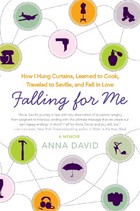
Book Review: Falling For Me: How I Hung Curtains, Learned to Cook, Traveled to Seville, and Fell in Love by Anna David
 Summary:
Anna David is a successful writer in her mid 30s living in NYC when an overwhelming depression hits her. She’s still single. What’s wrong with her? While fighting off tears in the self-help section, she finds a copy of Sex and the Single Girl by Helen Gurley Brown, which was a bestseller in the 1960s. Essentially a guide to being happy single while still keeping an eye open for Mr. Right, Anna instantly connects with Helen Gurley Brown and decides to spend the next year challenging herself and taking advantage of everything being single has to offer.
Review:
It should really need no explaining why I picked this book up. I’ve always been the relationship type (even when I tried not to be), but I also won’t settle for just anybody, and sometimes that combination leads to some ennui. I was hoping I would find a connection to and insight from Anna, and I was certainly right about that.
The very first chapter has Anna breaking down in line for food in her head, basically saying, “I’m going to be alone forever,” and going on from there adding that she’ll be the crazy old maid cat lady and going further and further on into ridiculousness that really doesn’t seem that ridiculous when it’s your brain saying it to yourself. I knew instantly that Anna and I would get along.
As opposed to a lot of other single gal memoirs, the focus is neither just love yourself the way you are nor fake everything to land a man. It’s more like….Do you have any idea how lucky you are to even have this phase in your life? You’re single! You can do anything, go anywhere, decorate however you want, and etc… Anna realizes that she hasn’t been taking full advantage of the things being single affords to her. Things like deciding to house swap and live for a month in Seville (try doing that with a baby) or taking French classes in the evening or spending the day rollerblading and winding up in a park in the sun. So Anna isn’t just trudging along being herself. She’s pushing herself to try new things, go new places, and yes the future Mr. Anna may be there, but even if he’s not, she’s still having a fun time doing it.
The book also addresses another common issue among single women and, well, people in general–grass is always greener syndrome. Anna eventually realizes that she seems to think all of her problems will just disappear if and when she gets married, when that is really not the case at all if you pay an iota of attention to married couples.
One specific line in S&SG that I keep thinking of—“I’ve never met a completely happy single girl or a completely happy married one”—and how it’s helped me to see that I’m somehow convinced that getting to the next stage will make me instantly joyous. (page 36)
The other thing that is sooo relatable that Anna talks about is how it’s so easy to become so desperate for a partner that you start trying to change yourself for him or worry constantly about whether or not you’re good enough for him, when that’s not how dating is supposed to work!
You spend all your time trying to manipulate a guy into wanting you to be his girlfriend when what you should be doing is enjoying yourself and then later figuring out if you even want him as a boyfriend. (page 205)
There are definitely things about Anna that I don’t like or I disagree with (for instance, she eats veal and foie gras, ahem, the book almost got thrown across the room at that point), but even though we’re different, we’re also the same. We’re two single gals who are wondering why everyone else seems to be coupling up but me? What Anna slowly realizes over her year-long experiment is that there is no timeline for love and marriage. It’s not like it’s a game of musical chairs and she’ll be left the only one without one. Maybe her music is just playing at a different speed. I think that’s a really important thing to remember and touching to see someone else struggling with, because it’s far too easy to start pressuring ourselves and the men we date into situations that just aren’t right for either of us. It’ll happen when it happens.
This is a rare instance when I feel the need to sort of reveal the ending. I was worried the book would end with Anna abundantly happy in a relationship, kind of like Eat, Pray, Love, which honestly would only have made me more depressed. Like the book was all about yay singlehood but I still landed a man, right? But no. Who Anna falls in love with is not a man, but herself.
Here’s what I’ve come to understand: I used to not really believe I deserved thick, gorgeous panels for my windows or to pull books from a bookshelf specifically selected for my apartment. It didn’t occur to me that I was worth cooking homemade chicken soup for or dressing in beautiful clothes. I thought I was half a person because I didn’t have a partner but that when I had one, I’d do those things for him. Now I see that I’m entirely whole so that if and when I find him, we can be two whole people together, not the person and a half we would have been. (page 305)
Yes, yes, yes! Finally. A book about being single and loving yourself and taking care of yourself and being a whole person as just you. Sure, the professionals tell us that, but it’s super-nice to get to hear it from a gal who could easily be somebody I have bimonthly cocktails with.
I highly recommend this book to any single ladies in their 20s and up. It’s a nice reminder that we’re not the only ones learning to love ourselves and be patient for the right person.
4 out of 5 stars
Source: Public Library

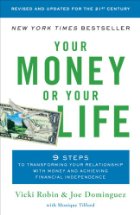
Book Review: Your Money or Your Life: 9 Steps to Transforming Your Relationship with Money and Achieving Financial Independence by Vicki Robin and Joe Dominguez
 Summary:
Dominguez achieved Financial Independence at the ripe old age of 30 and proceeded to provide his method to friends who encouraged him to offer it as a class. He finally wrote a book, and this edition is revised and updated for modern times by his friend and fellow achiever of Financial Independence, Vicki Robin. Offering steps and mind-set changes, not magic formulas, they promise that if you follow the steps, you can be Financially Independent in 5 to 10 years, no matter how much debt you are currently in or how much money you make.
Review:
It took me an astoundingly long time (for me) to read through this book, partly because the information really does alter your world-view, and partly out of a desire to let each step sink into my mind before reading the next one. I took sixteen pages of typed notes, something I haven’t done since grad school (ok, ok, undergrad….). The information is just that good.
What is Financial Independence? It’s when you’re out of debt and making enough income off of safe investments that you do not have to work for a living. This frees you up to do what you want with your life, whatever that may be. Some people volunteer, others start a business, some spend their time with family, some travel, the options are endless.
The steps are simple and straight-forward, but they all come back to the central idea that money is something we trade our life energy for. It seems obvious when you hear it spelled out that way, but personally it was not routine for me to think of my money and spending in that manner. Not anymore. When I was a work-study student and got to keep all my money, no taxes, no commute time, no work wardrobe to buy, no work lunches, it was easy to think “Ok, I have to work this many hours to buy this thing.” Grown-up, real world work isn’t that obvious. So figuring out my “real wage” by calculating out how many hours I actually spend working (including commute and lunch break), the cost of working (work wardrobe and T pass), reveals that one hour of my life equals $7. I figured this out back in December. Trust me, it completely changed my spending habits. It’s abundantly clear when you look at my mint.com account.
So, I can say that the early steps definitely have changed me. Can I tell you this book will work, and I will be Financially Independent in 5 to 10 years? No. I have no clue yet. I can tell you, though, that the steps are real and not toted as magic. It will take a lot of work. That, combined with the effects on me of the early steps, are enough for me to say that this book is worth it. It teaches you to be in control of your life, instead of letting money and the “American Dream” control you. But let me tell you the nine steps, just to prove to you that none of them are a “magic formula” type thing.
- Make peace with your past
- Track your life energy
- Tabulate monthly
- Ask yourself the three questions for each category during your monthly tabulation: a) Did I receive fulfillment, satisfaction and value in proportion to life energy spent? b) Is this expenditure of life energy in alignment with my values and life purpose? c) How might this expenditure change if I didn’t have to work for a living?
- Make a wall chart where you can plot your monthly expenditures, total income, and investment income in three different colors to help you see change and progress over time.
- Value your life energy by minimizing spending
- Value your life energy by maximizing income
- After you’ve tracked on your Wall Chart for a while, calculate your Crossover Point–the point in the future where your investment income and expenditures meet and “cross over.”
- Become knowledgeable and sophisticated about long-term income-producing investments and manage your finances for a consistent income sufficient to your needs over the long term.
If these steps intrigue you and you have a desire to become Financially Independent, then I strongly encourage you to read this book. In fact, I encourage everyone to read at least the first few chapters to learn how to have a different relationship with money. One where you are in control of it and thus regain control of your life.
5 out of 5 stars
Source: Public Library

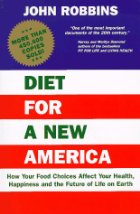
Book Review: Diet For a New America by John Robbins (Diet for a New America Reading Project, Book 1)
 Summary:
John Robbins was born into one of the most powerful corporations in America–Baskin-Robbins. A company based entirely on selling animal products. Yet he took it upon himself to investigate the reality of animal products and their impact on Americans, American land, and the world overall. This book summarizes his extensive research, including personal visits to factory farms.
Review/Discussion:
This is the first book in the Diet for a New America Reading Project 2012 I am hosting. The project is focused on educating ourselves on the facts behind health and preventative medicine for the well-being of all Americans, an issue that I am sure we can all agree is a serious one. If you join the project late, please feel free to come back to this post or the GoodReads group after you’ve finished the book to join in on the discussion. And now, on to the book!
There are books that you read that are so incredibly powerful you are left almost speechless. Simply wanting to hand out copies to everyone you know, everyone you meet and say, “Please, read this.” I highlighted so much in my copy that I couldn’t even do my usual of posting all highlighted quotes to my tumblr. I discovered I was practically illegally reproducing the book, hah. ;-) I thus will do my best to highlight precisely why I find this book trustworthy, why I feel inspired by John Robbins, and the most stunning facts I learned while reading the book.
Why You Should Trust This Book
As a medical librarian, I was very careful to check out Robbins’ resources for his facts, particularly for the health section, which is what this project is focused upon. Robbins drew his research from vetted, peer-reviewed, well-respected scientific journals, including ones I routinely use in my own work, such as Journal of the American Medical Association, the British Journal of Medicine, and The American Journal of Clinical Nutrition. He also cites the studies of such organizations as the FDA, the EPA, and the National Cancer Institute. Additionally, he conducted personal interviews with real factory farmers and scientists. Additionally, all of his citations are in order. You may not like the facts he reports, but they are still scientifically backed-up facts.
The fact that John Robbins researched the effects of animal derived foods on the environment and people and decided that it is bad for everyone involved is remarkable when you consider the fact that he comes from a family whose business is based entirely on selling dairy to Americans. If the man had an innate bias, it would absolutely be on the side of carnists/omnivores, but he astoundingly conducted the research and came down on the side veg*ism. (His family reunions must really be something…) This not only makes me respect him, but trust him. Somebody must be truly convinced to convert away from a business that has made his family, and presumably himself if he had agreed to take over the business, extremely wealthy.
But enough about why this book is trustworthy. Let’s move on to discuss the astounding scientific facts revealed in the three different sections: animal rights and factory farming, health consequences of eating animal based products, and environmental consequences of meat-based diets.
Animal Rights and Factory Farming
I definitely believe this knowledge is more widely spread than when this book was first published. I have a hard time imagining growing up in America and not coming to understand the horrors of factory farming, but you never know. Robbins talks about the psychiatric fact that children who grow up abusing animals are more likely to become criminals in later life. This, of course, is a basic reason to not base an entire sector of the American economy around factory farms that treat animals horribly like cogs in a machine. Of course there are more reasons to treat animals well, such as the fact that dogs’ EEG scans are identical to human’s or that dolphins routinely save humans and other animals in the ocean or that many species of animals mate for life showing a dedication most humans can’t pull off.
The horrors of factory farming are so extensive that it’s difficult to even list them. I feel as if I could go on and on. Perhaps the best way is to tell you to imagine being in the most crowded elevator possible. Now imagine that 20 of the 24 hours you’re in there it’s dark. You’re standing on a slanted, slatted, metal floor. The food for everyone is all on one side and is dumped in all at once and you must shove and race to get to it. Of course it’s difficult to even call this food. It’s a mix of shit, paper, sawdust, chemicals, and antibiotics all spiked with yet another chemical to make it smell better to you. If you are female, then a hand periodically reaches in and artificially inseminates you, only to rip your baby away from you the instant it is born and hitch machines up to your mammary glands instead of allowing your milk to go to your baby. If you are male, you are castrated by placing a band around your testicles until they fall off after weeks of the circulation being cut off.
That is the reality for factory farmed animals. Even if you can manage to ignore the fact that these animals are being pumped full of chemicals and artificial growth hormones that you will then ingest yourself when you eat them or their products, that is still a horrifying way to get your food. These animals live in terror and pain and die in terror and pain. There is nothing natural about a factory farm. Animals were meant to live outside and graze and nurse their babies and maybe live in a herd or a flock. Not be caged up in situations so unnatural that they literally go crazy and cannibalize each other when they are naturally herbivores. That is the reality of what you are supporting when you buy factory-farmed animal products.
Human Health
Ok, so maybe now you don’t believe in factory farming, but what about eating animals in general? We were raised to believe that a healthy diet involves meat, dairy, and eggs, right? Surely if an animal is raised organically and humanely all will be well? Well, the meat and dairy lobbyists have done a LOT of work to hide from you the scientific studies that show their products are unhealthy for you. If you read only a portion of this book, read the health section. It is impossible for me in this discussion and review to make as eloquent a point as Robbins does. I will instead sum it up for you.
In scientific studies published in reputable scientific journals such as JAMA, vegetarians have drastically less occurrence of: heart disease, all cancers, strokes, osteoporosis, diabetes, hypoglycemia, multiple sclerosis, ulcers, IBS, arthritis, kidney stones, gallstones, hypertension, anemia, and asthma. Those who still have any of the chronic diseases are distinctly less symptomatic than the meat-eaters. Vegans (people who consume no animal products whatsoever) have even LOWER occurrences than vegetarians. This is vetted by multiple different studies run by different scientists in multiple nations. Even simply comparing the data of these diseases between countries following the standard American diet and those following a primarily plant-based diet backs these statistics up.
I am sure that those of you who read the book as I did were stunned to hear that these studies have been in the reputable journals since as early as the late 1960s and 1970s and yet we have not heard about them. Who is to blame? The meat and dairy lobbyists of course. What would happen to their businesses if the American people suddenly stopped following the standard American diet? The Dairy Council provides the nutritional packets at your kids’ schools. Think about that.
The Environment
The environmental impact of a meat-based diet has started to crop up more often recently with the increased interest in the green movement. Essentially, Robbins primarily reiterates what I believe most of us already know. The chemicals necessary to factory farm are bad for the whole planet. It takes more fossil-fuel energy, more water, and more acreage to feed one person a meat-based diet than a plant-based diet. These are things that are definitely relevant, particularly to people who don’t believe in human population control. What I personally found most interesting in this section though was the discovery that American imports meat from Central and South American nations who have been destroying rainforest to do so, and their people are still overwhelmingly on a meat-based diet. Thus these nations are destroying their own ecologies to support Americans’ wasteful meat-based diets. That is just disgusting and selfish on our parts.
My Conclusion
I am honestly a bit shocked at the extent of the facts that I didn’t know when I became a vegetarian in January of 2006. I admit I mostly became one out of an empathy for animals that I have always strongly felt, but additionally the less meat I ate, the better I felt. Becoming a vegetarian mostly eliminated the symptoms of my IBS as the scientific studies Robbins cites showed. But….I have a hard time imagining anyone reading the facts like this and not drastically changing their eating habits. So many of the economic and personal problems in the US today have to do with health. So maybe you’ve read this book and you still don’t care about animals and you still believe humans are better than them. But don’t you want to be as healthy as you can be for your lifetime? Wouldn’t you rather be a happy, healthy grandparent than a stooped-over one on multiple heart medications or going through chemotherapy? Even if you don’t care about that, don’t you want to leave a healthier planet for your children and your children’s children? The facts unequivocally show that the fewer animal products you consume, the better all of these outcomes will be.
Once we become aware of the impact of our food choices, we can never really forget. (page 379)
Source: Better World Books

Discussion Questions:
- Robbins believes that the scientific studies reported in the medical journals aren’t well-known because of the meat and dairy lobbies. Do you think this is the case? Why or why not?
- If you do think the facts aren’t known because of the meat and dairy lobbies, how can we combat this?
- If you don’t think the lobbyists have anything to do with the lack of public knowledge of these issues, what do you think the true cause is?
- Do you believe the fight for organic animal farming is doing anything to help the environmental and health issues cited in the book?
- What do you think can be done to get the meat and dairy lobbyists out of our schools?
- Would you be willing to change your diet knowing the facts about the diseases it can cause or do you think it’s not worth the effort?
- Do you believe money is better spent on treating the disease or preventing the disease?
- Do you think world hunger can be successfully combated with a change in the diets of those in the first world countries?
Book Review: Nano House: Innovations for Small Dwellings by Phyllis Richardson
 Summary:
A nano house is a super-small house, generally between 300 and under 1,000 square feet. This book shows off nano houses from all over the world with different goals in mind, from an eco-friendly retreat that blends in with the surroundings to pod buildings that could be assembled into space-saving towers in the city to more traditional house boats. One goal of all the houses remains the same. How little space can one person or family take up to make the smallest impact on the environment?
Review:
I became fascinated with nano houses after stumbling across a few on the internet. One that sticks out in my mind is a couple that built theirs together and had a blog about it. There was another one in Australia that the woman made from plastic bottles and dirt. The whole concept was just so….refreshing. A small space that is uniquely you (or your family) that fits in just right with your surroundings. So when I found out about a book coming out collecting a bunch of these houses together, I put myself on the hold list at the library immediately. I wanted to know more details about building these remarkable little houses and the kind of people who are choosing them. Unfortunately, this book missed the entire soul of the blogs and blurbs I’d found online.
Instead of seeking out individuals and families who designed and built their homes themselves, the houses here were all made by architectural firms or design students. If you’ve ever met that snotty whoever in the bar who just can’t stop talking about his high-class ideas for making the whole world more up to his par, then you know the vibe this book sends off in waves. It’s not enough to make a small, livable house with minor impact, no, they must use this new, experimental flooring or make the house look like a storage shed or design their own perfectly circular furniture or give a speech about the revolutionary concept of having a yard on the roof of your houseboat. Um, newsflash, pretty sure I came up with that idea when I was 5.
Instead of interviewing the people who live in these houses, the author talks about what the houses are like and why they are built. We get to hear nothing about actually *living* in a nano house. Indeed, some of the houses were simply made for design contests or as student projects with no intention of anyone living in them at all, which seems to be the OPPOSITE of environmentally friendly if you ask me.
In fact, the whole book reads like greenwashing. Oh, they say anyone can afford to buy this house or live there, but in fact it’s the “eccentric” wealthy who own these houses as second homes or vacation homes or a place to stick guests so they aren’t in the main house….but it’s environmentally friendly, so it’s all cool. What I wanted to see was game changers. Ordinary people who chose to make their own home their own way. What I got instead was annoying architectural design students and getaways for the wealthy. Plus, there are not nearly enough pictures of the houses to get a good idea of what they are actually like, and any floor plans are printed so small that they are impossible to read.
Overall, this book has a great title, but is a huge disappointment. It reads like a bunch of wealthy people patting each other on the back at a party at the Ritz, missing the entire soul of the environmental movement.
2 out of 5 stars
Source: Public Library

Book Review: To ‘Joy My Freedom: Southern Black Women’s Lives and Labors After the Civil War by Tera W. Hunter (The Real Help Reading Project)
 Summary:
Hunter examines the lives of southern black women, particularly southern domestic workers, by narrowing her focus in on the development of the city of Atlanta after the Civil War. Since many ex-slaves moved to Atlanta and then migrated again north during the Great Migration decades later, this makes for an excellent focal point for the topic. By examining black women’s lives in Atlanta both in and out of their employer’s homes, she is able to dissect the roles of race, class, and gender in the elite’s attempts to maintain dominance in America.
Review:
I’ve said throughout the project that the nonfiction books have come up a bit short for me. Although they’ve contained valuable information, they haven’t been the most readable. Nonfiction can tell a story too, and Hunter does exactly that. She explores so much more than just the women’s lives in relation to their employers. Atlanta truly comes to life as we see the women commute to work via bicycle so as to avoid racist trolley lines and kick up their heels on the interracial Decatur Street after dark. We also get to see the empowering role of secret societies in black women’s lives, as well as reclamation of performing in black face and the terrifying resurgence of the Ku Klux Klan. It is impossible not to be moved and outraged by the tale of these women’s struggles. The book addresses three issues: classism, racism, and sexism.
In spite of Americans being told repeatedly that the American Dream is available to all if you work hard enough, Hunter quickly shows how the poor are fighting a losing battle and on top of it are demonized by the wealthy. For instance, the use of debt to keep the poor enslaved:
Poor women often borrowed money in meager amounts, less than one dollar at a time, amassed running accounts for several months or years, and repaid ever-accumulating interest in small installments. Many moneylenders were usurious. It was common for borrowers to pay 250 to 3500 percent interest on small sums, which exacerbated poverty with interminable debt. Fannie Holman, a washerwoman, borrowed between $60 and $90 over a two- or three-year period. Though she would repay over $1,000, the creditor applied it to defray the interest but not the principal of the loan. (page 134)
Similarly, upper class employers’ attempts to control every aspect of their employee’s lives, claiming a right over their bodies:
Dance halls were a menace, declared Proctor, because “the servant class tried to work all day and dance all night.” He warned employers that household laborers would not perform well if they used their leisure unproductively—dancing instead of resting in preparation for the next day of work. (page 179)
Hunter via maps and clear explanations demonstrates how the wealthy acquired the highest land in Atlanta most conveniently near shopping and such, while the poor and blacks were forced into the lowest land that, in addition, sewage was dumped into. These conditions combined with the poor housing provided by slumlords made a perfect scenario for disease, and yet the poor were blamed for the outbreak of tuberculosis in the city and even accused of exposing wealthy whites to it:
Tuberculosis signified more than a purely physiological condition. The disease became a medium for “framing” tensions in labor and race relations, with the rhetoric cloaked in scientific and medical legitimacy. (page 187)
Of course, the fact that black workers were poor was no coincidence. The entire city conspired since the Civil War to make black Americans poor and keep them that way. The wealthy whites, and in a lot of cases the poor whites, wanted black people out of sight and out of mind unless they were actively in service to them
Jim Crow and domestic labor thus represented contradictory desires among urban whites striving to distance themselves from an “inferior race,” but dependent on the very same people they despised to perform the most intimate labor in their homes. (page 105)
Segregation was not a system imposed entirely from above; it also helped to advance the interests of white workers, who were able to gain status from their position in the social hierarchy above all blacks. (page 119)
Jim Crow parks were designed not simply to put white urbanites closer to nature, but also to give them moments of reprieve and distance from blacks in order to channel racial friction in “wholesome” directions. (page 147)
Of course, on top of having their fight for the right over their own bodies and lives depicted by the ruling white class as them being uppity servants and uppity blacks, women had the additional injustice of having their femininity and womanhood called into question.
Like the defiant women in Galveston, strikers in Atlanta showed little attachment to prevailing middle-class conventions of femininity. As they did on other occasions, working-class women used street fights to settle disputes that jeopardized their unity and engaged in militant resistance. (page 89)
The moral implications of women consuming intoxicating substances troubled many middle-class blacks and whites. Women not only evaded laws prohibiting them from entering saloons, they frequented bar room “annexes,” they drank alcohol in alleys and streets, and they sold beer from their homes. (page 165)
I usually don’t quote this much, but the whole book is just so good. The three-way injustices faced by black working class women is palpable throughout. Facing one alone would be daunting enough, but facing three feels terrifyingly insurmountable even just reading about it, let alone living it. And yet some black domestic workers did pull through in spite of the odds and do great things. Women like Carrie Steele.
Former slave Carrie Steele, a stewardess and cook at the train station, volunteered her time as a probation officer for children in trouble with the law. This experience and her childhood as an orphan inspired her to start an orphanage in 1890. She believed that many of the children she came in contact with had fallen on hard times because they had no families to take care of them. Steele raised money to purchase four acres of land and the orphans’ first home by selling her own house, writing and selling her autobiography, and soliciting funds from generous individuals, black and white. By 1898 the Steele orphanage consisted of a brick building, hospital, and schoolhouse, and more than two hundred children had passed through its portals since its founding. (page 142)
Inspirational. Humbling. Awe-inspiring. Words that describe both Carrie Steele’s life and the book as a whole. Read it.
Source: Public Library

Discussion Questions:
- Why do you think Decatur Street was allowed to continue in spite of being the only known location in Atlanta where the races mingled?
- Hunter values the dance halls for the role of letting off steam and embracing black culture they played in black Americans’ lives. How do you feel about them?
- In spite of viewing black Americans as “unclean,” white Atlantans persisted in sending their laundry out to black homes to be washed. Why do you think people were able to hold onto such illogical dichotomies?
- Given the depiction of of everything stacked against them, do you view drug dealers, bootleggers, prostitutes, etc… differently now than you did before?
If you found this review helpful, please consider tipping me on ko-fi, checking out my digital items available in my ko-fi shop, buying one of my publications, or using one of my referral/coupon codes. Thank you for your support!
 Support my work with a tip or browse my shop for curated book club guides, how to guides, cross-stitch patterns, and more!


This work by Amanda Nevius is licensed under a Creative Commons Attribution-Noncommercial-No Derivative Works 3.0 United States License.
 Opinions of a Wolf