
Archive
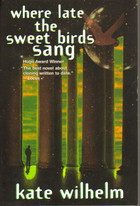
Book Review: Where Late the Sweet Birds Sang by Kate Wilhelm (Audiobook narrated by Anna Fields)
 Summary:
When the world goes through an apocalypse consisting of virulent strains of the flu, lack of food, and nuclear warfare, one wealthy family manages to survive because they saw it coming. Made up of highly intelligent and highly educated people, such as doctors and scientists, the family creates a 200 bed hospital and uses this as their home base. But there is a serious fertility problem, and how they address it just might change the core of humanity.
Review:
I love reading classics of scifi. It’s endlessly fascinating how different people in different times imagine a future (or an apocalypse). This award-winning book had the bonus of being written by a woman, which isn’t always easy to find in older scifi. I also was intrigued by the cloning theme. How would someone in 1977 view something that was, as yet, nowhere near as close to a reality as it is now, with our cloned sheep?
The book starts out incredibly strongly. So strongly, in fact, that I actually had nightmares from it, which never happens to me ever. I am basically a rock of horror and scifi, but this one creeped the bejesus out of me. It’s that creepy combination of incest and cloning. The family are really not people you would want retooling the world. They’re everything that can be (and usually is) bad about the 1%. They’re selfish, self-centered, snobby, and routinely employ nepotism. I found the incest in the first third of the book talking about the first generation of the family to be an interesting metaphor for how the elite can become so backwards and grotesque from sheer isolation. It’s powerful and moving, and a scenario that will remain in my mind.
The second third of the book focuses in on a woman, Molly, from the first generation of clones. This is disturbing in its own way, because they don’t just clone everyone once and have done with it, no. They clone everyone multiple times until there are clusters of the same person at different ages wandering around. They call these clusters “brothers” and “sisters” with the name of the original person as the name of the group, even though the individual ones have their own names. It is profoundly disturbing. This second third looks at the society of clones that the original family unintentionally made. It’s fascinating in its own way and an interesting different way of telling a post-apocalypse story. Often we get only the first generation, but here we get multiple generations.
The last third, unfortunately, didn’t live up to the first two-thirds of the book. Without giving too much away, it looks at a boy who came about by natural methods who gets integrated into the clone society at the age of five. They decide not to clone him and give him brothers for unclear reasons. This last third then looks at his impact on the clone society. I didn’t feel that this worked as well for multiple reasons. For one, it’s almost as if Wilhelm freaked herself out and backed off from the profoundly disturbing story she was telling and went a more conventional direction. That was disappointing. For another, I found it disappointing that she chose to make this game-changer a boy. I expect women scifi authors to be at least a bit cognizant of the need in scifi for more female main characters. In this one, the first third is a man, the second third a woman, and the last third a boy. That is not the best stats from a woman author. I also found certain parts of this to be very boring and slow-moving compared to the first two-thirds. That makes for odd pacing in a book.
Of course, my complaints about the last third backing off, being more conventional, and being rather dull don’t take away from the first two thirds at all. They bring about so many interesting societal questions. For instance, is the incestuous nature of the elite necessarily bad or will it one day save humanity? Will cloning remove something that makes us human, even if they look right? Is it better to cling on to technology at all costs or release it and go back to simpler times? And what about sex? Is monogamy natural and polyamory unnatural? Or is polyamory more welcoming and loving than potentially possessive monogamy? The questions go on and on, which is what is great about scifi.
As for the science itself, it is quite well-done. Wilhelm clearly thought through both keeping a closed-off community alive and cloning and bringing to term embryos. She also put thought into the scientific basis for why clusters of clones would be different from individual humans, touching on psychology and twin studies. I was a bit irritated that she bases the survival of these people on cloning farm animals, when that is not a good use of their limited land resources. Studies have shown many many times that a combination of farming vitamin-rich plants and hunting/gathering are the best use of limited land resources, so this particular element rang a bit of bad science. However, I am not certain how much land usage had been studied in the 1970s, so that could possibly just be a sign of the times.
Now, I did read the audiobook, so I should touch on the narration. Overall, Anna Fields does a very good job. I really enjoyed that they chose a female narrator for a book written by a female author. It let me almost imagine that Kate Wilhelm herself was reading it to me. Fields mostly strikes a good balance of changing voices for different characters without going over the top. The one exception to this is when she narrates children. The voice for that made me cringe, but they mercifully speak only a few times. Mostly, Fields reads smoothly and is easy to follow. She narrates without accidentally putting her own interpretation onto the work, which is ideal for an audiobook.
Overall, then, this is a fascinating classic of scifi. It examines the apocalypse through the lens of the elite, thereby analyzing and critiquing them, but it also looks at possible consequences of cloning and ponders what ultimately makes us human. Although the last third of the book is a bit less creative and more conventional than the first two, it is still a fascinating read. Recommended to scifi fans, particularly those with an interest in group dynamics.
4 out of 5 stars
Source: Audible

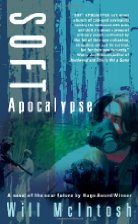
Book Review: Soft Apocalypse by Will McIntosh (Audiobook narrated by Erik Davies)
 Summary:
Jasper can’t believe he’s actually homeless, although a lot more people are homeless now than used to be. But still. He got his BA in sociology. He’s worked hard. How did this happen? He’s living with a tribe of other 20-somethings. They keep hoping things will get better, but somehow they just seem to keep getting worse. The economy doesn’t improve. Home-grown terrorists known as Jumpy-jumps start routinely terrorizing people. Driving anywhere, having dependable food, actual working police forces, they’re all a thing of the past. Not all apocalypses happen overnight.
Review:
I actually hesitated over keeping this book on my wishlist, but I’m very glad I did. I found it to be not quite what I was expecting. In a good way.
I think a lot of men in particular will enjoy it, because it kind of reminds me of a Judd Apatow film. There’s this complete and utter loser guy who you entirely hate (and I suspect McIntosh hates too) but who is just so damn funny you keep reading it. A lot of apocalypse books focus in on a strong leader type, but Jasper is actually a coward who just keeps trying to squeak by. On top of that, he claims to be looking for true love, but is actually completely lacking in any understanding of women. One of his “apt” observations, for instance, consists of stating to a guy friend, “Have you noticed that fat women have been getting hotter?” He’s trying to say that the more starvation threatens, the more attracted he is to women who obviously have enough to eat. But he isn’t philosophical about it at all, and that’s kind of hilarious. He also tries to impress a girl at one point by commenting on the fact that she’s reading a book, but he says it in such a way that it’s obvious he himself doesn’t read at all, which is utterly baffling in a world that no longer has electricity or other entertainment. Basically the whole book is laughing at a cowardly dude-bro, and that’s fun.
The apocalypse itself is quite creative. As the title and blurb imply, it’s a slow one. Gradual. Things get bad and just never get better then more things get bad. It’s a creative mix of economics, homegrown terrorist groups, scientists trying to make things better but actually making it worse, and international politics. None of it came across as utterly absurd or ridiculous, which shows that McIntosh did a good job.
There are two scenes that are truly horrific, which of course I loved. There’s a very creative death scene that I think will haunt me for a long time. (Again, that’s a good thing). The plot overall is a bit meandering, but that makes sense since Jasper isn’t the most focused or proactive dude on the planet. I’m a little sad the book ended when it did. I get why McIntosh ended it there, leaving things open-ended for readers, but….I could have read about Jasper much much longer. Yes, he’s a guy I would hate beyond all reason in real life, but I guess that schadenfreude factor is what makes the book so fun.
Now, I did read the audiobook, and I have to say I was very disappointed in the narration by Erik Davies. It does not live up to the content of the book at all. My main problem with him is that he does that awful thing of putting on what he thinks is a woman’s voice every time one of them speaks, but what actually sounds like a small child and nothing like us. I actually had to stop and rewind a couple of times to double-check if I was angry at how the book was portraying women or if the narrator was making it seem like the book was portraying women as childish idiots. Suffice to say, it’s definitely the narration, not the book. Yes, Jasper objectifies women and basically calls any woman who doesn’t fit into his definition of what a woman should be “crazy,” but the whole book is laughing at him, so really the book is showing how ridiculous it is to view women like that. The narrator reading women in this childish voice really messes with that whole presentation. So, definitely don’t get the audiobook.
Overall, then, this is a fun apocalyptic scifi featuring a cowardly loser who is delightful to follow and laugh at. I highly recommend it to scifi fans who also enjoy slacker flicks, but definitely get the print or ebook versions, not the audio.
4 out of 5 stars
Source: Audible

Book Review: Shadrach in the Furnace by Robert Silverberg (Audiobook narrated by Paul Boehmer)
 Summary:
After a giant volcanic eruption led to chaos and the virus wars, the world came under a one world government led by Genghis Mao based out of Mongolia. The virus wars also led to everyone being infected with organ rot, a condition that simply spontaneously starts whenever it feels like it. Only those working close to the government get the antidote. Shadrach Mordecai, an African-American, went straight from Harvard Med to being the personal doctor for the world dictator. He has implants that allow him to monitor Genghis Mao’s health through his own body, plus he is overseeing the three projects pursuing a way to keep Mao alive forever. But when Project Avatar, which would involve implanting Mao’s brain into a new body, loses its prime candidate, Shadrach realizes his position as aid to Mao might not be keeping him as safe as her previously believed.
Review:
One of my all-time favorite books, The World Inside (review), is by Robert Silverberg, so I decided I should start working on reading all of his writings. So when I saw this Silverberg book on Audible, I immediately knew where my June membership credit would be going.
There are quite a few things that make this piece of scifi stick out. First, out of the four main characters, three are people of color. Shadrach is black, Mao is obviously Mongolian, the head of Project Avatar is Native American (Navajo, I believe), and the head of the project seeking to put Mao into a robot body is headed by a white European woman. It’s an incredibly diverse cast that I really enjoyed. Plus, Shadrach gets it on with both Nikki Crowfoot and Katya (Native and European, respectively). There’s also the fascinating fact that Mao, who previously only wanted a Mongolian body, is totally into the idea of putting his brain into the body of strong, young black man. You could read this one of two ways: either as a scifi slave narrative (Mao owning Shadrach’s body) or as a progressive future where skintone doesn’t matter but the leaders still manage to be totally evil.
The scifi in the book is incredibly strong. Silverberg obviously did his brain and infectious diseases research. It was akin to reading abstracts from medical journals when Shadrach was talking about the various medical things going on with Mao’s body and with organ rot in the general population.
Religion is dealt with in an interesting manner. Most people seem to be more religious. Even the “secular” government workers follow the new religion, whose name I can’t remember I’m afraid, that involves monks and taking hallucinatory drugs. It’s obviously an idea of a futuristic religion born out of the 1970s in which it was written, but it works within the imaginary future it exists within.
Central to the novel is Shadrach’s struggle with the Hippocratic Oath. He is sworn to repeatedly save the life of an evil dictator who is willfully withholding an antidote to organ rot from the general population. It’s obviously an intense moral dilemma and the scifi setting helps the reader look at it with less emotion than if, say, we were talking about a modern setting wherein Shadrach was working for a neo-Nazi or something.
One thing that does date the book is that Silverberg made the choice of giving an exact year for when all of this is going down, and that year is 2012. I did find it an odd bit of serendipity that I just so happened to pick up this book in 2012. In a sense, then, for the modern reader it’s more like reading an alternate history. What *would* have happened if a huge natural disaster had occurred in the 1990s? Whereas in a book like 1984, it’s still the same book for modern readers as for the original readers (you just ignore the date), here the date actually has an impact on the reading of the story. The reading is different now than it probably was for people in the 1970s, but it still works. Just in a different way.
I did feel the pacing is a bit off in the book. It’s a bit up and down. There were a couple of moments earlier in the story that had the intensity level of almost a climax, whereas the climax feels….less climaxy. It took some of the tension out for me, even though I was pleased with the ultimate ending. This did make it ideal for an audiobook, though, since it was easier to come and go from it as I had time to listen. Related to the pacing issue, although most of the book is third person Shadrach’s perspective, there are a few chapters that are first person Mao’s perspective. Those threw me a bit. I’m still not sure how I felt about them. I honestly think it would take a second read in print to get a real vibe for that dynamic.
Speaking of the audiobook, the narrator, Paul Boehmer, does a phenomenal job. He gets many different accents spot on without ever seeming to be racist. He also does a great job differentiating between who is speaking and thinking and what have you. He also did an admirable job narrating the sex scenes. The tonality of his voice is spot on for the intimacy and excitement. I would gladly listen to another book he’s narrated.
Overall then this is an interesting piece of scifi that was originally written as futuristic and now reads as alternate history. It features a diverse, three-dimensional cast and provides a great setting for the moral dilemma of helping those who would harm others. I recommend it to fans of scifi that addresses moral issues.
4 out of 5 stars
Source: Audible

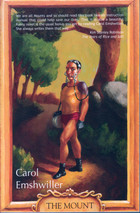
Book Review: The Mount by Carol Emshwiller (Bottom of TBR Pile Challenge)
 Summary:
Charley is an 11 year old Seattle and wants to be the best mount there is for his owner, Little Master. He eats his dry cakes, practices on the go-round, and behaves well. Little Master mostly likes their lessons. His ears wiggle, so Charley knows he’s giggling. But one day Wilds attack the village. They say that people are meant to be people, not mounts for Hoots. But the Hoots say the mounts were made for them, see how the primate species are perfectly designed for riding? It’s all very confusing for Charley.
Review:
It doesn’t take much guess-work to figure out how this wound up on my TBR pile. It’s a rather obvious allegory for animal rights, although instead of apes enslaving people like in Planet of the Apes, it’s an alien species with cat-like ears and weak legs enslaving humans. The concept is a good one, but the execution fell short for me, which is sad, because I wanted to love it.
The structure of the book is problematic. The first chapter is from the perspective of an entirely random Hoot who we never see again. Ever. We also never see his mount again. This is just weird. The rest of the book is told from the first person perspective of Charley, except for one random chapter narrated by his father. I don’t mind switching perspectives, but there should be some sort of consistency about it, and we should have at least a vague idea who the character in the new perspective is.
I also found myself completely baffled by Charley. In spite of being enslaved by the Hoots, he still wishes to use a bit one day and other things that drive his father nuts, and one cannot help but agree with his father. He never seems to really learn better through the book either. He persists in loving his Hoot and being a mount for his Hoot. That doesn’t work as an allegory for animal rights or slavery.
Emshwiller does show how teenage boys clash with their fathers very well, however. Charley’s relationship with his dad, Heron, is well fleshed-out and intriguing. They want to connect and love each other but struggle with how, exactly, to do that when they are so different yet so similar. Looking back, this relationship is what kept me reading. It shines in spite of the other oddities in the book.
I won’t spoil it, but the ending bothered me as well, and I found it profoundly confusing. In fact, I’d say for the book as a whole I am simply left perplexed by it. I feel like I missed something or didn’t quite get an accurate picture of the world they are living in or something.
Overall, it’s a very different take on humans being enslaved by another species, but its execution is rather disappointing. Recommended to readers with a marked interest in scifi depictions of human slavery.
3 out of 5 stars
Source: PaperBackSwap

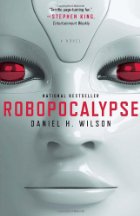
Book Review: Robopocalypse by Daniel H. Wilson (Audiobook narrated by Mike Chamberlain)
 Summary:
Cormac Wallace reviews the surveillance tape taken by Rob (robots) during the New War–the war between humans and robots. He thus recounts the history of the war to the reader.
Review:
Basically this is supposed to be World War Z only with robots. It falls incredibly short.
What makes World War Z such an awesome book (beyond the fact that zombies are better than robots) is that it is a mock oral history of a war. This is a thing that actually happens after a war in real life. Oral historians go around and gather real information from the survivors about the war. Although the NPR style narrator frames the chapters, they are all given by different survivors from their own perspectives.
The problem with Robopocalypse is that it tries to use the same method for a very different story. Much as Wilson may want a robot war to be like a zombie war, it ISN’T. And it shouldn’t be recounted in the same way. Wilson sort of realizes this, because he has Wallace recount the war by watching the “black box” surveillance of Rob. The thing is, though, that really doesn’t work in book form.
A) Why would Cormac write down something that is already available visually? Why wouldn’t he just copy/pasta the videotape and send it out?
B) The chapters swing wildly between Cormac describing what he’s seeing on screen (insanely boring) and random first hand accounts from everyone from himself to dead people. Yeah. Dead people have first-person accounts in this book. THAT MAKES NO SENSE.
Also, the pacing is off. The build up to Rob attacking is painfully slow, but Rob taking over misses a lot of the details that would be interesting. Similarly, details as to how people all over the world start collaborating and beat the brilliant Rob is sped up and glossed over too much. Essentially, things that should have more space in the book have too little, and things that should have very little space have too much.
I have to say that the narration by Mike Chamberlain did not help matters any. His voice is practically monotone, and he adds nothing to the story.
The concept of a robot war is a good one, although I admit to having more loyalty to zombies. However, the format used in World War Z just will not work in a robot war. Wilson should have focused on one small group of people or actually tried out the whole oral history thing. This bouncing around between perspectives and verbally recounting surveillance footage simply does not work. I cannot recommend this book. There is simply far better plotted scifi out there.
2 out of 5 stars
Source: Audible

Book Review: Haunted by Glen Cadigan
 Summary:
Mark is an Iraq War vet with PTSD, so he counts himself lucky when a Gulf War vet gives him the chance to be a security guard at an office tower. Unfortunately, he’s the night watchman, and he doesn’t seem to be alone in the tower.
Review:
This is a unique, sympathetic story idea that is not as well-executed as it deserves.
Mark is ultimately a well-rounded character, but it takes too long to get to know him in this novella. Since it is in first-person narrative, he has the option of holding off on telling us about his PTSD symptoms and how they affect him. While a soldier would certainly most likely be more stoic in a traditionally masculine way, it gets in the way of the reader understanding where Mark is coming from and empathizing with him. He *tells* us that his PTSD makes his life difficult, but we don’t really ever see it.
Because this is a first person novella, this problem with the characterization gets in the way of the strengths of the scifi/fantasy plot, which is honestly fairly unique. I was glad I got to the end and saw the surprise reveal, but I certainly wasn’t expecting such a good twist from the rest of the book.
Essentially, the scifi/fantasy element of the book is strong, but the characterization at the center of the first person narrative is weak. Although Mark is a soldier, Cadigan shouldn’t be afraid to let us see the vulnerability of his PTSD. Recommended to fans of a unique ghost story looking for a quick read.
3 out of 5 stars
Source: Kindle copy from author in exchange for my honest review

Counts For:
Book Review: Grey by Jon Armstrong (Audiobook narrated by Macleod Andrews)
 Summary:
In the near future capitalism has entirely taken over, and the world is ruled by a few families….and their corporations. People from all walks of life are also completely obsessed with fashion. Michael Rivers is the heir to the River Corporation and is being sent on worldwide-aired dates with Nora, the heir to another company. Just when they are about to announce their engagement, however, a freeboot shoots at Michael leaving the families blaming each other for the incident. Michael refuses to accept his father’s demands that he marry a different woman, however, and his quest to figure out a way to Nora leads to some deep dark scandals hid on all levels of the company.
Review:
I have to say that this is the first time I was sorely disappointed by a read I originally discovered via Little Red Reviewer’s blog. I was intrigued by the idea of fashionpunk, which is what this book is supposed to be. Fashionpunk is a new genre. Think scifi with a heavy focus on fashion. It’s unfortunate that the fashion aka world setting was the best part of the book.
Armstrong richly presents the near future he has imagined. People’s tendencies to reflect their world views via their fashion choices is completely exploded in this world. Michael identifies as a Grey. He wears only shades of grey and chooses everything from what bands he likes to what restaurants to eat in based on the grey fashion’s magazine. Every other type of fashion is similar. Even the Rivers security team are referred to by the type of clothing they wear–the Satins. I know! This sounds awesome and delicious to be in, and it was. But…..the story, you guys. The story.
This book’s plot is like the Kardashian show if it was written down and entirely sympathetic to Kim Kardashian. I know, right? Even reading that sentence is painful. It’s not that I’m saying someone wealthy can’t be a main character, but it helps if some aspect of them is sympathetic, and Michael is just not. He’s whiny and wimpy and sooooo obsessed with inane things and his “love” of Nora completely squicks me out. It reads more like an unhealthy obsession than star-crossed lovers. And he never really changes! No matter what he learns or what happens he’s still the same Michael by the end as he is at the beginning. There’s just….no character development. No underdog to root for. No nothing. I liked seeing Michael’s world, but I really would have preferred to wander off and follow the life of the director or a chauffeur or even the inane girl he goes on a date with who has pink fur growing out of her skin. See what I’m saying? Someone with a more interesting perspective. The problem with Michael is that grey truly is the best way to describe him. He’s dull and annoying. Like a grey, rainy day.
So why did I continue listening to it and finish it so quickly? The audiobook narrator, Macleod Andrews, is completely brilliant. It was like listening to a one-man show. He somehow managed to breathe some life into the dull plot. For that I thank him, and I also will be checking out what else he’s narrated on Audible.
Overall, the concept of fashionpunk that Armstrong has worked out is intriguing and makes for a visually and culturally rich world. Unfortunately, I found his plot completely unappealing. Perhaps people who enjoy the lives of the rich and famous would feel differently, however.
3 out of 5 stars
Source: Audible


Book Review: The Sparrow by Mary Doria Russell (Series, #1) (Bottom of TBR Pile Challenge)
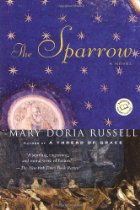 Summary:
It is the year 2060, and the Jesuit priest Emilio Endoz has been found on the planet Rakhat by the second Earth ship to travel there. Found in a whorehouse and killing a native inhabitant in front the UN members’ eyes, they nonetheless strap him into his original spaceship and send him back to the Jesuits. There he is treated for his horrifying wounds and through a series of flashbacks and current conversations with the various Jesuit committee members assigned to his case, we slowly see how everything that started out so right went so horribly wrong on Rakhat.
Review:
It may have been a while since it made it onto my tbr shelf, but I still have a crystal clear memory of why I acquired this book. I entirely blame Little Red Reviewer, who just so happens to be the only other female scifi fan who book blogs that I’m aware of. (Feel free to enlighten me to more in the comments). Her review that religion is there but in a questioning way that honors the tradition of scifi made me give this book with a Jesuit priest and mission at its core a chance. I’m glad I did.
This is a first contact story that takes the all-too-infrequent route of Earth finding the inhabited planet first and sending a mission to them. There’s so much more than that that makes this book unique, though. The future Earth just barely has the technology to make it to Alpha Centauri, and only the most tech-savvy are aware of it. Thus, we’re not an incredibly advanced civilization making first contact, just one slightly more so than Rakhat. I’d say a fair comparison might be late 19th to early 20th century earth to early to late 21st century Earth. It’s a short span of difference. Additionally, Russell made the intriguing choice of the first contact being run by missionaries, instead of a political unit. When you think about it, it makes perfect sense. Who tended to be first to the New World? Religious groups. Who can organize themselves quickly and have vast finances? Religious groups. Having first contact be missionaries makes so much sense that I’m shocked I didn’t think of it first.
That said, thankfully this book is not a love letter to organized religion or mission work. It is instead a complex, scientific, and anthropological study of the human condition, the difficulties of vastly different cultures meeting, linguistics, and much more. At its core it is all about why does god (if there is a god) let evil happen, especially to good people who are serving him? These issues are more easily addressed and made further complex by having agnostics, non-practicing Catholics, and a Jewish woman members of the mission team. The non-believers are about at even numbers with the priests. In fact, the deeper into the book I got, the more it tore at my heart-strings. Varying types of questioners are represented, and of course it’s possible to identify with many of them, particularly for a reader who once was religious but is not anymore. There’s the priest who is secretly gay, the Jewish woman who was wounded terribly by war but comes to learn to love again, the Father Superior who thinks he may be seeing the formation of a real live saint, the priest questioning the very existence of god, and the agnostic who wants to have the beautiful aspect of faith that she sees in those around her.
This book reads, it sounds a bit odd to say, almost like an agnostic’s prayer. Of course agnostics don’t pray, but if they did pray, the pain and wondering and intelligence found in this book would all be there.
We are, after all, only very clever tailless primates, doing the best we can, but limited. Perhaps we must all own up to being agnostic, unable to know the unknowable. (page 201)
The problem with atheism, I find, under these circumstances…is that I have no one to despise but myself. If, however, I choose to believe that God is vicious, then at least I have the solace of hating God. (page 394)
People more into science than the questioning human spirit will find plenty for themselves as well. The science of linguistics is astoundingly well presented. The way the two “sentient” species on Rakhat have evolved is also incredibly well thought-out and realistically drawn. The problems of poverty and war on earth are briefly explored too.
All of these things said, I do feel it took a bit too long to get things set up and moving. Granted, I tend to be a bit of an action-focused reader, so others may not have a problem with that. It was still a draw-back of the book for me though.
I sort of feel like I’m not doing the experience of reading this book justice. Suffice to say if you’ve ever questioned whether or not to have faith and love your big questions to be wrapped in well-thought-out scifi, this is the book for you.
4 out of 5 stars
Source: Better World Books

Counts For:
Book Review: Nova by Samuel R. Delany (Bottom of the TBR Pile Challenge)
 Summary:
Lorq von Ray is the head of one of the biggest corporations in the galaxy that for years has worked hand-in-hand with the Red corporation, currently headed by incestuous brother/sister partners Prince and Ruby. But now internal fighting between the two has made von Ray determined to find his corporation’s own supply of Illyrion, normally supplied by the Reds. He’s heard rumors you can fly through the center of a nova (an imploding star) and survive and that Illyrion is inside. He gathers an unlikely crew in a race against the clock to gather the fuel.
Review:
I really wish I could remember what made me acquire this book. The cover was nothing special, and the summary on the back said approximately diddly-squat about the actual plot (unlike my own). Supposedly this book took years and tons of research into the Tarot and the Holy Grail, yadda yadda. Fine. All I know is that it was boring as fuck with a plot like it was written by a fifth grader.
One of my updates on GoodReads said, “Reading this book is like going to the dentist,” and I still think that’s the most apt review of it. The plot drags, which is shocking for such a short novel. We learn an astonishing amount of backstory about the Mouse, who is a minor character, but not a ton about Prince and Ruby Red, who are far more essential to the plot. We don’t learn the backstory for the plugs everyone wears until the book is almost over, when plugs are key to the story. A set of black twins work on the ship with one mysteriously albino for no apparent plot reason, and they operate as one person finishing each other’s sentences. Their whole characterization really bumped my racism button. Yes, I know this is an old book, but still. We also have the annoying novelist member of the crew, who is such an obvious Mary Sue it’s painful. And I don’t throw around the term Mary Sue willy-nilly. Come on. The guy is a novelist trying to write a Holy Grail book. *blinks*
The amateurish exposition consists mainly of long speeches by various characters. The plot saving device of a miracle machine that can fix almost all wounds appears part-way through the story. The whole thing would get maybe a C from me in a creative writing class. Maybe.
The only thing that keeps this book from one star is that it does, in fact, have a plot and is readable. Of course, I can’t for the life of me figure out anyone who would want to read this if they knew what they were getting themselves into.
2 out of 5 stars
Source: PaperBackSwap

 Support my work with a tip or browse my shop for curated book club guides, how to guides, cross-stitch patterns, and more!


This work by Amanda Nevius is licensed under a Creative Commons Attribution-Noncommercial-No Derivative Works 3.0 United States License.
 Opinions of a Wolf