
Archive
Book Review: Song of Susannah by Stephen King (Series, #6)
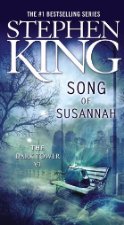 Summary:
The ka-tet faces three challenges: keep the chap from the Crimson King, save Susannah, and get Tower to sell them the rose. With the help of the Manni, they get the door to open two final times, and it sends Eddie and Roland to Maine to see Tower and Jake, Pere, and Oy to NYC in a final desperate attempt to save Susannah and the chap. Meanwhile, Susannah must face not only the foreign woman inside her, Mia, but also the figurative demons of her past and her personality in her mind.
Review:
There are elements of this book that are beautiful and quite literary, primarily everything to do with the title. There are of course two songs about Susannah. One is immediately evident. Each chapter ends with a stanza of a song, remarkably like the commala songs sung in the previous book, but of course the content of the stanza references what happened in that chapter. There’s also a song from Susannah’s past that winds up showing more about who she is and what her life has been than anything else in the books has done. What makes that beautiful is that it’s just a traditional folk song and wasn’t written by King for her at all.
Of course I’d consider this book a failure if all it did was develop Susannah’s character. The Dark Tower is about characters and the quest equally. Thankfully, this entry in the series addresses both. Various mysteries are addressed such as what the Low Men are, who Mia is, how Pere wound up in a book from another one of the worlds, and more. Plus a few new mysteries are added. But in the end the main questions remain: will the ka-tet make it to the Dark Tower and will the Dark Tower fall?
In spite of the well-written action sequences and character development, there is one aspect of this book that rubbed me the wrong way. King writes himself in as a character, but not just any character. He is the Crimson King’s opposite. In other words, he’s the essential good guy. For some reason when he writes his stories they have an impact on the worlds, so he must stay alive and keep writing the Dark Tower series if the ka-tet is to have any hope. The whole thing just reads as egotistical. Plus it forced me out of the story. I can suspend my disbelief for other worlds, but to suspend it enough to believe that the author is not only vaguely aware of these worlds but also his writing impacts them, well, it leaves you going “huh?” and kind of takes the escapism out of it. So I skimmed over the parts featuring King and tried to just focus on the ka-tet. It wasn’t that hard to do, so the King bits definitely didn’t ruin my experience; they just dulled it a bit.
Overall, this is a very good entry into the series. The characters and the plot move forward, and there are some wonderfully memorable scenes that will stick with you for a long time. If you’ve stuck with the series and enjoyed it this far, you’ll definitely enjoy this book.
4 out of 5 stars
Source: Borrowed
Previous Books in Series:
The Gunslinger, review
The Drawing of the Three, review
The Waste Lands, review
Wizard and Glass, review
Wolves of the Calla, review

Book Review: House of Stairs by William Sleator
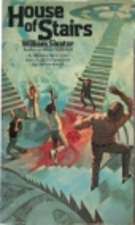 Summary:
Five sixteen year old orphans living in state institutions are called to their respective offices, blindfolded, and dropped off in a building that consists entirely of stairs and landings. There appears to be no way out. The toilet is precariously perched in the middle of a bridge, and they must drink from it as well. To eat they must bow to the whims of a machine with odd voices and flashing lights. It is starting to change them. Will any of them fight it, or will they all give in?
Review:
This book was enthralling from the first scene, featuring Peter awakening on a landing intensely disoriented and frightened. Showing a bunch of teenagers obviously in an experiment opens itself up to caricature and stereotype, but Sleator skillfully weaves depthves and intricacies to them.
The writing is beautiful, smoothly switching viewpoints in various chapters from character to character. Hints are dropped about the outside world, presumably future America, that indicate the teens are from a land ravaged by war and intense morality rules. For instance, their state institutions were segregated by gender. Sleator weaves these tiny details into the story in subtle ways that still manage to paint a clear framework for the type of cultural situation that would allow such an experiment to take place.
It is abundantly clear throughout the book that the teens are facing an inhumane experiment. Yet what is not clear at first is what a beautiful allegory for the dangerous direction society could take this story is. Not in the sense that a group of teens will be forcibly placed in a house of stairs, but that some more powerful person could mold our surroundings to make us do what they want us to do. To remove our most basic humanity. This is what makes for such a powerful story.
It’s also nice that friendship in lieu of romance is central to the plot. Modern day YA often focuses intensely on romance. Personally, my teen years were much more focused on friendship, and I enjoyed seeing that in this YA book. I also like how much this humanizes the animals facing animal testing, and Sleator even dedicates the book to “the rats and pigeons who have already been there.”
House of Stairs, quite simply, beautifully weaves multiple social commentaries into one. It is a fast-paced, engrossing read, and I highly recommend it to everyone.
5 out of 5 stars
Source: PaperBackSwap

Book Review: Feed by M. T. Anderson
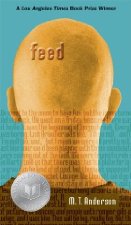 Summary:
Titus is your typical teenager of future America. He lives in a suburb where his parents program the weather. He drives an upcar. He’s got a feed–a microchip in his brain that allows him to chat silently with people, shop, look up anything he wants to know more about, etc… He’s also got a lesion, but a lot of people have those now. He is quite ordinary. But he meets a girl on a trip to the moon who is anything but ordinary. A girl who got the feed late and dares to question it.
Review:
This book has a great concept, essentially exploring what the world would be like if twitter was implanted into our brains. This is rather extraordinary given that twitter didn’t even exist yet when Anderson wrote it. It explores losing our individuality to machines and consumerism. Ceasing to care about important information due to being bombarded by inane information at all hours of the day. I just wish Anderson had taken this concept a different direction.
I immediately connected with Violet, the girl Titus meets on the moon. She’s quirky, is homeschooled, and really is a bit of a nerd who just wants a chance to try out hanging out with the popular kids and doing what they do. Titus is a complete and total asshole to her. I suppose I could forgive him for that if he showed that he learned anything from coming into contact with a person as powerful as Violet, but he doesn’t. He ditches her when she needs him most because she’s making him uncomfortable. He wants to stay in the cocoon of his feed-driven life, and nothing she does or says can change that. He clearly goes from girl to girl, using them up like paper towels or tissues, and then on to the next one. Maybe that was Anderson’s point–that the feed has dehumanized the people who have it–but it made for a less powerful book than if Titus had learned something. Anything.
Similarly some questions just aren’t answered simply because Titus doesn’t care, so we aren’t allowed to know. In particular the lesions are set up as some sinister mystery, but then we never find out why they are occurring. Nobody even really speculates as to why they’re showing up. They’re just there. I seriously doubt there’d be zero speculation over such a phenomenon, even in a future where people are obsessed with consumerism.
Overall, the concept and writing on a sentence level are good, but the story as a whole left me feeling empty and disappointed. There’s telling a bleak story, and then there’s telling a story that’s sympathetic to a jerkwad. This is the latter. If that type of story is something you enjoy, you will enjoy this book. Everyone else should look elsewhere, perhaps to The Hunger Games if you’re looking for a YA dystopia.
3 out of 5 stars
Source: Swaptree

Book Review: Mostly Harmless by Douglas Adams (Series, #5)
 Summary:
Arthur Dent thought his zany days earth-less days were over. The whole Earth-being-blown-up was undone, and he found a woman to love. But when they’re traveling through the universe together, she suddenly disappears and Arthur finds himself in a parallel universe where the exact Earth he once knew doesn’t exist. Meanwhile, Ford Prefect pays a visit to the Guide offices and finds that something just isn’t quite right.
Review:
Thank goodness I didn’t let the flop of the fourth book So Long, and Thanks for All the Fish deter me from finishing the series. Adams returns to his strengths in this entry–outerspace adventures of Ford and Arthur, not to mention zany robots and odd cultures on other planets that manage to reflect the oddities of our own. Plus, the storyline actually moves the original plot of the Earth being destroyed by the Vogons forward.
Some of the jokes rank right up there with The Restaurant at the End of the Universe. One that sticks out in my mind is when Ford messes with a robot’s circuitry making it endlessly joyful. It was a delightful flipping of the endlessly miserable robot, Marvin, featured earlier in the series. It was quite enjoyable to see how hilarious both extremes are. Also of note is the village religious man on a planet Arthur winds up on, who is quite clearly making the village’s religion up as he goes along, and the villagers are semi-aware of this, but shrug and let him. That said, at least half of the jokes, while they tickled my funny-bone in a pleasant way, didn’t have me actually laughing like the first couple of books did. It was a pleasant read, but not uproariously funny.
Entire essays and theses could be written (and probably have been) on the themes in the Hitchhiker series. Excuse me. Trilogy. From belonging to homelessness to the purpose of life, Adams’ work has it all, which is what makes it good humor, actually. It’s humor pointing out the most basic questions of life in a setting that removes it from our own experiences enough to make us see it in a different light.
Some readers will probably be unhappy with the ending. I enjoyed it and saw the humor in it, in spite of it being rather dark. I know that Adams expressed some discontent with it and was in the middle of writing a sequel, The Salmon of Doubt, when he died, which has now been posthumously published, as well as a sixth entry written by Adams’ widow and Eoin Colfer. I don’t cotton to posthumously published works assembled by people who are not the author, nor continuations based on what people “think the author would have wanted.” For all we know, Adams could have changed his mind yet again. I prefer to view Mostly Harmless as the end of the series, as it was the last book truly finished by Adams.
Mostly Harmless is a wonderful closing chapter to the series that contains delightful meta jokes, as well as new territory, and neatly ties up the experiences of the characters. Fans of the series won’t be disappointed with this entry, which is a delightful jump up from the fourth book, but they may be left a bit sad to see the end.
4 out of 5 stars
Source: Raven Used Books
Previous Books in Series:
The Hitchhiker’s Guide to the Galaxy
The Restaurant at the End of the Universe
Life, the Universe, and Everything
So Long, and Thanks for All the Fish, review

Book Review: The World Inside by Robert Silverberg
 Summary:
Hundreds of years in the future, Earth society has dealt with the population crisis by discovering the ability to build Urban Monads (urbmons). Each building is 1,000 stories and houses around 880,000 people. This vertical hive living has allowed for most of the land to be farmland, managed by communes still living in the traditional horizontal style. It’s a beautiful day in Urbmon 116, and we’ll get to meet people from each level of the city from artistic San Francisco to academic Shanghai to ruling Louisville. Their lives of enforced zero privacy, no locked doors, mandatory acceptance of sexual requests from anyone of age, and a reverence for fertility resulting in uncontrolled population growth present a unique social situation. An academic wonders if humanity has forcibly evolved itself to naturally enjoy the Urbmon lifestyle or if it is a cultural influence forced upon them. Maybe these next few days will help him tell.
Review:
This book is such a creative imagining of a possible future, one I certainly never had thought of. Silverberg approaches his storytelling by at first making it seem as if we will be exposed to a series of vignettes about the inhabitants of Urbmon 116, but then their interconnection suddenly becomes apparent as the dual climaxes approach. I was certainly not bored with the vignette portion as the society of the Urbmon is so interesting, but the interconnection moved it from being an interesting book to a powerful book.
The World Inside is a look at what would happen if the most fundamentalist pro-lifers were to win the majority and gain great power. There is no birth control, every fetus conceived is brought to childhood (although the gender may be manipulated to maintain a balance). Interestingly, in order for this pro-life construct to gain power, they also had to make concessions to the free love folks. Everyone gets married at a very young age, but there is no such thing as sexual loyalty. People are encouraged to nightwalk–leave their own abode at some point after midnight and enter another apartment and have sex with one of the adults there. Often the husband or wife will stay in the room in spite of the sex going on in the same bed as them with their spouse. This is explained as a necessary way to maintain harmony in the building. It is intriguing to see such a lack of regard for parental loyalty to each other in a society that encourages so much procreation, yet it all makes sense.
That is really what makes this such a strong book. It’s such a plausible future, given the proper circumstances, that it gives chills, and yet Silverberg still shows the basic humanity in these people, stuck in a culture, a society that they have little to no control over. If they fail to fit into the social constructs at all, they are simply put down the chute–killed and used as fuel for the building. There is no room for real discourse or exploration of where they may have gone wrong. It’s a social construct that happened out of necessity due to humanity’s refusal to stop procreating so much. They gave up all their other freedoms for that one. Even the freedom to chose to be monogamous if you want. It is such an emotional, thought-provoking warning gong. It’s definitely a book I will hold onto and re-read.
If you enjoy scifi, dystopias, or philosophical explorations of the human condition, you will definitely enjoy this book. I highly recommend it.
5 out of 5 stars
Source: PaperBackSwap

Book Review: Oryx and Crake by Margaret Atwood
 Summary:
Snowman used to be Jimmy. Jimmy was a word person in a science person world. He couldn’t splice genes to make rakunks or even to make new types of plants. He could sell them to the public who lived outside of the safe Compounds though. Jimmy was with Oryx, although he had to share her with Crake. Now, Snowman must take care of the Crakers with their rainbow of colors, naturally insect-repellant skin, and complex mating rituals. Snowman is alone except for the Crakers. Everyone else died in the bloody pandemic. Or did they?
Review:
This is a companion novel to Year of the Flood (review), although Oryx and Crake was published first. Companion novel means they’re set in the same time-span in the same universe and some characters may briefly cross over, but you don’t necessarily need to read them in a particular order or even read all of them.
Atwood is one of my favorite authors, so I have no idea how to react to the fact that I didn’t like this book. I didn’t hate it, but I didn’t like it. It was a bit of a struggle to get through. As usual, Atwood sets scenes beautifully, but I felt no emotion driving the story. I believe Oryx and Crake suffers from the fact that love triangle of Oryx, Crake, and Jimmy is only hinted at throughout the book, only to be revealed in such a manner that it rings false. Jimmy seems to surf through life on a wave of ennui, until Oryx shows up and cheers him up, but how does she do it? We just don’t ever really find out, because our narrator is Snowman–the version of Jimmy who’s lost his mind. Perhaps Atwood was trying to show a culture that had reached a point where people just couldn’t be truly happy. That’s a good thing to show, but it makes for a boring narrator.
What I really wanted to know about was what made Crake do the things he did. He’s clearly either a mad-man or a genius, but we never get to find out much about him at all. I wish he had been the narrator. To see inside his mind would have been amazing. I could have even overlooked the fact that he’s not a woman.
That’s the other thing that bugged me about this book. Atwood usually writes with female main characters, but in this instance, men were the main players. That kind of pisses me off. Was she unable to imagine a woman doing something so evil? A woman being so stupid? That’s just as sexist as women never being the hero. I would have enjoyed the book so much more if Jimmy and Crake were women (heck, Oryx could have stayed a woman too. That would have been an interesting change).
When you compare this to Year of the Flood, it’s evident that what Oryx and Crake lacks is the emotions driving the bigger picture. It’s a well-imagined and creative big picture, which is what makes the book still readable. I’m sure some people would like it, but don’t come into it expecting Atwood’s more typical emotion-driven story. You won’t find it.
3 out of 5 stars
Source: PaperBackSwap

Book Review: Bug Jack Barron by Norman Spinrad
 Summary:
Jack Barron was a baby Bolshevik hippie in his Berkeley days. He even set up the Social Justice League, which is now the third party competing against the Democrats and Republicans. All those high ideals got set aside with age and the offer of a weekly, vidphone-in program: Bug Jack Barron. He’s happy with the money and the calm embracing of reality, but Benedict Howards of the Freezer Foundation is about to shake it all up.
Benedict Howards is in mad pursuit of one thing–human immortality. He’s cryogenically freezing those who hope that some day the key to immortality may be found. Of course, they have to pay a high price for it, but there’s more to Bennie than meets the eye, and the money for those freezes might not be going to the research they claim to be. Best of all, he has the best bargaining ticket out there–free freezes, and he wants Jack Barron to be his own publicity machine.
Barron doesn’t think he’d ever cave to the likes of Benedict Howards, but when his long lost, baby Bolshevik love, Sara returns to his life, everything changes.
Summary:
Bug Jack Barron has a complex plot that is difficult to summarize and attempts to be a tour de force but that ultimately fell flat for me. It’s the perfect example of a scifi concept that didn’t age well. Published in 1969, the thoughts and ideas of the 1960s are rampant throughout. A large part of the plot revolves around a future where blacks and whites are still segregated by virtue of wealth in America. In fact, an entire piece of the plot revolves around the fact that a black man could never be president of the US. That kind of falls flat when you’re reading the book and your current president is a black man. Spinrad completely mispredicted where race relations would be at in the US in the future, and that soured the rest of the book to me.
Then there’s Sara, Jack’s love. She is the quintessential great woman behind a great man. Without Sara, Jack wouldn’t be great at all. He’d never meet his potential. Yet the relationship is hardly reciprocal. In fact, Sara seems much worse off for being involved with Jack at all. She doesn’t seem to improve or embrace her greater self as a result. I expected much more of Spinrad who wrote A World Between in which he pointed out how much good the two genders can do for each other. It’s not like Spinrad is critical of this woman behind the man set-up either. There’s an entire section where Sara regrets her misunderstanding of Jack’s macho nature as bad and instead embraces his man-nature greed for power as something she could never have. Excuse me, Spinrad, I would like to introduce you to Queen Elizabeth, Marie Antoinette, Madonna, etc… It’s bad enough that some modern cultures are still telling us women that we can only be our greatest when inspiring a great man. I don’t need it in my scifi.
Then there’s the whole immortality issue, which is largely what the book revolves around. I know some readers would find this idea very intriguing and would enjoy seeing how society would deal with it. The thing is, I’ve never been someone who wants to live forever. It all seems very natural that there’s life and death and why on earth would I want to live forever? It seems rather selfish, adolescent, and silly to me. I can understand not wanting to age. Wanting to have a young body throughout your 80 or so years on earth, but never dying? That wouldn’t be a trump card Benedict Howards could use on me, so I have a hard time sympathizing with Jack and Sara.
That said, Spinrad’s writing style is quite enjoyable as before. He writes in semi-run-on sentences that read as the characters’ trains of thought. It’s a great way of showing, not telling. Additionally, I could see other people being able to put aside the completely miscalculated race relations and enjoying the immortality part. It’s not badly written, ignoring the misogynistic Sara story arc, it’s just not my cup of tea.
3 out of 5 stars
Source: PaperBackSwap

Book Review: So Long, and Thanks for All the Fish by Douglas Adams (Series, #4)
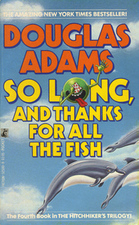 Summary:
Although the planet Earth definitely blew up, Arthur Dent has found himself back on it again, and not in the prehistoric past like before. Everything seems about the same, except that the dolphins all have disappeared and apparently there was a mass hallucination of the planet blowing up caused by a CIA experiment. You’d think this would require all of Arthur’s attention, but instead he’s rather highly focused on a woman named Fenchurch who claims the Earth really did blow up and insists something has felt off ever since.
Review:
It’s no secret that one of my favorite comedic books is The Restaurant at the End of the Universe, the second book in this series. While I felt that the third book suffered a bit, it was still pretty damn funny in my opinion. I really wish I could say the same about this.
I still enjoy Adams’ writing style. It’s tongue in cheek, snarky, and self-referencing. It is a pure pleasure to read. This still holds true here, but the problem is that it’s just not laugh out loud funny. Oh, there are bemusing moments, but mostly it’s a case of jokes falling flat. I think the reason for this is that what makes the books funny is Arthur Dent–average British dude–stuck into the bizarre situations that are the rest of the universe with only the equally bizarre Ford Prefect as a true companion. Indeed, my favorite bit of this book is when Arthur and Ford are reunited. Without that Arthur stuck in outerspace element, you wind up with a rather run-of-the-mill, “huh, something odd is going on on planet Earth” book. It’s cute, but it’s not surprising, and the element of surprise is what makes the rest of the series so funny.
I also wasn’t fond of Adams’ obvious response to the fan question, “Does Arthur ever have sex?!” with the addition of the love interest, Fenchurch. He may think it is witty to reference this and answer it, but I was disappointed. I enjoyed wondering if poor Arthur spent 8 years devoid of sex. It added a certain element of mystery to him. This whole part felt kind of like a cop-out.
I don’t want to sound like I hated the book, because I didn’t. When compared to books not written by Adams, it actually holds up quite well. It’s enjoyable and has some unique scenes. It’s just, in comparison to the rest of the series, I was left a bit disappointed. I still plan on finishing reading the series, though.
3 out of 5 stars
Source: PaperBackSwap
Previous Books in Series:
The Hitchhiker’s Guide to the Galaxy
The Restaurant at the End of the Universe
Life, the Universe, and Everything

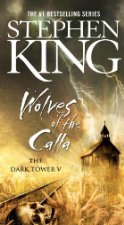
Book Review: Wolves of the Calla by Stephen King (Series, #5)
 Summary:
The gunslinger’s katet have a lot more on their plate than just continuing along the path of the beam. Susannah is pregnant and has developed another personality, Mia, to deal with the pregnancy as it is most likely demonic. The Rose is in danger in then when of 1977 New York City. The man who owns the empty lot it grows in is under pressure from the mob to sell it to an unseen man. So the last thing the katet needs is to run into a town desperately in need of the help of gunslingers.
The Calla, a town made up of rice growers and ranchers who mostly give birth to twins, has been facing a plague once every generation. Creatures referred to as Wolves come and take one child out of every set of twins between the ages of about 4 and puberty. The child is later returned mentally retarded. Their local robot messenger, Andy, has warned them that the Wolves are coming in about a month, and their holy man believes gunslingers are on their way.
Unable to turn down their duty as gunslingers or give up on their quest for the Dark Tower, can the gunslingers pull it all off or is it just more than any katet, even one as strong as theirs, can handle?
Review:
Toward the beginning of the book, Roland says something like, “Being a gunslinger means weeks of planning, preparation, and hard work for 5 minutes of battle.” That’s really a good description of this book. It’s a lot of exposition, albeit very interesting exposition, followed by a rather anticlimactic battle that is really the exposition for the next leg of the katet’s journey. This could have gone really badly, but thankfully there’s a lot of information King needs to tell us, and most of it is interesting and relevant to the gunslingers’ world, so it works.
King is good at creating a culture. The Calla and its people possess a very distinctive speech pattern and colloquialisms that are simultaneously easy enough for the reader to learn and to follow. He hints that he just took the Maine accent and exaggerated it. Maybe that’s why a New England gal like myself found it so easy to follow. In any case, the town of twins, ranchers, and rice is rich with local legends, folklore, and traditions. It is enjoyable to read about, and the town also manages to provide information about the katet’s greater quest for the Dark Tower.
It is well-known that King’s Dark Tower series brings in elements and characters from his other works, as he sees all of his stories happening in the same world and being connected. To that end, the holy man of the Calla is the priest from Salem’s Lot, and a part of Wolves of the Calla is him relating his backstory to the katet. Something that irritated me about all of the tales told in the “Telling of Tales” section of Wolves of the Calla is that it would switch from the character speaking to an italicized third person narrative. I don’t know if all of the italicized portions were previously written for other books or if King felt that he needed to be an omnipotent narrator in order to properly tell everything that had happened, but I found it disjointing and jarring. It was only my unanswered questions about the Wolves and the Dark Tower that kept me reading through that section.
I enjoyed the growth in the relationship between Roland and Jake. Roland is gradually growing into a father figure/adviser, while Jake is gradually becoming a man and an equal with the other gunslingers. King handles this transition well, and it is believable. Meanwhile, Eddie and Susannah’s relationship doesn’t change per se, but Eddie does realize that he will always love Susannah more than she loves him. It is evident that both of them are uncomfortable with her multiple personalities. This is an issue that clearly has not yet been resolved.
I do have three gripes with King. The first is that he persists in calling Susannah’s multiple personalities schizophrenia, which is just wrong. Schizophrenics hear voices, at worst, they do not have multiple personalities. What Susannah has is Dissociative Identity Disorder, and it is just inexcusable that he would get this wrong.
Second, although previously in the series the reader isn’t allowed to know or see something Roland knows, the reader always gets to know what the other gunslingers know. Here, information is pointedly held back from the reader. I can only assume this was an attempt to maintain suspense about the Wolves, which I found to be a cop-out. Either come up with an idea creative enough that we’ll be surprised anyway or have the characters be surprised as well as us. Also, I already had the wolves figured out long before they are revealed anyway. The suspense came in wondering how the final battle would play out, not in wondering who the Wolves were.
Third, I don’t like the fact that Susannah’s main storyline is a pregnancy. I don’t like that one of her key roles so far as a gunslinger was to fuck the shit out of a demon so that Jake could be pulled through (The Wastelands). I also really don’t like that something as simple as her being pregnant causes her to abandon her husband and her katet in the form of another personality, Mia. It almost seems that King uses the multiple personalities just so that he can have a sweet woman around when he needs one but then can instantaneously turn her back into all of the negative images of women out there. I need to see where Susannah’s storyline winds up before I can offer a final analysis of the character and its implications, but at the moment, it reads as a very negative view of women.
The overarching storyline of the quest for the Dark Tower, however, is still going strong in this book. We learn a bunch of new, important information about the Tower, the beams, and the worlds, and new questions pop up. With each book it becomes more evident that saving the Tower is important to the well-being of all worlds. I am pleased to report that this was a marked improvement over the previous book, although not quite up to the intensity of The Waste Lands or pure readability of The Gunslinger. It still manages to suck you in and gets the story back on the path of the beam.
3 out of 5 stars
Source: Borrowed
Previous Books in Series:
The Gunslinger, review
The Drawing of the Three, review
The Waste Lands, review
Wizard and Glass, review

Book Review: Woman on the Edge of Time by Marge Piercy
 Summary:
Connie, a 30-something Chicana of the 1970s who has led a rough life, enjoys the time she spends in 2137 at Mattapoisett with Luciente. She believes she is a catcher and Luciente a receiver, which allows her to time travel in her mind. Luciente tells her there are two possible futures, and they need her and all the downtrodden to fight and not give up or the utopian future of Mattapoisett will be lost. Connie’s family and friends, however, believe she is schizophrenic and in need of their help. Who is right?
Review:
I almost gave up on this in the first chapter when we discover that Connie’s daughter has been taken away from her due to child abuse. Connie blames everything bad in her life on other people–the police, social workers, white people, her brother, etc… She takes no responsibility for anything. I was concerned that Connie’s opinions were the author’s opinions as well–blame society for everything and take no individual responsibility. I was wrong about that, though, and I am very glad I didn’t stop reading.
Marge Piercy’s writing is astounding. She sets up a complex social situation and leaves it open-ended for the reader to decide who is right, what the problems really are, who is to blame, how things can be fixed. Unlike most books regarding time travel or mental illness, it is not obvious that Connie is actually time traveling or that she is schizophrenic. This fact makes this a book that actually makes you think and ponder big questions.
The future world of Mattapoisett is of course the reason this book is considered a classic of feminist literature. In this society it has been decided that all of the bad dualities of have and have not originate from the original division of male and female, so they have done everything they can to make gender a moot point. The pronouns he and she are not used, replaced with “per,” which is short for “person.” Women no longer bear children, instead they are scientifically made in a “breeder,” and then assigned three people to mother it. These people can be men or women; they are all called mother. In the future of Mattapoisett, women are allowed to be strong; men to be gentle, and that is just the tip of the iceberg of the interesting, thought-provoking elements of Mattapoisett.
At first I was concerned that this book is anti-psychiatry, but really it is just pro-compassion. The reader is forced to observe the world from multiple atypical perspectives that force a questioning of world view. More importantly though it helps the reader to put herself into another person’s perspective, which is something that it is easy to forget to do. To me the key scene in the book (which doesn’t give away any spoilers) is when two people in Mattapoisett dislike each other and are not getting along. The township gets them together and holds a council attempting to help each person see the situation from the other’s perspective, as well as to see the good in the other person.
What I’ve said barely touches the surface of the wonderful elements of this book. I absolutely loved it, and it is a book I will keep and re-read multiple times. I highly recommend it to all.
5 out of 5 stars
Source: PaperBackSwap

 Support my work with a tip or browse my shop for curated book club guides, how to guides, cross-stitch patterns, and more!


This work by Amanda Nevius is licensed under a Creative Commons Attribution-Noncommercial-No Derivative Works 3.0 United States License.
 Opinions of a Wolf