
Archive
Book Review: Altered Carbon by Richard K. Morgan (Series, #1) (Audiobook narrated by Todd McLaren)
 Summary:
In the future, people’s memories are backed up on sticks like external hard-drives, and when someone dies, they can just be put into a new body or resleeved. Criminals are put into the brain bank for a set period of time to serve their “prison” sentence before being resleeved. Kovacs is an ex-UN envoy but he’s also a criminal, and he wakes up one day in a new sleeve on Earth, not his home planet, before his sentence is up. A rich myth–someone who has been alive for centuries in the same body, due to their wealth–has been killed. After being resleeved, the local police told him it was suicide, but he doesn’t believe them. So he’s hired Kovacs to figure it out for him. If he solves the mystery, he’ll get sent back to his home planet and get a sleeve of his choice without serving any further sentence. If he doesn’t, he’ll serve out the rest of his sentence and get resleeved on Earth, far from home. Kovacs has no choice but to try to figure out who would waste their time killing a man who has endless sleeves to burn?
Review:
I love a good noir, and I liked the futuristic scifi sound of this one (the most famous futuristic scifi noir is Blade Runner/Do Androids Dream of Electric Sheep, in case you were wondering). Unfortunately, in spite of the very cool resleeving concept, I was left quite bored by the plot.
The setting and ideas for this future scifi world are fantastic. Earth has colonized various planets, and each planet was colonized by different mixes of cultures. Kovacs’ planet was colonized by the Japanese and Nordic cultures. When he was a UN envoy he fought on one colonized by Middle East cultures. So each planet has its own distinct culture, and, Kovacs at least, clearly feels that Earth is quite backwards. For instance, Earth has a cadre of people who believe that resleeving is unethical and sign documents saying they are ethically opposed to being resleeved. It sounds as if no other planets have that faction. Similarly, it sounds as if only Earth has people wealthy enough to become myths–people who can afford to be resleeved in new clones of their own bodies they grow and keep safe, as well as back up their brains at frequent intervals into a cloud. So Kovacs has some immediate culture shock, which is interesting to see.
Also, obviously, the idea of people’s brains being kept on usb sticks (basically) that you can just stick into the brain stem of another body and what implications that would have is just brilliant. It’s cool to read about, and it’s an interesting take on longevity. I also particularly appreciated that people *can* still die in various ways. For instance, if you shoot someone where this brain stick goes in, you ruin their stick and they therefore can’t be downloaded into a new body. This whole setting gives both a cool futuristic vibe and a complex environment for solving murders in. It’s hard to solve for murders when people can just be rebooted, basically.
There is a lot of realistic diversity in the book. The lead cop on the assignment is a Latina woman. Takeshi Kovacs is clearly intended to be biracial (white and Japanese). There is a big bad (who I won’t reveal) who is an Asian woman. The only other major characters are the myth and his wife, both of whom are white. However, the surrounding and minor characters all demonstrate a clear melting pot of race and creed. I appreciate it when futuristic scifi is realistic about the fact that all races and cultures and creeds would most likely be present.
One thing I do want to note, although I do think the book tries to address the obvious issue of what if a person gets resleeved into a race or gender different from their own, I’m not sure it was successful. Takeshi immediately notes that he is in a Caucasian sleeve, and that irritates him some. He continues to act like his own culture and exhibits a preference for the food of his home world but he doesn’t seem to be too bothered by being in someone else’s body. (Criminals get resleeved into other criminals at random. That is part of the punishment…not getting your own body back and knowing yours is out there being used by someone else). It is explained that Takeshi is able to deal with the dysphoria because he was trained for it in the UN Envoy but I do wish a bit more explanation was given to this issue. For instance, is being resleeved into a different race usually ok for the person? Or is it difficult just like every aspect of being resleeved into a new body is difficult? Does it vary person to person? This was unclear, largely because Takeshi’s Envoy training makes it a bit of a non-issue.
Similary, at one point a male character is resleeved into a female body, specifically because sleeving across genders is perceived of as an act of torture in this world (it is a bit unclear to me if this actually happened or if it’s virtual reality, but it is made very clear that virtual reality feels exactly the same as reality to the person in question, so the fact remains). I thought this was interesting and a nice send-up to trans issues. However, in the next breath, the character mentions that he can tell he’s in a woman’s body because he FEELS THINGS MORE EMOTIONALLY. *sighs* (I would provide you with a direct quote, but I don’t always manage to successfully bookmark passages in audiobooks, and this was one of those times). I get it that this passage is supposed to be a complement to women. The man in question talks at length about how women feel things so much more and isn’t that nice and what a burden it must be and men should understand it more. Yes, ok, fine, the character is being nice about it, but it’s still sexist. The character could have had the same experience and limited to just this sleeve without making it about all women, but no. He mentions that he’s been sleeved in women’s bodies before and this is how it always is.
On a related note, I just want to mention for anyone who might be triggered by such things that there is a rather graphic scene in which the same character inside a woman’s body is raped by torturers with a rod of hot iron. Just once I would like to get through a noir book without someone being raped, just saying. (If you appreciate warnings for this type of content, see my dedicated page here).
So the characters are interesting and diverse, and the scifi world is creative, but the plot is a bit ho-hum. Part of the problem is that I just honestly cannot make myself care about the rich myth and his problem. The second issue comes up though when Takeshi ends up having a problem that intertwines with the myth’s, and I just can’t care about his either, largely because it revolves around protecting someone who the reader meets for about two minutes of audiobook, so I’m imagining that’s only a few pages of the book. It’s basically big money all coming up against each other, and that’s a plot I personally struggle to really be interested in unless there’s at least one character I can really root for, and I just couldn’t root for any of these. I also think that it didn’t help that compared to how creative the world-building was, the plot is very average. So I was given high expectations with the world-building in the first few pages only to have a been there, seen that, reaction to the plot.
What lifted the book up from 3 stars to 4 for me was actually the audiobook narration. Todd McLaren does an awesome job of producing many different voices and accents for all the different characters, helping to keep complex scenes straight. He also has a great noir detective vibe to his voice when he speaks for Takeshi. I will note, though, that I did have to speed the audiobook up to 1.25x to match my listening speed. But I tend to listen fast, so other readers would probably prefer the slower speed.
Overall, scifi readers who also enjoy noir will most likely still enjoy the read, in spite of a seen it before plot, because the world-building is unique and creative. I would recommend that readers who enjoy both print and audiobook check out the audiobook, as I feel it elevates the story.
If you found this review helpful, please consider tipping me on ko-fi, checking out my digital items available in my ko-fi shop, buying one of my publications, or using one of my referral/coupon codes. Thank you for your support!
4 out of 5 stars
Length: 526 pages – chunkster
Source: Audible

Book Review: Bits of Bliss – Volume 1 by Andrea Trask (Series, #1)
 Summary:
A collection of nine erotica short stories, mostly featuring elements of fantasy. Covering everything from fairy tale retellings to vampires to a bit of scifi.
Review:
This erotica short story collection was quite hit or miss for me. The stories that excelled were creative and unique, but the stories that did not featured some problematic elements that prevented me from enjoying the erotica.
When I read a short story collection, I always individually rate the stories. My rating of the collection as a whole is just the average of those ratings. The highest rating any story in this collection received from me was four stars. There were three stories I gave four stars, and two of them were the first two stories in the collection, so it definitely started out strong for me. One is a F/F story featuring a woman who is also a flower (or a flower who is also a woman). It is poetic and heart-quickening. The second story features a sentient house that has missed its owner and demands attention. This made me laugh, and I enjoyed the oddity. It read like a lighter-hearted, erotica version of dark fantasies where there is an evil house–this one is just horny. The third four star read was enjoyable for a different reason. It’s a scifi erotica where two lovers are in a spaceship that is running out of air. They decide to make love, even though they will die quicker. It was so heart-breaking and beautiful that I wished it was a whole book.
Four of the stories received three stars. In each case I felt the story either didn’t take an idea far enough or the story wasn’t long enough to tell the story. Take it farther, and these all could be just as good as the first three I discussed.
Unfortunately, there were two stories that were big clunkers for me, with each receiving only one star, and they both had almost the same problem. “Hunting Hound” has a woman mating with a werewolf. She meets him when she is out riding, and they start making out against a tree, with her a willing participant. Then this happens.
“Stop” she said, and his face darted in toward her own with a low growl. “Too late to stop.” (loc 1650)
He proceeds to penetrate her. There is nothing sexy about a woman asking a man to stop and him claiming it’s too late and proceeding to rape her. It is never too late to stop, and it’s never too late for a partner to change their mind. It really bothers me that this type of scene is still being presented as sexy. I know everyone gets off to their own thing, but this is such a clear scene of consent being removed and then ignored that I just cannot say to each their own in this case. I also want to mention that the book blurb claims that this story features “consensual sexual violence” but it definitely did not read that way to me.
“Summer Nights,” which also received one star, has a similar problem. This story features a woman who keeps seeing the same mysterious man at parties. She goes out to the woods behind the house at one of these parties, and he follows her. She finds out he’s a vampire. She stands in the woods talking to him, holding a wineglass, when this happens:
“he struck like a train, his swinging backhand sending the wineglass flying toward the treeline, and I faintly registered the tinkling shatter of it, perhaps hitting a rock, or a fallen log.” (loc 5654)
She finds the fact that he just hit a glass out of her hand to be massively sexy and proceeds to bang him. This is, again, something I feel like I shouldn’t need to say, but there is nothing sexy about a partner violently hitting something out of your hand. Nothing. Sexy. This is not a sign that oh man she should totally bang this vampire. It is a sign she should run because she is alone in the woods with a violent motherfucker. This could have so easily been foreplay if, instead of hitting a glass out of her hand, he said something like, “I want you now,” and he gently took the glass from her hand and tossed it away. Or if she said, “I want you so much,” and tossed the glass over her shoulder. It would be so easy to have the same erotica about a powerful vampire alone in the woods with a woman without it turning into problematic territory.
I truly wish these last two stories were not in the collection. The rest of the collection is creative, features some fun queer content (the F/F story and a gender-swapping story), and in the case of the best three stories, has some unique ideas. Where the collection flounders is, interestingly enough, with the two most mainstream stories that take the agency out of the hands of the women in them and instead retreats to the tired idea of violent men being sexy.
Overall, if a reader is looking for some quick fantasy erotica, most of the stories in this book will satisfy this need, although I would recommend skipping over “Hunting Hound” and “Summer Nights.” The reader who enjoys the other stories for their uniqueness will most likely be disappointed by the “sexy violence” in these two.
If you found this review helpful, please consider tipping me on ko-fi, checking out my digital items available in my ko-fi shop, buying one of my publications, or using one of my referral/coupon codes. Thank you for your support!
3 out of 5 stars
Length: 53 pages – novella
Source: Kindle copy from author in exchange for my honest review

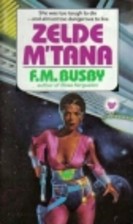
Book Review: Zelde M’Tana by F. M. Busby (Series, Prequel) (Bottom of TBR Pile Challenge)
 Summary:
Zelde M’Tana is one of the lost children, living away from UET influence and welfare or adults at all in gangs of violent kids. But she gets captured and sent in outerspace on a journey toward being a sex slave on a mining planet. When the ship mutinies, her chances for a future change for the better.
Review:
I picked this up because I heard it is the prequel for a black woman spaceship captain from a scifi series in the 70s. I was intrigued (who wouldn’t be by that cover) but I was ultimately disappointed by the characterization of Zelde.
This prequel is designed to be able to be read as a standalone, so that’s how I approached it. It’s not entirely clear what the problem is in this futuristic world, but it appears that an evil corporation known as the UET has taken over governing everybody and generally encourages violence and treats everyone like dirt. There are a few escaped ships and some colonies they have set up on other planets where people live freely. This prequel, then, basically tracks how Zelde comes to be escaped.
I almost stopped reading the book very early on during Zelde’s lost child years. She is a lost child who joins a gang and winds up climbing the ranks. There’s obviously a lot of violence. What I wasn’t expecting was for Zelde to be a rapist. In the context of the gang wars, when her gang overtakes another, she takes the leader of that gang and rapes him in front of everyone. (She achieves this by tying a rope around his penis and tugging on it until he gets hard). In one instance, perhaps in both, I’ve kind of tried to scrub it from my mind, she kills the man right after raping him. Now, the thing to understand is, Zelde is not ever presented as an anti-hero. She is 100% supposed to be a hero that the reader roots for. We want her to escape UET; we want her to succeed. But she’s a rapist. A hero rapist isn’t a character I can get behind, and I wouldn’t want other readers to either.
I kept reading the book because I was wondering if this would ever be addressed. If, perhaps after Zelde escapes and is able to get some education and safety she would realize what she did was wrong. But that never happens anywhere in the book. It’s really disappointing.
The second problem I have with the book, which is somewhat related, is in how it presents female sexuality. Basically, in this world, all women will have sex with other women if a man happens to not be around and convenient right when they get their urge. So, for instance, Zelde prefers men, but she’ll take a woman to pair up with if a man isn’t right handy. She also will dump her female pairing the instant there’s a hint she can get with a man. Similarly, there’s a triad relationship on the ship in which a man, Dopples, is paired with two blonde women. The women read as sisters, although it’s possible they’re not. In any case, this is one of our typical interactions with them:
She [Zelde] could never tell the two blonde women apart. The one who opened the door this time had bangs now–but so did the other, standing behind a little. Both naked, hair messed, a little sweaty and out of breath–were they having somebody else in here? no–not on Dopples; they wouldn’t dare that. Must be playing together, just by themselves. That figured–for two women, one man had to be short rations. (page 127)
It all feels like a misreading of female bisexuality. Female bisexuality isn’t a result of an appetite for sex that is just so high it can’t be satiated by just one person or that must be satiated at every opportunity. Bisexuality is not this idea that women need to have sex constantly and so will take just anyone, with a slight preference toward men. While I appreciate that a book published in 1980 includes the idea that women can be attracted to other women it reads from the perspective of a male gaze idea of female bisexuality instead of the reality. Similarly, not all women are bisexual and yet every single woman in this book seems willing to jump into bed with another woman if a man doesn’t happen to be available or in the context of a M/F/F threesome. Not all women are bisexual. Not all bisexual women prefer to pair up with men (some do, but not all). Not all bisexual women are open to the idea of a threesome. The only hint to the idea that not all women are bisexual that the book concedes to is that one character is asked at one point if she is “all for women” (page 257) as in are you a lesbian. (She is not, if you were wondering). It is just as erasing of bisexuality to operate from the assumption that all women are bisexual (but not all men) as it is to say none are. Some straight men may like the idea that women are off sleeping with each other every time their backs are turned and that of course any woman would want to participate in a M/F/F threesome given the opportunity, but that is not the reality.
One final issue I had with the book, which is a bit minor but is still annoying, is a bit of grammar. Almost every time a character says something like “would’ve” or “could’ve,” it’s spelled as “would of” or “could of.” It does this outside of times the characters speak, so it’s not an attempt at dialect.
A positive to say about the book is the plot is fast-moving and covers a lot of ground. Zelde’s life is eventful, and if a reader isn’t a fan of one phase, it will quickly change. Also, Zelde’s race is not just mentioned and then forgotten. Her existence as a black woman and what that means for her is confronted in the book in various ways. Also, Zelde rocks a natural hairstyle and gauges her ears at one point while still climbing the ranks of the ship.
Overall, this 1980 scifi book contains a fast plot and interesting future but its representation of female sexuality may be bothersome to some readers. Readers who seek to avoid scenes involving rape or being asked to identify with a rapist should avoid it. Recommended to readers of classic scifi and those interested in seeing representations of black women in literature in the 1970s and 1980s.
If you found this review helpful, please consider tipping me on ko-fi, checking out my digital items available in my ko-fi shop, buying one of my publications, or using one of my referral/coupon codes. Thank you for your support!
2 out of 5 stars
Length: 316 pages – average but on the longer side
Source: The now-defunct SwapTree (like PaperBackSwap).

Counts For:
Bottom of TBR Pile Challenge
Book Review: Rewinder by Brett Battles (Audiobook narrated by Vikas Adam)
 Summary:
It’s 2015, and Denny Younger of New Cardiff, California, is a caste of 8. He loves reading and studying but he knows he will probably end up working in the shops just like his father. But when he takes his placement test, he’s offered a position that he is promised is better, but he can’t know anything about it until he starts working, and he must leave his family behind. Denny’s family life is in pieces, so he eagerly agrees. Before he knows it, he is re-caste as a 5 and soon discovers that he will be traveling through time as an observer, recording family histories for the elite. Even the smallest error in time-travel can have far-reaching consequences, and before he knows it, Denny finds himself racing against time (and other time-travelers) to fix everything. But what does fixing everything actually mean?
Review:
I love a good time-travel book, so when Audible offered this one up to me for review, I eagerly agreed. This is an action-packed book but with far less time-travel than it originally appears and much more parallel universes.
The basic premise of the book is that this is the year 2015 in a wold where the American Revolution never occurred. Without the American Revolution, the British Empire ended up taking over most of the world (except East Asia). Everyone is sorted into extremely strict castes, and family history is everything. These people haven’t made it to the moon yet, but they have managed to discover time-travel. And they use this discovery solely to send people called “rewinders” back in time to verify people’s ancestry to solidify their ranking in this world. Now, this was my first major problem with the book, and it’s a plot point I just never was able to let go of. This society acknowledges the risk of the butterfly effect and yet they brazenly send people willy-nilly through time risking everything for what? Geneaology. And this has been going on for decades with no ill effects. Perhaps other readers can get past the idea that a federally (er, royally) backed agency would do this, but I simply could not.
Naturally, when our brave hero goes back in time, he is the first to woops his way into a butterfly effect. He knows he’s probably done it (he causes someone to leave a location 12 seconds late), but he still pops back up into the present to check on things. Once there, it takes him days to figure out that he’s changed history. Daaaaays. It should really not take him this long to figure this thing out. Denny causes a change. Denny pops up to the present. Denny has troubling connecting to his companion (a person in the present who grounds the person time-traveling), so he gets sick for a few days. Denny then wanders through our universe’s New York City and can’t figure out what’s going on. It takes traveling to California’s New Cardiff (in our world, Los Angeles) and seeing that his family home is gone to figure out what’s happened. Really? A person who has been trained in time-travel takes this long to figure out this very basic time-travel problem? It’s hard to believe, especially after we’ve been told repeatedly how smart Denny is, that he could be that stupid.
Denny then starts living in Los Angeles to investigate this parallel universe. He naturally meets a girl and falls for her. He then has trouble deciding whether to put everything back or not. And of course there are other rewinders out there he must contend with.
The basic plot idea is interesting. What would have happened if there had been no American Revolution and how would a person from that society react if they discovered a different option for their lives? But how the author gets there isn’t fully thought-out or fleshed-out enough. There are too many logical fallacies, such as the ones I’ve laid out above. That said, it was a fun read with a different plot than what has been coming from a lot of YA recently. I was glad to see a scifi that contains some history for YA readers. I also appreciated how many women characters are present in the book, including Denny’s trainer and his nemesis. Similarly, Denny’s world is extremely lacking in diversity due to the success of the British empire and its traditionalism. When he travels to our world, he immediately encounters greater diversity, both of race and of sexuality, and he seems to appreciate that, which is a nice touch.
The narrator does a good job both keeping a good pace and setting the tone for the book. While I understand why the narrator uses a British accent for the British characters from the 1700s, the history geek in me was frustrated, since the stereotypical modern “British accent” didn’t exist back then. (I knew this from my History BA, but here’s an article that explains what I’m talking about).
Overall, this book has an interesting premise and fast-moving plot. It has some romance, but is thankfully free of any love triangles. Time-travel fans may be frustrated by how easily characters brush off the real presence of time-travel issues. The science of time-travel is simply not explored enough, nor is history. However, YA readers looking for a quick read and something different in the genre will most likely enjoy it.
If you found this review helpful, please consider tipping me on ko-fi, checking out my digital items available in my ko-fi shop, buying one of my publications, or using one of my referral/coupon codes. Thank you for your support!
3 out of 5 stars
Length: 300 pages – average but on the shorter side
Source: Free download from Audible in exchange for my honest review

Book Review: Botanicaust by Tam Linsey (Series, #1)
 Summary:
When the world is devastated by GMO plants over-running the land and destroying cropland, humanity splits into multiple factions. There’s the people who firmly believe in transforming people so that they can photosynthesize food from the sun–and have green skin. There’s the cannibals, who have returned to a hunter/gatherer way and eat humans when necessary. Unbeknownst to the green folk, there’s a holdout of Old Order Amish. They’ve changed from how they were in the past but still hold onto many of their ways. In particular, they have decided that taking green skin is the Mark of the Beast, and will not go for it.
Tula is a scientist among the green folk who is tasked with assisting cannibal children who are kidnapped and converted. Levi is an Amish who leaves the compound against orders, seeking yet another group of scientists who are supposed to live in a mountain and may have the cure to his dying son’s Cystic Fibrosis. When Levi is swept up in a green raid of cannibal land, his and Tula’s worlds collide with unimaginable consequences.
Review:
I picked this up because the cover of a green-skinned woman in a desert appealed to me, and then the description seemed like an interesting post-apocalyptic future. This is certainly and interesting and unique read for any fans of post-apocalyptic or dystopian literature.
The future is imaginative with many different groups and reactions to the botanicaust (the destruction of plant matter that is considered this world’s apocalypse). As someone who has studied the Amish, I appreciated how the author imagined how the Old Order would handle such a crisis and address it for the future. Allowing people into the compound if they are willing to convert seems logical, and showing that the Old Order did accept some technological innovation also makes sense. Similarly, the green scientists who seek to photosynthesize everyone and don’t seem to care too much if the cannibals want to be photosynthesized or not make logical sense. The scientists believe this is the solution in a world without enough food, and hey haven’t bothered to do any cross-cultural studying to see if there is any rhyme or reason or value to the cannibal lifestyle. This again is a logical position for a group of scientists to hold. The other group of scientists who live in the mountain and have managed to find the solution to not aging are a great contrast to the groups of greens. Whereas the greens do sometimes do evil but don’t intend to, they only intend to be helping (with the exception of one bad guy character), the mountain dwellers have been turned inhumane by their abnormally long lives. These three groups set up a nice contrast of pros and cons of scientific solutions and advancement. At what point do we stop being human and at what point are we being too stubborn in resisting scientific advancement? How do we maintain ethics among all of this? The exploration of these groups and these questions was my favorite part of the book.
The plot is complex and fast-paced, visiting many areas of the land and groups of people. I wasn’t particularly a fan of the romance, but I can see where others would find that it adds to the book. I just wasn’t particularly a fan of the pairing that was established, but for no reason other than it seemed a bit illogical to me. Then again, romance is not always logical.
The one thing that really bothered me in the book was the representation of Down Syndrome and the language used to refer to it and those who have it. The mountain scientists have children, but as a result of tampering with their own genetics, all of their children have Down Syndrome. First, I don’t like that this makes it appear as if Down Syndrome is a punishment to the evil scientists who went too far with science. Down Syndrome is a condition some people are born with. It is not a condition as the result of anything a parent did, such as fetal alcohol syndrome. Second, all of the characters with Down Syndrome are presented as large, bumbling oafs with hearts of gold. There is just as much variety to the personalities and abilities of those with Down Syndrome as there are in those of us without Down Syndrome. Finally, the author persists in referring to these characters as:
a Down’s Syndrome woman (loc 2794)
or of course, “a Down’s Syndrome man.” First, the preferred term for Down Syndrome is Down Syndrome, not Down’s Syndrome. This is a mistake that is easy to make, though (I have made it myself), and I am willing to give the author a pass for that. The more upsetting element in the way she refers to these characters though is that she always lists the condition first and then the person, not the other way around. It is always preferred, in any illness or condition, to list the person first and the illness or condition second. For instance, a woman with cancer, not a cancerous woman. A man with PTSD, not a PTSD man. A child with Down Syndrome, not a Down Syndrome child. I cringed every single time this happened, and it happens a lot in the section of the book that takes place in the mountain. Given that this is an indie book, and it is thus quite easy to make editing changes and fixes, I would hope that the author would go through and fix this simple aspect of language. It would be a show of good faith to the entire community of people who have Down Syndrome, as well as their families. For more on the preferred language when referring to Down Syndrome and people who have Down Syndrome, please check out this excellent guide, written by the National Down Syndrome Society.
It’s a real bummer to me that the language about Down Syndrome and presentation of these characters isn’t better, because if it was, this would have been a five star read for me.
Overall, this is an interesting and unique post-apocalyptic future with an action-packed plot. Those who are sensitive to the language used to refer to Down Syndrome and representation of people with Down Syndrome may wish to avoid it, due to an unfortunate section where characters with Down Syndrome are referred to improperly and written a bit two-dimensionally.
If you found this review helpful, please consider tipping me on ko-fi, checking out my digital items available in my ko-fi shop, buying one of my publications, or using one of my referral/coupon codes. Thank you for your support!
4 out of 5 stars
Length: 348 pages – average but on the longer side
Source: Amazon

ETA:
The author has written a thoughtful and kind comment on this post. You may view it by going below. To sum up, she cannot make edits to those book, due to it also having an audiobook version. However, she has promised to edit for these issues in future books containing characters with Down Syndrome. This genuine and thoughtful response is much more than the community of those with Down Syndrome and their families and loved ones often get, and it is very much appreciated.
Book Review: Preserver by William Shatner, Judith Reeves-Stevens, and Garfield Reeves-Stevens (Series, #3) (Audiobook narrated by William Shatner)
 Summary:
Captain Kirk and his nemesis from the mirror universe, Tiberius Kirk, pair up to hunt down the preservers, orbs left by some more intelligent race. Kirk is teaming up with Tiberius because Tiberius holds the key to saving his wife’s and unborn son’s lives. Their quest will reveal hidden secrets about the universe.
Review:
This is the second audiobook my fiancé and I listened to on our road trip to and from Michigan. We listened to the previous book in the series, Dark Victory (review), on the drive out. We listened to this one on the drive back. (Each direction is a 13 hour drive). Whereas the previous book kept us entertained and awake for our road trip, this one left us confused and concerned we might actually be drifting off into sleep periodically, because it made so little sense. (For the record, we were not drifting off into sleep. This book just makes very little sense).
All of the audiobook qualities that were great about the previous book stay great here. Shatner’s narration alternates between hilariously good and hilariously bad but mostly is just hilariously Shatner. The sound effects continue to be stellar and one of my favorite parts of the book. It continues to feel like listening to a Star Trek movie as a radio show, and that it was kept me going through it.
The plot, however, just makes very little sense and seems to fall apart. Whereas in the previous book a continuing plot point is Shatner’s ruined hands, in this one it’s Shatner’s unborn (and then born) son who is all kinds of genetically messed up thanks to the poison in his mother’s system from the cloned children of Tiberius. (Are you confused yet?) This could possibly make for an interesting plot, but it’s dropped frequently to pursue the other plot about the preserver orb things. We read this book and both fiancé and I are still unclear as to precisely what the orbs mean. We’re not even sure if they’re good or bad. This is how confusing the plot is, I can’t even properly sum it up for you folks. In spite of the plot being really confusing, there are still some fun scenes, such as when Kirk meets his son for the first time. It’s a short audiobook, so I’m not unhappy I listened to it, even if I mostly only understood the Kirk’s son plot.
Overall, while this provides very little clear closure to the plot point set up earlier in the trilogy, it does feature the birth of Kirk’s son and all the fun of listening to a radio show version of a Star Trek movie. If you liked the previous books in the trilogy and don’t mind a confusing plot, you’ll enjoy finishing up the trilogy.
If you found this review helpful, please consider tipping me on ko-fi, checking out my digital items available in my ko-fi shop, buying one of my publications, or using one of my referral/coupon codes. Thank you for your support!
3 out of 5 stars
Length: 420 pages – average but on the longer side
Source: Audible

Previous Books in Series:
Spectre
Dark Victory

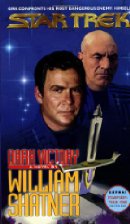
Book Review: Dark Victory by William Shatner, Judith Reeves-Stevens, and Garfield Reeves-Stevens (Series, #2) (Audiobook narrated by William Shatner)
 Summary:
Our universe has been invaded by the inhabitants of the Mirror Universe–a parallel universe that is a dark, twisted version of our own. Now, Captain Kirk, with the captains and crews of The Next Generation and Voyager must battle evil versions of themselves, led by the evil version of Kirk — Tiberius Kirk. What nightmares does Tiberius have planned for the Federation?
Review:
Back in December, my fiancé and I road-tripped to Michigan to visit his family. It’s about a 13 hour drive, and I had Audible credits, so I suggested we pick out a book. We both love Star Trek so we investigated what Star Trek options are available. This one jumped out at us for the obvious reason that it’s narrated by William Shatner himself! Other reviewers complained about sound effects, but that just made us more excited, so we downloaded it, oblivious to the fact that it’s the second book in a series. This book reads like a radio program version of a Star Trek movie featuring a crazy mash-up of the Original Series, Next Generation, and Voyager.
The action starts right away, which was admittedly a bit confusing, since we hadn’t read the first book. It starts with Tiberius and his crew escaping into our own universe, and Kirk and his trying to battle them. Also, Kirk’s hands are mysteriously mangled from something that happened in the first book. Ultimately, we were able to catch up with the plot and follow it somewhat. Kirk is in love with a woman who is pregnant with his baby. Tiberius seems intent on getting to some orbs that the Federation wants to protect. Kirk wants to stop him, but the Federation and some spy branch of theirs are trying to keep him from engaging in the fight anymore. They even go so far as to lie to him and tell him that Tiberius is dead. It’s a complex, twisting plot that makes some sense when listening to it, although summarizing it is nigh on impossible. Suffice to say, that if you enjoy the concept of the mirror universe and the characters from three series all interacting together, you’ll probably enjoy this plot. Plus, there’s also Kirk’s wedding in this book, and that is just not to be missed. (There are horses! And red leather outfits!)
What really made the book for me was the audiobook presentation of it. It is presented like a radio program, complete with amazing sound effects. The communicator actually beeps! There are impact noises from shots at the Enterprise! There are even whinnies from the horses. If you’re a more serious Star Trek fan, you might be irritated by the relative kitsch of this book and its reading, but if you enjoy Star Trek for its periodic utter ridiculous, then you’ll enjoy the way this audiobook is presented.
Shatner’s narration is sometimes good but often hilariously bad. His voice for women is unnaturally high and soft, making me giggle each time, and mysteriously, he uses the same voice for Captain Picard as for women. Listening to him narrate anyone who is not Captain Kirk is a bit like watching Captain Kirk “fight” in the Original Series. I enjoyed it for its ridiculousness, not for its quality.
Overall, if you’re a Star Trek fan who doesn’t take the show too seriously, you’ll enjoy this radio program like audiobook with a plot mashing up everything from a mirror universe to somehow placing Captains Kirk, Picard, and Janeway on the same ship.
If you found this review helpful, please consider tipping me on ko-fi, checking out my digital items available in my ko-fi shop, buying one of my publications, or using one of my referral/coupon codes. Thank you for your support!
4 out of 5 stars
Length: 303 pages – average but on the longer side
Source: Audible
Previous Books in Series:
Spectre

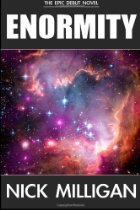
Book Review: Enormity by Nick Milligan
 Summary:
When Australian astronaut, Jack, crashlands on a planet during a mission and is the only survivor, he fears the worst. What he finds is a planet surprisingly similar to Earth–even speaking English–only with a culture of peace and non-violence. Seeking to survive as a homeless person, he starts busking with a guitar he finds, playing Earth songs. Before he knows it, he’s discovered and becomes a rock star, introducing the planet to Earth’s greatest rock songs, while claiming to have written them himself. But rock star is an awfully high profile for someone who is technically an alien.
Review:
This was my final accepted ARC from 2014, and I think it’s a fitting review for the last day of 2014 here on Opinions of a Wolf. This was an interesting read that kept me moderately entertained, although it wasn’t the rollicking good time I was initially expecting.
The book jumps right in to Jack as already a rock star on Heaven (the alien planet) and tells of his arrival and how he became famous through a series of flashbacks. This nonlinear storytelling works well with the plot. Starting with semi-familiar rock star territory, the book slowly reveals what is different about this planet, as well as about Jack.
It is evident that this was originally a three part series, as the plot consists of three distinct parts that, while connected, keep the book from having an overarching gradual build-up of suspense. Jack has three distinct episodes of action, and that lends the book and up and down quality that feels a bit odd in one novel. I actually think I might have enjoyed the book more if it was kept as a trilogy with each part’s plot fleshed out a bit and the overarching conflict made more evident. An overarching conflict does exist, but it is so subtle that the opportunity to build suspense is mostly missed.
Personally, Jack didn’t work for me as a main character. While I don’t mind viewing the world through a bad guy’s eyes, I usually enjoy that most when I get a lot of depth and insight into who that person is. Jack holds everyone, including the reader, at arm’s length, so I both saw the world through his objectifying eyes and couldn’t really get to know him at all. That said, I can definitely see some readers enjoying Jack and his viewpoint. He lends the unique ability to let people see the world both through a rock star’s eyes and through an astronaut’s. A reader who is into both famous people’s biographies/autobiographies and scifi would probably really enjoy him.
Similarly, the humor in the book just didn’t strike my funny bone. I could recognize when it’s supposed to be humorous, but I wasn’t actually amused. I know other people would find it funny, though. Readers expecting a Douglas Adams style humor would be disappointed. Those who enjoy something like Knocked Up would most likely appreciate and enjoy the humor.
There are certain passages that sometimes struck me as a sour note among the rest of the writing. Perhaps these are passages that would be humorous to other readers, but to me just felt odd and out of place in the rest of the writing. Most of the writing at the sentence level worked for me. It was just the right tone for the story it was telling. But periodically there are passages such as the one below that made me gnash my teeth:
Natalie is a rare beauty. A creature of potent sexuality. Someone you would step over your dying mother to penetrate. (loc 8803)
I take a seat in McCarthy’s desk chair. It’s comfortable. Luxurious in the way a set of stainless steel steak knives might feel to a psychopath. It’s beautiful and firm and smells nice, but in the wrong hands this chair could be used for evil. (loc 6821)
Again, perhaps this is humor that just didn’t work for me. I’m not certain. If you like the concept of the rest of the book, there are only a few of these passages that are easy to pass over. If you enjoy them and find them humorous, then you will most likely enjoy the book as a whole as well.
Overall, this is a piece of scifi with the interesting idea of turning an Earth astronaut into a rock star on another parallel planet. Potential readers should be aware that the book was originally told in three parts, and that is evident in the book. They should also be aware that the main character is both a self-centered rock star and a self-centered astronaut, while this viewpoint may work for some, it will not work for others. Recommended to those who enjoy both celebrity autobiographies/biographies and scifi who can overlook some bizarro coincidences.
If you found this review helpful, please consider tipping me on ko-fi, checking out my digital items available in my ko-fi shop, buying one of my publications, or using one of my referral/coupon codes. Thank you for your support!
3 out of 5 stars
Length: 470 pages – chunkster
Source: Kindle copy from author in exchange for my honest review

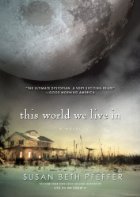
Book Review: This World We Live In by Susan Beth Pfeffer (Series, #3)
 Summary:
Miranda and her mother and brothers have barely survived the long winter that came right after the moon was knocked out of orbit by an asteroid, bringing an apocalypse. She’s been wondering for months what happened to her father and his pregnant new wife. She’s thrilled when they show up on the doorstep when her newborn half brother, but she’s not so sure about the three extra people they’ve brought with them — an adult man and a teenage boy and his little sister.
Review:
The third book in this series reverts back to the Miranda’s journal format of the first. While I appreciate bringing the diverse characters from the first two books in the series together, the use of Miranda’s journal exclusively in telling the story renders the tale a bit less interesting and strong than it could have been.
It should come as no surprise that a YA series featuring a girl in the first book and a boy in the second will bring the two together in the third. I must admit that although when I finished the first book I was very eager to read more about Miranda, when I finished the second I was intrigued at the idea of a series that saw the same apocalypse lived out in different places by different people throughout. That said, getting to know the extensive background of the love interest is appreciated and different but it is a bit jarring to go back to Miranda’s diary after getting to know Alex so thoroughly in the second book. The book could have been much more powerful if Miranda’s journals were interspersed with chapters from Alex’s perspective. Getting this perspective would have helped make their love seem more real, as opposed to just convenient. (Alex is the only teenage boy Miranda has seen in a year). Additionally, in spite of Miranda falling for Alex so fast, he mostly comes across as cold and overly religious in this book, whereas in his own book he was much more empathetic. Certainly the need for survival will make him come across stern, and we know that Alex has a tendency to say important things in Spanish, which Miranda cannot understand. Both of these facts means it would have worked much better to have alternating perspectives, rather than just Miranda’s.
The plot, with the exception of the instant love between Alex and Miranda, is good. It brings everyone into one place in a way that seems natural. The addition of new characters also breathes new life into Miranda’s situation. Plus, Pfeffer does a good job of forcing the family out of their stasis in the home, something that both makes logical sense (these people were not preppers, they are not equipped to stay in their home forever in the apocalypse) and also keeps the plot interesting (one can only read about people holed up in a house for so long). The plot developments also make more sense, scientifically, than in the previous books.
Religion is handled less smoothly here than in the previous two books. Everyone but Miranda’s mother and Miranda has church on Sunday (Protestant or Catholic), and Miranda doesn’t have enough of a reaction to or thoughts about this. She doesn’t really think about faith or spirituality. Church is just something some other people do. This is unrealistic. A teen who has just gone through a disaster and sees her father suddenly take up faith would definitely at the very least have some questions. Given that Alex has a very strong faith and they are interested in each other, one would think they would have some conversations about religion that go beyond whether or not they can have sex before they get married, yet they don’t. The first two books sets a great stage to talk about faith in its many forms, as well as lack of faith, yet the book backs away from actually tackling this issue. If it had, it would have offered something truly thought-provoking in the read. Instead it’s a post-apocalyptic survivor romance. Not a bad thing but not what I was expecting based on the first two books.
Overall, this is an interesting next entry in the series that brings Miranda and Alex back to the readers and moves the plot forward. However, it dances around the issue of faith vs. lack of faith brought up in the first two books, eliminates Alex’s voice from the story, and suffers from some instant romance. Those already invested in the series will still enjoy seeing what happens to Alex and Miranda, although skimming for plot points is recommended.
If you found this review helpful, please consider tipping me on ko-fi, checking out my digital items available in my ko-fi shop, buying one of my publications, or using one of my referral/coupon codes. Thank you for your support!
3 out of 5 stars
Length: 261 pages – average but on the shorter side
Source: Library

Previous Books in Series:
Life As We Knew It
The Dead and The Gone
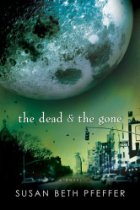
Book Review: The Dead and the Gone by Susan Beth Pfeffer (Series, #2)
 Summary:
Seventeen-year-old Alex Morales works hard with his eyes on a good college. He even works in a local pizza joint to pay for his own private Catholic school uniforms to help his Mami and Papi. Papi is in Puerto Rico for his mother’s funeral and Mami is working late when an asteroid strikes the moon and everything changes. New York City is struck by flooding and loss of infrastructure. Alex is left alone to care for his two younger sisters, Julie and Briana, and slowly he begins to think that maybe things will always be this bad. Maybe Mami and Papi will never come back, the moon will never look right again, and there will never be a world where he can go to college and not be left caring for his little sisters.
Review:
I inhaled the first book in this series, in spite of the scientific flaws (which I addressed in my review of the first book). Miranda’s journal ends so abruptly that I was eager to get to the next book right away. I was surprised, then, when the second book starts back before the moon is struck with an entirely different family in a different area of the country. This book shows Pfeffer’s abilities as a writer by showing the same apocalyptic event seen in the first book from the perspective of an entirely different family.
Miranda’s family is suburban-rural, agnostic/atheist humanist, blended (divorced parents with one remarried), and white. Alex’s family is urban (NYC), Latino, and devotedly Catholic. Both families are given room to have strengths and flaws, most of which have nothing to do with where they live, their ethnicities, or their religions (or lack of one). I honestly was startled to see Alex and his and his sisters’ strong faith treated with such respect in this book after Miranda’s lack of faith was treated with equal respect in the first. It’s easy, particularly in a book written as a journal, to mistake a character’s beliefs for an author’s, and Miranda, a teenage girl, has very strong beliefs. This book reminded me that those beliefs were just Miranda’s, just as Alex’s beliefs are just his, and it shows how well Pfeffer is able to write characters.
Some readers may find it odd and frustrating to go back in time to relive the apocalypse over again with different characters. I personally enjoyed it, because the world falling apart is one of the best parts of post-apocalyptic fiction for me. I also liked having the opportunity to see differences in how the apocalypse plays out based both on the location (suburban/rural versus urban) and the characters’ personalities and reactions. However, that said, I can see how this set-up of two vastly different sets of characters in books one and two could be off-putting to certain readers. Some religious readers may be turned off by the first book and Miranda’s staunch atheism. Those who read the first book and enjoy it for precisely that reason may similarly be turned off by the second book’s heavy Catholicism and faith. The diversity is a good thing but it also makes it hard to pinpoint an audience for the series. Those who are open to and accepting of other belief systems would ultimately be the best match but that’s a demographic that can sometimes be difficult to find or market to. However, if a reader is particularly looking for a diverse set of viewpoints of the apocalypse that is more than just characters’ appearances, this series will be a great match for them.
It should also be mentioned that this book is not a journal. It is told in third person, from Alex’s viewpoint, although the dates are still mentioned. It makes sense to do it this way, since Alex definitely does not come across as a character with the time or the inclination to keep a journal. It would have been interesting to view the apocalypse from the viewpoint of a boy who did keep a journal, however.
The plot makes sense and brings in enough danger without being overly ridiculous. It would have been nice to have maybe started the book just a bit earlier in the week to see more of Alex’s day-to-day life before the disaster. Instead, we learn about it through flashbacks, which makes it a bit harder to get to know him than it was to get to know Miranda.
Overall, this is a surprising and enjoyable second book in this post-apocalyptic series that lets readers relive the apocalypse from the first book over again with a different set of characters. This approach lends diversity to the series, as well as bringing in a greater variety of scenarios for those who enjoy the apocalypse process. Recommended to those looking for a diverse presentation of beliefs and how those impact how characters deal with an apocalypse.
If you found this review helpful, please consider tipping me on ko-fi, checking out my digital items available in my ko-fi shop, buying one of my publications, or using one of my referral/coupon codes. Thank you for your support!
4 out of 5 stars
Length: 341 pages – average but on the longer side
Source: Library
Previous Books in Series:
Life As We Knew It
 Support my work with a tip or browse my shop for curated book club guides, how to guides, cross-stitch patterns, and more!


This work by Amanda Nevius is licensed under a Creative Commons Attribution-Noncommercial-No Derivative Works 3.0 United States License.
 Opinions of a Wolf