
Archive
Book Review: Peyton Place by Grace Metalious
 Summary:
Peyton Place appears to be a picturesque small town in New Hampshire. But over the course of the novel, the secret passions, lies, and cruelties of its various inhabitants are revealed. From a single mother lying both about her daughter’s age and being a widow to the school janitor who drinks to dull the ache of his wife’s cheating to what exactly is buried in the sheep pen in the Cross’s yard. Small town life is anything but simple and picturesque.
Review:
This book was first recommended to me on either LibraryThing or GoodReads for being similar to The Group (review), another book written in the mid 1900s featuring an ensemble cast. I wound up ultimately picking it up because I read that it was quite scandalous when it first came out and it was the inspiration behind the first successful nighttime American soap opera of the same name (source). Additionally, I grew up in Vermont but spent a lot of time in New Hampshire, since I grew up on the Vermont border with New Hampshire. I even went to high school in New Hampshire (public school, my town in Vermont was too small for a high school so bussed us out to other ones nearby). I was curious to see if any element of the book would successfully evoke New Hampshire to me. I often find that books set in New Hampshire just don’t ring true with the New Hampshire I know. What I found was a book that almost gave me chills at how well it depicted a typical New Hampshire small town, but also was nowhere near what I would in my modern mind describe as scandalous, although I can see why it was at the time.
The story explores the intersecting lives of many town folk in the 1940s and 1950s, but primarily focuses on Constance MacKenzie, her daughter Allison, and her daughter’s friend from the wrong side of the tracks, Selena Cross. Constance is a frigid woman who has tamped down her sexuality in an attempt to raise her daughter who she conceived out of wedlock while having an affair with a married man in the right way. She has gone so far as to lie about her daughter’s age and to lie about being a widow to help her daughter seem “acceptable.” Allison grows up over the course of the novel, first having typical teenage angst, then moving away to NYC to become a writer. Selena Cross suffers from a good-for-nothing stepfather, living in a shack, and living with a mother who is not all mentally there. Through their eyes and lives we see snippets of the lives of many others in the town.
Here are the things that were considered scandalous when the book was first published: rape of a stepdaughter by a stepfather (you can probably guess who), abortion (which was illegal at the time), men locking themselves in a basement to go on a bender for weeks at a time. Things that were probably also considered scandalous but to less of a degree: teenage sex, out of wedlock sex, middle school aged boy spying on a couple having sex, murder in self-defense. I had to sit here and think for a bit to remember what was possibly deemed scandalous. It mostly just seemed like a very eventful book to me, and honestly I was just a bit surprised that nothing more scandalous happened. (Apparently, Metalious originally wrote the book with having a father rape a daughter, but the publisher made her change it because America wasn’t ready yet. Oh my how times have changed. Source). The only part of the book that really bothered me at all in the way that perhaps people were once scandalized was the depicted of Constance’s relationship with her new boyfriend. Basically she is frigid and he has to get her to open up and accept her sexuality in order to be her true self. That’s a fine plot, but the way it’s done often verges on the border of “she said no but ignore it because she really means yes.” I understand in the 1950s when this was written that it was progressive to have a woman character learning to open up and embrace her sexuality, so I shouldn’t be too harsh with modern critiques. Certainly the character herself deems what occurred between her and her boyfriend as lovemaking. But I definitely don’t think this portion aged well, and it soured my enjoyment of that particular chapter, and Constance’s plot as a whole.
I found the two abortion plots to be particularly poignant and important. Even though abortion is now legal, a lot of the arguments for and against it in the book are still heard today. I found the two abortions in the book to be an important reminder of why it’s important for abortion to be legal and also why it’s important to educate about safe sex at the same time.
What really made me enjoy the book though was its depiction of small town New Hampshire life. It just rang as so very true to me, right own to the scandals. I think too often people get this idealistic picture of small town life, and that is just not the reality for people who actually live there. People in small towns are just as human as people in cities. The real difference is that it’s hard to change your reputation in a small town. Similarly, small towns are more able to be a law in and of themselves. If the people agree on something, no outsiders can make them change their tune. That can both be a blessing and a curse. If you are interested in New Hampshire, this book certainly presents it in an unvarnished way. From the scenery to the proximity of Vermont to the mills and the problems with the mills to the way the small towns block out those who aren’t from here. If what the reader is looking for is a real representation of small town New Hampshire, they should certainly look no further.
One side-note: I find the story of the author’s life and how her book was received to be quite fascinating. For instance, how it was mostly received as chick lit, in spite of the fact that if the same story had been written by a man it would have been considered serious literature. I also find how the author found the information to inspire the story, as well as how she reacted to fame to be fascinating. If you want to read more about the former, I recommend picking up this edition of the book, as it has a great foreword talking about the history of the book from a women’s studies perspective. If you’re interested in the latter, I recommend reading this article from Vanity Fair about her life.
Overall, it is easy to see how this book was scandalous in its time, although it mostly holds no shock value today. Readers interested in small town New Hampshire life with a side of multiple overlapping juicy plots will not be disappointed.
If you found this review helpful, please consider tipping me on ko-fi, checking out my digital items available in my ko-fi shop, buying one of my publications, or using one of my referral/coupon codes. Thank you for your support!
4 out of 5 stars
Length: 384 pages – average but on the longer side
Source: PaperBackSwap

Counts For:
Bottom of TBR Pile Challenge
Book Review: Fated by S.G. Browne
 Summary:
Fabio is not a fan of his job as Fate. He never gets to actually influence the idiotic humans in his charge (everyone off the path of Destiny). He just gets to show up at the moment of their fateful decisions. Falling in love with a human (who just so happens to be on the path of Destiny) breaks rule #1, and once you break one rule, you may as well break others…. Soon, Fabio is interfering in his charges’ fateful decisions, but just how long can he do this without causing havoc and escaping Jerry’s (God’s) notice?
Review:
I remember I first acquired this because I really enjoyed Browne’s other novel, Breathers: A Zombie’s Lament (review). Although this book uses a similar irreverent tune, it just doesn’t work out as well given the content. Add in a few writing quirks and an ending that made me simultaneously scratch my head and go ewww, this just didn’t work for me.
The first thing that bothered me about the book is a quirk Fabio (our narrator) has to describe each and every character we encounter in the following way: “The thing about [name] is, s/he is [character flaw].” It’s cutesie the first few times. By the twentieth time it’s irritating and by the thirtieth you’re kind of wondering what the heck is wrong with Fabio that he’s been alive for this many thousands of years and still can’t seem to come up with a more creative way to talk.
The book’s mythology firmly asserts that Christianity is right. Although there’s a mysterious aside about how the Greek/Roman mythological gods and goddesses did exist but stopped being important once people stopped believing in them. So, in spite of Jerry and all of his servants all asserting that Jesus is the Son of God and Christianity is right, there’s also this idea that something else once existed when people believed in it. There is also an immortal character of Karma, who we are told exists mostly because of the many people in India who believe in him. You can probably spot the problem with these co-existing ideas. If immortal ideas/people exist because of belief, why would the only ones in existence be the Christian God and Karma, currently? There are clearly other religions in the world that people currently believe in, so…….My issue isn’t with the author choosing to assert that the Christian God is the one that is true in this world (although some readers might be bothered by it). My issue is that the book simultaneously does this and says that other gods/ideas can exist with belief, but then limits these to only ancient Greek/Roman gods and goddesses and modern-day Karma. This doesn’t work within the logic of the world that the author set up. It really bugged me.
There is also the problem that the immortal characters (well, and the human ones, but let’s focus on the immortal ones) are divided up in a very gender normative way. Destiny, Lust, and Lady Luck, Secrecy, and Honesty are all women. Sloth, Gluttony, Death, Fate, Karma, oh yeah and GOD are all men. Lust is an overwrought caricature of the evil temptress woman. Honesty is basically the most feminine innocent woman you could meet. It’s the classic virgin/whore dichotomy (oh and don’t forget the Virgin Mary, who’s also obviously mentioned quite a bit). It’s not exactly better for the men, being stuck with either being a lazy slob, someone who violently kills everyone, or Fate himself. Even if the reader is personally ok with gender normativity, this collection of characters is just expected and dull. There’s nothing that really throws the reader a curveball or strikes as creative. Right down to God going by the name Jerry and having a bureaucratic office in the sky.
Then we have the human who Fabio falls in love with, who is basically the manic pixie dream girl (a female character who exists only to show up and show a depressed male character the meaning of life. Full exploration of this trope), which I’ve talked about before in other reviews (not surprisingly in books by men set in fantastical settings and that are supposed to be funny, but I digress). Just like with gender normativity, this trope is just lazy. The only motivator to the male character (who is first person and depressed and dull) is for a magical woman to show up and fix his life (often while her own gets ruined). There’s no real characterization of the female character, and frankly it undersells the male character too. This book takes it a whole step further. The spoiler paragraph below goes into more depth about the problematic treatment of women in the book.
*spoilers*
Sara, the manic pixie dream girl, shows up and Fabio falls in love with her. She falls in love with him too. Fabio reveals to her who he is. She loves him anyway. They’re very happy together. Fabio finds out that Sara is on the path of Destiny because she’s supposed to be the mother of the second Son of God. So God is going to show up and bang his girlfriend at some point. He is very upset about this. God finds out about Fabio both telling a human who he is and interfering with human fates and punishes him by both turning him mortal and wiping him from Sara’s memory. Sara believes that Fabio was a one-night stand. Fabio proceeds to stalk her, forcing her to get a restraining order, which he then violates. It’s unclear if this is supposed to be seen as romantic, exactly, but it is clear that the reader is supposed to empathize with Fabio. Sara wouldn’t really want him to stay away from her if she just understood, which is problematic because of how it mirrors the logic of many stalkers. It gets worse though. Fabio in despair throws himself off a bridge, committing suicide. He then comes to realizing that he has been reformed as the fetus inside Sara’s uterus–the result of the one-night stand between her and God. He is the second Son of God. And he’s ok with this because he at least gets to be close to Sara. So Sara doesn’t just exist purely as a prop for Fabio’s character development, she’s also the woman who is banged once and thrown away by God to be forced to bring his second Son into the world who also just so happens to be the same dude as her ex-lover she has the restraining order against. It’s just so many levels of denying women any agency or rights or treating women as anything but passive vessels to be used by men and male gods however they want that it just made my head explode with rage when I read it. Most of this what the fuckery occurs in the last couple of chapters.
*end spoilers*
This is a book whose idea I felt had promise but the directions the author chose to take it just ruined it for me. Readers who won’t be bothered by a book with logical inconsistencies, gender normative representations of immortals, and the problematic characterizations and plots for women may enjoy the book for its irreverent humor about fate and destiny. Any readers who would be bothered by those things, though, should steer clear.
If you found this review helpful, please consider tipping me on ko-fi, checking out my digital items available in my ko-fi shop, buying one of my publications, or using one of my referral/coupon codes. Thank you for your support!
2 out of 5 stars
Length: 352 pages – average but on the longer side
Source: PaperBackSwap

Counts For:
Bottom of TBR Pile Challenge
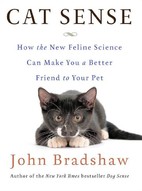
Book Review: Cat Sense: How the New Feline Science Can Make You a Better Friend to Your Pet by John W.S. Bradshaw
 Summary:
John W.S. Bradshaw, PhD, has been studying the behavior of cats and dogs and their people for over 25 years. In this book, he seeks to present the biology behind the modern domestic cat in the hopes of helping their humans understand them better. He also presents theories about the possible future of cats and suggestions as to how to direct that the best way possible for better human/cat relationships.
Review:
I picked this book up because I wanted to understand my adorable talkative tortie fluffball, Ayla, better. I certainly learned a few things about cats that I found useful in relating to my own, but I also learned a lot about the genetics of cats (not sure I really wanted to learn that), the history of human treatment of them, and theories on their future evolution.
The book is divided into 11 chapters, which could be casually grouped into the following general themes:
- the genetic and biological history of the cat or just how did we end up with a domesticated tiger anyway
- how the domestic cat thinks and feels or yes scientists are now proving that cats actually have feelings although maybe not quite to the extent that their most loving owners believe
- how cats relate to each other or cats hate other cats except for random kittens that are dropped into their nest or possibly other females from their own family
- how cats relate to people or cats think you are a giant mother cat who is possibly superior (possibly)
- how cats relate to wildlife or no cats aren’t destroying your precious birds you overly upset cat-haters (um except for possibly the wildlife on small islands but the invasive rats are actually worse and cats hunt them so there)
- the potential future of the cat or for the love of god stop spaying and neutering the bestest most loving kitties in the world and only allowing the anti-social ferals to breed.
Obviously this is a lot of ground, so I’m only going to touch on each one briefly. First though, just let me mention that the author is both a renowned expert in this science (the science of cats), and his book also features extensive references. This is thus a trustworthy source, however, potential readers should be aware that the author (just as every author) has biases, and Bradshaw’s are fairly clear in the book. The man clearly adores cats, and thus sometimes may sway a bit to the side of positive representations of cats and optimistic beliefs about the extent of their feelings and internal lives. Now, I love cats too, so that didn’t bother me in the least, but a reader just looking at the science should note this bias. Additionally, some of the studies he cites for his findings were quite small (under 100 participants, in one case, only 8 cats were tested). Studies this small show definite room for further research. Additionally, all of the cat studies he himself has conducted were in Great Britain, so cultural biases and differences in how cats and people interact should be considered when thinking about how he analyzes cat/human interaction and behavior.
The section about the history of the domestication of the cat and the genetics of the cat is, honestly, a bit of a heavy place to start for the average person just looking to get along with their cat better. There are sentences that go far more in-depth into the genetics of a cat than I really ever cared to know. Given that this book is marketed toward the average cat owner, it may have been better to dial down the genetic information just a bit to make it easier and also speedier to read in the lead-in into the more modernly relevant information. The most interesting things I learned in this section were that domestication of the cat happened in multiple different times and places, meaning multiple cultures saw the potential of the cat and domesticated them (loc 267). There is Egyptian temple art of cats sitting in baskets (loc 634), something I found to be pretty adorable. The genetics of just how we wind up with torties, which I admit to only being interested in because my own cat is a tortie:
If a cat carries one orange and one brown version of the gene, then both appear in the coat, in random patches: in one part of the skin, the chromosome with the orange version has been switched on, and in another it is it eh brown-black pattern that “wins,” producing a tortoiseshell-tabby (or “torbie”) cat. (loc 772)
If you found that quote a bit tedious to read, just bare in mind that that is the most interesting to me of the genetics information in this section. The cat is a “hypercarnivore” (loc 1176), meaning that unlike the dog, it has lost the ability to live on plants. Cats, unlike dogs, must eat meat. I also finally learned why I shouldn’t worry too much if my cat doesn’t drink very much water:
Cats do have two notable nutritional advantages over humans. First, their kidneys are very efficient, as expected for an animal whose ancestors lived on the edge of deserts, and many cats drink little water, getting all the moisture they need from the meat they eat. Second, cats do not require vitamin C. Taken together, these make cats well suited to shipboard life: they don’t compete with sailors for precious drinking water, getting all they need from the mice they catch, and they are not afflicted by scurvy. (loc 1192)
The next four sections often blurred together, since how a cat thinks and feels directly relates to how cats relate to each other, humans, and wildlife.
Cats can develop a cat form of PTSD if they are abandoned by their mothers early in life:
Kittens that are abandoned by their mothers and are then hand-raised can become excessively attention seeking toward their first owners, though some subsequently seem to “grow out of” this. Based on what we know about other mammals in similar situations, we can assume that after the mother’s departure, the kittens’ brains endure high levels of stress hormones. These consistently high levels cause permanent changes in their developing brains and stress hormone systems, such that they may overreact to unsettling events later in life. (loc 1371)
I found this particularly interesting, since I know my cat was abandoned by her first owners in their apartment when they moved away, and it took weeks for anyone to find her. I’ve often suspected my cat has some form of kitty PTSD, and I think this scientific information would support that, although the specific type of abandonment was different.
Cats can’t focus on anything closer than a foot from their nose. Your cat is not being stupid when it can’t spot a piece of food on the floor, she really can’t see it. It helps to move it around or tap the floor next to it, to get the cat to sniff that area. (loc 1644)
This section also addresses why cats are harder to train than dogs:
Cats are much more difficult to train than dogs are for at least three reasons. First, their behavior shows less intrinsic variety than that of dogs, so there is less raw material with which to work….Second, and perhaps most important, cats are less naturally attentive toward people than dogs are….Third, although dogs are powerfully rewarded by simple physical contact from their owner, few cats are. (loc 2086)
It goes on to explain how to do basic training with your cat, adapted to cats’ specific needs, primarily using a clicker (a device that makes a noise).
Feral cats have shown us that cat society is a matriarchy, with the females of the family sticking together and the toms getting booted out to go roam and make more kittens, although there are certain scenarios in which toms are tolerated living in close proximity, generally in a situation where the tom is valuable for protection of the kittens if the space is at a premium. (loc 2426)
In spite of the ability of feral cats to live in matriarchies, cats are not well-suited for a bunch of unrelated and gender-mixed cats living in one small space. Cats generally don’t like most other cats, and Bradshaw talks some about how forcing cats to live with other cats they are not related to or don’t particularly like can put undue stress on the cats.
Cats appear to be incapable of sustaining a large number of friendly relationships, even when all their neighbors are close relatives. (loc 2438)
However, the bond the cat feels with its immediate family is strong, and scientists believe they extend that bond to their owners, who they perceive of as being a sort of mother cat. (loc 3080) This section also offers potential reasons for why a cat may purr or lick their owner, but there is no definitive scientific answer yet. It is also noted that cat personalities are the result of a mix of nature and nurture, and affectionate owners tend to have affectionate cats but whether they pick out affectionate cats or cats become affectionate in response to the owner is uncertain.
Bradshaw then addresses the concern some groups have that domestic cats are hurting native wildlife populations, particularly birds. It’s clear that Bradshaw believes that this is mostly a bunch of hokum created by cat-haters as a way to get rid of cats. This is potentially true, and Bradshaw does cite some good studies about the actual impact cats have on wildlife (very small, and in some cases, helpful since they eat the invasive predator of a native species). However, it is difficult to believe everything he cites, since his bias in favor of cats is so clear, and I am saying this as a cat-lover myself. I would find it more useful for his evidence to be presented in a more balanced fashion, as I would then feel more confident citing it to people who are concerned about cat impact on wildlife.
Finally, Bradshaw looks at the potential future of the cat. He is clearly quite concerned that our current method of neutering pet cats will hurt future cats.
Because neutering inevitably targets those cats that are being best cared for, it must logically hand the reproductive advantage to those cats that are least attached to people, many of which are genetically predisposed to remain unsocialized. We must consider the long-term effects of neutering carefully: for example, it might be better for the cats of the future as a whole if neutering programs were targeted more at ferals, which are both the unfriendliest cats and also those most likely to damage wildlife populations. (loc 4039)
I found this argument to be quite moving and logical. Bradshaw suggests both that owners might let their pet cats breed once before neutering/spaying them and also that breeders could begin to work at breeding pet cats with an eye on personality rather than looks. He also suggests focusing spay/neuter programs on feral populations. This is definitely food for thought, and I certainly will consider letting a future pet cat have a litter of kittens.
Bradshaw ends his book with this statement:
Cats need our understanding–both as individual animals that need our help to adjust to our ever-increasing demands, and also as a species that is still in transition between the wild and the truly domestic. If we can agree to support them in both these ways, cats will be assured a future in which they are not only popular and populous, but are also more relaxed, and affectionate, than they are today. (loc 4072)
A good summary of the overall themes of the book.
Overall, this book will definitely teach cat owners and lovers some new things both about the science of cats and cat behaviors. Sometimes the science can veer a bit too in-depth for the audience of the book, and also sometimes the author’s love of cats can make him seem a bit biased in favor of them. However, readers who are willing to skim over the science that they are not so into will still be able to gleam lots of information from this book that will be directly helpful to them with their pet cats. Also, this audience probably won’t mind the love of cats bias in the science. ;-)
If you found this review helpful, please consider tipping me on ko-fi, checking out my digital items available in my ko-fi shop, buying one of my publications, or using one of my referral/coupon codes. Thank you for your support!
4 out of 5 stars
Length: 307 pages – average but on the longer side
Source: NetGalley

Book Review: Maplecroft by Cherie Priest (Series, #1)
 Summary:
“Lizzie Borden took an axe; gave her mother forty whacks….”
Any New Englander knows the nursery rhyme based on the true crime story of Mr. and Mrs. Borden who were murdered with an axe in 1892. In spite of being tried and acquitted for the murders, their daughter (in the case of Mrs. Borden, step-daughter), was widely believed to actually be responsible for the murders. In this book, she definitely was, but maybe not for the reasons you might think.
A darkness is trying to take over Fall River, Massachusetts, and Lizzie and her ailing sister Emma are all that might stand between the town and oblivion, with Lizzie’s parents being the first casualties in the battle.
Review:
I grew up chanting the nursery rhyme about Lizzie Borden the first half of which is quoted above (this perhaps says an awful lot about New Englanders, but I digress), and I also love tales from the Lovecraft universe, which also originated in New England. When I heard about this book that mashed up the two, I put it on my wishlist. Lo and behold, my future sister-in-law, who had never even seen my wishlist, bought it for me for Christmas last year. I thought this would be the perfect read for the fantasy challenge, and although it was a bit different than what I was expecting, I still enjoyed the mix of Lovecraft and women’s history that Priest has woven and am eagerly anticipating reading the sequel.
The story is told through a combination of first person accounts from Lizzie, Emma, and Nance, diary-style entries by their neighbor doctor, letters, police and fire reports, and first person ramblings of a professor from Miskatonic University (another Lovecraft element). Some readers may be put off by the combination of first person perspectives, but I’ve always enjoyed this style, particularly when it includes things like letters and police reports. I felt that it was one of the strengths of the book, and I also particularly enjoyed getting to see both Emma’s and Lizzie’s perspectives, as well as that of Lizzie’s lover, Nance.
The Lovecraft mash-up basically is that some sort of Dark One in the deep is out to turn everyone on the seacoast either into worshippers or victims or literally turn them into monstrous ones who live in the deep. Emma and Lizzie’s parents were among the first to begin succumbing to this infection and that is why Lizzie had to kill them. Lizzie and Emma now are conducting research, trying to figure out how to prevent the Dark One from actually rising up. This is all extremely Lovecraftian, including the fact that some of these developments don’t make a ton of sense, but things just don’t make sense in the dark fantasy world of Lovecraft, so I was ok with that. Readers new to the world of Lovecraft might be a bit more frustrated by how inexplicable most things to do with the Dark Ones and the deep are, however.
I particularly enjoyed how Priest explores how societal and cultural norms of 1890s New England affects women’s lives. Emma could be a scientist now that women are being accepted into colleges, but she chooses to instead write her scientific papers under a male pseudonym because she believes she would never garner respect otherwise. Lizzie and Nance are in love and must hide it, although Lizzie often feels why should she bother when she is already disgraced after the trial. The clashes between Lizzie and Emma regarding both her affair with Nance and the fact that Lizzie believes in trying out magical and fantastical defenses against the Dark One whereas Emma believes purely in science are interesting reading. They are two very different people who are thrust together both by virtue of being siblings and by the fact that as women in the 1890s their lives are limited.
On the other hand, in spite of liking the characters of the neighbor doctor and the Miskatonic professor and enjoying the exploration of Lizzie’s and Emma’s relationship and getting to see some of Emma’s character, I couldn’t help but feel that Lizzie didn’t get a chance to be enough in this book. Lizzie Borden is such a looming large figure in local history, even on the book cover she presents as a bad-ass in a period skirt holding a bloody axe. In contrast in the book she spends a lot of time dealing with her annoying sister. Similarly, I’m not a fan of the fact that Lizzie does very little of rescuing herself in this book, which is, I believe, if the historic Lizzie really did kill her parents, what she actually did in real life. To me Lizzie has always been a woman who said fucking enough and took an axe and dealt violently and finally with her problems. Whereas in the book, she starts off off-screen that way (we don’t actually see her kill her parents) and she sort of tapers off. Much as I enjoyed seeing her messed up relationship with Emma, I couldn’t help but feel it would have ended more powerfully if she’d said fucking enough and whacked Emma through the skull for being such an insufferable bitch and in the way all the time. This was my main issue with the book.
My second, more minor, issue is that I felt the plot takes too long to build up to actual horrifying events and/or murders. The first murders, as I mentioned before, happened off-screen. The beginning of the book then is a build-up of a lot of tension with not much actual gore or murder occurring. I should mention that I was watching “The Lizzie Borden Chronicles” on tv at the same time as I was reading this book. In that show, Lizzie kills at least one person an episode. Now, some of that gets over the top, but it does get the idea of the pacing one would expect from this type of story right. More mayhem. More murder. More danger. More often.
On a positive note, the scenes between Lizzie and Nance are beautifully done, and while I was frustrated to see Lizzie turn a bit into a lovesick fool, I was very glad it was happening with Nance. Their relationship and dynamic jumped off the page and really brightened up the book for me.
The set-up at the end of the book for the sequel is well-done, although I’m uncertain how the series can proceed forward so far removed from the actual historical event, I am excited to read it and see what happens.
Overall, this Lovecraft fantastical take on the Lizzie Borden of history and what led to the murders of her parents hits just the right note for Lovecraft fans. Readers who are new to the dark fantasy world of Lovecraft may be a bit surprised by the slow burn of the horror and how much of it winds up not making much sense, but those readers who can embrace this style of dark fantasy will enjoy it. Those looking for a bad-ass Lizzie should be aware that this Lizzie only acts when absolutely necessary and then with restraint, and they should perhaps tune into the made for tv movie Lizzie Borden Took An Ax instead. Recommended to fans of Lovecraft who are interested in getting some local history woven in to the New England settings they are familiar with from the Lovecraft universe.
If you found this review helpful, please consider tipping me on ko-fi, checking out my digital items available in my ko-fi shop, buying one of my publications, or using one of my referral/coupon codes. Thank you for your support!
4 out of 5 stars
Length: 435 pages – average but on the longer side
Source: Gift

Counts For:

Book Review: An Artificial Night by Seanan McGuire (Series, #3)
 Summary:
When two of Toby’s good friends’ children go missing from their own bedroom and another won’t wake up from being asleep, they call Toby in immediately to look for them. Soon the King of Cats reports that some of his kingdom’s children are missing too, and Quentin’s human girlfriend disappears as well. It quickly becomes clear that it’s time for the 100 year cycle of Blind Michael’s Hunt. Blind Michael, the Luidaeg’s brother, is incredibly powerful, and only three roads lead to his realm. Toby can only take each road once. That means she has only three chances to save the children and stop the Hunt.
Review:
I picked this book up immediately after finishing the second in the series and, oh man, it did not disappoint. This book presents an old school Brothers Grimm style blood-curdling, toes-curling fairy tale, peppered with characters we’ve already come to know and love.
Blind Michael is scary. What he does to the children is really scary. He turns the fae children into “Riders” monstrous twists on real fae features. He turns the human children into their horses for them to ride. Everything about Blind Michael and his twisted land scared the crap out of me, and I don’t scare easily. It was exactly the sort of scare I used to seek out as a child from the original Grimm Fairy Tales (the ones that are not cleaned up). This book goes a lot darker than the first two, which were already dark, and it went there in such a different way from the first two plots. The first two plots were entirely about murder, here we have someone stealing children from their beds. It’s a completely different type of scare and different sort of mystery for Toby to have to figure out.
The plot tells more than just this one mystery, though, it also brings out some information that is key to the overarching plot of the series. I really enjoyed how smoothly this was worked together, and I also must say I didn’t predict at all where it was going.
There are basically two themes in the book, one I appreciated and the other I didn’t particularly agree with. Let’s start with the one I didn’t agree with.
There’s a theme in the book that children on some level must deal with and be held responsible for the choices of their parents. Toby tries to pretend otherwise, but that doesn’t work out so well for her.
Blood will tell. I tried to pretend it wouldn’t that we could change, but blood always tells. We carry the burdens of our parents. (loc 312)
It basically reads as the idea that you can’t run away from your family or from your blood, your nature. Personally, I don’t like that frame of thought. You can leave your family of birth and not have to be held responsible for them. You are not your parents. You are your own person. You are not responsible for what your parents do after you leave home. So this theme didn’t sit well with me. Other readers who agree with this theme will obviously enjoy it more.
The other theme was one I was quite happy to see so directly addressed in an urban fantasy and that is of suicidal ideation. There are many different ways that suicidal ideation can manifest, but with Toby her symptoms are that she firmly believes her death is imminent and is planning for it, and she repeatedly throws herself into risk situations because she doesn’t care if she dies. Suicidal ideation essentially means that a person is lacking self-preservation instincts and is ok with dying. They won’t actually commit suicide but they will put themselves into dangerous situations because part of them does want to die. So they might run across a street without looking, go walking alone at 2am in a dangerous neighborhood, etc… Toby’s depression from the first two books has grown so much that she is now at this point, and people have started calling her out on it. Seeing her realize that she’s, in layman’s terms, got a death wish, is interesting and well-done. What I appreciate most about it is how directly it is addressed.
Because, dear October, you’re the most passively suicidal person I’ve ever met, and that’s saying something. You’ll never open your wrists, but you’ll run head-first into hell. You’ll have good reasons. You’ll have great reasons, even. And part of you will be praying that you won’t come out again. (loc 3876)
Overall, this entry in the series brings back the characters readers have come to love and puts them into a new mystery much more terrifying than the first two. Two strong themes in the book include nature/nurture/ties to parents and dealing with suicidal ideation. Fans of the series won’t be disappointed. This is a roller coaster ride of emotions and peril.
If you found this review helpful, please consider tipping me on ko-fi, checking out my digital items available in my ko-fi shop, buying one of my publications, or using one of my referral/coupon codes. Thank you for your support!
4 out of 5 stars
Length: 368 pages – average but on the longer side
Source: Library

Previous Books in Series:
Rosemary and Rue, review
A Local Habitation, review
Counts For:
Book Review: Zelde M’Tana by F. M. Busby (Series, Prequel) (Bottom of TBR Pile Challenge)
 Summary:
Zelde M’Tana is one of the lost children, living away from UET influence and welfare or adults at all in gangs of violent kids. But she gets captured and sent in outerspace on a journey toward being a sex slave on a mining planet. When the ship mutinies, her chances for a future change for the better.
Review:
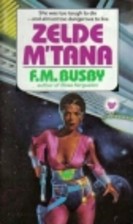
I picked this up because I heard it is the prequel for a black woman spaceship captain from a scifi series in the 70s. I was intrigued (who wouldn’t be by that cover) but I was ultimately disappointed by the characterization of Zelde.
This prequel is designed to be able to be read as a standalone, so that’s how I approached it. It’s not entirely clear what the problem is in this futuristic world, but it appears that an evil corporation known as the UET has taken over governing everybody and generally encourages violence and treats everyone like dirt. There are a few escaped ships and some colonies they have set up on other planets where people live freely. This prequel, then, basically tracks how Zelde comes to be escaped.
I almost stopped reading the book very early on during Zelde’s lost child years. She is a lost child who joins a gang and winds up climbing the ranks. There’s obviously a lot of violence. What I wasn’t expecting was for Zelde to be a rapist. In the context of the gang wars, when her gang overtakes another, she takes the leader of that gang and rapes him in front of everyone. (She achieves this by tying a rope around his penis and tugging on it until he gets hard). In one instance, perhaps in both, I’ve kind of tried to scrub it from my mind, she kills the man right after raping him. Now, the thing to understand is, Zelde is not ever presented as an anti-hero. She is 100% supposed to be a hero that the reader roots for. We want her to escape UET; we want her to succeed. But she’s a rapist. A hero rapist isn’t a character I can get behind, and I wouldn’t want other readers to either.
I kept reading the book because I was wondering if this would ever be addressed. If, perhaps after Zelde escapes and is able to get some education and safety she would realize what she did was wrong. But that never happens anywhere in the book. It’s really disappointing.
The second problem I have with the book, which is somewhat related, is in how it presents female sexuality. Basically, in this world, all women will have sex with other women if a man happens to not be around and convenient right when they get their urge. So, for instance, Zelde prefers men, but she’ll take a woman to pair up with if a man isn’t right handy. She also will dump her female pairing the instant there’s a hint she can get with a man. Similarly, there’s a triad relationship on the ship in which a man, Dopples, is paired with two blonde women. The women read as sisters, although it’s possible they’re not. In any case, this is one of our typical interactions with them:
She [Zelde] could never tell the two blonde women apart. The one who opened the door this time had bangs now–but so did the other, standing behind a little. Both naked, hair messed, a little sweaty and out of breath–were they having somebody else in here? no–not on Dopples; they wouldn’t dare that. Must be playing together, just by themselves. That figured–for two women, one man had to be short rations. (page 127)
It all feels like a misreading of female bisexuality. Female bisexuality isn’t a result of an appetite for sex that is just so high it can’t be satiated by just one person or that must be satiated at every opportunity. Bisexuality is not this idea that women need to have sex constantly and so will take just anyone, with a slight preference toward men. While I appreciate that a book published in 1980 includes the idea that women can be attracted to other women it reads from the perspective of a male gaze idea of female bisexuality instead of the reality. Similarly, not all women are bisexual and yet every single woman in this book seems willing to jump into bed with another woman if a man doesn’t happen to be available or in the context of a M/F/F threesome. Not all women are bisexual. Not all bisexual women prefer to pair up with men (some do, but not all). Not all bisexual women are open to the idea of a threesome. The only hint to the idea that not all women are bisexual that the book concedes to is that one character is asked at one point if she is “all for women” (page 257) as in are you a lesbian. (She is not, if you were wondering). It is just as erasing of bisexuality to operate from the assumption that all women are bisexual (but not all men) as it is to say none are. Some straight men may like the idea that women are off sleeping with each other every time their backs are turned and that of course any woman would want to participate in a M/F/F threesome given the opportunity, but that is not the reality.
One final issue I had with the book, which is a bit minor but is still annoying, is a bit of grammar. Almost every time a character says something like “would’ve” or “could’ve,” it’s spelled as “would of” or “could of.” It does this outside of times the characters speak, so it’s not an attempt at dialect.
A positive to say about the book is the plot is fast-moving and covers a lot of ground. Zelde’s life is eventful, and if a reader isn’t a fan of one phase, it will quickly change. Also, Zelde’s race is not just mentioned and then forgotten. Her existence as a black woman and what that means for her is confronted in the book in various ways. Also, Zelde rocks a natural hairstyle and gauges her ears at one point while still climbing the ranks of the ship.
Overall, this 1980 scifi book contains a fast plot and interesting future but its representation of female sexuality may be bothersome to some readers. Readers who seek to avoid scenes involving rape or being asked to identify with a rapist should avoid it. Recommended to readers of classic scifi and those interested in seeing representations of black women in literature in the 1970s and 1980s.
If you found this review helpful, please consider tipping me on ko-fi, checking out my digital items available in my ko-fi shop, buying one of my publications, or using one of my referral/coupon codes. Thank you for your support!
2 out of 5 stars
Length: 316 pages – average but on the longer side
Source: The now-defunct SwapTree (like PaperBackSwap).

Counts For:
Bottom of TBR Pile Challenge
Book Review: A Local Habitation by Seanan McGuire (Series, #2)
 Summary:
Toby Daye, changeling, private detective, and knight to the knowe of the powerful Sylvester, feels like she has her feet back under her after returning to human form after 14 years as a fish and also solving the murder of a powerful fae. When her liege requests she go investigate why he hasn’t heard from his niece in a while, she expects it to be a quick visit, although possibly a bit irritating since she has to bring along young Quentin, a teenaged full-blooded Daoine Sidhe fae. Sylvester’s niece just so happens to own the only fae tech company, and she claims that she has indeed been calling her uncle. But when an employee turns up dead and Toby finds out there have been two mysterious deaths previously, she realizes there’s more here than immediately meets the eye, particularly since she can’t read anything from the blood of the dead.
Review:
I enjoyed the first book in this urban fantasy series about a changeling investigator so much that I immediately checked out the second ebook from the Boston Public Library on my kindle. (If you have an ereader, definitely check out if your local public library will let you do this. It saves me so much money!) This book brought me right back into the wonderfully built world of Toby and offered up a new murder mystery even more mysterious than the first.
Readers of the first book know that Toby’s special fae power is the ability to read a person’s memories from tasting their blood. I found it startling and intriguing that McGuire immediately took this power away from Toby in the second book. There’s nothing to read in the victims’ blood. Why is that? It’s a plot I may have expected in the fourth or fifth book, but not so soon. From a writing perspective, it’s bold to take away your hero’s superpower in only the second book in the series. And it works. There’s ultimately a logical explanation for why the blood is telling Toby nothing (and no, it’s not Toby’s fault), so it never feels like a gimmick. I think that is what I like most about this series. The author utilizes techniques that could easily turn into a gimmick but she always keeps it from actually being a gimmick so it instead is utterly engaging and enthralling.
The fae world is also clearly much larger than we originally saw in the first book. The fae have a tech company so that they can rework modern technology to work in the fae knowes. On top of that, we also meet many more races of fae, as well as ways for the races we already know to exist and appear. For instance, Sylvester’s niece, January, has a daughter. But her daughter is in fact a tree fairy. Tree fairies are normally tied to a tree or a forest, so how is she in this tech building? January tied her branch to the computer server after her forest was destroyed, and she was able to keep living after adapting into the server and treating the server as a forest. Very cool idea, and it works beautifully in the story.
Even though I was basically able to predict whodunnit, I couldn’t figure out why or how, so the plot still satisfied me as I waited for Toby to figure all of that out.
One thing that kind of disappointed me in the book is that Toby meets a type of fae who can emit a magical scent that makes the person smelling it think they are massively attracted to him and thus sleep with him. They then become obsessed with this type of fairy, and the fae feeds off of the obsession. I was glad to see the book treat this as rape (basically drugging someone into sleeping with you) but I was also disappointed to see our heroine have to face off against an attempted rape. As I said in my review of the previous book, I get really tired of urban fantasy heroines being threatened constantly by rape. My hope is that this was a one-off type thing to introduce the concept of this type of fae rather than the new normal for the series.
Toby herself and the worldbuilding continue to be my two favorite aspects of the series. The plots are good, but I’d read almost anything plot-wise to visit Toby and her world again.
The essence of Toby and why I love her is evident in this quote:
Long dresses weren’t designed for walking in the woods. My mother could’ve made the walk without stumbling; she fits into the world that well, even insane. That’s what it means to be a pureblood. I stumble and fall, and I always get up and keep going. That’s what it means to be a changeling. (page 371)
Picking a quote to show why I love the worldbuilding so much is a bit harder, but here’s a particular favorite that really punched a visual of what this world is like home for me. In this passage, Toby is explaining that she and her mother are Daoine Sidhe and can see memories through blood:
My mother was so strong she could taste the death of plants. She could never stomach maple syrup; she said it tasted like trees screaming. (page 91)
As a born and raised Vermonter who grew up harvesting maple syrup, that line was a bit of a gut punch. An eloquent one.
Overall, readers of the first entry in the series will be pleased with this second outing. Toby continues to be a strong character set in a fascinating world. The mystery plot is another murder, but it is a series of murders and has a very different solving pattern and outcome than the first. Recommended to fans of the first book to continue on to the second as soon as they can.
If you found this review helpful, please consider tipping me on ko-fi, checking out my digital items available in my ko-fi shop, buying one of my publications, or using one of my referral/coupon codes. Thank you for your support!
4 out of 5 stars
Length: 390 pages – average but on the longer side
Source: Library

Previous Books in Series:
Rosemary and Rue, review
Counts For:
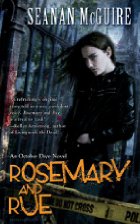
Book Review: Rosemary and Rue by Seanan McGuire (Series, #1)
 Summary:
October (Toby) Daye is a changeling — she’s half fae and half human. Half Daoine Sidhe to be exact. She has just enough fae features to not fit into the human world, but her magic is just weak enough to keep her from fitting into fae either. Toby was splitting the difference quite well, serving her fae liege as a private detective and living a semi-normal human life with her human husband. But when a bad fae turns her into a fish on a mission for her liege, and it takes fourteen years to be turned back, everything changes. Toby loses her family and her desires to have any ties to the fae world, but the fae world won’t let her be for long. A high-ranking fae who was also her friend turns up dead, killed by iron, and a curse means that Toby must investigate.
Review:
Interestingly enough, one of the later books in this series was recommended to me by an automatic readalike generator (whose name I know forget) as a readalike for Fudoki
The book takes a little bit to get set up. There’s a flashback to before Toby was a fish then the book pops quickly forward to the (near) present when Toby escapes being a fish. It at first struck me as a bit of an odd beginning, but by the end of the book I was loving it. The fact that Toby has a 14 year gap means that there are elements about her world she has to learn or relearn, meaning when key parts of information need to be told to the reader, it comes across as natural that Toby will need to learn about it or remember it. She did have those 14 years away, after all. It’s a plot-telling device, but it’s smart. It also isn’t forgotten when it comes to Toby’s character. The fact that she lost her family and all those years deeply impact her psyche, and that’s as it should be. It helps automatically make her a more well-rounded character.
Halfings are common in urban fantasy, but the ones in this universe are particularly well-done, mostly because there’s just so many of them. Toby isn’t an anomaly, halflings are a constant, persistent problem for the fae to have to deal with. They don’t quite fit into fae, but they also can’t just banish them for the humans to deal with. The humans don’t even know they exist, in fact, most humans who do mate with fae never even know that they did. While some fae are open to and embrace the halflings, others are not. Similarly, some halflings will give anything to just fit into fae or into the human world, while others are comfortable living partly in each. The fact that there are so many halflings allows for a lot of diversity and keeps Toby from looking like a marked heroine. She is just one of many, dealing as she can. I appreciate the everywoman aspect this lends her.
Toby is also extremely likeable. She’s down-to-earth and matter-of-fact about everything. She has many quotes that sound like an average person talking but contain a kernel of wisdom. She’s a humble smart woman who maybe doesn’t realize just how much savvy she does have.
That’s the true value in wards; not keeping things out, but telling you if something’s managed to get in. (loc 537)
It can’t all be dreams because a broken dream will kill you as surely as a nightmare will, and with a lot less mercy. At least the nightmares don’t smile while they take you down. (loc 2428)
The fae world is incredibly complex and yet makes a lot of sense. There are many different types of fae, and they are smoothly introduced. My personal favorite are the Caid Sidhe. They are surely the reason this book was recommended due to my loving Fudoki
The mystery is good, with Toby investigating a murder. There were plenty of plot-twists, although I did guess the responsible party far in advance of the ending, which was a bit of a bummer. I also must say that I’m not really a fan of heroines getting wounded within an inch of their life only to be saved by magic repeatedly. It removes some of the sense of danger for me. I did appreciate that for once there was an urban fantasy heroine who was never threatened with rape. That was a nice change of pace. I’ll take forcibly changed into a fish over that any day.
Overall, this book sets up the incredibly complex fae world of the series, as well as establishes the heroine’s character and background quite well. Readers will easily fall into the incredibly imaginative world that Toby partially lives in that runs parallel to and sometimes hand-in-hand with our own. Some readers may find the mystery a bit predictable, but this is an excellent first entry in an urban fantasy series that will leave the reader eager to pick up the next and go back to this rich world as soon as possible.
If you found this review helpful, please consider tipping me on ko-fi, checking out my digital items available in my ko-fi shop, buying one of my publications, or using one of my referral/coupon codes. Thank you for your support!
4 out of 5 stars
Length: 368 pages – average but on the longer side
Source: Gift

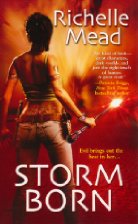
Book Review: Storm Born by Richelle Mead (Series, #1) (Audiobook narrated by Jennifer Van Dyck)
 Summary:
Eugenia Markham is a shaman who spends her time sending the fae back to their own world. She hates the fae both for trespassing into our world and for kidnapping women into their own. When fae start referring to her by her given name, rather than her working name, she becomes concerned something is awry. What she discovers is a prophecy that will change everything.
Review:
I picked this up because I love Richelle Mead’s Georgina Kincaid series (review) so much. I wish any of the summaries I read of the book had even hinted at one of the big plot points, as I think how a reader responds to that plot point will dictate how much they enjoy the series overall.
Without revealing too much, early on in the book, fae start showing up and attempting to rape Eugenie. She finds out that there is a prophecy that her child will be the one to bring about large changes in the land of the fae. (This is not particularly a spoiler, it is revealed early on and there are even more plot twists later on to complicate this). What this means for the reader is that our main character must repeatedly physically fight off would-be rapists. If I had realized this was such a key plot point, I would not have personally picked up this book, and I think there are probably quite a few other readers who would be similarly bothered by this repeated scene of our heroine trying to fight off rapists. To be clear, this is not one single solitary incident. It is one of the main repeated problems for this character. Fae keep trying to rape her.
Another plot line is that the fae are known for kidnapping and raping young (this is specified, young, as in early to mid teens) human women. Because the fae have fertility problems. In fact, the case that Eugenie takes on early in the book is trying to save a teenaged girl who has been kidnapped by the fae. Eugenie normally doesn’t go into the land of the fae in a corporeal form (she does send her spirit via astral projection), but she agrees to in this case because she is so bothered by the knowledge that this teenage girl is facing a lifetime of rape.
These are just two non-spoiler examples of the rape plots, and there is at least one more that I won’t reveal as it’s a big spoiler. Readers who for whatever reason do not want to read either about rapes occurring off-screen or about the threat of rape or about a woman repeatedly having to physically fight off rapists should not pick this book up. These are key and frequent plot points in this book.
Having said this, I do not judge the book for including these plot points. Rape is a part of some fae mythology, and the author has every right to include it in an urban fantasy book based in fae mythology. I also think the author handles the inclusion of the rape and threatened rape well. Rape is never excused, rapists are denounced, and there are some fae characters who state they would never have sex with a human female who hasn’t consented. The author has a valid reason for including the rape plots, and she handles them well. I simply wish that it was clearer from the official book blurb what a large role rape plays in this book, and thus, in my review, I am being certain to be clear for potential readers the extent of rape plot points in this book.
So what about the rest of the book? Eugenie is mostly what one expects from an urban fantasy heroine. She is strong, talented, wears her hair short and hates dresses. She has a questionable roommate and a cover story of being some sort of private investigator. What makes Eugenie unique in urban fantasy is that she is a shaman trained by her step-father, and the only really supernatural humanoids in her world are the fae and some mythological shapeshifters from other cultures (think of Japanese myth’s shifters). Don’t come to this series looking for vampires and werewolves. You won’t find them. The fantastical world of this book is simply that there is another world of fae, and sometimes they cross over into ours.
The prophecy at the center of the book has more to it than it originally seems, and the plot twists are surprising and exciting. Yes, many urban fantasy books revolve around a prophecy that has our heroine at the center, but this is the first one I’ve seen in a while that’s more about the heroine’s child than the heroine herself.
As is to be expected, Eugenie has two potential love interests, a half kitsune (shape shifting fox) half human man and a fae. Personally, I didn’t like either of her love interests. One is too bourgeois/royal, and the other is too macho for my taste. But I can see how other readers would enjoy one or the other or both of them and appreciate Eugenie’s difficulty in deciding who has her heart.
The audiobook narration by Jennifer Van Dyck starts out a bit awkward and gets better with time. For the first half or so of the book, her narration can sometimes be a bit stilted. She almost sounds like she’s reading lists. She pauses at odd times. Also, her voice sometimes comes across as elderly, which doesn’t suit the tone of the book. For the most part, though, the narration doesn’t detract too much from the book, it simply doesn’t elevate it either.
Overall, this is an entry in the urban fantasy genre that sticks closely to the well-loved trope of a strong, non-girly woman battling supernatural forces while also adding on some unique elements, such as a prophecy about her future child and sticking to the fae of mythology. Readers should be aware that attempted rape and rapes occurring off-screen feature frequently in the book. The plot itself is twisting and exciting, with enough unique elements to keep regular readers of urban fantasy engaged. Recommended to urban fantasy fans looking for a universe that sticks more closely to the traditional mythical depiction of the fae world and who don’t mind the inclusion of rape and attempted rape in the plot of the book.
If you found this review helpful, please consider tipping me on ko-fi, checking out my digital items available in my ko-fi shop, buying one of my publications, or using one of my referral/coupon codes. Thank you for your support!
3 out of 5 stars
Length: 361 pages – average but on the longer side
Source: Audible

Book Review: Maui Widow Waltz by JoAnn Bassett (Series, #1)
 Summary:
Maui wedding planner Pali Moon wouldn’t normally accept a last-minute request to plan a wedding when the groom is lost at sea, but the client wants to pay cash, and she is in debt up to her ears. Plus, the bride assures Pali that the groom’s best friend will stand in as his proxy if the groom hasn’t been found by the wedding date. What could possibly go wrong? Well, when a body washes up on shore….it turns out, a lot.
Review:
This would be a cozy mystery if it offered any type of recipes or patterns in the back, as it is, think of it as a light-hearted mystery with very little blood and some steamy kissing scenes. The story transports the reader to Hawaii with lovely described settings and keeps the reader there with an intriguing plot.
A wedding planner in Hawaii is just an interesting job to begin with. Plus, Pali has a bit of mystery to her. She admits from the very beginning that Pali isn’t her name, but the reader never finds out (in this entry in the series anyway) what her real name is. Why is she keeping it a secret? Plus, Pali’s friends (and enemies) are an interesting bunch. Her Native best friend who also runs the general store and officiates weddings is a breath of fresh air to the story. Her gay roommate may feel a bit expected at this point, but the author keeps him from verging too far into stereotype and gives of a hint of the three dimensions he could have in future installments. The bad guys may veer a bit toward caricature sometimes, but that lends the book part of its humor and lack of tension that is key to this type of mystery.
The mystery and plot consist of two main points of conflict. First, Pali is at risk of losing her business. Second, the missing groom and the bride’s family may not be precisely what they appear. This lends some realness to the character. She has more going on than this mystery that fell in her lap. It also gives her a reason for accepting a client who has a clear iffy feeling about them. That said, the will she or won’t she hold onto her business lacks some real tension, as it’s fairly clear that Pali will figure a way out of losing her business. With the missing groom conflict, while we know Pali will probably be safe, since she’s the main character, the rest of the characters are basically up for grabs for danger. This gives it just enough tension to stay interesting but not be stressful. Similarly, this plot was more well-written, with some unexpected yet believable twists. It also takes into consideration the local laws of Hawaii, so events stayed grounded in the real world.
The romance consists of two potential love interests. I am always a bit turned off when a main character has two people interested in them. It will never not feel a bit fake to me. However, the two potential love interests are handled in a balanced and modern way. Neither is the clear “right choice,” and readers could easily prefer one over the other while still liking the main character with either.
I also would like to mention that there is a good minor plot involving characters revealing that they are alcoholics who have been in recovery for a while. It’s good to see people with a mental illness that they have worked on and are actively managing in a positive way. I appreciate this diversity being included in this book.
Given all of these positives, why is it only an average read for me? There was nothing unexpected for this type of mystery. It is very similar to others I have read in the genre. Additionally, the main character can kind of rub me the wrong way sometimes. How she handles her love interests is not as up-front as it should be. It is also unclear as to how she managed to get herself into so much debt. It seems she might just be bad at balancing books but all for taking favors from friends. Similarly, she’s a white woman, albeit raised in Hawaii, but she goes by a Native name and never explains why, beyond the fact that she doesn’t like her own name. Add to this the fact that the romance didn’t really work for me, and this is why I consider this a rather average read. It may be more than average for you, if these factors I have named are not an issue for you.
Overall, this is a light-hearted mystery that transports the reader to the tropical island of Maui. Some readers may be a bit turned off by the main character or the romance secondary plot. Those who enjoy a non-tense mystery set in a tropical locale will most likely enjoy the read, however.
If you found this review helpful, please consider tipping me on ko-fi, checking out my digital items available in my ko-fi shop, buying one of my publications, or using one of my referral/coupon codes. Thank you for your support!
3 out of 5 stars
Length: 338 pages – average but on the longer side
Source: Amazon

 Support my work with a tip or browse my shop for curated book club guides, how to guides, cross-stitch patterns, and more!


This work by Amanda Nevius is licensed under a Creative Commons Attribution-Noncommercial-No Derivative Works 3.0 United States License.
 Opinions of a Wolf