
Archive
Book Review: Mommie Dearest by Christina Crawford
 Summary:
In the early days of Hollywood, Joan Crawford became one of the first celebrities to adopt children. From the outside, it looked like her children had it all–presents, inherent fame, an apparently adoring mother. However, in Christina’s tell-all memoir, she reveals the truth behind the image. A mother obsessed with cleanliness and rigid rules. A mother who demanded her children worship her like her fans did in order to receive her love. A mother so desperate to cling to her days of fame that she attempted to beat down any glimmer of success in her children. A mother who Christina still desperately loved to the bitter end.
Review:
This memoir is a must read for anyone who thinks that having money and being a celebrity automatically makes for a good parent. Joan Crawford expected her four adopted children to be exactly what she wanted them to be instead of loving them for their uniqueness and human imperfections. Christina’s situation gradually worsens as she becomes older and starts to show glimmers of being her own person. The scenes of abuse in Christina’s childhood are the best written in the book. It is clear that she remembers them vividly and can still identify with the emotions that went through her as a child and young teenager.
*spoiler warning*
That said, Christina never manages to disentangle herself from her mother. In spite of everything her mother has done, Christina still attempts anything and everything to reconcile with her, apparently ignoring or forgetting the fact that she never did anything wrong to cause her mother’s behavior in the first place. Joan Crawford is a cruel, spiteful, evil person, and Christina naively continues to seek her love even in her 30s. This makes it more sad than most memoirs about abuse as it seems that Christina never truly overcame her abuser.
*end spoiler*
The writing, beyond the scenes of abuse, is sub-par. Christina has a tendency to ramble a bit in an uninteresting way. She also seems to not understand which parts of her life to skim over a bit. I mean, did we really need to know exactly when in a funeral her husband hands her a paper cup of water? No. Additionally, she obviously had a bad editor, as there are quite a few spelling and grammar mistakes, which is odd for a mass market paperback.
Overall, it’s worth a read if you’re into memoirs or the inside Hollywood scoop. All others should probably give it a pass though.
3 out of 5 stars
Source: Swaptree

Book Review: The Year of the Flood By Margaret Atwood
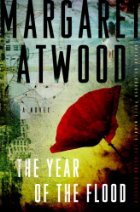 Summary:
Toby, a spa-worker, and Ren, an exotic dancer and prostitute, have both survived the waterless flood–a global pandemic that has killed almost all of humanity. They also both used to live with The Gardeners, a vegetarian cult that constantly warned of the impending apocalypse. A series of flashbacks tells how they survived the pandemic while the question of what to do now that the pandemic is mostly over looms large in their lives.
Review:
Margaret Atwood is one of my favorite authors. I love dystopian books, and she has an incredible talent for taking the current worries and news items and turning them into a near-future dystopia. Toby’s and Ren’s world prior to the waterless flood isn’t anything to be happy about. Slums dominate. Gangs run rampant. The world is now run by a giant evil corporation (which is somehow worse than a giant evil government? *shrugs*). It’s really the little things that makes this future world believable. Kids wear bracelets that have live mini jellyfish in them. Species have been spliced together to make new, more usable ones, such as the Mo’Hair–a sheep whose wool makes perfect fake hair for women. The people who don’t live in slums live in corporation-run compounds where everything they do is monitored. What makes this dystopia wonderful is how plausible it all seems.
Really, though, all of these dystopian features are just a back-drop for the real stories. Toby spends years hiding with The Gardeners and running because one man, Blanco, decided he owned her upon having slept with her. When Toby defied him, he vowed to kill her. He haunts her life for years on end. Similarly, Ren falls in love with a boy in highschool who breaks her heart yet somehow keeps coming back into her life and repeating the damage.
This is a book about mistakes. About how thinking we own the Earth and its creatures could cause our own demise. About how sleeping with the wrong man just once can haunt you for years. About how loving the wrong man can hurt you for years.
This is what I love about Atwood. She has such wonderful insight into what it is to be a woman. Insight into what haunts women’s dreams. When women talk about what scares them, it isn’t nuclear war–it’s the man in the dark alley who will grab her and rape her and never leave her alone. Toby’s Blanco is the embodiment of this fear. She sees him around every corner. She’s afraid to go visit a neighbor because he might find her on the street walking there. Setting this fear in an other world makes it easier for female readers to take a step back and really see the situation for what it is. Yes, he’s a strong, frightening man, but Toby let him disempower her by simply fearing him for years. This is what Atwood does well.
The pandemic, however, is not done so well. Too many questions are left. Where did the pandemic come from? Does it work quickly or slowly? Some characters seem to explode blood immediately upon infection, whereas others wander around with just a fever infecting others.
Similarly, the reader is left with no clear idea as to how long it has been since the pandemic started. On the one hand it seems like a month or two. On the other hand, the stockpiles of food The Gardeners made run out quite early, and that just doesn’t mesh given how much attention they gave to them prior to the pandemic.
I also found the end of the book extremely dissatisfying. It leaves the reader with way too many unanswered questions. In fact, it feels completely abrupt. Almost like Atwood was running out of time for her book deadline so just decided “ok, we’ll end there.” I know dystopian novels like to leave a few unanswered questions, but I don’t think it’s appropriate to leave this many unanswered.
The Year of the Flood sets up a believable dystopia that sucks the reader in and has her reconsidering all of her life perceptions. Unfortunately, the ending lets the reader down. I think it’s still worth the read, because it is enjoyable for the majority of the book, and I am still pondering issues it raised days later. If you’re into the environmental movement or women’s issues, you will enjoy this book–just don’t say I didn’t warn you when the ending leaves you throwing the book across the room. ;-)
4 out of 5 stars
Source: Library

 Support my work with a tip or browse my shop for curated book club guides, how to guides, cross-stitch patterns, and more!


This work by Amanda Nevius is licensed under a Creative Commons Attribution-Noncommercial-No Derivative Works 3.0 United States License.
 Opinions of a Wolf