
Archive
Book Review: The Road to Roswell by Connie Willis

When a woman who doesn’t believe in aliens comes to Roswell for her college roommate’s UFO-themed wedding, she’s shocked to find herself abducted by an alien and driving all over the southwest at his tentacled bidding.
Summary:
When level-headed Francie arrives in Roswell, New Mexico, for her college roommate’s UFO-themed wedding—complete with a true-believer bridegroom—she can’t help but roll her eyes at all the wide-eyed talk of aliens, which obviously don’t exist. Imagine her surprise, then, when she is abducted by one.
Odder still, her abductor is far from what the popular media have led her to expect, with a body like a tumbleweed and a mass of lightning-fast tentacles. Nor is Francie the only victim of the alien’s abduction spree. Before long, he has acquired a charming con man named Wade, a sweet little old lady with a casino addiction, a retiree with a huge RV and a love for old Westerns, and a UFO-chasing nutjob who is thoroughly convinced the alien intends to probe them and/or take over the planet.
But the more Francie gets to know the alien, the more convinced she becomes that he’s not an invader. That he’s in trouble and she has to help him. Only she doesn’t know how—or even what the trouble is.
Part alien-abduction adventure, part road trip saga, part romantic comedy, The Road to Roswell is packed full of Men in Black, Elvis impersonators, tourist traps, rattlesnakes, chemtrails, and Close Encounters of the Third, Fourth, and Fifth kind. Can Francie, stuck in a neon green bridesmaid’s dress, save the world—and still make it back for the wedding?
Review:
Connie Willis’s To Say Nothing of the Dog is one of my favorite scifi/romance/comedy reads of all time (review). I’m also a huge fan of the American Southwest, so when I heard about this book, it went on my wishlist immediately. (Shout-out to my siblings-in-law for the birthday present). This was definitely a rollicking, feel-good read, which was just what I needed.
Francie is a fun main character. Jumping right into her being at the airport on her way to a wedding she wants to help her old college roommate see is probably a bad idea builds up the identification and empathy right away. Who among us hasn’t had a friend in a questionable relationship? She doesn’t believe the alien stuff of everyone else at Roswell, but she’s kind about it. (She doesn’t go around calling them names in her head).
When she is abducted by an alien who looks like a tumbleweed who can’t speak but can only force her to drive with his tentacles and gesturing seriously in the direction he wants to go, I was hooting. What a fun idea for an alien species Indy is! I also like how the crux of the issue between humans and Indy is the difficulty in communication. Unlike a lot of scifi, he doesn’t just show up with a translator. Communication is a big problem and leads to a lot of comedic situations (including the, ahem, abduction). I was particularly fond of how Indy keeps semi-accidentally adding more people to his collection of abductees due to miscommunication.
The American Southwest is lovingly depicted from the glorious sunsets to the shocking vast emptiness, not to mention the overwhelming situation that is Las Vegas (right on down to an Elvis impersonator). Dusted on top of these depictions are quotes from various westerns (including a lot from one of my favorites, Support Your Local Sheriff). Movie westerns and how they reflect (accurately and inaccurately) the American Southwest are cleverly added via a character who is obsessed with them.
So I loved the setting, the plot, Francie, and Indy. The humor wasn’t quite working for me in the way it has in other books of hers, though. It didn’t ever bother me it just didn’t tickle my funny bone. That didn’t matter, because the book was still feel-good for me. But it did keep it from rocketing up to new favorite territory. There is also one infuriating scene where Francie is trying to get in touch with other people without Indy hearing and she, bafflingly, calls and leaves voicemails rather than texting. I just cannot think of a single person Francie’s age I know who would ever default to calling and not texting in a regular situation, let alone one where you want to not be overheard. (I mean, you can even text 911 these days….) I understand for the point of the plot that calling needed to happen but then we needed a reason for it. Maybe Francie’s texts wouldn’t go through. Maybe she lost her smartphone in the airport and had to borrow her friend’s old flip-phone. Something. This is a minor quibble though in a book that was generally a delight.
Overall, this a feel-good scifi read with a dash of romance and a very lovable alien. Perfect for scifi lovers wanting an escapist read or romance readers wanting a no spice read with a dash of something different.
If you found this review helpful, please consider tipping me on ko-fi, checking out my digital items available in my ko-fi shop, buying one of my publications, or using one of my referral/coupon codes. Thank you for your support!
4 out of 5 stars
Length: 405 pages – average but on the longer side
Source: Gift
Buy It (Amazon or Bookshop.org)
Book Review: Children of God by Mary Doria Russell (Series, #2)
 Summary:
Father Sandoz, the only person from the humanity’s first mission to Rakhat to return to Earth, has barely begun to recover from his ordeal when the Jesuits ask him to assist in preparing the second team. Reticent to assist anyone to go to Rakhat but enjoying the use of the languages again, he agrees.
Meanwhile, one survivor of the mission joins forces with the Runa and a rogue Jana’ata to bring about justice. What world will the second mission find when they return? It certainly won’t be the one previously held in a tenuous working balance between predator and prey.
Review:
The Sparrow really touched me, and I was eager to return to Rakhat, not to mention to see how Sandoz handled his recovery. What I found was a mixed bag. A creative expansion on the world of Rakhat but a message and character development that moved in directions that left me feeling very little.
The presence of humans upset the delicate balance between the Jana’ata and the Runa. The humans demonstrated to the Runa that they didn’t need the Jana’ata, and thus a revolution was born. The thing is though this culture is just so truly alien that it’s hard to root for the Runa or the Jana’ata.
The Jana’ata have a depraved world, yes, but they are also truly predators who evolved from predators. It’s hard to hate on them when they’re basically cats walking around in medieval clothes. Well, of course they’re acting barbaric. They’re cats! And the thing is, they’re not just cruel to the Runa, they’re cruel to each other as well.
The one real disjointed bit of the narrative is that this culture reads as a developing one, as if they are from the 1200s or 1300s on Earth. Yet they somehow have enough technology that they could broadcast music to Earth? It makes no sense that they would be so backwards and yet simultaneously so advanced in science.
Similarly, the Runa are a people with a culture but they also are a prey species. They reproduce like mad when they have enough food, and they act like herd animals. Yakking constantly and with no real art or science developing. It is easy to see how these two cultures came to co-exist, as well as the fact that they need each other. Put another way, everyone thinks deer are cute, and they are. But if they exist in a world with no natural predators, they soon over-run the place until they have too much population for the land to support, and they start to starve. Yes, the co-existence between the Jana’ata and the Runa could be handled better (certainly with more clarity and more maturity) but the Runa and Jana’ata need each other. They co-evolved.My perspective on the Runa and Jana’ata impacts how I feel about the rest of the book.
Russell presents the idea that it’s ok for the Runa to become the dominant culture so long as they “allow” the “good” Jana’ata (the ones who have sworn off eating Runa and struggle along eating the eggs of some other creature that can barely sustain them. Truly barely. One character has multiple problem pregnancies due to malnutrition). Positing the idea that the Jana’ata are bad because they are predators, and the Runa are good because they are herbivores (with some outliers in both groups of course) is just hard to swallow. Bad and good is much more nuanced than that. Is a shark bad because it eats a seal because it’s hungry? No. But if a shark kills a seal because it’s fun to kill a seal and then swims off without eating it? Then one could argue that’s a bad shark with a bad nature. This level of nuance is just something I felt was missing from the book and the world.
I also found Sandoz’s path back to god to be a bit irritating, as well as the repeatedly presented idea that we can all have different interpretations of the one god, but there is definitely one. A whole alien planet with two sentient species, and no one can even entertain the idea that there might be more than one god? People are allowed to think there’s not one at all, although the book does present this as a shortcoming of those people’s natures. Basically, if they were a bit more willing to open they could at least be agnostic about the idea. The ultimate “proof” of the existence of god in the book is something that made me laugh. I won’t reveal what is found but suffice to say that if you’ve heard the argument about a watch proving there’s a watchmaker, it’s very similar to that one. After the insight and the gray areas allowed in the first book with regards to faith, I was disappointed.
If my review seems a bit mixed and all over the place that’s because that’s how this book read to me. There were chapters of beauty and then others that made me sigh and still others that made me scratch my head. It’s a mixed bag of content set in a complicated world with an ending that some readers would definitely find satisfying but I do not. I still enjoyed the read overall simply because I love visiting the world of Rakhat. But would I want to visit it again? Given the direction it was going, probably not. Although I would gladly visit the future Earth that gets to meet a Jana’ata or a Runa on our own turf.
Overall, readers of the first book who enjoyed it for Rakhat will enjoy getting to know more about both the Runa and the Jana’ata culture will enjoy the sequel, whereas those who appreciated it for its nuance and exploration of gray areas and difficult topics will be less satisfied.
If you found this review helpful, please consider tipping me on ko-fi, checking out my digital items available in my ko-fi shop, buying one of my publications, or using one of my referral/coupon codes. Thank you for your support!
4 out of 5 stars
Length: 451 pages – chunkster
Source: Library
Previous Books in Series:
The Sparrow, review
Counts For:

Illness(es) featured: Autism Spectrum Disorder
Giveaway: Enormity by Nick Milligan (INTERNATIONAL)
 It’s the final giveaway of 2014 here at Opinions of a Wolf. Woohoo!! I was so happy to be able to offer so many giveaways this year! Thanks to the indie authors and indie publishing houses that made it possible.
There are TWO ebook versions of Enormity
What You’ll Win: One ebook copy of Enormity
How to Enter: Leave a comment on this post stating what your first single would be if you could introduce any Earth song to an alien planet.
Who Can Enter: INTERNATIONAL
Contest Ends: January 7th. One week from today!
Disclaimer: The winners will have their ebook sent to them by the author. The blogger is not responsible for sending the book. Void where prohibited by law.
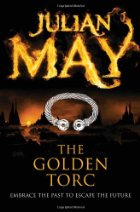
Book Review: The Golden Torc by Julian May (Series, #2)
 Summary:
The group of people who traveled from the future to the Pliocene past for a willful exile were split into two by the alien race, the Tanu, who, surprisingly, inhabits Earth. Half were sent to slave labor, while the others were deemed talented at mind powers, given necklace-like torcs to enhance those powers, and sent to the capital city of Muriah. In the first book, we followed the daring escape of the group sent into slavery. They then discovered that the Tanu share the Earth with the Firvulag–an alien race from their home planet that has many similarities to their own. They also organized an attack on the industrial city of Finiah. This book at first follows the adventures of the other group, the one sent to the capital city of Muriah. Through them we discover the inner workings of the Tanu, the intersections of humans and aliens, and the impact of the human/Firvulag attack on Finiah. When the time for the Great Combat between the Tanu/human subjects and the Firvulag arrives, the survivors of the escaped slave group end up coming back into contact with the group of humans in Muriah. With dire consequences.
Review:
I really enjoyed the first book in this series, finding it to be a delightful mash-up of scifi and fantasy. When I discovered my library had the next book in the series, I picked it up as quickly as possible. This entry feels more fantastical than the first, although science definitely still factors in. It is richer in action and intrigue and perhaps a bit less focused on character development.
This is a difficult book to sum up, since so very much happens. It’s an action-packed chunkster, providing the reader with information and new settings without ever feeling like an info-dump. The medieval-like flare of the Tanu and the goblin/fairie/shapeshifter qualities of the Firvulag are stronger in this entry, and it is delightful. Creating a medieval world of aliens on ancient Earth is probably the most brilliant part of the book, followed closely by the idea of torcs enhancing the brain’s abilities. May has created and weaved a complex, fascinating world that manages to also be easy enough to follow and understand. The sense of the medieval-style court is strong from the clothing, buildings, and organization of society. She doesn’t feel the need to willy-nilly invent lots of new words, which I really appreciated.
The intrigue is so complex that it is almost impossible to summarize, and yet it was easy to follow while reading it. Surprises lurk around every corner, and May is definitely not afraid to kill her darlings, following both William Faulkner’s and Stephen King’s writing advice. A lot happens in the book, the characters are tested, and enough change happens that I am excited there are still two more books, as opposed to wondering how the author could possibly tell more story. In spite of the action, sometimes the book did feel overly long, with long descriptions of vegetation and scenery far away from where most of the action was taking place.
The book is full of characters but every single one of them manages to come across as a unique person, even the ones who are not on-screen long enough to be fully three-dimensional. The cast continues to be diverse, similarly to the first book, with a variety of races, ages, and sexual preferences represented. I was surprised by the addition of a transwoman character. She is treated with a mix of acceptance and transphobia. I think, certainly for the 1980s when this was published, it is overall a progressive presentation of her. She is a doctor who is well-respected in Tanu society. However, she also is presented as a bit crazy (not because of being trans but in addition to being trans), and it is stated by one character that she runs the fertility clinic because it is the one part of being a woman that will always be out of her grasp. I am glad at her inclusion in the story but readers should be aware that some aspects of the writing of her and how other characters interact with her could be considered problematic or triggering. I would be interested to hear a transperson’s analysis of her character.
Overall, this entry in the series ramps up the action and more thoroughly investigates the world of the Pliocene Exile. Readers disappointed by the lack of information on the half of the group heading to the capital city in the first book will be pleased that their story is told in this one. Characters are added, including a transwoman doctor, and all continue to feel completely individual and easily decipherable, in spite of the growing cast list. The fast action pace sometimes is interrupted by lengthy descriptions of settings far away from the action, but overall the chunkster of the book moves along at a good pace and remains engaging. Recommended to fans of fantasy who want a touch of science in their stories and who are interested in the idea of medieval aliens.
4 out of 5 stars
Source: Library

Previous Books in Series:
The Many-Colored Land
Book Review: The Many-Colored Land by Julian May (Series, #1) (Audiobook narrated by Bernadette Dunne)
 Summary:
In the future, the universe exists in a peace-loving era that allows many alien races and humans to co-exist. People are expected to act within the confines of acceptability and are offered various humane treatment options to help if their nature or nurture sends them the wrong way. But some people don’t want to conform and would rather live in the wild, warrior-like days of old. When a scientist discovers time travel but only to the pliocene era, these people think they have found their solution. There’s only one catch. The time travel only works to the past. For decades the misfits step into the time travel vortex, not knowing what is on the other side. The government approves the solution, since it seems kind and no time paradoxes have occurred. When the newest group steps through, they will discover just what really waits on the other side of exile.
Review:
I became aware of this book thanks to a review by fellow book blogger, Resistance Is Futile. Imagine my surprise when going through my wishlist to check for audiobooks, I discovered a brand-new audiobook production of it featuring the audiobook superstar Bernadette Dunne. This is a creative, action-packed book that truly encompasses both scifi and fantasy in a beautiful way.
Since this is the first book of the series, it takes a bit to set the plot up and get to know the characters. People are sent through the time travel portal in groups, so we get to know everyone in one group prior to going through the time portal so we can follow them all after they go through it. May spends the perfect amount of time familiarizing the reader with the future world, as well as the people who are choosing to leave it. Some readers might be sad to see the imaginative future world left behind for the pliocene era, but it quickly becomes evident that the pliocene is just as richly imagined, albeit different. The pliocene era is not as straight-forward as the exiles believed, and new problems quickly arise for them. It’s not the lawless paradise they were envisioning, and while dealing with the realities of it in an action-packed manner, they also must deal with themselves. Now that they realize there is no true escape to solitude or an imagined perfect past, they must address those aspects of themselves that led them to exile in the first place. These deeper emotional issues are the perfect balance to the other, action-oriented plot. I did feel that the book ends a bit abruptly. However, it is part of a series and clearly the cliff-hanger is intentional. I prefer series entries that tell one complete smaller story within the larger, overarching plot, but this is still a well-done cliff-hanger.
The characters offer up a wide variety of experiences and ethnic and sexual backgrounds, representative of all of humanity fairly well. One of the lead characters is a butch lesbian, another is an elderly Polish-American male expert in the pliocene era, another a nun, another a frat boy style space captain. This high level of diversity doesn’t seem pushed or false due to the nature of the self-selection of exiles. It makes sense a wide variety of humans would choose to go, although the statistics presented in the book establish that more whites and Asians than Africans and more men than women choose to go. Some of the characters get more time to develop and be presented in a three-dimensional nature than others but enough characters are three-dimensional that the reader is able to become emotionally invested in the situation. My one complaint was in prominently featuring a nun in a futuristic scifi, yet again. Statistics show that less and less people are choosing to become nuns or priests. Given that this is set so far in the future with such a different culture, a religious leader of a new or currently rising religion would feel much more thoughtfully predictive of the future.
Most engaging to me is how the book mixes scifi and fantasy. Without giving too much away, the book offers a plausible scientific explanation for human myths of supernatural creatures such as fairies, elves, and shapeshifters. The presence of the inspirations for these myths give a delightful, old world fantastical feel to the story, even while May offers up scientific explanations for all of it. This is not a mix I have seen in much scifi or fantasy, and I was surprised at how much I enjoyed it.
Overall, this is a delightful new take on time-travel that incorporates some fantasy elements into the scifi. Readers looking just for futuristic hard scifi might be disappointed at how much of the book takes place in the ancient past, but those who enjoy scifi and fantasy will delight at the mixing of the two.
4 out of 5 stars
Source: Audible
Book Review: The Prometheus Project: Captured by Douglas E. Richards (series, #2)
 Summary:
Brother/sister duo Ryan and Regan are back only this time they’re officially part of the team of scientists working in the top-secret alien city discovered deep underground in Pennsylvania. They rush off every day after school to work in the city of Prometheus. One weekend they convince their parents to let them sleep over in the city, only to wake up to discover all of the adults captured by a ruthless alien escaped convict whose mind control abilities mysteriously fail to work on the kids. It’s up to them to save not just the adults, but the earth itself from alien rule.
Review:
This follow-up to The Prometheus Project: Trapped (review) brings even more action and science than the first time around. It’s also a longer length that is more suitable for the older middle grade crowd.
Ryan and Regan’s relationship with each other has progressed from sibling tolerance to a level of respect for each other clearly due to working together in the city. It’s nice to see a healthy sibling relationship modeled in a middle grade book.
Again the plot fooled me with a twist ending I didn’t see coming, but that made perfect sense when it was revealed. This is the sort of thing I’d have loved as a middle grade reader. A mystery that manages to out-wit me without playing any tricks.
The villain is threatening without being too frightening. Although the kids’ parents are held captive, no undue violence is shown. Predominantly the scientists are held with plastic ties on their wrists and a simple verbal threat of “do this or else….” It seems an appropriate level of suspense for the age-range. The enemy is formidable, but it is possible to out-wit him.
Although the science, plot, and characters are strong, something just couldn’t let me jump from liking it a lot to loving it. Perhaps this is because I am out of the age-range intended, but it does seem to me as though sometimes the story expects a bit too little of the young reader enjoying it. I hope in future books that Richards challenges young readers a bit more with the writing in addition to the science.
Overall, this is another strong entry in this middle grade series. I firmly believe the series will keep young readers with an interest in scifi and secret government operations happily engaged while parents and guardians can have peace of mind about what they are reading.
4 out of 5 stars
Source: Won copy in exchange for my honest review from the author via LibraryThing
Previous Books in Series:
The Prometheus Project: Trapped, review
Buy It

 Support my work with a tip or browse my shop for curated book club guides, how to guides, cross-stitch patterns, and more!


This work by Amanda Nevius is licensed under a Creative Commons Attribution-Noncommercial-No Derivative Works 3.0 United States License.
 Opinions of a Wolf