
Archive
Book Review: The Mount by Carol Emshwiller (Bottom of TBR Pile Challenge)
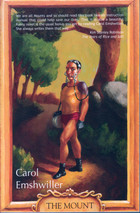 Summary:
Charley is an 11 year old Seattle and wants to be the best mount there is for his owner, Little Master. He eats his dry cakes, practices on the go-round, and behaves well. Little Master mostly likes their lessons. His ears wiggle, so Charley knows he’s giggling. But one day Wilds attack the village. They say that people are meant to be people, not mounts for Hoots. But the Hoots say the mounts were made for them, see how the primate species are perfectly designed for riding? It’s all very confusing for Charley.
Review:
It doesn’t take much guess-work to figure out how this wound up on my TBR pile. It’s a rather obvious allegory for animal rights, although instead of apes enslaving people like in Planet of the Apes, it’s an alien species with cat-like ears and weak legs enslaving humans. The concept is a good one, but the execution fell short for me, which is sad, because I wanted to love it.
The structure of the book is problematic. The first chapter is from the perspective of an entirely random Hoot who we never see again. Ever. We also never see his mount again. This is just weird. The rest of the book is told from the first person perspective of Charley, except for one random chapter narrated by his father. I don’t mind switching perspectives, but there should be some sort of consistency about it, and we should have at least a vague idea who the character in the new perspective is.
I also found myself completely baffled by Charley. In spite of being enslaved by the Hoots, he still wishes to use a bit one day and other things that drive his father nuts, and one cannot help but agree with his father. He never seems to really learn better through the book either. He persists in loving his Hoot and being a mount for his Hoot. That doesn’t work as an allegory for animal rights or slavery.
Emshwiller does show how teenage boys clash with their fathers very well, however. Charley’s relationship with his dad, Heron, is well fleshed-out and intriguing. They want to connect and love each other but struggle with how, exactly, to do that when they are so different yet so similar. Looking back, this relationship is what kept me reading. It shines in spite of the other oddities in the book.
I won’t spoil it, but the ending bothered me as well, and I found it profoundly confusing. In fact, I’d say for the book as a whole I am simply left perplexed by it. I feel like I missed something or didn’t quite get an accurate picture of the world they are living in or something.
Overall, it’s a very different take on humans being enslaved by another species, but its execution is rather disappointing. Recommended to readers with a marked interest in scifi depictions of human slavery.
3 out of 5 stars
Source: PaperBackSwap

Book Review: A Long Way Down by Nick Hornby (Bottom of TBR Pile Challenge)
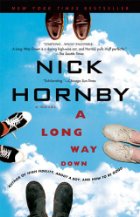 Summary:
On New Year’s Eve, four incredibly different strangers accidentally meet on Topper’s House a popular local spot for suicides. Somehow running into each other leads to them taking the long way down that night instead of the quick one. What happens after is a continuance of their life stories that no one could have predicted.
Review:
I distinctly remember that this book made it into my tbr pile because of the suicide theme. What makes these four different people want to kill themselves, and what makes them not do it. Clearly this is a book about depression and suicidality. But it is not a depressing book. Not by far.
Without revealing too much, since the revelations are part of the fun of the read, I will just say that the four suicidal people span different generations, reasons, and nations of origin. Different levels of conservatism and liberalism. But what makes them come to understand each other is their universal depression and suicidal thoughts. This fact that someone out there gets them….well oftentimes that can help get a profoundly depressed or mentally unwell person over the hump. Feeling less alone.
Her past was in the past, but our past, I don’t know…Our past was still all over the place. We could see it every day when we woke up. (page 253)
In spite of this being a book about depressed people bonding over their depression, it doesn’t read as such. I was reading it on an airplane and found myself literally laughing out loud at sections. Because these people are brilliant. They have a great understanding of the world. Of art. Of relationships. Even of themselves.
I had that terrible feeling you get when you realize that you’re stuck with who you are, and there’s nothing you can do about it. (page 208)
That is, after all, frequently what depression can be all about. A profoundly clear understanding of how royally fucked up you are or your life is. What’s hard is seeing past that moment. The book is kind of a snapshot of the process of them learning to do that. And that’s what makes it so eloquent and poignant. Nothing is done melodramatically. Things are just presented as they are. Even down to the four being able to laugh together periodically (and make you laugh in the process). Depression isn’t just oh everything sucks nonstop. There are moments of laughter. It’s just that those moments are outweighed by the weight of the depression. Getting rid of that weight is a cleansing, uplifting process, and that’s how it feels to read this book. You bond and you laugh and you maybe even cry (if you have more susceptible tear ducts than this reader). And in the end you come to an understanding of that suicidal dark place without being abandoned in it.
Overall this book manages to eloquently present depression without being a depressing book. It is compelling to any reader who has ever struggled with a depressed period of life. Highly recommended to the depressed and the sympathetic. Both will be left feeling lighter and less alone.
4 out of 5 stars
Source: PaperBackSwap

Counts For:
Book Review: Acacia: The War With the Mein by David Anthony Durham (Series, #1) (Bottom of TBR Pile Challenge)
 Summary:
The Akarans have ruled the Known World for twenty-two generations, but the wrongfully exiled Meins have a bit of a problem with that. They enact a take-over plot whose first action is assassinating the king. Suddenly his four children are flung to different parts of the Known World in exile where they will need to come to terms with who they are, who the Mein are, and the wrongs past generations of Akarans committed in order to help the Known World make a change for the better.
Review:
I have a big announcement to make. Huge even. THIS IS THE FIRST HIGH FANTASY BOOK I HAVE LOVED. There. I said it! And it’s true.
I wish I had some vague idea of how this ended up on my TBR pile. The only clue I have is that I acquired it via PaperBackSwap, so I know I got it very intentionally after reading a review or something somewhere. But where? And why? Who knows! It was entirely out of my comfort zone, took me much longer than my norm to read (over two weeks according to GoodReads), and yet. I loved every moment of it.
A momentous occasion such as this obviously leaves me asking why. Why when I generally am irritated by most high fantasy did this one not just not bug me but worm its way into my heart? This is a key question, because it’s something that helps stories cross genres. I do have an answer, but of course it has many elements.
First, although this primarily depicts a war, no side is depicted as pure evil or good. Both sides have good points and flaws. Good people work for both. Bad people work for both. The Akaran king isn’t a bad guy per se, but he’s allowing things to happen under his rule that are bad. The Meins have a just cause, but they do horrible things in the process of achieving that cause. This realistic complexity is something that I have found to be sorely missing in other fantasy. The Known World is its own fantastical place with its own cultures and history, but it is realistic in the fact that everything is complex and nothing is clear-cut.
Second, the female characters are incredibly well-written. They are well-rounded, strong and yet vulnerable. Beautiful and yet terrifying. They are innately a part of the world depicted, not just princesses in a tall tower or the girl at the side of the field whose beauty inspires the men. Women are historically a part of the Akaran army, and the two Akaran princesses have strengths and flaws of PEOPLE. They are not “female flaws.” They are people who happen to have vaginas. It is some of the best writing of women I’ve seen from a male writer in a while.
Third, the Known World is complex and eloquently imagined, yet clear and easy to understand. It is its own thing, but it is similar enough to our own real world that I wasn’t left grasping for straws trying to understand things. People in cold climates are pale, and people in deserts are dark. The animals range from recognizable horses and monkeys to fantastical creatures that are a mix of rhinoceroses and pigs. It is creative yet fathomable.
Finally, the storyline is complex. I could not predict what was going to happen next at any moment, really. The ending caught me completely by surprise, and I am baffled as to what Durham will be doing with the middle book of the trilogy. Baffled and impatient.
My god. I love a fantasy story.
Overall, this is now the book I will hold up when people ask me what is good fantasy. It is what leaves me with hope for the genre that it can be more than pasty white men wishing for a patriarchal past of quivering ladies in waiting and knights fighting dragons. Fantasy can imagine a world where some things are better than ours, and yet other things are worse. It can be a reflection of our own world through a carnival mirror. Something that makes us think hard while getting lost. I highly recommend it to anyone looking for those things in their reading.
5 out of 5 stars
Source: PaperBackSwap

Book Review: Succubus Blues by Richelle Mead (Series, #1) (Bottom of TBR Pile Challenge)
 Summary:
Georgina Kincaid is a succubus. Has been for hundreds of years. She’s currently assigned to the demon district of Seattle, but she’s not really feeling being a succubus anymore. Oh, sure, she still needs to eat sexual energy from men, but she tries to keep it to the low-lifes, like cheaters, and avoid the good guys. Thankfully her demon boss lets her lack of stealing souls for the bad side slide. All in all, life is pretty good for Georgina. Her favorite author is even coming to do a reading at the bookstore she works at! But one night a vampire is killed and threats start coming in against all the baddies in Seattle–including Georgina.
Review:
Sometimes the books I’ve read for the Bottom of TBR Pile Challenge make me wonder what the hell past Amanda was thinking, and other times they make me realize that past Amanda was still me…..and I really do love to love the bad guys. And hoo boy is this book ever about the bad guys! Also, sex. Lots of sex. I mean, a succubus has gotta eat.
Getting an urban fantasy that isn’t all about a demon slayer but instead is about the demons is just awesome. It is really fun to be rooting for the succubus, demons, and vampires, but not in a Sookie Stackhouse sort of way. These guys are the other side of the war, and are they ever fun. It’s obvious that Mead is aware that she’s flipping the typical story on its head from a delicious tongue-in-cheek scene in which an angel’s helper shows up completely covered up and mocking Georgina’s sexy succubus outfit and blushing at all the swear words the bad crowd tosses around. And it’s so true! The good guys wouldn’t be *fun*. The good guys would be boring, and they sure as hell wouldn’t say fuck.
Also, it’s nice that for once we pop into the middle of the main character’s life instead of meeting her right when she gets her powers. It lends more depth to the character, adds mystery, and lets us just get on with the supernatural. This makes for a much faster moving plot as well, which is definitely appreciate. Plus, there’s the historical aspect to Georgina’s flashbacks, and that’s always fun.
The sex scenes are well-written. Um, really well-written. *coughs* The love interest is realistically attractive and intelligent, which is pure win. For once we aren’t stuck with a gorgeous, perfect man. We have an imperfect one who is still totally loveable.
So what’s keeping it from five stars for me? I’m not a fan that Georgina has somehow turned into a reluctant succubus. I want my succubus to steal men’s life energy and LIKE IT. But I get it that this makes Georgina more lovable to probably just about everyone else. I am still hoping that this reluctance will change in the next book. Haha.
Overall, this is a delicious urban fantasy that I highly recommend to fans of the genre who enjoy steamy sex and rooting for the bad guys.
4 out of 5 stars
Source: PaperBackSwap

Book Review: The Sparrow by Mary Doria Russell (Series, #1) (Bottom of TBR Pile Challenge)
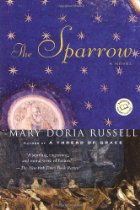 Summary:
It is the year 2060, and the Jesuit priest Emilio Endoz has been found on the planet Rakhat by the second Earth ship to travel there. Found in a whorehouse and killing a native inhabitant in front the UN members’ eyes, they nonetheless strap him into his original spaceship and send him back to the Jesuits. There he is treated for his horrifying wounds and through a series of flashbacks and current conversations with the various Jesuit committee members assigned to his case, we slowly see how everything that started out so right went so horribly wrong on Rakhat.
Review:
It may have been a while since it made it onto my tbr shelf, but I still have a crystal clear memory of why I acquired this book. I entirely blame Little Red Reviewer, who just so happens to be the only other female scifi fan who book blogs that I’m aware of. (Feel free to enlighten me to more in the comments). Her review that religion is there but in a questioning way that honors the tradition of scifi made me give this book with a Jesuit priest and mission at its core a chance. I’m glad I did.
This is a first contact story that takes the all-too-infrequent route of Earth finding the inhabited planet first and sending a mission to them. There’s so much more than that that makes this book unique, though. The future Earth just barely has the technology to make it to Alpha Centauri, and only the most tech-savvy are aware of it. Thus, we’re not an incredibly advanced civilization making first contact, just one slightly more so than Rakhat. I’d say a fair comparison might be late 19th to early 20th century earth to early to late 21st century Earth. It’s a short span of difference. Additionally, Russell made the intriguing choice of the first contact being run by missionaries, instead of a political unit. When you think about it, it makes perfect sense. Who tended to be first to the New World? Religious groups. Who can organize themselves quickly and have vast finances? Religious groups. Having first contact be missionaries makes so much sense that I’m shocked I didn’t think of it first.
That said, thankfully this book is not a love letter to organized religion or mission work. It is instead a complex, scientific, and anthropological study of the human condition, the difficulties of vastly different cultures meeting, linguistics, and much more. At its core it is all about why does god (if there is a god) let evil happen, especially to good people who are serving him? These issues are more easily addressed and made further complex by having agnostics, non-practicing Catholics, and a Jewish woman members of the mission team. The non-believers are about at even numbers with the priests. In fact, the deeper into the book I got, the more it tore at my heart-strings. Varying types of questioners are represented, and of course it’s possible to identify with many of them, particularly for a reader who once was religious but is not anymore. There’s the priest who is secretly gay, the Jewish woman who was wounded terribly by war but comes to learn to love again, the Father Superior who thinks he may be seeing the formation of a real live saint, the priest questioning the very existence of god, and the agnostic who wants to have the beautiful aspect of faith that she sees in those around her.
This book reads, it sounds a bit odd to say, almost like an agnostic’s prayer. Of course agnostics don’t pray, but if they did pray, the pain and wondering and intelligence found in this book would all be there.
We are, after all, only very clever tailless primates, doing the best we can, but limited. Perhaps we must all own up to being agnostic, unable to know the unknowable. (page 201)
The problem with atheism, I find, under these circumstances…is that I have no one to despise but myself. If, however, I choose to believe that God is vicious, then at least I have the solace of hating God. (page 394)
People more into science than the questioning human spirit will find plenty for themselves as well. The science of linguistics is astoundingly well presented. The way the two “sentient” species on Rakhat have evolved is also incredibly well thought-out and realistically drawn. The problems of poverty and war on earth are briefly explored too.
All of these things said, I do feel it took a bit too long to get things set up and moving. Granted, I tend to be a bit of an action-focused reader, so others may not have a problem with that. It was still a draw-back of the book for me though.
I sort of feel like I’m not doing the experience of reading this book justice. Suffice to say if you’ve ever questioned whether or not to have faith and love your big questions to be wrapped in well-thought-out scifi, this is the book for you.
4 out of 5 stars
Source: Better World Books

Counts For:
Book Review: Nova by Samuel R. Delany (Bottom of the TBR Pile Challenge)
 Summary:
Lorq von Ray is the head of one of the biggest corporations in the galaxy that for years has worked hand-in-hand with the Red corporation, currently headed by incestuous brother/sister partners Prince and Ruby. But now internal fighting between the two has made von Ray determined to find his corporation’s own supply of Illyrion, normally supplied by the Reds. He’s heard rumors you can fly through the center of a nova (an imploding star) and survive and that Illyrion is inside. He gathers an unlikely crew in a race against the clock to gather the fuel.
Review:
I really wish I could remember what made me acquire this book. The cover was nothing special, and the summary on the back said approximately diddly-squat about the actual plot (unlike my own). Supposedly this book took years and tons of research into the Tarot and the Holy Grail, yadda yadda. Fine. All I know is that it was boring as fuck with a plot like it was written by a fifth grader.
One of my updates on GoodReads said, “Reading this book is like going to the dentist,” and I still think that’s the most apt review of it. The plot drags, which is shocking for such a short novel. We learn an astonishing amount of backstory about the Mouse, who is a minor character, but not a ton about Prince and Ruby Red, who are far more essential to the plot. We don’t learn the backstory for the plugs everyone wears until the book is almost over, when plugs are key to the story. A set of black twins work on the ship with one mysteriously albino for no apparent plot reason, and they operate as one person finishing each other’s sentences. Their whole characterization really bumped my racism button. Yes, I know this is an old book, but still. We also have the annoying novelist member of the crew, who is such an obvious Mary Sue it’s painful. And I don’t throw around the term Mary Sue willy-nilly. Come on. The guy is a novelist trying to write a Holy Grail book. *blinks*
The amateurish exposition consists mainly of long speeches by various characters. The plot saving device of a miracle machine that can fix almost all wounds appears part-way through the story. The whole thing would get maybe a C from me in a creative writing class. Maybe.
The only thing that keeps this book from one star is that it does, in fact, have a plot and is readable. Of course, I can’t for the life of me figure out anyone who would want to read this if they knew what they were getting themselves into.
2 out of 5 stars
Source: PaperBackSwap

 Support my work with a tip or browse my shop for curated book club guides, how to guides, cross-stitch patterns, and more!


This work by Amanda Nevius is licensed under a Creative Commons Attribution-Noncommercial-No Derivative Works 3.0 United States License.
 Opinions of a Wolf