
Archive
Book Review: Model Home by Rivers Solomon

When Ezri’s parents die under mysterious circumstances, they return to their Texan childhood home—possibly haunted—in a gated community where their family is the only Black family.
Summary:
The three Maxwell siblings keep their distance from the lily-white gated enclave outside Dallas where they grew up. When their family moved there, they were the only Black family in the neighborhood. The neighbors acted nice enough, but right away bad things, scary things—the strange and the unexplainable—began to happen in their house. Maybe it was some cosmic trial, a demonic rite of passage into the upper-middle class. Whatever it was, the Maxwells, steered by their formidable mother, stayed put, unwilling to abandon their home, terrors and trauma be damned.
As adults, the siblings could finally get away from the horrors of home, leaving their parents all alone in the house. But when news of their parents’ death arrives, Ezri is forced to return to Texas with their sisters, Eve and Emanuelle, to reckon with their family’s past and present, and to find out what happened while they were away. It was not a “natural” death for their parents . . . but was it supernatural?
Review:
I’ve read most of Rivers Solomon’s books—they’re auto-reads for me at this point. I love their unique perspective and creative twists on speculative fiction. Solomon’s books always challenge me, so even though haunted house stories aren’t my favorite subgenre, I picked it up—and I’m glad I did. This turned out to be a queer psychological thriller that was hard to put down, keeping me up late reading.
The mystery starts early, with Ezri receiving texts from “mom,” but they suspect it’s the “other mother”—the ghost that haunted the family home in a gated community when they were children. It doesn’t take long before Ezri and discovers their parents dead in the backyard in what initially seems like a murder-suicide—but the siblings suspect it’s something far more complicated.
I appreciated how Solomon depicted the family dynamics under stress—three siblings thrown together for an unexpectedly long visit during a family tragedy. It’s the messy, real stuff of love and tension between people who care about each other but don’t always get along perfectly in a pressure cooker situation. The haunting also impacted each sibling differently, not just because of their age but due to the way their parents parented them, shaped by birth order.
I can’t discuss the most shocking part of the book without spoiling the twist. Suffice it to say, it was dark, gritty, and far less supernatural than anything else I’ve read by Solomon. That’s what made it so powerful—it felt so close to being like other psychological thrillers I’ve read but conveyed something profoundly different. It was deeply rooted in the Black experience in America, and it left me almost breathless.
Along with being a story about a Black family, Ezri is nonbinary, and both they and their child have diabetes. I really appreciated how Ezri’s gender identity was never an issue for their family—even when they were a child. This was refreshing and grounded in a sense of acceptance and love.
Please note that this book includes an explicit sex scene that is consensual. It also discusses predation on a minor and child sexual abuse (CSA).
Due to these sensitive topics, this was not a five-star read for me. While the book was beautifully written, I reserve five-star ratings for books I feel personally connected to. Books with such content usually don’t end up in my favorites category. (Grown by Tiffany D. Jackson was a big exception for me.)
Overall, this is a unique take on both the haunted house and psychological thriller genres. It offers a scathingly insightful analysis of being Black in America, while giving voice to a nonbinary sibling. Highly recommended for readers looking for a Black perspective on the haunted American house.
If you found this review helpful, please consider tipping me on ko-fi, checking out my digital items available in my ko-fi shop, buying one of my publications, using one of my referral/coupon codes, or signing up for my free microfiction monthly newsletter. Thank you for your support!
4 out of 5 stars
Length: 304 pages – average but on the longer side
Source: Library
Buy It (Amazon or Bookshop.org)
Book Review: The China Study: The Most Comprehensive Study of Nutrition Ever Conducted And the Startling Implications for Diet, Weight Loss, And Long-term Health by T. Colin Campbell, PhD and Thomas M. Campbell II
 Summary:
Dr. Campbell spent the early part of his scientific career researching diseases of affluence such as cancer, heart disease, and diabetes. When a study in rat livers demonstrated that a greater percentage of protein in the diet led to greater disease, Campbell became intrigued. He designed the China Study to compare Chinese citizens with American citizens, since the Chinese have low rates of these diseases until they immigrate to the United States. Through this and other studies, he believes he has the proof that most diseases of affluence are caused by the Standard American Diet. In his book he presents these findings, as well as an insider’s look at the scientific, health, and government trifecta that vastly affects what Americans learn about health.
Review:
Clearly the most valuable part of this book is the chapter that explains Campbell’s China Study. Since it’s generally not considered ethical to study humans and disease by injecting them with various substances, one of the better methods available is population studies. You compare and contrast over a long period of time the differences between different populations and attempt to determine what aspects may cause bad health. It is undeniable that the traditional Chinese rural population compared to Americans eat less animal products and move more. Additionally they have less disease, particularly cancers, heart disease, and diabetes. Campbell’s study establishes this easily observed fact into something that has been scientifically proven. It is also interesting to note that those who emigrate to the US and adopt the Standard American Diet (SAD) change to the American rate of these diseases. This is ground-breaking information, of course, but it is easy to gather this all from one chapter. Campbell finds it necessary, for some reason, to devote a chapter to each illness, which frankly gets repetitive and tedious to read.
Beyond the study itself, which is interesting and good for people who aren’t already convinced of the health problems caused by animal products, I felt the rest of the presentation of these facts to be dull in comparison to Diet for a New America
He also eloquently shows why we have constantly conflicting news stories on health. Everyone knows the joke about how eggs were bad for you then good for you then bad for you (but only the yolks) all over again. Campbell shows how this is the direct result of the conflict within the science and health industry.
I have come to the conclusion that when it comes to health, government is not for the people; it is for the food industry and the pharmaceutical industry at the expense of the people. It is a systemic problem where industry, academia and government combine to determine the health of this country. (page 318)
I have worked in the health field myself for years now, and I can tell you, the vast majority of the people who do genuinely care about you and your health. But traditions are hard to break and even those within the system don’t know everything that goes on among the lobbyists and the top echelons. I mean, they are still teaching medical students to utilize BMI to determine health in their patients, when multiple studies have shown it is not a reliable tool. Why is this? People want to believe what they’ve first learned, and especially in medicine, if a new idea comes along many many many studies must be done and obstinate people push for it before the method utilized will be changed. This is meant to protect you from quacks, but unfortunately it can lead to the burying of ground-breaking information.
Plus, how would Americans react if tomorrow Mrs. Obama and her obesity prevention program came out and said everyone needs to go vegetarian or vegan? Hell, the woman is taking flak for daring to suggest children play outside. I think you can see my point.
Overall, this book definitely could have been shorter. I believe it would have worked better if Campbell had presented his study and his insider’s knowledge as to why the health care and science industries seem so confused and conflicting half the time. I hope this knowledge will convince more Americans to take direct control of their own health and conduct their own research to come to their own conclusions. It’s worth a read for this knowledge, but if you are not interested in the politics of science and health and simply want the information, then I suggest you go with the more reader-friendly Diet for a New America
4 out of 5 stars
Source: Public Library

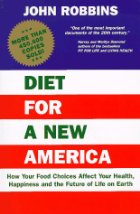
Book Review: Diet For a New America by John Robbins (Diet for a New America Reading Project, Book 1)
 Summary:
John Robbins was born into one of the most powerful corporations in America–Baskin-Robbins. A company based entirely on selling animal products. Yet he took it upon himself to investigate the reality of animal products and their impact on Americans, American land, and the world overall. This book summarizes his extensive research, including personal visits to factory farms.
Review/Discussion:
This is the first book in the Diet for a New America Reading Project 2012 I am hosting. The project is focused on educating ourselves on the facts behind health and preventative medicine for the well-being of all Americans, an issue that I am sure we can all agree is a serious one. If you join the project late, please feel free to come back to this post or the GoodReads group after you’ve finished the book to join in on the discussion. And now, on to the book!
There are books that you read that are so incredibly powerful you are left almost speechless. Simply wanting to hand out copies to everyone you know, everyone you meet and say, “Please, read this.” I highlighted so much in my copy that I couldn’t even do my usual of posting all highlighted quotes to my tumblr. I discovered I was practically illegally reproducing the book, hah. ;-) I thus will do my best to highlight precisely why I find this book trustworthy, why I feel inspired by John Robbins, and the most stunning facts I learned while reading the book.
Why You Should Trust This Book
As a medical librarian, I was very careful to check out Robbins’ resources for his facts, particularly for the health section, which is what this project is focused upon. Robbins drew his research from vetted, peer-reviewed, well-respected scientific journals, including ones I routinely use in my own work, such as Journal of the American Medical Association, the British Journal of Medicine, and The American Journal of Clinical Nutrition. He also cites the studies of such organizations as the FDA, the EPA, and the National Cancer Institute. Additionally, he conducted personal interviews with real factory farmers and scientists. Additionally, all of his citations are in order. You may not like the facts he reports, but they are still scientifically backed-up facts.
The fact that John Robbins researched the effects of animal derived foods on the environment and people and decided that it is bad for everyone involved is remarkable when you consider the fact that he comes from a family whose business is based entirely on selling dairy to Americans. If the man had an innate bias, it would absolutely be on the side of carnists/omnivores, but he astoundingly conducted the research and came down on the side veg*ism. (His family reunions must really be something…) This not only makes me respect him, but trust him. Somebody must be truly convinced to convert away from a business that has made his family, and presumably himself if he had agreed to take over the business, extremely wealthy.
But enough about why this book is trustworthy. Let’s move on to discuss the astounding scientific facts revealed in the three different sections: animal rights and factory farming, health consequences of eating animal based products, and environmental consequences of meat-based diets.
Animal Rights and Factory Farming
I definitely believe this knowledge is more widely spread than when this book was first published. I have a hard time imagining growing up in America and not coming to understand the horrors of factory farming, but you never know. Robbins talks about the psychiatric fact that children who grow up abusing animals are more likely to become criminals in later life. This, of course, is a basic reason to not base an entire sector of the American economy around factory farms that treat animals horribly like cogs in a machine. Of course there are more reasons to treat animals well, such as the fact that dogs’ EEG scans are identical to human’s or that dolphins routinely save humans and other animals in the ocean or that many species of animals mate for life showing a dedication most humans can’t pull off.
The horrors of factory farming are so extensive that it’s difficult to even list them. I feel as if I could go on and on. Perhaps the best way is to tell you to imagine being in the most crowded elevator possible. Now imagine that 20 of the 24 hours you’re in there it’s dark. You’re standing on a slanted, slatted, metal floor. The food for everyone is all on one side and is dumped in all at once and you must shove and race to get to it. Of course it’s difficult to even call this food. It’s a mix of shit, paper, sawdust, chemicals, and antibiotics all spiked with yet another chemical to make it smell better to you. If you are female, then a hand periodically reaches in and artificially inseminates you, only to rip your baby away from you the instant it is born and hitch machines up to your mammary glands instead of allowing your milk to go to your baby. If you are male, you are castrated by placing a band around your testicles until they fall off after weeks of the circulation being cut off.
That is the reality for factory farmed animals. Even if you can manage to ignore the fact that these animals are being pumped full of chemicals and artificial growth hormones that you will then ingest yourself when you eat them or their products, that is still a horrifying way to get your food. These animals live in terror and pain and die in terror and pain. There is nothing natural about a factory farm. Animals were meant to live outside and graze and nurse their babies and maybe live in a herd or a flock. Not be caged up in situations so unnatural that they literally go crazy and cannibalize each other when they are naturally herbivores. That is the reality of what you are supporting when you buy factory-farmed animal products.
Human Health
Ok, so maybe now you don’t believe in factory farming, but what about eating animals in general? We were raised to believe that a healthy diet involves meat, dairy, and eggs, right? Surely if an animal is raised organically and humanely all will be well? Well, the meat and dairy lobbyists have done a LOT of work to hide from you the scientific studies that show their products are unhealthy for you. If you read only a portion of this book, read the health section. It is impossible for me in this discussion and review to make as eloquent a point as Robbins does. I will instead sum it up for you.
In scientific studies published in reputable scientific journals such as JAMA, vegetarians have drastically less occurrence of: heart disease, all cancers, strokes, osteoporosis, diabetes, hypoglycemia, multiple sclerosis, ulcers, IBS, arthritis, kidney stones, gallstones, hypertension, anemia, and asthma. Those who still have any of the chronic diseases are distinctly less symptomatic than the meat-eaters. Vegans (people who consume no animal products whatsoever) have even LOWER occurrences than vegetarians. This is vetted by multiple different studies run by different scientists in multiple nations. Even simply comparing the data of these diseases between countries following the standard American diet and those following a primarily plant-based diet backs these statistics up.
I am sure that those of you who read the book as I did were stunned to hear that these studies have been in the reputable journals since as early as the late 1960s and 1970s and yet we have not heard about them. Who is to blame? The meat and dairy lobbyists of course. What would happen to their businesses if the American people suddenly stopped following the standard American diet? The Dairy Council provides the nutritional packets at your kids’ schools. Think about that.
The Environment
The environmental impact of a meat-based diet has started to crop up more often recently with the increased interest in the green movement. Essentially, Robbins primarily reiterates what I believe most of us already know. The chemicals necessary to factory farm are bad for the whole planet. It takes more fossil-fuel energy, more water, and more acreage to feed one person a meat-based diet than a plant-based diet. These are things that are definitely relevant, particularly to people who don’t believe in human population control. What I personally found most interesting in this section though was the discovery that American imports meat from Central and South American nations who have been destroying rainforest to do so, and their people are still overwhelmingly on a meat-based diet. Thus these nations are destroying their own ecologies to support Americans’ wasteful meat-based diets. That is just disgusting and selfish on our parts.
My Conclusion
I am honestly a bit shocked at the extent of the facts that I didn’t know when I became a vegetarian in January of 2006. I admit I mostly became one out of an empathy for animals that I have always strongly felt, but additionally the less meat I ate, the better I felt. Becoming a vegetarian mostly eliminated the symptoms of my IBS as the scientific studies Robbins cites showed. But….I have a hard time imagining anyone reading the facts like this and not drastically changing their eating habits. So many of the economic and personal problems in the US today have to do with health. So maybe you’ve read this book and you still don’t care about animals and you still believe humans are better than them. But don’t you want to be as healthy as you can be for your lifetime? Wouldn’t you rather be a happy, healthy grandparent than a stooped-over one on multiple heart medications or going through chemotherapy? Even if you don’t care about that, don’t you want to leave a healthier planet for your children and your children’s children? The facts unequivocally show that the fewer animal products you consume, the better all of these outcomes will be.
Once we become aware of the impact of our food choices, we can never really forget. (page 379)
Source: Better World Books

Discussion Questions:
- Robbins believes that the scientific studies reported in the medical journals aren’t well-known because of the meat and dairy lobbies. Do you think this is the case? Why or why not?
- If you do think the facts aren’t known because of the meat and dairy lobbies, how can we combat this?
- If you don’t think the lobbyists have anything to do with the lack of public knowledge of these issues, what do you think the true cause is?
- Do you believe the fight for organic animal farming is doing anything to help the environmental and health issues cited in the book?
- What do you think can be done to get the meat and dairy lobbyists out of our schools?
- Would you be willing to change your diet knowing the facts about the diseases it can cause or do you think it’s not worth the effort?
- Do you believe money is better spent on treating the disease or preventing the disease?
- Do you think world hunger can be successfully combated with a change in the diets of those in the first world countries?
 Support my work with a tip or browse my shop for curated book club guides, how to guides, cross-stitch patterns, and more!


This work by Amanda Nevius is licensed under a Creative Commons Attribution-Noncommercial-No Derivative Works 3.0 United States License.
 Opinions of a Wolf