
Archive
Book Review: Where Late the Sweet Birds Sang by Kate Wilhelm (Audiobook narrated by Anna Fields)
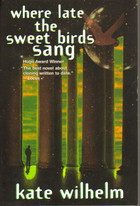 Summary:
When the world goes through an apocalypse consisting of virulent strains of the flu, lack of food, and nuclear warfare, one wealthy family manages to survive because they saw it coming. Made up of highly intelligent and highly educated people, such as doctors and scientists, the family creates a 200 bed hospital and uses this as their home base. But there is a serious fertility problem, and how they address it just might change the core of humanity.
Review:
I love reading classics of scifi. It’s endlessly fascinating how different people in different times imagine a future (or an apocalypse). This award-winning book had the bonus of being written by a woman, which isn’t always easy to find in older scifi. I also was intrigued by the cloning theme. How would someone in 1977 view something that was, as yet, nowhere near as close to a reality as it is now, with our cloned sheep?
The book starts out incredibly strongly. So strongly, in fact, that I actually had nightmares from it, which never happens to me ever. I am basically a rock of horror and scifi, but this one creeped the bejesus out of me. It’s that creepy combination of incest and cloning. The family are really not people you would want retooling the world. They’re everything that can be (and usually is) bad about the 1%. They’re selfish, self-centered, snobby, and routinely employ nepotism. I found the incest in the first third of the book talking about the first generation of the family to be an interesting metaphor for how the elite can become so backwards and grotesque from sheer isolation. It’s powerful and moving, and a scenario that will remain in my mind.
The second third of the book focuses in on a woman, Molly, from the first generation of clones. This is disturbing in its own way, because they don’t just clone everyone once and have done with it, no. They clone everyone multiple times until there are clusters of the same person at different ages wandering around. They call these clusters “brothers” and “sisters” with the name of the original person as the name of the group, even though the individual ones have their own names. It is profoundly disturbing. This second third looks at the society of clones that the original family unintentionally made. It’s fascinating in its own way and an interesting different way of telling a post-apocalypse story. Often we get only the first generation, but here we get multiple generations.
The last third, unfortunately, didn’t live up to the first two-thirds of the book. Without giving too much away, it looks at a boy who came about by natural methods who gets integrated into the clone society at the age of five. They decide not to clone him and give him brothers for unclear reasons. This last third then looks at his impact on the clone society. I didn’t feel that this worked as well for multiple reasons. For one, it’s almost as if Wilhelm freaked herself out and backed off from the profoundly disturbing story she was telling and went a more conventional direction. That was disappointing. For another, I found it disappointing that she chose to make this game-changer a boy. I expect women scifi authors to be at least a bit cognizant of the need in scifi for more female main characters. In this one, the first third is a man, the second third a woman, and the last third a boy. That is not the best stats from a woman author. I also found certain parts of this to be very boring and slow-moving compared to the first two-thirds. That makes for odd pacing in a book.
Of course, my complaints about the last third backing off, being more conventional, and being rather dull don’t take away from the first two thirds at all. They bring about so many interesting societal questions. For instance, is the incestuous nature of the elite necessarily bad or will it one day save humanity? Will cloning remove something that makes us human, even if they look right? Is it better to cling on to technology at all costs or release it and go back to simpler times? And what about sex? Is monogamy natural and polyamory unnatural? Or is polyamory more welcoming and loving than potentially possessive monogamy? The questions go on and on, which is what is great about scifi.
As for the science itself, it is quite well-done. Wilhelm clearly thought through both keeping a closed-off community alive and cloning and bringing to term embryos. She also put thought into the scientific basis for why clusters of clones would be different from individual humans, touching on psychology and twin studies. I was a bit irritated that she bases the survival of these people on cloning farm animals, when that is not a good use of their limited land resources. Studies have shown many many times that a combination of farming vitamin-rich plants and hunting/gathering are the best use of limited land resources, so this particular element rang a bit of bad science. However, I am not certain how much land usage had been studied in the 1970s, so that could possibly just be a sign of the times.
Now, I did read the audiobook, so I should touch on the narration. Overall, Anna Fields does a very good job. I really enjoyed that they chose a female narrator for a book written by a female author. It let me almost imagine that Kate Wilhelm herself was reading it to me. Fields mostly strikes a good balance of changing voices for different characters without going over the top. The one exception to this is when she narrates children. The voice for that made me cringe, but they mercifully speak only a few times. Mostly, Fields reads smoothly and is easy to follow. She narrates without accidentally putting her own interpretation onto the work, which is ideal for an audiobook.
Overall, then, this is a fascinating classic of scifi. It examines the apocalypse through the lens of the elite, thereby analyzing and critiquing them, but it also looks at possible consequences of cloning and ponders what ultimately makes us human. Although the last third of the book is a bit less creative and more conventional than the first two, it is still a fascinating read. Recommended to scifi fans, particularly those with an interest in group dynamics.
4 out of 5 stars
Source: Audible

Book Review: Nano House: Innovations for Small Dwellings by Phyllis Richardson
 Summary:
A nano house is a super-small house, generally between 300 and under 1,000 square feet. This book shows off nano houses from all over the world with different goals in mind, from an eco-friendly retreat that blends in with the surroundings to pod buildings that could be assembled into space-saving towers in the city to more traditional house boats. One goal of all the houses remains the same. How little space can one person or family take up to make the smallest impact on the environment?
Review:
I became fascinated with nano houses after stumbling across a few on the internet. One that sticks out in my mind is a couple that built theirs together and had a blog about it. There was another one in Australia that the woman made from plastic bottles and dirt. The whole concept was just so….refreshing. A small space that is uniquely you (or your family) that fits in just right with your surroundings. So when I found out about a book coming out collecting a bunch of these houses together, I put myself on the hold list at the library immediately. I wanted to know more details about building these remarkable little houses and the kind of people who are choosing them. Unfortunately, this book missed the entire soul of the blogs and blurbs I’d found online.
Instead of seeking out individuals and families who designed and built their homes themselves, the houses here were all made by architectural firms or design students. If you’ve ever met that snotty whoever in the bar who just can’t stop talking about his high-class ideas for making the whole world more up to his par, then you know the vibe this book sends off in waves. It’s not enough to make a small, livable house with minor impact, no, they must use this new, experimental flooring or make the house look like a storage shed or design their own perfectly circular furniture or give a speech about the revolutionary concept of having a yard on the roof of your houseboat. Um, newsflash, pretty sure I came up with that idea when I was 5.
Instead of interviewing the people who live in these houses, the author talks about what the houses are like and why they are built. We get to hear nothing about actually *living* in a nano house. Indeed, some of the houses were simply made for design contests or as student projects with no intention of anyone living in them at all, which seems to be the OPPOSITE of environmentally friendly if you ask me.
In fact, the whole book reads like greenwashing. Oh, they say anyone can afford to buy this house or live there, but in fact it’s the “eccentric” wealthy who own these houses as second homes or vacation homes or a place to stick guests so they aren’t in the main house….but it’s environmentally friendly, so it’s all cool. What I wanted to see was game changers. Ordinary people who chose to make their own home their own way. What I got instead was annoying architectural design students and getaways for the wealthy. Plus, there are not nearly enough pictures of the houses to get a good idea of what they are actually like, and any floor plans are printed so small that they are impossible to read.
Overall, this book has a great title, but is a huge disappointment. It reads like a bunch of wealthy people patting each other on the back at a party at the Ritz, missing the entire soul of the environmental movement.
2 out of 5 stars
Source: Public Library

Book Review: Blue Bloods by Melissa de la Cruz (Series, #1)
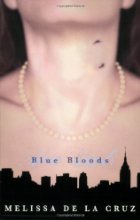 Summary:
The students at Duchesne Academy in New York City appear to be your typical bunch of wealthy, elite teenagers. Naturally gorgeous twins Mimi and Jack rule the school. Bliss became part of Mimi’s entourage when her oil wealthy Texas family moved to NYC. Schuyler is part of the crowd of misfits who wear goth clothes instead of the more typical Louis Vuitton. They all gradually discover, however, that the secret to their families’ wealth isn’t just that they came over on the Mayflower. They are Blue Bloods–vampires who retire from their human shells every 100 years or so then come back with the same blood. Their teenage years are vulnerable ones, and someone or something out there is managing to kill some of the young Blue Bloods.
Review:
The vampire lore behind this story is not my style. It is so much not my style that just writing the above summary made me cringe. None of the official summaries of the book reveal much about the vampire lore, so let me tell you just in case it’s not your style either. Blue Bloods is heavily steeped in Christianity. The vampires are fallen angels who are attempting to atone for their rebellion. They face hundreds of years of punishment trapped in human bodies that they must eventually retire then return in new ones. The vampires accomplish this reincarnation by taking some of the blood from the dead vampire and implanting it into a vampire woman’s uterus. It all rings as a bit odd when you have a teenage character who’s never done anything more wrong than sneak into a club be told that she must atone for this rebellion against god that she doesn’t even remember doing hundreds of years ago. It really takes the bite out of vampires and makes them kind of pathetic.
Where the book is strongest is oddly where the vampire thing is on the back burner. Schuyler and Bliss get to model for a jean company, and that scene was actually quite enjoyable to read. If this had been your more typical murder mystery at an elite high school, I think it would have been a much better book.
Some reviewers had a problem with the presence of teenage drinking, drugging, and sex. I actually thought the sex was handled quite well, with teens talking about it a lot but nobody actually managing to do it. That read as very real. The alcohol is kind of a non-factor, since vampires can’t be affected by alcohol. My only confusion with this is if that’s the case, then why are they risking breaking the law to drink? I suppose it seems minor compared to convincing a human to become your familiar so you can feed off them. The drugs are entirely presented in a negative light the few times they are briefly mentioned.
What shocked me, and I can’t believe how infrequently this is mentioned, is that there is incest and the vampires accept it. Gah! There are times when incest is present in a book, and it is handled so that all sides of the issue may be seen–all of the accompanying emotions are delicately handled. Here, the vampires just say that it’s the way it should be and are protective of the siblings. Not much else is said of it, beyond a few teen vampires being grossed out, but it is made clear that their reactions are considered inappropriate by the vampires.
That said, it’s not badly written on a sentence level. It reads naturally, which is probably the only reason I struggled through the cringe-inducing lore. It is essentially Gossip Girl crossed with Vampire Diaries with some incest and Christianity tossed in. If that’s your thing, you will enjoy it. All others should probably pass though.
2.5 out of 5 stars
Source: PaperBackSwap

Gardening Is Not Elitist
I’m sure you’ve heard the people claiming it’s elitist to backyard or container garden. The “reasoning,” apparently, is that because other people in the world have to farm to subsist, doing so when you don’t have to is rude to them. Or something like that. Excuse me, but the assumption that farming is something you only do until you can afford not to is what’s elitist. It’s looking down on farmers. It’s looking down on people who are actually willing to get their hands dirty to sustain themselves. It’s looking down on everyone who works along the line to make the packaged, processed foods these so-called humanitarians eat.
There is, of course, a place for production farming. It’s a great way to produce a lot of food in a short amount of time at a relatively low price to feed a bunch of people. It’s obviously far more logical to have a large farm of rice paddies than for me to attempt to make my own rice paddy in Boston. I’m laughing just thinking about it.
But what about your backyard that is currently just grass? What about your balcony that’s decorated only with chairs and a few garden gnomes? What about the 3 feet of space in my kitchen that’s too small to fit an appliance or table in, so is currently just wasted space? If I grow vegetables and/or fruit there, I’m:
- Using space that would otherwise be wasted for a valuable purpose
- Lessening my environmental impact, which is a benefit for everyone
- Becoming more self-reliant, which is always a good thing
- Maintaining important knowledge to help pass down to future generations
These people seem to think that big business manufacturing is The Answer to all societal problems, but it isn’t. It isn’t too hard to imagine a future where no one knows the basics. Where no one is in touch with the earth or with their food or with their clothing or with the animals. We’re practically living in it now. Just look at the obesity epidemic, the violence, the general feeling of ennui permeating modern life. We’ve become so caught up in the power of manufacturing that we’ve forgotten even good things are bad if they aren’t in moderation. It’s great that I can get rice and tofu in the store–those aren’t exactly things that I can grow in my backyard. But it’s also great that I can grow a tomato in my kitchen. Nothing teaches you where food comes from quite so well as planting the seed, nurturing the plant, and harvesting the fruit yourself. It’s empowering. It’s understanding on a close, personal level what we as people are capable of with our opposable thumbs and big brains. Gardening isn’t elitist. It’s bringing a sense of humanity back to a people whose culture continually tries to rob them of it.
 Support my work with a tip or browse my shop for curated book club guides, how to guides, cross-stitch patterns, and more!


This work by Amanda Nevius is licensed under a Creative Commons Attribution-Noncommercial-No Derivative Works 3.0 United States License.
 Opinions of a Wolf