
Archive
Book Review: Positively, Penelope by Pepper D. Basham

A grumpy/sunshine, no spice romance set in the theater world.
Summary:
Penelope Edgewood is practically positive in every way, so when, fresh out of college, she is awarded a paid internship to help save a century-old theater on the island of Skymar, she jumps at the chance. After all, a crumbling theater needs the special touch of someone who reveres all things vintage and adores the stage.
Unfortunately, not everything is as it seems at Darling House Theatre. Finances are in shambles, the local theater group is disenchanted, and the two brothers, Matt and Alec Gray, can’t seem to see eye-to-eye about how to run their theatrical business. So, of course, it’s the perfect place for Penelope to shine her own personal brand of sunshine.
With a little help from GK, the person emailing her encouragement along the way, she puts all her heart into helping the Grays save Darling House. But between Matt’s ever-present skepticism, Alec’s tendency to treat Penelope a little too much like the “princess” she thinks she wants to be (until someone actually started treating her that way), a grandfather who is stuck in his grief, and a mysterious person stealing Penelope’s marketing ideas, she’s not sure her optimism is enough to make a happily-ever-after of her own story, let alone The Darling House’s.
Between an adorable little girl, a matchmaker, a sea monster or two, and a copious amount of musical references, can Penelope draw enough confidence from her faith, her family, and her adoration of all things Julie Andrews, to find the thief and save the theater . . . without getting her heart broken in the process?
Review:
This book is presented as a Christian fiction romance told “mostly” in an epistolary style, but I found it to be neither of those things.
This is definitely a light-hearted, no spice romance. I found Penelope endearing, and her love interest just the appropriate amount of grumpy with a reason. As a musical theater geek myself, I absolutely loved all of the references to classic musicals and how the male main character alludes to Gene Kelly. I also like that while Penelope is a sunshine character, we get to see how she has to actively choose to be happy and optimistic. It’s not her natural default. She’s given a depth.
Now, I love epistolary books, and I didn’t notice that the book said only that it was “mostly” epistolary, so I was jarred the first time there was a non-epistolary scene. I was willing to give it a pass, though, since it was a phone call scene. In fact, I could see how a phone call scene might work in a modern epistolary novel. However, by about two-thirds of the way through the book, most of the writing was typical book – not epistolary. It wasn’t even phone call scenes. It was basically like any modern book that includes some text messages and such. I like both styles of writing for different reasons, but I found the mixing the total flip-flop from one to the other jarring to say the least.
I realize this book is from a Christian publishing house, but I think it’s a marketing flaw to market it as “Christian fiction.” The characters’ religious beliefs played almost no role in the book. They mention God a few times, and the characters mention having gone to church a couple of times, but no scenes are set in a church. They mention praying but never actually pray on-screen. Also, in spite of being Christians, they never mention Jesus or the Holy Spirit, and we never see them reading the Bible. The blurb says that her faith guides Penelope’s decisions, but I absolutely did not see that in the book. I found Hani and Ishu’s Guide to Fake Dating (review), published by a mainstream publishing house, to have more issues of religion and faith in it. One of the main characters is Muslim, and her faith impacts her relationships with her friends, we see her praying, we see her reading the Quran, we see her go to the mosque. All of which is to say, if you’re interested in the romance but turned off by the idea that it’s “Christian romance” – don’t be. On the other hand, if you’re interested in seeing faith represented in what you read, you won’t get that here.
This book is set on a fictional island colonized by the UK. The Indigenous people are mentioned in passing a couple of times (as “natives”), but we never actually meet one or see their culture. This is extra bizarre since The Darling House is a community-based theater. Why is it only celebrating the colonizer’s culture? There’s also a royal family that’s not tied to the UK anymore. There’s no exploration, even in passing, of the ethical issues in colonization or even a whiff of a suggestion of decolonization. I get wanting to set your romance in a fantasy land, but the way to do that is like the fake country of Genovia or the fake royalty in a fake country in Never Ever Getting Back Together (review). Why imagine additional colonization tragedies if you’re not going to explore them and broach the topic of decolonizing? The way the book is written, it’s clear none of the characters see any problems with colonizing or issues for the Indigenous peoples, and that’s not the sort of fantasy land I personally want to visit. This is also another example of how, in my opinion, this book is not really rooted in strong Christian theology, as social justice is a key Christian issue.
Overall, this is a lighthearted, no spice grumpy/sunshine romance. It focuses on the grumpy character’s heart warming up over time. The book itself makes some comparisons of the romance to The Sound of Music but the von Trapp’s resisted an invading fascist force whereas these characters celebrate a colonizing royalty.
If you found this review helpful, please consider tipping me on ko-fi, checking out my digital items available in my ko-fi shop, buying one of my publications, using one of my referral/coupon codes, or signing up for my free microfiction monthly newsletter. Thank you for your support!
3 out of 5 stars
Length: 416 pages – average but on the longer side
Source: Library
Buy It (Amazon or Bookshop.org)
Why I Love Bridget Jones’s Diary & A Review of the 25th Anniversary Edition

A Delightful Start
My first encounter with Bridget Jones’s Diary was the 2001 movie starring Renee Zellweger, Hugh Grant, and Colin Firth. I remember stumbling onto it on my dad’s satellite tv when I was in high school. I’d long loved epistolary novels, but especially anything diary based. (The Dear America series was an early obsession.) Even in high school, I loved New Year’s Resolutions, and the idea of reinventing and improving myself. So those two incredible opening scenes of the movie when Bridget goes to a diastrous New Year’s Day turkey curry buffet and then subsequently decides to reinvent herself with New Year’s Resolutions and a diary to keep herself accountable drew me in immediately. From that point on, rewatching the movie became a holiday season/January tradition for me.
What’s This Diary About Anyway?
For those of you who don’t know, Bridget Jones’s Diary is a romcom told through Bridget’s diary entries for one full year. She’s a woman in her early 30s living in London and working in publishing. She spends the year initially falling for her boss at work, Daniel Cleaver, and later for Mark Darcy, a human rights barrister her mother tried to set her up with. Other key plot elements include the hang outs, trials, and travails of her friends (both singletons and marrieds), her mother and father’s late in life marriage troubles, and her ongoing quest for self-improvement, including struggles with alcohol, cigarettes, instants (the lottery), and delightful asides like why it takes her 3 hours to get ready in the morning.
Discovering the Book
A few years later, I finally picked up the book, and I was blown away. How could a movie I loved so much be even better in book form?! I could scarcely believe it. The audiobook version as read by Imogen Church is my go-to when I’m having trouble sleeping or am under a lot of stress and need to just relax for a bit. Her reading of Bridget is simply perfection.
Why Do I Love Bridget So Much, Exactly?
1. how each entry starts
At the start of each diary entry are some things that Bridget tracks. What exactly she’s tracking changes throughout the book. The key items are her weight, calories consume, alcohol drunk, cigarettes smoked, and instants (lottery tickets) bought. But there are other trackings that pop in like number of smoothies consumed or number of times called 1471 (like American *69 only it tells you what number called you rather than ringing them back). I love data and statistics and tracking the mundane things in my life. The lists at the start of each entry make me laugh because they remind me of myself, and they provide a different type of insight into Bridget. I also love how she self-comments on each item, especially how she will say “v.g.” for “very good.” This is one of those pop cultureisms that has made it into my own daily life.
2. depiction of diet culture
Sometimes I hear people talking about Bridget Jones (especially those who’ve only seen the movie), and they complain specifically about Bridget’s obsession with her weight when she is, in fact, a healthy weight. To them I say, that’s the point! This book is an amazing take-down of 1990s diet culture. Bridget is a healthy weight. But she doesn’t think she is. And anytime she’s having problems, she thinks they might be magically solved if she was “no longer fat.” In fact, in diary entries when Bridget is feeling particularly down are when she is most likely to berate herself for her size.
There are two episodes in the book that really drive home the fact that this is a critique of diet culture. The first is that Bridget does get down to her goal weight. She goes to a party with her friends and is ecstatic for them to see her. But they express concern. They don’t think she looks well. Her friend Tom tells her she looked better before. She has a bit of a breakthrough and wonders if her calorie counting is unhealthy and stops tracking them for a while. But then something stressful happens and she begins again. The second episode is when the same friend Tom wonders about how many calories are in something, and Bridget recites the precise number off to him. He’s shocked she knows this then proceeds to quiz her on the number of calories in various things, all of which she knows off the top of her head. She asks doesn’t everyone know this? To which Tom emphatically tells her know. Bridget briefly wonders what other information she could have stored in her head if it wasn’t so busy with calories. Amazing! Just because Bridget never breaks free of her disordered eating doesn’t mean the book itself isn’t criticizing the culture that inflicted it upon her to begin with.
3. Bridget is gloriously imperfect
At the beginning of the book Bridget drinks too much alcohol and smokes cigarettes. She struggles to get to anything on-time. One could say her doing things is always a series of unfortunate calamities. None of this really changes by the end of the year. One could argue that she kind of fails at the majority of her New Year’s Resolutions. But the thing that does change is that Bridget has started to like the core of who she is, and that in turn has made it possible for her to open up to a kind man, instead of, as she would say, the fuckwits she’s been dating previously. She’s become a bit kinder to herself about the flaws that aren’t really flaws per se but just personality quirks (like her complete inability to do anything efficiently). But she’s also very willing to keep trying on the things she probably should still be improving on (like the number of cigarettes she smokes). She simply feels real.
4. it’s hysterically funny
Part of what makes the book funny is, due to its diary entry nature, not every single scene necessarily contributes to the main plot, although each one does help with character development. As such, we get some scenes that are just simply bananas hysterical that a book with a different structure might have left out. One of my favorites is when Bridget decides to study herself to see why it takes her so long to get out the door in the morning. We then get time-stamped entries of each activity she does. It’s gloriously inefficient (including imagining her taking the time to actually write all of this down when she’s already running late to work…but she does it anyway.) Even secondary characters are richly imagined, which I think is probably partially due to the fact that Helen Fielding based many of them on people in her real life (she discusses this in the special 25th anniversary edition). Everyone in Bridget’s world, even her over-the-top batshit mother, feels real. And that’s part of what makes it so funny. It’s easy to imagine all of this really happening.
Review of the 25th Anniversary Edition
For my birthday this year, my husband gifted me the 25th anniversary edition of Bridget Jones. It’s a beautiful hardcover with a foil embossing of Bridget’s famous granny panties on the cover. Even more exciting, it has over 100 pages of new and unpublished material from Helen Fielding.
The first section is “Life Before Bridget” which gives a selection of some of Helen’s journalism articles from before Bridget took off. (Bridget was originally a newspaper column before becoming a book). I loved seeing Helen’s development as a writer and especially the context she gave. My favorite was a restaurant review in which she explains she went with her two best friends who were the inspiration for Jude and Shazzer in the book. I could hear echoes of those two in the restaurant review and absolutely loved it.
The second section is “The Diary of Bridget Jones” in which she explains how the idea for Bridget came to be, and we get selections from some of the initial Bridget newspaper articles.
Next is “Bridget Becomes a Thing,” which includes her interview with Colin Firth in character as Bridget, comics from the time period that reference Bridget, and Helen’s reflections on how it felt to realize she had written a cultural touchstone.
The next section is “Bridget in the 21st Century,” which are Bridget diary entries from 2018 on that Helen wrote for a variety of reasons from inclusion in a feminism book to addressing Brexit to the whole…2020 thing.
There is also an Introduction and a Conclusion written in Helen’s voice but int he style of a Bridget diary entry.
I had to stop saying “I loved it” after the end of each section explanation. It was getting ridiculously repetitive. It’s so rare for me to get to know an author better and enjoy their work more as a result. In all honesty I usually try to avoid getting to know an author because I don’t want things ruined for me. This had the opposite effect on me. I could see being friends with Helen. She’s witty and down-to-earth. I especially liked one section where she talked about people asking her about why she wrote something so silly and why she didn’t write more serious things and how her response was her first book was very serious (set in a war zone or something, I don’t remember), and no one wanted to read it. But they did want to read this. And that’s just the sort of smart commentary that’s throughout the book too. Posh people can try to judge Bridget for how she is, but how she is is, in fact, at least partially a survival response to how the world is. She’s doing her best in a good-natured sort of way in a world that seems to constantly harshly critique her no matter what.
It’s probably obvious by now this is 5 out of 5 stars from me.
Buy the 25th Anniversary Edition (Amazon not available on Bookshop.org)
Buy the Audiobook Read by Imogen Church (Amazon not available on Bookshop.org)
Buy the Movie (Amazon or Bookshop.org)
Length: 464 pages (25th anniversary edition) – chunkster
310 pages (original content) – average but on the longer side
If you found this review helpful, please consider tipping me on ko-fi, checking out my digital items available in my ko-fi shop, buying one of my publications, or using one of my referral/coupon codes. Thank you for your support!
Book Review: This World We Live In by Susan Beth Pfeffer (Series, #3)
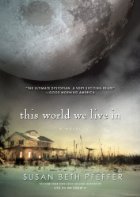 Summary:
Miranda and her mother and brothers have barely survived the long winter that came right after the moon was knocked out of orbit by an asteroid, bringing an apocalypse. She’s been wondering for months what happened to her father and his pregnant new wife. She’s thrilled when they show up on the doorstep when her newborn half brother, but she’s not so sure about the three extra people they’ve brought with them — an adult man and a teenage boy and his little sister.
Review:
The third book in this series reverts back to the Miranda’s journal format of the first. While I appreciate bringing the diverse characters from the first two books in the series together, the use of Miranda’s journal exclusively in telling the story renders the tale a bit less interesting and strong than it could have been.
It should come as no surprise that a YA series featuring a girl in the first book and a boy in the second will bring the two together in the third. I must admit that although when I finished the first book I was very eager to read more about Miranda, when I finished the second I was intrigued at the idea of a series that saw the same apocalypse lived out in different places by different people throughout. That said, getting to know the extensive background of the love interest is appreciated and different but it is a bit jarring to go back to Miranda’s diary after getting to know Alex so thoroughly in the second book. The book could have been much more powerful if Miranda’s journals were interspersed with chapters from Alex’s perspective. Getting this perspective would have helped make their love seem more real, as opposed to just convenient. (Alex is the only teenage boy Miranda has seen in a year). Additionally, in spite of Miranda falling for Alex so fast, he mostly comes across as cold and overly religious in this book, whereas in his own book he was much more empathetic. Certainly the need for survival will make him come across stern, and we know that Alex has a tendency to say important things in Spanish, which Miranda cannot understand. Both of these facts means it would have worked much better to have alternating perspectives, rather than just Miranda’s.
The plot, with the exception of the instant love between Alex and Miranda, is good. It brings everyone into one place in a way that seems natural. The addition of new characters also breathes new life into Miranda’s situation. Plus, Pfeffer does a good job of forcing the family out of their stasis in the home, something that both makes logical sense (these people were not preppers, they are not equipped to stay in their home forever in the apocalypse) and also keeps the plot interesting (one can only read about people holed up in a house for so long). The plot developments also make more sense, scientifically, than in the previous books.
Religion is handled less smoothly here than in the previous two books. Everyone but Miranda’s mother and Miranda has church on Sunday (Protestant or Catholic), and Miranda doesn’t have enough of a reaction to or thoughts about this. She doesn’t really think about faith or spirituality. Church is just something some other people do. This is unrealistic. A teen who has just gone through a disaster and sees her father suddenly take up faith would definitely at the very least have some questions. Given that Alex has a very strong faith and they are interested in each other, one would think they would have some conversations about religion that go beyond whether or not they can have sex before they get married, yet they don’t. The first two books sets a great stage to talk about faith in its many forms, as well as lack of faith, yet the book backs away from actually tackling this issue. If it had, it would have offered something truly thought-provoking in the read. Instead it’s a post-apocalyptic survivor romance. Not a bad thing but not what I was expecting based on the first two books.
Overall, this is an interesting next entry in the series that brings Miranda and Alex back to the readers and moves the plot forward. However, it dances around the issue of faith vs. lack of faith brought up in the first two books, eliminates Alex’s voice from the story, and suffers from some instant romance. Those already invested in the series will still enjoy seeing what happens to Alex and Miranda, although skimming for plot points is recommended.
If you found this review helpful, please consider tipping me on ko-fi, checking out my digital items available in my ko-fi shop, buying one of my publications, or using one of my referral/coupon codes. Thank you for your support!
3 out of 5 stars
Length: 261 pages – average but on the shorter side
Source: Library

Previous Books in Series:
Life As We Knew It
The Dead and The Gone
Book Review: Life As We Knew It by Susan Beth Pfeffer (Series, #1) (Bottom of TBR Pile Challenge)
 Summary:
Miranda’s journal starts out like any other teenage girl’s diary. Worries about school, her after-curricular activities, and wondering how her family will work out with her dad having a brand-new baby with his new wife. But when a meteor strikes the moon things start to change. Slowly at first but with ever-increasing speed. Tsunamis wipe out the coasts. Volcanoes erupt. And soon Miranda finds herself, her mother, and her two brothers struggling to survive in a world that increasingly bares no resemblance to the one she once knew.
Review:
I’m a sucker for journal entry books, even though I know rationally that no diary ever has as much content and exposition as is contained in these fictional works. In addition to the journal format, I liked the premise for the dystopian world Miranda finds herself in. It’s very different from a lot of the other ones out there, since it’s 100% gradual natural disaster. This book lives up to the expectations set by its summary, offering a fun journal entry take on a natural disaster that turns into a dystopia.
Miranda, who lives in semi-suburban Pennsylvania, starts out the journal as a very average teenage girl, adapting to her parents’ divorce and father’s subsequent re-marriage, her older brother being away for his first year of college, and hoping to convince her mother to let her take up ice skating again. The book clearly yet subtly shows her development from this young, carefree teenager through angst and denial and selfishness in the face of the disaster to finally being a young woman willing to make sacrifices for her family. Miranda is written quite three-dimensionally. She neither handles the disaster perfectly nor acts too young for her age. While she sometimes is mature and sees the bigger picture at other times she simply wants her own room and doesn’t understand why she can’t have that. Pfeffer eloquently shows how the changes force Miranda to grow up quickly, and this is neither demonized nor elevated on a pedestal. Miranda’s character development is the best part of the book, whether the reader likes her the best at the beginning, middle or end, it’s still fascinating to read and watch.
Miranda also doesn’t have the perfect family or the perfect parents, which is nice to see a piece of young adult literature. Her parents try, but they make a lot of mistakes. Miranda’s mother becomes so pessimistic about everything that she starts to hone in on the idea of only one of them surviving, being therefore tougher on Miranda and her older brother than on the youngest one. Miranda’s father chooses to leave with his new wife to go find her parents, a decision that is perhaps understandable but still feels like total abandonment to Miranda. Since Miranda is the middle child, she also has a lot of conflict between being not the youngest and so sheltered from as much as possible and also not the oldest so not treated as a semi-equal by her mother like her oldest brother is. This imperfect family will be relatable to many readers.
Miranda’s mother is staunchly atheist/agnostic/humanist and liberal, and this seeps into Miranda’s journal. For those looking for a non-religious take on disaster to give to a non-religious reader or a religious reader looking for another perspective on how to handle disasters, this is a wonderful addition to the YA dystopian set. However, if a reader has the potential to be offended by a disaster without any reliance on god or liberal leanings spelled out in the text, they may want to look elsewhere.
I know much more about medical science than Earth science or astronomy, but I will say that when I was reading this book, the science of it seemed a bit ridiculous. An asteroid knocks the moon out of orbit (maybe) so the tides rise (that makes sense) and magma gets pulled out of the Earth causing volcanoes and volcanic ash leading to temperature drops Earth-wide (whaaaat). So I looked it up, and according to astronomers, an asteroid is too small to hit the moon out of orbit. If it was large enough to, it would destroy the moon in the process. Even if for some reason scientists were wrong and the moon could be knocked out of orbit, even in that scenario, the only thing that would happen would be the tides would be higher. (source 1, source 2) I know dystopian lit is entirely what if scenarios, but I do generally prefer them to be based a bit more strongly in science. I would recommend that reading this book thus be accompanied by some non-fiction reading on astronomy and volcanology. At the very least, it’s good to know that you can safely tell young readers that this most likely would not happen precisely this way, and this book is a great opening dialogue on disasters and disaster preparedness.
Overall, this is a fun take on the dystopian YA genre, featuring the journal of the protagonist and dystopia caused primarily by nature rather than humans. Potential readers should be aware that the science of this disaster is a bit shaky. The story featuring an agnostic humanist post-divorce family makes it a welcome diversifying addition to this area of YA lit.
If you found this review helpful, please consider tipping me on ko-fi, checking out my digital items available in my ko-fi shop, buying one of my publications, or using one of my referral/coupon codes. Thank you for your support!
4 out of 5 stars
Length: 337 pages – average but on the longer side
Source: PaperBackSwap
Book Review: The Postmortal by Drew Magary (Bottom of TBR Pile Challenge)
 Summary:
John Farrell got The Cure before it was legal. Three painful shots, and now he’ll never age, although he can still be killed by accidents, murder, and disease. It doesn’t take long before public pressure forces governments to legalize The Cure, in spite of the concerns, sometimes expressed in the form of terrorist acts, of those who believe in natural aging. Of course, nobody listens, because who wants to age? But slowly the world starts to change in more ways than becoming increasingly overpopulated. We’ve reassembled what happened when The Cure was legal through combining John’s blog entries with news articles from his time period, as a cautionary tale.
Review:
I actually bought this when it was released because it sounded so intriguing to me. A futuristic epistolary novel looking at overpopulation is right up my alley. Unfortunately, I got so busy that I didn’t have time to read it right away. I was happy to be able to finally pick it up. The book presents an interesting dystopia but the storytelling struggles increasingly throughout the book, falling flat at the end.
The book starts out incredibly strong. Magary strikes the right balance of realistic personal blog entries with snippets of news, twitter/facebook feeds, etc… to tell the early story of The Cure. The world building doesn’t suffer at all, with a clear near-future established, and John’s character is immediately easy to understand. The years immediately after The Cure is legalized are similarly well-told, with Magary choosing interesting and realistic consequences to The Cure, including violent anti-Cure extremists, peaceful anti-Cure moderates, bohemian everlasting youth, those who build fortresses around themselves and their families, and even internet trolls who take their trolling out into real life.
The world slowly establishes to the point where it’s clearly too overpopulated, and various governments make various choices about how they’re going to deal with that, and John gets caught up in the control side of the US government’s choices. It is here, midway through the book, where things stop being so well-written and thought out and stop working quite so well.
First, the parameters of The Cure seem clear early on in the book. It appears that it cures not just aging but any illness that could be correlated to being the result of aging, such as heart disease. It is clearly listed out that The Cure protects you from many things but not extreme things like AIDS or being smashed by a safe. Later on in the book, though, those who have The Cure but have a real age of elderly start having diseases that tend to show up late in life, such as cancer and heart disease. This shakiness of exactly what The Cure does is a real problem in the book’s world building. The reader expects one set of parameters but then gets a different one.
Second, although early in the book Magary strikes a great balance of realistic blog entries, news articles, and twitter/facebook feeds, as the book continues on, this balance drops off, and the book reads more and more like a straight-forward first-person narration, with only the occasional news article. This makes it harder to believe these are real blog entries, particularly as they get more and more unrealistically long as John becomes busier and does more dangerous tasks.
Similarly, as the world becomes more complex, some of the world building choices make less and less sense. For instance, a certain country chooses to periodically blow up its cities with nuclear bombs in order to control its population. It’s hard to imagine any country dumping nuclear waste into itself just to control population. Surely even just bombs with less environmental impact would be chosen. Similarly, a certain type of violent gang becomes rampant across the US but their motivations or reasons for turning so violent and bloody are never examined. Are they striving to be the only people left? Do they just enjoy causing chaos? Dehumanizing them makes it easy to other them, which in turn makes the dystopic future less frightening, as it’s only the crazy, monstrous people who form into violent gangs. Some of these limits come from the fact that our main character, whose blog entries we’re reading, isn’t a particularly inquisitive person. He tumbles along and doesn’t seem to care much about anything, particularly in the final portions of the book. Yes, he is probably depressed, but even early on he never seems that interested in other viewpoints. The rare two occasions where we get glimpses into something besides his day-to-day life are once at the behest of his job, and once because his son implores him to come to his church. In other words, it takes extraordinary circumstances for John, our narrator, to investigate anything other than what is right in front of his face, which makes for a story that’s missing a lot of information about this dystopic future, particularly when we only get John’s perspective for hundreds of years. The story would probably have been better served by analyzing multiple different people’s blogs. Perhaps John’s, his son’s mother’s, his son’s, his partner’s at work, a troll’s, etc…. This would have given the same epistolary feel but also more information about the dystopic world and more depth.
Finally, the ending takes a sharp turn into manic pixie dream girl land, that I found incredibly frustrating. John makes a sudden, completely inexplicable, unrealistic change in personality thanks to a manic pixie dream girl showing up (a female character who exists only to show up and show a depressed male character the meaning of life. Full exploration of this trope). Given the whole rest of the book, the ending was completely out of left field, and frankly felt lazy. A much richer, deeper ending could have been written that went right into the depth and darkness of John’s soul, giving him no miraculous last-minute redemption. Instead his character does a complete 180 and gives the reader an unexpected, and unearned, ending.
Given all of these complaints, why am I still giving the book three stars? The world it sets up is awesome. It’s a dystopia I want to visit again and again. The first third of the book handles the futuristic, tech-savvy epistolary novel really well, and that’s hard to do. Finally, most of my complaints have to do with the author not giving me enough, not taking things deep enough, dark enough, not living up to the writing in the first third of his own book. It’s a sign of a good book to leave me wanting more, and that’s why I’m still happy I read it. It’s a creative vision of a dystopic future that I hadn’t seen before, and I would love to see more books set in it. Recommended to fans of dystopias who won’t mind a frustrating ending.
If you found this review helpful, please consider tipping me on ko-fi, checking out my digital items available in my ko-fi shop, buying one of my publications, or using one of my referral/coupon codes. Thank you for your support!
3 out of 5 stars
Length: 369 pages – average but on the longer side
Source: Amazon

 Support my work with a tip or browse my shop for curated book club guides, how to guides, cross-stitch patterns, and more!


This work by Amanda Nevius is licensed under a Creative Commons Attribution-Noncommercial-No Derivative Works 3.0 United States License.
 Opinions of a Wolf