
Archive
Book Review: A Cyclist’s Guide to Crime and Croissants by Ann Claire
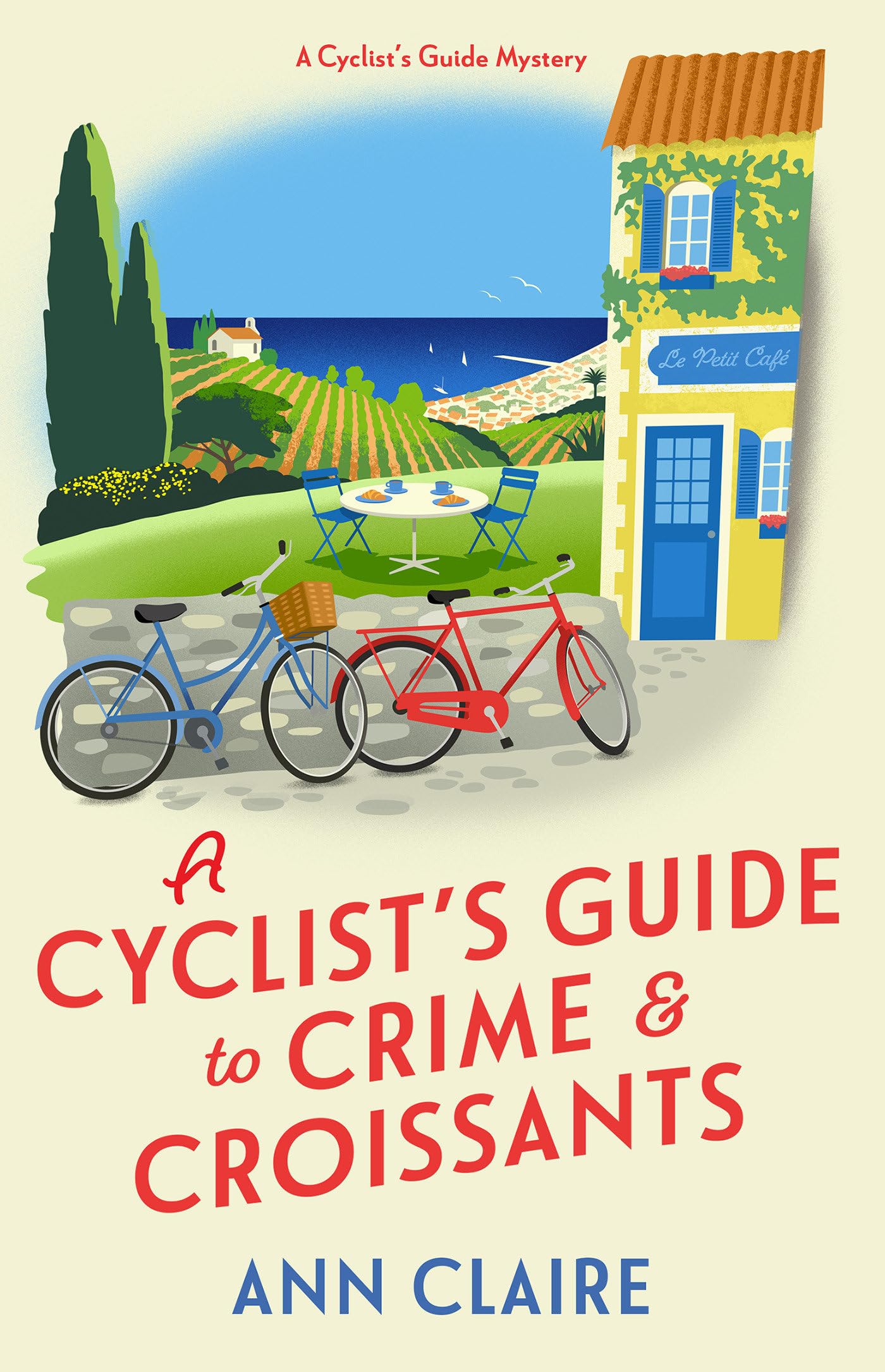
A charming cycling tour in the French countryside takes a deadly turn in this cozy mystery, perfect for fans of Emily in Paris—if Emily spoke French and solved murders between croissant breaks.
Summary:
Nine months ago, Sadie Greene shocked friends and family by ditching her sensible office job in the Chicago suburbs and buying a sight-unseen French bicycling tour company, Oui Cycle. Now she’s living the unconventional life of her dreams in the gorgeous village of Sans-Souci-sur-Mer. Sans souci means carefree, but Sadie feels enough pressure to burst a tire when hometown friends arrive for a tour, including her former boss, Dom Appleton. Sadie is determined to show them the wonders of France and cycling—and to prove she made the right move.
She hopes her meticulously planned nine-day itinerary will win them over, with its stunning seascapes, delicious wine tastings, hilltop villages, and, of course, frequent stops for croissants. When Dom drags his heels on fun, Sadie vows he’ll enjoy if it kills her. That is, until Dom ends up dead. The tragedy was no accident. Someone went out of their way to bring a permanent end to Dom’s vacation.
As more crimes—and murder—roll in, suspicions hover over Oui Cycle. To save her dream business, help her friends, and bring justice, Sadie launches her own investigation. However, mysteries mount with every turn. On an uphill battle for clues, can Sadie come to terms with her painful past while spinning closer to the truth—or will a twisted killer put the brakes on her for good?
Review:
If you’re looking for escapist literature, this cozy mystery delivers. A delightful, trope-perfect entry in the genre, it checks all the essential boxes—a murder that happens off-page? Check. A love interest suspicious of the FMC? Check. A dream career and a picturesque setting? Triple check.
One of the challenges of cozy mysteries is giving the main character an aspirational life without making them unlikable. Sadie, however, is wonderfully relatable. Her backstory is both heartwarming and tragic, making her move to France feel earned rather than enviable. She originally planned to start a bicycle tour business someday with her best friend—until tragedy struck, and her friend was killed in a hit-and-run. This loss becomes the catalyst for Sadie’s life-changing decision, and she makes it happen through a mix of financial prudence (as a former accountant) and a seller who values passion over profit. It’s a compelling, well-crafted setup.
The week of the fateful tour, Sadie’s not-quite-family but family-like friends arrive from the U.S., ostensibly to take her tour—but really, to check up on her. This dynamic adds a layer of personal drama, making the tour more than just a random mix of clients (though there are those, including a sharp-eyed reviewer). The result? Plenty of tension before the mystery even begins.
The French countryside and cuisine are absolutely lovely to read about, and you don’t have to be a cycling enthusiast to enjoy the journey. That said, I personally loved the cycling details, from the Is an e-bike cheating? debate to the hardcore Tour de France trainees Sadie encounters along the way. (If you love cycling too, check out the Bikes in Space anthology I have a short story in.)
Unlike in some cozies, the first murder (yes, first) feels eerily realistic. While I enjoy a good poisoned pie moment, this crime—especially as a cyclist—felt alarmingly plausible, adding genuine weight to the investigation.
One thing I often struggle with in cozies is the detective as a love interest—I tend to find detectives off-putting. However, this one worked for me, largely because his investigative approach felt fresh and culturally distinct. It helped maintain the escapist feel rather than making it feel like a procedural.
Speaking of characters, despite the large cast, I never once lost track of who was who. Each character felt distinct without veering into caricature. That said, the diversity felt a bit Eurocentric—the most notable examples being a Ukrainian refugee and an ex-convict. While I enjoyed both characters, I would have liked to see a bit more variety in representation given the size of the cast.
Halfway through, I was convinced I had solved the mystery. I was wrong. And once the reveal came, I could see exactly where I had been misled—not in a frustrating way, but in a deeply satisfying one.
This is a fun, immersive cozy mystery with a likeable main character, a realistic first murder, and plenty of French countryside charm. Recommended for cozy mystery fans who love an escapist read with a side of cycling, crime, and croissants.
If you found this review helpful, please consider tipping me on ko-fi, checking out my digital items available in my ko-fi shop, buying one of my publications, using one of my referral/coupon codes, or signing up for my free microfiction monthly newsletter. Thank you for your support!
4 out of 5 stars
Length: 346 pages – average but on the longer side
Source: Library
Buy It (Amazon or Bookshop.org)
Book Review: Midnight in Peking: How the Murder of a Young Englishwoman Haunted the Last Days of Old China by Paul French
 Summary:
In 1937 the entire world is on the brink of war. In Peking, China, the Japanese invaders are encroaching. In the midst of this chaos the adopted daughter of British consulman is brutally murdered, her body found in the shadow of the Fox Tower, universally viewed with suspicion by the Pekingers as haunted by spirits. Due to the special circumstances, the murder investigation requires the presence of both a Chinese and a British investigator. They must race to find Pamela’s murderer before the Japanese engulf the city.
Review:
This true crime novel takes a bit to get things set up, but once they are, oh my how it sucks you in.
My fellow librarians will appreciate the backstory of how this true tale was discovered by French. In the Afterword he states that he was digging around in some archives and stumbled upon a box of evidence that Pamela’s father sent off to the government, which was never really looked at and just put away in storage and then into archives. It was through libraries that he even discovered this fascinating, intersectional true crime. I think that’s encouraging to any librarian who has ever spent hours making a finding aid for archives.
So just what makes this true crime more fascinating than others? Pamela was the adopted daughter of Werner, and her adoptive mother died at a young age. She had been away at boarding school in Tientsin and was home for the holidays. Because she was born in China but was also adopted by British consulman, there is an interesting assimilation into Chinese culture going on in her life that we don’t often see in Western novels. Peking itself featured the legations and white districts for multiple different white Western countries. This means that because Pamela was technically a British citizen murdered on Chinese ground both the Chinese and the British police force had to be involved and work together in the investigation. Officer Han and DCI Dennis certainly make for a unique investigation team. In addition, Pamela’s body was discovered in the shadow of the Fox Tower, and this led to speculation about fox spirits, which in Chinese tradition show up as wily women. Of course quickly the seedy underbelly of Peking is implicated, featuring a multicultural bunch of addicts, dope dealers, brothels, and more, and naturally some of the classy elite start to be implicated into that underworld as well. Add in the fact that the Japanese invasion was encroaching and toss in the first rumblings of Communism, and it makes for a story that is impossible to not find fascinating.
French unfurls the story well. He quotes only when it is fairly certain what was said, but summarizes scenes well. A clear picture of both Pamela and Peking are rendered fairly early in the novel. I also appreciate that he spent time at the end talking about what happened to all of the key players and discussing how all-encompassing the Japanese invasion were. I think what he handled best though was presenting people as individuals and not representative of their race or nation or even class. In a true crime as multicultural as this one, that is important. It’s also nice that in a story that could have easily turned into victim blaming, which happens so often when the victim is a young woman, he eloquently avoids any hint of that:
Pamela wasn’t perfect; she was making the same mistakes many girls do when experimenting with their independence, their newfound power on men. Her tragedy was to encounter the wrong men, at just the wrong moment. (location 2834)
I did, however, feel that the beginning was a bit lacking. It took a bit to truly get into the story. A faster pace or a more clear this is where we are going set-up would have been nice. At first it felt like the rather dull story of some poor little imperialist rich girl. But that’s not the story at all. The story is that of an adopted girl in a country where she just so happens to be the color of worldwide colonizers, but it is instead the story of a diverse group of people horrified by the brutal murder of a young woman by a diverse group of sick, twisted people. It would be nice if that was more clear from the beginning.
Overall, this is a well-told, historic true crime novel that manages to avoid victim blaming and also embrace multiculturalism. It will be of particular interest to anyone with a fascination for Chinese or WWII history.
4 out of 5 stars
Source: Netgalley

Movie Review: The Dinner Game (1998) France Le diner de cons
 Summary:
Pierre and his friends have a recurring dinner party where they each bring an idiot. The person who brings the best idiot wins. Pierre is excited that he may have finally found a winner in Pierre–a government worker who makes models out of matchsticks and talks about them incessantly. However, he throws his back out the night of the party, and his wife walks out on him, leaving him at the hands of the bumbling Francois.
Review:
This is the French movie that is being remade/Americanized into Dinner for Schmucks, which is being released this summer. This is what led me to watch it, and I must say I don’t know why I always forget how much I enjoyed the foreign films I watched in university. They’re such a fun way to immerse yourself in another culture.
The Dinner Game plays with that classic light-handed touch often found in French films. The wit is sly, not heavy-handed. The jokes build slowly, rather like American black-and-white classic films.
I found it delightful that the writers made the choice to make Pierre basically an unredeemable douchebag who you still end up sympathizing with. It takes talent to pull that off, and it is done quite smoothly.
The movie is quite short, though, ringing in at only 81 minutes. I wanted it to last longer! Additionally, the ending was rather sudden. People who don’t like to left guessing won’t enjoy that part of it. I also felt the set-up took a bit long, particularly given the length of the film.
If you enjoy light-handed wit and a good character study, you will enjoy this film.
4 out of 5 stars
Source: Netflix

 Support my work with a tip or browse my shop for curated book club guides, how to guides, cross-stitch patterns, and more!


This work by Amanda Nevius is licensed under a Creative Commons Attribution-Noncommercial-No Derivative Works 3.0 United States License.
 Opinions of a Wolf