
Archive
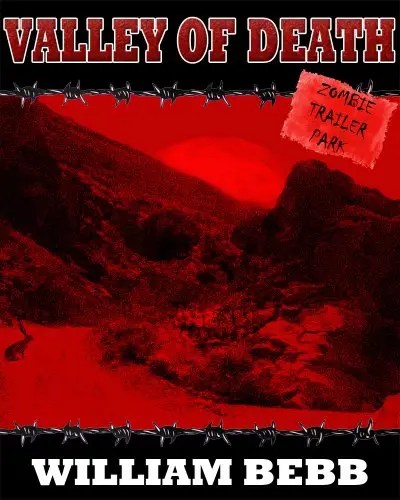
Book Review: Valley of Death, Zombie Trailer Park by William Bebb
Summary:
When Josey arrives a secluded trailer park near Albuquerque to empty their septic tank, it soon becomes apparent that not all is right in the park. In fact, most of the residents have turned to zombies. As Josey’s fight for survival goes on, we meet a quirky cast of survivors, bystanders, perpetrators–and zombies: illegal immigrants who call the valley home, their exploitative factory boss, a WWII veteran and grandpa, his young grandson, a paraplegic Vietnam Vet, a boa constrictor, bicycling missionaries, and many more. Will anyone survive the valley of death?
Review:
I have finally found the exception to my don’t-take-book-recommendations-from-other-people rule: my daddy. My dad texted me and told me he was reading a book about a zombie trailer park and asked if I’d like to borrow it when he was done. I couldn’t turn that down, so he sent his kindle loan to me as soon as he was finished reading it. I knew within the first few pages that my dad had picked a winner. That really shouldn’t surprise me, because, well, it’s my dad, and we’re very similar, but I had been burned a few times with book recommendations recently. Anyway. On to the review!
Bebb’s book is a fresh, engaging take on a zombie outbreak. The origin is a factory error, which is decidedly different from the more usual government experimentation or voodoo approach. It’s great commentary on the exploitative practices of factories, not to mention the exploitation of illegal immigrants, without ever being too heavy-handed or preachy. The zombies are a mix of the rage virus and traditional undead. Before dying they are inexplicably full of rage and will eat almost anything but also when they die they reanimate. It’s a cool mix, and I enjoyed it.
The cast of characters is incredibly imaginative, diverse, and even-handed. People are truly just people (or zombies) regardless of age, gender, or ethnicity. And, really, how many books can say they have a WWII vet, a sewer truck worker, a mechanically talented Latina, a wheelchair-bound obese meth chef, a loyal dog, bicycling missionaries, and a pot-growing paraplegic Vietnam Vet. I mean, really. And none of them are two-dimensional caricatures either. They are all well-rounded and presented with thought and humanity. I also never had that problem I sometimes have in books where you can’t tell the different characters apart. Everyone was entirely unique and easy to remember.
The plot is complex. I honestly did not know how it was going to end, and it maintains a fast pace throughout. I was never bored and was never entirely certain what was going to happen next. That’s coming from a big zombie fan, so I do think that’s saying something significant about the uniqueness of the engaging plot.
What really makes the book, though, is the sprinkling of humor throughout. This type of humor won’t match everyone, but it certainly works for me. I described it to my dad as “Patrick F. McManus with zombies,” but if you don’t get that reference, it’s hard to describe the humor. So, here are a couple of quotes from the book to demonstrate it.
Your average one armed pot growing hermit who just murdered two men might be thinking about a variety of things. (location 2592)
Crazy cop fuckers done bit off my titty! (location 5423)
That second one….oh man. I laugh every time I see it.
So with all this love, why not five stars? Well, much to Bebb’s chagrin, I’m sure, there aren’t enough commas. (His author’s intro states that previous reviews said there were too many and now people will probably think there are too few. Sorry to confirm that suspicion, Bebb!) Compound sentences tend to run on and on with no commas or semi-colons, which can be a bit frustrating to read. Also, the book isn’t quite properly formatted for the kindle. Its display varies from section to section. Similarly, while some sections are clearly divided by a dividing line (such as with tildes “~~~~”), others just have a big gap, which is not what one should use for ebooks. With the variety of ereaders, it’s important to use something besides space as a signal that the reader has entered a new section, since the space can display drastically differently on different readers. It’s best to use something like the tildes between sections. Using empty space is a holdover from print that doesn’t work. Bebb did use the tilde line in some sections, but not all, so there’s also a bit of a consistency problem.
Overall, though, the formatting and comma issues did not distract me from the wonderfully unique and humorous zombie trailer park story. I’m so glad my dad discovered this indie author and passed his work on to me, and I look forward to reading more of it in the future. Highly recommended to all zombie fans, provided you like the type of humor outlined above.
If you found this review helpful, please consider tipping me on ko-fi, checking out my digital items available in my ko-fi shop, buying one of my publications, or using one of my referral/coupon codes. Thank you for your support!
4 out of 5 stars
Length: 363 pages – average but on the longer side
Source: Borrowed
Buy It (Amazon. Not available on Bookshop.org.)
ETA: Had a delightful email convo with the author, and we determined that I read an older version of the book. The current one available should have mostly cleared up editing/layout concerns.
Book Review: Chasing the Moon by A. Lee Martinez (Audiobook narrated by Khristine Hvam)
 Summary:
Diana doesn’t have much going for her–a bad job and perpetual unwanted singledom, plus she’s been sleeping on friend’s couches since losing her apartment. So when a room in a building with a quirky landlord shows up, she grabs it instantly. Only to discover that a monster called Vom the Hungry is in her closet waiting for her to let him out, at which point he will probably eat her. In fact, the whole building is oddly connected to other dimensions full of monsters, creatures, mayhem, and madness….not to mention tentacles.
Review:
I obviously had to read this book. The cover has tentacles on it, and it’s clearly a Lovecraftverse story. These are both basically automatic must reads in Amanda-land.
The storyline is fairly straight-forward as far as the Lovecraftverse goes. There’s a place where the lines between dimensions and reality fade and threaten mere humans with madness. The monsters that Diana meets within her own apartment are fairly creative. There’s Vom the Hungry who is pretty endearing, there’s the hedgehog looking guy (whose name I can’t remember and can’t look up because: audiobook) who spawns copies of himself when he’s upset, and of course there’s the giant floating eye with tentacles who tries very hard to be prim and proper. They’re creative and funny.
The foes–the cult of the moon god–are not so creative. They’re your typical moon-loving shapeshifters, and the moon god even has three forms just like a certain other god of a religion we’re all familiar with. Compared to the creativity of the apartment and the apartment’s monsters, it just doesn’t feel like a worthy foe.
Similarly, although I liked Diana and the world she’s living in, she has basically no backstory. I have a hard time believing she’d have such an easy time mostly abandoning her friends and family from her time prior to the apartment. I can believe she’s not afraid and can handle the horrors, but it’d be nice if we got at least a toss-up to the concept of her having a family or even a mention of estrangement from them, if that’s the case. That doesn’t happen, so I was left feeling that Diana is very two-dimensional.
Given these elements, I’m sure I would have skimmed through it very quickly in print and probably missed the humor that it does contain, except that I read the audiobook. The audiobook narrated by Khristine Hvam. And she is an incredibly talented voice actor.
Every single character had their own entirely unique voice, and the voices perfectly matched the character, even an eyeless faceless omnivorous Vom the Hungry. Hvam is just….just so amazing to listen to! I kept listening more to just hear her perform than due to a true vested interest in the story. In fact, I looked up her voice actor page on Audible after just to maybe get another one of her books. She mostly narrates scifi/fantasy, unfortunately mostly YA, which we all know I don’t like. But I will be keeping my eye out for more of her adult work. She is just so amazingly talented.
So, overall then, the story itself rates 3 stars, but the narration rates 5, so my rating must average those two out. Be aware, though, that I recommend Khristine Hvam over the book, but if you are intrigued by the book and don’t mind a lack of backstory or average villains, then I recommend picking the audiobook for twice the fun.
4 out of 5 stars
Source: Audible

Book Review: Love Me by Danger Slater
 Summary:
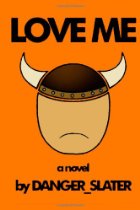
I am awesome. I am the fucking awesomest awesome dude that ever was. I live on a hilltop in my castle made from 300 human skulls. I sit on the roof and fight with Moon while wearing my Totally Authentic Viking Outfit I bought on ebay. My tears are cancerous. No really. See how the animals that drink them keel over and die? I surround my castle with a moat of blood and entrails where my crocoweilers live. (They’re crocodiles cross-bred with rottweilers). The thing is, I’m kind of lonely. So maybe I should go have some adventures around the world and do shit like invent Christianity? Yeah, that sounds like a plan.
Review:
This book is definitely intended for a narrow audience. But for that audience it is hilarious and awesome. You have to love swearing, gross-out humor, complete zaniness, and have an ability to overlook certain discrepancies like the fact that Christianity did not originate in America and if the whole world was at nuclear war why is there suddenly a fully functional president in the White House? I’m sure that all sounds crazy and bizarre because it is. But it’s also hilarious.
It’s incredibly hard to describe and articulate just way such a zany book is awesome to read, so I’ll let a couple of quotes speak for themselves.
Three days later Jesus used his magic/zombie/God powers to come back from the dead. All the Romans were like, “No fucking way!” And Jesus was all like, “Fucking way, bro!” (location 662)
My heart, once again, whimpers. It gets all emo and grows an unattractive beard and starts writing bad poetry. My heart is looking very Cat Stevens. (location 1964)
I bind my novel in the hide of the now extinct Caspian tiger just so the publishers will know, Whoa, this dude is serious, and I mail it out. (location 529)
But it’s not just all zany humor. Slater also demonstrates a clear understanding and knowledge of the rise of Western society and culture. Passages periodically toss out allusions to not just pop culture and religious history, but also to parts of the Western Canon, such as Greek Mythology:
I welcome the unctuous numbness into my body. It offers me relief. I let the Charon of alcohol ferry me across the River Styx. I let it guide me deeper into Hell. (location 2879)
Underneath the humor and the allusions though what the book really is is a parable for anyone who ever searched for the meaning of life and wound up agnostic or atheist. Parts of it truly speak to the experience of finding and losing religion. Of then investing yourself into other ideals that just don’t work out for you either until you’re left with the only solution, that life’s purpose is….
to exist in any way you see fit, plain and simple. (location 1391)
The one drawback to the novel is that this small indie press work needs an editor (or another editing swoop from Slater). Although his writing itself is very good, there are a few misspelled words, typos, etc…. that, alas, interfere with the book’s good qualities. Please listen to this reviewer and either do it yourself or find a friend to! Your work is too good for such an easily fixed short-coming.
Overall this book is a delicious, zany, humorous parable of the agnostic/atheist journey through Western society in a search for the meaning of life. If that sounds like it’d appeal to you and swearing and dick jokes don’t offend you, then I highly recommend it.
4 out of 5 stars
Source: Kindle copy from author in exchange for my honest review

Book Review: To Say Nothing of the Dog by Connie Willis
 Summary:
Ned Henry is a time-traveling historian at Oxford, who has unfortunately been assigned to Lady Shrapnell’s quest to recreate an historic church. For the last…god knows how long, he’s been searching for the bishop’s bird stump in the 1940s. He finds himself suffering from time-lag and is promised a vacation in Victorian England where Lady Shrapnell can’t find him. Of course, the Oxford historians need him to take care of one teeny tiny little incongruity caused by fellow time-traveling historian, Verity, who just so happens to be as beautiful as a naiad. Of course, that could just be the time-lag talking.
Review:
Wow. Wow. I literally hugged this book multiple times as I was reading it. I love it that much. You know that old Looney Tunes cartoon with the abominable snowman who finds Bugs Bunny and then scoops him up and rocks him saying, “I will hug him and love him and squeeze him and call him George” ? If I was the abominable snowman, this book would be my Bugs Bunny.
It is incredibly witty in that highly intelligent manner that expects you to be educated to get the joke. Multiple references to classic literature, historic events, and more tossed around as quips and comparisons to events characters are currently going through. It also features the put-upon hero, Ned, who maintains a good sense of humor about the whole thing in that lovely self-deprecating way that makes me wish the character could pop out of the book and be my best friend.
Additionally, I love history as long-time readers of this blog know. History was one of my two majors in university. I was the 7 year old girl who sat around watching war movies and PBS documentaries. I also love scifi. Hence, the entire concept of time-travel is one of my all-time favorite things, and Willis handles it so intelligently and beautifully! I love that time travel is something only the academics do since everyone else finds it dull once it’s discovered they can’t loot from the past. It makes so much sense! I love the implication that non-academics are quite happy with shopping malls while Ned and Verity go traipsing around through the past navigating a world distantly related to our own. One of my favorite moments is when Ned discovers that Victorians actually used exclamations like “pshaw” that are found in Victorian novels. It’s a historian’s dream come true!
Finally, a significant portion of the storyline revolves around cats. Adding an extra layer of awesome to this is the fact that cats are extinct in the future, so Ned has never encountered one before. He makes the initial mistake of thinking cats are like dogs. Any cat lovers, I’m sure, can envision the hilarity that ensues from this little thought process. Also, seriously, Willis clearly understands animals perfectly. The mannerisms of the cats and the bull dog, Cyril, are written to a T.
Put together humor, time travel, history, and animals, and this is the perfect read. If you enjoy any one of those things, but definitely if you enjoy more than one of them, you absolutely must give this book a chance. I haven’t loved a book this much in years, and I just….I just want to spread the love. I also want to go re-read it right now.
5 out of 5 stars
Source: PaperBackSwap

Book Review: The Android’s Dream by John Scalzi
 Summary:
People think Harry Creed is squandering his talents, but he actually quite enjoys his job working for the UNE breaking bad news to various sentient alien races residing on Earth. Still, he doesn’t mind doing a favor for his old friend, Ben Javna, who calls up saying the lizard race, the Nidu, need a specific breed of sheep for the coronation ceremony, and it’s vital in keeping the peace between the two planets that Earth help provide one. Creed doesn’t think this will be much of a challenge, but he soon finds up he’s signed up for more than he bargained for, running into everything from The Church of the Evolved Lamb, to a Nagch who digests his victims alive, to other computer geniuses, to scandal within the UNE.
Review:
This is one of those scifi political intrigue books crossed with Douglas Adams style humor. I don’t usually do political intrigue in scifi, since I avoid politics like the plague in real life, but the Douglas Adam style humor manages to make it all actually interesting and intriguing.
It’s impossible not to enjoy all of the very strongly developed characters, whether they’re a villain or not. Frankly, that’s a good thing, as it’s rather hard to tell half the time who’s the villain and who isn’t (with the exception of Creek of course). The alien sentient species imagined are rather traditional in appearance, but not so much in behavior, which keeps them interesting. For instance, the Nidu are able to communicate through smell in addition to speech, and this tends to lead to problems on Earth. Even very minor characters who are only in the story for a few pages are so crisply described, that it is impossible not to imagine them as clearly as if it was a film. In fact, the whole book reads rather like a scifi action film in the style of The Fifth Element.
The action sequences are universally stunning. There is one shoot-out scene in a mall, in particular, that also incorporates equipment from a futuristic game, reminiscent of Ender’s Game that left me grinning with joy at the sheer awesomeness of it. The social commentary in the form of The Church of the Evolved Lamb is also fun. This is a religion that knows that its founder was a fraud, but has decided to attempt to make his prophecies come true anyway. It makes for some really wild moments.
That said, sometimes the political intrigue itself was a bit hard to follow. I’m still rather confused as to what exactly was going on, politically, in the middle of the book. I think I’d have to re-read it to figure that out, exactly. I think the fact that I didn’t get confused at all in The Dark Tower series, but did here says something. Still though, the humor and action sequences kept the plot moving enough that the political intrigue didn’t really matter that much anyway.
Overall, if you enjoy humorous scifi in the style of Douglas Adams, you will definitely enjoy this book.
4 out of 5 stars
Source: Harvard Coop

Book Review: Breathers By S. G. Browne

Summary:
Billing itself as a rom-zom-com (romantic zombie comedy), Breathers looks to get into the psyche of those reanimated corpses out to eat your brains, not to mention deep-fry your fingers. Andy is in his 30s and living in his parents’ basement after reanimating from a car crash that left his wife permanently dead. Andy is depressed and slowly decaying, but all that changes when he starts attending Undead Anonymous weekly meetings. There he meets Rita, and together with other members, they stumble upon southern zombie Ray who gives them jars of his venison that tastes remarkably good to Andy and has some interesting affects on him.
Review [spoiler warning]:
Breathers starts out with a bang. Nothing sucks you in quite like a main character waking up from an alcohol-induced blackout to discover he’s killed his parents and stuffed their dismembered bodies in the fridge and freezer. Browne’s dark humor serves the storyline well. It’s not easy to take a repulsive, cannibalistic, walking corpse and make him a sympathetic character instead of the terrifying other, and Browne achieves this…..to a certain extent.
At first Andy and the reader don’t know that the “venison” he’s eating is actually people. Both the reader and Andy see the positive effects of eating humans before they fully realize that’s what he’s eating. (Although, come on, I had my definite suspicions, even in a world where vampires are “vegetarians” and have Tru Blood.) Andy stops decaying and starts protesting for his civil rights to be reinstated, for zombies to be recognized as equal and valid. This is a popular, obvious analogy for various human rights fights going on around the globe. Awesome. It’s great for people who aren’t ordinarily treated as an other to get a first-person account of what that’s like.
This analogy though is why I have a bit of a problem with the twist toward the end whereby we see that eating humans leads to cravings for more humans and eventually we have a full-out blood bash eating a house full of frat boys. Aesthetically, as a horror fan, I love the blood bash. Nothing quite like reading a first-person account of what it’s like to eat another human being alive. However, the lesson learned here is that while the other may seem cute and cuddly, all your suspicions about them are true. Don’t trust them for a minute or they’ll turn full evil on you.
Browne doesn’t seem to have an issue demonizing select groups. The whole frat boys stealing limbs from zombies as pledges followed by the zombies eating the frat boys and their various one-night stands and girlfriends reeks of a weak, geeky boy’s wet dream. Revenge of the nerds zombie-style.
It’s unfortunate that Browne lets his bitterness undermine his enjoyable writing style–a wonderful mix of humor and horror. Hopefully his next effort leaves the personal grudges behind and just gives us the humorous horror we want.
If you found this review helpful, please consider tipping me on ko-fi, checking out my digital items available in my ko-fi shop, buying one of my publications, or using one of my referral/coupon codes. Thank you for your support!
3.5 out of 5 stars
Length: 310 pages – average but on the longer side
Source: Library
Buy It (Amazon or Bookshop.org)
Book Review: I’m Perfect; You’re Doomed By Kyria Abrahams
 Summary:
Kyria Abrahams is rising in visibility in comic circles. She originally wanted to tell her memoir as a one-woman show, but instead ended up writing it down as a book. Kyria’s memoir takes the reader from an inside look at what it was like to be raised a Jehovah’s Witness in Rhode Island in the late 1980s and early 1990s to her marriage at 16 to her eventual disfellowship. Not your typical serious-toned memoir, Kyria approaches her heavy material with a comic’s graceful tongue-in-cheek snark.
Review:
Anyone who had a fundamentalist upbringing will find the first half of Kyria’s book incredibly relatable and will be relieved at being granted permission to laugh at the absurd concerns fundie kids get saddled with. Kyria was encompassed in a conservative world continually seeing demons lurking around every corner, or even in that plate you stupidly bought at a yardsale from that old woman who is probably a witch. A typical example of her writing style can be found in the first chapter, “The succession of power was this: Jesus was the head over man; man was the head over woman; and woman was the head over cooking peach cobbler and shutting up.” It’s rare to find a laugh out loud memoir dealing with something as intense as being raised in a cult, and Kyria handles it well.
This style holds out through Kyria’s early teen years and her rebellion of marrying a Witness eight years older than her. It starts to fall apart after the wedding though. The writing becomes fuzzy. It’s unclear exactly how much time has passed or why she suddenly stopped going to the Meetings (the Witness version of church services). This, to me, should have been one of the most compelling parts of the book. Why did she leave? Why was she so incredibly desperate to be disfellowshipped that she actually asked for it at the meeting about her adultery? Although earlier in the book, Kyria demonstrates remarkable acumen at analyzing herself and her behavior, at the end of the book she loses this. I am certain, as an ex-fundie myself, that Kyria spent a lot of time analyzing why she left, yet none of this introspection is written into the book.
Similarly, the reader is left really wondering about Kyria’s OCD. While it was excruciatingly debilitating in her mid to late teens, it seems to suddenly mostly disappear, or at least disappear enough so that she can live in a crappy apartment in a bad neighborhood by herself. I’m not discrediting Kyria, but what happened in that interim?
The seemingly sudden decision to get disfellowshipped and the lack of information on her OCD are the two most glaring examples of the disjointedness of the second half of the book. Of greater concern to me, though, is the fact that Kyria really does seem worse off at the end of the memoir than at the beginning. She ends up in a crappy apartment, drinking and doing drugs fairly consistently, screwing random poets, having given herself permission to “fuck up.” This is a stereotype of the ex-fundie woman, and I have to say it’s a fairly accurate one. Normally though, this is a phase the person goes through before finding her own new footing using morals she has chosen for herself. I’m a bit concerned that ending on the rebelling and going crazy note rather than the finding the new footing note will make fundamentalists feelvindicated. They will point to this as evidence that they are correct that apostates really are worse off. What concerns me more though is the general population reading this book, the ones raised normally who are not apostates, were given no guides by Kyria to understand why she behaved the way she behaved. There are very good reasons why ex-fundies go crazy for a little bit. They weren’t given the tools to deal with the world. The lack of introspection in the second half of the book will leave people who haven’t experienced it thinking the problem is Kyria’s inherent nature and not the way she was nurtured.
The book still does provide good insight into the world of those people who knock on your door in pairs. Additionally, it is refreshing to read a funny memoir about a serious topic.
3.5 out of 5 stars
Source: Library

 Support my work with a tip or browse my shop for curated book club guides, how to guides, cross-stitch patterns, and more!


This work by Amanda Nevius is licensed under a Creative Commons Attribution-Noncommercial-No Derivative Works 3.0 United States License.
 Opinions of a Wolf