
Archive
Book Review: Peace Child by Don Richardson

Part history of the 20th century for the Sawi people of New Guinea, part personal memoir by the first missionary to live with them.
Summary:
In 1962, Don and Carol Richardson risked their lives to share the gospel with the Sawi people of New Guinea. Peace Child tells their unforgettable story of living among these headhunters and cannibals, who valued treachery through fattening victims with friendship before the slaughter. God gave Don and Carol the key to the Sawi hearts via a redemptive analogy from their own mythology. The “peace child” became the secret to unlocking a value system that had existed through generations. This analogy became a stepping-stone by which the gospel came into the Sawi culture and started both a spiritual and a social revolution from within. With an epilogue updating how the gospel has impacted the Sawi people, this missionary classic will inspire a new generation of readers who need to hear this remarkable story and the lessons it teaches us about communicating Christ in a meaningful way to those around us.
Review:
There’s a lot of controversy about modern mission work. Not to mention the known atrocities committed by missionaries in the US, Canada, and other places in historic times. I support Indigenous peoples and condemn the horrific means used by these supposed “missionaries.” (I personally do not consider these people to be true believers bringing the gospel but rather colonizers acting on behalf of a nation. For example, Jesus loved children and yet these people murdered them.) So I approached this book with quite a bit of trepidation. Yet slowly over the course of it, I came to see the picture of a very different type of mission work.
Unlike many missionary memoirs, the perspective of the first third of the book is actually that of a historical account of approximately one year in the life of the Sawi before the missionaries arrived. It immerses you into the world of New Guinea and also gives a neutral depiction of the cannibalism as it existed at that point in time. Because Sawi culture honored duplicitousness and treachery, the different villages were quite isolated and small. Betrayal with the end result being death and, yes, cannibalized, was a real consistent threat. There was a Sawi saying about honoring this treachery – “fatten with friendship for the slaughter.” Starting the book from the Sawi perspective sets the expectation that this book is really about the Sawi, not Don and his wife Carol.
Something Don makes clear early on is that other cultures were encroaching on the Sawi. They were not going to continue to be left untouched for long due to the political situation in New Guinea. Essentially, the people with the hands-off approach were departing. It was clear the ones incoming were going to go into the jungles themselves but also allow hunters, prospectors, etc… in. Don’s belief was that the first people the Sawi encountered shouldn’t be out to exploit them for anything but rather should be there to help them in as many ways as possible, not solely with the gospel but also to adjust to their world shifting more dramatically than it had in generations. Don and his wife brought medical care and information on how the outside world that was coming into contact with them would work. A story that particularly struck me was how Don and Carol taught Sawi how to be shopkeepers. You might, like me, think at first, oh no, he’s destroying their hunter/gather society with money. But when he explained his reasoning, I was humbled at how forward-thinking and selfless it was.
Educating Papuans without training some of them to be shopkeepers invites non-Papuans to come in and take control fo the supply and pricing of manufactured goods. As non-Papuans enrich themselves, they eventually gain ownership of land bequeathed to Papuans by their ancestors. Papuans thus tend to end up as exploitable cheap labor or, worse yet, as beggars foraging on garbage cast off by non-Papuans. Hoping to spare our Sawi friends such a fat, we trained some of them to be, yes, shopkeepers! Shopkeepers who charge prices lower than non-Papuans care to compete with! Shopkeepers who see no need to sell their land because their shops are doing quite well, thank you!
location 3632
Beyond helping the Sawi to prepare for meeting the world, Don’s perspective on mission work is essentially that the culture you are visiting already has inbuilt messaging from God about Jesus. You just have to find what it is to help them see it, since they haven’t heard the message before. In the case of the Sawi, that is the cultural tradition of the peace child. I won’t go into the details of how the peace child works in Sawi culture. I think that is most impactful by actually reading the book. What is interesting to me to note, however, is how his method of missions doesn’t supplant the culture or force another culture upon it. It rather takes an aspect of the culture that already exists and builds upon it. Now, all cultures have good and bad aspects. Essentially what Don does is he tries to help enhance what is good within the culture and tamp down what is only hurting the people. The Sawi inability to trust anyone because of treachery being so upheld as a positive trait is an easy to understand example of this. Once the Sawi understanding of a peace child was uplifted higher instead and became more achievable for anyone, then the Sawi were able to start trusting each other and uniting so that they might remain that way when facing the world. I frankly found myself wishing someone could come help my own culture in such a way to help us be better, more communal, versions of ourselves!
I was also surprised by how things turn out. Ultimately, the mission group withdraws from the Sawi villages, not in defeat, but because they feel the Sawi are ready to stand on their own within the extended world they now find themselves in. Updates on the Sawi indicate they are still doing well and have even sent their own missionaries to another Indigenous group, the Sumo, further inland. This article also talks about the fact that Don use the Indonesian characters to write down Sawi and translate the New Testament. This means that when the Sawi were newly required to go to government schools and learn Indonesian they could also automatically read Sawi, helping to preserve the language.
Overall, this is a very engaging and informative read about one Indigenous nation encountering the larger world in the 20th century. It also gave me a new appreciation for how mission work can be done ethically. While I understand that some may disagree and say there is no such thing as ethical mission work, I think how Don and his wife Carol helped the Sawi maintain control of their land and literacy in their own language is a strong counterpoint.
If you found this review helpful, please consider tipping me on ko-fi, checking out my digital items available in my ko-fi shop, buying one of my publications, using one of my referral/coupon codes, or signing up for my free microfiction monthly newsletter. Thank you for your support!
4 out of 5 stars
Length: 256 pages – average but on the shorter side
Source: Library
Buy It (Amazon or Bookshop.org)
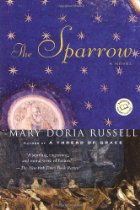
Book Review: The Sparrow by Mary Doria Russell (Series, #1) (Bottom of TBR Pile Challenge)
 Summary:
It is the year 2060, and the Jesuit priest Emilio Endoz has been found on the planet Rakhat by the second Earth ship to travel there. Found in a whorehouse and killing a native inhabitant in front the UN members’ eyes, they nonetheless strap him into his original spaceship and send him back to the Jesuits. There he is treated for his horrifying wounds and through a series of flashbacks and current conversations with the various Jesuit committee members assigned to his case, we slowly see how everything that started out so right went so horribly wrong on Rakhat.
Review:
It may have been a while since it made it onto my tbr shelf, but I still have a crystal clear memory of why I acquired this book. I entirely blame Little Red Reviewer, who just so happens to be the only other female scifi fan who book blogs that I’m aware of. (Feel free to enlighten me to more in the comments). Her review that religion is there but in a questioning way that honors the tradition of scifi made me give this book with a Jesuit priest and mission at its core a chance. I’m glad I did.
This is a first contact story that takes the all-too-infrequent route of Earth finding the inhabited planet first and sending a mission to them. There’s so much more than that that makes this book unique, though. The future Earth just barely has the technology to make it to Alpha Centauri, and only the most tech-savvy are aware of it. Thus, we’re not an incredibly advanced civilization making first contact, just one slightly more so than Rakhat. I’d say a fair comparison might be late 19th to early 20th century earth to early to late 21st century Earth. It’s a short span of difference. Additionally, Russell made the intriguing choice of the first contact being run by missionaries, instead of a political unit. When you think about it, it makes perfect sense. Who tended to be first to the New World? Religious groups. Who can organize themselves quickly and have vast finances? Religious groups. Having first contact be missionaries makes so much sense that I’m shocked I didn’t think of it first.
That said, thankfully this book is not a love letter to organized religion or mission work. It is instead a complex, scientific, and anthropological study of the human condition, the difficulties of vastly different cultures meeting, linguistics, and much more. At its core it is all about why does god (if there is a god) let evil happen, especially to good people who are serving him? These issues are more easily addressed and made further complex by having agnostics, non-practicing Catholics, and a Jewish woman members of the mission team. The non-believers are about at even numbers with the priests. In fact, the deeper into the book I got, the more it tore at my heart-strings. Varying types of questioners are represented, and of course it’s possible to identify with many of them, particularly for a reader who once was religious but is not anymore. There’s the priest who is secretly gay, the Jewish woman who was wounded terribly by war but comes to learn to love again, the Father Superior who thinks he may be seeing the formation of a real live saint, the priest questioning the very existence of god, and the agnostic who wants to have the beautiful aspect of faith that she sees in those around her.
This book reads, it sounds a bit odd to say, almost like an agnostic’s prayer. Of course agnostics don’t pray, but if they did pray, the pain and wondering and intelligence found in this book would all be there.
We are, after all, only very clever tailless primates, doing the best we can, but limited. Perhaps we must all own up to being agnostic, unable to know the unknowable. (page 201)
The problem with atheism, I find, under these circumstances…is that I have no one to despise but myself. If, however, I choose to believe that God is vicious, then at least I have the solace of hating God. (page 394)
People more into science than the questioning human spirit will find plenty for themselves as well. The science of linguistics is astoundingly well presented. The way the two “sentient” species on Rakhat have evolved is also incredibly well thought-out and realistically drawn. The problems of poverty and war on earth are briefly explored too.
All of these things said, I do feel it took a bit too long to get things set up and moving. Granted, I tend to be a bit of an action-focused reader, so others may not have a problem with that. It was still a draw-back of the book for me though.
I sort of feel like I’m not doing the experience of reading this book justice. Suffice to say if you’ve ever questioned whether or not to have faith and love your big questions to be wrapped in well-thought-out scifi, this is the book for you.
4 out of 5 stars
Source: Better World Books

Counts For:

 Support my work with a tip or browse my shop for curated book club guides, how to guides, cross-stitch patterns, and more!


This work by Amanda Nevius is licensed under a Creative Commons Attribution-Noncommercial-No Derivative Works 3.0 United States License.
 Opinions of a Wolf