
Archive
Book Review: The Serviceberry: Abundance and Reciprocity in the Natural World by Robin Wall Kimmerer
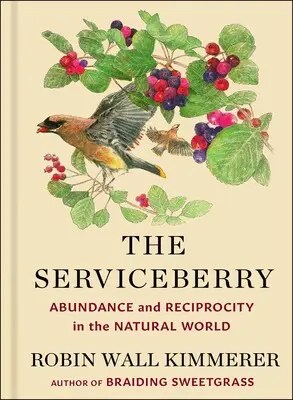
A Potawatomi author and botanist explores the concept of gift economies through the author’s reflections on nature, reciprocity, and the lessons of the serviceberry tree.
Summary:
As indigenous scientist and author of Braiding Sweetgrass Robin Wall Kimmerer harvests serviceberries alongside the birds, she considers the ethic of reciprocity that lies at the heart of the gift economy. How, she asks, can we learn from indigenous wisdom and the plant world to reimagine what we value most? Our economy is rooted in scarcity, competition, and the hoarding of resources, and we have surrendered our values to a system that actively harms what we love.
Meanwhile, the serviceberry’s relationship with the natural world is an embodiment of reciprocity, interconnectedness, and gratitude. The tree distributes its wealth—its abundance of sweet, juicy berries—to meet the needs of its natural community. And this distribution insures its own survival. As Kimmerer explains, “Serviceberries show us another model, one based upon reciprocity, where wealth comes from the quality of your relationships, not from the illusion of self-sufficiency.”
Review:
I was incredibly moved by Robin Wall Kimmerer’s Braiding Sweetgrass, which beautifully wove together the spiritual and the scientific. So, I was excited to dive into her new book, The Serviceberry, which blends natural biology with economics—yes, you read that right.
This short book is gorgeously illustrated by John Burgoyne with thematic line drawings that complement Kimmerer’s reflections. The story centers on her harvesting serviceberries, and this simple activity becomes the starting point for a profound exploration of economic systems.
I’ll admit, before reading this book, I didn’t know much about serviceberries, even though I spent my childhood picking wild berries. After reading Kimmerer’s description and researching more, I’m still not sure I’ve encountered them in the wild myself. I wonder if having a personal connection to the plant would have deepened my connection to the book, much like it did with many of the plants discussed in Braiding Sweetgrass.
The core of the book discusses gift economies—systems of mutual support that thrive on sharing abundance. Kimmerer writes:
Gift economies arise from an understanding of earthly abundance and the gratitude it generates. A perception of abundance, based on the notion that there is enough if we share it, underlies economies of mutual support. (page 75)
Kimmerer uses her own harvest of serviceberries as a metaphor: after gathering more than enough berries, she shares them with her neighbors, who might then return the generosity by baking a pie to share. She connects this to examples like Little Free Libraries and free stands giving away zucchini, offering a hopeful vision of a world where wealth is measured not by money, but by the relationships we build.
However, I struggled to fully embrace this vision. While I appreciate Kimmerer’s focus on the power of sharing, I was reading this book during a time of travel frustration—waiting overnight for a massively delayed airplane—and found myself questioning the likelihood of these ideas. The concept of abundance feels hard to grasp when faced with the reality of scarcity—especially when airlines don’t have enough seats for stranded travelers.
I also hear the idealistic rebuttal: in a gift economy, I wouldn’t need to travel far to see family because we’d all be close by, sharing our abundance. But my personal experience with things like Little Free Libraries, where people dump books in condition too bad for anyone to use, makes me question the idealism of this system. While Serviceberry presents a beautiful vision of generosity, it doesn’t address the real challenges of maintaining such systems at scale.
Despite this, I still value Kimmerer’s generosity in donating all her advance payments to support land protection, restoration, and justice. Her actions speak louder than words, and that’s something I deeply respect.
Overall, this is a quick read that challenges readers to think about economics, abundance, and reciprocity in new ways. While it didn’t convince me of the feasibility of the gift economy, it certainly provided food for thought. I recommend it to those who are interested in reimagining our current economic systems through a natural lens.
If you found this review helpful, please consider tipping me on ko-fi, checking out my digital items available in my ko-fi shop, buying one of my publications, using one of my referral/coupon codes, or signing up for my free microfiction monthly newsletter. Thank you for your support!
4 out of 5 stars
Length: 128 pages – novella/short nonfiction
Source: Library
Buy It (Amazon or Bookshop.org)
Book Review: Native: Identity, Belonging, and Rediscovering God by Kaitlin B. Curtice

Summary:
This is simultaneously a memoir about her faith journey and an opinion piece from her perspective as both a Christian and a member of the Potawatomi nation (a nation Indigenous to both the US and Canada). Kaitlin fearlessly grapples with the historical and current weaponization of Christianity, how she interprets Christianity in her own life, and how her Potawatomi knowing comes into her faith.
Review:
This book, to me, is first and foremost beautiful. I read it on my kindle fire just so I could enjoy its beauty in full-color and larger size than my paperwhite. There are five parts, and each part begins with an illustrated poem from Potawotami tradition that ties into the designated part.
A lot about this book is difficult to categorize, and that is part of its strength and beauty. It is partially a memoir, although not necessarily told in a linear fashion. In fact, it reminded me quite a bit of Braiding Sweetgrass (review). It is both about a topic the author has a lot of knowledge on (the experience of Christianity as an Indigenous person), but also is a memoir because her knowledge and herself cannot be separated as they inform each other.
Although I am not biracial myself, I imagine this book would be meaningful to readers who are. Kaitlin, while a full member of the Potawatomi nation, is half white and half Potawatomi. In addition to this, her parents split up when she was young, so she also experienced both living on the reservation and living off the reservation in a white town in a white church with folks essentially considering her to be white and ignoring her Potawatomi self. She discusses what it means to her to be able to pass for white and why she generally as an adult chooses not to. (She even flies with her tribal membership card, which while officially accepted, is usually not recognized by the first TSA agent she sees).
Her insights into how to improve what is broken or ostracizing in the church in the US were simultaneously interesting and challenging. I can imagine a reader very deeply enveloped in the church may feel challenged by her willingness to question what is often accepted as the word of God and also by her desire to draw in aspects of Potawatomi ways. Similarly, I can imagine a reader who has already cast aside the church might wonder why she bothers staying with something that may seem to them to be so obviously broken. This is the beauty of the book. Kaitlin refuses to do what might seem to either side to be the easiest and rather forges her own way, encouraging others to do the same.
The problem isn’t that we search for truth; the problem is that we become obsessed with our belief that we hold the truth, and we destroy entire cultures in the process.
52%
I know I am not the only person who has been wondering lately about other white women who support the patriarchy, and Kaitlin directly addresses this with her insight that comes from being a white passing Indigenous woman in white conservative spaces. I found what she had to say helped me both establish some understanding for something I previously could not understand at all and consider new ways to potentially reach these women.
Unless your lived experience is very similar to the author’s, I expect this will be a book that challenges you. It certainly challenged me. But to be challenged is to grow, and I thank the author for sharing her understanding of the world and her experiences. Being challenged helped me to grow in my understanding. Recommended for all but especially for those who are seeking a greater understanding of the church in the US.
4 out of 5 stars
Length: 208 pages – average but on the shorter side
Source: Purchased
Buy It (Amazon or Bookshop.org)
If you found this review helpful, please consider tipping me on ko-fi, checking out my digital items available in my ko-fi shop, buying one of my publications, or using one of my referral/coupon codes. Thank you for your support!
Book Review: Braiding Sweetgrass: Indigenous Wisdom, Scientific Knowledge, and the Teachings of Plants by Robin Wall Kimmerer
Summary:
Member of the Potawatomi Nation and botanist Robin Wall Kimmerer presents a series of essays on plants of North America, incorporating some memoirs from her life and her daughter’s recollections as well.
Review:
It’s difficult to describe how meaningful this book is. The description sounds so simple and yet, to me, it is a collection of scientific and Indigenous knowledge intertwined as near poetry. As an urban gardener who grew up rural among farms, I think of myself as plant knowledgeable, but I was humbled by this book. I also teach, and I found her ruminations on teaching and balancing teaching other people’s children versus your own to be beautifully honest. This book takes time to get through but because of the rich meaning in each essay. You find yourself wanting to savor it.
As a person who feels both spiritually and scientifically minded, this book spoke to me on a mind and soul level simultaneously in ways I cannot fully describe. I wish there was greater focus on teaching this way. I wish the two were not divorced from each other in our society. I think it would be healing to us all and to nature as well if they were not.
Allow me to try to pull out a few meaningful quotes to me by theme.
On morality, contentment, and consumerism:
Refusal to participate is a moral choice.
Transformation is not accomplished by tentative wading at the edge.
Balance is not a passive resting place.
In a consumer society, contentment is a radical proposition.
The consumption-driven mind-set masquerades as “quality of life” but eats us from within.
On teaching and being taught:
The professor made me doubt where I came from, what I knew, and claimed that his was the right way to think.
Teach any who will come.
I’d left my baby girls at home with their dad in order to introduce other people’s children to something they cared little about.
Facts about plants that fascinated me, include that a 3 sisters garden [growing corn, beans, and squash together the Indigenous way] yields more food than if you grew each alone, polycultures are less susceptible to pest outbreaks than monocultures, breathing in the smell of humus (the dirt, not the food) releases oxcytocin, and lichens are actually two beings together (a fungus and an alga). I also learned:
Sweetgrass thrives where it is used and disappears elsewhere.
Plantain is not indigenous but naturalized. It’s so prevalent and well-integrated that we think it’s native.
Estuaries can have the highest biodiversity and productivity of any method.
Forest ecologists estimate that the window of opportunity for cedars to get started occurs perhaps only twice a century.
I hope I have made you intrigued by this book. I loved it so much that I bought myself a copy after starting off with a digital library copy.
5 out of 5 stars
Length: 391 pages – average but on the longer side
Source: Purchased
Buy It (Amazon or Bookshop.org)

 Support my work with a tip or browse my shop for curated book club guides, how to guides, cross-stitch patterns, and more!


This work by Amanda Nevius is licensed under a Creative Commons Attribution-Noncommercial-No Derivative Works 3.0 United States License.
 Opinions of a Wolf