
Archive
Cookbook Review: Living Cuisine: The Art and Spirit of Raw Foods by Renee Loux Underkoffler
 Summary:
With an intro endorsement from actor Woody Harrelson, who just so happens to also be vegan, Chef Renee Loux Underkoffler seeks to present not just the ins and outs of raw cooking, but also the beauty in it.
Review:
So, I picked up a copy of this via Better World Books back when a close friend and I were getting into trying some new raw food recipes. They’re great in the summer for a change from salads when you want something cool, fresh, and healthy to eat. Plus, I’m always interested in learning more, so I was excited to see that Underkoffler provided more than just recipes, but also chapters featuring the benefits of the various raw ingredients and preparation techniques. Unfortunately, ultimately this cookbook really did not work for me.
First there’s the fact that a book seeking to show the beauty of raw foods has zero color pictures and almost no black and white illustrations. It is almost entirely straight text. Very unattractive in a cookbook!
Second, the background information goes on for an excruciatingly long time. The recipes do not start until page 261 of the book! And as much as I like learning more about some veggies and fruits, it felt like information overload to me. If I really wanted to know all the properties of every fruit and vegetable out there, I’d become a nutritionist. Knowing the basics, such as what is provided by the scientists in DASH–lots of servings of brightly colored fruits and vegetables are good for you–that’s really all the consumer needs to know. Well, that and how to properly assemble the foods for the right tastes and textures.
So I was pleased to get to the recipes, but only found three that I found to be at all doable by me. The rest required either an insane amount of prep time, special tools, or special ingredients that even with all of my grocery options in a city like Boston I was unable to even fathom where I would find them. (Vegans should also note that the recipes make abundant use of raw honey).
I, admittedly, have yet to try the three recipes I did find, primarily because they all require a blender, and mine is broken. I did save them to try in the summer during a hot spell of a week. But even if Underkoffler’s recipes are delicious, they are overly involved and intimidating, even to someone like myself who cooks a ton. I suppose her market might be raw chefs, but then why have the entire beginning of the book be toned toward beginners with no idea what’s in fruits and vegetables? The book is a bit of a mystery to me, honestly.
Ultimately, although the title of the cookbook is lovely, the recipes and content themselves are not. Underkoffler’s cookbook lacks a true direction. It is unclear if her target audience is talented raw chefs or the average American developing an interest in raw foods. As such, neither audience is properly served. I would not recommend starting with this book if you have a new interest in raw cooking, but chefs may be interested in flipping through the recipes in the back to see if any are new ideas to them.
2 out of 5 stars
Source: Better World Books

Book Review: Evolution in a Toxic World: How Life Responds to Chemical Threats by Emily Monosson
 Summary:
Monosson attempts to explain both current and possible future impacts of chemical pollutants on humans by examining how life responded to toxic threats in the past.
Review:
Allow me to preface my review by saying that although I am not a scientist, my profession is that of a medical librarian, so scientific jargon is not new to me. I would therefore say my understanding of science is somewhere above average American but below actual scientist. I had the impression from the description that this book is written by a scientist for public consumption aka the average American. It misses the mark.
The content is great and informative, but it is couched in such an overload of scientific jargon and an assumption of an above average understanding of how the human body works that it was incredibly difficult to get through in order to glean out the interesting information. Thank goodness I had the kindle version and could look up words easily as I went, or I would have given up within the first chapter. Additionally, just when things were starting to get interesting, such as with how DDT impacts development in utero, Monosson would switch topics. Very frustrating!
That said, I did learn quite a bit from this book. It was just difficult to get to these understandable tidbits given the writing style and structure. Here are a few interesting things I learned:
Like some pervasive computer operating systems, p53 is an archetypical example of the unintelligent design and compromise that is inherent in evolution—a multifunctional, multipurpose transcriptional coordinator that has only lately been retasked to the job of tumor suppression in large, long-lived orgasms….At the end of the day p53, together with all our other suppressor mechanisms, fails half of humanity. (location 1314)
Though two species may share a common ancestor and hence a common ancestral receptor or enzyme, once they part ways on the family tree, the branches evolve independently. (location 1670)
For a genetically male mammal to come out looking and functioning male, he requires in utero exposure to hormones like testosterone and its more potent derivative, dihydrotestosterone, along with a functioning AR. An embryo lacking either hormones or a properly functioning AR (or exposed to chemicals that disrupt either receptor or hormone production) will take on a female appearance, despite possessing a Y chromosome….work by Kelce, Gray, and others revealed that a metabolite of the pesticide DDT was an even more potent inhibitor of the AR than was vinclozolin. Given the ubiquity of DDT and its metabolites, this was a potentially explosive finding. (location 1716)
If our CYP enzymes are increasingly metabolizing a variety of pharmaceuticals, what happens when we add one more, or change our diet, or breathe in chemicals like polyaromatics bound to micron-sized air pollution particulates? (location 2509)
Ultimately though, although I learned a lot, the reading experience itself was a bit daunting for the average American. I believe this book would best be enjoyed by a scientist for whom evolution is not their normal research area. They thus would have an easier time with the jargon, but also not already know what Monosson is talking about.
3 out of 5 stars
Source: NetGalley

Book Review: Acacia: The War With the Mein by David Anthony Durham (Series, #1) (Bottom of TBR Pile Challenge)
 Summary:
The Akarans have ruled the Known World for twenty-two generations, but the wrongfully exiled Meins have a bit of a problem with that. They enact a take-over plot whose first action is assassinating the king. Suddenly his four children are flung to different parts of the Known World in exile where they will need to come to terms with who they are, who the Mein are, and the wrongs past generations of Akarans committed in order to help the Known World make a change for the better.
Review:
I have a big announcement to make. Huge even. THIS IS THE FIRST HIGH FANTASY BOOK I HAVE LOVED. There. I said it! And it’s true.
I wish I had some vague idea of how this ended up on my TBR pile. The only clue I have is that I acquired it via PaperBackSwap, so I know I got it very intentionally after reading a review or something somewhere. But where? And why? Who knows! It was entirely out of my comfort zone, took me much longer than my norm to read (over two weeks according to GoodReads), and yet. I loved every moment of it.
A momentous occasion such as this obviously leaves me asking why. Why when I generally am irritated by most high fantasy did this one not just not bug me but worm its way into my heart? This is a key question, because it’s something that helps stories cross genres. I do have an answer, but of course it has many elements.
First, although this primarily depicts a war, no side is depicted as pure evil or good. Both sides have good points and flaws. Good people work for both. Bad people work for both. The Akaran king isn’t a bad guy per se, but he’s allowing things to happen under his rule that are bad. The Meins have a just cause, but they do horrible things in the process of achieving that cause. This realistic complexity is something that I have found to be sorely missing in other fantasy. The Known World is its own fantastical place with its own cultures and history, but it is realistic in the fact that everything is complex and nothing is clear-cut.
Second, the female characters are incredibly well-written. They are well-rounded, strong and yet vulnerable. Beautiful and yet terrifying. They are innately a part of the world depicted, not just princesses in a tall tower or the girl at the side of the field whose beauty inspires the men. Women are historically a part of the Akaran army, and the two Akaran princesses have strengths and flaws of PEOPLE. They are not “female flaws.” They are people who happen to have vaginas. It is some of the best writing of women I’ve seen from a male writer in a while.
Third, the Known World is complex and eloquently imagined, yet clear and easy to understand. It is its own thing, but it is similar enough to our own real world that I wasn’t left grasping for straws trying to understand things. People in cold climates are pale, and people in deserts are dark. The animals range from recognizable horses and monkeys to fantastical creatures that are a mix of rhinoceroses and pigs. It is creative yet fathomable.
Finally, the storyline is complex. I could not predict what was going to happen next at any moment, really. The ending caught me completely by surprise, and I am baffled as to what Durham will be doing with the middle book of the trilogy. Baffled and impatient.
My god. I love a fantasy story.
Overall, this is now the book I will hold up when people ask me what is good fantasy. It is what leaves me with hope for the genre that it can be more than pasty white men wishing for a patriarchal past of quivering ladies in waiting and knights fighting dragons. Fantasy can imagine a world where some things are better than ours, and yet other things are worse. It can be a reflection of our own world through a carnival mirror. Something that makes us think hard while getting lost. I highly recommend it to anyone looking for those things in their reading.
5 out of 5 stars
Source: PaperBackSwap

Book Review: Grey by Jon Armstrong (Audiobook narrated by Macleod Andrews)
 Summary:
In the near future capitalism has entirely taken over, and the world is ruled by a few families….and their corporations. People from all walks of life are also completely obsessed with fashion. Michael Rivers is the heir to the River Corporation and is being sent on worldwide-aired dates with Nora, the heir to another company. Just when they are about to announce their engagement, however, a freeboot shoots at Michael leaving the families blaming each other for the incident. Michael refuses to accept his father’s demands that he marry a different woman, however, and his quest to figure out a way to Nora leads to some deep dark scandals hid on all levels of the company.
Review:
I have to say that this is the first time I was sorely disappointed by a read I originally discovered via Little Red Reviewer’s blog. I was intrigued by the idea of fashionpunk, which is what this book is supposed to be. Fashionpunk is a new genre. Think scifi with a heavy focus on fashion. It’s unfortunate that the fashion aka world setting was the best part of the book.
Armstrong richly presents the near future he has imagined. People’s tendencies to reflect their world views via their fashion choices is completely exploded in this world. Michael identifies as a Grey. He wears only shades of grey and chooses everything from what bands he likes to what restaurants to eat in based on the grey fashion’s magazine. Every other type of fashion is similar. Even the Rivers security team are referred to by the type of clothing they wear–the Satins. I know! This sounds awesome and delicious to be in, and it was. But…..the story, you guys. The story.
This book’s plot is like the Kardashian show if it was written down and entirely sympathetic to Kim Kardashian. I know, right? Even reading that sentence is painful. It’s not that I’m saying someone wealthy can’t be a main character, but it helps if some aspect of them is sympathetic, and Michael is just not. He’s whiny and wimpy and sooooo obsessed with inane things and his “love” of Nora completely squicks me out. It reads more like an unhealthy obsession than star-crossed lovers. And he never really changes! No matter what he learns or what happens he’s still the same Michael by the end as he is at the beginning. There’s just….no character development. No underdog to root for. No nothing. I liked seeing Michael’s world, but I really would have preferred to wander off and follow the life of the director or a chauffeur or even the inane girl he goes on a date with who has pink fur growing out of her skin. See what I’m saying? Someone with a more interesting perspective. The problem with Michael is that grey truly is the best way to describe him. He’s dull and annoying. Like a grey, rainy day.
So why did I continue listening to it and finish it so quickly? The audiobook narrator, Macleod Andrews, is completely brilliant. It was like listening to a one-man show. He somehow managed to breathe some life into the dull plot. For that I thank him, and I also will be checking out what else he’s narrated on Audible.
Overall, the concept of fashionpunk that Armstrong has worked out is intriguing and makes for a visually and culturally rich world. Unfortunately, I found his plot completely unappealing. Perhaps people who enjoy the lives of the rich and famous would feel differently, however.
3 out of 5 stars
Source: Audible

Book Review: Succubus on Top by Richelle Mead (Series, #2)
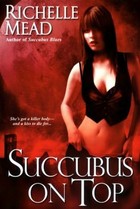 Summary:
Georgina Kincaid, the succubus that wishes sex with hot men didn’t always steal their life energy, has held up her side of the bargain with her demon supervisor. She’s been going after quality men in exchange for him not wiping the memory of her human boyfriend, the hot writer Seth. Of course, they can’t have sex together without yanking some years off his life, so when they sleep together, it’s literal sleeping. But life continues in spite of boyfriends and job accolades. Georgina finds herself caught up in helping an old incubus friend, as well as trying to find out what has her coworker, Doug, so full of energy.
Review:
Ahhh, Georgina. You are quite possibly my favorite urban fantasy heroine, although your fixation on Seth kinda bugs me. Anyway, everything that made Succubus Blues so fun is back with a bang this time around. We’ve got crazy sex scenes, paranormal mystery, and an every reluctant succubus.
The story itself is a bit more predictable than the first one, but that’s ok. I may have known right away what was up with the incubus’s project as well as what was wrong with Doug, but it’s so much fun to be in Georgina’s world that I honestly didn’t care that I knew. I mostly delighted in this new version of Seattle that Mead has created.
Georgina is complex and so well-rounded. We constantly learn little snippets of her long life, this time around focusing in more on her succubus years than her human ones. She may have sex down pat, but she still doesn’t have relationships figured out, which is part of what makes her character work. Men can still surprise her sometimes. Especially Seth.
There is honestly not that much else to say about this book. The world is delicious, the plot predictable, the heroine delightful. It’s drizzled in intelligent wit and topped off with some red hot sex scenes. This series is definitely remaining my go to for urban fantasy. Fans of the first won’t be disappointed, and anyone with even an inclination toward the genre should definitely check it out.
4 out of 5 stars
Source: Public Library

Previous Books in Series
Succubus Blues

Book Review: Warm Bodies by Isaac Marion (Audiobook narrated by Kevin Kenerly)
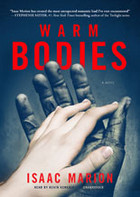 Summary:
R is a zombie, and he remembers nothing about his life before he was one–except that his name starts with the letter R. He and his group of the other living dead inhabit an old abandoned airport and are ruled by the bonies. They hunt the living not just for the food, but also for the memories that come from ingesting their brains. It’s like a drug. One day when he’s out on a hunt, R eats the brain of a young man who loves a young woman who is there, and R steps in to save her. It is there that an unlikely love story begins.
Review:
Now that I have a new job I decided to stop going through the rigamarole that is finding something you actually want to read as an audiobook in the public library and subscribe to Audible, especially since I always have my kindle with me anyway. I decided to choose audiobooks to read from the bottom of my wishlist, so everything you’ll be seeing on here (unless it was free on Audible) was put on my wishlist a long time ago. Half the time I couldn’t remember why it wound up there. That was the case here. I mean; I’m assuming it was there for the zombies, but I basically had no other idea about it heading in. This is partly why my mind was blown, so if you want a similar experience I’m telling you to go get yourself a copy right this instant! Vamoose! For those who need more convincing, though, please do read on.
Perhaps surprisingly, I have read zombie love stories before, so I wasn’t expecting too many new or particularly engaging ideas. This book is overflowing with them though. Everything from zombies getting high on other people’s memories to getting to see both the zombie and living side of the war to the concept of what the war is ultimately about to even what a zombie is was all brand-new. And it pretty much all makes sense in the world Marion has set up and is engaging. I could not “put the book down.” I listened to it in every spare second I had. Nothing went the way I predicted and yet it all made complete sense.
R is far more complex than what you’d expect from a zombie, even before his symbolic awakening. Julie is everything you would want from a heroine. She’s pretty, smart, and she says fuck! She can hold her own but is still emotional and vulnerable. She’s exactly what any artistic, strong woman would be in a zombie apocalypse. Even the more minor characters are well-rounded, and there is the racial diversity one would expect from a zombie apocalypse in a big city.
Alas, the narration was not quite as amazing as the story. Although Kenerly does a very good job, sometimes he fails to convey all of the emotions going on in the scenes or doesn’t switch characters quite quick enough. Don’t get me wrong, it was very good and didn’t detract from the story at all, but I also don’t feel that it added a ton to it.
This is a book that I know I will want to read again, and I may even need to buy an ebook or print version just to do so in a whole nother way next time. It is an engaging new look at a zombie apocalypse that reads more as a dystopia than post-apocalyptic. Anyone who needs restored faith in the ability of humanity to fix where we’ve gone wrong should absolutely give this book a shot.
5 out of 5 stars
Source: Audible

Book Review: The China Study: The Most Comprehensive Study of Nutrition Ever Conducted And the Startling Implications for Diet, Weight Loss, And Long-term Health by T. Colin Campbell, PhD and Thomas M. Campbell II
 Summary:
Dr. Campbell spent the early part of his scientific career researching diseases of affluence such as cancer, heart disease, and diabetes. When a study in rat livers demonstrated that a greater percentage of protein in the diet led to greater disease, Campbell became intrigued. He designed the China Study to compare Chinese citizens with American citizens, since the Chinese have low rates of these diseases until they immigrate to the United States. Through this and other studies, he believes he has the proof that most diseases of affluence are caused by the Standard American Diet. In his book he presents these findings, as well as an insider’s look at the scientific, health, and government trifecta that vastly affects what Americans learn about health.
Review:
Clearly the most valuable part of this book is the chapter that explains Campbell’s China Study. Since it’s generally not considered ethical to study humans and disease by injecting them with various substances, one of the better methods available is population studies. You compare and contrast over a long period of time the differences between different populations and attempt to determine what aspects may cause bad health. It is undeniable that the traditional Chinese rural population compared to Americans eat less animal products and move more. Additionally they have less disease, particularly cancers, heart disease, and diabetes. Campbell’s study establishes this easily observed fact into something that has been scientifically proven. It is also interesting to note that those who emigrate to the US and adopt the Standard American Diet (SAD) change to the American rate of these diseases. This is ground-breaking information, of course, but it is easy to gather this all from one chapter. Campbell finds it necessary, for some reason, to devote a chapter to each illness, which frankly gets repetitive and tedious to read.
Beyond the study itself, which is interesting and good for people who aren’t already convinced of the health problems caused by animal products, I felt the rest of the presentation of these facts to be dull in comparison to Diet for a New America
He also eloquently shows why we have constantly conflicting news stories on health. Everyone knows the joke about how eggs were bad for you then good for you then bad for you (but only the yolks) all over again. Campbell shows how this is the direct result of the conflict within the science and health industry.
I have come to the conclusion that when it comes to health, government is not for the people; it is for the food industry and the pharmaceutical industry at the expense of the people. It is a systemic problem where industry, academia and government combine to determine the health of this country. (page 318)
I have worked in the health field myself for years now, and I can tell you, the vast majority of the people who do genuinely care about you and your health. But traditions are hard to break and even those within the system don’t know everything that goes on among the lobbyists and the top echelons. I mean, they are still teaching medical students to utilize BMI to determine health in their patients, when multiple studies have shown it is not a reliable tool. Why is this? People want to believe what they’ve first learned, and especially in medicine, if a new idea comes along many many many studies must be done and obstinate people push for it before the method utilized will be changed. This is meant to protect you from quacks, but unfortunately it can lead to the burying of ground-breaking information.
Plus, how would Americans react if tomorrow Mrs. Obama and her obesity prevention program came out and said everyone needs to go vegetarian or vegan? Hell, the woman is taking flak for daring to suggest children play outside. I think you can see my point.
Overall, this book definitely could have been shorter. I believe it would have worked better if Campbell had presented his study and his insider’s knowledge as to why the health care and science industries seem so confused and conflicting half the time. I hope this knowledge will convince more Americans to take direct control of their own health and conduct their own research to come to their own conclusions. It’s worth a read for this knowledge, but if you are not interested in the politics of science and health and simply want the information, then I suggest you go with the more reader-friendly Diet for a New America
4 out of 5 stars
Source: Public Library

Cookbook Review: Alive in Five: Raw Gourmet Meals in Five Minutes! by Angela Elliott
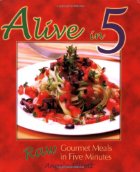 Summary:
Using mainstream ingredients and quick-fix instructions, Elliott seeks to show the intrepid new raw food cook how easy it is to incorporate vegan raw food into their everyday life.
Review:
I’m finally doing cookbook reviews! I’m afraid mine won’t be as in-depth as on some blogs. I simply don’t have the time to snap pictures as I cook and copy out recipes. But I will tell you the basics of how the cookbook is set up, how well it works, and whether I would recommend it.
I have no intention to go full raw food, but I did think incorporating some raw recipes into my week might help up my veggie and fruit intake. I also am a busy young professional so don’t have tons of time, so clearly the title appealed to me. So are these 5 minute recipes? Um. Not for me they weren’t. I’d say that on average the recipes took me anywhere from 10 to 15 minutes to accomplish, and I don’t think learning the recipes or improving techniques would help with that. Five minutes is definitely an understatement.
The book is set up with a list of all the ingredients she uses, a suggested weekly meal plan, and then divided into your typical breakfast, lunch, dinner, snacks, desserts, etc…. categories. It is a convenient size, although you will need something to hold it open for you. It is wonderfully illustrated with gorgeous full-color pictures.
I selected a breakfast, lunch, and dinner to try out since snacks are best kept simple (in my book), and I’m not much of a desserts person.
Breakfast was a smoothie. Something I am incredibly skeptical of keeping me full. It consisted of freshly squeeze orange juice (TIME-CONSUMING), half a banana, almond milk, and ice cubes. It tasted surprisingly good, but did it keep me full? HAHAHA NO. I was hungry again by the time I got to work. So that was kind of a fail. Especially with all the effort that went into making it. Seriously, I think I expended those calories purely in squeezing out the oj.
Lunch was….a salad. A salad that did not taste nearly as good as my salads I usually make. Plus, I was bothered by the fact that she wanted half of your leafy greens to be iceberg lettuce when spinach and kale are so much healthier for you. I consider this salad kind of a fail. It did keep me full, though, and others might like the proportions and such better than I did.
Dinner was a raw avocado “soup,” which basically was a bunch of things blended in the blender. You guys. This did not taste like soup. It tasted like a good dip, so that’s how I ate it. It totally would score 4 stars as a dip, but as dinner it failed. Really. A lot.
The main problem I had with this book, then, was a) the recipes take way more than 5 minutes and b) I kind of like to chew things periodically. All of this blending made me feel like an invalid.
That said, the book is definitely not bad, it is just not my cup of tea. Others might enjoy the tastes and style better than I did, and it is well-organized. Plus others might be less irritated by the fact that the recipes take 10 to 15 minutes rather than 5.
Recommended to vegans with an openness to incredibly simple raw meals being integrated into their diets.
3 out of 5 stars
Source: Public Library

Book Review: In the Flesh by Portia Da Costa (Series, #5)
 Summary:
Beatrice Weatherly is a virginal member of the Ladies Sewing Circle that so loves scandalous talk but now her reputation in Victorian English society has been soiled by scandalous nude photos that an ex-fiance sold on the black market. Since she’s already considered a scarlet woman, Bea decides to enter into a courtesan-style relationship with the fierce businessman and mysteriously secretive Edward Ellsworth Richie. Meanwhile their servants and Bea’s brothers get up to their own scandalous scenarios.
Review:
Yet again I requested an ARC that was surprisingly part of a series. Thankfully, the style of this series makes it completely possible to read them out of order with no confusion. Each book or novella is about one member of the circle, so I was not lost at all.
Let me be crystal clear here. I would not, by any stretch of the imagination, call this a romance. This is erotica. In fact, one of my GoodReads updates states that I’ve never seen this much sex in a book before, and I do read erotica from time to time. Generally one would find this a positive in an erotica, but personally the reason I like them is that they don’t fade out of scenes that happen in real life BUT THERE IS STILL PLOT MOVING AT A GOOD RATE. The plot here is minimal and is frequently dropped, hurried, or pushed aside in favor of yet another sex scene. And as for the sex scenes, they could have been more redundant, what with Bea being a virgin and all, but they still kinda are super redundant. She’s a virgin, she’s worried, will it hurt? But oh she can see his hard-on through his pants and she wants him to fuck her but no he won’t because he’s bringing her virginal self into it slowly and missionary position and oh my goodness orgasms and he won’t sleep in bed with her. Over and over again. Oh except she rides him once. I don’t know about you, but there’s only so much virgin I can take in my erotica, and this crosses the line.
Meanwhile, the main plot is incredibly bare bones and rushed. Everything happens in the span of a month from meeting to engagement. Plus there’s the super annoying mad first wife in the attic trope of Vicorian lit. Maybe. Mayyyybe the author meant this to be a sort of parody of Jane Eyre? I don’t know. But it doesn’t work really. It’s kind of insulting, actually, especially for a book that supposedly is pro women’s rights but then we have a first wife who went mad after being basically raped by her husband but it’s not his fault because he couldn’t stop himself.
o_O
Yeah, so, there is that. What saves this book from two stars is actually the subplot involving Bea’s brother and the male and female servant. They end up establishing a three-way relationship that is healthy for all of them and then move to the countryside to carry it on in peace. Now this is a fascinating little situation and leaves the door wide-open for all sorts of fun sex scenes, but we only get one with all three of them.
Le sigh.
My advice to the author would be next time to focus on the unique storyline instead of the one that’s sort of a rip-off from old Victorian lit.
And also not to make the main dude a rapist.
Overall if you’re open to lots of types of sex scenes in your erotica and have a certain affinity for Victorian clothes and virgin sex, then you’ll enjoy this read and certainly get the bang for your buck. (haha) All others should steer clear.
3 out of 5 stars
Source: NetGalley

Previous Books in Series
A Gentlewoman’s Predicament
A Gentlewoman’s Ravishment
A Gentlewoman’s Pleasure
A Gentlewoman’s Dalliance


 Support my work with a tip or browse my shop for curated book club guides, how to guides, cross-stitch patterns, and more!


This work by Amanda Nevius is licensed under a Creative Commons Attribution-Noncommercial-No Derivative Works 3.0 United States License.
 Opinions of a Wolf