
Archive
Book Review: The Baker’s Daughter by Sarah McCoy
 Summary:
It’s 2007, and Reba is a journalist living in El Paso, Texas, with her fiance, border patrol guard, Riki. She hasn’t been able to bring herself to be fully honest with him about her dark childhood overshadowed by her Vietnam Vet father’s struggle with depression and PTSD. Christmas is coming up, and she is interviewing Elsie, the owner of the local German bakery. Elsie has some intense secrets of her own that show it’s not always easy to know what’s right when your country and family go wrong.
Review:
I have an intense love for WWII stories, and I immediately was drawn to the idea of intergenerational similarities and learning from an older generation innate in this book’s plot. It is a complex tale that McCoy expertly weaves, managing to show how people are the same, yet different, across race, time, and gender.
Reba’s and Elsie’s tales are about two very different kinds of bravery. Reba has a wounded soul that she must be brave enough to reveal to the man she loves. She lives in fear of turning into her father or losing herself entirely in the love for another, the way her mother did. She faces a struggle that I have heard voiced by many in my generation–do I risk myself and my career for love or do I continue on alone? To this end, then, the most memorable parts of Reba’s story, for me, are when Elsie advises her on love in real life, as opposed to the love you see in movies and fairy tales.
I’ve never been fooled by the romantic, grand gestures. Love is all about the little things, the everyday considerations, kindnesses, and pardons. (location 482)
The truth is, everyone has a dark side. If you can see and forgive his dark side and he can see and forgive yours, then you have something. (location 844)
One issue I had with the book, though, is that although we see Elsie’s two relationships before her husband in stark clarity and reality, we never really see what it is that made her ultimately choose her own husband. We see their meeting and first “date,” yes, but that’s kind of it. I felt the book was building up to what ultimately made Elsie choose her American husband and move to Texas, but we only see snippets of this, whereas we see a lot of Elsie’s interactions with her prior two boyfriends. That was a big disappointment to me, because I wanted to know how Elsie knew he was the one, and how she herself was brave enough to take the leap she encourages Reba to make.
I am sure most people will most intensely react to the story of Elsie’s actions to attempt to save a Jewish boy during WWII and may even wish that was the only real story told. Elsie’s life during wartime Germany. It is definitely the stronger of the two stories, but I so enjoyed the lesson in valuing and listening to those older than you that we see through Reba meeting and learning from Elsie that I must say I like the book just the way it is. Is it different? Yes. But that’s part of what makes it stand out in a slew of WWII fiction. Elsie did this brave thing, and her whole life she never knew if it really made much of a difference. She just lived her life, married, had a daughter, was kind to a journalist. In a sense, it makes her story seem more realistic. Less like something from “The Greatest Generation” and more like something possible to accomplish for anyone with a strong will and willingness to make up her own mind.
One critique I have that slowed the book down for me and made it less enjoyable are the insertion of letters between Elsie and her sister, Hazel, who is in the Lebensborn program. Compared to the rest of the book, the letters were slow-moving and only moderately interesting. I can’t help but feel shorter letters would have gotten the same message across without slowing down the story quite so much. Yes, the inclusion of the sister was necessary to the story, but I feel like she got too much stage time, as it were.
I also have to say that I really hate the cover. It reflects none of the spirit or warmth of the book itself. The story is wrapped in warm ovens, scents of cinnamon, and bravery, and yet we get the back of a woman’s head with an inexplicable gingham strip at the bottom? Yeesh.
Overall, this is a life-affirming story that teaches the value of connecting with the older generations and cautions against thoughtless nationalism. I highly recommend it to fans of literary and WWII fiction alike.
4 out of 5 stars
Source: NetGalley

Book Review: The Walking Dead, Book Five by Robert Kirkman (Series, #5) (Graphic Novel)
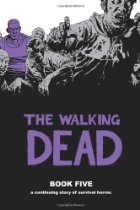 Summary:
After the slaughter at the prison, Carl and Rick are alone in the open, keeping a constant vigil against the walking dead. They are not alone for long, though, quickly finding Michonne and the other survivors. Soon yet another group of strangers stumbles upon them. These ones, though, claim that one among them is a scientist who knows how the whole plague started, and they’re heading to DC to put a stop to it.
Review:
This entry in the series could easily be called, “The survivors start losing their damn minds.” Not that you can blame them, what with the constant deaths, being surrounded by zombies, and disturbingly frequent loss of limbs. (Seriously. If I’m ever in a zombie apocalypse, I’m wearing chain mail. The amount of limbs lost is starting to freak me out).
Basically, almost everyone in the group is starting to show symptoms of post-traumatic stress disorder, in spite of still being in the middle of trauma. I applaud Kirkman for being realistic and including the whole going crazy bit in the storyline. Too often in these sort of post-apocalyptic stories the people all show this unrealistic super-human strength. Having people talking to their dead relatives, people trying to commit suicide, people pretending like some of the dead never existed, and kids becoming surprisingly cool-headed about killing are all realistic outcomes of a hypothetical scenario. The character development at this point is basically the kids are turning cold and the adults are losing their shit.
Meanwhile, the plot has the much needed addition, finally, of a scientist. We are being teased by a possible reason for the zombies, after finally accepting there isn’t one, and it’s awesome.
Speaking of the zombies, this book finally delivers what we haven’t really seen since book one–a zombie herd. A horde of hundreds and hundreds of flesh-eating zombies. So much gore to look at. And each one is unique in its own way. This is why zombie graphic novels are *fun*.
In spite of the character development and propelling of the plot forward, this entry does not have the power of the last one. It’s hard to compete against The Governor and the loss of key characters, of course. This book felt like the classic setting the stage for the next big event syndrome often found in series. It’s fun, not mind-blowing, but necessary.
4 out of 5 stars
Source: Public Library

Previous Books in Series:
The Walking Dead, Book One
The Walking Dead, Book Two
The Walking Dead, Book Three
The Walking Dead, Book Four
Book Review: Diet For a New America by John Robbins (Diet for a New America Reading Project, Book 1)
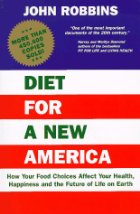 Summary:
John Robbins was born into one of the most powerful corporations in America–Baskin-Robbins. A company based entirely on selling animal products. Yet he took it upon himself to investigate the reality of animal products and their impact on Americans, American land, and the world overall. This book summarizes his extensive research, including personal visits to factory farms.
Review/Discussion:
This is the first book in the Diet for a New America Reading Project 2012 I am hosting. The project is focused on educating ourselves on the facts behind health and preventative medicine for the well-being of all Americans, an issue that I am sure we can all agree is a serious one. If you join the project late, please feel free to come back to this post or the GoodReads group after you’ve finished the book to join in on the discussion. And now, on to the book!
There are books that you read that are so incredibly powerful you are left almost speechless. Simply wanting to hand out copies to everyone you know, everyone you meet and say, “Please, read this.” I highlighted so much in my copy that I couldn’t even do my usual of posting all highlighted quotes to my tumblr. I discovered I was practically illegally reproducing the book, hah. ;-) I thus will do my best to highlight precisely why I find this book trustworthy, why I feel inspired by John Robbins, and the most stunning facts I learned while reading the book.
Why You Should Trust This Book
As a medical librarian, I was very careful to check out Robbins’ resources for his facts, particularly for the health section, which is what this project is focused upon. Robbins drew his research from vetted, peer-reviewed, well-respected scientific journals, including ones I routinely use in my own work, such as Journal of the American Medical Association, the British Journal of Medicine, and The American Journal of Clinical Nutrition. He also cites the studies of such organizations as the FDA, the EPA, and the National Cancer Institute. Additionally, he conducted personal interviews with real factory farmers and scientists. Additionally, all of his citations are in order. You may not like the facts he reports, but they are still scientifically backed-up facts.
The fact that John Robbins researched the effects of animal derived foods on the environment and people and decided that it is bad for everyone involved is remarkable when you consider the fact that he comes from a family whose business is based entirely on selling dairy to Americans. If the man had an innate bias, it would absolutely be on the side of carnists/omnivores, but he astoundingly conducted the research and came down on the side veg*ism. (His family reunions must really be something…) This not only makes me respect him, but trust him. Somebody must be truly convinced to convert away from a business that has made his family, and presumably himself if he had agreed to take over the business, extremely wealthy.
But enough about why this book is trustworthy. Let’s move on to discuss the astounding scientific facts revealed in the three different sections: animal rights and factory farming, health consequences of eating animal based products, and environmental consequences of meat-based diets.
Animal Rights and Factory Farming
I definitely believe this knowledge is more widely spread than when this book was first published. I have a hard time imagining growing up in America and not coming to understand the horrors of factory farming, but you never know. Robbins talks about the psychiatric fact that children who grow up abusing animals are more likely to become criminals in later life. This, of course, is a basic reason to not base an entire sector of the American economy around factory farms that treat animals horribly like cogs in a machine. Of course there are more reasons to treat animals well, such as the fact that dogs’ EEG scans are identical to human’s or that dolphins routinely save humans and other animals in the ocean or that many species of animals mate for life showing a dedication most humans can’t pull off.
The horrors of factory farming are so extensive that it’s difficult to even list them. I feel as if I could go on and on. Perhaps the best way is to tell you to imagine being in the most crowded elevator possible. Now imagine that 20 of the 24 hours you’re in there it’s dark. You’re standing on a slanted, slatted, metal floor. The food for everyone is all on one side and is dumped in all at once and you must shove and race to get to it. Of course it’s difficult to even call this food. It’s a mix of shit, paper, sawdust, chemicals, and antibiotics all spiked with yet another chemical to make it smell better to you. If you are female, then a hand periodically reaches in and artificially inseminates you, only to rip your baby away from you the instant it is born and hitch machines up to your mammary glands instead of allowing your milk to go to your baby. If you are male, you are castrated by placing a band around your testicles until they fall off after weeks of the circulation being cut off.
That is the reality for factory farmed animals. Even if you can manage to ignore the fact that these animals are being pumped full of chemicals and artificial growth hormones that you will then ingest yourself when you eat them or their products, that is still a horrifying way to get your food. These animals live in terror and pain and die in terror and pain. There is nothing natural about a factory farm. Animals were meant to live outside and graze and nurse their babies and maybe live in a herd or a flock. Not be caged up in situations so unnatural that they literally go crazy and cannibalize each other when they are naturally herbivores. That is the reality of what you are supporting when you buy factory-farmed animal products.
Human Health
Ok, so maybe now you don’t believe in factory farming, but what about eating animals in general? We were raised to believe that a healthy diet involves meat, dairy, and eggs, right? Surely if an animal is raised organically and humanely all will be well? Well, the meat and dairy lobbyists have done a LOT of work to hide from you the scientific studies that show their products are unhealthy for you. If you read only a portion of this book, read the health section. It is impossible for me in this discussion and review to make as eloquent a point as Robbins does. I will instead sum it up for you.
In scientific studies published in reputable scientific journals such as JAMA, vegetarians have drastically less occurrence of: heart disease, all cancers, strokes, osteoporosis, diabetes, hypoglycemia, multiple sclerosis, ulcers, IBS, arthritis, kidney stones, gallstones, hypertension, anemia, and asthma. Those who still have any of the chronic diseases are distinctly less symptomatic than the meat-eaters. Vegans (people who consume no animal products whatsoever) have even LOWER occurrences than vegetarians. This is vetted by multiple different studies run by different scientists in multiple nations. Even simply comparing the data of these diseases between countries following the standard American diet and those following a primarily plant-based diet backs these statistics up.
I am sure that those of you who read the book as I did were stunned to hear that these studies have been in the reputable journals since as early as the late 1960s and 1970s and yet we have not heard about them. Who is to blame? The meat and dairy lobbyists of course. What would happen to their businesses if the American people suddenly stopped following the standard American diet? The Dairy Council provides the nutritional packets at your kids’ schools. Think about that.
The Environment
The environmental impact of a meat-based diet has started to crop up more often recently with the increased interest in the green movement. Essentially, Robbins primarily reiterates what I believe most of us already know. The chemicals necessary to factory farm are bad for the whole planet. It takes more fossil-fuel energy, more water, and more acreage to feed one person a meat-based diet than a plant-based diet. These are things that are definitely relevant, particularly to people who don’t believe in human population control. What I personally found most interesting in this section though was the discovery that American imports meat from Central and South American nations who have been destroying rainforest to do so, and their people are still overwhelmingly on a meat-based diet. Thus these nations are destroying their own ecologies to support Americans’ wasteful meat-based diets. That is just disgusting and selfish on our parts.
My Conclusion
I am honestly a bit shocked at the extent of the facts that I didn’t know when I became a vegetarian in January of 2006. I admit I mostly became one out of an empathy for animals that I have always strongly felt, but additionally the less meat I ate, the better I felt. Becoming a vegetarian mostly eliminated the symptoms of my IBS as the scientific studies Robbins cites showed. But….I have a hard time imagining anyone reading the facts like this and not drastically changing their eating habits. So many of the economic and personal problems in the US today have to do with health. So maybe you’ve read this book and you still don’t care about animals and you still believe humans are better than them. But don’t you want to be as healthy as you can be for your lifetime? Wouldn’t you rather be a happy, healthy grandparent than a stooped-over one on multiple heart medications or going through chemotherapy? Even if you don’t care about that, don’t you want to leave a healthier planet for your children and your children’s children? The facts unequivocally show that the fewer animal products you consume, the better all of these outcomes will be.
Once we become aware of the impact of our food choices, we can never really forget. (page 379)
Source: Better World Books

Discussion Questions:
- Robbins believes that the scientific studies reported in the medical journals aren’t well-known because of the meat and dairy lobbies. Do you think this is the case? Why or why not?
- If you do think the facts aren’t known because of the meat and dairy lobbies, how can we combat this?
- If you don’t think the lobbyists have anything to do with the lack of public knowledge of these issues, what do you think the true cause is?
- Do you believe the fight for organic animal farming is doing anything to help the environmental and health issues cited in the book?
- What do you think can be done to get the meat and dairy lobbyists out of our schools?
- Would you be willing to change your diet knowing the facts about the diseases it can cause or do you think it’s not worth the effort?
- Do you believe money is better spent on treating the disease or preventing the disease?
- Do you think world hunger can be successfully combated with a change in the diets of those in the first world countries?
Book Review: Brothers (and Me): A Memoir of Loving and Giving by Donna Britt
 Summary:
Now in her fifties, Donna Britt, an award-winning and ground-breaking black, female journalist, takes a look back at her life to see what has influenced her the most. She is unsurprised to find that her life has largely been affected by loving and giving to brothers–black men she’s both related to and not. From growing up surrounded by three blood brothers, to loving brothers, to raising them, Britt discusses the universal influence heterosexual women’s love for men has on their lives, as well as the unique aspect of loving a race of men persecuted in the United States and raising her three boys in the face of the odds stacked against them.
Review:
Britt’s career as a writer shows in her memoir. It is the most well put-together memoir I’ve read in quite some time. Each chapter looks at a key event in her life in order of it being lived, but also looks at the impact those events had on her as a person. She does this by starting with a photograph and an anecdote related to the event, then moves on to describing the event in detail. Everything in her life, though, is impacted by her brother, Darrell’s, death at the hands of two policemen in his early 20s. This terribly unjust incident and how it flavors the rest of her life is the simplest and most effective anti police brutality message I’ve ever read. Was her brother threatening the officers? Maybe. But all it would have taken was for those two men to aim to stop rather than to kill to prevent the loss of someone’s loved one. Britt says later in her memoir that she knows that those officers just saw “a crazy black man” and not a person, and it is now her goal to always see the person, not the stereotype.
Britt, like other memoirists I’ve enjoyed, never takes a “poor me” attitude or tone, in spite of the fact that she really could given the loss of her brother, being raped, and a first marriage to a man who soon got lost in cocaine addiction. Not to mention her second husband’s affair. Yet, through all of this, Britt’s resilience is evident. She constantly tries to improve not just the world but herself. Britt has an ability to look at herself without rose-tinted glasses. She knows her own faults, primarily that she’s a perfectionist and expects too much from people. I think that’s what makes her so relatable and sympathetic. She’s an imperfect person struggling in an imperfect world, but that doesn’t mean she isn’t right about the injustices she’s seen throughout her life.
I think any female reader who has a brother can understand the other central question in Britt’s memoir–How exactly did these boys who were our brothers who loved us and pranked us and guarded us with their fists when we were young grow up into these baffling men? Boys are easy to understand. Men, not so much. That’s even the case with Britt’s own brothers, one of whom grew from a rebel into a religious man who changes his name from Steve to Melech and whom she barely speaks to anymore. Why is it when boys become men and we go from girls to women that communication becomes so hard? Hard, but rewarding and not impossible. Sure, no answers are offered, but it’s nice to see this experience through someone else’s eyes.
Beyond social justice and the universal communication difficulties between men and women, Britt’s memoir also clearly demonstrates an issue that is sometimes hard to explain–that of privilege. Those born with privilege sometimes have a hard time understanding what, exactly, it is those without it are speaking about. I sometimes wonder myself if I’d understand privilege if I’d been born a white MAN instead of a white WOMAN. Britt with a gift of subtlety makes this clear. She talks about needing to be extra perfect, extra good in order to combat the stereotype of the useless black children. Of feeling like she’s representing the entire race when she’s the only black student in her graduate class. Of the fact that maybe if her brother had been white and acting crazy the cops might not have shot him. Of being extra concerned when her son shoplifts because he probably wouldn’t get away with just a slap on the wrist if he got caught. Instead of talking loudly about privilege, it’s simply evident throughout her entire life and the lives of those around her. I would hope that anyone reading this would start to see how inequality survives today, even if it’s not as institutionalized as it once was.
Overall, this is a powerful memoir by a humble woman that again demonstrates why it’s important to listen to the life stories of those older than us. There is always something to learn or to relate to from their life journey. I, naturally, don’t always agree with Britt or her choices, but I respect her commitment to living the best life she can.
I recommend this memoir to fans of the genre, especially, but also to those with an interest in racism in 20th century America and relationships between men and women.
4 out of 5 stars
Source: NetGalley

Book Review: Nova by Samuel R. Delany (Bottom of the TBR Pile Challenge)
 Summary:
Lorq von Ray is the head of one of the biggest corporations in the galaxy that for years has worked hand-in-hand with the Red corporation, currently headed by incestuous brother/sister partners Prince and Ruby. But now internal fighting between the two has made von Ray determined to find his corporation’s own supply of Illyrion, normally supplied by the Reds. He’s heard rumors you can fly through the center of a nova (an imploding star) and survive and that Illyrion is inside. He gathers an unlikely crew in a race against the clock to gather the fuel.
Review:
I really wish I could remember what made me acquire this book. The cover was nothing special, and the summary on the back said approximately diddly-squat about the actual plot (unlike my own). Supposedly this book took years and tons of research into the Tarot and the Holy Grail, yadda yadda. Fine. All I know is that it was boring as fuck with a plot like it was written by a fifth grader.
One of my updates on GoodReads said, “Reading this book is like going to the dentist,” and I still think that’s the most apt review of it. The plot drags, which is shocking for such a short novel. We learn an astonishing amount of backstory about the Mouse, who is a minor character, but not a ton about Prince and Ruby Red, who are far more essential to the plot. We don’t learn the backstory for the plugs everyone wears until the book is almost over, when plugs are key to the story. A set of black twins work on the ship with one mysteriously albino for no apparent plot reason, and they operate as one person finishing each other’s sentences. Their whole characterization really bumped my racism button. Yes, I know this is an old book, but still. We also have the annoying novelist member of the crew, who is such an obvious Mary Sue it’s painful. And I don’t throw around the term Mary Sue willy-nilly. Come on. The guy is a novelist trying to write a Holy Grail book. *blinks*
The amateurish exposition consists mainly of long speeches by various characters. The plot saving device of a miracle machine that can fix almost all wounds appears part-way through the story. The whole thing would get maybe a C from me in a creative writing class. Maybe.
The only thing that keeps this book from one star is that it does, in fact, have a plot and is readable. Of course, I can’t for the life of me figure out anyone who would want to read this if they knew what they were getting themselves into.
2 out of 5 stars
Source: PaperBackSwap

Book Review: The Rabbi’s Cat by Joann Sfar (Series, #1) (Graphic Novel)
 Summary:
The rabbi’s cat gives us a glimpse inside the home world of an Orthodox Rabbi and his young adult daughter in Algeria in the 1930s. The cat is who we could call the “questioning” member of the family, a fact that isn’t too bothersome until one day he gains the ability to speak.
Review:
I loooove animal perspective books, and the drawing of Zbalya holding the cat on the cover was so adorable that I just had to grab this off the library shelf. I was not disappointed.
Although I think anyone could enjoy this book, it definitely helps to have a bit of an understanding of how Orthodox Judaism works in order to catch some of the inside jokes. The first chapter sucks you right in when the cat eats the “forbidden fruit”–the family’s pet parrot. This renders him with the ability to speak. Since I don’t have the book right in front of me, I can’t quote, but allow me to paraphrase the first conversation the cat has with the rabbi:
Rabbi: You ate the parrot!
Cat: No, I did not.
Rabbi: You are lying!
Cat: I am not lying, I am questioning. Good Jews question.
Rabbi: You are not a Jew.
Cat: Why not? You’re a Jew, and you are my master.
Rabbi: You are not circumcised.
Cat: I’m a cat. Cats can’t be circumcised.
Rabbi: Fine, but you have not been bar mitzvahed.
Cat: I am only 7.
Rabbi: In cat years that is 49.
Cat: Fine, than bar mitzvah me.
The rabbi agrees to start teaching him the Torah, and the questioning and ridiculousness continues. It’s completely hilarious.
The cat is everything you imagine a cat to be–snarky, questioning, judgmental, but ultimately wants nothing more than to be held by Zbalya while she studies or sleeps, which leads directly into the second conflict in chapter two–Zbalya gets married and leaves the cat behind in her father’s household. The final chapter covers a family visit to Paris to meet Zbalya’s husband’s family.
The drawings are rich and quirky. The cat is not a beautiful cat, but he with his big ears and funky body shape matches the tongue in cheek witticisms of the story. Algeria and Paris are exquisitely drawn, albeit from a cat-eye perspective.
It’s obvious that Sfar respects Judaism yet questions some of the rigorous rules of Orthodox Judaism. Among the things the cat questions are Shabbat rules, why he can no longer sleep in his mistress’s room after she is married, why humans are so secretive about sex, why questioning is supposedly welcomed yet it annoys the humans, and why the name of god must not be spoken aloud except in prayer. Even if you’re not religious, the book does make you wonder just what your pets think about your own habits and belief systems when they’re not purring in your lap.
Overall, this was a fun book with a cool perspective on Orthodox Judaism, Algeria, and Paris. Although the last chapter wasn’t as strong as the first two, it was still well-worth the read, and I am eagerly anticipating diving into the next entry.
I recommend this to cat lovers and those with a knowledge of Judaism.
4 out of 5 stars
Source: Public Library

Book Review: Nano House: Innovations for Small Dwellings by Phyllis Richardson
 Summary:
A nano house is a super-small house, generally between 300 and under 1,000 square feet. This book shows off nano houses from all over the world with different goals in mind, from an eco-friendly retreat that blends in with the surroundings to pod buildings that could be assembled into space-saving towers in the city to more traditional house boats. One goal of all the houses remains the same. How little space can one person or family take up to make the smallest impact on the environment?
Review:
I became fascinated with nano houses after stumbling across a few on the internet. One that sticks out in my mind is a couple that built theirs together and had a blog about it. There was another one in Australia that the woman made from plastic bottles and dirt. The whole concept was just so….refreshing. A small space that is uniquely you (or your family) that fits in just right with your surroundings. So when I found out about a book coming out collecting a bunch of these houses together, I put myself on the hold list at the library immediately. I wanted to know more details about building these remarkable little houses and the kind of people who are choosing them. Unfortunately, this book missed the entire soul of the blogs and blurbs I’d found online.
Instead of seeking out individuals and families who designed and built their homes themselves, the houses here were all made by architectural firms or design students. If you’ve ever met that snotty whoever in the bar who just can’t stop talking about his high-class ideas for making the whole world more up to his par, then you know the vibe this book sends off in waves. It’s not enough to make a small, livable house with minor impact, no, they must use this new, experimental flooring or make the house look like a storage shed or design their own perfectly circular furniture or give a speech about the revolutionary concept of having a yard on the roof of your houseboat. Um, newsflash, pretty sure I came up with that idea when I was 5.
Instead of interviewing the people who live in these houses, the author talks about what the houses are like and why they are built. We get to hear nothing about actually *living* in a nano house. Indeed, some of the houses were simply made for design contests or as student projects with no intention of anyone living in them at all, which seems to be the OPPOSITE of environmentally friendly if you ask me.
In fact, the whole book reads like greenwashing. Oh, they say anyone can afford to buy this house or live there, but in fact it’s the “eccentric” wealthy who own these houses as second homes or vacation homes or a place to stick guests so they aren’t in the main house….but it’s environmentally friendly, so it’s all cool. What I wanted to see was game changers. Ordinary people who chose to make their own home their own way. What I got instead was annoying architectural design students and getaways for the wealthy. Plus, there are not nearly enough pictures of the houses to get a good idea of what they are actually like, and any floor plans are printed so small that they are impossible to read.
Overall, this book has a great title, but is a huge disappointment. It reads like a bunch of wealthy people patting each other on the back at a party at the Ritz, missing the entire soul of the environmental movement.
2 out of 5 stars
Source: Public Library

Book Review: To ‘Joy My Freedom: Southern Black Women’s Lives and Labors After the Civil War by Tera W. Hunter (The Real Help Reading Project)
 Summary:
Hunter examines the lives of southern black women, particularly southern domestic workers, by narrowing her focus in on the development of the city of Atlanta after the Civil War. Since many ex-slaves moved to Atlanta and then migrated again north during the Great Migration decades later, this makes for an excellent focal point for the topic. By examining black women’s lives in Atlanta both in and out of their employer’s homes, she is able to dissect the roles of race, class, and gender in the elite’s attempts to maintain dominance in America.
Review:
I’ve said throughout the project that the nonfiction books have come up a bit short for me. Although they’ve contained valuable information, they haven’t been the most readable. Nonfiction can tell a story too, and Hunter does exactly that. She explores so much more than just the women’s lives in relation to their employers. Atlanta truly comes to life as we see the women commute to work via bicycle so as to avoid racist trolley lines and kick up their heels on the interracial Decatur Street after dark. We also get to see the empowering role of secret societies in black women’s lives, as well as reclamation of performing in black face and the terrifying resurgence of the Ku Klux Klan. It is impossible not to be moved and outraged by the tale of these women’s struggles. The book addresses three issues: classism, racism, and sexism.
In spite of Americans being told repeatedly that the American Dream is available to all if you work hard enough, Hunter quickly shows how the poor are fighting a losing battle and on top of it are demonized by the wealthy. For instance, the use of debt to keep the poor enslaved:
Poor women often borrowed money in meager amounts, less than one dollar at a time, amassed running accounts for several months or years, and repaid ever-accumulating interest in small installments. Many moneylenders were usurious. It was common for borrowers to pay 250 to 3500 percent interest on small sums, which exacerbated poverty with interminable debt. Fannie Holman, a washerwoman, borrowed between $60 and $90 over a two- or three-year period. Though she would repay over $1,000, the creditor applied it to defray the interest but not the principal of the loan. (page 134)
Similarly, upper class employers’ attempts to control every aspect of their employee’s lives, claiming a right over their bodies:
Dance halls were a menace, declared Proctor, because “the servant class tried to work all day and dance all night.” He warned employers that household laborers would not perform well if they used their leisure unproductively—dancing instead of resting in preparation for the next day of work. (page 179)
Hunter via maps and clear explanations demonstrates how the wealthy acquired the highest land in Atlanta most conveniently near shopping and such, while the poor and blacks were forced into the lowest land that, in addition, sewage was dumped into. These conditions combined with the poor housing provided by slumlords made a perfect scenario for disease, and yet the poor were blamed for the outbreak of tuberculosis in the city and even accused of exposing wealthy whites to it:
Tuberculosis signified more than a purely physiological condition. The disease became a medium for “framing” tensions in labor and race relations, with the rhetoric cloaked in scientific and medical legitimacy. (page 187)
Of course, the fact that black workers were poor was no coincidence. The entire city conspired since the Civil War to make black Americans poor and keep them that way. The wealthy whites, and in a lot of cases the poor whites, wanted black people out of sight and out of mind unless they were actively in service to them
Jim Crow and domestic labor thus represented contradictory desires among urban whites striving to distance themselves from an “inferior race,” but dependent on the very same people they despised to perform the most intimate labor in their homes. (page 105)
Segregation was not a system imposed entirely from above; it also helped to advance the interests of white workers, who were able to gain status from their position in the social hierarchy above all blacks. (page 119)
Jim Crow parks were designed not simply to put white urbanites closer to nature, but also to give them moments of reprieve and distance from blacks in order to channel racial friction in “wholesome” directions. (page 147)
Of course, on top of having their fight for the right over their own bodies and lives depicted by the ruling white class as them being uppity servants and uppity blacks, women had the additional injustice of having their femininity and womanhood called into question.
Like the defiant women in Galveston, strikers in Atlanta showed little attachment to prevailing middle-class conventions of femininity. As they did on other occasions, working-class women used street fights to settle disputes that jeopardized their unity and engaged in militant resistance. (page 89)
The moral implications of women consuming intoxicating substances troubled many middle-class blacks and whites. Women not only evaded laws prohibiting them from entering saloons, they frequented bar room “annexes,” they drank alcohol in alleys and streets, and they sold beer from their homes. (page 165)
I usually don’t quote this much, but the whole book is just so good. The three-way injustices faced by black working class women is palpable throughout. Facing one alone would be daunting enough, but facing three feels terrifyingly insurmountable even just reading about it, let alone living it. And yet some black domestic workers did pull through in spite of the odds and do great things. Women like Carrie Steele.
Former slave Carrie Steele, a stewardess and cook at the train station, volunteered her time as a probation officer for children in trouble with the law. This experience and her childhood as an orphan inspired her to start an orphanage in 1890. She believed that many of the children she came in contact with had fallen on hard times because they had no families to take care of them. Steele raised money to purchase four acres of land and the orphans’ first home by selling her own house, writing and selling her autobiography, and soliciting funds from generous individuals, black and white. By 1898 the Steele orphanage consisted of a brick building, hospital, and schoolhouse, and more than two hundred children had passed through its portals since its founding. (page 142)
Inspirational. Humbling. Awe-inspiring. Words that describe both Carrie Steele’s life and the book as a whole. Read it.
Source: Public Library

Discussion Questions:
- Why do you think Decatur Street was allowed to continue in spite of being the only known location in Atlanta where the races mingled?
- Hunter values the dance halls for the role of letting off steam and embracing black culture they played in black Americans’ lives. How do you feel about them?
- In spite of viewing black Americans as “unclean,” white Atlantans persisted in sending their laundry out to black homes to be washed. Why do you think people were able to hold onto such illogical dichotomies?
- Given the depiction of of everything stacked against them, do you view drug dealers, bootleggers, prostitutes, etc… differently now than you did before?
If you found this review helpful, please consider tipping me on ko-fi, checking out my digital items available in my ko-fi shop, buying one of my publications, or using one of my referral/coupon codes. Thank you for your support!
Book Review: Dark Life by Kat Falls (Series, #1) (Bottom of TBR Pile Challenge)
 Summary:
Ty was the first person born subsea. His family are settlers on the bottom of the ocean, a new venture after global warming caused the Rising of the seas. Ty loves his life subsea and hates Topside. One day while adventuring around in the dark level of subsea, he stumbles upon a submarine and a Topside girl looking for her long-lost older brother. Helping her challenges everything Ty believes in.
Review:
This is one of those rare YA books that gives me renewed hope for the genre. There are no stupid love triangles. The adults are intelligent and good parents. There are bigger worries than who you’re taking to prom. There’s adventure but no gratuitous violence. Romance but in a healthy way. Basically, it’s everything you’d hope for in a YA book. I’d gladly hand this to any teen or preteen looking for a good read and feel happy in doing so too.
The post-apocalyptic setting is unique, intelligent, well thought-out, and supported by science. Creating a new American frontier under the ocean is delightful, and Falls draws on the American pioneer experience in cute, tongue-in-cheek ways. For instance, the settler kids call their parents “Ma” and “Pa.” They earn their acres by successfully farming them for 5 years (a common time-frame in the old west). Plus, the world is different beyond subsea as well, reflecting drastic changes that would occur with such a huge change in the world. There are people called “floaters” who live in houseboats. Those who still live on land live in huge skyscrapers, and everyone sends their kids to boarding schools. Perhaps most interestingly is the fact that ever since the falling of the land into the ocean the US has been under “emergency law.” A harrowing possibility to any astute YA reader today.
Ty and Gemma are adventurous and intelligent yet still flawed in their own ways. Gemma can be too impulsive, Ty too cautious. This is naturally part of what makes them a good potential couple. They balance each other. Similarly, Ty’s parents are smart and caring, yet still capable of being wrong sometimes, even though well-intentioned. They’re an example of the type of parent we hope most kids will have. In contrast, Gemma is an orphan with an evil boarding school mistress to provide an adult for kid to hate.
The plot is deliciously complex and for once I actually did not guess the ending. It left me surprised and happy simultaneously. Falls does not take the easy way, but she also doesn’t use any lame deus ex machinas.
I feel my review is not doing this book justice. Suffice to say it is a richly complex world she has created, filled with characters that are worthy of being looked up to but with interesting scifi elements to keep the interest level high. I found myself never wanting to leave the subsea world and sort of wishing living subsea was an option in real life.
Overall, I recommend this to fans of YA scifi, but also to anyone with a curiosity about what it might be like to live on the bottom of the ocean as a new pioneer.
5 out of 5 stars
Source: PaperBackSwap

Book Review: Beast Saves the Brothers and Sisters of the Cosmic I Am by G. W. Davies
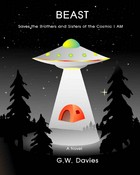 Summary:
Lisa Miller can’t believe she’s off chasing after her fraternal twin sister, Millie, yet again. After her sister ran away to join the hippie commune, Lovestock, she thought it was out of her system. But a hippie named Beast from Millie’s past shows up in town, and together they head off for Montana following The Two who claim to be in contact with the Twellorasians who will soon arrive to whisk away their followers. Along the way, they pick up a junkie jazz trumpeter and his drummer and get tailed by the drug dealer the junkie stole heroin from.
Review:
I kept reading this book thinking, “I should be finding this funny. I should be enjoying this story. I should be lost in this world,” but I never once laughed and glanced at the clock more times than I can count. I think I’m really just not the intended audience for this book.
The storyline is definitely unique and zany without being unbelievable. The split of the camp into the hippies who follow The Two and the hippies who follow the jazz trumpeter was a great move and added depth to the story. The characters are easily differentiated and fairly well-rounded. There are two bisexual characters presented in a positive light, which was nice. The dialogue is snappy.
There is a serial rapist element to the story that some might find triggering. I, personally, don’t think it’s played for laughs and Davies handles both male and female rape well. But readers wary of that content should be aware it is in the book.
I think three elements really made the book a miss for me. The humor is not my style. It’s composed of a lot of similes and tongue-in-cheek references to 1960s culture (like the Beatles and stoners) that I just personally don’t find funny. Second, the story is set in the 1960s in the middle of hippie culture, and that’s the sort of setting that takes an amazing storyline to leave me satisfied. Third, I disliked the ending, but I know some people will love it.
Overall, although this book didn’t do it for me, it is well-written, and I believe it will appeal to those with a vested interest in the 1960s and hippie culture.
3 out of 5 stars
Source: Kindle copy from the author in exchange for my honest review

 Support my work with a tip or browse my shop for curated book club guides, how to guides, cross-stitch patterns, and more!


This work by Amanda Nevius is licensed under a Creative Commons Attribution-Noncommercial-No Derivative Works 3.0 United States License.
 Opinions of a Wolf