
Archive
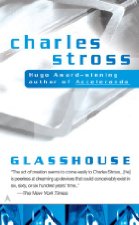
Book Review: Glasshouse by Charles Stross
 Summary:
Robin lives in the 27th century where your consciousness can be switched from body to body (and not just ortho-human ones) indefinitely. Frequent back-ups in an A-gate protect you from ever really dying. Of course, sometimes people go in to get some memories wiped. This is the closest thing to a chance at a new life. Robin wakes up in one of these facilities with a far more extensive memory wipe than usual. People are trying to kill him, and he finds himself signing up for a social experiment where the experimenters are attempting to recreate the second dark ages–the end of the 20th and beginning of the 21st century. He thinks he’ll be safe here, but he might not be. Is he really at risk though or is he just messed up in the head?
Review:
This future where Earth no longer exists and a person is a person because of their consciousness and not their bodies is incredibly richly imagined. It is abundantly clear that Stross has a clearly laid out society in mind when writing. This is all taking place within a world within a certain timeline within a certain culture. That is what makes for the best scifi reading experience, and Stross pulls it off quite well.
The plot is endlessly surprising and nearly impossible to predict until the last few chapters. Of course any plot involving people who can change bodies with a complex civil war previously fought involving a computer virus that enters people’s consciousness via the A-gates would be complex. But don’t be deterred! It is really not difficult to follow, although you may have to stop to think about it a few times.
I also want to say kudos to Stross for writing such an incredibly GLBTQ friendly piece of scifi that isn’t necessarily about gender or sexuality. It’s the first time I’ve ever seen the terms “cis-gendered and trans-gendered” used in a scifi book. In this future where people can pick whatever body they want, it’s natural for everyone to spend at least a few lifetimes as both a male and a female, although they all ultimately tend to choose one over the other. In fact, a plot-point for the book involves the researchers randomly placing someone who identifies predominantly as female in a male body and the resulting depression from that. Similarly, characters identify as mono or poly, meaning both monogamous and polyamorous sexualities are recognized as equally valid. It is an incredibly welcoming environment where people are encouraged to be themselves that only makes the experiment set during our own time period all the more jolting. I could see any queer person finding this story very relatable.
Unfortunately, the strong set-up kind of lost me toward the end. I’m still not quite sure exactly what I should have taken from the ending, but I felt that it didn’t live up to the incredibly high bar Stross set for himself early on. I’m still glad I read it as it was a very different, unique experience, but I do wish he’d spent a bit more time figuring out an ending worthy of the meat of the book.
Overall, I recommend this to scifi fans, and highly recommend it to GLBTQ readers and advocates.
4 out of 5 stars
Source: PaperBackSwap

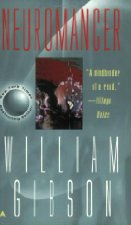
Book Review: Neuromancer by William Gibson
 Summary:
Billy Case used to be the best cowboy in the matrix–the digital world you plug yourself into. But then he pissed off the wrong boss who had his neurons fried so he can’t jack in anymore. Case has been biding his time waiting to die in Japan, until a mysterious woman named Molly shows up. She’s tricked out with blades that emerge from under her fingernails and sunglasses built into her skull. She says her boss has a job for Case and will fix his neurons, beginning the adventure of Case’s life.
Review:
This is a good example of how to effectively drop a reader into a completely unfamiliar world and explain nothing and yet have enough make sense for the reader to be invested in the outcome for the characters. Gibson doesn’t explain much to the reader, and yet what doesn’t make sense eventually clicks into place if the reader is persistent enough in the reading.
The settings vary from a creatively imagined future Japan to a Rastafarian space station to what is essentially Miami in outer space. They are all immediately engrossing and intriguing. What led the world to develop this way in Gibson’s imagination? That is never entirely clear, but that’s part of the fun. After all, when is it ever entirely clear why the world works out the way it does?
By far the most interesting character is Molly. Like a Whedon heroine, she kicks ass and takes no names. She is not just brains or brawn; she is both. Case pales abundantly in comparison to her, and he knows it. Although they do hook up, he states that Molly could never really be anyone’s woman. She is her own. Molly’s life is incredibly more interesting than Case’s, and perhaps one of the more frustrating parts of the book is that we only get to see of her what Case gets to see. The book is not about her; it is about Case’s experiences with her. Yet that is also what makes the book intriguing. She flits into and out of Case’s life and yet will linger forever in his memory as someone significant.
Of course, I would be remiss to review this classic piece of scifi without mentioning the impact its imaginings of the internet would have. Obviously there is the matrix and plugging in concepts. The idea of the internet as something that you participate in in a 3D manner. The concept of AI as a computer rather than as a robot. The list goes on and on. If you’re a scifi fan and have not read this book, you really need to. It is clear from page one what an impact Gibson has had on the genre.
The plot itself is convoluted and confusing. I’m still not entirely sure I understand exactly what happened. Yet I’m also not sure Case understands exactly what happened either. This is one of the few times I’ve finished a book and instantly wanted to re-read it, hoping to understand it a bit better the second time around. Yet such a convoluted plot is a bit distracting when there is so much else wonderful going on. It holds the book back from being superb.
Overall, this piece of classic scifi is an interesting character study and immersion in a different world. It would be interesting to anyone who enjoys that type of experience in their reading, but is also a must-read for anyone who considers themselves a scifi fanatic.
4 out of 5 stars
Source: SwapTree

Book Review: The Day of the Triffids by John Wyndham
 Summary:
Bill wakes up in the hospital the day after a worldwide comet show with his eyes still bandaged from a triffid accident. His regular nurse doesn’t show up and all is quieter than it should be except for some distraught murmurings. Shortly he finds out that everyone who saw the comet show has lost their sight, leaving a random bunch of people who just so happened to miss it the only sighted humans left in the world. A hybrid plant created years ago for its highly useful oil, the triffid, is able to walk and eats meat. Swarms of them are now wreaking full havoc on the people struggling to save the human race.
Review:
This book reads like the novelization of a 1950s horror film. Man-eating plants! Dangerous satellite weapons of mass destruction! Humanity being reduced to the countryside! Classic morals versus new morals! This is not a bad thing, and Wyndham seems to be conscious of the innate ridiculousness of his tale, as it possess a certain self-aware wittiness not often present in apocalyptic tales.
Bill is a well-drawn character who is enjoyable as a hero precisely because he is an everyman who is simultaneously not devoid of personality. He is not the strongest or the smartest survivor, but he is just strong and smart enough to survive. Similarly, his love interest, Josella, impressively adapts and changes over time, and their love story is actually quite believable, unlike those in many apocalyptic tales. In fact, all of the characters are swiftly developed in such a way that they are easy to recognize and tell apart. This is important in a tale with so much going on.
On the other hand, the action is stuttering. It never successfully builds to an intense, breaking point. Multiple opportunities present themselves, but Wyndham always pulls the story back just before a true climax. After this has been done a few times, the reader loses the ability to feel excitement or interest in the characters and simply wants the tale to be over. In a way it is almost as if Wyndha couldn’t quite decide which direction to take the action, so took it briefly in all directions instead. This makes for a non-cohesive story that pulls away from the investment in the rich characters.
Additionally, I do not believe the whole concept of the triffids was used to its fullest extent. The name of the book has triffids in it, for goodness sake. I expect them to feature more prominently and fearfully than they do. Perhaps I’ve just read too many zombie books, but the triffids just seem more like a pest than a real threat. The concept of man-eating plants taking over the world is a keen one, and I wish Wyndham had invested more into it.
Overall, the book is a quick, entertaining, one-shot read that could have been much more if Wyndham had made better choices as an author. I recommend it to kitschy scifi and horror fans looking for a quick piece of entertainment.
3.5 out of 5 stars
Source: PaperBackSwap

Book Review: Arizona Free by Doug Martin
 Summary:
Three white collar schmucks sign up for a classic pyramid scheme selling energy drinks known as DINAmite. Gradually, they start noticing disturbing changes in the consumers of the energy drinks and find themselves pulled into the world of a nefarious plot to change humanity as we know it.
Review:
Not in years have I read a book I disliked this much. I generally try to find at least one redeeming quality when reviewing a book, remembering that not everyone likes what I enjoy, but honestly. This book is terrible, and I have zero idea how it managed to get published in the first place. The publisher’s website doesn’t give very much information on how and why they choose books to publish, so no answers to that particular question were found there. Anyway. On to why this is the first book ever to receive one star here on Opinions of a Wolf.
First, there’s the writing. I felt like I had landed back in beginner’s creative writing in high school and had been assigned the worst writer’s short story to critique. It abounds with showing, not telling. The dialogue is painfully fake sounding. Most of the characters are completely unmemorable, and the few that managed to put some image into my brain were simply charicatures lacking any dimensions at all.
I’ve read books before that struggled with sophomoric writing but that at least showed potential through a strong, uniquely imagined plot. There is none of that here. The plot changes its mind so many times throughout that I honestly have no idea what actually happened in the end. I’m completely baffled. You can’t throw that many surprises at a reader without offering some modicum of explanation or elaboration. The characters are simply straight up told “This is happening now,” and they go along with it.
Of course writing and plot are the core of what makes a good book, so it’s bad enough this book fails on both of those already, but it’s topped off with a nice icing of homophobia and womanizing. The characters and the narrator repeatedly make slams against gay people. One of the characters, Catherine, plays tennis with a lesbian, who yet again is a characature who speaks in the most fake Russian accent ever. This lesbian tennis player is interested in Catherine, and this of course grosses out everyone in the story, including Catherine. Also, the lesbian is turned into a hulk-like villain, complete with horns. I was so disgusted by the homophobia that I almost stopped reading the book, but I refuse to write reviews of books I didn’t finish, and frankly, I wanted a bad review of this homophobic piece of trash out there.
Bottom line, I can’t recommend it to anyone. It’s completely made up of bad writing, terrible plot structure, and rampant homophobia.
1 out of 5 stars
Source: Free copy via LibraryThing‘s EarlyReviewers program

Movie Review: Soylent Green (1973)
 Summary:
In the then moderately distant future of 2022, the world has turned to being a congested chaos due to overpopulation and global warming. People survive on various colors of food-like paste sold by Soylent, the favorite of which is Soylent Green. When a police man is called in to investigate the murder of an unusually wealthy man, he realizes it all has to do with the Soylent Corporation and makes a sinister discovery.
Review:
Obviously I came at this movie knowing the “spoiler” that Soylent Green is people. What scifi nerd hasn’t heard that quote? Still, even coming in knowing the big secret, I was expecting more from this film. By far the most enjoyable portion takes place in the wealthy man’s condo where we learn women have come to be attached to condo’s as part of the “furniture” and are passed along with the condo from owner to owner. In return for being the lady of the house, they get safety, security, and food. A whole other story could be told with what is essentially a return to the caveman way of doing things. Unfortunately, this gets glossed over for the supposedly more interesting plot line.
The story is told like a 1970s futuristic version of a film noir. We have the detective fighting all odds to get to the nitty gritty truth of the story. Of course, this is the 1970s version of a future dystopia. As such, the wealthy dwellings look straight out of a 1970s porno, and the unfortunate dystopic surroundings of the poor look eerily similar to a hot and sweaty version of communist Russia. It’s an odd dichotomy that doesn’t quite work.
I was waiting for the film to move from setting up the dystopia to slowly building the horror up, but it never happened. Honestly, given the intensely overpopulated surroundings these people live in and severe lack of food, I actually came away thinking that recycling the dead almost seemed logical, and being a vegetarian, that’s quite the leap for me to make! Clearly the film missed its mark somehow. When the policeman rants about the humans being treated as cattle, all I could think was how earlier in the film both he and a friend drooled over a slab of beef. Why should I be horrified that he feels as if he’s being treated like cattle when he would willingly treat cattle exactly the same way? I was left with no sympathy for him, only for the women who get passed along as furniture with the condo’s in this future.
Overall, Soylent Green had the potential to tell an interesting story of a future where women revert back to their old subservient roles as a survival tactic. Instead, it unfortunately veers off toward a storyline I find unsympathetic and that rings as falsely horrifying given the general set-up of the movie. There are far better 1970s horror films out there, as well as better dystopias.
2 out of 5 stars
Source: Netflix

Book Review: The Android’s Dream by John Scalzi
 Summary:
People think Harry Creed is squandering his talents, but he actually quite enjoys his job working for the UNE breaking bad news to various sentient alien races residing on Earth. Still, he doesn’t mind doing a favor for his old friend, Ben Javna, who calls up saying the lizard race, the Nidu, need a specific breed of sheep for the coronation ceremony, and it’s vital in keeping the peace between the two planets that Earth help provide one. Creed doesn’t think this will be much of a challenge, but he soon finds up he’s signed up for more than he bargained for, running into everything from The Church of the Evolved Lamb, to a Nagch who digests his victims alive, to other computer geniuses, to scandal within the UNE.
Review:
This is one of those scifi political intrigue books crossed with Douglas Adams style humor. I don’t usually do political intrigue in scifi, since I avoid politics like the plague in real life, but the Douglas Adam style humor manages to make it all actually interesting and intriguing.
It’s impossible not to enjoy all of the very strongly developed characters, whether they’re a villain or not. Frankly, that’s a good thing, as it’s rather hard to tell half the time who’s the villain and who isn’t (with the exception of Creek of course). The alien sentient species imagined are rather traditional in appearance, but not so much in behavior, which keeps them interesting. For instance, the Nidu are able to communicate through smell in addition to speech, and this tends to lead to problems on Earth. Even very minor characters who are only in the story for a few pages are so crisply described, that it is impossible not to imagine them as clearly as if it was a film. In fact, the whole book reads rather like a scifi action film in the style of The Fifth Element.
The action sequences are universally stunning. There is one shoot-out scene in a mall, in particular, that also incorporates equipment from a futuristic game, reminiscent of Ender’s Game that left me grinning with joy at the sheer awesomeness of it. The social commentary in the form of The Church of the Evolved Lamb is also fun. This is a religion that knows that its founder was a fraud, but has decided to attempt to make his prophecies come true anyway. It makes for some really wild moments.
That said, sometimes the political intrigue itself was a bit hard to follow. I’m still rather confused as to what exactly was going on, politically, in the middle of the book. I think I’d have to re-read it to figure that out, exactly. I think the fact that I didn’t get confused at all in The Dark Tower series, but did here says something. Still though, the humor and action sequences kept the plot moving enough that the political intrigue didn’t really matter that much anyway.
Overall, if you enjoy humorous scifi in the style of Douglas Adams, you will definitely enjoy this book.
4 out of 5 stars
Source: Harvard Coop

Book Review: Ender’s Game by Orson Scott Card
 Summary:
Humanity survived the second Bugger invasion by pure luck. Now they’re determined to be prepared for a third invasion and actively train children in Battle School, seeking the child who could be the commander to save humanity. They think Ender, with his ability to perceive and understand null gravity spaces, just might be that commander, but Ender isn’t so sure.
Review:
Card has created a rich, complex, entirely believable future where individual sacrifice is vital to the survival of the human species. This goal makes the adults’ treatment of the children in Battle School justifiable and allows Card to create a story where children are simultaneously treated as adults and misled by them. Adults will recognize the feeling of being pawns to those in control of society. Children and young adults will appreciate that the children characters are treated as adults in smaller bodies. It’s a fun narrative set-up.
The world-building is excellent. The complex scenes of the Battle School, Battle Room, and videogames the children play are all so clearly drawn that the reader truly feels as if she is there. Readers who also enjoy videogames will particularly enjoy the multiple videogame sequences in which the narrative action switches focus to the videogame. This isn’t just for fun, either. It’s an important feature that comes to play later in the book. In fact, it’s really nice to see videogaming being featured in a future as something important to society and not just recreational. It’s a logical choice to make in scifi too, as the military is moving increasingly toward using weapons that are manned by soldiers behind the lines with videogame-like controls.
These fantastic scenes are all set against a well-thought-out human society reaction to multiple alien invasions. In spite of the threat of a third invasion, there is still violent nationalism brewing under the surface. Politicians must worry about their image. Dissenting voices can be heard on the internet. The teachers of the Battle School must worry about the retributions for their actions, even as they make the choices that will hopefully save humanity. The people in this future are still people. They act in the sometimes stupid and sometimes brilliant ways people act. They don’t miraculously become super-human in the face of an alien threat. I really enjoyed this narrative choice, as I get really sick of the super-human trope often found in scifi.
The ending….I don’t know if I’ll ever be able to make up my mind on how I feel about the ending. I definitely didn’t guess it ahead of time, which is a nice change, but I can’t decide how I feel about it. The fact is, I liked part of it, and I didn’t like another part of it. I think I may have found the ultimate message a bit too idealistic, and Ender too gullible.
*spoiler warning*
Here’s the thing. The Bugger queen claims that the Buggers didn’t know that humans were sentient creatures, and Ender believes her, but I call bullshit. Humans and Buggers built cities that were similar enough so that humans could live in Bugger buildings. In spite of being drastically different from an evolutionary stand-point, it’s still obvious that humans were sentient enough to build cities and spaceships. That should have been a warning sign. So ultimately, I view the queen larva and message to Ender as a last-ditch effort to come back from the brink of extinction and beat humanity, and Ender fell for it. Of course I don’t want to argue for the extinction of an entire species. I’m a vegetarian. I’m pretty much against the killing of species of any kind, but the fact remains that the Buggers attacked humans twice. What were they supposed to do? Sit back and let themselves get wiped out? I’m not one of these nutters who says don’t kill the polar bear attacking you, and in this case, the polar bear had already attacked twice. I like the message of a possible peaceful coexistence, but I don’t think it was very realistic in that world, and I was left feeling that Ender didn’t really learn anything from his experience.
*end spoilers*
Overall, however, Card has achieved near perfection in telling a unique, scifi story. The world is entrancing and draws the reader in, and the reader is left with multiple philosophical questions to ponder long after finishing reading the book. It is a book I definitely plan on re-reading, and I highly recommend it to scifi and videogaming fans.
5 out of 5 stars
Source: Amazon

BBAW: Forgotten Treasure
 Sorry to have missed yesterday’s topic! I’ve been ill this week, which unfortunately meant only the pre-scheduled posts made it through…until today that is! Today’s BBAW theme is to highlight a book that we wish would get more attention/would be more well-known.
It was honestly kind of difficult for me to pick just one book. I’d say around 1/3 to 1/4 of my reading is random obscure scifi/dystopian novels that I wish would get more attention. Actually, I wish dystopias would get more attention in general. I think they’re such an excellent way to explore issues and philosophically think about possible outcomes to modern decisions. In fact, I think the world would be a better place in general if everyone would just stop and seriously think before making decisions….but that’s another topic for another blog post.
 In any case, there’s a book that I read this year that I’ve certainly never heard mentioned before anywhere–Robert Silverberg’s The World Inside
The World Inside
Whether Silverberg is for ever-increasing population or not is deliciously unclear. His future is a world where all privacy is absent. Where diversion from the norm is unacceptable. Offenders get only one chance then they are “sent down the chute” aka given capital punishment. It is a world where all life is welcomed, yes, but at what cost? The solutions to overpopulation he presents are ones that make sense, but he also clearly shows the costs on the individual. Life as a whole is valued so much that the individual is discounted. On the other hand, he uses the farming culture to show how always choosing the individual over the whole could also be perceived as unfair or barbaric.
This book is an intriguing, eye-opening read. It is nearly impossible to put down once you pick it up, and I believe it would do wonders to opening true dialogue between the opposing viewpoints on world population/overpopulation. No matter what your viewpoint is on the issue, it will do wonders to expand your mind and make you think. That’s why I love dystopian literature, and that’s why The World Inside
Movie Review: A.I. Artifical Intelligence (2001)
 Summary:
In the near future, robots, aka “mecha,” have become the norm. They exist to serve humanity, have self-protecting pain aversion, but they do not have emotion. One research team sets out to make a robot who can love. A child robot designed to always love the parents. Monica and Henry, whose son is in a coma, try out the first prototype named David. He winds up being more than they bargained for though, and unwilling to return him to the company to be destroyed, they abandon him on the roadside. He then begins a quest for the blue fairy to become a real boy.
Review:
This movie is long, nearly 2 1/2 hours, yet I was entranced with the story for every minute. It truly addresses one of the most basic questions–what makes us human? If it is intelligence, emotion, a sense of self, then David has all that. Is he therefore worthy of love? Worthy of being treated as more than a toaster? The film leaves us with no easy answers, but it explores the question in such a creative, intriguing manner.
In addition to being wonderfully thought-provoking, the film is also well-done. The special effects are stunning for the early 2000s. Of particular note is David’s toy robot bear, who walks and talks as an individual. The make-up is done subtly, providing just a few hints at who is mecha and who orga. A slight plastic sheen to the hair, perhaps, or a lack of hair on the arms.
The film boasts an all-star cast, most notably Haley Joel Osment in the leading role and Jude Law as a sex working robot. Osment brings a stunning combination of intense creepiness and vulnerability that gives the character of David exactly the right amount of relatability and disturbing moments. Jude Law similarly displays mechanical movements while simultaneously expressing just the right amount of possible emotion passing across his face.
Given all that, I’m not sure why I didn’t love this movie in lieu of really liking it. I suspect it has something to do with the ending, which rubbed me the wrong way a bit. It just seemed….odd. Particularly in comparison to the rest of the film.
However, don’t let that detract you from seeing this movie. It is highly enjoyable and leaves you with philosophical thoughts and queries for days. I highly recommend it to fans of scifi and philosophy alike.
4 out of 5 stars
Source: Netflix

Movie Review: Terminator 2: Judgment Day (1991) (Series, #2)
 Summary:
The machines didn’t just send one terminator back in time; they sent two. The second is a T1000 made of molten metal that can morph into the shape of anything it touches. It’s out to get Sarah’s son, John, who is extra vulnerable since his mother is locked up in a mental institution.
Review:
This is a fan favorite, and people tended to be floored when they found out I hadn’t seen it yet, so I finally got around to watching it. It is deliciously 90s, and when I found out the special effects are phenomenal for the time period. In fact, I wouldn’t be too disappointed to see a movie made today with this level of special effects. The T1000 looks believable, and the fight scenes are dramatic and powerful.
I enjoyed the twist and new approach to Arnold Schwarzenegger’s character. His accent is perfect for playing a robot, and this was truly great casting.
Anyone who knows me won’t be surprised that I disliked the mental hospital part of the plot. It presents a very false example of what mental institutions were like in the 90s and demonizes the doctors and other mental health workers. Obviously mental health workers aren’t going to go around believing people who claim to be visited by time traveling robots, but they will and do treat them kindly. Other scifi stories have handled similar plot lines much better, and I was disappointed to see such harsh treatment of a helping institution.
Also, the voice overs by Sarah Connor were completely unnecessary, overly dramatic, and full of cringe-inducing dialogue. It kind of reminded me of the voice over in Blade Runner. Blech.
These two negative elements did not take up much of the screen time, however. That mostly consisted of John Connor and Arnold Schwarzenegger both of whom were quite pleasurable to watch. If you enjoy action movies, you will definitely enjoy this film.
3.5 out of 5 stars
Source: Netflix
Previous Movies in Series:
Terminator

 Support my work with a tip or browse my shop for curated book club guides, how to guides, cross-stitch patterns, and more!


This work by Amanda Nevius is licensed under a Creative Commons Attribution-Noncommercial-No Derivative Works 3.0 United States License.
 Opinions of a Wolf