
Archive
Book Review: Altered Carbon by Richard K. Morgan (Series, #1) (Audiobook narrated by Todd McLaren)
 Summary:
In the future, people’s memories are backed up on sticks like external hard-drives, and when someone dies, they can just be put into a new body or resleeved. Criminals are put into the brain bank for a set period of time to serve their “prison” sentence before being resleeved. Kovacs is an ex-UN envoy but he’s also a criminal, and he wakes up one day in a new sleeve on Earth, not his home planet, before his sentence is up. A rich myth–someone who has been alive for centuries in the same body, due to their wealth–has been killed. After being resleeved, the local police told him it was suicide, but he doesn’t believe them. So he’s hired Kovacs to figure it out for him. If he solves the mystery, he’ll get sent back to his home planet and get a sleeve of his choice without serving any further sentence. If he doesn’t, he’ll serve out the rest of his sentence and get resleeved on Earth, far from home. Kovacs has no choice but to try to figure out who would waste their time killing a man who has endless sleeves to burn?
Review:
I love a good noir, and I liked the futuristic scifi sound of this one (the most famous futuristic scifi noir is Blade Runner/Do Androids Dream of Electric Sheep, in case you were wondering). Unfortunately, in spite of the very cool resleeving concept, I was left quite bored by the plot.
The setting and ideas for this future scifi world are fantastic. Earth has colonized various planets, and each planet was colonized by different mixes of cultures. Kovacs’ planet was colonized by the Japanese and Nordic cultures. When he was a UN envoy he fought on one colonized by Middle East cultures. So each planet has its own distinct culture, and, Kovacs at least, clearly feels that Earth is quite backwards. For instance, Earth has a cadre of people who believe that resleeving is unethical and sign documents saying they are ethically opposed to being resleeved. It sounds as if no other planets have that faction. Similarly, it sounds as if only Earth has people wealthy enough to become myths–people who can afford to be resleeved in new clones of their own bodies they grow and keep safe, as well as back up their brains at frequent intervals into a cloud. So Kovacs has some immediate culture shock, which is interesting to see.
Also, obviously, the idea of people’s brains being kept on usb sticks (basically) that you can just stick into the brain stem of another body and what implications that would have is just brilliant. It’s cool to read about, and it’s an interesting take on longevity. I also particularly appreciated that people *can* still die in various ways. For instance, if you shoot someone where this brain stick goes in, you ruin their stick and they therefore can’t be downloaded into a new body. This whole setting gives both a cool futuristic vibe and a complex environment for solving murders in. It’s hard to solve for murders when people can just be rebooted, basically.
There is a lot of realistic diversity in the book. The lead cop on the assignment is a Latina woman. Takeshi Kovacs is clearly intended to be biracial (white and Japanese). There is a big bad (who I won’t reveal) who is an Asian woman. The only other major characters are the myth and his wife, both of whom are white. However, the surrounding and minor characters all demonstrate a clear melting pot of race and creed. I appreciate it when futuristic scifi is realistic about the fact that all races and cultures and creeds would most likely be present.
One thing I do want to note, although I do think the book tries to address the obvious issue of what if a person gets resleeved into a race or gender different from their own, I’m not sure it was successful. Takeshi immediately notes that he is in a Caucasian sleeve, and that irritates him some. He continues to act like his own culture and exhibits a preference for the food of his home world but he doesn’t seem to be too bothered by being in someone else’s body. (Criminals get resleeved into other criminals at random. That is part of the punishment…not getting your own body back and knowing yours is out there being used by someone else). It is explained that Takeshi is able to deal with the dysphoria because he was trained for it in the UN Envoy but I do wish a bit more explanation was given to this issue. For instance, is being resleeved into a different race usually ok for the person? Or is it difficult just like every aspect of being resleeved into a new body is difficult? Does it vary person to person? This was unclear, largely because Takeshi’s Envoy training makes it a bit of a non-issue.
Similary, at one point a male character is resleeved into a female body, specifically because sleeving across genders is perceived of as an act of torture in this world (it is a bit unclear to me if this actually happened or if it’s virtual reality, but it is made very clear that virtual reality feels exactly the same as reality to the person in question, so the fact remains). I thought this was interesting and a nice send-up to trans issues. However, in the next breath, the character mentions that he can tell he’s in a woman’s body because he FEELS THINGS MORE EMOTIONALLY. *sighs* (I would provide you with a direct quote, but I don’t always manage to successfully bookmark passages in audiobooks, and this was one of those times). I get it that this passage is supposed to be a complement to women. The man in question talks at length about how women feel things so much more and isn’t that nice and what a burden it must be and men should understand it more. Yes, ok, fine, the character is being nice about it, but it’s still sexist. The character could have had the same experience and limited to just this sleeve without making it about all women, but no. He mentions that he’s been sleeved in women’s bodies before and this is how it always is.
On a related note, I just want to mention for anyone who might be triggered by such things that there is a rather graphic scene in which the same character inside a woman’s body is raped by torturers with a rod of hot iron. Just once I would like to get through a noir book without someone being raped, just saying. (If you appreciate warnings for this type of content, see my dedicated page here).
So the characters are interesting and diverse, and the scifi world is creative, but the plot is a bit ho-hum. Part of the problem is that I just honestly cannot make myself care about the rich myth and his problem. The second issue comes up though when Takeshi ends up having a problem that intertwines with the myth’s, and I just can’t care about his either, largely because it revolves around protecting someone who the reader meets for about two minutes of audiobook, so I’m imagining that’s only a few pages of the book. It’s basically big money all coming up against each other, and that’s a plot I personally struggle to really be interested in unless there’s at least one character I can really root for, and I just couldn’t root for any of these. I also think that it didn’t help that compared to how creative the world-building was, the plot is very average. So I was given high expectations with the world-building in the first few pages only to have a been there, seen that, reaction to the plot.
What lifted the book up from 3 stars to 4 for me was actually the audiobook narration. Todd McLaren does an awesome job of producing many different voices and accents for all the different characters, helping to keep complex scenes straight. He also has a great noir detective vibe to his voice when he speaks for Takeshi. I will note, though, that I did have to speed the audiobook up to 1.25x to match my listening speed. But I tend to listen fast, so other readers would probably prefer the slower speed.
Overall, scifi readers who also enjoy noir will most likely still enjoy the read, in spite of a seen it before plot, because the world-building is unique and creative. I would recommend that readers who enjoy both print and audiobook check out the audiobook, as I feel it elevates the story.
If you found this review helpful, please consider tipping me on ko-fi, checking out my digital items available in my ko-fi shop, buying one of my publications, or using one of my referral/coupon codes. Thank you for your support!
4 out of 5 stars
Length: 526 pages – chunkster
Source: Audible

Announcement: I Am Open to Review Requests Now Through December 31st for Review in 2015
 Hooray!!
I am happy to announce that as of now I am open to review requests for books to be reviewed in 2015!!!
Now through December 31st, feel free to fill out the submission form if you are interested in being reviewed right here on Opinions of a Wolf at some point during 2015.
Here’s how it’s going to work:
- You lovely authors and publishers read my review policies to determine if your book is a good match for me.
- If you think your book is a good match for me, you fill out the submission form.
- Between January 1st and 7th, I go over the submissions and determine which ones I will accept. I will accept no more than 6 to prevent overloading myself.
- Between January 8th and 10th, I send out acceptance emails to all the accepted authors/publishers.
- By January 17th, accepted authors/publishers reply to this email either with a copy of the ebook or confirmation that they have sent out the print book to me. If I do not hear back from accepted authors/publishers by January 17th, the opportunity will be passed on to another author/publisher.
- On January 24th, I will write a post right here announcing the books I have accepted for review. This means that if you are accepted for review, you have the potential for three instances of publicity: 1) the announcement 2) the review 3) a giveaway (if you request one AND your book receives 3 stars or more in the review). You may view 2014’s announcement post here.
I would like to note that I strongly encourage women writers and GLBTQA writers to submit to me, particularly in genres that do not normally publish works by these authors. I was quite disappointed last year to get very few women or GLBTQA authors submitting. Please help me get the word out that I am actively seeking works by these authors.
If you are interested in the breakdown of submissions I received last year and what was ultimately accepted, check out my 2014 accepted review copies post.
Thank you for your interest in submitting your books to Opinions of a Wolf! I’m looking forward to reading through all of the submissions, and I can’t wait to see what review copies I’ll be reading in 2015!
Reminder: I Will Be Accepting Review Requests November 1st through December 31st for Review in 2015
Just a quick reminder that Opinions of a Wolf will be OPEN to review requests November 1st through December 31st. All requests accepted will be reviewed during 2015 right here on this blog.
On November 1st a post will go live with full details on how exactly the review request process will work this year. There are two big changes for the review process this year.
- All requests will be submitted via a submission form. I will NOT be accepting requests via email or comments on the blog.
- I will only be accepting a maximum of 6 books for 2015.
I read and review review request books from indie authors only. Indie authors are defined (by me) as self-published or backed by a small, independent publishing house. These reviews are a two-pronged labor of love for me. First, as an indie author myself, I know many reviewers do not accept indie books. So I want to give you a place to send your books. Second, as a reader, I also want to do a service to the reading community by providing only 100% honest reviews of these books. If I say an indie book is good, they know they can trust it, since I’m not afraid of giving a negative review to an indie author. The value of your book being reviewed here is that everyone will know the review was honest from someone who reads a lot of indie work. Even a negative review proves that it’s not just your family and friends reviewing your work. Please remember that I am a real person trying to do a helpful thing for the community for free and engage with me from a place with that in mind.
I would also like to note that I strongly encourage women writers and GLBTQA writers to submit to me, particularly in genres that do not normally publish works by these authors. I was quite disappointed last year to get very few women or GLBTQA authors submitting. Please help me get the word out that I am actively seeking works by these authors.
You may see the full list of genres I am open to reviewing here. This list will also be on the submission form.
Remember: Don’t submit before November 1st and don’t submit in any way except using the submission form I will provide.
Good luck!
Book Review: The Drowning Girl by Caitlin R. Kiernan (Audiobook narrated by Suzy Jackson)
 Summary:
India Morgan Phelps, Imp to her friends, is sure that there were two different Eva Cannings who came into her life and changed her world. And one of them was a mermaid (or perhaps a siren?) and the other was a werewolf. But Imp’s ex-girlfriend, Abalyn, insists that no, there was only ever one Eva Canning, and she definitely wasn’t a mermaid or a werewolf. Dr. Ogilvy wants Imp to figure out for herself what actually happened. But that’s awfully hard when you have schizophrenia.
Review:
I’d heard that this book was a chilling mystery featuring queer characters and mental illness. When I discovered it on Audible with an appealing-sounding narrator, I knew what I was listening to next. This book is an engaging mystery that also eloquently captures the experience of having a mental illness that makes you question yourself and what you know while simultaneously giving a realistic glance into the queer community.
Imp is an unreliable first person narrator, and she fully admits this from the beginning. She calls herself a madwoman who was the daughter of a madwoman who was a daughter of a madwoman too. Mental illness runs in her family. She states that she will try not to lie, but it’s hard to know for sure when she’s lying. This is due to her schizophrenia. Imp is writing down the story of what she remembers happening in journal style on her typewriter because she is trying to figure out the mystery of what exactly happened for herself. The reader is just along for this ride. And it’s a haunting, terrifying ride. Not because of what Imp remembers happening with Eva Canning but because of being inside the mind of a person suffering from such a difficult mental illness. Experiencing what it is to not be able to trust your own memories, to not be sure what is real and is not real, is simultaneously terrifying and heart-breaking.
Imp’s schizophrenia, plus some comorbid anxiety and OCD, and how she experiences and deals with them, lead to some stunningly beautiful passages. This is particularly well seen in one portion of the book where she is more symptomatic than usual (for reasons which are spoilers, so I will leave them out):
All our thoughts are mustard seeds. Oh many days now. Many days. Many days of mustard seeds, India Phelps, daughter of madwomen, granddaughter, who doesn’t want to say a word and ergo can’t stop talking. Here is a sad sad tale, woebegone story of the girl who stopped for the two strangers who would not could not could not would not stop for me. She. She who is me. And I creep around the edges of my own life. Afraid to screw off the mayonnaise lid and spill the mustard seeds. (Part 2, loc 55:35)
The thing that’s great about the writing in the book is that it shows both the beauty and pain of mental illness. Imp’s brain is simultaneously beautiful for its artistic abilities and insight and a horrible burden in the ways that her mental illness tortures her and makes it difficult for her to live a “normal” life. This is something many people with mental illness experience but find it hard to express. It’s why many people with mental illness struggle with drug adherence. They like the ability to function in day-to-day society and pass as normal but they miss being who they are in their own minds. Kiernan eloquently demonstrates this struggle and shows the beauty and pain of mental illness.
Dr. Ogilvy and the pills she prescribes are my beeswax and the ropes that hold me fast to the main mast, just as my insanity has always been my siren. (Part 1, loc 4:08:48)
There is a lot of queer representation in the book, largely because Kiernan is clearly not just writing in a token queer character. Imp is a lesbian, and her world is the world of a real-to-life lesbian. She is not the only lesbian surrounded by straight people. People who are part of the queer community, in multiple different aspects, are a part of Imp’s life. Her girlfriend for part of the book is Abalyn, who is transwoman and has slept with both men and women both before and after her transition. She never identifies her sexuality in the book, but she states she now prefers women because the men tend to not be as interested in her now that she has had bottom surgery. The conversation where she talks about this with Imp is so realistic that I was stunned. I’m not sure I’ve ever seen a conversation about both transitioning and the complicated aspects of dating for trans people that was this realistic outside of a memoir. Eva Canning is bisexual. It’s difficult to talk about Eva Canning in-depth without spoilers, so, suffice to say, Eva is out as bisexual and she is also promiscuous. However, her promiscuity is not presented in a biphobic way. Bisexual people exist on the full spectrum from abstinent to monogamous to poly to promiscuous. What makes writing a bisexual character as promiscuous biphobic is whether the promiscuity is presented as the direct result of being bi, and Kiernan definitely does not write Eva this way. Kiernan handles all of the queer characters in a realistic way that supports their three-dimensionality, as well as prevents any queerphobia.
The plot is a difficult one to follow, largely due to Imp’s schizophrenia and her attempts at figuring out exactly what happened. The convoluted plot works to both develop Imp’s character and bring out the mystery in the first two-thirds of the book. The final third, though, takes an odd turn. Imp is trying to figure out what she herself believes actually happened, and it becomes clear that what she ultimately believes happened will be a mix of reality and her schizophrenic visions. That’s not just acceptable, it’s beautiful. However, it’s hard to follow what exactly Imp chooses to believe. I started to lose the thread of what Imp believes happens right around the chapter where multiple long siren songs are recounted. It doesn’t feel like Imp is slowly figuring things out for herself and has made a story that gives her some stability in her life. Instead it feels like she is still too symptomatic to truly function. I never expected clear answers to the mystery but I did at least expect that it would be clear what Imp herself believes happened. The lack of this removed the gut-wrenching power found in the first two-thirds of the book.
The audiobook narration by Suzy Jackson is truly stellar. There are parts of Imp’s journal that must truly have been exceedingly difficult to turn into audio form, but Jackson makes them easy to understand in audio form and also keeps the flow of the story going. Her voice is perfect for Imp. She is not infantilized nor aged beyond her years. She sounds like the 20-something woman she is. I’m honestly not sure the story would have the same power reading it in print. Hearing Imp’s voice through Jackson was so incredibly moving.
Overall, this book takes the traditional mystery and changes it from something external to something internal. The mystery of what really happened exists due to Imp’s schizophrenia, which makes it a unique read for any mystery fan. Further, Imp’s mental illness is presented eloquently through her beautiful first-person narration, and multiple queer characters are present and written realistically. Recommended to mystery fans looking for something different, those seeking to understand what it is like to have a mental illness, and those looking to read a powerful book featuring queer characters whose queerness is just an aspect of who they are and not the entire point of the story.
If you found this review helpful, please consider tipping me on ko-fi, checking out my digital items available in my ko-fi shop, buying one of my publications, or using one of my referral/coupon codes. Thank you for your support!
4 out of 5 stars
Length: 332 pages – average but on the longer side
Source: Audible

Counts For:

Book Review: The Golden Torc by Julian May (Series, #2)
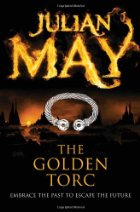 Summary:
The group of people who traveled from the future to the Pliocene past for a willful exile were split into two by the alien race, the Tanu, who, surprisingly, inhabits Earth. Half were sent to slave labor, while the others were deemed talented at mind powers, given necklace-like torcs to enhance those powers, and sent to the capital city of Muriah. In the first book, we followed the daring escape of the group sent into slavery. They then discovered that the Tanu share the Earth with the Firvulag–an alien race from their home planet that has many similarities to their own. They also organized an attack on the industrial city of Finiah. This book at first follows the adventures of the other group, the one sent to the capital city of Muriah. Through them we discover the inner workings of the Tanu, the intersections of humans and aliens, and the impact of the human/Firvulag attack on Finiah. When the time for the Great Combat between the Tanu/human subjects and the Firvulag arrives, the survivors of the escaped slave group end up coming back into contact with the group of humans in Muriah. With dire consequences.
Review:
I really enjoyed the first book in this series, finding it to be a delightful mash-up of scifi and fantasy. When I discovered my library had the next book in the series, I picked it up as quickly as possible. This entry feels more fantastical than the first, although science definitely still factors in. It is richer in action and intrigue and perhaps a bit less focused on character development.
This is a difficult book to sum up, since so very much happens. It’s an action-packed chunkster, providing the reader with information and new settings without ever feeling like an info-dump. The medieval-like flare of the Tanu and the goblin/fairie/shapeshifter qualities of the Firvulag are stronger in this entry, and it is delightful. Creating a medieval world of aliens on ancient Earth is probably the most brilliant part of the book, followed closely by the idea of torcs enhancing the brain’s abilities. May has created and weaved a complex, fascinating world that manages to also be easy enough to follow and understand. The sense of the medieval-style court is strong from the clothing, buildings, and organization of society. She doesn’t feel the need to willy-nilly invent lots of new words, which I really appreciated.
The intrigue is so complex that it is almost impossible to summarize, and yet it was easy to follow while reading it. Surprises lurk around every corner, and May is definitely not afraid to kill her darlings, following both William Faulkner’s and Stephen King’s writing advice. A lot happens in the book, the characters are tested, and enough change happens that I am excited there are still two more books, as opposed to wondering how the author could possibly tell more story. In spite of the action, sometimes the book did feel overly long, with long descriptions of vegetation and scenery far away from where most of the action was taking place.
The book is full of characters but every single one of them manages to come across as a unique person, even the ones who are not on-screen long enough to be fully three-dimensional. The cast continues to be diverse, similarly to the first book, with a variety of races, ages, and sexual preferences represented. I was surprised by the addition of a transwoman character. She is treated with a mix of acceptance and transphobia. I think, certainly for the 1980s when this was published, it is overall a progressive presentation of her. She is a doctor who is well-respected in Tanu society. However, she also is presented as a bit crazy (not because of being trans but in addition to being trans), and it is stated by one character that she runs the fertility clinic because it is the one part of being a woman that will always be out of her grasp. I am glad at her inclusion in the story but readers should be aware that some aspects of the writing of her and how other characters interact with her could be considered problematic or triggering. I would be interested to hear a transperson’s analysis of her character.
Overall, this entry in the series ramps up the action and more thoroughly investigates the world of the Pliocene Exile. Readers disappointed by the lack of information on the half of the group heading to the capital city in the first book will be pleased that their story is told in this one. Characters are added, including a transwoman doctor, and all continue to feel completely individual and easily decipherable, in spite of the growing cast list. The fast action pace sometimes is interrupted by lengthy descriptions of settings far away from the action, but overall the chunkster of the book moves along at a good pace and remains engaging. Recommended to fans of fantasy who want a touch of science in their stories and who are interested in the idea of medieval aliens.
4 out of 5 stars
Source: Library

Previous Books in Series:
The Many-Colored Land
Book Review: A Queer and Pleasant Danger: The True Story of a Nice Jewish Boy Who Joins the Church of Scientology and Leaves Twelve Years Later to Become the Lovely Lady She is Today by Kate Bornstein (Audiobook narrated by Alice Rosengard)
 Summary:
Kate Bornstein is a playwright, gender theorist, and queer activist. She chose to write a memoir as a way to reach out to her daughter, Jessica, who is still in the Church of Scientology, and thus, must not speak to her. Her memoir talks about growing up Jewish in the 1950s, feeling like a girl inside a boy’s body. It then talks about why and how she joined Scientology (still identifying as a man, Al), climbing Scientology’s ladder, marrying, fathering Jessica, and finally getting kicked out of Scientology and becoming disillusioned. From there the memoir explains to Jessica how and why Al decided to become Kate and talks about the person behind the queer theory, trying to explain who the incredibly unique parent she has truly is.
Review:
I was feeling bad about how far behind I’ve fallen in writing up reviews for the books I’ve finished reading, but with the historic DOMA ruling in the US yesterday (giving official federal support to marriage equality), I’m really glad I had a LGBTQIA+ book in the queue ready to be reviewed. And not just any LGBTQIA+ book. An amazing one! You can’t read that title and not be intrigued. It’s impossible. I spotted it on tumblr and instantly knew I had to read it. A memoir about a transwoman who was a member of Scientology?! It’s the intersection of three topics I find fascinating.
Kate is unabashedly honest about the fact that this book exists as a letter to her daughter, Jessica. The prologue explains that this memoir came about as a way for Kate to reach out to Jessica and her children, even after Kate has passed away. This lends a tone to the book of an elderly neighbor sitting down to tell you their life story, and you finding out gradually that your elderly neighbor is, in fact, a bad ass, and age has nothing to do with how cool a person still is to this day. And Kate doesn’t hold back because of this perspective. If anything, she is more brutally honest than she might otherwise be. She wants Jessica to have a whole, clear picture of who she is. Flaws and all. One technique that I thought was brilliant for a memoir and helped establish trust in truth between the reader and the author was the fact that Kate would tell a family story she heard growing up and then say, well, that was a lie. I thought it was true, but it turns out what people told me was a lie. Given that, how can we ever know what really is true? Just because we think something is true doesn’t mean it is. It’s an excellent grain of salt to be given in a memoir.
After the prologue, Kate tells her story chronologically. Her story can be roughly summarized as the following sections: growing up a gender queer person, joining Scientology, break-down after getting kicked out of Scientology and coming to terms with her queerness, transitioning, life as a lesbian trans activist, finding BDSM, and overcoming depression and suicidal thoughts. It’s an emotional rollercoaster ride, and one cannot help but feel empathy for this person just struggling to find a place in the world. Personally, I think Kate’s life story is an excellent argument for breaking down the binary gender divide. A lot of Kate’s struggles come from the rigid gender norms and expectations placed upon her by others. It would have been much simpler for people to have let her be gender fluid, and indeed, Kate in more recent years has come to be an activist for gender fluidity and queerness (as is evidenced by her book Gender Outlaw: On Men, Women and the Rest of Us
The Scientology section was surprisingly mundane compared to what I thought actually happens in Scientology. Yes, there was abuse and lies and many other things going on that demonstrate the fallacies of L. Ron Hubbard, but honestly none of it was that much worse than religious extremists of any religion. Scientology expects its followers to cut themselves off from people deemed poisonous and to proselytize non-stop. It takes over the lives of the people in the upper-echelons, controlling every aspect of their lives. We can see all of this in Kate’s years in Scientology, and while it was interesting, none of it is shocking to anyone moderately informed on Scientology. I actually was more interested in how Kate wound up joining Scientology. Scientology teaches the the soul is genderless, and you also reincarnate. Everyone has been in both male and female bodies. Kate (then Al) found this incredibly comforting. It’s possible that his soul was just more frequently in female bodies, and so that’s why he felt like a girl inside. What an appealing concept to a confused, unsupported trans or gender queer young adult. I think this part of the book demonstrates clearly why it’s important for families and loved ones to be supportive of their LGBTQIA+ teens and young people. You don’t want a harmful group of people snapping them up with promises of understanding and caring and information that sounds more supportive than the people they live with.
Interestingly, the much more shocking section was the one in which Kate discusses discovering BDSM and getting pleasure from pain. Kate was part of a BDSM triad for quite some time, and this is addressed. It does, however, come with a warning for Jessica and readers who might not want to hear the details so they can easily skip over it and still get the most important information without getting all the details. I thought that was a nice touch from Kate, showing her maturity and openness. Of course, I read that section, and I will say that Kate had a more intense BDSM relationship than you tend to see in literature, and it was interesting to read about.
It’s also interesting to note that from the prologue Kate is honest with the reader about being diagnosed with Borderline Personality Disorder years ago. This is not something I knew coming into the book, and I don’t think Kate’s mental illness played very much into the book. I certainly think she would have had a better time coping with her mental health issues if she had had a supportive environment for her queerness. Even within the LGBTQIA+ community, she was ostracized for some of her less mainstream beliefs within that community. It’s sad that even a community of people ostracized by the larger society, people can still be unaccepting and unloving. In spite of the fact that the book talks a lot about depression, self-injury, and other mental health issues, I am hesitant to label it as counting for my Mental Illness Advocacy Reading Challenge. I don’t want the casual reader to think that I’m equating being queer with having a mental illness. However, the fact remains that Kate herself states she was diagnosed with BPD, and trans and queer people certainly can have mental illnesses. One does not cause the other, although certainly I think lack of acceptance and loving increases symptoms of mental illnesses. In any case, for this reason, I am counting this read for the challenge, but I want to be crystal clear that this is due to Kate’s BPD and NOT her queer/trans orientation.
The narration of the audiobook was perfect. Thankfully, they chose to use a female narrator throughout, which fits perfectly with the image of an older Kate Bornstein telling her life story to her daughter. Alice Rosengard was a perfect narrator. She became Kate in my mind, and there’s not a better complement you can pay a narrator than that.
I feel like I’ve rambled a lot about this book. It’s hard to succinctly discuss a memoir as unique as this one, let alone a book you love as much as I loved this one. It’s amazing. It’s unique. It does exactly what a memoir should do. It tells a unique life story in an engaging way that forces the reader to put herself into someone else’s shoes and feel empathy and maybe even come out of it with a changed worldview, however slightly. I strongly recommend this book to everyone, really, but especially anyone with an interest in LGBTQIA+ history/theory/studies or an interest in the first few decades of Scientology. I will definitely be reading more of Kate’s works, myself, and want to thank her for being a pioneer, in spite of everything.
5 out of 5 stars
Source: Audible

Counts For:

 Support my work with a tip or browse my shop for curated book club guides, how to guides, cross-stitch patterns, and more!


This work by Amanda Nevius is licensed under a Creative Commons Attribution-Noncommercial-No Derivative Works 3.0 United States License.
 Opinions of a Wolf