
Archive
Book Review: Soul Surfer: A True Story of Faith, Family, and Fighting to Get Back on the Board by Bethany Hamilton
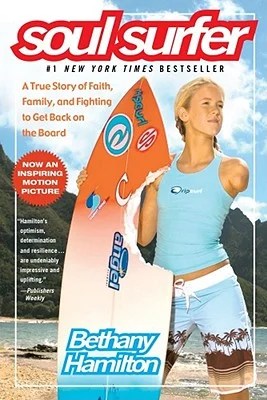
A powerful disability memoir about faith, resilience, and healing after a shark attack.
Summary:
They say Bethany Hamilton has saltwater in her veins. How else could one explain the passion that drives her to surf? How else could one explain that nothing—not even the loss of her arm—could come between her and the waves? That Halloween morning in Kauai, Hawaii, Bethany responded to the shark’s stealth attack with the calm of a girl with God on her side. Pushing pain and panic aside, she began to paddle with one arm, focusing on a single thought: “Get to the beach….” And when the first thing Bethany wanted to know after surgery was “When can I surf again?” it became clear that her spirit and determination were part of a greater story—a tale of courage and faith that this soft-spoken girl would come to share with the world.
Soul Surfer is a moving account of Bethany’s life as a young surfer, her recovery after the attack, the adjustments she’s made to her unique surfing style, her unprecedented bid for a top showing in the World Surfing Championships, and, most fundamentally, her belief in God. It is a story of girl power and spiritual grit that shows the body is no more essential to surfing—perhaps even less so—than the soul.
Review:
In many of the circles I’m in, “recovery” means recovery from addiction. But it can also mean recovery from trauma—and for many of us (studies suggest around 75%), those things are intertwined. That’s part of why memoirs about recovering from trauma resonate so deeply with me. I’m especially drawn to the ones that focus not on the traumatic event itself, but on the response to it—the healing, the resilience, the rebuilding. This is that kind of memoir.
I remember when the news broke in 2003: a teenage surfer in Hawaii had lost her arm to a shark attack. I was in high school myself, and even though I lived in Vermont (far from any waves), I immediately felt heartbroken for her, losing not just a limb, but the ability to pursue something she loved. Years later, when I learned Bethany was not only surfing again but competing professionally, I was stunned—and moved.
Bethany knows that readers will come to her story expecting to read about the shark attack, and she doesn’t shy away from it. But she also doesn’t sensationalize it. It’s described early in the book with striking clarity and calm. There’s no melodrama—just presence, perspective, and truth. It’s a credit to both her and her editorial team that this tone is preserved. Her calm focus in the water (“Get to the beach…”) is echoed in how she writes.
What carries Bethany through, more than anything, is her deep faith. She was a girl of faith before the attack, during recovery, and continues to lean on her faith throughout her life. Her story isn’t preachy, but it is grounded in that spiritual strength. Her family, too—supportive parents and brothers—play a major role, along with a strong friend group that surrounds her in the aftermath.
One of my favorite moments in the book is her description of working with a blind therapist during her recovery. That peer connection—being guided by someone who also lives with a disability—felt powerful and familiar. Coming from the world of recovery, I saw that moment as a type of peer support. Rather than being told how to heal by someone without shared experience, Bethany was supported by someone who understood. It’s a powerful reminder of why peer-based healing matters.
Bethany also takes care to honor Hawaiian culture. As a white surfer growing up in Hawaii, she shares what she’s learned about the Indigenous roots of surfing, respectfully credits Hawaiian words and traditions, and speaks with admiration about her Hawaiian coach. This kind of cultural awareness—especially in faith-based memoirs—is both rare and welcome.
Later in the memoir, she explores what it was like to become famous almost overnight. From media appearances to a Hollywood movie adaptation, Bethany shares the highs and lows with honesty—including awkward encounters with strangers and challenging public questions.
I listened to the audiobook, which includes a charming guitar riff at the end of each chapter—a small touch that added to the overall tone and kept me engaged.
Overall, this is an uplifting, engaging memoir of trauma, recovery, and spiritual grit. It doesn’t just tell the story of a shark attack. It tells how we can recover. If you’re interested in memoirs, faith-based stories of resilience, or narratives about disability and healing, this one’s worth the read.
If you found this review helpful, please consider tipping me on ko-fi, checking out my digital items in my ko-fi shop, buying one of my publications, using one of my referral or coupon codes, signing up for my free microfiction monthly newsletter, or tuning into my podcast. Thank you for your support!
4 out of 5 stars
Length: 222 pages – average but on the shorter side
Source: Library
Buy It (Amazon or Bookshop.org)
Book Review: The Woman in Me by Britney Spears

Two years after her conservatorship ended, pop star Britney Spears tells her story.
Summary:
In June 2021, the whole world was listening as Britney Spears spoke in open court. The impact of sharing her voice—her truth—was undeniable, and it changed the course of her life and the lives of countless others. The Woman in Me reveals for the first time her incredible journey—and the strength at the core of one of the greatest performers in pop music history.
Written with remarkable candor and humor, Spears’s groundbreaking book illuminates the enduring power of music and love—and the importance of a woman telling her own story, on her own terms, at last.
Review:
I think it’s important you know what sort of perspective you’re getting in my review. So let me be clear: I am a Britney Spears fan. From the moment I heard the first four notes of …Baby One More Time’s mp3 playing through the tinny speakers on my family’s pc when I was 13 years old, I was enamored – and I hadn’t even seen the music video yet! (And I didn’t for a while.) When I did finally start seeing Britney and not just hearing her, it got even better. Her fashion sense was, to me, spot on. I wanted nothing more than to wear those jeans and bare my midriff like her. (Although, I did not have the body confidence to do so.) Her eyeliner, her music videos, her sound.
Britney’s music was a perpetual backdrop to my rough teens and twenties. I laughed when Oops! I Did It Again mentioned the necklace in The Titanic. I got teary-eyed singing Lucky in my bedroom. I played I’m a Slave 4 U both because I liked it and because it drove my mother insane. I was terrified of snakes, and Britney DANCED with one while performing. I was a closeted bisexual, and when she kissed Madonna, I lost my mind. When she had kids, I was in college. I didn’t understand why she was so excited to be a mom, but I loved that she knew what she wanted so much. Blackout dropped my senior year, and I belted out Piece of Me on study breaks. I listened to Womanizer to make myself feel better when I was lonely in grad school Circus is still on my #GirlBoss playlist I listen to to help hype myself up when I’m doing something that feels scary in my various careers. (I’m on my second.)
When her conservatorship started, I didn’t understand what it meant. I thought she had trouble with her finances, and someone was helping her out. My husband took me to see her at her Vegas residency. I was so excited I threw up in our hotel room right before the show. I feel badly now knowing what she was going through (I did not know then), but I am here to tell you she still put on a phenomenal show for us fans in spite of all that.
When the #FreeBritney movement really started to take off, and I came to understand what a conservatorship actually meant, I joined in calling for her to be freed. I explained to anyone who would listen what was wrong with a conservatorship. And I believe this for anyone, not just for Britney. No one deserves to have their adult agency taken away, regardless of their mental abilities and/or mental health. Anything else is just ableist.
Anyway, that is who is reviewing this memoir for you. A fan who loves Britney for who she is.
The ghostwriters did a very good job of leaving Britney’s voice clearly in-tact throughout the book. It sounds like her. The story is told mostly chronologically from her childhood forward, although there is sometimes some jumping back and forth in some places. If you have read Britney’s Instagram captions, then you have some idea of the general tone of the book. But it has been edited so it is clearer than those. (And with less run-on sentences, and no emojis except in the Afterword.)
What stood out to me the most about the book was these things. First, Britney expresses that being put in the conservatorship caused her to regress sometimes. Essentially, treating her like a child made her act like a child. This is excellent insight, and a reason to not inflict conservatorships on people of any ability level. Everyone deserves to be treated with respect and like an adult. (I’d argue children deserve to be treated with more agency than they are, but that’s another topic for another blog post.) Second, Britney is of the opinion that what happened to her would never happen to a male pop star. How she was infantilized and not allowed space to be weird and creative was largely because she was a woman. Third, Britney feels part of why what happened to her did was because she tries so hard to be a “nice girl” that people end up walking all over her. She talks a bit about Madonna and how, “she demanded power, and so she got power.” (page 101) But that’s not part of Britney’s nature.
Fourth, Justin Timberlake broke up with her via text message then used the break-up to make her into the bad guy and spur on his solo career. Reminder to those who maybe weren’t around at that time – cell phones at that time didn’t let you write long messages. A break-up in a text message would have been necessarily character-limited. It makes it even worse. It seems that Britney was well and truly heart-broken and betrayed and society really piled on her on top of it. I didn’t realize that the paparazzi laws have changed since the early 2000s. I obviously wasn’t a celebrity but I remember how it was. You could see the paparazzi swarming celebrities constantly even in their own photos and videos. I used to wonder how they could stand it. (The answer is: a lot of them couldn’t.) The media was also incredibly cruel. I still have the internalized messages from just being a young woman at that time – and I wasn’t their target.
The magazines seemed to love nothing more than a photo they could run with the headline “Britney Spears got HUGE! Look, she’s not wearing makeup!” As if those two things were some kind of a sin–as if gaining weight was something unkind I’d done to them personally, a betrayal.”
The book makes it abundantly clear that the instigators of the conservatorship were her family. They swept in, claiming to be worried about her but actually wanting to control her. At the beginning of the book, she talks about her family history. How her father’s dad was abusive to him. This same grandfather also locked away her grandmother as “crazy” and left to rot there. The same thing her father tried to do to her. The intergenerational trauma gave me chills.
Ok, so why four stars instead of five? There were a few places where I wanted more. Not about any of her traumas. She has every right to only tell as much as she wants to tell. But some of the business stuff. I wanted to know more. I loved how she told us about what it was like to shoot her first music video and to dance with the snake at the awards show. I wanted more of that. What was it like to kiss Madonna? Why did she? (She says it was her idea, that they didn’t rehearse that way, but not much else.) I wish the ghost writers had nudged her a bit more to put more of those types of anecdotes in the book. Or when they came up to say more. (She says she threw a party with Natalie Portman but essentially nothing about what the party was like.) I wanted to know more about this part of Britney. Her successes, not just her traumas.
A question I was asked when I was seen reading the book was if I think Britney is really mentally unwell. My answer is this: this is a book written by a traumatized person. Britney was traumatized by her family, by the media, by various romantic partners, by the conservatorship. I don’t want to diagnose anyone. But I will say that trauma often leads to C-PTSD. And C-PTSD can often be misdiagnosed as other mental health conditions. So I hope people will keep these things in mind when looking at Britney and give her some grace. I do also think Britney is a simple, trusting person. Those type of people often end up being taken advantage of.
I’m assuming most fans have either already read the book or are (im)patiently waiting for their copy. If you’re on the fence, to you I say, this book is worth the read to explore intergenerational trauma and to dive down into late 90s/early 2000s culture. To be reminded (or learn) how misogynistic it was, even to women who were succeeding by its own rules.
If you found this review helpful, please consider tipping me on ko-fi, checking out my digital items available in my ko-fi shop, buying one of my publications, using one of my referral/coupon codes, or signing up for my free microfiction monthly newsletter. Thank you for your support!
4 out of 5 stars
Length: 288 pages – average but on the shorter side
Source: Library
Buy It (Amazon or Bookshop.org)
Book Review: Stuff: Compulsive Hoarding and the Meaning of Things by Randy O. Frost and Gail Steketee
 Summary:
It may be difficult to describe a hoard, but you know one when you see one. Maybe you have a neighbor who keeps their shades drawn but when you enter their home you see piles and piles of stuff that either they keep for a project they’ll do one day or because every scrap of it contains important information (according to them). Maybe you’ve only encountered hoarding through reality tv shows focused around the forced clean-up of homes that immediately appear unlivable to you but yet that the person on the show insists is full of treasures. Or maybe you grew up in a home where the hoard slowly encroached on your own room
Between 2 and 5 percent of the population suffers from Hoarding Disorder. Frost and Steketee were the first to begin scientifically studying it. Here, couched in tales of real interactions with and homes of clients (who granted their permission to be featured in an anonymized fashion) Frost and Steketee present both what we know and what we don’t know about hoarding, as well as best practices for helping someone with the disorder.
Review:
As an outside observer of a hoard, it can often be difficult to imagine what leads a person to believe trash is treasure. But of course it’s more complicated than someone just being unable to recognize trash. After all…one man’s trash is another man’s treasure. The authors attack this head-on by first giving a true definition to what counts as hoarding and then talking about various causes and possible presentations of the disorder. So what counts as hoarding?
It hardly matters how much stuff anyone owns as long as it doesn’t interfere with his or her health or happiness or that of others….Hoarding is not defined by the number of possessions, but by how the acquisition and management of those possessions affects their owner. (page 58)
So basically, it counts as hoarding if the collection of items interferes with the person’s health or happiness or the health or happiness of others nearby. The complicated gray area of course is that the sufferer may not realize that the hoard is interfering with their happiness and health. That is the point of conflict for many loved ones of people who hoard.
After establishing and defining what hoarding disorder is and is not, the authors continue on to analyze the behavior and mind of someone suffering from hoarding. Fascinatingly, hoarding shares commonalities with many other mental illnesses, seeming to a certain extent to defy categorization, although the DSM 5 currently lists it among “Obsessive Compulsive and Related Disorders.” Are you shocked? Did you think that OCD always means cleanliness? The fact is that is often not what OCD means. It’s a misunderstanding spurred on by popular culture. OCD is an obsession. It can be with cleaning and germs but it can also be with anything. It also often features repetitive behaviors. If you think about it, you can see what hoarding has in common with this. People who hoard become obsessed with the idea of not losing something important, of collecting everything relevant to a certain idea, of not wasting things. They also can come to establish repetitive behaviors such as maybe always buying a newspaper from a certain store on the way home from work. Another similarity with OCD is that hoarders often are perfectionists. Part of why their homes become cluttered is they are obsessed with only doing a perfect job of cleaning up or of fixing something or using some item for a project, and they become paralyzed with the fear that they can’t do it good enough, so they never start.
The authors also talk about how hoarding has commonalities with Impulse-Control Disorders, such as gambling and compulsive buying. Many people who hoard also struggle with both of these ICDs, and it’s easy to see the relationship here. Similarly, many hoarders show symptoms of ADD. They often do much better cleaning up if there is simply someone there to help them maintain focus, rather than being easily distracted.
Hoarding is also often a result of trauma. People suffer a trauma and essentially attempt to build a protective space around themselves by hoarding.
Compared to people who do not suffer from hoarding problems, clutterers report a greater variety of traumatic events (an average of six versus three), as well as a greater frequency (an average of fourteen versus five) of such events. The type of trauma most often experienced by hoarders include having had something taken by threat or force, being forced into sexual activity, and being physically assaulted. (page 87)
Interestingly, there’s a comparatively low incidence of PTSD among hoarders, in spite of such a high incidence of trauma. (A 2006 study found only 6% of hoarders had PTSD, page 91). It is possible that hoarding prevents the development of PTSD. Many hoarders also report a childhood devoid of warmth and support, so even if they were not traumatized, it is still likely that they had a cold, distant childhood. In contrast to PTSD, the majority of hoarders (nearly 60%) meet the criteria for major depression, and it is posited that this depression could be in response to the hoarding itself.
People draw conclusions about their worth and competence based on their inability to control their living space, and not being able to entertain people in their homes isolates them and limits their social lives. (loc 532)
The authors then talk about what may be going on in the heads of people who hoard. People don’t do things completely irrationally. There are reasons for it. There are multiple possibilities for hoarding of what may be going on. No single aspect has been determined yet. However, in general, hoarders suffer from a different type of threat signal. They fear something being removed, rather than the presence of something. It has also been posited that they have the opposite of claustrophobia. They feel safer in small, tight spaces, so they artificially create them. Hoarders also frequently struggle with identity. Rather than knowing who they are, they often are defined by the question “Who am I?” and collect items to try to show who they are. In addition to the aforementioned perfectionism, hoarders also seem to view items differently from the rest of us. They are generally very optimistic about future usefulness and can be quite creative as to reusing things. It has been posited that hoarding may be creativity run amok. However, many hoarders also gamble compulsively and the relationship between a hoarder’s positive thinking and a gambler’s is interesting.
“Seeing the scratch tickets over the counter at the convenience store leads me to think, One of those tickets is surely a winner, maybe a million-dollar winner. How can I walk away when the opportunity is there?” Our hoarders have said similar things about items they’ve wanted to acquire. (loc 202)
Distress avoidance is also often a common feature. Distress avoidance is when a person seeks to avoid a situation that they think will cause them distress. They then build up that situation in their heads to be more of a stressor than it actually would be. Continual avoidance of these types of situations also weakens a person’s ability to deal with them (due to lack of practice), so it’s a bit of a self-fulfilling prophecy.
Animal hoarding is its own special subcategory, and it seems that in addition to all of the other possible hoarding issues, animal hoarders may suffer from a form of an attachment disorder where their bonds with other humans are frayed and easily broken and replaced by bonds with animals.
So, essentially, hoarders are often people who are perfectionists who tend to perform rituals and struggle with impulse control. They may compulsively shop and/or gamble in addition to hoarding. They often had cold, distant childhoods and/or suffered a trauma (or traumas). They tend to come at life from a basis of fear and feel safer in tight, closed spaces, and their fear is heightened by removal of things, rather than appearance of new things. At some point, they started avoiding distress, and this distress avoidance became a self-fulfilling cycle. They also frequently struggle with knowing who they are internally, rather looking outward to possessions for identity signals. In addition to these compulsions and fears, hoarders also often see things differently or in more detail than non-hoarders, and they also struggle to focus or concentrate, making cleaning up even more difficult for them.
The authors conclude by discussing both how to treat hoarding and effects on family members and loved ones (as well as on communities). The authors stress repeatedly that forced clean-ups are the absolute worst possible solution or treatment option. A forced clean-up just fulfills the person’s fear that people are out to get them, and simply makes them cling on to their possessions even more aggressively. It also can make them more depressed. Since their identity is wrapped up in their possessions, getting rid of them by force can cause emotional trauma akin to someone chopping off your hair by force. I was stunned to learn that there have been cases of people who hoard committing suicide after a forced clean-up. The authors strongly advocate for the much slower, but with more long-term positive results, method of going through the hoard with the person slowly and basically teaching them new ways to think about both their possessions and their identity. They also state that it’s easier to treat compulsive buying and gambling than hoarding, so when possible treat that first to prevent the arrival of new items into the hoard. It is a long, difficult treatment plan to go through a hoard slowly, and sometimes it may be necessary to remove the person from the home for safety but then to return with them repeatedly to work on cleaning out the hoard.
The fact that forced clean-ups are the worst possible solution for the sufferer and the fact that hoards get worse over time leads me to believe that early interventions are absolutely critical to render the most help to those suffering from hoarding. But this is a complex thing. Since many cases of hoarding start due to a cold home environment or from trauma, it may be difficult to get parents behind addressing the situation early. Many people who hoard interviewed in the book talk about their hoarding beginning to get out of control by late in their freshman year of college. Perhaps this is something colleges should be keeping an eye out and offering help for. Additionally, shame is often mentioned as a factor in keeping the problem hidden. Perhaps PSAs and other public service campaigns could both lessen the stigma and offer help to people early on in the development of a hoard.
So much of hoarding is stigmatized. To a certain extent this is understandable. It often isn’t seen by the public until it has reached a public health crisis level or in situations where animal hoarders are keeping their hoards in deplorable conditions. Often loved ones of those who hoard feel trapped and frustrated by the hoarding. They feel as if the loved one loves their stuff more than them. These are complex issues and professional help is required to address them. I honestly don’t think this is a situation that is easily handled one family at a time. A family member must be well-informed and patient and empathetic enough to wait through the long treatment process. Often that family member is the child of the hoarder and therefore a minor with no power, which makes the issue even more complex. This is definitely a situation in which public health education campaigns on things like early warning signs of hoarding tendencies and ways to seek help could be extremely helpful long-term. I do believe the authors could have taken things one step further at the end of the book to this connection to public health, rather than mostly focusing on individual therapy. They do mention less consumerism would be helpful, but that simply is not much of an observation. It is a small complaint, but I do feel that this interdisciplinary leap is important.
Overall, this was a fascinating, enlightening book. The authors have conducted extensive scientific research for years, and they do an awesome job of writing this information at the consumer level, as well as humanizing it by bringing in real cases with clients who they render in a three-dimensional fashion. I know I for one will never be able to stomach watching forced clean-ups on the tv show “Hoarders” again. Recommended to really everyone. Anyone could potentially know someone who struggles with hoarding, whether now or in the future, and the book is very readable.
If you found this review helpful, please consider tipping me on ko-fi, checking out my digital items available in my ko-fi shop, buying one of my publications, or using one of my referral/coupon codes. Thank you for your support!
4 out of 5 stars
Length: 309 pages – average but on the longer side
Source: Library
Counts For:
Illness(es) featured: Hoarding Disorder
 Support my work with a tip or browse my shop for curated book club guides, how to guides, cross-stitch patterns, and more!


This work by Amanda Nevius is licensed under a Creative Commons Attribution-Noncommercial-No Derivative Works 3.0 United States License.
 Opinions of a Wolf