
Archive
Book Review: Steering the Craft by Ursula K. Le Guin
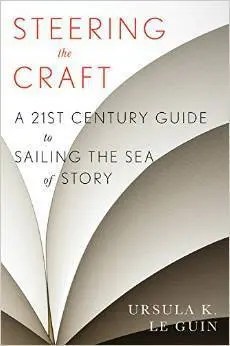
An essential, genre-inclusive writing guide packed with practical advice and thoughtful exercises for writers at any stage.
Summary:
From the celebrated Ursula K. Le Guin, “a writer of enormous intelligence and wit, a master storyteller” ( Boston Globe ), the revised and updated edition of her classic guide to the essentials of a writer’s craft.
Completely revised and rewritten to address modern challenges and opportunities, this handbook is a short, deceptively simple guide to the craft of writing.
Le Guin lays out ten chapters that address the most fundamental components of narrative, from the sound of language to sentence construction to point of view. Each chapter combines illustrative examples from the global canon with Le Guin’s own witty commentary and an exercise that the writer can do solo or in a group. She also offers a comprehensive guide to working in writing groups, both actual and online.
Masterly and concise, Steering the Craft deserves a place on every writer’s shelf.
Review:
Ten chapters. Ten essential elements of writing craft. Each paired with clear, focused exercises designed to sharpen your skills—no matter your genre.
I first borrowed the ebook from my library, but found it so helpful I requested the print version as a holiday gift. Now it lives on the shelf with my most trusted writing resources, right alongside The Emotion Thesaurus.
Despite her legendary status, Le Guin never talks down to the writer. Her tone is accessible, encouraging, and—when needed—direct. It’s the kind of guidance that feels both generous and grounded. Though best known for speculative fiction, she pulls examples from across genres and even tailors prompts for nonfiction writers, especially memoirists.
The topics span everything from grammar and punctuation to big-picture fundamentals like point of view. One of my favorite prompts came from Chapter 1, “The Sound of Your Writing.” I used it to write Pumas, Coffee, and Writing About Grief, a microfiction piece that became one of the most popular episodes on my podcast. That’s the power of this book—it doesn’t just teach; it unlocks ideas.
The final chapter on running peer workshops is full of practical wisdom. If you’re thinking of starting a group (or reviving one that’s fizzled), it’s worth reading for that section alone.
Overall, this is a resource I’ll return to again and again. If you’re a writer at any stage of the journey, I can’t recommend it enough.
If you found this review helpful, please consider tipping me on ko-fi, checking out my digital items in my ko-fi shop, buying one of my publications, using one of my referral or coupon codes, signing up for my free microfiction monthly newsletter, or tuning into my podcast. Thank you for your support!
5 out of 5 stars
Length: 160 pages – average but on the shorter side
Source: Gift
Buy It (Amazon or Bookshop.org)
Book Review: The Left Hand of Darkness by Ursula K. Le Guin (Bottom of TBR Pile Challenge)
 Summary:
On the planet Winter, everyone is born intersex, morphing into one sex or the other during their mating cycle. The Ekumen of Known Worlds has sent a representative, Genly Ai, to make first contact. The Known Worlds have discovered that they are all related with the same ancestors who colonized the planets years ago. Genly Ai is at first horrified by the intersex nature of the Gethenians but slowly begins to adapt as he works the political situation on the planet to reach a state of belief in what this one man from his one ship is saying. A state of belief that is necessary to bring this planet into the Ekumen.
Review:
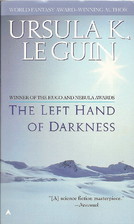
I picked this up when I saw it on sale at a local brick and mortar bookstore for two reasons. I’d never read an Ursula K. Le Guin book, which felt like sacrilege as a young feminist scifi author myself, so she was already on my radar. But why this book? Honestly, I liked the cover. It’s such a pretty cover! So many scifi/fantasy books seem to be set on a hot planet, but this is set on an icy one, and I really liked that. So when I picked it up, I had no idea that it’s considered to be a gender theory scifi. It’s presented as a book about a planet totally lacking in gender. You’ll notice that in my own summary that is not how I present it. Why not? Frankly, a gender-free society is not what I found in this book, which was a big disappointment.
The Gethenians really are not a gender free society, and Le Guin also doesn’t present them that way. It is definitely an intersex society, but it’s intersex people who predominantly present as male/masculine. Now, in case you’ve never had it explained, gender is a construct and sex is your body parts. So you could have an intersex gendered female society or an intersex gender neutral society or an intersex gender male society. The last one is what we have in this book. At first it seems that this might just be Genly Ai’s misperception (the off-world ethnologist). He mentions that he can’t help seeing the Gethenians as male, although sometimes he sees more “feminine features” in them. Perhaps. But when the narration changes from Genly’s viewpoint to a Gethenian one, we get the exact same presentation of everyone as a gendered he. There is no gender neutral pronoun used. There is no perception by the Gethenians of being free of gender. Indeed, instead of seeing themselves as gender-neutral or gender-queer, they see themselves as male until their mating cycle when some of them turn into women for a bit. (They also stay female long enough to be pregnant). Genly points out after a couple of years on this planet that he’s forgotten what it’s like to be around women. Not what it’s like to be around gender constructs. What it’s like to be around women. This is, thus, not a gender neutral society. It’s a society of male-identifying intersex persons who are free of sex-drive most of the time, and who sometimes grow vaginas/breasts for the purpose of reproduction but for nothing else. It is definitely interesting to see an exploration of this type of society, but it’s decidedly not an exploration of a gender-neutral society or really much gender theory at all. It is much more an exploration of the sex drive and a world without female-identifying persons. Now I’m not saying this isn’t a valid exploration or that it’s not well-done. I am saying that the presentation and marketing of this book gets it all wrong, which makes me wonder did Le Guin think she was exploring a gender neutral society and accidentally make an intersex male gendered one instead? Or did the publishers completely misunderstand everything about gender and sexuality and mismarket her book as something it is not? I have no idea, but the potential reader should know that they are not getting an exploration of gender and queerness from a famous scifi/fantasy author when they pick up this book.
Moving beyond the queer theory and mismarketing of it, how is the rest of the book? Well, the imagining of the world is stunning and clearly presented. The idea that planets were all settled by common ancestors and then forgotten about only to be rediscovered later (very Stargate SG1) is subtly introduced into the plot without an info-dump. The world of Winter contains multiple cultures and peoples (something often left out in scifi). The planet even has its own way to mark the passing of time and has evolved to handle the coldness of the planet without Le Guin just copying an Earth culture from a cold area, like the Inuit. No, this is all a unique way of approaching the demands of the climate. It’s also interesting to note that different skin colors are present on Winter, showing that a mixed-race group originally colonized the planet, although their bone structure and height has changed with time and evolution. The world building is so complex that I’m having difficulty explaining just how awesomely complex it is to you, so that should say something I suppose.
The plot is very political. Genly is here on Winter to get the planet as a whole to unify enough to become part of the Ekumen. Thus there is typical political intrigue across a couple of nations and various amounts of striving for power. There’s nothing incredibly unique about this element of the book but it is clearly done and is not completely predictable.
There is an interesting character development where Genly has a friendship that could take a turn for the romantic. How that line is walked could be endlessly analyzed. I will just say to keep it spoiler free that I appreciated what Le Guin did with the relationship, and it was a unique one to see in literature.
Overall, this is a richly imagined scifi world where the setting is much more the focus of the book than the more typical political intrigue/first contact plot. Do not be misled by the marketing to think that this is a book exploring a world free of gender. Rather it is a male-gendered intersex world. Thus, it is a book that will appeal to scifi lovers who prefer world-building over plot but don’t go into it expecting a scifi exploration of gender theory.
4 out of 5 stars
Source: Harvard Books

 Support my work with a tip or browse my shop for curated book club guides, how to guides, cross-stitch patterns, and more!


This work by Amanda Nevius is licensed under a Creative Commons Attribution-Noncommercial-No Derivative Works 3.0 United States License.
 Opinions of a Wolf