
Archive
Book Review: Eva by Peter Dickinson
 Summary:
Eva wakes up from a car accident to discover that her scientist, chimp researcher parents have allowed for her to be part of a new experiment. Her brain patterns have been implanted into a chimp’s brain. She is a human brain trapped in a chimp’s body. What will this mean for Eva? For the chimps? For the world?
Review:
This a truly horrifying concept. What would it be like to wake up from a car accident in a body that is not your own? There is much potential for exploration here, but the direction Dickinson took it in fell flat for me.
The setting is a near future in which the world is vastly overpopulated and nearly all animal species have died out except for chimps, who are all kept in captivity. It’s odd in a world that is so overpopulated that the vast majority of people never leave their apartments that scientists have made such an ethically questionable move to save human lives. As Eva herself points out, not only is there the problem of what it means to be a human in a chimp’s body, but also there’s the fact that the chimp essentially had to die for Eva to live. How is that right or fair?
I appreciate that Dickinson has Eva start to identify with the animals and fight for animal rights, yet I simultaneously did not appreciate his depiction of the inner workings of animals and their social groups. In spite of Eva being one of and among them, Dickinson persists in presenting them from a largely disconnected human perspective. I’ve read more sympathetic passages on the inner workings of animal groups on vegetarian websites than I got from Eva’s perspective as, essentially, one of the chimps herself.
*spoiler warning* Some readers will also be disturbed by the fact that Eva goes on to mate with one of the chimps. Although this is not shown, it is shown that a male is interested in Eva when she is in estrus, and it is later shown that she has had multiple chimp babies. Although I am highly sympathetic to animal rights, this is far too close to beastiality for my own comfort. Perhaps if Dickinson had addressed the issue and made it a thought-provoking issue instead of glossing over it I would feel differently. But he truly just makes it happen and tries to skip over the issue. I found this disturbing and was disappointed that this overshadowed the more interesting questions of animal rights versus human welfare. *end spoiler*
Overall, the book is well-written and thought-provoking, but falls far short of what it could have been. I’m sure there must be better YA books out there that address the issue of animal rights in a clearer, less disturbing manner.
2 out of 5 stars
Source: Swap.com

Book Review: Ender’s Game by Orson Scott Card
 Summary:
Humanity survived the second Bugger invasion by pure luck. Now they’re determined to be prepared for a third invasion and actively train children in Battle School, seeking the child who could be the commander to save humanity. They think Ender, with his ability to perceive and understand null gravity spaces, just might be that commander, but Ender isn’t so sure.
Review:
Card has created a rich, complex, entirely believable future where individual sacrifice is vital to the survival of the human species. This goal makes the adults’ treatment of the children in Battle School justifiable and allows Card to create a story where children are simultaneously treated as adults and misled by them. Adults will recognize the feeling of being pawns to those in control of society. Children and young adults will appreciate that the children characters are treated as adults in smaller bodies. It’s a fun narrative set-up.
The world-building is excellent. The complex scenes of the Battle School, Battle Room, and videogames the children play are all so clearly drawn that the reader truly feels as if she is there. Readers who also enjoy videogames will particularly enjoy the multiple videogame sequences in which the narrative action switches focus to the videogame. This isn’t just for fun, either. It’s an important feature that comes to play later in the book. In fact, it’s really nice to see videogaming being featured in a future as something important to society and not just recreational. It’s a logical choice to make in scifi too, as the military is moving increasingly toward using weapons that are manned by soldiers behind the lines with videogame-like controls.
These fantastic scenes are all set against a well-thought-out human society reaction to multiple alien invasions. In spite of the threat of a third invasion, there is still violent nationalism brewing under the surface. Politicians must worry about their image. Dissenting voices can be heard on the internet. The teachers of the Battle School must worry about the retributions for their actions, even as they make the choices that will hopefully save humanity. The people in this future are still people. They act in the sometimes stupid and sometimes brilliant ways people act. They don’t miraculously become super-human in the face of an alien threat. I really enjoyed this narrative choice, as I get really sick of the super-human trope often found in scifi.
The ending….I don’t know if I’ll ever be able to make up my mind on how I feel about the ending. I definitely didn’t guess it ahead of time, which is a nice change, but I can’t decide how I feel about it. The fact is, I liked part of it, and I didn’t like another part of it. I think I may have found the ultimate message a bit too idealistic, and Ender too gullible.
*spoiler warning*
Here’s the thing. The Bugger queen claims that the Buggers didn’t know that humans were sentient creatures, and Ender believes her, but I call bullshit. Humans and Buggers built cities that were similar enough so that humans could live in Bugger buildings. In spite of being drastically different from an evolutionary stand-point, it’s still obvious that humans were sentient enough to build cities and spaceships. That should have been a warning sign. So ultimately, I view the queen larva and message to Ender as a last-ditch effort to come back from the brink of extinction and beat humanity, and Ender fell for it. Of course I don’t want to argue for the extinction of an entire species. I’m a vegetarian. I’m pretty much against the killing of species of any kind, but the fact remains that the Buggers attacked humans twice. What were they supposed to do? Sit back and let themselves get wiped out? I’m not one of these nutters who says don’t kill the polar bear attacking you, and in this case, the polar bear had already attacked twice. I like the message of a possible peaceful coexistence, but I don’t think it was very realistic in that world, and I was left feeling that Ender didn’t really learn anything from his experience.
*end spoilers*
Overall, however, Card has achieved near perfection in telling a unique, scifi story. The world is entrancing and draws the reader in, and the reader is left with multiple philosophical questions to ponder long after finishing reading the book. It is a book I definitely plan on re-reading, and I highly recommend it to scifi and videogaming fans.
5 out of 5 stars
Source: Amazon

Book Review: The Forest of Hands and Teeth by Carrie Ryan (Series, #1)
 Summary:
Mary’s world is tightly controlled by the Sisters and the Guardians. The Sisters show the village how to find favor with God via the yearly and daily rituals. The Guardians check and maintain the fence that keeps the Unconsecrated out. The Sisters says the Unconsecrated came with the Return as a punishment to the people. This is why they must maintain God’s favor. But Mary dreams of the tales of the ocean and tall buildings her mother told her about, and her mother’s mother for generations back. She will need those dreams when her world is turned upside down with a breach of the fence. They’ve happened before, but never like this.
Review:
This is an interesting take on the traditional zombie tale. In lieu of starting with the outbreak or just after the outbreak, Ryan envisions what life would be like for the descendants of the few who’ve managed to survive. Of course the sheer number of zombies in the world means it’s impossible for the few survivors left to kill them all, so they must live with constant vigilance. In the case of Mary’s village, they’ve turned to religion to maintain the level of control required to keep them all safe. This is the strongest portion of the book as it leads to interesting questions. The threat outside the fence is indeed real. Mary’s questions are making it difficult for the Sisters to maintain the control needed and prevent panic in the village. On the other hand, the Sisters aren’t exactly being honest with the population or giving them a happy life. They’re just giving them a life.
Where the action supposedly picks up with the breach of the fence is where the book sort of left me behind. The fact of the matter is, I wound up caring more about the village than Mary, and I don’t think I was supposed to. Where I was supposed to be rooting for Mary, I found myself rooting for the community, the group of survivors. Mary’s individualism rings as starkly selfish to me in light of the very real threat around them. This is odd because generally I’m in favor of people being themselves and not necessarily following the group, but that’s different when a crisis is being faced. I found myself wishing it had read more like Elizabeth Gaskell’s classic Cranford, which is a study of a town and not an individual.
Of course, that’s not the type of book Ryan set out to write. She set out to write a book about a girl in a future where zombies are a fact of life. She writes beautifully, with exquisite sentences that read more like an 18th century novel than a 21st century one. I also am certain that the teenage audience this YA book is aimed at will be rooting for Mary in her quest to find herself and her dreams.
If you are a teen or a teen at heart looking for an adventure tale with a touch of romance, you will enjoy this book. If traditional zombies are what you are after, however, you should look elsewhere.
3.5 out of 5 stars
Source: PaperBackSwap

Book Review: I Am Not a Serial Killer by Dan Wells
 Summary:
Fifteen year old John Wayne Cleaver has an odd fascination with the bodies he helps cremate in the family mortuary. He also has difficulty feeling any emotions. He even has been studying serial killers for years. He is not one, however. At least, not yet. His therapist believes John may have Antisocial Personality Disorder, but both he and John hope John can learn to control his illness, an illness John refers to as Mr. Monster. However, when bodies start appearing on the streets of the town gruesomely murdered, John wonders how long he can keep Mr. Monster in check.
Review:
I originally had high expectations for this book. Then I had to wait for it so long that they waned, and I felt that it was probably just going to be a watered down YA version of Dexter. Then I grabbed it for my camping trip because I am insane and love to terrify myself when sleeping in the middle of nowhere in the woods with strange men with hatchets I don’t know a mere campsite away. It didn’t turn out to be a watered down Dexter. It also isn’t terrifying. The best word I can think to describe this book is relatable.
Dan Wells chose to write a YA book about mental illness and couch it with some supernatural features and a premise that will appeal to any teens, not just those struggling with a mental illness themselves. These were both smart moves as it makes I Am Not a Serial Killer more widely appealing. However, he not only chose to depict a mental illness, he chose to depict one of the ones that is the most difficult for healthy people to sympathize with and relate to–antisocial personality disorder. John Cleaver has no empathy, and this baffles those who naturally feel it.
Yet Wells manages to not only depict what makes John scary to those around him, but also how it feels to be John. He simultaneously depicts the scary parts of having a mental illness with the painful parts for the one struggling with it. John makes up rules for himself to try to control his behavior. He has to think things through every time he interacts with people or he will do or say the wrong thing. John is fully aware that he doesn’t fit in, but he wants to. He wants to be healthy and normal, but he also wants to be himself, which at this point in time includes the behavior that is his illness.
Of course, this is a book about a serial killer, and it delivers there. The death scenes hold just the right level of gruesomeness without going over the top. Anyone with a love of the macabre will also enjoy the mortuary scenes, which depict the right combination of science and John’s morbid fascination. There also is a tentatively forming teen dating relationship that is simultaneously sweet and bit nerve-wracking.
I feel I would be amiss not to mention that there is some self-harm in this book. It is very brief and is clearly shown as a part of John’s illness. In fact for the first time in reading about it in any book I can say the author handled it quite well, depicting the self-injurer and his reasons for doing so sympathetically and correctly, but without making it seem like something the reader should copy.
Overall this book delivers the thrills and chills it promises, but does so without demonizing John Cleaver. It depicts what it feels like to have a mental illness in a powerful, relatable manner while still managing to be a fast-paced YA thriller. I highly recommend it to anyone who enjoys YA, books dealing with mental illness, or thrillers.
5 out of 5 stars
Source: PaperBackSwap

Book Review: House of Stairs by William Sleator
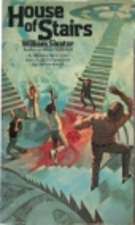 Summary:
Five sixteen year old orphans living in state institutions are called to their respective offices, blindfolded, and dropped off in a building that consists entirely of stairs and landings. There appears to be no way out. The toilet is precariously perched in the middle of a bridge, and they must drink from it as well. To eat they must bow to the whims of a machine with odd voices and flashing lights. It is starting to change them. Will any of them fight it, or will they all give in?
Review:
This book was enthralling from the first scene, featuring Peter awakening on a landing intensely disoriented and frightened. Showing a bunch of teenagers obviously in an experiment opens itself up to caricature and stereotype, but Sleator skillfully weaves depthves and intricacies to them.
The writing is beautiful, smoothly switching viewpoints in various chapters from character to character. Hints are dropped about the outside world, presumably future America, that indicate the teens are from a land ravaged by war and intense morality rules. For instance, their state institutions were segregated by gender. Sleator weaves these tiny details into the story in subtle ways that still manage to paint a clear framework for the type of cultural situation that would allow such an experiment to take place.
It is abundantly clear throughout the book that the teens are facing an inhumane experiment. Yet what is not clear at first is what a beautiful allegory for the dangerous direction society could take this story is. Not in the sense that a group of teens will be forcibly placed in a house of stairs, but that some more powerful person could mold our surroundings to make us do what they want us to do. To remove our most basic humanity. This is what makes for such a powerful story.
It’s also nice that friendship in lieu of romance is central to the plot. Modern day YA often focuses intensely on romance. Personally, my teen years were much more focused on friendship, and I enjoyed seeing that in this YA book. I also like how much this humanizes the animals facing animal testing, and Sleator even dedicates the book to “the rats and pigeons who have already been there.”
House of Stairs, quite simply, beautifully weaves multiple social commentaries into one. It is a fast-paced, engrossing read, and I highly recommend it to everyone.
5 out of 5 stars
Source: PaperBackSwap

Book Review: Feed by M. T. Anderson
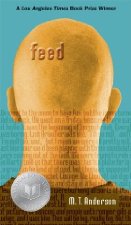 Summary:
Titus is your typical teenager of future America. He lives in a suburb where his parents program the weather. He drives an upcar. He’s got a feed–a microchip in his brain that allows him to chat silently with people, shop, look up anything he wants to know more about, etc… He’s also got a lesion, but a lot of people have those now. He is quite ordinary. But he meets a girl on a trip to the moon who is anything but ordinary. A girl who got the feed late and dares to question it.
Review:
This book has a great concept, essentially exploring what the world would be like if twitter was implanted into our brains. This is rather extraordinary given that twitter didn’t even exist yet when Anderson wrote it. It explores losing our individuality to machines and consumerism. Ceasing to care about important information due to being bombarded by inane information at all hours of the day. I just wish Anderson had taken this concept a different direction.
I immediately connected with Violet, the girl Titus meets on the moon. She’s quirky, is homeschooled, and really is a bit of a nerd who just wants a chance to try out hanging out with the popular kids and doing what they do. Titus is a complete and total asshole to her. I suppose I could forgive him for that if he showed that he learned anything from coming into contact with a person as powerful as Violet, but he doesn’t. He ditches her when she needs him most because she’s making him uncomfortable. He wants to stay in the cocoon of his feed-driven life, and nothing she does or says can change that. He clearly goes from girl to girl, using them up like paper towels or tissues, and then on to the next one. Maybe that was Anderson’s point–that the feed has dehumanized the people who have it–but it made for a less powerful book than if Titus had learned something. Anything.
Similarly some questions just aren’t answered simply because Titus doesn’t care, so we aren’t allowed to know. In particular the lesions are set up as some sinister mystery, but then we never find out why they are occurring. Nobody even really speculates as to why they’re showing up. They’re just there. I seriously doubt there’d be zero speculation over such a phenomenon, even in a future where people are obsessed with consumerism.
Overall, the concept and writing on a sentence level are good, but the story as a whole left me feeling empty and disappointed. There’s telling a bleak story, and then there’s telling a story that’s sympathetic to a jerkwad. This is the latter. If that type of story is something you enjoy, you will enjoy this book. Everyone else should look elsewhere, perhaps to The Hunger Games if you’re looking for a YA dystopia.
3 out of 5 stars
Source: Swaptree

Book Review: Viola in Reel Life by Adriana Trigiani
 Summary:
Viola loves her life in Brooklyn with her quirky filmmaker parents. Unfortunately, they need to go to Afghanistan to make a documentary and have dumped her in an Indiana boarding school for a year. Can Viola see past her homesickness and embrace what Prefect Academy has to offer or will she be Queen Snark for a year?
Review:
I came at this book simultaneously expecting to like it and not like it. I expected to like it, because when I was in the YA age group, I loved boarding school books, and I’ve read Trigiani’s Big Stone Gap trilogy and really liked her writing. On the other hand, reviews online stated they disliked it due to a negative portrayal of Indiana and what they felt was a lack of understanding of teenagers. Well, I liked Viola in Reel Life, and I would like to offer up rebuttals to both opinions.
First, the book is written from Viola’s perspective. She’s a fourteen year old who has spent her entire life in Brooklyn, and she didn’t want to go to boarding school. Her negative comments about Indiana are to be expected in this case. She’s a New Yorker in the country for the first time. Of course she’s going to think the fashion stinks. Of course she’s going to miss the noise of the city. Personally, I found Indiana and the folks in it to be portrayed in a positive light, because despite her anger and snark, they persist at comforting her homesickness and winning her over. She comes to like aspects of Indiana just as much as she likes aspects of Brooklyn. That is a key part of her growing up that is the main storyline. She has to learn to make home wherever she is and be independent. That point would not have come across strongly if she loved everything about Indiana from the moment she arrived.
Now to those who felt it was too young for teenagers, I think you’re starting to fall for the media’s portrayal of all teens as growing up very fast. They’re not all having sex, doing drugs, and drinking. I wasn’t that type of teen, and even teens who are can appreciate that not everyone is living a Gossip Girl life. It is a clean book, and I liked that because it left room for me to focus on Viola growing as a person. The kids are kind of innocent, and Viola acknowledges that she’s led a protected life so far. On the other hand, Viola and her friends have to deal with step-parents, new siblings, serious family illness, money problems, and more. Their problems are middle class type problems, but what’s wrong with that? Not everyone grows up abused or poor or filthy rich or debaucherous. The overall messages are excellent ones for teen girls to hear–be loyal to your friends, grow up and help your parents, don’t choose a boy over yourself, do your best and be gracious. Plus the storyline supporting these messages is fun and interesting to read.
My only complaint with the book is the minor sub-plot of a ghost. I don’t think it really fit in very well with the overall world and feel of the book. I would have much preferred that Viola find an old diary or something that made her come to understand Prefect Academy better. However, it wasn’t in the book enough to make me dislike the story.
Overall, it’s a fun read, and I recommend it if you enjoy YA lit or stories set in boarding schools.
4 out of 5 stars
Source: Won on Reading Sarah’s blog. Thanks!

Book Review: Leviathan By Scott Westerfeld
Thanks to my friend Margaret for lending me her ARC of Leviathan! I’ve enjoyed Scott Westerfeld’s other YA books, and my recent surge in curiosity about steampunk (due to love of the fashion) made me extra-curious about this new YA steampunk book.
 Summary:
World War I takes on a whole new look when the Allied powers function utilizing machine-like, genetically engineered animals, and the Axis powers use tanks that walk using steam power. In this alternate history reside Deryn and Alek. Deryn is a teenaged Scottish girl who pretends to be a boy so she can join the air service working aboard the Leviathan–an ecosystem that resembles a zeppelin. Alek as the son of the assassinated Austrian archduke must go into hiding in Switzerland, escaping with a few loyal servants and a walker–one of the walking tanks. Their worlds end up colliding, as worlds tend to do in a world war.
Review:
This book should come with a warning. “By YA we mean for middle schoolers younger than the characters, not late teens like Westerfeld’s other books.” Although this is technically YA, it reads like a children’s book. Some would say the lovely illustrations throughout made it feel that way, but I don’t think that’s the case. Some adult books are full of wonderful illustrations, yet we still know they are meant for adults. I really think it’s the storyline and the writing that came off so young this time. Maybe Westerfeld wanted to write younger, but his publisher should have notified his fans that this is a book meant for younger people.
Westerfeld does an excellent job of explaining the Darwinist world in a subtle way to the reader. I have difficulty even explaining the flying ecosystems to people, yet I understood them perfectly in the book. Similarly, I had no issue picturing the walkers, even though I couldn’t fathom why anyone would want to build such a thing. I also liked Deryn. She is a well-rounded character–with flaws, but still someone a young audience can look up to. Similarly, the most intelligent person on the airship is a woman, which is a feature I highly appreciated.
On the other hand, I found Alek to be a completely confusing and unsympathetic character. At first I thought he was about nine years old, then overnight he seems to be fifteen. Yes, I know his parents died, but I don’t think a fifteen year old would be playing with toy soldiers the night prior, regardless. Similarly, Alek repeatedly makes stupid decisions. I know characters sometimes make them, but he makes them so often that I just want to slap him upside the head. There is very little that is redeemable about Alek. By the time he makes a wise decision, I was so sick of him that it failed to raise my opinion of him at all.
Similarly, I’m bothered that all of the servants loyal to Alek are men. Why couldn’t a single woman be loyal to him? Deryn’s world consists of both powerful men and women, yet Alek’s is entirely male except for his low-born mother. I know this is early 20th century, but if you’re going alternate history, why not empower a few more women along the way?
Even though there is steam power and Victorian clothing in an alternate history, Leviathan didn’t feel very steampunky to me because, well, the setting is Victorian! Maybe I’m too into steampunk fashion, but I would have been far more impressed if all these things were true in an alternate history of the Vietnam War, for instance, or even World War II. I think World War I is just far too close to the actual Victorian age to truly feel like an alternate, steampunk world. I get enjoying books written in the Victorian era from a steampunk viewpoint, but current authors could be far more creative when utilizing this genre.
Finally, I have to say, I hate the ending! I know Westerfeld is a huge fan of writing trilogies, but this ending is far too abrupt. I was left going “what the hell?” instead of feeling pleasantly teased about the second book in the series.
Leviathan isn’t a bad book. It isn’t painful to read, and the storyline is enjoyable. It’s kind of like a mash-up of Jurassic Park, 20,000 Leagues Under the Sea, and your typical 21st century YA novel. Only minus all the blood, guts, and gore. Middle schoolers with a taste for the whacky will enjoy it. Older teens and adults should choose more sophisticated steampunk–perhaps even the classic 20,000 Leagues Under the Sea.
3 out of 5 stars
Source: Borrowed ARC from a friend

 Support my work with a tip or browse my shop for curated book club guides, how to guides, cross-stitch patterns, and more!


This work by Amanda Nevius is licensed under a Creative Commons Attribution-Noncommercial-No Derivative Works 3.0 United States License.
 Opinions of a Wolf