
Archive
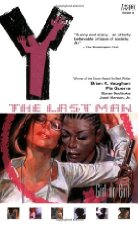
Book Review: Y: The Last Man: Girl on Girl by Brian K. Vaughan (Series, #6) (Graphic Novel)
 Summary:
We catch up with Yorick, 355, and Dr. Mann on board a freighter headed for Australia by way of Japan. They seem to have abandoned their hunt for Ampersand the monkey for now. The captain of the ship is gorgeous and has the hots for Yorick, but trouble arrives in the form of an Australian submarine. Is it the freighter or the submarine that is the pirates?
Review:
So the title is sort of a double entendre. We do get an excellent lesbian sex scene (inter-racial no less!), but we also have the war between the submarine of women and the ship of women. Haha, well played, Vaughan!
The great thing about this entry in the series is that by itself it has a lot of very cool elements, but it also moves the plot forward. We find out some about what’s been happening on the other side of the globe since the men died, characters hook up, and we get some really good action. It gets us places (specifically moving across the ocean), but it doesn’t feel like a filler book the way #4 did.
Plus, the Pacific Islander ship captain is really hot and badass.
Overall, this is an excellent entry in the series that is entertaining and moves the plot forward. Fans will not be disappointed.
5 out of 5 stars
Source: Public Library

Previous Books in Series
Y: The Last Man: Unmanned
Y: The Last Man: Cycles
Y: The Last Man: One Small Step
Y: The Last Man: Safeword
Y: The Last Man: Ring of Truth
Book Review: The Rabbi’s Cat 2 by Joann Sfar (Series, #2) (Graphic Novel)
 Summary:
The talking cat with the big ears who offers insightful commentary on his rabbi master and life in Algeria in the early 20th century is back. The rabbi’s daughter is fighting with her husband (also a rabbi), and the cat is quite happy with that. It means more snuggles from his mistress, Zlabya. Of course, the talking cat also has a couple of adventures. First he and a snake tag along with the famous Malka and his lion on a trek around the desert. Then, a stowaway Russian Jew shows up in Zlabya’s house, and he understands the cat! Soon a rag-tag bunch are off looking for the mysterious lost city of Jerusalem. We thus get to see a lot of Africa through the cat’s eyes.
Review:
I have to say, I didn’t enjoy this sequel quiiite as much as the original. I suspect that the fact that I was less familiar with the topics the cat is offering snarky commentary on had something to do with this. I really don’t know much about Northern Africa or the “lost city of Jerusalem,” so I’m sure I missed some of the inside jokes. Whereas the previous book was mostly about Jews in Algeria and the French occupation, this book seems to talk a lot more about the relative merits of the various monotheistic religions and why can’t we all just be friends.
While on their various treks, the groups run across some Muslim tribes who state that Jews are their brothers who they respect, but it is still their duty to attempt to get them to convert. The rabbi eloquently states that he is too old to learn a new language for prayer, and he is sure god will understand. Similarly, the Russian Jew falls in love with an African woman (I am uncertain from which country), and they ask the rabbi to marry them. He says he can only marry two Jews, and she states she is glad to take her husband’s god as her own. Exasperated, the rabbi states it is not that simple, she must study for years, but then relents when seeing how in love they are and says that god will understand. The cat too has learned when to hold his tongue around extremists, although he still offers commentary to the other animals, whether over an obsessive Muslim prince or a Kabbalistic elderly rabbi. What is incited repeatedly in this book is extremism in favor of tolerance and love, which is certainly always a good message.
The other message is never to judge someone as less intelligent than you simply because they speak a different language or their ways are different. I really like how this is carried over into the animal kingdom where the cat even seeks to understand the snake. At first the cat thinks the snake just willy-nilly bites people and animals, but then he realizes that this is his only tool of friendship. And yet although we should seek to understand, the cat also doesn’t hang around too long anyone who is extremist or annoying. The Muslim prince and the English explorer (who thinks the Algerians don’t bathe) are both quickly dumped by the traveling group.
While these are all good messages, I must say I missed the no holding back talking cat of the first book. I suppose he’s older and wiser, but I like him precisely because I can’t imagine a talking cat ever actually holding his tongue. Seeing him do so in this book made me kind of sad. Also, I feel like the story of Zlabya and her husband got dumped partway through and never picked back up. We know they’re fighting a lot, but then we just leave them and go off on an adventure across Africa. It felt like a final chapter was missing from the book.
Overall, this is an interesting look at the intersection of many cultures, religions, and races on the continent of Africa through the unique eyes of a rabbi’s cat, a wandering lion, and a friendly snake. If you enjoyed the first book, you shouldn’t skip this one.
3.5 out of 5 stars
Source: Public Library

Previous Books in Series:
The Rabbi’s Cat
Counts For:
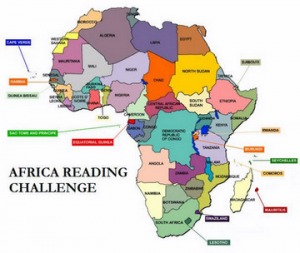
Specific country? Algeria, primarily
Friday Fun! (Cool People I Follow!)
Hello my lovely readers! I don’t have too terribly much to update you on today since I managed to get bronchitis “with a touch of strep” and have been down for the count all week. I am on antibiotics now. They are a beautiful beautiful thing. Anyway, so since my life this week has mostly consisted of laying around with a fever watching Big Bang Theory and Battlestar Galactica on repeat, I thought I’d do something different today and let you guys know about a few unique folks I follow in my GoogleReader that you might want to check out.
ANZ LitLovers LitBlog is a book blog I just recently discovered that focuses in on the literature of Australia and New Zealand. The instant I saw the title of the blog I went, “Wow, duh, what a gap in my reading!” She has a great page featuring a listing of must read ANZ lit titles.
Joe’s Blog is one of the few author blogs I follow (as opposed to authors who happen to have book blogs. I follow a few of those). Joseph Robert Lewis is an indie author whose books are available as ebooks, and he is a smart dude. Not only does he write scifi/fantasy/steampunk with a feminist slant out of a desire to write the types of books he wants to be available for his daughters to read, he’s also a really giving guy. He has a great section of advice for fellow writers looking to self-publish and maintains a great relationship with his readers (um, including me). His blog itself is an awesome mix of posts on what inspires his scifi/fantasy/steampunk worlds, his own life, and musings on writing. Oh, also, he came up with this awesome idea for a series co-written by a bunch of authors who have never met before all set in the same universe, and he’s actually pulling it off. The dude is creative and productive. Check him out, even if his books aren’t your genre.
Native Appropriations is run by fellow Boston gal, Adrienne, who is a member of the Cherokee tribe and currently studying for her PhD. Her posts discuss representation and appropriation of Native American culture in American pop culture and media. Her posts are thought-provoking and eloquent. Seriously, get rid of your People Magazine and Cosmo subscriptions and read what this smart lady has to say instead.
No Meat Athlete is run by a male vegan who also is, you guessed it, an athlete. He primarily runs marathons, but his posts feature great information for any type of athlete or fitness fan who is plant-based. I particularly found his post 7 Secrets of Post Work-out Recovery super useful for this plant-based weight-lifting lady. He’s also going to be doing the Boston Marathon. Yeahhhhh!
Finally, for everything vegan from vegans in the news to animal rights to product reviews, definitely follow Vegansaurus. They are my go-to site for sane animal rights coverage (unlike PETA *cough*). They also feature real life help this one situation here this one time if you can shout-outs that help me feel connected to the animal rights community. (Like one time we all got together to help a gal get her pup needed surgery, because, you know, who actually has insurance for their pets?) Between that, the cookbook reviews, the recipes, the products, and the news bits, it’s one of my favorite news sources.
I hope you all found some new reading material. Happy weekends!
Movie Review: Guess Who’s Coming to Dinner (1967)
 Summary:
A liberal couple’s beliefs are challenged when their daughter comes home from a Hawaiian vacation with a surprise fiance who just so happens to be black.
Review:
I am chagrined to say that I saw the awful, horrible 2005 remake of this classic prior to seeing the classic version. That attempt at humor (that was totally unfunny) thus had me coming at this film rather skeptically, but it was in my suggested films pile on Netflix, and given that I’d just finished up The Real Help Reading Project, I thought a classic 1960s film exploring the black/white issues in America just might be interesting. It certainly was not what I was expecting.
First, the cast is absolutely stellar, featuring Katharine Hepburn, Sidney Poitier, Katharine Houghton, Spencer Tracy, Beah Richards, Cecil Kellaway, and Isabel Sanford. These people have serious acting chops, and I doubt a lesser cast could have pulled off this film. In particular, I cannot imagine another person in the role of the mother than Katharine Hepburn. Now THERE is an actress.
The film feels more like watching a dramatic play in three acts. There is a lot of dialogue and emotional speeches. It may feel a bit heavy-handed to the modern viewer, but it must be remembered the world this film was made in. One line really reminds the viewer, when the young couple are reminded that their relationship is still illegal in sixteen or seventeen states. Wow, ok, suddenly both sets of parents’ concern that their children are choosing an incredibly tough life for themselves doesn’t seem like such an over-reaction. It puts the whole film a bit more into perspective.
That’s what the film is really about. It isn’t about either set of parents being prejudiced against a skin color. They’re concerned that the prejudice of the world will make the marriage unbearable for their children. The movie is about choosing to stand up and hold on to the ones you love in the face of prejudice. That’s a powerful message and not at all the issue I was expecting to come to the surface in this film.
Now consider all of those to be reasons to watch this classic that’s a classic for a reason. I now want to talk about one character whose presence was totally different to me since doing The Real Help–that of the white family’s maid, Tillie. Tillie’s role seems to be that of reassuring the (white) audience that not just the white parents are concerned about this black man John. She immediately is in fisticuffs over the whole thing. She tells John, “I don’t care to see a member of my own race getting above himself. ” She threatens him that she knows his type and although he may be able to fool the white folks, he’s not fooling her. She even says, “Civil rights is one thing. This here is somethin else!” The daughter tells Tillie that she loves her and loving John is no different, and the parents even have her come sit down for the big finale stating that she’s “one of the family.” What is fascinating about this completely false and stereotyped role of Tillie in this film is that it is there in the midst of a forward thinking main plot. It is as if the filmmakers wanted to give the audience the familiar, non-threatening, stereotyped role of the trustworthy black help that is in favor of the status quo to help them feel more comfortable during the film. Perhaps that is the case. But even if the choice was deliberate and worked for the audience at the time, I personally found the role to be Tom-ing and distracting from the much better main storyline. However, it is also fascinating how a movie with a role like this *still* is better than The Help.
Overall, this is a classic deserving of the title. Although it is a bit dated, if the audience bares in mind the actual world of race and racism at the time the film was produced, they will be surprised at how progressive it actually was.
4 out of 5 stars
Source: Netflix

 Support my work with a tip or browse my shop for curated book club guides, how to guides, cross-stitch patterns, and more!


This work by Amanda Nevius is licensed under a Creative Commons Attribution-Noncommercial-No Derivative Works 3.0 United States License.
 Opinions of a Wolf