
Archive
Book Review: The Sparrow by Mary Doria Russell (Series, #1) (Bottom of TBR Pile Challenge)
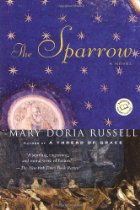 Summary:
It is the year 2060, and the Jesuit priest Emilio Endoz has been found on the planet Rakhat by the second Earth ship to travel there. Found in a whorehouse and killing a native inhabitant in front the UN members’ eyes, they nonetheless strap him into his original spaceship and send him back to the Jesuits. There he is treated for his horrifying wounds and through a series of flashbacks and current conversations with the various Jesuit committee members assigned to his case, we slowly see how everything that started out so right went so horribly wrong on Rakhat.
Review:
It may have been a while since it made it onto my tbr shelf, but I still have a crystal clear memory of why I acquired this book. I entirely blame Little Red Reviewer, who just so happens to be the only other female scifi fan who book blogs that I’m aware of. (Feel free to enlighten me to more in the comments). Her review that religion is there but in a questioning way that honors the tradition of scifi made me give this book with a Jesuit priest and mission at its core a chance. I’m glad I did.
This is a first contact story that takes the all-too-infrequent route of Earth finding the inhabited planet first and sending a mission to them. There’s so much more than that that makes this book unique, though. The future Earth just barely has the technology to make it to Alpha Centauri, and only the most tech-savvy are aware of it. Thus, we’re not an incredibly advanced civilization making first contact, just one slightly more so than Rakhat. I’d say a fair comparison might be late 19th to early 20th century earth to early to late 21st century Earth. It’s a short span of difference. Additionally, Russell made the intriguing choice of the first contact being run by missionaries, instead of a political unit. When you think about it, it makes perfect sense. Who tended to be first to the New World? Religious groups. Who can organize themselves quickly and have vast finances? Religious groups. Having first contact be missionaries makes so much sense that I’m shocked I didn’t think of it first.
That said, thankfully this book is not a love letter to organized religion or mission work. It is instead a complex, scientific, and anthropological study of the human condition, the difficulties of vastly different cultures meeting, linguistics, and much more. At its core it is all about why does god (if there is a god) let evil happen, especially to good people who are serving him? These issues are more easily addressed and made further complex by having agnostics, non-practicing Catholics, and a Jewish woman members of the mission team. The non-believers are about at even numbers with the priests. In fact, the deeper into the book I got, the more it tore at my heart-strings. Varying types of questioners are represented, and of course it’s possible to identify with many of them, particularly for a reader who once was religious but is not anymore. There’s the priest who is secretly gay, the Jewish woman who was wounded terribly by war but comes to learn to love again, the Father Superior who thinks he may be seeing the formation of a real live saint, the priest questioning the very existence of god, and the agnostic who wants to have the beautiful aspect of faith that she sees in those around her.
This book reads, it sounds a bit odd to say, almost like an agnostic’s prayer. Of course agnostics don’t pray, but if they did pray, the pain and wondering and intelligence found in this book would all be there.
We are, after all, only very clever tailless primates, doing the best we can, but limited. Perhaps we must all own up to being agnostic, unable to know the unknowable. (page 201)
The problem with atheism, I find, under these circumstances…is that I have no one to despise but myself. If, however, I choose to believe that God is vicious, then at least I have the solace of hating God. (page 394)
People more into science than the questioning human spirit will find plenty for themselves as well. The science of linguistics is astoundingly well presented. The way the two “sentient” species on Rakhat have evolved is also incredibly well thought-out and realistically drawn. The problems of poverty and war on earth are briefly explored too.
All of these things said, I do feel it took a bit too long to get things set up and moving. Granted, I tend to be a bit of an action-focused reader, so others may not have a problem with that. It was still a draw-back of the book for me though.
I sort of feel like I’m not doing the experience of reading this book justice. Suffice to say if you’ve ever questioned whether or not to have faith and love your big questions to be wrapped in well-thought-out scifi, this is the book for you.
4 out of 5 stars
Source: Better World Books

Counts For:
Book Review: Blanche on the Lam by Barbara Neely (Series, #1) (The Real Help Reading Project)
 Summary:
Blanche’s employers failed to pay her on time, and now she has some bad checks. She had no idea that bouncing a few checks would land her with a 30 day jail sentence, though, so when she gets the chance, Blanche goes on the lam. She decides to take a temporary job she had originally decided against as a way to hide out. She’s going to be the help for a family on a week-long vacation in the countryside. Naturally, things can never be simple, and Blanche starts to suspect one of the family members is a murderer.
Review:
It’s hard to believe Amy and I are on our penultimate book for the project, not to mention the final fiction book on the list. And what a book! If I had to pick one of the fiction books we read to hand to fans of The Help to get a much more real representation of black women in domestic service, this is definitely the book I would hand them.
Somehow this tiny mystery novel (called a Kriminalroman in German, which I think sounds much better) manages to cover pretty much every aspect of black female domestic workers’ lives that we’ve discussed throughout the project. Blanche faces: police and criminal justice prejudice, stinginess on the part of wealthy employers, rape at the hands of a white male employer, classism, employers’ racist attempts to control her body, non-traditional family structure, and much much more. Yet facing all of those odds, Blanche remains determined and strong. She is not someone who needs OR wants a white woman (or man) to come along and rescue her. I think Blanche’s personality is best summed-up here:
She always returned to domestic work. For all the chatelaine fantasies of some of the women for whom she worked, she was really her own boss, and her clients knew it. She was the expert. She ordered her employers’ lives, not the other way around. She told them when they had to be out of the way, when she would work, and when she wouldn’t. (page 86)
That’s one of the wonderful things about this book. It turns the whole white woman saving the help thing from The Help on its head. Blanche is the one who saves the white family in this book, and then she refuses to accept help from them in return, beyond clearing up her ridiculously unfair legal troubles. Instead of taking a cushy job with them, she leaves, because she is her own woman.
Now, all of that said, I was personally a bit distracted from the race and class issues in this book due to the presence of the character Mumsfield. Mumsfield is the cousin of the sinister family members, and he has Down’s Syndrome. I don’t think all of my readers know this, but my niece has Down’s, so I certainly am a bit sensitive to the portrayal of it in literature. Knowing and loving a person with Down’s removes a lot of the misperceptions of it that exist in the world. At first, I was concerned that Neely had fallen for these things. Mumsfield at first seems too trusting, too caring, a real simpleton. But by the end of the book, Blanche realizes that she hadn’t really listened to what Mumsfield was actually saying earlier in the week. If she had, she would have realized that while Mumsfield is kind and giving, he’s not stupid. Knowing Mumsfield also helps Blanche see that her experiences as a black woman in America have made her racist against white people, when not all of them are bad. Thus, I am pleased to report that Mumsfield is actually an accurate and positive portrayal of people with Down’s.
Now, I will say, personally I’m not generally into the typical mystery novel. I like to get my genre reading from urban fantasy, pnr, and cozies. I am well aware, though, that a lot of people love this kind of book, and it is definitely well-done. It has all of the well-loved aspects of the genre, plus manages to address race, class, and even Down’s Syndrome. It is absolutely a worthwhile read.
3 out of 5 stars
Length: 215 pages – average but on the shorter side
Source: Library
Buy It (Amazon or Bookshop.org)
Discussion Questions:
- How do you feel about Blanche’s initial jail sentence and her decision to go on the lam?
- Blanche sees Mumsfield as an exception to the rule when it comes to white people, aka it’s unusual for them to be kind. Do you think this is an unfair assessment?
- Blanche assesses her caring for Mumsfield as a symptom of “Darkies Disease” aka when the help start acting like the idealized Mammies. What do you think of this assessment?
If you found this review helpful, please consider tipping me on ko-fi, checking out my digital items available in my ko-fi shop, buying one of my publications, or using one of my referral/coupon codes. Thank you for your support!
Friday Fun! (Freelance Editing, Reading Projects, and United States of Tara)
Hello my lovely readers! Gosh, things have been hopping here this January, haven’t they? I’m not sure why my reading has reached such a nice, steady rhythm, but I’m certainly enjoying it. :-)
A quick announcement. I’ve decided to start freelance editing. If you’re at all interested, please check out the dedicated page for more details. You all know that I’m a trustworthy, hard-working, smart gal, so I’d also appreciate it tons if you’d help spread the news. Thanks!
I was super-pleased at the extent of conversation and interaction that the first book for the Diet for a New America Reading Project saw. Thanks guys! Next month is The China Study
Tomorrow is the discussion of the penultimate book in The Real Help Reading Project–Blanche on the Lam
On Wednesday I was home sick, and you know how sometimes when you’re sick you just don’t have the focus to read. I therefore poked around my Netflix account and was pleased to see that the final season of United States of Tara was finally up on instant. The United States of Tara is a Showtime half-hour show about a woman with Dissociative Identity Disorder (formerly known as Multiple Personality Disorder) trying to learn to cope with her disease without creativity-numbing medications so she can be free again to pursue her art. I was very pleased with the first two seasons that showed the reality of coping with a mental disease, but that did not demonize Tara or bestow sainthood upon her family members. I thus was really disappointed to see the third season take such a nosedive, and now I’m thinking I’m going to have to remove it from my recommended list.
The thing that made US of Tara so appealing in the first two seasons was that, yes, sometimes Tara did bad things as the result of her illness, but she was fairly good at finding a balance. She made mistakes like healthy people, just for different reasons. In season three, though, Tara develops a new alter who is pure evil. We’re talking stabby, Psycho sound effects, steals babies and tears her own teenage son’s room apart evil. This alter is an abuser alter–an alter who takes on the whole personality of Tara’s abuser. Now this is a real thing in DID (source) but the show handles it all wrong. Yes, the new alter is scary and would be to all of the known alters, Tara, and her family. However, having the alter kill all of Tara’s other alters then Tara kill the abuser alter is the exact opposite of how healthy healing from DID works. Healthy healing is either learning to cope with having alters or integration. Killing your alters and then proceeding to run off to therapy after the fact shrieks of writers who didn’t get their facts straight. For a show that started off so strongly and well-supported by the Mental Illness Alliance community, I was really disappointed in this.
The other bad message in season three that really bothers me as an advocate is the change in Tara’s family and how they handle things. Tara basically becomes too much for them to handle, and they all want to ship her off and lock her up. Ok, some people do need in-patient treatment, and I definitely would have re-entered Tara into real therapy much sooner than her family does to prevent all this drama in the first place, but essentially the family comes to say that Tara isn’t worth it. Tara is too much to handle. They’re just gonna go do their thing now. They even judge Max, Tara’s husband, for refusing to not continue to stick by her. He insists repeatedly that he’s neither a stupid person nor a saint. He just loves Tara. Yet, in the end, the whole family is torn apart, leaving just Max and Tara.
While it is, unfortunately, very true that a lot of people abandon loved ones with a mental illness, one of the positive aspects of this show was that it let people with a mental illness believe that in an enlightened family unit, it doesn’t have to be that way. Season three kills all that. The only one who truly loves and advocates for Tara is Max, and everyone else feels pity for him because of it. Sad stuff. Definitely not advocate stuff.
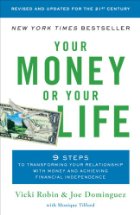
Book Review: Your Money or Your Life: 9 Steps to Transforming Your Relationship with Money and Achieving Financial Independence by Vicki Robin and Joe Dominguez
 Summary:
Dominguez achieved Financial Independence at the ripe old age of 30 and proceeded to provide his method to friends who encouraged him to offer it as a class. He finally wrote a book, and this edition is revised and updated for modern times by his friend and fellow achiever of Financial Independence, Vicki Robin. Offering steps and mind-set changes, not magic formulas, they promise that if you follow the steps, you can be Financially Independent in 5 to 10 years, no matter how much debt you are currently in or how much money you make.
Review:
It took me an astoundingly long time (for me) to read through this book, partly because the information really does alter your world-view, and partly out of a desire to let each step sink into my mind before reading the next one. I took sixteen pages of typed notes, something I haven’t done since grad school (ok, ok, undergrad….). The information is just that good.
What is Financial Independence? It’s when you’re out of debt and making enough income off of safe investments that you do not have to work for a living. This frees you up to do what you want with your life, whatever that may be. Some people volunteer, others start a business, some spend their time with family, some travel, the options are endless.
The steps are simple and straight-forward, but they all come back to the central idea that money is something we trade our life energy for. It seems obvious when you hear it spelled out that way, but personally it was not routine for me to think of my money and spending in that manner. Not anymore. When I was a work-study student and got to keep all my money, no taxes, no commute time, no work wardrobe to buy, no work lunches, it was easy to think “Ok, I have to work this many hours to buy this thing.” Grown-up, real world work isn’t that obvious. So figuring out my “real wage” by calculating out how many hours I actually spend working (including commute and lunch break), the cost of working (work wardrobe and T pass), reveals that one hour of my life equals $7. I figured this out back in December. Trust me, it completely changed my spending habits. It’s abundantly clear when you look at my mint.com account.
So, I can say that the early steps definitely have changed me. Can I tell you this book will work, and I will be Financially Independent in 5 to 10 years? No. I have no clue yet. I can tell you, though, that the steps are real and not toted as magic. It will take a lot of work. That, combined with the effects on me of the early steps, are enough for me to say that this book is worth it. It teaches you to be in control of your life, instead of letting money and the “American Dream” control you. But let me tell you the nine steps, just to prove to you that none of them are a “magic formula” type thing.
- Make peace with your past
- Track your life energy
- Tabulate monthly
- Ask yourself the three questions for each category during your monthly tabulation: a) Did I receive fulfillment, satisfaction and value in proportion to life energy spent? b) Is this expenditure of life energy in alignment with my values and life purpose? c) How might this expenditure change if I didn’t have to work for a living?
- Make a wall chart where you can plot your monthly expenditures, total income, and investment income in three different colors to help you see change and progress over time.
- Value your life energy by minimizing spending
- Value your life energy by maximizing income
- After you’ve tracked on your Wall Chart for a while, calculate your Crossover Point–the point in the future where your investment income and expenditures meet and “cross over.”
- Become knowledgeable and sophisticated about long-term income-producing investments and manage your finances for a consistent income sufficient to your needs over the long term.
If these steps intrigue you and you have a desire to become Financially Independent, then I strongly encourage you to read this book. In fact, I encourage everyone to read at least the first few chapters to learn how to have a different relationship with money. One where you are in control of it and thus regain control of your life.
5 out of 5 stars
Source: Public Library

Book Review: Death Island by Joan Conning Afman
 Summary:
In future America the prisons are so overcrowded that the government needed to come up with a new idea. So they started sending the worst criminals to a remote island to live out their lives (or deaths). Naturally, this Lord of the Flies style punishment is also a nationally televised weekly reality tv show. When Danny is wrongfully accused of serial killing five women with an axe, including his own wife, this reality tv show becomes his stark….reality.
Review:
At this point, the idea of a reality televised punishment type thing run by the government is relatively passe. A trope of the dystopian scifi genre, even. However, Afman does bring a unique twist to this basic idea that keeps the book fresh and engaging.
For instance, the inhabitants of the island are not forced to pit themselves against each other. They sort of naturally divided up into the Village, the Tribe, and the loners. The Village consists of those men who feel badly about their crimes and are trying to live out their lives with some semblance of normalcy. A lot of them have formed couples and shacked up. The Tribe are basically the psychopathic killers who periodically get drunk on their homemade rum and randomly attack others on the island. The loners are relatively self-explanatory. Having this type of conflict naturally happen instead of forcing it upon the participants is a nice throwback to The Lord of the Flies.
On the other hand, the fact that Danny proclaims his innocence and is innocent makes the plot far less appealing to me. There’s no real moral ambiguity at the center that would drive the reader to question her own belief system or the concept of justice in general. It’s odd to me that Afman chose Danny as the main character when there is a minor character on the island who admittedly committed a crime but perhaps for the right reasons. This is where the meat of a real story would lie. Choosing Danny instead makes it sort of like those tv shows people put on for background noise but don’t pay any real attention to.
Of course, Danny is not the entire plot. We also have the minister’s wife, Charlie, who firmly believes in Danny’s innocence and works toward freeing him. She provides the connection to the real axe murderer and a really odd romance layer to the book. Seeing the program how those in America do is interesting, but wouldn’t it be more interesting to travel around to various viewing parties in the US? Perhaps to those who are blood-thirsty to the casual viewers to family members of those sent to the island, even. Instead, every time Charlie’s plot interrupts Danny’s it’s distracting.
All of those things said, it’s not that the book is badly written. It’s not. It’s just not amazing or even very good. It’s just good. It entertains for a couple of hours and then is easily tossed aside. Perhaps for some people that’s enough. Personally I was hoping for more.
Overall, I recommend this book to those who are a fan of the concept looking for a light, quick read.
3 out of 5 stars
Source: LibraryThing’s EarlyReviewers

Book Review: The Baker’s Daughter by Sarah McCoy
 Summary:
It’s 2007, and Reba is a journalist living in El Paso, Texas, with her fiance, border patrol guard, Riki. She hasn’t been able to bring herself to be fully honest with him about her dark childhood overshadowed by her Vietnam Vet father’s struggle with depression and PTSD. Christmas is coming up, and she is interviewing Elsie, the owner of the local German bakery. Elsie has some intense secrets of her own that show it’s not always easy to know what’s right when your country and family go wrong.
Review:
I have an intense love for WWII stories, and I immediately was drawn to the idea of intergenerational similarities and learning from an older generation innate in this book’s plot. It is a complex tale that McCoy expertly weaves, managing to show how people are the same, yet different, across race, time, and gender.
Reba’s and Elsie’s tales are about two very different kinds of bravery. Reba has a wounded soul that she must be brave enough to reveal to the man she loves. She lives in fear of turning into her father or losing herself entirely in the love for another, the way her mother did. She faces a struggle that I have heard voiced by many in my generation–do I risk myself and my career for love or do I continue on alone? To this end, then, the most memorable parts of Reba’s story, for me, are when Elsie advises her on love in real life, as opposed to the love you see in movies and fairy tales.
I’ve never been fooled by the romantic, grand gestures. Love is all about the little things, the everyday considerations, kindnesses, and pardons. (location 482)
The truth is, everyone has a dark side. If you can see and forgive his dark side and he can see and forgive yours, then you have something. (location 844)
One issue I had with the book, though, is that although we see Elsie’s two relationships before her husband in stark clarity and reality, we never really see what it is that made her ultimately choose her own husband. We see their meeting and first “date,” yes, but that’s kind of it. I felt the book was building up to what ultimately made Elsie choose her American husband and move to Texas, but we only see snippets of this, whereas we see a lot of Elsie’s interactions with her prior two boyfriends. That was a big disappointment to me, because I wanted to know how Elsie knew he was the one, and how she herself was brave enough to take the leap she encourages Reba to make.
I am sure most people will most intensely react to the story of Elsie’s actions to attempt to save a Jewish boy during WWII and may even wish that was the only real story told. Elsie’s life during wartime Germany. It is definitely the stronger of the two stories, but I so enjoyed the lesson in valuing and listening to those older than you that we see through Reba meeting and learning from Elsie that I must say I like the book just the way it is. Is it different? Yes. But that’s part of what makes it stand out in a slew of WWII fiction. Elsie did this brave thing, and her whole life she never knew if it really made much of a difference. She just lived her life, married, had a daughter, was kind to a journalist. In a sense, it makes her story seem more realistic. Less like something from “The Greatest Generation” and more like something possible to accomplish for anyone with a strong will and willingness to make up her own mind.
One critique I have that slowed the book down for me and made it less enjoyable are the insertion of letters between Elsie and her sister, Hazel, who is in the Lebensborn program. Compared to the rest of the book, the letters were slow-moving and only moderately interesting. I can’t help but feel shorter letters would have gotten the same message across without slowing down the story quite so much. Yes, the inclusion of the sister was necessary to the story, but I feel like she got too much stage time, as it were.
I also have to say that I really hate the cover. It reflects none of the spirit or warmth of the book itself. The story is wrapped in warm ovens, scents of cinnamon, and bravery, and yet we get the back of a woman’s head with an inexplicable gingham strip at the bottom? Yeesh.
Overall, this is a life-affirming story that teaches the value of connecting with the older generations and cautions against thoughtless nationalism. I highly recommend it to fans of literary and WWII fiction alike.
4 out of 5 stars
Source: NetGalley

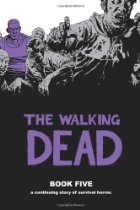
Book Review: The Walking Dead, Book Five by Robert Kirkman (Series, #5) (Graphic Novel)
 Summary:
After the slaughter at the prison, Carl and Rick are alone in the open, keeping a constant vigil against the walking dead. They are not alone for long, though, quickly finding Michonne and the other survivors. Soon yet another group of strangers stumbles upon them. These ones, though, claim that one among them is a scientist who knows how the whole plague started, and they’re heading to DC to put a stop to it.
Review:
This entry in the series could easily be called, “The survivors start losing their damn minds.” Not that you can blame them, what with the constant deaths, being surrounded by zombies, and disturbingly frequent loss of limbs. (Seriously. If I’m ever in a zombie apocalypse, I’m wearing chain mail. The amount of limbs lost is starting to freak me out).
Basically, almost everyone in the group is starting to show symptoms of post-traumatic stress disorder, in spite of still being in the middle of trauma. I applaud Kirkman for being realistic and including the whole going crazy bit in the storyline. Too often in these sort of post-apocalyptic stories the people all show this unrealistic super-human strength. Having people talking to their dead relatives, people trying to commit suicide, people pretending like some of the dead never existed, and kids becoming surprisingly cool-headed about killing are all realistic outcomes of a hypothetical scenario. The character development at this point is basically the kids are turning cold and the adults are losing their shit.
Meanwhile, the plot has the much needed addition, finally, of a scientist. We are being teased by a possible reason for the zombies, after finally accepting there isn’t one, and it’s awesome.
Speaking of the zombies, this book finally delivers what we haven’t really seen since book one–a zombie herd. A horde of hundreds and hundreds of flesh-eating zombies. So much gore to look at. And each one is unique in its own way. This is why zombie graphic novels are *fun*.
In spite of the character development and propelling of the plot forward, this entry does not have the power of the last one. It’s hard to compete against The Governor and the loss of key characters, of course. This book felt like the classic setting the stage for the next big event syndrome often found in series. It’s fun, not mind-blowing, but necessary.
4 out of 5 stars
Source: Public Library

Previous Books in Series:
The Walking Dead, Book One
The Walking Dead, Book Two
The Walking Dead, Book Three
The Walking Dead, Book Four
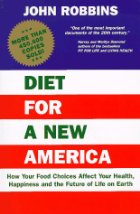
Book Review: Diet For a New America by John Robbins (Diet for a New America Reading Project, Book 1)
 Summary:
John Robbins was born into one of the most powerful corporations in America–Baskin-Robbins. A company based entirely on selling animal products. Yet he took it upon himself to investigate the reality of animal products and their impact on Americans, American land, and the world overall. This book summarizes his extensive research, including personal visits to factory farms.
Review/Discussion:
This is the first book in the Diet for a New America Reading Project 2012 I am hosting. The project is focused on educating ourselves on the facts behind health and preventative medicine for the well-being of all Americans, an issue that I am sure we can all agree is a serious one. If you join the project late, please feel free to come back to this post or the GoodReads group after you’ve finished the book to join in on the discussion. And now, on to the book!
There are books that you read that are so incredibly powerful you are left almost speechless. Simply wanting to hand out copies to everyone you know, everyone you meet and say, “Please, read this.” I highlighted so much in my copy that I couldn’t even do my usual of posting all highlighted quotes to my tumblr. I discovered I was practically illegally reproducing the book, hah. ;-) I thus will do my best to highlight precisely why I find this book trustworthy, why I feel inspired by John Robbins, and the most stunning facts I learned while reading the book.
Why You Should Trust This Book
As a medical librarian, I was very careful to check out Robbins’ resources for his facts, particularly for the health section, which is what this project is focused upon. Robbins drew his research from vetted, peer-reviewed, well-respected scientific journals, including ones I routinely use in my own work, such as Journal of the American Medical Association, the British Journal of Medicine, and The American Journal of Clinical Nutrition. He also cites the studies of such organizations as the FDA, the EPA, and the National Cancer Institute. Additionally, he conducted personal interviews with real factory farmers and scientists. Additionally, all of his citations are in order. You may not like the facts he reports, but they are still scientifically backed-up facts.
The fact that John Robbins researched the effects of animal derived foods on the environment and people and decided that it is bad for everyone involved is remarkable when you consider the fact that he comes from a family whose business is based entirely on selling dairy to Americans. If the man had an innate bias, it would absolutely be on the side of carnists/omnivores, but he astoundingly conducted the research and came down on the side veg*ism. (His family reunions must really be something…) This not only makes me respect him, but trust him. Somebody must be truly convinced to convert away from a business that has made his family, and presumably himself if he had agreed to take over the business, extremely wealthy.
But enough about why this book is trustworthy. Let’s move on to discuss the astounding scientific facts revealed in the three different sections: animal rights and factory farming, health consequences of eating animal based products, and environmental consequences of meat-based diets.
Animal Rights and Factory Farming
I definitely believe this knowledge is more widely spread than when this book was first published. I have a hard time imagining growing up in America and not coming to understand the horrors of factory farming, but you never know. Robbins talks about the psychiatric fact that children who grow up abusing animals are more likely to become criminals in later life. This, of course, is a basic reason to not base an entire sector of the American economy around factory farms that treat animals horribly like cogs in a machine. Of course there are more reasons to treat animals well, such as the fact that dogs’ EEG scans are identical to human’s or that dolphins routinely save humans and other animals in the ocean or that many species of animals mate for life showing a dedication most humans can’t pull off.
The horrors of factory farming are so extensive that it’s difficult to even list them. I feel as if I could go on and on. Perhaps the best way is to tell you to imagine being in the most crowded elevator possible. Now imagine that 20 of the 24 hours you’re in there it’s dark. You’re standing on a slanted, slatted, metal floor. The food for everyone is all on one side and is dumped in all at once and you must shove and race to get to it. Of course it’s difficult to even call this food. It’s a mix of shit, paper, sawdust, chemicals, and antibiotics all spiked with yet another chemical to make it smell better to you. If you are female, then a hand periodically reaches in and artificially inseminates you, only to rip your baby away from you the instant it is born and hitch machines up to your mammary glands instead of allowing your milk to go to your baby. If you are male, you are castrated by placing a band around your testicles until they fall off after weeks of the circulation being cut off.
That is the reality for factory farmed animals. Even if you can manage to ignore the fact that these animals are being pumped full of chemicals and artificial growth hormones that you will then ingest yourself when you eat them or their products, that is still a horrifying way to get your food. These animals live in terror and pain and die in terror and pain. There is nothing natural about a factory farm. Animals were meant to live outside and graze and nurse their babies and maybe live in a herd or a flock. Not be caged up in situations so unnatural that they literally go crazy and cannibalize each other when they are naturally herbivores. That is the reality of what you are supporting when you buy factory-farmed animal products.
Human Health
Ok, so maybe now you don’t believe in factory farming, but what about eating animals in general? We were raised to believe that a healthy diet involves meat, dairy, and eggs, right? Surely if an animal is raised organically and humanely all will be well? Well, the meat and dairy lobbyists have done a LOT of work to hide from you the scientific studies that show their products are unhealthy for you. If you read only a portion of this book, read the health section. It is impossible for me in this discussion and review to make as eloquent a point as Robbins does. I will instead sum it up for you.
In scientific studies published in reputable scientific journals such as JAMA, vegetarians have drastically less occurrence of: heart disease, all cancers, strokes, osteoporosis, diabetes, hypoglycemia, multiple sclerosis, ulcers, IBS, arthritis, kidney stones, gallstones, hypertension, anemia, and asthma. Those who still have any of the chronic diseases are distinctly less symptomatic than the meat-eaters. Vegans (people who consume no animal products whatsoever) have even LOWER occurrences than vegetarians. This is vetted by multiple different studies run by different scientists in multiple nations. Even simply comparing the data of these diseases between countries following the standard American diet and those following a primarily plant-based diet backs these statistics up.
I am sure that those of you who read the book as I did were stunned to hear that these studies have been in the reputable journals since as early as the late 1960s and 1970s and yet we have not heard about them. Who is to blame? The meat and dairy lobbyists of course. What would happen to their businesses if the American people suddenly stopped following the standard American diet? The Dairy Council provides the nutritional packets at your kids’ schools. Think about that.
The Environment
The environmental impact of a meat-based diet has started to crop up more often recently with the increased interest in the green movement. Essentially, Robbins primarily reiterates what I believe most of us already know. The chemicals necessary to factory farm are bad for the whole planet. It takes more fossil-fuel energy, more water, and more acreage to feed one person a meat-based diet than a plant-based diet. These are things that are definitely relevant, particularly to people who don’t believe in human population control. What I personally found most interesting in this section though was the discovery that American imports meat from Central and South American nations who have been destroying rainforest to do so, and their people are still overwhelmingly on a meat-based diet. Thus these nations are destroying their own ecologies to support Americans’ wasteful meat-based diets. That is just disgusting and selfish on our parts.
My Conclusion
I am honestly a bit shocked at the extent of the facts that I didn’t know when I became a vegetarian in January of 2006. I admit I mostly became one out of an empathy for animals that I have always strongly felt, but additionally the less meat I ate, the better I felt. Becoming a vegetarian mostly eliminated the symptoms of my IBS as the scientific studies Robbins cites showed. But….I have a hard time imagining anyone reading the facts like this and not drastically changing their eating habits. So many of the economic and personal problems in the US today have to do with health. So maybe you’ve read this book and you still don’t care about animals and you still believe humans are better than them. But don’t you want to be as healthy as you can be for your lifetime? Wouldn’t you rather be a happy, healthy grandparent than a stooped-over one on multiple heart medications or going through chemotherapy? Even if you don’t care about that, don’t you want to leave a healthier planet for your children and your children’s children? The facts unequivocally show that the fewer animal products you consume, the better all of these outcomes will be.
Once we become aware of the impact of our food choices, we can never really forget. (page 379)
Source: Better World Books

Discussion Questions:
- Robbins believes that the scientific studies reported in the medical journals aren’t well-known because of the meat and dairy lobbies. Do you think this is the case? Why or why not?
- If you do think the facts aren’t known because of the meat and dairy lobbies, how can we combat this?
- If you don’t think the lobbyists have anything to do with the lack of public knowledge of these issues, what do you think the true cause is?
- Do you believe the fight for organic animal farming is doing anything to help the environmental and health issues cited in the book?
- What do you think can be done to get the meat and dairy lobbyists out of our schools?
- Would you be willing to change your diet knowing the facts about the diseases it can cause or do you think it’s not worth the effort?
- Do you believe money is better spent on treating the disease or preventing the disease?
- Do you think world hunger can be successfully combated with a change in the diets of those in the first world countries?
Africa Reading Challenge! (Hosted by Kinna Reads)
 I’m super-excited to get to participate in a reading challenge this year that I heard rumblings about and was announced this week. The Africa Reading Challenge! Hosted by Kinna Reads.
According to Kinna, the rules are:
Challenge Period
January 1, 2012 to December 31, 2012Region
The entire African continent, including its island-states, which are often overlooked. Please refer to this Wikipedia “list of sovereign states and dependent territories in Africa”. Pre-colonial empires and regions are also included.Reading Goal
5 books. That’s it. There will be no other levels. Of course, participants are encouraged to read more than 5 books. Eligible books include those which are written by African writers, or take place in Africa, or are concerned with Africans and with historical and contemporary African issues. Note that at least 3 books must be written by African writers.
Why this challenge?
Getting to know Kinna and Amy in 2011 connected me to African lit and showed me the uniqueness of it. I enjoyed reading it, so of course I want to read more! Plus, participating in this challenge will hopefully call attention to this whole other world of books that is so frequently ignored in the book blogging world. Also, reading is how I travel, and I just love visiting Africa through a writer’s eyes.
My (tentative) reading list:
- Music and Dance Traditions of Ghana: History, Performance and Teaching
by Paschal Yao Younge (current tbr pile) Ghana
- Yellow-Yellow
by Kaine Agary (current tbr pile) Nigeria
- The Chicken Thief
by Fiona Leonard (current tbr pile) Ghana
- The Rabbi’s Cat 2
by Joann Sfar (current tbr pile) Algeria
- His Treasure (Men of Valor)
by Kiru Taye (current tbr pile) Nigeria
- The Memory of Love
by Aminatta Forna (wishlist) Sierra Leone
- Twenty Chickens for a Saddle: The Story of an African Childhood
by Robyn Scott (wishlist) South Africa and Zimbabwe
- Death of the Mantis: A Detective Kubu Mystery
by Michael Stanley (wishlist) Botswana
- Woman at Point Zero
by Nawal El Saadawi (wishlist) Egypt
- The African American Odyssey of John Kizell: The Life and Times of a South Carolina Slave Who Returned to Fight the Slave Trade in His African Homeland
by Kevin G. Lowther (wishlist) Sierra Leone
- Half of a Yellow Sun
by Chimamanda Ngozi Adichie (wishlist) Nigeria
- King Peggy: An American Secretary, Her Royal Destiny, and the Inspiring Story of How She Changed an African Village
by Peggielene Bartels (wishlist) Ghana
I’m hoping to read all of these, but obviously the only ones set in stone are the ones I own. Suggestions, both from my list and not, are welcome! I’m excited by the new variety this challenge will bring to my blog and also for the camaraderie innate in reading challenges. It’s gonna be a fun year. :-)
Book Review: Brothers (and Me): A Memoir of Loving and Giving by Donna Britt
 Summary:
Now in her fifties, Donna Britt, an award-winning and ground-breaking black, female journalist, takes a look back at her life to see what has influenced her the most. She is unsurprised to find that her life has largely been affected by loving and giving to brothers–black men she’s both related to and not. From growing up surrounded by three blood brothers, to loving brothers, to raising them, Britt discusses the universal influence heterosexual women’s love for men has on their lives, as well as the unique aspect of loving a race of men persecuted in the United States and raising her three boys in the face of the odds stacked against them.
Review:
Britt’s career as a writer shows in her memoir. It is the most well put-together memoir I’ve read in quite some time. Each chapter looks at a key event in her life in order of it being lived, but also looks at the impact those events had on her as a person. She does this by starting with a photograph and an anecdote related to the event, then moves on to describing the event in detail. Everything in her life, though, is impacted by her brother, Darrell’s, death at the hands of two policemen in his early 20s. This terribly unjust incident and how it flavors the rest of her life is the simplest and most effective anti police brutality message I’ve ever read. Was her brother threatening the officers? Maybe. But all it would have taken was for those two men to aim to stop rather than to kill to prevent the loss of someone’s loved one. Britt says later in her memoir that she knows that those officers just saw “a crazy black man” and not a person, and it is now her goal to always see the person, not the stereotype.
Britt, like other memoirists I’ve enjoyed, never takes a “poor me” attitude or tone, in spite of the fact that she really could given the loss of her brother, being raped, and a first marriage to a man who soon got lost in cocaine addiction. Not to mention her second husband’s affair. Yet, through all of this, Britt’s resilience is evident. She constantly tries to improve not just the world but herself. Britt has an ability to look at herself without rose-tinted glasses. She knows her own faults, primarily that she’s a perfectionist and expects too much from people. I think that’s what makes her so relatable and sympathetic. She’s an imperfect person struggling in an imperfect world, but that doesn’t mean she isn’t right about the injustices she’s seen throughout her life.
I think any female reader who has a brother can understand the other central question in Britt’s memoir–How exactly did these boys who were our brothers who loved us and pranked us and guarded us with their fists when we were young grow up into these baffling men? Boys are easy to understand. Men, not so much. That’s even the case with Britt’s own brothers, one of whom grew from a rebel into a religious man who changes his name from Steve to Melech and whom she barely speaks to anymore. Why is it when boys become men and we go from girls to women that communication becomes so hard? Hard, but rewarding and not impossible. Sure, no answers are offered, but it’s nice to see this experience through someone else’s eyes.
Beyond social justice and the universal communication difficulties between men and women, Britt’s memoir also clearly demonstrates an issue that is sometimes hard to explain–that of privilege. Those born with privilege sometimes have a hard time understanding what, exactly, it is those without it are speaking about. I sometimes wonder myself if I’d understand privilege if I’d been born a white MAN instead of a white WOMAN. Britt with a gift of subtlety makes this clear. She talks about needing to be extra perfect, extra good in order to combat the stereotype of the useless black children. Of feeling like she’s representing the entire race when she’s the only black student in her graduate class. Of the fact that maybe if her brother had been white and acting crazy the cops might not have shot him. Of being extra concerned when her son shoplifts because he probably wouldn’t get away with just a slap on the wrist if he got caught. Instead of talking loudly about privilege, it’s simply evident throughout her entire life and the lives of those around her. I would hope that anyone reading this would start to see how inequality survives today, even if it’s not as institutionalized as it once was.
Overall, this is a powerful memoir by a humble woman that again demonstrates why it’s important to listen to the life stories of those older than us. There is always something to learn or to relate to from their life journey. I, naturally, don’t always agree with Britt or her choices, but I respect her commitment to living the best life she can.
I recommend this memoir to fans of the genre, especially, but also to those with an interest in racism in 20th century America and relationships between men and women.
4 out of 5 stars
Source: NetGalley

 Support my work with a tip or browse my shop for curated book club guides, how to guides, cross-stitch patterns, and more!


This work by Amanda Nevius is licensed under a Creative Commons Attribution-Noncommercial-No Derivative Works 3.0 United States License.
 Opinions of a Wolf