
Archive
Book Review: The Postmortal by Drew Magary (Bottom of TBR Pile Challenge)
 Summary:
John Farrell got The Cure before it was legal. Three painful shots, and now he’ll never age, although he can still be killed by accidents, murder, and disease. It doesn’t take long before public pressure forces governments to legalize The Cure, in spite of the concerns, sometimes expressed in the form of terrorist acts, of those who believe in natural aging. Of course, nobody listens, because who wants to age? But slowly the world starts to change in more ways than becoming increasingly overpopulated. We’ve reassembled what happened when The Cure was legal through combining John’s blog entries with news articles from his time period, as a cautionary tale.
Review:
I actually bought this when it was released because it sounded so intriguing to me. A futuristic epistolary novel looking at overpopulation is right up my alley. Unfortunately, I got so busy that I didn’t have time to read it right away. I was happy to be able to finally pick it up. The book presents an interesting dystopia but the storytelling struggles increasingly throughout the book, falling flat at the end.
The book starts out incredibly strong. Magary strikes the right balance of realistic personal blog entries with snippets of news, twitter/facebook feeds, etc… to tell the early story of The Cure. The world building doesn’t suffer at all, with a clear near-future established, and John’s character is immediately easy to understand. The years immediately after The Cure is legalized are similarly well-told, with Magary choosing interesting and realistic consequences to The Cure, including violent anti-Cure extremists, peaceful anti-Cure moderates, bohemian everlasting youth, those who build fortresses around themselves and their families, and even internet trolls who take their trolling out into real life.
The world slowly establishes to the point where it’s clearly too overpopulated, and various governments make various choices about how they’re going to deal with that, and John gets caught up in the control side of the US government’s choices. It is here, midway through the book, where things stop being so well-written and thought out and stop working quite so well.
First, the parameters of The Cure seem clear early on in the book. It appears that it cures not just aging but any illness that could be correlated to being the result of aging, such as heart disease. It is clearly listed out that The Cure protects you from many things but not extreme things like AIDS or being smashed by a safe. Later on in the book, though, those who have The Cure but have a real age of elderly start having diseases that tend to show up late in life, such as cancer and heart disease. This shakiness of exactly what The Cure does is a real problem in the book’s world building. The reader expects one set of parameters but then gets a different one.
Second, although early in the book Magary strikes a great balance of realistic blog entries, news articles, and twitter/facebook feeds, as the book continues on, this balance drops off, and the book reads more and more like a straight-forward first-person narration, with only the occasional news article. This makes it harder to believe these are real blog entries, particularly as they get more and more unrealistically long as John becomes busier and does more dangerous tasks.
Similarly, as the world becomes more complex, some of the world building choices make less and less sense. For instance, a certain country chooses to periodically blow up its cities with nuclear bombs in order to control its population. It’s hard to imagine any country dumping nuclear waste into itself just to control population. Surely even just bombs with less environmental impact would be chosen. Similarly, a certain type of violent gang becomes rampant across the US but their motivations or reasons for turning so violent and bloody are never examined. Are they striving to be the only people left? Do they just enjoy causing chaos? Dehumanizing them makes it easy to other them, which in turn makes the dystopic future less frightening, as it’s only the crazy, monstrous people who form into violent gangs. Some of these limits come from the fact that our main character, whose blog entries we’re reading, isn’t a particularly inquisitive person. He tumbles along and doesn’t seem to care much about anything, particularly in the final portions of the book. Yes, he is probably depressed, but even early on he never seems that interested in other viewpoints. The rare two occasions where we get glimpses into something besides his day-to-day life are once at the behest of his job, and once because his son implores him to come to his church. In other words, it takes extraordinary circumstances for John, our narrator, to investigate anything other than what is right in front of his face, which makes for a story that’s missing a lot of information about this dystopic future, particularly when we only get John’s perspective for hundreds of years. The story would probably have been better served by analyzing multiple different people’s blogs. Perhaps John’s, his son’s mother’s, his son’s, his partner’s at work, a troll’s, etc…. This would have given the same epistolary feel but also more information about the dystopic world and more depth.
Finally, the ending takes a sharp turn into manic pixie dream girl land, that I found incredibly frustrating. John makes a sudden, completely inexplicable, unrealistic change in personality thanks to a manic pixie dream girl showing up (a female character who exists only to show up and show a depressed male character the meaning of life. Full exploration of this trope). Given the whole rest of the book, the ending was completely out of left field, and frankly felt lazy. A much richer, deeper ending could have been written that went right into the depth and darkness of John’s soul, giving him no miraculous last-minute redemption. Instead his character does a complete 180 and gives the reader an unexpected, and unearned, ending.
Given all of these complaints, why am I still giving the book three stars? The world it sets up is awesome. It’s a dystopia I want to visit again and again. The first third of the book handles the futuristic, tech-savvy epistolary novel really well, and that’s hard to do. Finally, most of my complaints have to do with the author not giving me enough, not taking things deep enough, dark enough, not living up to the writing in the first third of his own book. It’s a sign of a good book to leave me wanting more, and that’s why I’m still happy I read it. It’s a creative vision of a dystopic future that I hadn’t seen before, and I would love to see more books set in it. Recommended to fans of dystopias who won’t mind a frustrating ending.
If you found this review helpful, please consider tipping me on ko-fi, checking out my digital items available in my ko-fi shop, buying one of my publications, or using one of my referral/coupon codes. Thank you for your support!
3 out of 5 stars
Length: 369 pages – average but on the longer side
Source: Amazon

Book Review: The Second Lives of Honest Men by John R. Cameron
 Summary:
Professor Jacob Wentworth is the last of his kind, the only humanities professor at the university. With his retirement at the end of the year, the humanities department will officially be closed. But when the university’s star genius student, Bryce, takes a liking for Jacob and what he can teach him, Jacob stays on indefinitely. Jacob has refused to ever use the Interface directly. He won’t put in the contacts or earbuds that open up a whole virtual world. He doesn’t want to give the Company that much control over his life. In spite of his tutelage, years later Bryce is working on improving the Interface, making it into a brain implant instead of contacts. But Bryce’s connection with Jacob has done something to him, and he finds himself distracted by building a time machine and not wanting to help the Company anymore. Together they decide to bring Abraham Lincoln to the present, replacing him with a double just moments before his death. Maybe it will take a man out of time to save the future.
Review:
When this book was submitted to me during my annual review copy open submissions, I was immediately intrigued by the combination of a dystopian future with time-travel and history. Cameron’s story didn’t disappoint. The book gives a unique flair to the concept of fighting an overpowering dystopian government with the addition of time-travel and a historical figure that makes it engaging and highly readable.
The futuristic setting is both well-imagined and evoked in a non-intrusive, showing not telling way. It is easy to relate to Jacob immediately on his walk to work, and the futuristic elements are introduced gradually. It helps that Jacob is a bit of a luddite, as it gives him a bit of an outsider’s perspective to describe things to the reader. The futuristic tech described in the book is well-imagined. High tech contact lenses are definitely the wave of the future, and jumping from that to a neural interface makes total sense. Cameron also takes into account other elements of the future beyond the science, such as climate, politics, and trends. It’s a fun world to visit in spite of it being a dystopia.
Jacob and Bryce start out a bit two-dimensional but grow to be three-dimensional over the course of the story. The addition of the female biologist who assists them manages to add both diversity and a romance, which is nice. She also much more quickly takes on a three-dimensional quality. Having her and the romance around really kick the whole story up a notch. Abraham Lincoln was probably the most difficult character to handle, since he is obviously based on a real person. He is presented respectfully, yet still as a flawed human being. When he speaks, his words are accessible yet sound just different enough to provide the reader with the consistent cue that he is a man out of time.
The plot mostly works well, moving in a logical, well thought-out manner. The end has a bit of a deus ex machina that is rather disappointing.
*spoiler*
A main character is saved from death via time travel, thus making all of the main character “good guys” survive the battle with the Company. Stories about battles of one ideal against another are generally better if at least some casualties are had. I do not count a minor secondary character who dies, since that is akin to killing off a red shirt in Star Trek.
*end spoiler*
Some readers may be bothered by the level of anti-tech found in the book. The Interface isn’t just bad because the new neural version will give the Company control over people. It also is bad because it supposedly inhibits the development of the users’ brains, rendering them to an elementary level of intelligence. The book also strongly argues the idea that friends in virtual reality aren’t real friends, and that old tech, such as print books, are better. Even television is lauded as better than any virtual reality activity. I’m fine with not agreeing 100% with the protagonists in a story. It’s not necessary for me to enjoy it, and I appreciate seeing their perspective and the freedom fight that follows. However, this perspective may bother some readers, so they should be aware it exists within the story.
Overall, this is a well-written, original take on the idea of fighting a dystopian future with an advisor ripped out of time. The book is weakened a bit by a deus ex machina ending. Some readers may not like or enjoy the anti-tech position of the protagonists. It is still a fun frolic through a richly imagined possible future. Recommended to fans of dystopian scifi and US History.
4 out of 5 stars
Source: Kindle copy from author in exchange for my honest review

Series Review: The MaddAddam Trilogy by Margaret Atwood
Introduction:
I post series reviews after completing reading an entire series of books. It gives me a chance to reflect on and analyze the series as a whole. These series reviews are designed to also be useful for people who: A) have read the series too and would like to read other thoughts on it or discuss it with others OR B) have not read the series yet but would like a full idea of what the series is like, including possible spoilers, prior to reading it themselves or buying it for another. Please be aware that series reviews necessarily contain some spoilers.
 Summary:
In the not-too-distant future, the heavily populated world is run by corporations instead of governments. The corps keep their workers and people in Compounds where they’ll be safe from the rampant crime in the rest of the world. Supposedly. Those who can’t get jobs at a corp must live in the pleeblands, essentially ghettoes. The pleeblands are haunted by painballers–people who fought their way out of prison in a gladiator-style competition and who are usually now addicted to drugs.
The world isn’t entirely humans and corps, though. There are also a whole slew of new GMO plants and animals, such as rakunks and pigoons. Children can buy bracelets with live fish inside them as wearable pets.
Jimmy works in a corp with Crake. Crake is a genius who the corp allows to create basically whatever he wants. They share a love interest in Oryx, who works with them, caring for the creations Crake makes. Toby lives in the pleeblands, working in fast food restaurants. She is being pursued by a violent stalker, who she is sure will kill her one day. Then she discovers God’s Gardeners, a vegetarian cult that lives on the rooftops of the city gardening, learning all the species of the planet, and preparing for the impending End Times. And the End Times come in the form of a virus released by Crake to destroy humanity and make room for the new breed of humans he has created in his lab–Crakers. Crakers are herbivorous, polyamorous, and turn blue when they are in heat. The pandemic wipes out almost everyone, but not quite. Jimmy is left to care for the Crakers, and Toby survives, reminiscing about how her life has gone. And there are some that Crake gave an immunity drug to. They gather together and attempt to survive, guide the Crakers, and ponder on how things turned out this way.
 Review:
The future world Atwood creates in this series is inventive and engrossing. Unfortunately, many of the characters and some of the plot fail to fully engage the reader.
The future world, prior to the virus outbreak that destroys most human life, is incredibly imaginative and simultaneously realistic. It is by far the strength of the series. Atwood takes real modern day science and intelligently extrapolates how that combined with our evolving culture would affect life on Earth. The change from politicians and nations controlling the world to corporations doing so makes excellent sense. The types of animals those corps create are also logical both within that context and from a scientific perspective. For instance, the mo’hairs are sheep who have had their genetics modified so that their wool is instead human hair to makes wigs out of. How the world works makes sense and is slightly frightening at the same time. It’s a subtle dystopia.
The post-apocalyptic setting is slightly less creative. Only a few humans survive and quickly leave the cities to live in the countryside. Conveniently, at least half of the group of survivors are from the vegetarian cult, God’s Gardeners, who predicted the end times, and so are well prepared for living in the wild. This setting is much staler compared to the pre-apocalypse dystopia. It feels as if the characters are just sitting in a clearing in the woods chatting at each other. This would not be a problem if the characters were rich enough to sustain the plot when the creative world has disappeared. But most of them are not.
Atwood is known for writing richly imagined female characters in scifi settings. Unfortunately, this series is dominated by men, with the women mostly relegated to secondary roles, with the exception of Toby. Toby starts out strong, and the book focusing on her story (The Year of the Flood
 The plot is clearly meant to show us how the world could be destroyed and also how new life begins, complete with religious mythology. Some of the plot twists that go with this core of the plot work and others don’t. For the world destroying, the plot approaches it in two ways. There’s telling how the world ends from an outsider, underprivileged perspective of a woman who happens to survive. This aspect of the plot had enough twists and differences, such as Toby’s involvement in the God’s Gardeners cult, that it maintained interest. The plot also tells how the world ends from the perspective of a man caught in a hopeless hetero love triangle with a kind woman and an evil genius. This common trope takes no different plot twists or turns. It is entirely predictable and dull. A bit of a flop. The twists in the final third of the story, how the world begins and the last of the prior world fades out with a murmur, does nothing truly daring. Toby’s romance ends essentially as expected. Loose ends are tied up. And the Crakers take over with a new mythology given to them by a flawed human being. I’m sure this is meant to say something radical, and maybe someday to someone it will, but to the reader who has already read many thinly veiled take-downs of religion and where it comes from in scifi, it was rather ho-hum and long-winded. Particularly when compared to the much shorter and more richly written work by Atwood taking a similar anti-religion stance: The Handmaid’s Tale
Overall, this is a series with two-thirds of the plot set in a richly imagined and intelligently extrapolated subtle dystopia future. The basic plot of dystopia to apocalypse to post-apocalypse is told slightly non-linearally with some interesting poetic-style writing inserted in-between chapters. Most of the characters feel flat against the rich backdrop, although one female character at first stands out then slowly fades. Recommended to readers interested in a realistic near future dystopia who don’t mind a rather typical plot and two-dimensional characters will enjoy most of the series, although they may enjoy the first two books more than the third.
3.5 out of 5 stars
Source: PaperBackSwap, library, and Audible
Books in Series:
Oryx and Crake
The Year of the Flood
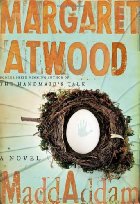
MaddAddam
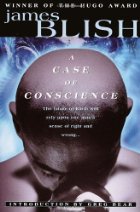
Book Review: A Case of Conscience by James Blish (Series, #4)
 Summary:
A new inhabited planet, Lithia, has been discovered, and an exploratory Earth crew of four is sent to determine how Earth will respond to the planet. Ruiz-Sanchez is a scientist and a member of this crew, but he’s also a Jesuit priest. Although he admires and respects the reptilian-humanoid inhabitants of Lithia, he soon decides that the socialist, perfectly co-existing society must be an illusion of Satan, so he advises against maintaining ties with the planet. The vote of the crew is a tie, however, so the UN must ultimately decide the fate. While they are awaiting the decision, Ruiz-Sanchez and the others must raise and guardian a Lithian child who is sent as a present to Earth. Soon, Ruiz-Sanchez starts having fears about just who the child might be.
Review:
This is the third book from the collection of 1950s American scifi classics from Netgalley, which I will review as a whole at a future date. I was surprised that a book that is fourth in its series was included in the collection. Upon investigation, I discovered that this series isn’t surrounding a certain set of events or characters but instead is multiple books around a similar theme. The theme for the series is each book deals with some aspect of the price of knowledge. So each book works as a standalone as well. There is also some disagreement as to precisely what book is what number in the series. I have chosen to use the number used by GoodReads. I had previously read a scifi book with a Jesuit priest scientist visiting a newly found planet (The Sparrow
Ruiz-Sanchez is a rather two-dimensional character who quickly turns into a bumbling priest trope. Very little attention is paid to his credentials as a scientist within the story, so instead of coming to know Ruiz-Sanchez the scientist, the man, and the priest, we only know him in his priest role. This prevents a connection or even a basic understanding of his rather bizarre concerns. Whereas in The Sparrow
The plot is fascinating, although it does jump around a lot. Essentially there’s the part on Lithia, which primarily consists of discourse between the scientists. Then there’s the development of the Lithian child into an adult who doesn’t fit anywhere, since he lacked the social training on Lithia and also is a reptilian humanoid on planet Earth. He then starts to incite rebellion among the youth. Meanwhile, Ruiz-Sanchez is told by the Pope that he committed an act of heresy and he must re-win favor by stopping the Anti-Christ aka the Lithian on Earth. All of the settings are fascinating, and the plot is certainly fast-paced. However, the plot is so far-fetched that it is difficult to properly suspend disbelief for it.
The settings are the strength of the book. Lithia is well-imagined, with uniqueness from Earth in everything from technology to how the Lithians handle child-rearing. The tech involves trees since they lack minerals, and the child-rearing is non-existent. The Lithians are simply birthed then allowed to develop on the planet, similar to turtles on Earth. Earth’s setting is interestingly imagined as well. The fear of nuclear weapons has driven humans to live underground for generations with only the elite living above ground, and the UN working hard to keep it that way. It’s a fun mix of alternate alien civilization and dystopia.
Essentially, the book has interesting world-building and what could be a promising plot that get derailed by two-dimensional characters and too many bizarre plot-twists and occurrences. It’s certainly an interesting read, particularly if you are interested in immersing yourself in this odd world Blish has created. However, readers should not expect to connect with the characters on an emotional level and should be prepared for a bizarre plot.
3 out of 5 stars
Source: Netgalley

Previous Books in Series:
Doctor Mirabilis
Black Easter
The Day After Judgement
The Devil’s Day


Book Review: The Stars My Destination by Alfred Bester
 Summary:
In the future, men have discovered the ability to jaunte–to teleport from one location to the other. The only catch is that you can only teleport to a place you have previously been. This means that jauntes around the world are the domain of the wealthy who can make the journey first. In this future of teleportation and telepaths, the rich have become a hipster elite, showing off their wealth by using outmoded and and outdated methods of transportation like cars and trains.
Foyle is one of the working poor. A hand on a spaceship that has an accident, leaving him in a closet grasping to the last straws of oxygen. Another spaceship passes him by, after clearly seeing his flare, and he vows vengeance upon them if he ever escapes alive. Which he does. What follows is a tangle of intrigue across time and space.
Review:
I got this in a collection of 1950s American scifi classics from Netgalley (which I will review as a whole at a future date). I was surprised to discover that I already had this particular book on my wishlist tagged simply as a scifi classic. So I went in with an enthusiasm that was definitely well-met. This book is worth reading for the world-building alone, even if the main plot and point of the novel doesn’t particularly speak to you.
The world Bester built for this book is complex and unique. Many authors would have left the future building at the jaunting alone. These people can teleport (and some are telepaths), what more is needed? But Bester takes it out a step further. Giving jaunting a limitation allows him to further expand upon how the change impacts people and culture differently based upon their wealth. On the one hand, since jaunting is only possible if you’ve physically been to the place you want to go, it becomes a bastion of the elite who can afford to travel there first.
They would memorize jaunte stages in widening circles, limited as much by income as ability; for one thing was certain: you had to actually see a place to memorize it, which meant you first had to pay for the transportation to get you there. Even 3D photographs would not do the trick. The Grand Tour had taken on a new significance for the rich. (loc 2465)
On the other hand, the wealthy will show off that they don’t need to jaunte because they can afford outmoded means of transportation like cars and trains.
As men climbed the social ladder, they displayed their position by their refusal to jaunte. (loc 2595)
Jaunting impacts the world further with the wealthy building labyrinths so that people can’t easily jaunt within their estate and home (since you can’t jaunt someplace you can’t see). In contrast, the working poor jaunte everywhere they possibly can to save their precious time and energy. On top of all of this, there’s space travel and space colonization, complete with slavery to mine the outer planets. But even the working poor who aren’t officially slaves are still essentially slaves to the wealthy elite. It’s a nightmare of a future where a few big corporations, and thus a few families, own the majority of the wealth, power, and luxury, and are unafraid to stomp on the poor to get ever more.
It makes sense that a good plot for this world would be a poor working man out to get vengeance on the corporation that left him to die in space. But Foyle isn’t a good guy himself. At first, none of his quest for vengeance is noble or is about anything other than himself. Plus, Foyle is an animal of a man. The book clearly believes that this animal state is the fault of the corrupt imbalance of power in the world. The wealthy elite have made many of the working poor into nothing more than scrabbling animals who will take what they can get violently when they can and live based on the more baser urges. As Foyle gradually climbs the social ladder in his espionage, he slowly learns what it is to be human and develops a conscience. I’m not a fan of this idea that the poor are forced into an animal-like state by the elite. Living without luxury doesn’t make a person animal-like. A lack of moral education contributes more than anything, and that can occur at any level of wealth. Thus, although I appreciate the fact that this vengeance plot allows for us to see the entire world from the bottom up, I’m not a fan of how Foyle’s growth and change is presented.
Some readers may be bothered by the fact that Foyle early in the book rapes someone and then later earns redemption, including from the woman he raped. The rape is described as part of his animal state, and he has now risen above it. When the rape occurs in the book, it is off-screen and so subtle that I honestly missed it until later in the book when someone calls Foyle a rapist. I appreciate that Bester does not depict the actual rape, as that would have prevented my enjoyment of the book. I don’t like the idea of rape being something only done by someone in an “animal state” or the idea that it’s something a person can ever redeem themselves from. I don’t think that’s the case at all. However, this is a very minor plot point in an extremely long book. Most of my issues with it are tied into my issues with the plot overall. I was able to just roll my eyes and tell the characters that they are wrong. It’s not that hard to do when most of them are presented as evil or anti-heroes to begin with. But this plot point might bother some readers more than others.
Overall, the world building is so excellent and gets so much attention from Bester that it overshadows the more average vengeance plot with iffy morals. Readers who enjoy immersing themselves in various possible futures will revel in the uniqueness and richness of the future presented here. Those who believe firmly in punishment for crime as opposed to redemption may not be able to get past the plot to enjoy the setting. Recommended to scifi fans interested in a unique future setting.
4 out of 5 stars
Source: Netgalley

Book Review: The Wanting Seed by Anthony Burgess (Bottom of TBR Pile Challenge)
 Summary:
In the near future world with no war and totalitarian governments there’s an ever-looming threat of starvation thanks to overpopulation and diseases attacking the crops. The governments have responded with worldwide one child policies and psa campaigns to encourage homosexual relationships. Englishman, Tristram Foxe, lives in a skyscraper with his wife, Beatrice-Joanna and works as a social studies teacher. But his advancement suffers both from his status as a person with siblings and as a married man with a child. When he discovers that his wife is cheating on him with his passing as gay brother who works for the Infertility Bureau, his world falls apart just as the world around him tilts from totalitarian regime to cannibalism and pagan fertility rituals.
Review:
When I picked up this book, the summaries I’d seen were nowhere near as clear or straightforward as the one I just wrote for you. I’m not sure I would have ever picked it up if I’d had an inkling of an idea as to what I was getting myself into. All I saw was a dystopian overpopulated future by the same author as A Clockwork Orange
The first half of the book reads like a treatise by a Quiverfull (Evangelical Christians who believe in having as many children as possible, more info) with some terror of a hyper-liberal future where people are denied their right to choose to have children (funny how they fear that but don’t get that pro-choice is all about protecting a woman’s right to choose what to do with her own reproductive organs but that’s another rant for another day), and people are forced into being gay/lesbian. I know this sounds like it could be an interesting flip-flop of current times, but it didn’t read that way for me. It read as a lot of homophobia and yelling about how population control goes against god’s plan and going against god’s plan sends the plagues. Seriously. That’s how it reads. But, I traveled on because this is Anthony Burgess, and characters don’t have to be likeable. They could be used to show the opposite point. But that’s not really what happens. What happens is that this set-up gets ditched for a mad-cap dash through sociology.
The last half of the book is kind of an interesting sociological exploration of how the world moves through the liberal/conservative/military cycle. It is mad-cap and bizarre, and as a person with a BA in History, I really enjoyed seeing a country move through those cycles at rapid-fire in a slapstick humor style. This part of the book felt like an entirely different book in fact. But I also think only a certain type of person would enjoy it. (Like, oh, Political Science and History majors).
As for character development, there is none. Everyone ends up pretty much where they started after having lived through the cycles of political change. It really reminds me a lot of playing Civ or SimCity where you move artificial people around to illustrate greater points. I enjoyed this alright, but I would have preferred stronger characterizations or at least some growth.
So, is the book a phobic conservative dream of what a liberal society would look like? I don’t think so. I think Burgess actually presented each part of the political cycle as awful, including the fall into tribal-feeling paganism. It sort of felt like the book was saying that someone somewhere will always be unhappy no matter what the political/sociological situation is. Depressing, huh? And yes I know it’s dystopian and lot of people think dystopias are innately depressing, but personally I think they can frequently offer a lot of insight and hope for the future. This just felt a bit defeatist. With some Quiverfull and homophobic characters to boot.
Overall I’m left feeling decidedly no reaction either way to this book, which is not what I was expecting from Burgess. I was neither offended nor enlightened and mildly entertained but I could have had the same entertainment from playing Civ on my computer. I think this book best appeals to readers who also enjoy studying political science or the history of societies, but even they should proceed with the caution that this is decidedly a mad-cap, non character-driven look at those topics.
3 out of 5 stars
Source: PaperBackSwap

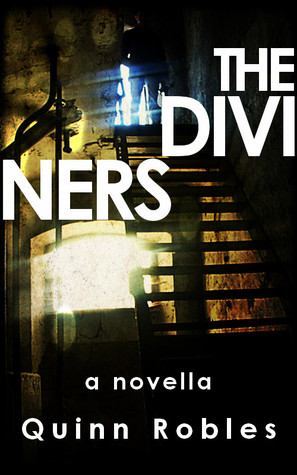
Book Review: The Diviners by Quinn Robles
 Summary:
In a world where the 1% has taken over the government and resources and the rest are left to fend for themselves, the Symmonds siblings seek to keep starvation at bay with their divining abilities. Everyone knows diviners can find a water source with two rods, but the Symmonds siblings can find much more, including lost people. When they are asked to find girls most likely stolen by the government for sex slavery, they must face a choice. Should they risk it all to save them?
Review:
I actually hesitated over whether or not to review this book because it does not appear to be available for sale anymore in spite of coming out just this February. This shows me that perhaps the author is already aware that it wasn’t quite ready for publication, so why pile it on? But I did promise a review in exchange for a copy, and I also review everything I read, so I ultimately decided to review. But I will keep it short and try to offer simply constructive criticism.
There are two issues with the book. One is some awkward sentence structures and flat-out wrong grammar. This is something that could be quickly fixed in another editing pass, which I recommend. The other is larger, though. The world building is confusing and weak. It took me until around 75% through the kindle book to finally figure out what was going on in this world, and some of it was still unclear. For instance, what I think is a branch of the government (still not sure) is called the “Jacobs,” but they are just called the Jacobs for so long with no other information that at first it seems that they are a rival family or something. The little information the reader does get about the dystopian world is delivered via information dump. It’s not smoothly written into the story. It is told to the reader like a confusing history book. If this wasn’t a review copy, I would have quit in the first chapter, because it’s simply not pleasant to receive information via info dump. The dystopian world itself, though, is interesting and timely. It’s based around the Occupy movement’s rhetoric about the 1% with the wealthy ultimately blatantly taking over. I could see a lot of people really enjoying the mix of that with the more fantastical element of divining. The characters are also fairly well-rounded and easy to tell apart.
Overall I would say it’s a good idea and a good first draft, but it needs some reworking and editing. I hope that’s what this author is doing and that she keeps at it, because her ideas are definitely unique.
2 out of 5 stars
Source: Kindle copy from author in exchange for my honest review
Currently unavailable to buy, but check out the author’s website
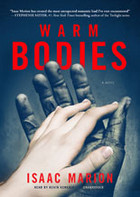
Book Review: Warm Bodies by Isaac Marion (Audiobook narrated by Kevin Kenerly)
 Summary:
R is a zombie, and he remembers nothing about his life before he was one–except that his name starts with the letter R. He and his group of the other living dead inhabit an old abandoned airport and are ruled by the bonies. They hunt the living not just for the food, but also for the memories that come from ingesting their brains. It’s like a drug. One day when he’s out on a hunt, R eats the brain of a young man who loves a young woman who is there, and R steps in to save her. It is there that an unlikely love story begins.
Review:
Now that I have a new job I decided to stop going through the rigamarole that is finding something you actually want to read as an audiobook in the public library and subscribe to Audible, especially since I always have my kindle with me anyway. I decided to choose audiobooks to read from the bottom of my wishlist, so everything you’ll be seeing on here (unless it was free on Audible) was put on my wishlist a long time ago. Half the time I couldn’t remember why it wound up there. That was the case here. I mean; I’m assuming it was there for the zombies, but I basically had no other idea about it heading in. This is partly why my mind was blown, so if you want a similar experience I’m telling you to go get yourself a copy right this instant! Vamoose! For those who need more convincing, though, please do read on.
Perhaps surprisingly, I have read zombie love stories before, so I wasn’t expecting too many new or particularly engaging ideas. This book is overflowing with them though. Everything from zombies getting high on other people’s memories to getting to see both the zombie and living side of the war to the concept of what the war is ultimately about to even what a zombie is was all brand-new. And it pretty much all makes sense in the world Marion has set up and is engaging. I could not “put the book down.” I listened to it in every spare second I had. Nothing went the way I predicted and yet it all made complete sense.
R is far more complex than what you’d expect from a zombie, even before his symbolic awakening. Julie is everything you would want from a heroine. She’s pretty, smart, and she says fuck! She can hold her own but is still emotional and vulnerable. She’s exactly what any artistic, strong woman would be in a zombie apocalypse. Even the more minor characters are well-rounded, and there is the racial diversity one would expect from a zombie apocalypse in a big city.
Alas, the narration was not quite as amazing as the story. Although Kenerly does a very good job, sometimes he fails to convey all of the emotions going on in the scenes or doesn’t switch characters quite quick enough. Don’t get me wrong, it was very good and didn’t detract from the story at all, but I also don’t feel that it added a ton to it.
This is a book that I know I will want to read again, and I may even need to buy an ebook or print version just to do so in a whole nother way next time. It is an engaging new look at a zombie apocalypse that reads more as a dystopia than post-apocalyptic. Anyone who needs restored faith in the ability of humanity to fix where we’ve gone wrong should absolutely give this book a shot.
5 out of 5 stars
Source: Audible

Book Review: The Cause by Clint Stoker
 Summary:
In an overpopulated future, a city stands where there are not familial or close relationships, but everyone celebrates every night. Air was recently relocated to a new position as a purger, and he slowly discovers the sinister side of the city.
Review:
This is an interesting concept that is poorly executed, badly edited, and takes a turn for the worse at the end.
Anyone who follows this blog knows that I love an overpopulation scifi story. Stoker has an interesting take on it–the world is overpopulated so constantly at war. A city arises where the residents can stay young forever but must follow a series of articles that removes the true joy of living from them. The problem is that I just stated that more succinctly than Stoker does at any point in the novel.
What we have here is the classic example of a good idea poorly executed. The basic concept is great. But the main character’s flashbacks and current thoughts are difficult to read. I found myself constantly skimming the flashbacks, because they were so confusing to read and lent so little to the story.
More upsetting though were the constant errors that had less to do with typos or difficult grammar and more to do with poor understanding of the English language. Examples:
A golden metal sat at the top of his desk. (location 2879)
Won’t even know your there (location 3148)
I thought we we’re in this together (location 4225)
He put Air to sleep so he could remain innocent in the cities eyes (location 4509)
A transport past by (location 4588)
You can’t bring people back once their dead. (location 5050)
I am ti sro and you are the villain. (location 5083)
Anybody, understandably, would be frustrated with this amount of errors.
Perhaps more distressing is the “surprise” ending, which to me was just confusing. Essentially, five infants are killed every 50 years to keep the city of 30 million people alive, yet the science of that is never explained. The key to scifi is plausible science, yet Stoker ignores that entirely. It’s a good idea, but without plausible explanations and good writing, it falls flat. I’d recommend he gets a solid editor before his next attempt.
2 out of 5 stars
Source: Kindle copy from the author in exchange for my honest review

Book Review: Fourth Degree Freedom by Libby Heily
 Summary:
A collection of five widely varied short stories.
“Thank You For Calling”–A day in the life of a woman working for a call center during the Recession.
“The Event”–A dystopian future where once a year male teens and young adults go out and shoot the elderly.
“Fourth Degree Freedom”–A post nuclear war future where some children are born as different degrees of “monsters.”
“The Last Six Miles”–A woman gets over her divorce by becoming a runner.
“She Floats”–A woman wakes up in a tank with limited oxygen left and a man observing.
Review:
It’s difficult to talk about this collection as a whole, since the stories range so vastly, not only over different genres, but also in quality of writing. Thus, I must address them individually.
“Thank You For Calling”
I don’t usually do contemporary literary, but this one made me smile and sad almost simultaneously. The main character is struggling during the recession, but she also must listen to other people’s problems all day. A bit of a typical storyline? Yes. But still relatable and well-written. 3 stars
“The Event”
The best story in the collection. I recommend to Heily that she turn this one into a novel. A future with no violence and thus overpopulation is typical is dystopian fiction, but Heily takes it in a fun direction. The final scene leaves the reader doubting that the main character knows the truth about his own society. There were also no obvious flaws in the writing itself. 5 stars
“Fourth Degree Freedom”
This personally didn’t hit any of my own hot buttons, but it is well written. The idea of chemicals from war affecting different pregnancies in different ways is an interesting one. Having a sibling see the humanity in the monster child where others do not is rather typical, but still touching. 4 stars
“The Last Six Miles”
Being the fitness nut that I am, I really enjoyed seeing the main character go from a depressed over-eater to a marathon runner. The content of this story is uplifting, even if the ending is a bit predictable. 4 stars
“She Floats”
I was so incredibly disappointed in this one. I had the feeling from the first few sentences that this was basically going to be a Saw rip-off, and it was. There’s nothing wrong with having a psycho kidnap a person and put them in a trap to get out of, but it must have something else in it that makes it different from the well-known series. 1 star
Overall, this collection starts out average, strengthens, then crashes at the end. I also believe Heily may have trouble finding an audience due to the variance from literary to dystopian and then to horror. I would advise her to take the two strong dystopian stories and either make them into novels or write more scifi short stories and repackage them together. Similarly, the literary fiction I believe would strongly appeal to many modern women during this current recession. If she adds more literary stories to these two and packages it as a type of collection for the modern woman, she could have great success with them. The last story must be re-done or trashed, however. It sours the rest.
Essentially, if any of the short stories above appeals to you, I would encourage you to get this book. It is only 99cents, and a good short story is definitely worth that.
3 out of 5 stars
Source: Kindle copy from the author in exchange for my honest review

 Support my work with a tip or browse my shop for curated book club guides, how to guides, cross-stitch patterns, and more!


This work by Amanda Nevius is licensed under a Creative Commons Attribution-Noncommercial-No Derivative Works 3.0 United States License.
 Opinions of a Wolf