
Archive
Book Review: Rage by Jackie Morse Kessler (Series, #2)
 Summary:
Melissa Miller is your typical 16 year old–mom, dad, annoying sister, a jerk of an ex-boyfriend–with one small difference. She deals with her emotions by cutting herself. She keeps a razor in a locked box in her closet and pulls it out when she gets overwhelmed. One night she accidentally cuts too deep, and Death shows up with an option. Either die now or become one of the Horsemen of the Apocalypse–War. Missy chooses the latter option, and as she gets to know the other Horsemen and her job as War, she starts to realize she needs to face the rage inside her.
Review:
Speaking as someone who knows a lot about mental illness, self-injury is one of the illnesses that people who don’t have it have the most difficulty understanding. It seems bizarre to those who don’t self-injure, even as for the self-injurer those moments of cutting or burning or whatever chosen method are the best coping mechanism they can come up with. It’s not easy for those who don’t self-injure to understand, which is why I am so impressed at how well Morse Kessler has grasped the inner workings of the self-injurer in order to write such a well-rounded, sympathetic character as Missy.
Missy is simultaneously relatable as a typical teenager, for instance she gets horribly embarrassed at a party one night, but she also has this deep, dark, misunderstood secret. Gradually other teens find out and are either concerned or lash out at her due to their fear and lack of understanding, but Missy feels that she can’t confide in even the sympathetic ones. In perhaps one of the most powerful passages, the reader gets to see exactly why Missy cuts, while she simultaneously explains why she can’t explain it to her sister.
She could tell her that she turned to the blade because she wanted to live and sometimes pain was the only thing that kept her alive. She could tell her that she was terrified of things she couldn’t even begin to name, that friends could be fickle and lovers could be false. She could try to explain all of that and more, and maybe her sister would understand. But trust was as fragile and cutting as a crystal sword. (page 100)
That is perhaps the most clear, succinct explanation of self-injury I’ve seen outside of nonfiction clinical books. Missy’s reasons for cutting are clear, even as it becomes more and more evident to the reader that this coping mechanism is not truly addressing Missy’s real problems.
Of course, the fantasy element comes to play here again, and it works perhaps even better this time around. Giving the fantasy personas for Missy to talk to and express herself to gives her a safe space to think out her emotions instead of cutting them out. There are also a few cameos from Famine, which is fun to see after reading the first book. The fantasy also works here because it helps give the book a distance that makes it less triggering. There are intense emotional moments, but then Death shows up with a humorous quip to lighten the situation. It addresses the real problems without getting bogged down in over-emotionality.
This book will give self-injuring teens a way to see themselves reflected in literature and accepted and loved for who they are. It will give them a chance to maybe address their own emotions and issues. Similarly, non-self-injuring teens will hopefully become more empathetic to their peers who struggle with it. It’s a book that is simultaneously enlightening but not preachy. I highly recommend it to teens and those who work in mental health or with teenagers.
5 out of 5 stars
Source: Amazon

Previous Books in Series:
Hunger, review
Counts For:

Book Review: Faeries of Dreamdark: Blackbringer by Laini Taylor (Series, #1)
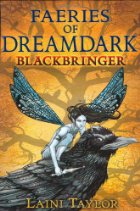 Summary:
Magpie Windwitch has spent most of her life traveling the world with her parents fighting to save the faerie magic and rid the world of demons and devils mannies accidentally loose from their bottle prisons. Now chasing after a surprisingly powerful demon has brought her and her crew of crow guardians back to her birthplace of Dreamdark, a faerie land no mannie can enter. Here she encounters more members of her generation of faeries, including Poppy who can speak to plants and Talon who possesses an extraordinary knitting talent. Soon Magpie will discover not only secrets about the world, but about herself as well.
Review:
I’ve been working at reading from the bottom of my print TBR pile, and I really do wish I could remember what led me to pick up this book. Faeries and fantasy are generally not my thing, but clearly something caught my eye about this story, and rightly so, for I found myself swept into the tale and really quite enjoying it.
Taylor has created a fun heroine with all the usual traits of a chosen one in fantasy. Blessed by those more powerful, something special about her, has a few flaws such as a strong will, yadda yadda. One thing that really sticks out though is that she’s a girl. The chosen champion is a girl, and so was the most famous prior champion. Nice to see that difference! Plus, seeing a guy fall for a girl because she’s exciting, adventurous, and strong-willed is always fun to see depicted for a change. I truly enjoyed Magpie and Talon, and to me they are the ones who held the story together.
The faerie world is richly imagined without crossing over into being overly romanticized or sexualized like so many faerie stories are wont to do currently. The entire setting reminds me of the books about the adventures of animals in the woods that we humans just can’t see that I used to so enjoy reading as a child. It’s just that in this case in addition to the animals, there are faeries.
The author was inspired by her own drawings, and they pepper throughout the book. They are truly beautiful drawings, and I found myself stopping reading entirely just to get lost in them. Don’t read this one on the tiny screen of an iPod.
The mystery itself is logical within the setting, although it honestly seemed a bit trite and commonplace among fantasy. I was hoping for something a bit more unique. Must every fantasy story be about saving the whole world? Additionally, there were a few side-plots that seemed totally unnecessary, particularly once all was revealed at the end of the book.
On the other hand, the more progressive aspects of the story-telling excuse these short-comings in my mind. Taylor gently expresses a necessary respect for all living creatures, as well as non-gendered expectations and inter-racial relationships. I confidently recommend this to those seeking a fantasy story for middle-grade or YA readers with these positive elements.
4 out of 5 stars
Source: PaperBackSwap

Book Review: Hunger by Jackie Morse Kessler (Series, #1)
 Summary:
Lisabeth Lewis thought it was just a nightmare. Death coming to her when she tried to commit suicide with her mom’s antidepressants and offering to make her Famine–one of the four horsemen of the apocalypse–instead of letting her die. It’s just all way too ironic, her as Famine. After all, she’s fat. She has to watch what she eats very carefully. The Thin voice tells her all the time exactly how many calories each bit of food is and how much exercise it’ll take to burn it off. Yes. Lisabeth Lewis is fat. So why would Death assign Famine to her anyway?
Review:
When I heard the concept of this new YA series–each horseman of the apocalypse representing and dealing with a mental health issue relevant to teens–I was incredibly skeptical. Writing about mental illness in a way that teens can relate to without talking down to them as well as in a responsible manner is difficult enough without having a fantasy element present. Toss in the fantasy and I was worried this would either read like one of those old 1950s cautionary films shown in highschools or would miss dealing with the mental illness entirely. Boy was I wrong. Kessler has found such a unique, creative way to address a mental illness yet cushions it in the fantasy so that it isn’t too in your face. It’s the ideal scenario for teens reading about it, but it’s also enjoyable for adults.
The fantasy element is very tongue-in-cheek. It strongly reminds me of Buffy the Vampire Slayer in style. For instance, Death resembles a heroin-chic dead rock star, and he speaks in a mix of classic English and mocking teen speak to Lisa.
“Thou art Famine, yo,” Death said. “Time to make with the starvation.” (Location 661)
It quickly becomes apparent that Death and the Horsemen aren’t entirely what they initially seem to be. Indeed, they seem to function to get Lisa out of her own head and problems and to look at the greater world around her. She literally travels the world on her horse and sees real hunger, and it affects her. It doesn’t make her feel guilty for being anorexic, but it makes her want to be better so she will be strong enough to help others. That’s a key element of any mental illness treatment. Getting the person to see outside of themselves, and Kessler has personified it through the Four Horsemen.
She, Lisabeth Lewis, seventeen and anorexic and suicidal and uncertain of her own path–she’d done something that mattered. She’d ignored her own pain and had helped others. Maybe she wanted to live after all. (Location 2007)
Of course the non-fantastical passages dealing with Lisa’s anorexia and her friend’s bulimia are incredibly realistic. If they weren’t, the book would immediately fail as the whole thing would ring false to the teens reading it. Her anorexia is dealt with as a very real thing even as the Four Horsemen are presented as either truth or hallucinations of her starved mind. This is key. The anorexia cannot be presented as an element of fantasy.
I was concerned the ending would be too clean-cut. I won’t give any spoilers, but suffice it to say, Kessler handles the ending in a realistic, responsible manner. There are no easy solutions, but there are solutions to strive for.
Overall, Hunger takes the incredibly real problem of anorexia and presents it with a touch of fantasy to help bring the reader not only into the mind of the anorexic but also outside of herself to look at the bigger picture. It is an inspiring, fresh take on YA lit dealing with mental illness, and I highly recommend it to fans of YA lit as well as those interested in literature dealing with mental illnesses.
5 out of 5 stars
Source: Amazon

Counts For:

Movie Review: Red Riding Hood (2011)
 Summary:
Valerie has always lived in a small village surrounded by a dark forest haunted by a werewolf every month at the full moon. For the last ten years the wolf has kept the peace with the town by accepting a sacrifice of a beloved livestock. Now Valerie is a woman and planning on eloping with her lover, Peter, to escape an undesired marriage to the smith’s son, Henry. Just as they are about to elope, though, Valerie’s sister is found dead. The victim of the wolf. Now the town brings in a priest of questionable character in an attempt to rid them of the curse once and for all.
Review:
To me this film was truly all about atmosphere, being a feast for the eyes like the village is a feast for the wolf. Although the first few moments of the film are set in harvest time, the rest of it is during winter, complete with beautiful snowfall scenes. The village itself is simultaneously sinister and picturesque. What truly makes the atmosphere though is the costuming. Gorgeous elbow-length knitted gloves. Covetable dresses with the perfect waist-length. Sleeveless cloaks worn by all in demure shades that truly make Valerie’s red cloak pop when she receives it from her grandmother. The entire atmosphere screams fairy tale.
The story was of course re-written with red riding hood made into a young woman instead of a little girl. The character of the wolf became more complex than just the big bad wolf in the woods. However, the key creepy elements of the fairy tale remain. In all honesty, I was surprised at how good of an updated adaptation this was, and I’ve seen my fair share of fairy tale adaptations.
The one draw-back was the awkward love triangle inserted into the story. There was one scene in particular that simply screamed “This director also directed Twilight!” Ugh. I’m getting incredibly sick of love triangles existing in any story that features young adults. Plus this scene elicited laughter from the audience, which I am pretty sure was not what the director was going for.
Overall, however, this was a delightful adaptation of a beloved fairy tale. I recommend it to lovers of fairy tales and adaptations, as well as those who enjoy an exquisite atmosphere in film.
4 out of 5 stars
Source: AMC movie theater

Book Review: Zoo City by Lauren Beukes
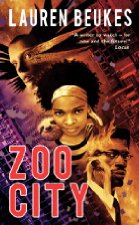 Summary:
In the near future those who’ve committed a serious wrong for which most would feel guilty are given an animal by the spiritual world. They are known as Zoos, and the animals attempt to guide them back to the straight and narrow as well as keeping the Undertow at bay. Separation is painful and almost impossible. If the animal dies, the Zoo dies. Zinzi December of Johannesburg is one of these Zoos. Her animal is a sloth, and her magical power is finding lost things. Normally she sticks to everyday objects such as keys in the sewer, but when a music producer approaches her via his assistants for help in finding a missing teen Afropop star, she bends the rules. She just may come to regret that decision.
Review:
Beukes excels at world-building, setting a vivid example of how to use showing not telling to its best, fullest extent. I was instantly swept into this fantastical version of a nation I’ve never been to, yet somehow was able to quickly decipher which elements were pure fantasy and which based on the realities of modern South Africa. The reader comes to understand how Zoos first showed up and why they exist without even really realizing she is acquiring this information.
Similarly, the character of Zinzi was a refreshing change from the typical urban fantasy female lead. While she is clever and fairly fit, she is neither abnormally strong not incapable of making bad decisions. She is a three-dimensional character with both positive and negative qualities. She is not simply the put-upon dark heroine. Her struggles are real and current, not simply in the past. At first it appears that Beukes is going to fall into the completely redeemed heroine trope, but instead Zinzi still has demons to face. She must repeatedly fall and get back up, something that rings as far more real than one epic fall followed by heroine perfection.
The one draw-back is that the plot is a bit confusing. I had to re-read the climax to fully understand exactly what had been revealed as the big secret Zinzi was discovering. Part of that was due to a couple of elements of the plot that seemed not to mesh well with the rest of it. Some of the important fantasy parts of the plot should have, perhaps, had a bit more explanation. There is a lot going on in this novel and sometimes it can be a bit overwhelming for the reader who is new not only to the fantastical elements of the tale, but to the South African cultural elements as well. Although the plot is ultimately decipherable, it is not immediately easy to follow.
Overall this is a creative, unique piece of urban fantasy that simultaneously presents a truly flawed heroine and takes the genre into a city many modern readers are not familiar with. I recommend it to fans of urban fantasy as well as fans of African literature.
4 out of 5 stars
Source: Gift

Book Review: Heart’s Blood by Juliet Marillier
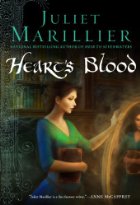 Summary:
This retelling of the classic fairy tale, Beauty and the Beast, is set in a medieval Ireland facing the constant threat of Norman invasion. Caitrin, an Irish lass trained in the trade of a scribe by her now deceased father, runs away from an abusive situation and stumbles upon the mysterious Whistling Tor. The crippled lord of the area lives in Whistling Tor and seeks a scribe. The local villagers warn Caitrin against taking the summer job due to a fear of the host living on the hill, but Caitrin sees no other choice.
Review:
Fantasy is one of those genres that I have never been able to get into, but I do love fairy tales, so I thought maybe a retelling of a classic would work for me. When will I ever learn that I just don’t like fantasy?
Marillier does all the elements of a fantasy book well. She sets up the mysterious, old land of Ireland with just enough description to place the reader there but not so much as to slow down the action. Gothic mystery seeps through every page. The idea of the non-human servants and household members of the castle are creatively handled, as is the lord’s beast-like qualities. The members of the host who could so easily have flowed together are artfully individualized.
Additionally, the romance between Caitrin and the lord of the castle is one I actually approve of for once in a YA book. They both are flawed and have issues to work on, but love each other and have good hearts. Thank you. That’s what a relationship is supposed to look like. I would be entirely comfortable seeing a teenage girl reading this. It’s a healthy, realistic relationship.
Still, though, I had to force myself to slog through the book. I was bored a lot of the time. I don’t like long descriptive passages of a forest. I don’t like reading about dull politics of various areas of Ireland. I’m not interested in explanations of the other-worldly figures. The most interesting part to me was the mirrors all over the household, and they were not addressed fully to my liking. In spite of being able to recognize this as a well-told story, it failed to draw me in. I don’t particularly know why. My best guess is that it is fantasy, and fantasy has always bored me. I was hoping venturing away from the more typical knights in shining armor and dragons style fantasy would solve the problem, but I was wrong.
Thus, this YA fantasy retelling of Beauty and the Beast is creative and well-done. I recommend it to those who know they enjoy a good fantasy story, but those who do not should probably skip it.
3 out of 5 stars
Source: PaperBackSwap

Series Review: The Dark Tower Series by Stephen King (spoiler warning)
Introduction:
I post series reviews after completing reading an entire series of books. It gives me a chance to reflect on and analyze the series as a whole. These series reviews are designed to also be useful for people who: A) have read the series too and would like to read other thoughts on it or discuss it with others OR B) have not read the series yet but would like a full idea of what the series is like, including possible spoilers, prior to reading it themselves or buying it for another. Please be aware that series reviews necessarily contain some spoilers.
 Summary:
“The man in black fled across the desert, and the gunslinger followed.” This famous opening line begins the distinctly American fantasy epic tale of Roland the gunslinger’s quest for the Dark Tower. In this fantasy, there are multiple parallel universes, referred to as whens and wheres. The one Roland inhabits that is home to the Dark Tower and beams that keep all the worlds together and operating functionally just so happens to distinctly resemble the old American wild west. Gunslingers in this world are like the knights of the round table in old England, and Roland is the last of his kind. He’s on a quest both to reach the Dark Tower and save it and the beams, as  they seem to be breaking. Through the course of his quest, Roland draws three new gunslingers and a billy-bumbler to become his ka-tet–his family bound by ka (fate) not blood. These new gunslingers all come from America, but from different whens and versions of America. Eddie is a heroin addict. Susannah is an African-American woman from the 1960s who is missing both of her legs from the knees down and has Dissociative Identity Disorder (more commonly known as multiple personality disorder). Jake is a boy from a wealthy family in NYC that hardly pays attention to him. Oy is a billy-bumbler; a creature from Roland’s world that looks a bit like a dog with a long snout and a curly tail but is able to talk. After training and bonding together, they continue on their quest for the Dark Tower. A quest that leads them through old ruined cities in Roland’s world, gangster territory
  and rural Maine in America, a countryside farming community where almost all births are twins, and much much more. The ultimate questions of ka, how the worlds are bound together, and just what role this gunslinger has to play in all of it loom at the center of this epic tale.
Review:
The interesting thing about the Dark Tower series is that each book has its own unique vibe, feel, and style to it, yet they together work to make up a complete whole that has its own unique feel to it too. Because of this, certain entries  in the series may appeal less to some people than others. For instance, I did not enjoy Wizard and Glass, because it was essentially a slow-paced wild west romance story, yet I know some readers enjoy that entry immensely. Similarly, I love Song of Susannah for both its horror and the way King structured it using song stanzas to correlate with the sections of the book, yet I know some people who found it too dense for one entry in the series. The thing is though, to me, the Dark Tower is more about the experience of reading the series as a whole than the individual books. I’m perfectly willing to work through a book or a few chapters that aren’t quite the genre I prefer, because I know that will change up later on and whatever is being discussed is important to the story as
  a whole. It frankly is interesting to read a series that explores so many different genres within itself. It makes the whole concept of parallel worlds more believable as each area they go through feels different.
The characterization at first seems simplistic. There’s Roland the gunslinger. He’s got a one-track mind in pursuit of the tower. He’ll do anything to reach it, even if it’s questionable. Is he justified in his vehemence? It’s hard to tell at first. Similarly, the man in black who he is originally pursuing is extraordinarily one-dimensional. He is just an evil magician, and that is all. Similarly, when Eddie, Susannah, and Jake are first drawn into Roland’s world, they are also one-dimensional. Eddie is just the junky. Susannah is the crazy woman with multiple  personalities. Jake is a lonely, frightened little boy. Yet as the series progresses, King gradually develops the characters to be rich and multi-dimensional. Their characters are so intensely vivid, including even Oy, that I actually found myself crying as bad things happened to various members of the ka-tet. Eddie overcomes his addiction, as well as the emotional wounds inflicted on him by his older brother to grow up and become a true man. Susannah does not lose her multiple personalities, but she learns to work with them. They are a part of her, and she grows to accept that. She stops being bitter about her accident and her lot in life and comes to be self-sufficient and caring of those around her. Jake quickly grows to become a confident young man who cares for his ka-tet, but especially Oy and Roland. Finally, Roland gradually learns to open himself up to relationships. Although
  the tower still calls to him, he finds himself questioning if maybe the ka-tet is better than the tower.
The horror elements in the series definitely live up to what one would expect from King. There are disgusting moments, such as a man sick from the weed drug in Roland’s world that makes users go insane. There are also truly terrifying moments such as when a baby boy turns into a spider and eats his own mother via her breast. Then there are mentally disturbing themes such as the children who get stolen by the wolves and are returned with their brains completely ruined. It is later discovered that their brain power was fed to telepaths in service of the Crimson King who is seeking to destroy all the worlds. Whatever flavor of horror suits you best, you will find it in the series.
The themes of love and building your own family and being at the hands of fate are what truly carry the series, though. These themes are what make the reader care about the horrors that are happening to Roland and his ka-tet. They’re what makes it possible to suspend disbelief about multiple worlds being held together by a tower, a rose, and beams. The ideas of self-sacrifice, serving your purpose, and caring for others who ka has brought into your life are powerful and subtly expressed. To me the whole concept of making your own family is the most endearing part of the series, and I loved seeing it portrayed in such a subtle, tender manner.
Of course what really brought the series to a whole new level for me is the ending. It blew me away. It was completely unexpected. Roland reaches the tower after having lost his ka-tet. He goes in and climbs with each floor displaying items and smells to represent each year of his life. He reaches the top door and pulls it open only to realize, horrified at the last moment, that he is being pulled through back to the desert where the series began. The voice of the tower speaks to him about his journey. That he’s done it before. That he’s learning a little each time. It points out that Roland realized his mistake in not taking a few moments to pick up the horn of Eld, so this time, it is strapped to Roland’s side, where it wasn’t originally. For a moment Roland remembers what has just occurred, but soon he just feels it was all a mirage. A heat-induced daydream of finally reaching the dark tower. He continues on, ending the series with the same sentence it began with.
Personally, I feel that this puts the series in a whole new light. Who exactly is this Roland that he is so important that he has to redo this quest until, presumably, he gets it right? Why did King choose to tell us about one of the times he didn’t get it right? What did he get wrong? What lessons is Roland supposed to be learning? Will Roland ever escape the cycle or is it some sort of hell punishment he’s doomed to repeat forever? Of course, it all reads a bit like the belief in reincarnation and learning something each life cycle. In any case, it made me personally want to immediately start rereading the series, searching for clues about the repetition of the journey. It brings the series to a whole new philosophical level that truly elevated it in my mind from a fun fantasy to an epic.
Overall, there are parts of the series I didn’t enjoy, and due to the vast variety of genres represented in the series, most people will probably dislike or struggle with at least bits of it. However, when the series is put together and all the pieces click together in your mind, it becomes an unforgettable, completely American epic. A wild west fantasy is unique, and the themes and philosophical questions explored underneath the entertaining prose make for something even deeper than that. I am incredibly glad I took the time to read this series, and I would recommend it to anyone. It is well worth the time invested.
5 out of 5 stars
Source: borrowed, Harvard Book Store
Books in Series:
The Gunslinger, review, buy it
The Drawing of the Three, review, buy it
The Waste Lands, review, buy it
Wizard and Glass, review, buy it
Wolves of the Calla, review, buy it
Song of Susannah, review, buy it
The Dark Tower, review , buy it


Book Review: The Dark Tower by Stephen King, (Series, #7)
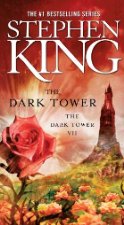 Summary:
Roland and his ka-tet face their greatest challenges yet. First they must successfully save the rose in NYC. Then they must find each other, and Susannah and Jake need to escape the low men who would harm them. Also on their list before continuing to pursue the Dark Tower is to stop the breakers who mean to destroy the beam, thereby leading the worlds to ruin. Can they save the beam? Will Roland reach his beloved Dark Tower with his ka-tet whole or shattered? Will he reach it at all? The Dark Tower looms with a far greater presence than ever before, calling to both Roland and reader commala-come-come.
Review:
Now I understand why people who’ve read the entire Dark Tower series rant with showers of praise about it. This final entry in the series totally blew my mind. The settings were perfectly drawn and easy to visualize. The multiple plot lines were all complex and yet simultaneously easy to follow. I cried multiple times reading this book, including in public, and those who know me know that I generally don’t cry at stories. All of the characters of the ka-tet are treated with full-formed character development. They are richly drawn, but it is also easy to see how they have grown and changed throughout the series. The multiple, inter-locking worlds of Roland and his ka-tet suddenly snap into place in the reader’s mind, and suddenly everything is nearly as clear as it probably is for King.
This book is quite long, but it didn’t feel like it. I wanted to read it nearly constantly, yet I had to put it down periodically due to the emotional wringer King was bringing me through. It’s been so long since I read a series that wasn’t either a trilogy or a serial romance that I’d forgotten how emotional it can get to have a long, fully realized tale told with characters you’ve grown to know and care for. These people read as real people, and the world feels real. It makes me want to go look for my own unfound door to journey to a parallel reality. Even though at first I kind of laughed at the idea of a rose and a tower and beams somehow controlling and seeing over multiple worlds, at some point I bought into it. I suspended my disbelief, and that’s exactly what a spinner of tales is supposed to be able to help his readers do.
What made me truly fall in love with the story and make me want to instantly start re-reading the series over again from the beginning is the ending. I wouldn’t give it away and ruin the experience of discovering it yourself for anybody, so just let me say, it totally blew my mind. I did not see it coming. It made my perspective on the whole tale change, which explains why I want to re-read it so much. (Maybe next year). I can also say that the ending makes reading the rest of the long series entirely worth it. Definitely don’t give up on the series part-way through. Continue all the way to the end.
If you’ve been reading the Dark Tower series and are uncertain about continuing, absolutely do. I don’t hesitate to say that the last entry in the series is tied for the best and will totally blow your mind. I highly recommend the whole series, but I especially encourage anyone who has started it to finish it. It’s well worth your time.
5 out of 5 stars
Source: Harvard Book Store
Previous Books in Series:
The Gunslinger, review
The Drawing of the Three, review
The Waste Lands, review
Wizard and Glass, review
Wolves of the Calla, review
Song of Susannah, review
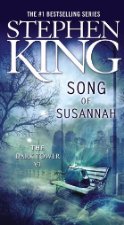
Book Review: Song of Susannah by Stephen King (Series, #6)
 Summary:
The ka-tet faces three challenges: keep the chap from the Crimson King, save Susannah, and get Tower to sell them the rose. With the help of the Manni, they get the door to open two final times, and it sends Eddie and Roland to Maine to see Tower and Jake, Pere, and Oy to NYC in a final desperate attempt to save Susannah and the chap. Meanwhile, Susannah must face not only the foreign woman inside her, Mia, but also the figurative demons of her past and her personality in her mind.
Review:
There are elements of this book that are beautiful and quite literary, primarily everything to do with the title. There are of course two songs about Susannah. One is immediately evident. Each chapter ends with a stanza of a song, remarkably like the commala songs sung in the previous book, but of course the content of the stanza references what happened in that chapter. There’s also a song from Susannah’s past that winds up showing more about who she is and what her life has been than anything else in the books has done. What makes that beautiful is that it’s just a traditional folk song and wasn’t written by King for her at all.
Of course I’d consider this book a failure if all it did was develop Susannah’s character. The Dark Tower is about characters and the quest equally. Thankfully, this entry in the series addresses both. Various mysteries are addressed such as what the Low Men are, who Mia is, how Pere wound up in a book from another one of the worlds, and more. Plus a few new mysteries are added. But in the end the main questions remain: will the ka-tet make it to the Dark Tower and will the Dark Tower fall?
In spite of the well-written action sequences and character development, there is one aspect of this book that rubbed me the wrong way. King writes himself in as a character, but not just any character. He is the Crimson King’s opposite. In other words, he’s the essential good guy. For some reason when he writes his stories they have an impact on the worlds, so he must stay alive and keep writing the Dark Tower series if the ka-tet is to have any hope. The whole thing just reads as egotistical. Plus it forced me out of the story. I can suspend my disbelief for other worlds, but to suspend it enough to believe that the author is not only vaguely aware of these worlds but also his writing impacts them, well, it leaves you going “huh?” and kind of takes the escapism out of it. So I skimmed over the parts featuring King and tried to just focus on the ka-tet. It wasn’t that hard to do, so the King bits definitely didn’t ruin my experience; they just dulled it a bit.
Overall, this is a very good entry into the series. The characters and the plot move forward, and there are some wonderfully memorable scenes that will stick with you for a long time. If you’ve stuck with the series and enjoyed it this far, you’ll definitely enjoy this book.
4 out of 5 stars
Source: Borrowed
Previous Books in Series:
The Gunslinger, review
The Drawing of the Three, review
The Waste Lands, review
Wizard and Glass, review
Wolves of the Calla, review
Book Review: The Collected Public Domain Works of H. P. Lovecraft
 Summary:
Lovecraft was an American author of horror living during the late 19th and early 20th centuries. He has a bit of a cult following, largely due to a creature featured in some of his stories known as Cthulu. (I’d link, but your experience will be much more amusing if you google “cthulu”). Some common themes in his horror include eerie things coming from ocean depths, scientific reanimation of corpses, human-like apes, the dreamworld, and ancient myths being fact. This collection includes 24 short stories–The Alchemist, The Beast in the Cave, Beyond the Wall of Sleep, The Cats of Ulthar, Celephais, The Crawling Chaos, Dagon, The Doom that Came to Sarnath, Ex Oblivione, Facts Concerning the Late Arthur Jermyn and His Family, Herbert West: Reanimator, Memory, The Music of Erich Zann, The Nameless City, Nyarlathotep, The Picture in the House, Polaris, A Reminiscence of Dr. Samuel Jackson, The Statement of Randolph Carter, The Street, The Terrible Old Man, The Tomb, The Tree, and The White Ship.
Review:
I decided I needed to actually read some Lovecraft after getting swept up in the Cthulu subculture last December through Cthulumas hosted on Tor.com. So I searched Librivox via the Audible app and found this collection. Unfortunately, there was no Cthulu in it. Also unfortunately, I wasn’t too impressed by most of the stories.
I think the main issue is that a lot of the horror just didn’t age well. Lovecraft’s stories depend largely on the unknown, only a lot of what was unknown in his time is known now. For instance one of his stories focuses around the mystery of the North Star, which isn’t so mysterious anymore. They also depend on unexplored territories on the continents, whereas now it’s space that is unexplored. I can’t get into the character’s mindset of fear when he reads simply as naive and uneducated.
His stories that center around the hypothetical reanimation of the dead are some of the best ones. They read like a mix of zombie and Frankenstein, and it works because we still don’t know what happens after death. Herbert West: Reanimator was one of the only stories to give me the actual chills.
I would be amiss not to mention the racism evident in his stories. Any that feature Africa talk of a pervasive fear of what lies in the depths of the continent and repeatedly mention apes mixing with men. Even if he was unaware that he was harboring racism, these read at the very least as being anti-miscegenation. It’s hard to listen to stories whose horror centers around fear of what people look like as opposed to what they may be capable of doing.
Similarly, he read as being anti-science. Any scientists in his short stories are portrayed as sticking their noses where they don’t belong. Apparently, we can never fathom the universe, so we better not. It’ll hurt us if we try. I found myself rolling my eyes at the sleep stories. They were all so ridiculous when I know doctors and researchers studying sleep. It’s really not this dangerous other-world he presents it to be.
Where Lovecraft is at his strongest is when he veers from his typical themes. My loyal readers probably won’t be surprised at all that one of the most pleasurable reads to me was The Cats of Ulthar, which basically presents animals as sentient and capable as humans.
I can only hope that the Cthulu stories fall more in the category of Herbert West: Reanimator and The Cats of Ulthar. The rest wrought a decided “meh” reaction from me. I’d recommend them only if you have no issue reading horror centering around unknowns that are now known.
2 out of 5 stars
Source: Librivox recording via Audible app for the iTouch and iPhone
 Support my work with a tip or browse my shop for curated book club guides, how to guides, cross-stitch patterns, and more!


This work by Amanda Nevius is licensed under a Creative Commons Attribution-Noncommercial-No Derivative Works 3.0 United States License.
 Opinions of a Wolf