
Archive
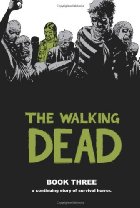
Book Review: The Walking Dead, Book Three by Robert Kirkman (Series, #3) (Graphic Novel)
 Summary:
The rag-tag band of survivors have adjusted to living in the prison. One day they spot a helicopter go down in flames. Rick, Michonne, and Glenn head out to check on it and end up finding another group of survivors whose leader is known as The Governor. Unfortunately for them, not everyone has maintained their humanity amid the walking dead.
Review:
This entry in the series puts the graphic in graphic novel. We’re talking mutilation, torture, and rape. Also the usual murders and zombies. It is not a book for those disturbed by those things or who find them gratuitous. However, for those of us who love violence all up in our literature, it’s a squee-inducing violence fest. Although you may not want to read it in public just in case someone glances over your shoulder during the rape and/or torture scenes.
The addition of another group of survivors where everything is not hunky dory and evil has arisen was exactly what this series needed. It shows the very dark possibilities that the group we’ve been following have thus far managed to avoid. It puts things like Tyreese and Rick’s fight in the previous book into perspective. Woodbury and The Governor also demonstrate how key Rick has been to the group’s survival and maintenance of a healthy community. All it takes is one bad apple wanting the power for a bad culture to spring up. It’s a good lesson that’s taught here in a subtle way.
I thought long and hard about how I feel about Michonne’s rape. At first I was angry about it with reactions ranging from, “she’s so strong; it doesn’t make sense” to “oh sure, rape the only black woman *eye-roll*.” But the more I thought about it I realized I was being unfair. In a world gone to hell and full of evil rape is going to happen. Rape happens every day now let alone in a post-apocalyptic world, and Kirkman manages to show it in a graphic novel in a way that is respectful to the victim, which I am sure was not easy to do. The concept of what is happening is clear, but at the same time, the drawings focus in on the victim’s emotions and reactions. Similarly, Michonne is the logical choice because she is the most adventurous of the women. She does not stay at home with the kids while the men run out and do things. She’s a strong woman, yes, but being strong doesn’t stop bad things from happening to you. That said, if you are a person who finds rape scene triggering, you should definitely skip this entry in the series and get someone to sum it up for you.
Overall, this is a strong entry that keeps the series fresh and introduces more drama into the post-apocalyptic world. Fans of the first two books will not be disappointed by this one. Highly recommended.
4 out of 5 stars
Source: Public Library

Previous Books in Series:
The Walking Dead, Book One
The Walking Dead, Book Two
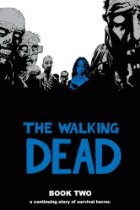
Book Review: The Walking Dead, Book 2 by Robert Kirkman (Series, #2) (Graphic Novel)
 Summary:
The rag-tag group of survivors of the zombie apocalypse stumble upon a prison with two circles of fences just in time. With the warm weather more zombies are active now that they’re no longer frozen. Of course they also discover locked in the cafeteria three surviving inmates. Attempts to make the odd mix of original survivors, inmates, and the farmers into one group might be a task too huge to overcome. Especially when you add in a mysterious woman who arrives with two pet zombies she leads by chains.
Review:
Now that Kirkman has the post-apocalyptic zombie world firmly established, he is more free to move his characters around within it, seeing how different personalities and mores react to an entirely reordered society. This leads to some interesting storylines, such as the May/December romance, suicide pacts, and the idea of a fresh start for the living inmates. It does, however, also lead to some….overly dramatic speeches, let’s say. One in particular reminded me of the infamous “Live together, die alone” speech from Lost, only this one goes, “You kill; you die!” I had to stop reading for a minute to giggle. The close-up of the sheriff’s overly dramatic face had me in stitches, and I”m pretty sure that wasn’t the intended reaction, lol.
That said, though, all of the drama and death and zombies is exactly what one is looking for in a zombie graphic novel. If anything gives a writer an excuse to be overly dramatic, it’s a rag-tag bunch of survivors of the zombie apocalypse. Death and chaos are what we’re looking for here, while also addressing survival issues like farming and people having nervous break-downs. There’s also a creative zombie lore twist that I won’t spoil for you, but that is highly enjoyable.
Overall, Kirkman finds more stable footing in this second entry in the series. It’s chaotic, high-speed disasters, violence, and sex. If that’s what you look for in your graphic novels, I highly recommend this one.
4 out of 5 stars
Source: Public Library
Previous Books in Series:
The Walking Dead, Book 1
Book Review: Buddha Volume Three Devadatta by Osamu Tezuka (Series, #3) (Graphic Novel)
 Summary:
Siddhartha is now a young monk pursuing knowledge and education. He runs into a one-eyed monk who attempts to educate him on the concept of ordeals–essentially punishments for the body designed to help attain enlightenment. The childhood of Devadatta is also depicted. He is bullied and becomes a killer at a young age, thrown out to the wolves who then raise him. Thus his hatred of humanity is explored.
Review:
I am consistently finding this series to be decidedly meh, yet I persist in reading it. I think the art is a large piece of why. It’s almost immediately relaxing to look at, so much so that it doesn’t really matter too much to me what the story is that’s going along with it.
I was intrigued to see a “raised by wolves” myth in another culture. It’s interesting that instead of turning Devadatta into a great warrior, though, it makes him hate humans. A great section is where the wolf mother tells Devadatta that humans are the only animals who kill when they are not hungry. The kindness of and lessons to be learned from the animal world is a persistent theme throughout the series that I enjoy.
Siddhartha’s journey here though does not read at all the way I read it in Siddhartha in college. I appreciate that we’re seeing how no one seems to have answers that ring true for him. For instance, he does not agree with choosing physical punishment purely to suffer an ordeal for no apparent reason. It’s interesting to see his nature depicted as one that just happens to be able to sniff out falseness. It’s a different perspective on the Buddha that I value seeing.
It is odd though for a graphic novel series on an important topic like the Buddha’s life to feel as if it is best read by those already educated on the Buddha. I assumed it would read like an easy introduction, but instead it is so subtle and leaves out so many key details that it is actually best read by those already well educated on Buddhism and the Buddha’s life.
3 out of 5 stars
Source: Public Library

Previous Books in Series:
Buddha, Volume 1: Kapilavastu
Buddha, Volume 2: The Four Encounters
Book Review: Y: The Last Man: Cycles by Brian K. Vaughan (Series, #2) (Graphic Novel)
 Summary:
Yorick and his monkey, Ampersand, (the last males on Earth) continue their reluctant quest to help the government find a way to fix the disease that killed all the other men or at least to clone new men. Their train trip from Boston to California is caught up in Ohio, though, where they stumble upon an oddly utopian town of women. Meanwhile, Yorick’s sister, Hero, and the Amazons continue their quest to rid the Earth of the last man. Plus there’s a mysterious Russian woman who keeps insisting a spaceship with men on it is going to land.
Review:
Now that the premise of the post-apocalyptic world is set up, Vaughan’s story really picks up speed. There is much less explaining and far more action this time around. There are now multiple plot lines and mysteries beyond Yorick’s main one going as well, which helped, because let’s be honest, Yorick isn’t that likeable.
About 1/3 of this entry is set in Boston, primarily around Fenway and the train station. I think having the Amazons duke it out in front of Fenway Park was a pretty nice touch too.
I don’t recall laughing with the first entry, but this one had me laughing out loud on the bus then having to explain to my companions around me what was so funny. The line?
Killing’s easy. Like….like doing laundry!
It is a random, quirky sense of humor that I really enjoy, although I do expect that it might not strike some people as humorous.
The artwork continues to be bright and easy to follow. I really appreciated the preliminary sketches featured in the back of the book. It was most surprising to see that agent 355 originally was white and gradually was changed to black. I’m glad Vaughan made the move, but I do wonder what brought it on!
Overall, if you like a post-apocalyptic graphic world with biting wit and gender commentary, you’re going to enjoy this book.
5 out of 5 stars
Source: Public Library

Previous Books in Series:
Y: The Last Man: Unmanned
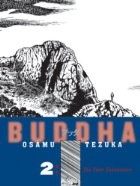
Book Review: Buddha Volume Two The Four Encounters by Osamu Tezuka (Series, #2) (Graphic Novel)
 Summary:
The second entry in the novelization of the Buddha’s life takes us through Siddhartha’s youth spent as a prince. He meets a mysterious Brahmin who tells him he is destined to help the whole world, not rule a single kingdom. Siddhartha is weak, frequently sleeps, and has visions. He is discontent as a prince yet reluctant to abandon his people. On an adventure outside the castle walls he meets a grown-up Tatta and falls for a slave woman, Migaila. Conflict between what he believes and his duties as a prince seem central to the plot, yet in fact it is Siddhartha’s reluctance to follow his calling and leave the castle to be a monk that is at the core of the conflict.
Review:
I was pleased to see this entry in the series jump right into Siddhartha’s life instead of those on the periphery, yet Tezuka also brings in the major characters from the first book as minor characters in this one. It works well, definitely better than the first book. However, I am left wondering if the love between Siddhartha and a slave woman was based at all on fact or hearsay or purely came out of Tezuka’s mind. It would definitely give a new perspective on Siddhartha to know he once had an ill-fated love affair.
Although it’s important to know where the Buddha came from, it is difficult and not particularly enjoyable to read about the time in his life when he was a spoiled brat. Siddhartha does not treat his wife or his father well. Although he has natural talents with meditation and visions, he surprisingly lacks compassion for others. One of the things I like, of course, about the Buddha is that he did start out this way. He’s not perfect; he just learned and worked toward Nirvana. So it’s important to see this part of his life, even if it is uncomfortable to read.
I again felt distracted by the characters Tezuka made up though. I wish he had stuck to a straight-forward graphic novelization of Siddhartha or the legends of the Buddha at least. The weakest points of the book are the parts including characters Tezuka made up purely on his own.
The art is again enjoyable but not amazing. The pictures show the story but do not suck you in. They give the feeling of being there to do a job, not necessarily to provide a memorable visual experience to the reader.
Overall, it’s an interesting new way to explore the life of the Buddha, but I would not recommend it to someone completely new to Siddhartha. It is an improvement over the first entry, and hopefully they will continue to improve, but an idea that could have been great is simply average. That’s disappointing.
3.5 out of 5 stars
Source: Public Library

Previous Books in Series:
Buddha, Volume 1: Kapilavastu
Book Review: Hetalia: Axis Powers Volume 2 by Hidekaz Himaruya (Series, #2) (Manga)
 Summary:
The manga featuring the countries from WWII as characters is back this time focusing more on the future of the nations after WWII instead of the history before WWII. Russia’s dilemmas with his sisters the Ukraine and Belarus are explored. Canada’s persistent ability to somehow be invisible to most of the rest of the G8 nations (and also to be mistaken for America). The various vignettes are punctuated with Japan-kun and America-kun visiting each other’s homes and attempting to reach a cultural understanding.
Review:
Himaruya’s tongue in cheek representation of global politics and national cultures is just as strong here as in the first entry into the series. I appreciate that he addressed before and after WWII first. It puts everything into an interesting historic perspective.
The art is still gorgeous. The countries who are “relatives” of each other are similar looking but still decipherable from each other (although Canada probably wishes he looked a bit less like America). There is a lot to feast your eyes upon on every page.
I again found myself laughing uproariously at the wit within the pages. Every country is teased by the author, including his own. He points out shortcomings without judging them too harshly. It is what it is, and the more I read nations as characters, the easier it is to see the world as one big loopy extended family.
I particularly appreciate how Himaruya explains the former Soviet Union nations’ problems so clearly. It’s something that I must admit as an American we didn’t ever really address in school, so this was all new to me and yet I came away knowing the facts from a manga.
That’s what makes this series awesome. It’s factual without being judgmental. It sees the humor in local customs and quirks. And somehow it teaches you something in the meantime. Highly recommended to all. Just remember to start reading it at the back. ;-)
5 out of 5 stars
Source: Public Library

Previous Books in Series:
Hetalia: Axis Powers, Vol. 1
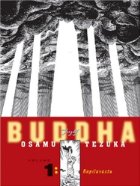
Book Review: Buddha Volume 1 Kapilavastu by Osamu Tezuka (Graphic Novel) (series, #1)
 Summary:
The tale of the Buddha’s life is told peripherally to those of fictional, central characters. There is Tatta, an untouchable who can inhabit the bodies of animals. He is joined by Chapra, a slave who wants to become a warrior. Also there is Chapra’s mother and a young monk. Their lives are impacted by the birth of the Buddha.
Review:
I picked this up randomly from the shelf in the library, and I must say I was expecting a bit more focus on the Buddha than is present in the story. Instead this is one of those tales about fictional people living in the shadow of a world-changing person. I honestly was really excited about the idea of the story of the Buddha told in the graphic novel style, so that was a bit of a disappointment to me.
The art style is interesting. Somewhere between manga and more western-style animation. The characters are really easy to tell apart, though, which was a nice change from some manga.
Although the Buddha is mostly gestating and being born during the course of the book, Buddhist ideas are still present periodically in the storyline. One of my favorites is when a saint chastises the monk for how he orders Tatta to use his talents:
To save just one human, you mindlessly harnessed numerous beasts to an impossible task…and killed them one by one! The beasts you bent to your purpose all suffered greatly and died cruelly! You believe that human lives are sacrosanct while animal lives are worthless?!?! You saved [the human], but the beasts that you sacrificed for his sake are now beyond saving. Life is sacred whether or not it is human! (page 350-1)
It was fun to see these sorts of ideals in the context of a story, and I do always enjoy reading a graphic novel. The main story itself fell flat for me though. It mostly focuses in on Chapra attempting to become a great warrior and save his mother from being a slave, which I fail to see how that relates to the Buddha. As I said, though, this book was not what I was expecting, and I don’t tend to really go for warrior/mother tales. Except Oedipus.
Overall, the art is an interesting style and some of the ideas contained within the book are fun to see in fiction, but the main storyline separate from Buddha’s life simply did not resonate with me. Perhaps it will with you.
3 out of 5 stars
Source: Public Library
Book Review: Hetalia: Axis Powers by Hidekaz Himaruya (series, #1) (manga)
 Summary:
The nations involved in WWII and the events leading up to it are personified as over-the-top manga characters and through manga-style scenarios the historic events leading up to WWII are explored.
Review:
One of my good friends loaned this to me informing me that I would love it. I DID. I REALLY DID. I haven’t seen WWII this funny since Hogan’s Heroes was a mild obsession of mine in middle school, only this is historically accurate.
Each nation’s stereotypes (that are partly true) are blown over the top for the manga characters. France is proud and snobby but pathetically weak. The UK acts like a put-upon uncle who really just wants everyone to start acting their age. Japan is impatient with Germany for including Italy in their alliance. Italy is really short and loves pasta. The US can’t stop eating hamburgers long enough to speak with his mouth empty. It just goes on and on from there. Every page or two depicts a different historic event that set the scene for WWII to explode across the globe, complete with footnotes to clarify anything that might not be entirely clear from the manga-style interaction.
I was a History major in undergrad, and WWII was “my war.” (Every History major has a favorite war. My close second was the Revolutionary War, but I digress). In any case, I have a lot of knowledge about WWII, and Himaruya clearly knows his stuff, but he also gets the irony and funny aspects of different cultures clashing, and that’s what makes Hetalia so incredible. It felt like reading nonfiction in an incredibly entertaining way. It reminds me of back when the History Channel was amazingly cool.
I can’t wait to swap this for the next book in the series from my friend. I’m incredibly curious as to how Himaruya will handle the more serious topics such as the Bataan Death March and the Holocaust in the future entries.
While I loved this book, I primarily recommend it to fans of humorous manga and WWII buffs primarily. I have the feeling others might not “get it.”
5 out of 5 stars
Source: Borrowed
Book Review: I Kill Giants by Joe Kelly (Graphic Novel)
 Summary:
Barbara is a middle school student with one intense focus–she must learn how to kill giants before it is too late. She doesn’t fit in much at school or have many friends, but she doesn’t really care, because she needs to be ready for the giant. The giant is connected to a secret at home, you see, and this secret takes over her life too much to care about all those silly things the other girls talk about.
Review:
I picked up this graphic novel because it was getting tons of buzz as being an excellent graphic novel. I also wanted to know what this big secret was in Barbara’s life. Does the graphic novel address something that isn’t discussed much in polite society but is still an issue for many middle schoolers out there? I was dying to know! Unfortunately, I found myself incredibly disappointed with this graphic novel. I can’t discuss why without spoiling what the giant is, so if you don’t want to be spoiled, skip this review.
I was expecting the giant Barbara is facing at home to be something like abuse or incest. Instead, it turns out Barbara’s mother is dying of cancer. Um. Ok. I’m sorry, a big scary giant doesn’t seem to be quite the right metaphor for a dying parent. What makes this little girl think she can fight death? I guess I just don’t get it.
Additionally, I just really didn’t like Barbara. I honestly get tired of graphic novel writers always making the main character a geek. This little girl–shocker–plays D&D. She is cruel to her classmates. She judges them. She’s even mean to the one girl who for some unearthly reason shows an interest in Barbara and what she likes to do. She, quite frankly, rubs me the wrong way, and I don’t think she’s supposed to.
Then there’s the art. I also didn’t like that, especially how he drew Barbara. Why does she have bunny ears? What’s up with that? The drawing style never feels artistic. Not once did I find myself sucked into the pictures to get further into Barbara’s world. They felt more like badly-done newspaper comic strips than a graphic novel.
Overall, I’m disappointed that I even bothered with this book. It’s one of those few instances when if I’d known the spoiler ahead of time, I’d have saved myself some time. I can’t even imagine handing this over to a middle schooler dealing with a terminally ill relative, because I don’t think it particularly presents healthy coping mechanisms or solutions to unhealthy ones. Why this book is so popular remains a mystery to me.
2 out of 5 stars
Source: Amazon
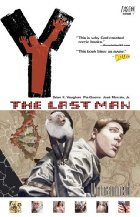
Book Review: Y: The Last Man: Unmanned by Brian K. Vaughan (Graphic Novel) (Series, #1)
 Summary:
The world is changed overnight when all the men and boys in the world mysteriously drop dead. Factions quickly develop among the women between those who want the world to remain all female and those who would like to restore the former gender balance. One man is mysteriously left alive though–Yorick. A 20-something, underachieving magician with a girlfriend in Australia. He desperately wants to find her, but the US government and the man-hating Amazons have other ideas.
Review:
As soon as I heard the concept for this series, I knew I had to read it. Plenty of scifi books have explored other planets consisting entirely of women or an Earth of just women decades after the men died out, but very few go to the immediate after-math of the loss of men. I like that one man is left alive. It lends a scientific mystery to the social aspects of a planet suddenly full of just women. Yorick’s characterization is perfect. He’s laid back enough that there’s not constant angst over the situation, but intelligent enough that he gives the different factions a run for their money. I also appreciate that Vaughan didn’t have all the women suddenly singing kumbaya and holding hands. The fighting, violence, and disagreements among the women are honestly a far more accurate representation of how things work. Women are people, and people fight and disagree. That certainly isn’t a realm that belongs to just men. Vaughan gives an even-handed, fair representation of women covering everyone from women mourning the loss of rock stars to women set world domination and everything in between. I commend Vaughan for that.
The art work is full-color and impactful. Periodically there are full-page illustrations instead of panels. This apocalytpic world isn’t dark. It’s full of light, passion, and energy. Everyone is drawn consistently, and it is not at all difficult to tell people apart. One of the most impactful pages features a close-up of one of the Amazon women with one of her breasts cut (or burnt) off. It’s a very powerful image.
I also appreciated that around 1/4 of this issue takes place in Boston, and Boston is accurately drawn and represented. I love that Boston is key to the story for the scientific community here. It’s tiring always seeing us represented as just the center of the Irish-American mafia. I hope Boston pops up again in future installments. It’s nice seeing my city in print.
Unmanned does an excellent job of quickly setting up the dystopian world where only one man is left alive. The artwork is compelling, and the storyline fairly represents the broad spectrum of female personalities. If the basic concept of this dystopia intrigues you at all, I highly encourage you to try it out.
4 out of 5 stars
Source: Amazon

 Support my work with a tip or browse my shop for curated book club guides, how to guides, cross-stitch patterns, and more!


This work by Amanda Nevius is licensed under a Creative Commons Attribution-Noncommercial-No Derivative Works 3.0 United States License.
 Opinions of a Wolf