
Archive
February 2018 Book Reviews – The Lakota Way (#nonfiction), The Empty Room (#alcoholism), Before We Were Yours (#historic), The Gravity Between Us (#newadult), The Nonborn King (#fantasy)

Some breakfast reading at my in-laws’ in Michigan. For more shots check out my bookstagram
Hello my lovely readers! I’m a bit behind in my book reviews (as usual) because life just keeps happening. But I’ve still been finding time to read (obviously). Looking back on it, I’m kind of amazed I got so much reading done in February seeing as I had the flu and also took a trip to Michigan to see my in-laws and had a very busy work month. (When I’m busy at work I often find myself too brain tired to do much reading). But obviously I did get a lot of reading done! Let’s take a look at what I read.
The Lakota Way: Stories and Lessons for Living by Joseph M. Marshall III was a gift from my husband when we were first dating. I had been trying to read it mindfully and slowly a chapter at a time but clearly I kept forgetting about it instead. This happens to me when I read digital books sometimes. So I decided this month to just pick it up and finish it off. The author of this nonfiction is a member of the Lakota nation, and here he shares the wisdom of his people for us all to benefit from. I am honored and humbled by the fact that he chooses to do so when so much was wrested away from the Lakota by colonization. Reading this book was like sitting down with a wise older uncle who tells stories that may seem disconnected at first but ultimately all revolve around a theme (like love). The stories are also connected with the history of the Lakota people (before and during colonization). I found the entire collection to be moving, and I would recommend it to anyone with an interest in the Native Peoples of the Americas.
(4 out of 5 stars, buy it)
(Source: gift)
Next, I tore through my first 5 star read of the year – The Empty Room by Lauren B. Davis. This is a fictional telling of one day in the life of a woman with alcoholism. Davis is in recovery herself, and her first-hand experience is obvious here. I tore through this in just one day. It’s the most realistic depiction of alcoholism in women I’ve seen. Gritty and dark yet compassionate and hopeful.
She was always 5 minutes away from being the person she wanted to be.
(location 14%)Alcohol, the man said, had first given him wings then taken away the sky.
(location 55%)
Just writing about it now makes me want to pick it up and read it again. If you’ve ever struggled with alcohol yourself or struggled to understand someone who does, give this read a chance.
(5 out of 5 stars, buy it)
(Source: Amazon)
Throughout the month I was working on my audiobook – Before We Were Yours by Lisa Wingate. I call this a historic fiction but really it’s one of those dual setting books with a narrator both in the present and in the past. If you’ve been on book blogs at all in the past year you’ve heard of it. This book looks at a dark history of adoption in the United States, with children being snatched from their families under the guise of the law in the name of eugenics (in this case, the idea that beautiful children are better raised by the rich). I very much appreciate the importance of this history being presented and how well-researched it is, but I must admit that both of the main characters rubbed me the wrong way, which wasn’t something I was able to get past.
(3 out of 5 stars, buy it)
(Source: Audible)
Next I picked up The Gravity Between Us by Kristen Zimmer. This book was at the disadvantage of being my first read after having my soul touched by The Empty Room. I often find that after a read that touching I struggle to enjoy my next read, so keep that in mind when considering my thoughts. This new adult romance looks at two best friends who fall in love with each other but struggle to admit it to each other. Complicating factors include they’re both women, in their late teens, and have just moved to LA. Oh and one is a break-out movie star. It’s a great premise but the execution didn’t work for me. Alternating chapters between the two main character’s perspectives took a lot of the tension out and sometimes left me confused about who was feeling what and who was talking. I also felt like both Kendall and Payton really mistreated their friends around them (a straight guy and a bisexual gal who help them keep the relationship under wraps) and while people make mistakes they never really apologize for this or make up for it to them.
(3 out of 5 stars, buy it)
(Source: Amazon)
Finally I wrapped up the month by finishing my print read of the month: The Nonborn King by Julian May. This is the last in a fantasy trilogy with four disparate plots that ultimately come together in the end of course. I wasn’t into half of them, so that made it a bit of a slog. I also had read the previous two books in audiobook format with multiple narrators, and I wonder how much of my feeling of this being a slog was that it wasn’t being performed at me. I hadn’t realized how much the performance enhanced the books. I still very much enjoy the world of The Pliocene Exile but the direction it went here was puzzling.
(3 out of 5 stars, buy it)
(Source: PaperBackSwap I think?)
It looks like the month started strong then went mediocre. Since I got the flu at the end of the month, I wonder how much of that vibe was just a bad flu mood? Hard to say! Regardless, I know I’ll be readingThe Empty Room again.
My total for the month of February 2018:
- 5 books
- 4 fiction; 1 nonfiction
- 4 female authors; 1 male author
- 3 ebooks; 1 print book; 1 audiobook
If you found this helpful, please consider tipping me on ko-fi, checking out my digital items available in my ko-fi shop, buying one of my publications, or using one of my referral/coupon codes. Thank you for your support!
April 2017 Reads — #historic, #mystery, #horror, #urbanfantasy

An bookstagram shot from while I was reading Moloka’i. For more check out opinionsofawolf.
I read so many books in April (7!) that I had to look back to postulate why. My husband took me on a surprise trip which means I had a bunch of airplane time, so I think that might have been part of it. In the future, when I’m doing these wrap-ups on time, I’ll know exactly why.
Anyway, April was kind of all over the place in terms of genre, as you can see from the title.
I started off the month with Moloka’i by Alan Brennert, a print book that had been languishing on my tbr shelf for a while. It’s about a Hawaiian girl who gets sent to a leper colony in the late 1800s. We follow her life in this prison forced upon her through no fault of her own. Through this book I learned that leprosy is better called Hansen’s Disease and while I knew about the exploitation of Hawaii, it was interesting to see it through this new lens. It also called into question a lot of medical and public health ethics that tend to come up with something like quarantine. A sad but powerful read.
(4 out of 5 stars, buy it)
(source: paperbackswap)
I next picked up a Harlequin romance mystery that was given to me Wanted Woman by B. J. Daniels. It involves a woman running from false charges on a motorcycle. It was interesting to see the motorcycle bad boy flipped on its head a bit but the book left me feeling kind of meh. I didn’t hate it but I had a hard time even remembering what it was about to write this.
(3 out of 5 stars, buy it)
(source: gift)
Next I picked up another historic fiction (although this time wrapped up with contemporary fiction) — Orphan Train by Christina Baker Kline. I had a phase when I was a little girl of being very into the concept of the orphan trains. For those who don’t know, orphan children from the east coast were put on trains and sent west with the idea that they’d be more able to find homes among the farmers. While some found homes and true families, others of course were only “adopted” to be cheap farmhands. This book has a modern day teenage girl in the foster system doing community service with an elderly lady who it turns out was on the orphan trains. It shows how orphan and foster children are currently and have been mishandled. I liked the beginning of this one quite a bit but found the ending to be disappointing (“cop-out” is the exact phrase I wrote in my initial thoughts.)
(3 out of 5 stars, buy it)
(source: paperbackswap)
Next I changed pace and picked up a monster horror — The Colony by A. J. Colucci. In this case the monster is ant colonies that man has tampered with to create a superweapon that of course gets accidentally unleashed on New York City. Mayhem ensues! This is another one that started out good but was ruined by the ending for me.
(3 out of 5 stars, buy it)
(source: library)
I was so excited for the fourth Miriam Black book to come out that I actually pre-ordered the kindle version. Miriam Black is an urban fantasy series by Chuck Wendig whose lead character can see people’s deaths if she touches them and also has an odd relationship with birds (mainly, that she can kind of send her soul out into a flock of them). I used to love this series. Really love. I’m not sure if I’ve changed or the series has changed. I’d have to go back and re-read the previous entries to know for sure, and I’m not much of a re-reader so I doubt that’ll happen. What I do know is I used to find Miriam gritty and real and this time in Thunderbird I found her annoying and immature. I particularly was not fond of her repeated “nic fits,” in which she brushed off responsibility for her behavior. I also didn’t like the big bad this time, finding them to be boring and unlikely foe for Miriam. I also thought the book sometimes came across as preachy. I know an author’s viewpoint will always come into a book but it shouldn’t do so in an out-of-character way, which happens a few times in this book. Even if this wasn’t the case, though, I found this book to be mostly filler getting ready for the next book in the series, and that always annoys me. So I was disappointed but I’m choosing to believe it’s just that I changed and it’s time for the series and me to part ways.
(3 out of 5 stars, buy it)
(source: purchased)
I next picked up a chick lit, which I reviewed in haiku form here.
I finished up the month with another horror, this one by Richard Matheson. Hell House isn’t what he’s best known for but I was curious about it as a classic of the haunted house genre. This book features investigators going to Belasco House to see once and for all if it’s haunted. I thought it had some frightening moments and enjoyed its stance that it took science and spirituality together to accomplish things but man did it have some stuff that just didn’t age well (and honestly was probably not too great even when it was first published in 1971). For instance, one of the horrors of the house is that a woman’s long-buried same-sex attraction is brought to the surface. This is treated with the same horror as molestation or rape in the book. This is obviously problematic. It also has a Native American character who does not have a well-rounded representation. I’d also give the trigger warning that there are grotesque sex scenes and disfigurings of religious figurines (albeit by evil characters).
(3 out of 5 stars, buy it)
(source: purchased)
My total for the month of April 2017:
- 7 books
- 7 fiction; 0 nonfiction
- 4 female authors; 3 male authors
- 3 ebooks; 3 print books; 1 audiobook
If you found this helpful, please consider tipping me on ko-fi, checking out my digital items available in my ko-fi shop, buying one of my publications, or using one of my referral/coupon codes. Thank you for your support!
Book Review: Loud is How I Love You by Mercy Brown (Series, #1)
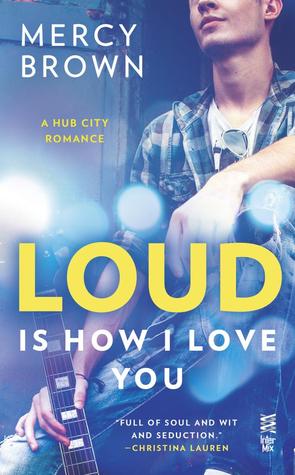 Summary:
Twenty-one-year-old front girl Emmylou knows that getting her band noticed in the ‘90s indie rock scene will be no easy task. She definitely knows better than to break the number one rule of the band: Don’t sleep with your bandmates! But after she ends up having the best sex of her life with her guitarist, Travis, she finds following that rule is a lot harder than it sounds.
When the band gets the gig of their dreams, making it big seems just within reach. But Emmy’s inability to keep her hands off Travis threatens everything they’ve worked for. Can Emmy find a way to break the rules and not blow the chance of a lifetime?
Review:
It took me a moment to get past the fact that 90s now count as historic fiction. *pours one out for the 90s* But then again Fresh Off the Boat is set entirely in the 90s, much like That 70s Show, so it appears the time has come. I was not a “new adult” (refers to those post high school but pre having your shit together) in the 90s (I was solidly a kid coveting a tamagotchi) but I vaguely knew about all the fads the older kids were into like….flannel and grunge. This book oozes that, and the characters get to have the problems that arise from not having a cell phone or YouTube to promo your band. That was fun.
For those who don’t know, New Adult means to expect more sex. And oh man. The sex scenes in this book. There are a lot of them. They are explicit. I like that sort of thing, and even though I rolled my eyes occasionally at some of their more interesting bedroom pursuits (like “tattooing” with permanent marker), I still thought they were hot, well-written, within character, and, most importantly, made sense within the plot.
What I think could make people love or hate this book is the main character, Emmy. She narrates it in the first person and she is, well, she’s a 21-year-old. She makes problems where there shouldn’t be any problems. She gets all up in her head. She thinks in black and white. She is, basically, young and acts and talks like a young person. Yeah, sometimes it’s infuriating to see her fucking her own life up, but that’s realistic, especially for a character who’s supposed to be a passionate artistic type in a band. I was able to appreciate her for who she is and have faith that she’d grow and get past her issues, but I do think that not everyone would be able to see past that and enjoy it in the same way.
The series will follow other people involved in the indie rock scene, and so we’ve already met them in this book as secondary characters. I’m excited to see what hot shenanigans they get up to and hear a new voice’s take on everything going on for the various bands.
Recommended to those who want to take a visit to the 90s through the eyes of a passionate new adult.
If you found this review helpful, please consider tipping me on ko-fi, checking out my digital items available in my ko-fi shop, buying one of my publications, or using one of my referral/coupon codes. Thank you for your support!
4 out of 5 stars
Length: 227 pages – average but on the shorter side
Source: Library
Book Review: Tara Road by Maeve Binchy
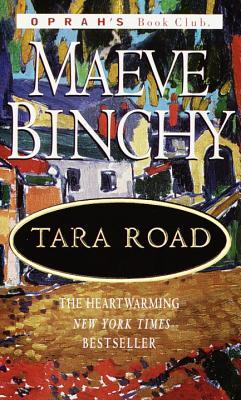 Summary:
Ria lived on Tara Road in Dublin with her dashing husband, Danny, and their two children. She fully believed she was happily married, right up until the day Danny told her he was leaving her to be with his young, pregnant girlfriend. By a chance phone call, Ria meets Marilyn, a woman from New England unable to come to terms with her only son’s death and now separated from her husband. The two women exchange houses for the summer with extraordinary consequences, each learning that the other has a deep secret that can never be revealed.
Review:
Is “two women swap houses and their lives change” a subgenre of women’s fiction? Because I feel like it should be. I have a real soft spot for house swap stories, starting back when The Holiday came out (one of my favorite romcoms). I was excited to see one featuring both Ireland and New England (Connecticut, specifically), and I sensed that the drama would be pretty high in this story. I wasn’t disappointed.
I learned a lot about recent Irish history from this book. For instance, I had no idea that divorce wasn’t legal in Ireland until 1995! The whole culture, too, wasn’t just that divorce wasn’t legal but that young marriage was expected. This directly impacts Ria’s life and her decisions. Learning this recent Irish history through Ria’s eyes helped make it more real and reminds the reader that these cultural norms and laws have a real impact on real people.
The settings were beautifully rendered. From Tara Road to the home in Connecticut, I felt completely present in each. I could hear the noises and smell the cooking at Tara Road and feel the cool pool water in Connecticut. The rich settings helped me take the perhaps at times ridiculous plot with the grain of salt such a story warrants.
Many issues are covered without ever feeling like the book was written just to talk about them. Rather, the issues exist because they just happen to in real life so why wouldn’t they in this book. Among the issues: alcoholism, domestic violence, grief, infertility, and more that I can’t mention without being plot spoilery.
Still, though, in spite of the strong setting and interesting plot, I did feel that it ended a bit too abruptly. I felt as if I was left hanging, wondering what ultimately was going to happen with these women. Being left wanting more isn’t necessarily a bad thing but after investing so much into these two women, I would have enjoyed at least an epilogue.
Overall, a strong entry in women’s fiction. It’s a house swap story that stays unique with the house swap not being about romance but rather about dealing with personal issues and where you want your life to go.
If you found this review helpful, please consider tipping me on ko-fi, checking out my digital items available in my ko-fi shop, buying one of my publications, or using one of my referral/coupon codes. Thank you for your support!
4 out of 5 stars
Length: 648 pages – chunkster
Source: Library
Book Review: Fever by Mary Beth Keane (Audiobook narrated by Candace Thaxton)
 Summary:
Have you ever heard of Typhoid Mary? The Irish-American cook in the early 1900s who was lambasted for spreading typhoid through her cooking. What many don’t know is that she was an asymptomatic carrier. This was the early ages of germ theory, and most didn’t realize you could pass on an illness without any symptoms. Captured and held against her will on North Brother Island, it’s easy to empathize with her plight. Until she’s released and begins cooking again.
Review:
I grew up hearing the cautionary tale of Typhoid Mary, who was mostly mentioned within hearing range in combination with an admonition to wash your hands. But some people (mainly other children) told tales of her purposefully infecting those she served. These sentences were spoken with a combination of fear and awe. On the one hand, how understandable at a time when worker’s rights were nearly completely absent and to be both a woman and Irish in America was not a good combination. On the other hand, how evil to poison people with such a heinous illness in their food. In any case, when this fictionalized account of Mary Mallon came up, I was immediately intrigued. Who was this woman anyway? It turns out, the mixture of awe and fear reflected in myself and other children was actually fairly accurate.
I’m going to speak first about the actual Mary Mallon and then about the writing of the book. If you’re looking for the perfect example of gray area and no easy answers mixed with unfair treatment based on gender and nation of origin, then hoo boy do you find one with Mary Mallon. The early 1900s was early germ theory, and honestly, when you think about it, germ theory sounds nuts if you don’t grow up with it. You can carry invisible creatures on your skin and in your saliva that can make other people but not yourself sick. Remember, people didn’t grow up knowing about germs. It was an entirely new theory. The status quo was don’t cook while you’re sick, and hygiene was abysmally low…basically everywhere. It’s easy to understand how Mary was accidentally spreading sickness and didn’t know it. It’s also easy to understand why she would have fought at being arrested (she did nothing malicious or wrong and was afraid of the police). Much as we may say now that she should have known enough to wash her hands frequently. Wellll, maybe not so much back then.
Public health officials said that they tried to reason with Mary, and she refused to stop cooking or believe that she was infecting others. This is why they quarantined her on North Brother Island. Some point to others (male, higher social status) who were found to be asymptomatic carriers who were not quarantined. True. But they also acknowledged the risk and agreed to stop doing whatever it was that was spreading the illness. Maybe Mary was more resistant because of the prejudice she was treated with from the beginning. Or maybe she really was too stubborn to be able to understand what a real risk she posed to others. Regardless, it is my opinion that no matter the extraneous social factors (being a laundress is more difficult than being a cook, people were overly harsh with her, etc…) Mary still knowingly cooked and infected people after she was released from North Brother Island. Yes, there were better ways public health officials could have handled the whole situation but that’s still an evil thing to do. So that’s the real story of Mary Mallon. Now, on to the fictional account (and here you’ll see why I bothered discussing the facts first).
At first Keane does a good job humanizing a person who has been extremely demonized in American pop culture. Time and effort is put into establishing Mary’s life and hopes. Effort is made into showing how she may not have noticed typhoid following her wherever she went. She emigrated from Ireland. She, to put it simply, saw a lot of shit. A lot of people got sick and died. That was just life. I also liked how the author showed the ways in which Mallon was contrarian to what was expected of women. She didn’t marry. She was opinionated and sometimes accused of not dressing femininely enough. But, unfortunately, that’s where my appreciation fo the author’s handling of Mallon ends.
The author found it necessary to give Mallon a live-in boyfriend with alcoholism who gets almost as much page time as herself. In a book that should be about Mary, he gets entirely too much time, and that hurts the plot. (There is seriously a whole section about him going to Minnesota that is entirely pointless). A lot of Mary’s decisions are blamed on this boyfriend. While I get it that shitty relationships can cause you to make shitty decisions, at a certain point accountability comes into play. No one held a gun to Mary’s head and made her cook or made her date this man (I couldn’t find any records to support this whole boyfriend with alcoholism, btw).
On a similar note, a lot of effort is made into blaming literally everyone but Mary for the situation. It’s society’s fault. It’s culture’s fault. It’s Dr. Soper’s fault. They should have rehabbed her with a new job that was more comparable to cooking than being a laundress. They should have had more empathy. Blah blah blah. Yes. In a perfect world they would have realized how backbreaking being a laundress is and trained her in something else. But, my god, in the early 1900s they released her and found her a job in another career field. That’s a lot for that time period! This is the early days of public health. The fact that anyone even considered finding her a new career is kind of amazing. And while I value and understand the impact society and culture and others have on the individual’s ability to make good and moral decisions, I still believe ultimately the individual is morally responsible. And at some point, Mary, with all of her knowledge of the fact that if she cooked there was a high probability someone would die, decided to go and cook anyway. And she didn’t cook just anywhere. She cooked at a maternity ward in a hospital. So the fact that the book spends a lot of time trying to remove all personal culpability from Mary bothered me a lot.
I’m still glad I read the book, but I sort of wish I’d just read the interesting articles and watched the PBS special about her instead. It would have taken less time and been just as factual.
If you found this review helpful, please consider tipping me on ko-fi, checking out my digital items available in my ko-fi shop, buying one of my publications, or using one of my referral/coupon codes. Thank you for your support!
Source: Audible
3 out of 5 stars
Length: 336 pages – average but on the longer side
Buy It (Amazon or Bookshop.org)
If you found this review helpful, please consider tipping me on ko-fi, checking out my digital items available in my ko-fi shop, buying one of my publications, or using one of my referral/coupon codes. Thank you for your support!
Book Review: A Spell of Winter by Helen Dunmore
 Summary:
Cathy and her brother Rob live with their emotionally distant grandfather on family land in England because her mother left, and her father died in a mental institution. Cathy and Rob seek refuge with each other against the world, but World War I won’t let them keep the world at bay forever.
Review:
I generally enjoy controversial books, and I heard that this historical fiction included the always controversial plot point of incest. The short version of my review is: it’s amazing how boring a book about incest and WWI can actually be. For the longer version, read on.
The book is told non-linearly in what appears to be an attempt to build suspense. The constant jumping with very few reveals for quite some time, though, just led to my own frustration.
I was similarly frustrated by the fact that Cathy’s childish interpretation of her father’s mental illness never progresses. She never moves from a child’s understanding to an adult’s understanding. This lack of progress gave a similar stagnant feeling to the book.
Of course, what the book is best-known for is the incest between Cathy and Rob. I found the scenes of incest neither shocking nor eliciting of any emotion. There are scenes where Cathy and Rob discuss how “unfair” it is that they cannot have children and society will judge them. But then again there are scenes that imply that Rob took advantage of Cathy. Well, which is it? It’s not that I demand no gray areas, but the existence of gray areas in such a topic would best be supported by a main character with insight. Cathy remains childlike throughout the book. Indeed, I think the characterization of Cathy is what holds the whole book back. Because the book is Cathy’s perspective, this lack in her characterization impacts the whole thing. What could be either a horrifying or a thought-provoking book instead ends up being simply meh. A lot of time is spent saying essentially nothing.
That said, I did enjoy how the author elicits the setting. I truly felt as if I was there in that cold and often starving rural England. I felt as if I could feel the cold in my bones. That beauty of setting is something that many writers struggle with.
Overall, this book read as gray and dull to me as the early 20th century English countryside it is set in. Readers with a vested interest in all varieties of WWI historic fiction and those who enjoy a main character with a childlike inability to provide insight are the most likely to enjoy this book. Those looking for a shocking, horrifying, or thought-provoking read should look elsewhere.
If you found this review helpful, please consider tipping me on ko-fi, checking out my digital items available in my ko-fi shop, buying one of my publications, or using one of my referral/coupon codes. Thank you for your support!
3 out of 5 stars
Length: 320 pages – average but on the longer side
Source: PaperBackSwap
Counts For:
Bottom of TBR Pile Challenge
Book Review: The Veiled Mirror: The Story of Prince Vlad Dracula’s Lost Love by Christine Frost
 Summary:
Vlad the Impaler, a Wallachian prince, inspired the story of Dracula with his bloodthirsty, iron-handed ruling. This, though, is the story of his long-time consort, Ecaterina Floari, mother one of his sons and a daughter. She loves him deeply but is haunted by his ruling style, as well as spirits in a helmet he brings into their home from one of his battles.
Review:
I picked this up during the Smashwords Summer/Winter sale years ago but it took a while for my mood to be just right to read it. It is a historic piece set in 1400s with splashes of the fantastic, and I tended to be in the mood for one or the other but not both. Finally in the heat of the summer, I was ready for a dark historic fantasy that would take me away to heavy gowns and ancient rulers. I was surprised by the level of historic research and detail in the book, as well as the tie-in to the Dracula story, making it a marriage of two genres.
This is a long book with a lot of rich setting detail. That doesn’t tend to be my style but it works with the feel the book is going for, and many readers will enjoy the pace at which the book moves. The dark fantasy elements take time to set up, but when they get into motion they really add to the story. The story strikes a nice balance of Ecaterina working with the culture of her time-period and being bothered by certain things Vlad does. For instance, it bothers her that he has mistresses, but she comes to accept it as is expected of her in the time-period. This trajectory acknowledges the feelings the modern reader may have about the situation but also lets the character be true to her time-period.
The author toes a finely-held line of showing Vlad’s cruelty but also keeping him human and not demonizing him. He was a cruel ruler but he wasn’t a monster. Similarly, although Ecaterina loves him she is still disturbed by his actions when ruling. This lends both characters depth they would not have if Ecaterina’s love was blind or Vlad was monstrous.
In spite of appreciating the historic fiction plot covering many decades, I did sometimes feel that the plot meandered a bit too much. I also felt that sometimes the book told too much instead of showing. Similarly, there were a few too many typos and grammatical errors for a book that is in its final version. It was not enough to make me stop reading but it was enough to detract from my overall enjoyment of the story.
I appreciated how much of the book is from women’s perspectives. Not just Ecaterina’s but her mother’s, servants, and other consorts and even a spy are featured. The female cast is strong, and that would be easy for a less thoughtful writer to pass over in favor of showcasing the men history chose to record more thoroughly.
Overall, readers seeking to learn something about the 1400s in Romania will be pleased by how much they will learn reading this book. Those who come to it due to the Dracula connection will enjoy the fantastical elements toward the end in particular. Recommended to readers of historic fiction and fantasy who do not mind a long book with a slow burn.
If you found this review helpful, please consider tipping me on ko-fi, checking out my digital items available in my ko-fi shop, buying one of my publications, or using one of my referral/coupon codes. Thank you for your support!
4 out of 5 stars
Length: 284 pages – average but on the shorter side
Source: Smashwords

Book Review: Thieves’ Quarry by D.B. Jackson (Series, #2) (Audiobook narrated by Jonathan Davis)
 Summary:
It’s September 1768 in Boston, Massachusetts, and the King’s navy has sailed into Boston Harbor to start an occupation in an attempt to restore order and stop the stewing rebellion. Conjurer and thieftaker Ethan Kaille isn’t sure how he feels about the occupation but he is sure how he feels about the large spells he’s started feeling in Boston–not good. He feels even worse he finds out that all the men on board one of the British ships have been killed by a conjuring. The British navy hires him to investigate, while the mayor of Boston threatens to have all conjurers hanged in mere days if he doesn’t find the culprit.
Review:
I loved the first book in this series. Urban fantasy set in a historical time period in the city I actually live in just appealed to me so much. (I really do wish there was more historical urban fantasy. It is awesome). This book failed to capture my attention the way the first in the series did, and I’m uncertain if it was due to the tone, the plot, or the audiobook narration.
Ethan comes across as a bit more insufferable in this entry than in the first. Perhaps as an American and a Bostonian I just simply struggle to understand Loyalist leanings, but Ethan siding with the Crown over and over again, in spite of a literal military occupation just rubbed me the wrong way. It takes him far too long to be irritated by this over-reaction from the Crown, in spite of being on good terms with some of the Patriot leaders. I suppose what it comes down to is that I could take his waffling in the first book when rebellion was just beginning to brew. I thought he was closer to being on the Patriots’ side by the time period of this book, and he wasn’t. This would bother some readers less than it bothered me, I am sure.
Similarly, I had a hard time caring about the plot. I cared about Ethan solving the mystery in time to save the conjurers, but I simply didn’t care who had killed the men on the occupation ship. Everyone in the book, even the Patriots leaders, seemed to think it was this huge evil thing, and I just didn’t care much one way or the other. Part of this could be because I don’t see the difference between casting a spell and murder in other ways, whereas the characters in the book do. Part of it is that the reader never gets a chance to get to know anyone on the ship in a way that would make them sympathize. It felt for a lot of the book like Ethan was investigating a calamity of war, rather than a crime, and that just made it a bit dull to me.
All of that said, this book is a poor fit for an audiobook. I am certain I would have enjoyed it better if I was reading it myself, in retrospect. The pacing just isn’t suited to an audiobook’s speed. I wanted it to go faster, and I did speed up the narration speed, but I couldn’t speed it up too much or I’d miss important things. It was a bit frustrating, in spite of the narrator’s talents at creating unique voices for each character, which is something I always appreciate.
The ending of the book does speed up its pace, and the solution to the mystery is fascinating. This saved the book for me, although I am uncertain if I will continue along in the series. I may need to poke around and see if Ethan goes fully Patriot in the next book before I venture to pick it up.
Overall, this entry in the series fails to live up to the first, although an interesting ending will still spur the reader on to the next entry in the series. Readers who will be turned off by Loyalist leanings in a Revolutionary War book may wish to look elsewhere. But those who simply enjoy seeing urban fantasy in a historic era will not be disappointed.
If you found this review helpful, please consider tipping me on ko-fi, checking out my digital items available in my ko-fi shop, buying one of my publications, or using one of my referral/coupon codes. Thank you for your support!
3 out of 5 stars
Length: 317 pages – average but on the longer side
Source: Audible

Previous Books in Series:
Thieftaker, review
Book Review: Garlic, an Edible Biography: The History, Politics, and Mythology Behind the World’s Most Pungent Food — With Over 100 Recipes by Robin Cherry
 Summary:
A history of the world and medicine as seen through the eyes of garlic, plus a lesson on the many varieties of garlic, how to grow it, and where to find other garlic lovers. Topped off with a collection of over 100 recipes from all over the world featuring garlic, both historic and new.
Review:
When I saw this book on NetGalley, I knew I needed a review copy. I’m a passionate home chef with a love of garlic and a never-ending interest on the history of food. This book’s title indicated it would hit all three of those interests, and its content did not let me down.
The book is divided into two parts. Part One focuses on everything but the recipes. Part Two is the recipes. Part One’s chapters cover the history of using garlic for health and for food, garlic in legends and lore, and how to grow your own. This is the section that most entertained my friends and fiancé, as they found themselves the recipients of random facts about garlic. One friend received an email of all of the types of garlic that originated in the country of Georgia; another a tip that growing some near her fruit tree might be beneficial for the tree. Here are a few of my favorite facts that I learned in Part One:
- The world’s first-known medical text also mentions medical uses of garlic (loc 129)
- Garlic is designated as a drug in Japan (loc 222)
- Spanish immigrants were the most likely to survive during the colonization of the Western hemisphere, thanks to their consumption of garlic. Carrying the cloves protected them from disease-carrying mosquitoes. (loc 309-313)
- Garlic vodka is used as an antiflu remedy in Russia (Bonus: the book has the recipe for making this for yourself). (loc 392)
- “In addition to preventing colds, garlic is effective in killing viral meningitis, viral pneumonia, influenza, and herpes.” (loc 423)
- “Garlic also kills bacteria directly, by invading its cells and causing them to explode, thus bacteria has not opportunity to develop a resistance to it.” (loc 427)
- “Green-colored garlic is stronger than white garlic because it contains more of the aromatic sulfuric compounds.” (loc 922)
- The earliest bridal bouquets incorporated garlic to ward off the evil spirits. (loc 1067)
- There are over 200 varieties of garlic. (loc 1203)
Part One ends with tips on how to cultivate garlic and a selection of the various types of garlic, including notes on where they grow best, how they look, and how they taste. Garlic may be broadly divided into hardnecks and softnecks, but there are subvarieties within these two main ones. (Softnecks are the ones that you can braid). My one criticism of Part One is that I wish it had gone more in-depth into the history of garlic all over the world. It left me wanting more. Perhaps there isn’t more, but I certainly wish there was. I would additionally note that, although I personally enjoyed reading about the many varieties of garlic and took copious notes, some readers might find the listing of the types a bit tedious to read and may not be expecting it in a book of this nature.
Part Two is the recipes. It starts with notes on how to handle and prepare garlic. The recipes are then divided into: dips, sauces, and condiments; bread, pizza, and pasta; soups; salads and salad dressings; appetizers; poultry; lamb; beef; seafood; vegetarian; side dishes; dessert; and historical recipes. I marked off a total of 19 recipes that I definitely want to try, which is quite a lot for me. Often I’ll read a cookbook and only be interested in one or two of the recipes. The recipes cover a nice variety of cuisines, and the historic recipes are fascinating, although most readers will probably not try them as they require things such as fresh blood. Besides the historic recipes, the dessert ones are probably the most surprising. I actually did mark one off as one I’d like to try–Roasted Garlic Creme Brulee.
I have managed to make one of the recipes so far: Garlic Scape Pesto (loc 1649). For those who don’t know, garlic scapes are the green stalks that grow out of the bulbs. They must be trimmed (on most varieties). They taste a bit like a cross between garlic and leeks. Our local produce box happened to give us a bunch of them right around when I read the book, and I’m a big pesto fan, so I decided to try the recipe.
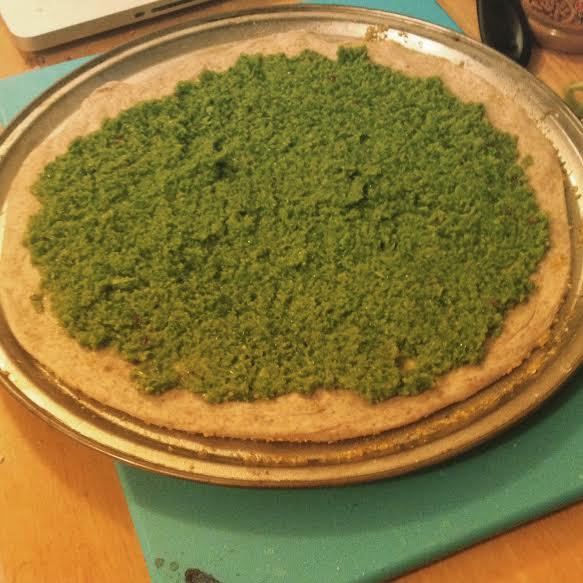
Garlic Scape Pesto on top of my pizza crust, before the rest of the toppings were added.
The recipe is supposed to make 2 cups. I halved it, and somehow still wound up with 2 cups of pesto. The recipe suggests storing the leftovers under a layer of olive oil. I found that unnecessary. My extra kept in the fridge in a tupperware container for a week without adding a layer of protective oil. The pesto was truly delicious though. I partially chose it since I have made garlic scape pesto before, and I must say I found this one much more delicious than the other recipe that I tried. I am looking forward to trying the others I am interested in, although I will probably continue to halve the recipes, as I am only cooking for two.
Overall, foodies with a love of garlic will find this book both fascinating and a source of new recipes to try. Some readers may wish for more information, while others may find themselves a bit more informed on the varieties of garlic than they were really looking for. All will find themselves chock full of new information and eager to try new ways to use garlic…and perhaps even to start growing some heirloom varieties for themselves.
If you found this review helpful, please consider tipping me on ko-fi, checking out my digital items available in my ko-fi shop, buying one of my publications, or using one of my referral/coupon codes. Thank you for your support!
4 out of 5 stars
Length: 240 pages – average but on the shorter side
Source: NetGalley

Book Review: The Poisonwood Bible by Barbara Kingsolver
 Summary:
In 1959 Nathan Price took his wife and four young daughters on a mission to the Congo to spread the Evangelical Baptist message. Nathan, abusive and stubborn, refuses to listen to anyone around him–not the chief of the village he’s living in, not their Congolese maid, not the organizers of the mission, and certainly not his wife or daughters. When the Congo’s fight for independence from Belgium arrives, Nathan refuses to return to the United States with lasting consequences on all of the Prices.
Review:
I was told by several people that as a deconvert from the Evangelical Baptist faith I was raised in, I would enjoy this secularly published take on an Evangelical mission to Africa. While I did enjoy the beginning of the book for its honest look at what missions are actually like, the character development becomes increasingly more lackluster and flat throughout the book, working in direct contrast with an increasingly complex plot and souring the whole book. Additionally, although the book avoids having a Christian slanted take to missions, it certainly does not manage to tell the neutral story I was hoping for. The author’s slant is more and more apparent as the book goes on, and it ends up being quite heavy-handed by the end.
The beginning of the book is excellent. Rather than giving Nathan the voice, all of the story telling is from the point of view of one of the women in his life whom he silences–Orleanna (his wife), Rachel, Leah, Adah, and Ruth May. It is so powerful to see him through their eyes. To see him striving so hard to maintain control over everyone and simultaneously hear from their thoughts that he can never truly control them. It’s empowering and simultaneously heartbreaking.
It’s also interesting to see how Nathan’s stubbornness and know-it-all nature prevents him from ever truly connecting to or even helping the people in the village he’s working in. He thinks his way is always the best, completely missing that he and the villagers could actually trade knowledge and information and all end up better. Because they are, in his mind, backwards and unsaved, he refuses to ever listen to them. His refusal to ever bend causes the mission to break. For instance, he insists on baptism in the river, even though the villagers are afraid to go in the river because of crocodiles. He could have made a compromise, perhaps a tub of water in the church, but he continues to insist on the river, leading the villagers to believe he is out to get their children killed by crocodiles. It’s a gentle and subtle message, unlike others in the book, that could be applied to many aspects of many lives. Be willing to listen, grow, and learn.
Once the Congo rebellion starts though, the book begins a slow slide off the rails. The voices of the women change from developing toward a well-rounded presentation of their characters to flat cardboard cut-out versions of their original selves. For instance, Rachel goes from being a femme teenager frustrated with being stuck in the jungle to a cardboard cut-out racist white supremacist. While being a white supremacist is obviously wrong, Rachel isn’t well-rounded enough to let her still be human. She is instead a monster, which is a disservice to us all. It is only by seeing how those who seem monstrous are just humans gone wrong can we learn something. The same is true of the rest of the women, although they are all taken in different directions toward different stereotypes. One loses her mental health, another becomes a scholar, etc… But they all become stereotypes rather than older versions of their well-rounded younger selves.
Similarly, although the multiple different perspectives work well for a bunch of different sets of eyes seeing the same situations play out in the same village, when the daughters grow up, the multiple perspectives become instead individual perspectives of their own individual lives with some periodic judgment from one sister to another on how she’s choosing to live her life. Instead of giving a richly varied representation of one situation, the reader instead gets a slanted viewpoint of several different situations. It again renders the story flat instead of well-rounded. I found myself thinking many times that the book would have been better if it had just ended at the end of the section that takes part in the daughters’ childhoods.
The plot and character shifts both line up with a tone shift that goes from neutrally presenting what occurs in the village to having a decided political slant. It feels as if the point goes from telling a good story to convincing the reader to feel a certain way. I think it’s interesting that this slant and the weaker writing go hand-in-hand. It’s a good reminder that if you focus on telling a good story, a message may come across on its own anyway, but don’t try to force a story to fit a message you want to tell. That hurts the story.
Overall, the beginning of the book is quite strong, featuring an interesting plot and characters but about 2/3 of the way through, it loses its strength, falling into caricature and message pushing that hurt the story as a whole. Recommended to readers who are quite interested in the beginning and wouldn’t mind skimming the end.
If you found this review helpful, please consider tipping me on ko-fi, checking out my digital items available in my ko-fi shop, buying one of my publications, or using one of my referral/coupon codes. Thank you for your support!
3 out of 5 stars
Length: 546 pages – chunkster
Source: PaperBackSwap

Counts For:
Bottom of TBR Pile Challenge
 Support my work with a tip or browse my shop for curated book club guides, how to guides, cross-stitch patterns, and more!


This work by Amanda Nevius is licensed under a Creative Commons Attribution-Noncommercial-No Derivative Works 3.0 United States License.
 Opinions of a Wolf