
Archive
Book Review: Slither by Edward Lee
 Summary:
Nora and Loren are polychaetologists–worm scientists. They are asked by their college to accompany a National Geographic photographer to an island off the coast of Florida to help her photograph a rare worm. They are accompanied by a member of the military, as it is an island that is unused military property. Also coming surreptitiously to the island are two criminal brothers and their mutual girlfriend to check on their pot growing operation and a group of four college students looking to party. What they don’t know is that the island is gradually becoming infested with a parasitic worm. Only this worm isn’t microscopic. It’s huge and has multiple, gruesome ways of using its hosts. As the various groups try frantically to avoid the worms and their ova, it seems that someone in toxin-blocking suits is watching them.
Review:
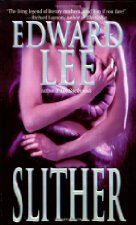
I originally picked this book up and read its blurb because of the cover. I mean, look at that! Such a striking piece of art. Upon reading the description, I decided it sounded a bit like a slightly more phallic Michael Crichton-esque book. In a way, it certainly is. It has the group with scientists attempting to solve a situation that is putting civilians at risk. The similarities kind of end there, however.
This is definitely a horror book, but I wouldn’t call it a scientific horror book. There’s nothing particularly plausible about any of it. I’d absolutely classify it more as the B-type movie gross-out fest. Lee does the gross-out part well. I found myself continually surprised and disgusted by the various things the worms do to human beings. The worms are…well, they’re so gross that it took me a bit longer than usual to read this book because I couldn’t read it right before bed or while I was eating. So he’s definitely good at that!
The book blurb hints at exciting sexual tension, but the sex veers much more strongly toward sexual abuse or gross sex than fun, crazy sex. I didn’t particularly find this bothersome, although a bit sad for the characters. However, I know some readers find that triggering, so you should be aware.
I enjoy watching B films with silly effects and bad dialogue, but it’s a lot more tedious to read awful dialogue than it is to hear it, for some reason. The dialogue really, truly is atrocious. Particularly bad is when Nora talks or thinks. It’s like Lee has never been around a nerdy woman in his life. It’s not much better when he’s writing anyone’s thoughts. They all have the most inane thoughts I’ve ever read. This actually was so tedious to get through that I almost gave up on the book a few times in the beginning. I’m glad I didn’t, because the end is absolutely a surprise. Not so much in the who survives sense, but in the mystery of the worms. It was a satisfying payoff, but I wish he’d either gotten to it sooner.
I feel that overall this is a decent horror book. It’s entirely possible that the beginning just didn’t jive with me, but would with others. I recommend it to fans of gross out horror who don’t mind flimsy dialogue.
3 out of 5 stars
Source: PaperBackSwap

Book Review: The Collected Public Domain Works of H. P. Lovecraft
 Summary:
Lovecraft was an American author of horror living during the late 19th and early 20th centuries. He has a bit of a cult following, largely due to a creature featured in some of his stories known as Cthulu. (I’d link, but your experience will be much more amusing if you google “cthulu”). Some common themes in his horror include eerie things coming from ocean depths, scientific reanimation of corpses, human-like apes, the dreamworld, and ancient myths being fact. This collection includes 24 short stories–The Alchemist, The Beast in the Cave, Beyond the Wall of Sleep, The Cats of Ulthar, Celephais, The Crawling Chaos, Dagon, The Doom that Came to Sarnath, Ex Oblivione, Facts Concerning the Late Arthur Jermyn and His Family, Herbert West: Reanimator, Memory, The Music of Erich Zann, The Nameless City, Nyarlathotep, The Picture in the House, Polaris, A Reminiscence of Dr. Samuel Jackson, The Statement of Randolph Carter, The Street, The Terrible Old Man, The Tomb, The Tree, and The White Ship.
Review:
I decided I needed to actually read some Lovecraft after getting swept up in the Cthulu subculture last December through Cthulumas hosted on Tor.com. So I searched Librivox via the Audible app and found this collection. Unfortunately, there was no Cthulu in it. Also unfortunately, I wasn’t too impressed by most of the stories.
I think the main issue is that a lot of the horror just didn’t age well. Lovecraft’s stories depend largely on the unknown, only a lot of what was unknown in his time is known now. For instance one of his stories focuses around the mystery of the North Star, which isn’t so mysterious anymore. They also depend on unexplored territories on the continents, whereas now it’s space that is unexplored. I can’t get into the character’s mindset of fear when he reads simply as naive and uneducated.
His stories that center around the hypothetical reanimation of the dead are some of the best ones. They read like a mix of zombie and Frankenstein, and it works because we still don’t know what happens after death. Herbert West: Reanimator was one of the only stories to give me the actual chills.
I would be amiss not to mention the racism evident in his stories. Any that feature Africa talk of a pervasive fear of what lies in the depths of the continent and repeatedly mention apes mixing with men. Even if he was unaware that he was harboring racism, these read at the very least as being anti-miscegenation. It’s hard to listen to stories whose horror centers around fear of what people look like as opposed to what they may be capable of doing.
Similarly, he read as being anti-science. Any scientists in his short stories are portrayed as sticking their noses where they don’t belong. Apparently, we can never fathom the universe, so we better not. It’ll hurt us if we try. I found myself rolling my eyes at the sleep stories. They were all so ridiculous when I know doctors and researchers studying sleep. It’s really not this dangerous other-world he presents it to be.
Where Lovecraft is at his strongest is when he veers from his typical themes. My loyal readers probably won’t be surprised at all that one of the most pleasurable reads to me was The Cats of Ulthar, which basically presents animals as sentient and capable as humans.
I can only hope that the Cthulu stories fall more in the category of Herbert West: Reanimator and The Cats of Ulthar. The rest wrought a decided “meh” reaction from me. I’d recommend them only if you have no issue reading horror centering around unknowns that are now known.
2 out of 5 stars
Source: Librivox recording via Audible app for the iTouch and iPhone
Book Review: Wolves of the Calla by Stephen King (Series, #5)
 Summary:
The gunslinger’s katet have a lot more on their plate than just continuing along the path of the beam. Susannah is pregnant and has developed another personality, Mia, to deal with the pregnancy as it is most likely demonic. The Rose is in danger in then when of 1977 New York City. The man who owns the empty lot it grows in is under pressure from the mob to sell it to an unseen man. So the last thing the katet needs is to run into a town desperately in need of the help of gunslingers.
The Calla, a town made up of rice growers and ranchers who mostly give birth to twins, has been facing a plague once every generation. Creatures referred to as Wolves come and take one child out of every set of twins between the ages of about 4 and puberty. The child is later returned mentally retarded. Their local robot messenger, Andy, has warned them that the Wolves are coming in about a month, and their holy man believes gunslingers are on their way.
Unable to turn down their duty as gunslingers or give up on their quest for the Dark Tower, can the gunslingers pull it all off or is it just more than any katet, even one as strong as theirs, can handle?
Review:
Toward the beginning of the book, Roland says something like, “Being a gunslinger means weeks of planning, preparation, and hard work for 5 minutes of battle.” That’s really a good description of this book. It’s a lot of exposition, albeit very interesting exposition, followed by a rather anticlimactic battle that is really the exposition for the next leg of the katet’s journey. This could have gone really badly, but thankfully there’s a lot of information King needs to tell us, and most of it is interesting and relevant to the gunslingers’ world, so it works.
King is good at creating a culture. The Calla and its people possess a very distinctive speech pattern and colloquialisms that are simultaneously easy enough for the reader to learn and to follow. He hints that he just took the Maine accent and exaggerated it. Maybe that’s why a New England gal like myself found it so easy to follow. In any case, the town of twins, ranchers, and rice is rich with local legends, folklore, and traditions. It is enjoyable to read about, and the town also manages to provide information about the katet’s greater quest for the Dark Tower.
It is well-known that King’s Dark Tower series brings in elements and characters from his other works, as he sees all of his stories happening in the same world and being connected. To that end, the holy man of the Calla is the priest from Salem’s Lot, and a part of Wolves of the Calla is him relating his backstory to the katet. Something that irritated me about all of the tales told in the “Telling of Tales” section of Wolves of the Calla is that it would switch from the character speaking to an italicized third person narrative. I don’t know if all of the italicized portions were previously written for other books or if King felt that he needed to be an omnipotent narrator in order to properly tell everything that had happened, but I found it disjointing and jarring. It was only my unanswered questions about the Wolves and the Dark Tower that kept me reading through that section.
I enjoyed the growth in the relationship between Roland and Jake. Roland is gradually growing into a father figure/adviser, while Jake is gradually becoming a man and an equal with the other gunslingers. King handles this transition well, and it is believable. Meanwhile, Eddie and Susannah’s relationship doesn’t change per se, but Eddie does realize that he will always love Susannah more than she loves him. It is evident that both of them are uncomfortable with her multiple personalities. This is an issue that clearly has not yet been resolved.
I do have three gripes with King. The first is that he persists in calling Susannah’s multiple personalities schizophrenia, which is just wrong. Schizophrenics hear voices, at worst, they do not have multiple personalities. What Susannah has is Dissociative Identity Disorder, and it is just inexcusable that he would get this wrong.
Second, although previously in the series the reader isn’t allowed to know or see something Roland knows, the reader always gets to know what the other gunslingers know. Here, information is pointedly held back from the reader. I can only assume this was an attempt to maintain suspense about the Wolves, which I found to be a cop-out. Either come up with an idea creative enough that we’ll be surprised anyway or have the characters be surprised as well as us. Also, I already had the wolves figured out long before they are revealed anyway. The suspense came in wondering how the final battle would play out, not in wondering who the Wolves were.
Third, I don’t like the fact that Susannah’s main storyline is a pregnancy. I don’t like that one of her key roles so far as a gunslinger was to fuck the shit out of a demon so that Jake could be pulled through (The Wastelands). I also really don’t like that something as simple as her being pregnant causes her to abandon her husband and her katet in the form of another personality, Mia. It almost seems that King uses the multiple personalities just so that he can have a sweet woman around when he needs one but then can instantaneously turn her back into all of the negative images of women out there. I need to see where Susannah’s storyline winds up before I can offer a final analysis of the character and its implications, but at the moment, it reads as a very negative view of women.
The overarching storyline of the quest for the Dark Tower, however, is still going strong in this book. We learn a bunch of new, important information about the Tower, the beams, and the worlds, and new questions pop up. With each book it becomes more evident that saving the Tower is important to the well-being of all worlds. I am pleased to report that this was a marked improvement over the previous book, although not quite up to the intensity of The Waste Lands or pure readability of The Gunslinger. It still manages to suck you in and gets the story back on the path of the beam.
3 out of 5 stars
Source: Borrowed
Previous Books in Series:
The Gunslinger, review
The Drawing of the Three, review
The Waste Lands, review
Wizard and Glass, review

Book Review: Wizard and Glass By Stephen King (Series, #4)
 Summary:
Roland and his ka-tet escape Blaine the Train, but they accidentally wind up off the path of the beam and in yet another alternate version of Jake, Eddie, and Susannah’s world. They start following an interstate, heading for a palace and hoping therein lies the solution for returning to the path of the beam. One night while traveling, Roland finally tells them what has been haunting him all this time with the story of the summer he was 14 years old and his first love.
Review:
As with The Waste Lands, this book reads like multiple books in one. I was expecting that, since The Waste Lands ended abruptly without solving the problem of Blaine the Train. This book takes care of that storyline, then jumps into a flashback that lasts almost the entire book then jumps back to the present and attempts to solve a big problem. It’s a lot for one book to handle, and it would have worked better if Lud and Blaine the Train were one book taking place after The Waste Lands but before Wizard and Glass. If after doing this, King had shortened the flashback, The Wizard and Glass would be an excellent book. Of course, he didn’t do it that way.
Now that I am this far into the series, I’m seeing that King, whether intentionally or not, is writing different bits of the series as different genres. This could be why it holds wide appeal–if someone doesn’t like the genre the story is currently being told in, it will change soon enough. The first book is mainly a travelogue. The second a horror story. The third is a mix of scifi with the time paradox and horror again with Lud and Blaine the Train. Here, we get partly fantasy with the current issues for Roland’s ka-tet, but mostly a medieval romance–the story of Roland and Susan.
That medieval romance starts out well. King sets up three dialects–High Speech, In-World Speech, and Mejis accent–very well. All three are easy to differentiate, and yet are easy to read. Roland’s world is a wonderful mix of the knights of Arthur and the fabeled American west. It’s fun to read, but only when something’s really happening. That’s the problem with the flashback. It feels too long, because very little happens in large portions of it. Roland, Cuthbert, and Alain must spend most of their summer in Mejis waiting, and instead of telling the reader “wow, they waited a long time,” King makes the reader wait too, and it’s fucking boring and annoying. I seriously wanted to give up, and right when I was about to, the action started again. Finally. The action makes excellent use of this mix of fantastical and wild west, but it really takes too long to come about.
As far as the characters go, I know I’m supposed to feel for Susan, but I honestly found her annoying and dull, which is problematic since she’s Roland’s first love. Also, after all this time of Roland stating how Eddie is almost as funny as Cuthbert, I was expecting Cuthbert to be, y’know, funny. He’s not. He acts like that boy in school who used to pull your braids and think it was funny. He’s just juvenile, not witty. On the other hand, the character of the witch Rhea is excellently done. She’s simultaneously disgusting and intriguing, and she’s one of the few who manages to out-wit Roland, partly because he underestimates her since she is an old, disgusting woman. If only Cuthbert and Alain had been so vividly drawn instead of wandering shells of people for Roland to talk at.
The book is a necessary read if you plan on finishing the series. It gives important insight into why Roland is the man he is today, not to mention explains how the ka-tet escapes Blain the Train and gets back on the path of the beam. I think this is the almost inevitable dull book in an overall good series. Just take my advice and skim over the dull part of Mejis until the action picks up again.
2.5 out of 5 stars
Source: Borrowed
Previous Books in Series:
The Gunslinger, review
The Drawing of the Three, review
The Waste Lands, review

Book Review: The Waste Lands By Stephen King (Series, #3)
 Summary:
This entry in the Dark Tower series opens with Eddie, Susannah, Roland, and Jake dealing with the paradox created when Roland saves Jake from being killed in his own world. Now Jake and Roland are both living with the knowledge of two different ways a time period of about three weeks went down, and it is driving them both mad. They must solve the paradox before it is too late. After working out the paradox the ka-tet faces a post-apocalyptic city stuck in an age-based civil war. Can the ka-tet who fit into neither side survive? More importantly, can they hitch a ride on a long-forgotten train to speed up their quest for the tower?
Review:
This book opens with a bang. I thought King was going to gloss over the obvious paradox caused by Roland saving Jake in The Drawing of the Three, but a significant portion of this book is spent dealing with just that paradox. I think King is at his best when he writes about psychological horrors, and he gets to really exercise his hand at this with this plot point. That’s not to say there aren’t physical horrors here as well. Of course there are. They mainly show up as the guardians of the ends of the beams that function like spokes around the tower. Decaying beasts and demons haunt the ka-tet’s every move. I actually had serious issues putting the book down during its first half.
The problem arises in the second half. First of all, this book really should have been divided into two. The plots are almost entirely different between the first and second halves, and this was more jolting than if the second storyline was started knowing that it was the next entry in the series. Even King acknowledges in an Afterword that the second storyline stops extremely abruptly. I believe this is because of the sheer length the book was getting to. This wouldn’t have been a problem if this storyline was its own book entirely.
I also personally don’t like plots revolving around kidnappers out to hurt children, which is essentially what this plot is, only in a more fantastical world and with a side-mission for Eddie and Susannah. I’m sure some people enjoy this plot idea, but I personally am far too disturbed at the thought to become thoroughly sucked into the story.
I could forgive these things, mainly due to the addition of a lovable critter to the ka-tet, if it wasn’t for an event toward the end of the book that I felt was too over-top, unbelievable, and done purely for shock value. I won’t tell you what it is here, because that’d be a major plot spoiler, but suffice to say you’ll know it when you see it, and it’ll probably upset you too. It read like lazy writing, and that made me feel like I was being talked down to as a reader.
In spite of the disjointed ending that was also a bit uncomfortable for me, the beginning was truly excellent. I’m hoping the next entry in the series reads entirely like the beginning of this one, but this book is still worth the read for the first half alone.
3.5 out of 5 stars
Source: Borrowed
Previous Books in Series:
The Gunslinger, review
The Drawing of the Three, review

Book Review: The Drawing of the Three by Stephen King (Series, #2)
 Summary:
After finishing the first stage in a long series toward finding The Dark Tower, Roland knows he must now “draw the three.” He will recruit three people to assist him in his quest. Now past the desert and mountains, he has reached an ocean beach where dangerous creatures lurk. As he walks up this beach he gradually finds doors to other realities where his three assistants reside, completely unaware they are about to be drawn into a quest in another world.
Review:
The Drawing of the Three makes it abundantly clear that The Dark Tower series is all about plot and not about character development. The characters do things that work for the plot, but make zero sense from a character stand-point. I’m not talking about mistakes here. I know in the real world people do stupid things. It’s more akin to say a Nazi suddenly deciding he loves a Jew. (That doesn’t happen in the book, but similar things do). I personally find this jarring, but if you’re more of a plot person than a character person, it won’t bother you.
My other issue, and bare in mind that I’ve now read three Stephen King books, is that his writing tends to be misogynistic. Sometimes it’s subtle. An example in this book is when a pharmacist who hates his job is on the phone with a complaining female client. Instead of thinking that he hates these people who complain, he thinks that he hates all these bitches who complain. I, as someone who works with the public, am certain that he has had men and women complain, so why did King specify only women? It seems whenever there’s an opportunity for a character to slur against women, they do. I’m not saying no character should be misogynistic. That’d be like saying no character should ever be racist. I am saying that King shouldn’t take every opportunity to be misogynistic and run with it.
*spoiler warning*
An even better example of this is the only female character in this book, the second assistant, Odetta. She has Dissociative Identity Disorder. (King wrongfully calls this Schizophrenia, which is an entirely different illness). Stereotypically, one personality is “good,” and the other is “bad.” The good personality is grateful to the men for helping her. She is quiet, submissive, intelligent, and strong inside. Naturally one of the men instantaneously falls in love with her. *rolls eyes* The bad personality attempts to defend herself, is physically strong, and vehemently protects herself against suspected rape. She actually tells these men that she will kill them with her cunt. The only women I know who use that word are raging feminists attempting to reclaim the word, and that is not the context here. She is also described as an ugly hag. Granted later these two personalities merge into one, but the implications are there. Men love women who act appropriately feminine. If you behave in any unfeminine manner, you are an ugly hag they naturally want to kill.
*end spoiler*
In spite of that, though, I do still like King’s stories. I’m mostly willing to overlook the bouts of misogyny, because the man can certainly write plot-driven horror. The plot here is excellent. We have doors that lead into people’s brains, horrifying creatures called “lobstrosities,” drugs, shoot-outs, infections, murderers, and more. There is literally horror on almost every page. I couldn’t put it down.
If you like plot-driven horror and don’t mind overlooking character development weakness, then you will enjoy this entry into the Dark Tower series.
3 out of 5 stars
Source: Borrowed
Previous Books in Series:
The Gunslinger, review

Book Review: The Gunslinger By Stephen King
 Summary:
The first in King’s epic, Tolkien-like Dark Tower series, The Gunslinger introduces Roland who lives in a world similar to, yet different from our own. He is the last gunslinger, a kind of wild west type warrior. As he pursues the Man in Black across a desert in the first of many steps toward his goal of the Dark Tower, some elements of his dark past are revealed, as are some secrets of the many parallel, yet somehow linked, universes.
Review:
I admit it. I’m not normally a Stephen King fan, but after two people I know started devouring this series, I decided I had to know just what was so exciting.
I’m shocked to discover, I like a Stephen King book. I’m not so shocked to discover that this is an incredibly male book. Roland’s life centers around violence, guns, a quest, the women he beds, and taking care of a boy. It isn’t just the plot line that’s masculine though. The writing style is decidedly male. Roland is abrupt and to the point. Instead of talking about his heart fluttering, he gets hard-ons. Instead of his palms sweating with nerves, his balls retract up tightly against him. It’s gritty, dark, and male. And I liked it.
It reminds me a lot of watching old westerns with my father. This shouldn’t be surprising, since in the introduction King essentially says that he set out to write the American version of an epic in the style of Tolkien. What’s more American and epic than the wild west? Oh, I know, a parallel universe version of the wild west. With mutants.
It is a bit slow-moving at first. That’s not surprising, though, given that it’s the first in a series of seven. Think of it as the introduction chapter, only prolonged through two-thirds of the book. It’s not a boring introduction by any means; it just takes a while to get attached to the characters and thoroughly engrossed in the over-arching story. That’s ok though, because King provides plenty of nightmarish scenes in the mean-time to keep you reading.
I’ve always had a bit of a tendency to thoroughly enjoy more masculine stories just as much, if not more than more feminine stories. (I was the little girl who was excited to watch the war movie marathon on Veteran’s Day.) If you know that you enjoy this type of gritty story, definitely give The Gunslinger a shot. You won’t be disappointed.
4 out of 5 stars
Source: Borrowed

 Support my work with a tip or browse my shop for curated book club guides, how to guides, cross-stitch patterns, and more!


This work by Amanda Nevius is licensed under a Creative Commons Attribution-Noncommercial-No Derivative Works 3.0 United States License.
 Opinions of a Wolf