
Archive
Book Review: The Girl Who Drew Butterflies: How Maria Merian’s Art Changed Science by Joyce Sidman

A beautifully illustrated middle grade biography of Maria Merian—the 17th-century artist-scientist who transformed our understanding of butterflies, nature, and the role of women in science.
Summary:
Bugs, of all kinds, were considered to be “born of mud” and to be “beasts of the devil.” Why would anyone, let alone a girl, want to study and observe them?
One of the first naturalists to observe live insects directly, Maria Sibylla Merian was also one of the first to document the metamorphosis of the butterfly. In this nonfiction biography, illustrated throughout with full-color original paintings by Merian herself, author Joyce Sidman paints her own picture of one of the first female entomologists and a woman who flouted convention in the pursuit of knowledge and her passion for insects.
Review:
For my birthday in 2024, I went to The Butterfly Place in Westford, Massachusetts—a magical indoor garden filled with butterflies. In the gift shop, I found this stunning book, and my husband bought it for me. It was gorgeous just sitting on my shelf, but when I finally read it, I was even more blown away.
Told in lyrical yet accessible prose, it is structured around the butterfly life cycle, with chapter titles that mirror each stage from egg to molting to flight. It begins with a short glossary of entomological terms that makes the rest of the book easier to navigate, especially for younger readers.
Every page includes illustrations—historic images that ground us in Maria’s time, reproductions of her own scientific watercolors, and thoughtfully placed modern visuals. The full-color format is truly stunning, making this a standout book for readers of any age.
Maria Merian was born in 1647 in Frankfurt, Germany, into a world where women were expected to remain in the home or quietly assist with family businesses. Her father was a publisher, and, after he passed away, her stepfather was a painter—giving her rare early exposure to both printing and art. Yet as a woman, she was denied access to many materials and was considered a “hobbyist,” painting in watercolors, which were viewed as an inferior medium.

From childhood, Maria was drawn to caterpillars and butterflies—despite the scientific consensus at the time that butterflies spontaneously emerged from mud. She collected caterpillars, documented their transformations, and painted them in astonishing detail. She published a caterpillar book that was well-received. Shortly after this, she left her husband and moved into a Labadist community – a secluded religious group. This allowed her to eventually achieve a divorce for religious reasons. Six years after joining the Labadist community, she left for Amsterdam where she established a business of art supplies, art, and preserved insects with her two daughters.
Years later in her 50s, she did the unthinkable—she self-funded a trip to Suriname to study tropical insects firsthand. The journey took a toll on her health, but she returned with the materials to publish her most famous scientific work. She died a few years later, having defied nearly every expectation placed on women of her time.
The writing is geared toward a middle grade audience. While accessible for the young, it’s also rich enough for adults. Difficult topics are handled with sensitivity: the challenges of being a woman in science, the expectations of motherhood, and Maria’s time in Dutch-colonized Surinam. The author acknowledges Maria’s reliance on local knowledge and her resistance to the sugar trade, while also honestly confronting her complicity in a system of enslavement.
While reading, I couldn’t help but imagine this book sitting on the shelf of one of the characters in Bloemetje, my own literary space fantasy about a Dutch company colonizing Venus—lush with plants, bees, and quiet rebellion. Perhaps I should have included a few more butterflies too.
Overall, this is a beautiful, immersive read that educates about butterflies, art, and women’s history all at once. It’s a remarkable tribute to a woman who saw the natural world differently—and helped change how the rest of us see it too. Highly recommended.
If you found this review helpful, please consider tipping me on ko-fi, checking out my digital items in my ko-fi shop, buying one of my publications, using one of my referral or coupon codes, signing up for my free microfiction monthly newsletter, or tuning into my podcast. Thank you for your support!
5 out of 5 stars
Length: 120 pages – short nonfiction
Source: Gift
Buy It (Amazon or Bookshop.org)
Book Review: Steering the Craft by Ursula K. Le Guin
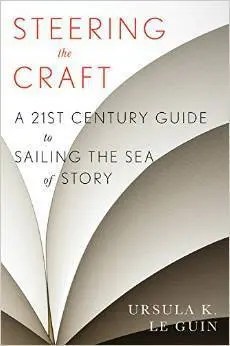
An essential, genre-inclusive writing guide packed with practical advice and thoughtful exercises for writers at any stage.
Summary:
From the celebrated Ursula K. Le Guin, “a writer of enormous intelligence and wit, a master storyteller” ( Boston Globe ), the revised and updated edition of her classic guide to the essentials of a writer’s craft.
Completely revised and rewritten to address modern challenges and opportunities, this handbook is a short, deceptively simple guide to the craft of writing.
Le Guin lays out ten chapters that address the most fundamental components of narrative, from the sound of language to sentence construction to point of view. Each chapter combines illustrative examples from the global canon with Le Guin’s own witty commentary and an exercise that the writer can do solo or in a group. She also offers a comprehensive guide to working in writing groups, both actual and online.
Masterly and concise, Steering the Craft deserves a place on every writer’s shelf.
Review:
Ten chapters. Ten essential elements of writing craft. Each paired with clear, focused exercises designed to sharpen your skills—no matter your genre.
I first borrowed the ebook from my library, but found it so helpful I requested the print version as a holiday gift. Now it lives on the shelf with my most trusted writing resources, right alongside The Emotion Thesaurus.
Despite her legendary status, Le Guin never talks down to the writer. Her tone is accessible, encouraging, and—when needed—direct. It’s the kind of guidance that feels both generous and grounded. Though best known for speculative fiction, she pulls examples from across genres and even tailors prompts for nonfiction writers, especially memoirists.
The topics span everything from grammar and punctuation to big-picture fundamentals like point of view. One of my favorite prompts came from Chapter 1, “The Sound of Your Writing.” I used it to write Pumas, Coffee, and Writing About Grief, a microfiction piece that became one of the most popular episodes on my podcast. That’s the power of this book—it doesn’t just teach; it unlocks ideas.
The final chapter on running peer workshops is full of practical wisdom. If you’re thinking of starting a group (or reviving one that’s fizzled), it’s worth reading for that section alone.
Overall, this is a resource I’ll return to again and again. If you’re a writer at any stage of the journey, I can’t recommend it enough.
If you found this review helpful, please consider tipping me on ko-fi, checking out my digital items in my ko-fi shop, buying one of my publications, using one of my referral or coupon codes, signing up for my free microfiction monthly newsletter, or tuning into my podcast. Thank you for your support!
5 out of 5 stars
Length: 160 pages – average but on the shorter side
Source: Gift
Buy It (Amazon or Bookshop.org)
Book Review: Undrowned: Black Feminist Lessons from Marine Mammals by Alexis Pauline Gumbs

A poetic and powerful collection of life lessons drawn from marine mammals, rooted in Black feminist thought and visionary activism.
Summary:
A book-length meditation for social movements and our whole species based on the subversive and transformative guidance of marine mammals. Our aquatic cousins are queer, fierce, protective of each other, complex, shaped by conflict, and struggling to survive the extractive and militarized conditions our species has imposed on the ocean. Gumbs employs a brilliant mix of poetic sensibility and naturalist observation to show what they might teach us, producing not a specific agenda but an unfolding space for wondering and questioning. From the relationship between the endangered North Atlantic Right Whale and Gumbs’s Shinnecock and enslaved ancestors to the ways echolocation changes our understandings of “vision” and visionary action, this is a masterful use of metaphor and natural models in the service of social justice.
Review:
I read this as research for my upcoming sci-fi novel centered on feminism, environmental justice, and the ocean. (If you’re interested in similar themes, check out my space fantasy about decolonization.) With that frame, how could I not pick this up? A thoughtful mix of marine biology, Black feminist reflection, social justice commentary, and daily spiritual practice, this book made for the perfect before-bed read—soothing yet deeply stirring.
Each chapter is framed around a self-care principle, such as breathe, be vulnerable, or honor your boundaries. But layered themes emerge across the book. The ones that resonated most with me were love, resilience, capitalism, and the complexities of visibility and invisibility.
So there you are, reading a fact about the deep ocean—how scientists keep discovering life thriving even deeper than previously thought. You’re solidly in your analytical brain. And then, out of nowhere, Gumbs offers a breathtaking meditation on love:
“We act on the knowledge that everything could change and yet if I was choosing I would choose you again.”
Sometimes, the connections between marine life and human struggle are made more explicitly. The chapter on how capitalism entwined whaling and slavery shocked me—I couldn’t believe I hadn’t been taught that before. Another chapter explores how narwhal tusks were sold as “unicorn horns,” and how enforced marginality and profit have always been linked.
I especially appreciated how Gumbs pairs the stories of animals we rarely see—deep sea creatures, endangered whales—with those we’re forced to see in captivity. Think SeaWorld and “marketable captives for capitalism.” These stories mirror how, as humans under capitalism, we’re harmed both by being seen and not being seen. We’re told we must look a certain way to be worthy of attention, while that very attention can also endanger us.
It might sound like a heavy read, but it isn’t. Because it’s not just a litany of what’s wrong. Each chapter centers around resilience-building, for ourselves and our communities. Just as marine mammals rely on the stabilizing force of dorsal fins, Gumbs encourages us to build our own internal structures for surviving—and thriving—in a deeply extractive world.
“When we tap into the part of us that is not for sale, so unmarketable that the capitalists say it don’t exist, but it do. It is you. It is all of us. I love you.”
As you can probably tell from the quotes, the book’s tone is warm, conversational, and poetic. It’s fact-based, with insights from scientists and naturalists, but feels more like talking to a passionate friend over coffee than reading an academic text. It’s not a hard read in terms of accessibility—but it will challenge you to think deeply about who you are, how you live, and how you might live differently.
Overall, this is a gentle yet transformative book—easy to read, but it lingers long after the final page. Recommended for anyone interested in environmental justice, resilience under capitalism, or simply learning from the wisdom of marine mammals.
If you found this review helpful, you might also enjoy my podcast, where I explore big ideas in books, storytelling, and craft. You can also support my work by tipping me on ko-fi, browsing my digital items available in my ko-fi shop, buying one of my publications, using one of my referral/coupon codes, or signing up for my free microfiction monthly newsletter. Thank you for supporting independent creators!
4 out of 5 stars
Length: 174 pages – average but on the shorter side
Source: Library
Buy It (Amazon or Bookshop.org)
Book Review: The Dragon from Chicago: The Untold Story of an American Reporter in Nazi Germany by Pamela D. Toler

Discover the untold story of Sigrid Schultz, the fearless American journalist who exposed the rise of Nazi Germany—at a time when women were underrepresented in jouranlism.
Summary:
Schultz was the Chicago Tribune ‘s Berlin bureau chief and primary foreign correspondent for Central Europe from 1925 to January 1941, and one of the first reporters—male or female—to warn American readers of the growing dangers of Nazism.
Drawing on extensive archival research, Pamela D. Toler unearths the largely forgotten story of Schultz’s years spent courageously reporting the news from Berlin, from the revolts of 1919 through Nazi atrocities and air raids over Berlin in 1941. At a time when women reporters rarely wrote front page stories, Schultz pulled back the curtain on how the Nazis misreported the news to their own people, and how they attempted to control the foreign press through bribery and threats.
Review:
This wasn’t on my TBR or wishlist, but when I saw the cover and subtitle at the library, I had to pick it up. I love a troublemaking woman journalist trope—and this was that trope in real life, plus WWII! This nonfiction history book delivers, and in a reader-friendly way.
Despite its depth, this book reads almost as easily as fiction. The author takes care not to put words in the mouths of historical figures—every direct quote comes from letters, interviews, or official documents—yet the scenes are vivid and easy to follow. Each phase of Sigrid Schultz’s life gets just the right amount of attention, from her childhood in Chicago, to her teen years in Europe, to her time as a pioneering journalist. There’s even a well-developed chapter about her post-journalism years in Connecticut, which many historical biographies tend to gloss over.
When I review historical nonfiction, I like to share a few standout insights without giving away everything—so here’s what stuck with me the most.
Sigrid’s sense of identity was deeply American—despite living abroad from age 8 onward. She was so committed to her citizenship that she turned down a full-ride scholarship for singing because accepting it would have required her to renounce her U.S. citizenship.
Her personal life was shaped by loss. Sigrid lost her fiancé in WWI and her second great love to illness in the 1930s. It’s a stark reminder of how much death and grief defined the early 20th century. She didn’t choose to be an independent woman supporting herself and her mother—it was a necessity.
The 1916–1917 German food crisis led to absurd propaganda. Wartime shortages meant that Germans were forced to survive almost entirely on rutabagas. The government tried to spin it, dubbing them “Prussian Pineapples” and publishing recipes for rutabaga soups, casseroles, cakes, bread, coffee, and even beer (yes, rutabaga beer). (📖 page 17).
Although Sigrid’s reporting on the Nazis’ rise to power was the most gripping part of the book—especially during the 1936 Berlin Olympics, when the world was watching—what lingered with me was the story of her later years.
After WWII, Sigrid lost out on professional opportunities because she opposed the Allied occupation of Germany, believing that “any army of occupation is apt to be fascist in its tendencies”—regardless of the occupier’s intent. While I support people having strong ethical stances, her unwavering focus on this issue contributed to a series of choices that prevented her from adapting to the postwar world.
She struggled to transition from journalism to writing for magazines and books, finding it difficult to adjust her style. While the world moved on to focus on the Red Scare, she remained laser-focused on the rise of fascism, convinced it would resurface again. Her stubbornness and focus were, in many ways, her strengths—she even fought off eminent domain in Connecticut, keeping her home from being turned into a parking lot until her death. But they were also a hindrance. It’s real food for thought: when should we adapt, and when should we hold our ground? The balance between the two can shape an entire life.
The book primarily touches on diversity through Sigrid’s observations of the Jewish persecution during the rise of the Nazi regime. Unlike figures such as Corrie ten Boom or Oskar Schindler, she wasn’t someone routinely saving Jewish lives—but she did take small, meaningful actions when possible. One notable example: she convinced a friend to “buy” a Jewish man’s library, allowing him to falsely appear financially stable enough to get a green card—effectively saving his life.
She was also among the first reporters at the liberation of concentration camps and covered the Dachau war crimes trials. The book also explores the possibility that her mother was secretly Jewish, though it remains uncertain.
That said, the book is overwhelmingly told through a white woman’s lens, with little focus on wider global perspectives beyond Sigrid’s own.
Overall, this is an engaging, accessible read, written for popular audiences rather than academic historians. It offers fresh insights into WWII journalism, even for those already familiar with the era, and provides a fascinating look at a pioneering woman in media history. Recommended for readers interested in WWII, investigative journalism, and women’s history. For a more lighthearted take on trailblazing women in journalism, check out Eighty Days, the story of investigative journalist Nellie Bly’s race around the world.
If you found this review helpful, you might also enjoy my podcast, where I explore big ideas in books, storytelling, and craft. You can also support my work by tipping me on ko-fi, browsing my digital items available in my ko-fi shop, buying one of my publications, using one of my referral/coupon codes, or signing up for my free microfiction monthly newsletter. Thank you for supporting independent creators!
4 out of 5 stars
Length: 288 pages – average but on the shorter side
Source: Library
Buy It (Amazon or Bookshop.org)
Book Review: The Serviceberry: Abundance and Reciprocity in the Natural World by Robin Wall Kimmerer
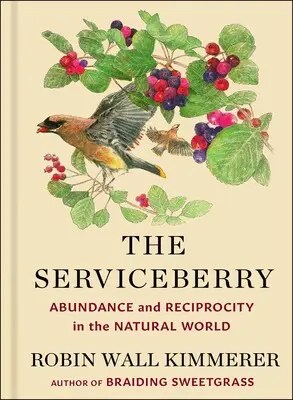
A Potawatomi author and botanist explores the concept of gift economies through the author’s reflections on nature, reciprocity, and the lessons of the serviceberry tree.
Summary:
As indigenous scientist and author of Braiding Sweetgrass Robin Wall Kimmerer harvests serviceberries alongside the birds, she considers the ethic of reciprocity that lies at the heart of the gift economy. How, she asks, can we learn from indigenous wisdom and the plant world to reimagine what we value most? Our economy is rooted in scarcity, competition, and the hoarding of resources, and we have surrendered our values to a system that actively harms what we love.
Meanwhile, the serviceberry’s relationship with the natural world is an embodiment of reciprocity, interconnectedness, and gratitude. The tree distributes its wealth—its abundance of sweet, juicy berries—to meet the needs of its natural community. And this distribution insures its own survival. As Kimmerer explains, “Serviceberries show us another model, one based upon reciprocity, where wealth comes from the quality of your relationships, not from the illusion of self-sufficiency.”
Review:
I was incredibly moved by Robin Wall Kimmerer’s Braiding Sweetgrass, which beautifully wove together the spiritual and the scientific. So, I was excited to dive into her new book, The Serviceberry, which blends natural biology with economics—yes, you read that right.
This short book is gorgeously illustrated by John Burgoyne with thematic line drawings that complement Kimmerer’s reflections. The story centers on her harvesting serviceberries, and this simple activity becomes the starting point for a profound exploration of economic systems.
I’ll admit, before reading this book, I didn’t know much about serviceberries, even though I spent my childhood picking wild berries. After reading Kimmerer’s description and researching more, I’m still not sure I’ve encountered them in the wild myself. I wonder if having a personal connection to the plant would have deepened my connection to the book, much like it did with many of the plants discussed in Braiding Sweetgrass.
The core of the book discusses gift economies—systems of mutual support that thrive on sharing abundance. Kimmerer writes:
Gift economies arise from an understanding of earthly abundance and the gratitude it generates. A perception of abundance, based on the notion that there is enough if we share it, underlies economies of mutual support. (page 75)
Kimmerer uses her own harvest of serviceberries as a metaphor: after gathering more than enough berries, she shares them with her neighbors, who might then return the generosity by baking a pie to share. She connects this to examples like Little Free Libraries and free stands giving away zucchini, offering a hopeful vision of a world where wealth is measured not by money, but by the relationships we build.
However, I struggled to fully embrace this vision. While I appreciate Kimmerer’s focus on the power of sharing, I was reading this book during a time of travel frustration—waiting overnight for a massively delayed airplane—and found myself questioning the likelihood of these ideas. The concept of abundance feels hard to grasp when faced with the reality of scarcity—especially when airlines don’t have enough seats for stranded travelers.
I also hear the idealistic rebuttal: in a gift economy, I wouldn’t need to travel far to see family because we’d all be close by, sharing our abundance. But my personal experience with things like Little Free Libraries, where people dump books in condition too bad for anyone to use, makes me question the idealism of this system. While Serviceberry presents a beautiful vision of generosity, it doesn’t address the real challenges of maintaining such systems at scale.
Despite this, I still value Kimmerer’s generosity in donating all her advance payments to support land protection, restoration, and justice. Her actions speak louder than words, and that’s something I deeply respect.
Overall, this is a quick read that challenges readers to think about economics, abundance, and reciprocity in new ways. While it didn’t convince me of the feasibility of the gift economy, it certainly provided food for thought. I recommend it to those who are interested in reimagining our current economic systems through a natural lens.
If you found this review helpful, please consider tipping me on ko-fi, checking out my digital items available in my ko-fi shop, buying one of my publications, using one of my referral/coupon codes, or signing up for my free microfiction monthly newsletter. Thank you for your support!
4 out of 5 stars
Length: 128 pages – novella/short nonfiction
Source: Library
Buy It (Amazon or Bookshop.org)
Book Review: My Body Is Not a Prayer Request: Disability Justice in the Church by Amy Kenny

A disabled Christian woman shares her experiences with ableism in the church and offers solutions and actionable steps for fostering disability justice and inclusion.
Summary:
Much of the church has forgotten that we worship a disabled God whose wounds survived resurrection, says Amy Kenny. It is time for the church to start treating disabled people as full members of the body of Christ who have much more to offer than a miraculous cure narrative and to learn from their embodied experiences. Written by a disabled Christian, this book shows that the church is missing out on the prophetic witness and blessing of disability. Kenny reflects on her experiences inside the church to expose unintentional ableism and cast a new vision for Christian communities to engage disability justice. She shows that until we cultivate church spaces where people with disabilities can fully belong, flourish, and lead, we are not valuing the diverse members of the body of Christ. Offering a unique blend of personal storytelling, fresh and compelling writing, biblical exegesis, and practical application, this book invites listeners to participate in disability justice and create a more inclusive community in church and parachurch spaces. Engaging content such as reflection questions and top-ten lists are included.
Review:
Intertwining memoir, Biblical commentary, and disability justice scholarship, the author explores disability within the US American Christian church.I picked this book up as research for the second book in my closed-door paranormal romance series, which uses werewolfism as a metaphor for disability (look for it this year!). You can grab the first book on Amazon, Bookshop.org, or other retailers, or request an advanced copy of the sequel.
The book is organized into ten chapters—seven of which start with the title “disability” and three with “disabled.” Each chapter begins with a memoir vignette and delves into the theme of the chapter. One chapter I particularly resonated with is “Disability Blessings.” It opens with the author singing a pop song during a medical procedure, before discussing the societal pressure to “fix” disabled bodies rather than support them. She then brings the conversation to the Bible, exploring the story of Jacob, who becomes disabled after wrestling with God. This disability, Kenny argues, is a sign of blessing, not something to be eradicated.
Faith, then looks like wrestling–all night long–and emerging with a healing limp….I treasure this image, because it allows me to envision my limp as part of my healing instead of something that must be cured or killed off in hopes of inspiring nondisabled people. (page 51)
She ends each chapter with bullet-point listed calls to action for disability justice. For example, in this chapter, the reader is invited to re-explore disability narratives in the Bible and view them through a lens of celebrating disabled people. After this, she features a “top ten” list of things people have actually said to her as a disabled person with each chapter on a theme. The theme of this chapter is “I know how you feel,” with the message being, of course, no one really knows how anyone else actually feels to live in their body.
The themes of the rest of the chapters are curatives, discrimination, doubters, justice, mosquitoes, lessons, disabled foundations, disabled God, and disabled church. The most controversial seems to be that of disabled God, but I found it rather inspiring. For example, the resurrected Christ, God incarnate, has the marks of the nails on his hands and a hole in his side. He invites Thomas to touch these places. Jesus was not resurrected with a “perfect” body, so why is there so much pressure on disabled Christians to “faith their way” to one?
Sometimes the author’s writing challenged me, but I viewed it as an invitation to sit with the discomfort. Why was what the author was saying making me uncomfortable? Was it really how she was saying it or was it just an entirely new perspective being brought to me? For example, I didn’t like that she didn’t disclose exactly what condition she has. But I sat with that and wondered why I felt the right to know?
As someone who is writing about disability through metaphor myself, this book encouraged me to consider my character viewing his werewolfism as a blessing, not a curse. Of course, there is nuance to this. For example, Kenny points out that of course she would prefer to not be in pain. But it’s possible to both dislike the negatives of a disability while also seeing the blessings that come with it. This is a perspective I’m striving to bring to my own book.
Overall, this is an interesting mix of memoir, Christian exegesis, and disability justice. Recommended to Christian readers looking to become better disability justice advocates and disability justice advocates looking to understand the Christian perspective.
If you found this review helpful, please consider tipping me on ko-fi, checking out my digital items available in my ko-fi shop, buying one of my publications, using one of my referral/coupon codes, or signing up for my free microfiction monthly newsletter. Thank you for your support!
4 out of 5 stars
Length: 208 pages – average but on the shorter side
Source: Library
Buy It (Amazon or Bookshop.org)
Book Review: Monsterland: Encounters with UFOS, Bigfoot, and Orange Orbs by Ronny Le Blanc

Explore the Bigfoot sightings, UFO encounters, and mysterious phenomena of Leominster, Massachusetts—dubbed ‘Monsterland’—through the eyes of author and researcher Ronny Le Blanc.
Summary:
There is an area known to the locals of Leominster, Massachusetts as MONSTERLAND. There are sightings of UFOS, Bigfoot and Orange Orbs. They have been coming and going for years. But where are they coming from? Why are they here? It seems that the state of Massachusetts has had a long history of sightings and encounters with these mysterious entities and they are occurring in the present day. Could all of these events somehow be connected? What is so special about Leominster that they have plagued the area for so long? Author and Researcher Ronny Le Blanc of Leominster thinks that he might have the answers to some of these questions. But the answers received lead to a whole new understanding of the unknown…. Welcome to MONSTERLAND.
Review:
Believe it or not, I picked up Monsterland as research for the second book in my paranormal romance series (Get the first book here). Paranormal romance thrives on supernatural creatures, and I wanted to infuse more local flavor by diving into the biggest tall tales of the area. Ronny Le Blanc is something of a local celebrity here in Massachusetts. While reading this at a coffee shop, people literally pointed and said, “Is that Monsterland?!” with wide eyes. I don’t share Ronny’s true believer status, but I do approach these topics with an open mind.
Ronny grew up in Leominster and opens the book with his own childhood encounter with Bigfoot in the Leominster State Forest. This personal connection sets a relatable tone and serves as a thread he frequently returns to. From there, he dives into local legends, including those rooted in the histories of the Nipmuc – the people Indigenous to the area.
One of the most interesting parts of the book is Ronny’s breakdown of commonalities in Bigfoot sightings. He highlights recurring details: the eerie silence of wildlife right before a sighting, tracks appearing and vanishing mysteriously (sometimes even under rocks), and witnesses reporting immobilization, intense fear, and disorientation. According to Ronny, these phenomena are a defense mechanism of Bigfoot—which, he argues, explains the lack of high-quality footage. (Although he also talks about a Canadian man who’s allegedly been consistently communicating with Bigfeet on YouTube.)
The book takes a turn into the mysterious world of orange orbs. Admittedly, these chapters dragged for me, but they’re crucial to Ronny’s overarching theory: Bigfoot are not mere animals—they’re aliens or interdimensional beings. The orange orbs, he believes, represent an intermediary phase of Bigfoot, explaining the disappearing footprints. He also connects this idea to Choctaw and Yaqui cultural beliefs about spirit beings and orbs.
At one point, Ronny recounts speaking aloud to Bigfoot, asking for proof in the form of a marble—and later finding one inexplicably placed in the middle of his home.
My favorite chapters were the tighter, more focused ones. Some of the longer sections could have benefited from more editing to maintain pacing and clarity. That said, there’s something undeniably special about reading folklore rooted in places I know so well. Ronny does an excellent job drawing connections between stories and theories.
However, I noticed a slight anti-yeti bias—Ronny briefly mentions them as the “least intelligent” of Bigfoot species and then essentially drops the subject. I also think the book would have been stronger with an Indigenous co-author for the chapters exploring Native folklore.
Overall, this is an enjoyable read for both cryptid enthusiasts and open-minded skeptics. Ronny’s storytelling style is engaging, and the included photos add a nice visual layer to the experience. If you’re curious about Massachusetts’s Bigfoot sightings, UFO lore, and the unique believer culture of Leominster, this one’s worth picking up.
If you found this review helpful, please consider tipping me on ko-fi, checking out my digital items available in my ko-fi shop, buying one of my publications, using one of my referral/coupon codes, or signing up for my free microfiction monthly newsletter. Thank you for your support!
4 out of 5 stars
Length: 275 pages – average but on the shorter side
Source: Library
Buy It (Amazon or Bookshop.org)
Book Review: Slacks and Calluses: Our Summer in a Bomber Factory by Constance Bowman Reid & Clara Marie Allen

Explore the world of women working on airplane factory lines in this memoir with hand-drawn illustrations from 1944.
Summary:
In 1943 two spirited young teachers decided to do their part for the war effort by spending their summer vacation working the swing shift on a B-24 production line at a San Diego bomber plant. Welding torches and climbing into bomb bays, they learned to use tools that they had never seen before, live with aluminum shavings in their hair, and get along with supervisors and coworkers from all walks of life.
They also learned that wearing their factory slacks on the street caused men to treat them in a way for which their “dignified schoolteacher-hood” hadn’t prepared them. At times charming, hilarious, and incredibly perceptive, Slacks and Calluses brings into focus an overlooked part of the war effort, one that forever changed the way the women were viewed in America.
Review:
I knew the instant I flipped this book open it would be a new favorite. Two teacher friends set out to help the war effort in WWII in their summer off and document it. Constance was a writer, and Clara Marie (fondly called C.M. in the book) was an artist. The book maintains an upbeat tone throughout, in spite of being written prior to the authors having any knowledge of how the war would turn out.
This is an easy read. It feels like chatting with a friend about their unique summer. It starts off with a brief description of their friends’ reactions to their plan for their summer. It then goes through the process of signing up and their first day on the line. Subsequent chapters talk about specific issues. For example, the time the factory tried to make all the women employees fully cover their hair. Or what it was like to commute in pants. C and C.M. were surprised to find how differently they were treated in public in pants.
The characters are memorable, even with the authors doing due diligence to anonymize real people. In From the foremen to women colleagues to men colleagues to the folks they encounter on their commute. Everyone feels real. Some are of course more well-rounded than others. (The foremen or “Red Buttons” are particularly flat.) But this simply adds to the realness of the memoir. Isn’t that how we all encounter people in our lives? With some developing into full-fledged members of our lives and others staying two-dimensional background characters.
The illustrations are utterly charming and are throughout the book.

The authors reflect on things like the fact that while they will be returning to school in the fall, others will be working on factory lines throughout their life. They also consider the impact the war is having on gender roles in society, although not in academic language. They simply discuss things like how more women are wearing pants and how men treat them when they do. In general, though, the women try to keep the tone light.
Overall, this is a compelling primary document in memoir form of the women on the factory lines in WWII. It’s interesting they had the foresight to realize this was an important moment in history. Immediately writing the book and finding a publisher. They were published in 1944. Their factory work was just the year before in 1943. An easy gift for any WWII aficionado. Also, check out my other reviews of books dealing with WWII.
If you found this review helpful, please consider tipping me on ko-fi, checking out my digital items available in my ko-fi shop, buying one of my publications, using one of my referral/coupon codes, or signing up for my free microfiction monthly newsletter. Thank you for your support!
5 out of 5 stars
Length: 200 pages – average but on the shorter side
Source: Gift
Buy It (Amazon or Bookshop.org)
Book Review: Prisoners of the Castle: An Epic Story of Survival and Escape from Colditz, the Nazis’ Fortress Prison by Ben Macintyre

The true story of the Allied Prisoners of War in Colditz, a German fortress turned into a prison.
Summary:
During World War II, the German army used the towering Colditz Castle to hold the most defiant Allied prisoners. For four years, these prisoners of the castle tested its walls and its guards with ingenious escape attempts that would become legend.
Review:
This is a rare combination for historic nonfiction. Well-researched and engagingly written. As easy to read as a well-paced thriller. Yet chock-full of fascinating facts.
The book is organized into sub-sections chronologically by year. Each year then has however many chapters it needs to tell the story. This made it quite easy to keep track of what was going on. There are two insets of wonderful photographs, clearly labeled. This allows the reader to easily put a face to the name of the person being discussed at various points.
Here are just a few of my favorite things that I learned in reading this book.
- An Indian officer was a prisoner at Colditz – and Indian soldiers were prisoners of war in general. Indians fought in WWII on the British side. The Germans tried to get them to come over to their side by appealing to the desire to be free of British rule. This appeal worked for some but not for others.
- A real person inspired the character Q from James Bond. He was responsible for some very creative methods of getting supplies through to the Allied POWs. (For a read about spies in WWII, check out this other book review.)
- The demographic with the most successful escape attempts were the French.
- It’s not so much that officers had a duty to escape as that the Germans would treat them with the courtesy “due an officer” so it was safer for them to attempt escape than for enlisted soldiers to do so.
- The British had a fighter ace who was a double amputee. He was missing part of both legs. He was an excellent flyer but, by all accounts, a real jerk to other people.
- Class structure existed within POW camps. Officers were sent to Colditz with enlisted men who acted as their servants. These men were called orderlies. These men even had their escape attempts denied to continue serving the officers. In one case, a man was given the chance to go home with German consent, but his officer blocked it, insisting he couldn’t go home until the officer did.
My one complaint about the book is this. There were some POWs who the Germans called “Prominente.” They were men with prestigious ties in the West. (For example: a relative of Winston Churchill.) The Germans oversaw them much more closely as they thought they might be valuable as a bargaining ticket. When the Allies were approaching Colditz, these Prominente were sent deeper into German territory, along with their orderlies. Given how attentive to detail this book is, I found it jarring that the two Maori orderlies who accompanied the Prominente were left nameless in the book. (They were Ben McLean and Reginald Mitai.) There were also no details provided on if they escaped the war with their lives. This in spite of the book providing a very detailed run-down at the end of what happened to most of the named prisoners and Germans in the book.
Overall, this is a well-written and enjoyable read on a specific area of WWII. Anyone with an interest in the experience of Allied prisoners in WWII will enjoy this one.
If you found this review helpful, please consider tipping me on ko-fi, checking out my digital items available in my ko-fi shop, buying one of my publications, using one of my referral/coupon codes, or signing up for my free microfiction monthly newsletter. Thank you for your support!
4 out of 5 stars
Length: 368 pages – average but on the longer side
Source: Library
Buy It (Amazon or Bookshop.org)
Book Review: Dead Weight: Essays on Hunger and Harm by Emmeline Clein

A woman in eating disorder recovery explores the world of eating disorders and treatment in the west through a pop culture lens.
Summary:
Emmeline Clein tells the story of her own disordered eating alongside, and through, other women from history, pop culture and the girls she’s known and loved. Tracing the medical and cultural history of anorexia, bulimia, binge eating disorder, and orthorexia, Clein investigates the economic conditions underpinning our eating disorder epidemic, and illuminates the ways racism and today’s feminism have been complicit in propping up the thin ideal. While examining Goop, Simone Weil, pro-anorexia blogs, and the flawed logic of our current treatment methods, Clein grapples with the myriad ways disordered eating has affected her own friendships and romantic relationships.
Review:
This collection of essays consisting of research intertwined with memoir was an engaging read. I particularly liked how Clein approached talking about the negative aspects of Big Pharma in a historical context. That wasn’t something I was expecting in this book, and it was well done. Expect to learn about how amphetamines were marketed as a weight loss drug post WWII because the manufacturers needed a new market now that soldiers were no longer using them to stay awake. Or about how it was Big Pharma who advocated for the labeling of obesity as a disease in the early 2000s (so insurance would pay for drugs to “treat” it.) Or about how the company that originally marketed amphetamines for ADHD was fined for “inappropriate marketing.” (For more about the impact of big pharma on our everyday lives, see my review of Drugs for Life.)
Another thing I appreciated as a person in recovery from addiction was how Clein analyzed addiction and eating disorders as systemic, rather than personal, issues.
The addiction model still requires that we understand ourselves as addicts, rather than see our culture, our food systems, and drug and diet companies as conspiring to encourage addictive patterns. When we believe we are sinners and criminals who deserve to be punished because we are out of control, we don’t demand change to any of the underlying structures that are actually out of our control, controlled by corporations. In it current iteration, the addiction model still makes us blame ourselves and then retrofit our stories into some fictional hero’s journey of abstinence and discipline over the compulsion to consume–stories rooted in the very values at the heart of anorexia and its hold on so many minds.
There were a few things that I did not like about the book, though.
First, her take on the intersection of Irritable Bowel Syndrome (IBS) and eating disorders is woefully short-sighted and lacking empathy for not only those with IBS but other chronic illnesses that the medical industry offers little to nothing for. (Strange for a book that takes down big pharma so aggressively.) Clein presents the opinion that IBs is essentially always second to developing an eating disorder. That IBS symptoms are the body’s natural response to being starved or facing binges. But EDs can be and are triggered by IBS. The fact is, for many people, an ED develops in response to suffering from IBS.
Second, her choice to exclude men from a book about ED is troubling. The overall thesis seems to be that a minuscule number of men have EDs so it’s not worth talking about. In fact, approximately 1/3 of those known to have an ED are men, and there is concern that EDs in men are underreported. Even if it was the case that very few men have EDs (which again, it is not), leaving them out of the book hurts the overall arguments about EDs.
Third, Clein does not talk at all about the interplay between EDs and OCD. This is a more glaring lapse given how much space is given to discussing depression, anxiety, and EDs.
Fourth, while drinking is mentioned repeatedly, drunkorexia is not discussed at all, nor is alcoholism, something which, again, often comes hand-in-hand with EDs and is even seen in vignettes in the book but not addressed.
Fifth, there is a chapter about religion and ED. It completely ignores all other faiths except Judaism, Protestantism, and Catholicism. Clein does not understand Protestantism enough to discuss it in the ways that she does. Every time she brings up Protestantism, it’s clear she doesn’t have a high level understanding of it. She basically makes comments about Protestantism being all about asceticism and self-denial and then moves on. Unlike Catholicism, she does not limit her comments about Protestantism to only the chapter when she’s discussing religion explicitly either. It trickles in throughout the book. (She does also discuss Judaism throughout the book, but she is Jewish, and her faith comes up in the memoir portions, which makes sense.)
As you can perhaps tell from both the featured quote and how long this review is, this is a long and dense book. It seems to have attempted to do something very large when perhaps it might have been better served with a narrower focus and more memoir.
Overall, this book features important information on the intertwining of Big Pharma and eating disorders in the west but it does fall short of an inclusive portrait of eating disorders in the west.
If you found this review helpful, please consider tipping me on ko-fi, checking out my digital items available in my ko-fi shop, buying one of my publications, using one of my referral/coupon codes, or signing up for my free microfiction monthly newsletter. Thank you for your support!
3 out of 5 stars
Length: 288 pages – average but on the shorter side
Source: Library
Buy It (Amazon or Bookshop.org)
 Support my work with a tip or browse my shop for curated book club guides, how to guides, cross-stitch patterns, and more!


This work by Amanda Nevius is licensed under a Creative Commons Attribution-Noncommercial-No Derivative Works 3.0 United States License.
 Opinions of a Wolf