
Archive
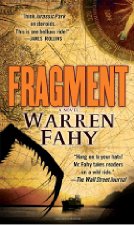
Book Review: Fragment by Warren Fahy (Series, #1)
 Summary:
When the floating reality tv show SeaLife receives a distress beacon coming from a remote island, it looks like their ratings are going to improve. Henders Island has not been visited since the 1700s, and the scientists aboard the Trident are excited at the possible new species they could find. Unfortunately, the species aren’t as benign as they thought.
Review:
This was recommended to me by a couple of friends who know I’m a huge Michael Crichton fan as a Crichton-esque reading experience. I can definitely say that this falls solidly in the hard, plausible scifi genre that has been so empty since Crichton’s passing.
Fahy takes the concept of an island splitting off from the rest of civilization and evolving separately and runs with it. The creatures he comes up with are fantastic and frightening yet simultaneously plausible, which is part of what makes the thrills so thrilling. Similar to Crichton, there are long passages of science explained at a level easily understandable by anyone with a high school diploma. Also, there are passages that at first seem unimportant but later are revealed to be connected and important.
The characterization is strong enough for a thriller of this sort, although that of the main characters could be a bit stronger. Everyone is easy to tell apart, however, and their motivations are clear, something that can be difficult to pull off at the fast pace of a thriller. In future writings, I do hope that Fahy’s main characters will be a bit more well-rounded, however.
The pacing is a bit bumpy with some passages that remove the previously built-up suspense. Although this was necessary to explain the science, it does seem that it could have been worked in more smoothly. The last quarter of the book, however, is paced perfectly with no interruptions and just the right amount of suspense.
One of the highlights of the book is definitely the inclusion of the reality tv show. It lends it a current real vibe. Things are recorded as they happen. The world sort of knows what’s going on, but not quite. The military has to get involved. Everything reads as very plausible and realistically connected to how the modern world actually works. Plus the scenes involving the reality tv producers are just good comic relief.
I absolutely plan on reading Fahy’s future works, and definitely recommend this to fans of Crichton style scifi.
4 out of 5 stars
Source: PaperBackSwap


Book Review: Thinner by Stephen King
 Summary:
Billy Halleck is an overweight, high-powered lawyer in a wealthy Connecticut town. He’s getting a bit irritated at his wife and a bit frustrated with his weight, but he loves his teenage daughter. One day, a band of gypsies come to town, and Billy accidentally runs one of them down with his car, killing her. His law firm and the cops, naturally, get him out of the manslaughter charge, but nobody can protect him from the lead gypsy’s curse, uttered while stroking one finger down his cheek, “Thinner.” Now he’s dropping weight no matter how much he eats, and he must race against the clock in an attempt to save himself.
Review:
A book about gypsy curses could easily slide into racist territory, but in fact Thinner actually criticizes the treatment the gypsies have received in the United States over the years, in spite of them not always being the most sympathetic characters in the book. They may be a bit non-mainstream and overly quick to exact their own vengeance, but Billy Halleck and his cronies are a much more frightening type of bad. They’re the bad that comes from too much money and power. The bad that comes from being so self-centered and over-indulgent that you’ve stopped noticing the rest of the world exists.
So, the social commentary is good and not offensive, what about the horror and thrills? That is, after all, what one reads a King novel for. The grotesqueness definitely builds gradually over time, making this much more of a thriller than a horror. At first Billy’s weight loss is welcomed. He was, after all, overweight before. Gradually, though he starts to freak out about how much weight he’s consistently losing in spite of eating as much as he possibly can. He starts to investigate and discovers two others with their own unique and, frankly, much more frightening curses. Although the beginning may feel a bit slow, that is exactly as it should be. Billy goes from normal life to life under a curse to racing against the clock to save his own life. The horror builds perfectly.
That said, this still doesn’t quite read as sophisticated as some of King’s later work. It does almost seem like a bit too obvious an allegory. A bit too obvious a statement being made. In spite of the story providing chills, it’s not quite terrifying or mind-blowing. It’s a fun read, but it’s no Dark Tower.
Overall this thriller provides chills, horror, and a good social commentary. I recommend it to fans of horror and thrillers alike, although slightly more to fans of thrillers.
4 out of 5 stars
Source: Harvard Book Store

Book Review: Mr. Monster by Dan Wells (Series, #2)
 Summary:
John Wayne Cleaver, diagnosed sociopath and assistant in his family’s morgue, is trying to recover from the aftermath of the demonic serial killer that was haunting Clayton County until a few months ago. A few months ago when he let loose his own inner sociopath, otherwise known as Mr. Monster, and killed the demon. For the sake of the town. Now he is struggling to get Mr. Monster back under control as well as deal with new feelings for his neighbor, Brooke, both of which would be easier if the demon hadn’t killed his therapist. In spite of all this, things seem to be slowly calming down–until new dead bodies start showing up.
Review:
In a series such as this, the second book is rather crucial. In the first book, we see John trying to deal with his mental illness in the normal ways, only to be confronted with an abnormal solution. He takes it. The next book must then show not only if John continues down this path, but also why, not to mention set up the structure so that he may continue down this path indefinitely for most of the rest of the series. Wells definitely accomplishes this tough task, although not quite as smoothly or uniquely as he set up the initial plot and character of John in the first book.
One thing that this book suffers from is uneven pacing. Whereas the first book used the classic thriller scenario of gradually amping up the tension, here the tension rises and falls so frequently and to such different levels that it’s a bit off-putting. It provides too many moments where it’s not too distressing to put the book down and go do something else. It is only the last few chapters of the book that hold the same tension as in the first entry in the series. This is problematic when this is supposed to be a thriller, but understandable given all of the set-up and developments that Wells must pull off.
The new demon is definitely well-done and scary in his own way, although I must say I guessed who he was pretty much the instant he showed up in the book. Thus, what was shocking was not who the demon is, but what he does to his victims, why, and how he pulls it off. This part is creative and thankfully it is evident that the demons in the series will be variable and non-formulaic. This is essential if the elements of surprise, disgust, horror, and delight are to remain.
Yet the focus is not just on the demons, thankfully. Wells skillfully still includes the issues John faces as someone struggling with a rather non-sympathetic mental illness, making him alternately relatable and grotesque. John struggles. He is sometimes unlikable, but he tries so damn hard. Similarly, Wells continues to develop the messed-up family structure John has to deal with, an issue that is absolutely relatable to most readers of YA lit. There is much more going on here than demon fighting. Indeed, even John’s first romantic interest is addressed.
I feel the need to say to animal lovers, particularly ones who love the wonderful kitties among us, that there is a very distressing scene in this book involving a cat that almost made me stop reading it. I do think Wells handles it well, including the aftermath, but if you find animal cruelty incredibly upsetting, um, either skip this book or skim that section. You’ll know when it’s coming.
Overall, this entry in the series does well for all the tasks it had to do to smoothly connect the set-up in the first book to the running themes of the rest of the series. Although the pacing struggles a bit, characterization is still strong, as are surprising plot points. I’m interested to see what Wells does with the next book in the series, and I recommend this one to fans of psychological and paranormal thrillers alike.
4 out of 5 stars
Source: PaperBackSwap

Previous Books in Series:
I Am Not a Serial Killer, review
Counts For:
Book Review: American Psycho by Bret Easton Ellis
 Summary:
Patrick Bateman is a 1980s yuppie working a Wall Street job with a dark secret. He doesn’t connect to other people except in the moments he’s torturing and killing them. But is he really a psychopathic murderer or is it all in his head?
Review:
I have a high tolerance for and even a tendency toward graphic violence and sex in novels, so I feel the need to warn my readers that this book was shockingly graphic even to me, and I was unphased by Battle Royale. So take that warning as you will. If you can’t handle graphic violence and sex, this book is definitely not for you. That said, this book pushes those with a high tolerance for such things in their reading out of their comfort zone, which is always an interesting experience.
The book is told from the first person perspective of Patrick Bateman. This is essential for us to see and feel what it is to struggle as him. This, of course, is painfully uncomfortable because we are put in the head of a madman while he violently dismembers and eventually kills multiple people, mainly women. Some people don’t ever want to be in that person’s head. Personally, I feel it is essential to understand what drives some people to be psychopaths and Breat Easton Ellis has a frightening ability to get inside that head. It is chilling to feel that Patrick gets the same sense of release from killing someone as I get from having a glass of wine at the end of the day. Simultaneously, I don’t doubt this at all, because that is what it is to be a psychopath.
Bret Easton Ellis also does an excellent job of depicting Antisocial Personality Disorder. Essentially, people suffering from this disorder are incapable of connecting emotionally or empathizing at all with other human beings. Patrick recognizes this disconnect when he is talking with various people in his life. He suffers significantly from this inability to find any connection with anything but violence.
My pain is constant and sharp and I do not hope for a better world for anyone. In fact I want my pain to be inflicted on others. I want no one to escape. (Location 8020-8023)
Beyond this, Patrick is completely confused about his world, and he knows it. He is unsure what is reality and what is not. This was one of the first aspects of mental illness to be recognized and seeing it all from the perspective of someone who is suffering from it is eloquent.
My mask of sanity was a victim of impending slippage. (Location 5975-5978)
Of course, beyond the uncomfortable identification with and depiction of someone suffering from one of the most difficult to understand mental illnesses is the depiction of the yuppie environment of the 1980s. What a vain, vapid existence these people lead. Extensive passages feature Patrick delineating every single designer name everyone in the room is wearing. One of the main issues in the week for all of the yuppie characters is getting into what is considered to be the best restaurant that week. Only the “best” alcohol is ordered. Only the “best” food is served, and it is served in such tiny portions that the yuppies are still hungry, yet this is considered to be better than being satiated. Frankly, I found these passages annoying to read, but they are necessary to the book. They show what a shallow, vapid world Patrick is in; one that he feels he cannot escape. These people are so selfish and lacking in empathy in that there is no way in hell they will ever notice anything is wrong with Patrick. It’s a scathing commentary on the yuppie culture.
The only negative from a writing aspect I can say about the book is the random chapters in which Patrick educates us on various musical groups. I honestly have no idea what the point of those are, and I skimmed over them. I definitely think Bret Easton Ellis should have cut them.
Overall, this is definitely a difficult book to read. It’s not comfortable or easy to alternate between identifying with a possible killer and being disgusted by his actions. Feeling sympathy for a killer is not something our society encourages, yet this book makes you feel it. Additionally, the passages depicting the yuppie world are vapid and annoying if for no other reason than because yuppies are vapid and annoying. Those difficulties though are what makes the book work. It takes the reader out of their comfort zone and forces them to confront things that they may not want to confront. Killers are not simply inhuman. They may do inhuman acts, but there are still elements of them that we may identify with. That is the truly scary part of American Psycho.
I highly recommend this book to everyone who thinks they can handle the graphic sex and violence. It will push your boundaries and force you to sympathize with those society depicts to us as the least sympathetic.
4 out of 5 stars
Source: Amazon

Counts For:

Book Review: Room by Emma Donoghue
 Summary:
Most of the time it’s just Jack and Ma in Room. Jack likes watching shows on the planets on the television, but Ma only lets him watch two a day. She says his brain will turn to mush if he watches it too much. So instead they have phys ed where they run track in a smile around the bed or Jack plays trampoline while Ma calls out his moves. Sometimes Ma reads to Jack or they lay in the sun that comes in through the skylight. All day things are good in Room. But every night Old Nick comes, and Jack has to stay in Wardrobe while Old Nick spends time with Ma. Ma doesn’t like it when Old Nick comes. Neither does Jack. Jack’s whole life Ma has told him only they are real, and everything on television and in books is just stories. But one day she tells him those were lies. And now she’s unlying. Because they have to escape soon to Outside. Outside Room.
Review:
This is a mind-blowingly powerful book. I totally devoured it. It was impossible to put it down. Told entirely from the perspective of 5 year old Jack who was born in Room, it puts an incredibly heart-wrenching and revealing look into what has unfortunately been all over the news in recent years. Cases of women kidnapped and then locked up to be used by their kidnappers as, essentially, sex slaves. These cases often result in the births of children, and although stories have been told from the woman’s point of view, I am unaware of any others that tell them from the child’s point of view.
I have no idea how Donoghue was able to sound so completely like an actual 5 year old, but not just a 5 year old. A 5 year old going through such a unique and painful situation. From the very first page, I entirely believed that I was listening to what was going on inside Jack’s head. That means sometimes there are a few paragraphs about playing, and how Jeep and Remote Control play and fight with each other. But it also reveals what incredible insight children can have into life. That children are in fact little people and should be respected as such. For example, at one point Jack says:
I have to remember they’re real, they’re actually happening in Outside all together. It makes my head tired. And people too, firefighters teachers burglars babies saints soccer players and all sorts, they’re all really in Outside. I’m not there, though, me and Ma, we’re the only ones not there. Are we still real? (Location 1257-1261)
Jack is simultaneously childlike and insightful, and that lends a powerfully unique touch to a tale of evil inflicted on others. I honestly cannot think of anyone I would not recommend this book to, except perhaps someone for whom the events in it might be triggering. Beyond that, everyone should have the experience of reading it.
5 out of 5 stars
Source: Amazon

Reading Challenge: R.eaders I.mbibing P.eril
 I love horror. Love love love it. I know a lot of readers don’t. They say it scares them too much or keeps them awake at night. The thing is, I used to be one of those readers! I used to avoid horror because when I was younger horror would absolutely petrify me for weeks on end. I’d think every squeak my old house would make was the boogey-man coming to get me. But then I decided, “Enough of this shit! I’m letting my fears get in the way of an entire genre.” So I dabbled my toes, then I jumped in, and now it’s one of my favorite genres. Horror lets me get lost in a world where it’s ok to be scared and supernatural things occur and I basically get to watch car crashes repeatedly. It’s awesome. The whole genre. I can’t believe how much I’d be missing if I’d continued to avoid it! For instance: Zombies. Tree porn. Everything Stephen King ever wrote. You get my point.
Anyway, so when I saw via Chris at Book-a-rama that Carl of Stainless Steel Droppings is hosting a mystery/suspense/thriller/dark fantasy/gothic/horror/supernatural reading challenge for the spooky fall months of September and October entitled R.eaders I.mbibing P.eril, I knew I wanted to sign up. Not that I won’t be reading horror for these two months anyway, but I thought if I signed up, it’d alert you guys to the challenge. Maybe one of my lovely readers is tentative about one of those genres? Well this is the perfect opportunity to stretch your boundaries! Plus you’ll be in the company of a lovely bunch of people for a couple months to do it.
Of course, that’s my other reason for participating. I want to virtually meet other book lovers who are reading horror!
Originally, in light of the fact that I try to keep my reading unstructured and fun, I was going to sign up for one of the lower levels of the challenge….then I saw how much of my TBR pile fits! Lol, so I’m signing up for the Peril the First level: read four books that fit into any of the genres I mentioned above.
My potential reads for the challenge (direct from my TBR pile) include:
- An Edgar Allan Poe collection whose name is escaping me at the moment
- The Lady in the Lake
by Raymond Chandler
- Thinner
by Stephen King
- The Dark Tower
by Stephen King
- The Vampire Lestat
by Anne Rice
- Hunt Beyond the Frozen Fire
by Gabriel Hunt
- His Father’s Son
by Bentley Little
- Fragment: A Novel
by Warren Fahy
- The Day of the Triffids
by John Wyndham
- The Devil You Know
by Mike Carey
I hope you’ll sign up and do the challenge with me! Especially if you’re afraid of horror. You can sign up for one of the lower levels and just dip your toe in. :-)
Any votes for which four out of my list I should read?
Book Review: The Turn of the Screw by Henry James
 Summary:
Late at night at a party, a gentleman offers to read a ghost story. He claims this story occurred to a woman he knows personally. The narrative then switches to the governess’s voice, and she tells of going to work at her first job as a governess caring for an absent uncle’s nephew and niece. Upon arriving there, she discovers that the property is haunted by the ghosts of the former governess and her lover….or is it?
Review:
I loved the prologue about the party. It’s full of clearly intelligent and world-wise people, which is rare of the Victorian era. I was then disappointed when it switched to the governess’s voice. She is painfully innocent and frankly annoying. She frequently waxes lyrical about how simply delightful and angelic the children are to an extent that it made me sick to my stomach. I frankly would have given up on the story if it wasn’t for the fact that it was my audiobook download, the reader had a pleasant voice, and it’s very short, so I figured, why not finish it? I now am glad I did.
Upon arriving at the end, I found myself wondering if I’d missed something, as I was a bit confused about what happened, and my mind does wander sometimes when listening to an audiobook. Since it’s a classic, I decided to look a bit at the literature guides online just as I would have gone into lecture in university excited to hear what a professor had to say about a work that I found confusing. Well, lo and behold, apparently critics have had two distinct opinions on what exactly happens in the story pretty much since the day it was published. I don’t think it’s a plot spoiler to say that James intentionally wrote it as ambiguous as to whether the ghosts actually exist or the governess is insane. It can either be read as a straight-up ghost story with some sexual innuendos or as a commentary on the ill effects of the tight-laced Victorian culture on women. That’s kind of cool, and for the record, I prefer the insane governess reading of the story, as I think that’s actually more creepy than the ghosts.
After reading the commentary and about James’ opinions in general, I realized that James probably found the governess as annoying as I did. I enjoyed the prologue, and the prologue was a reflection of James and his friends. This makes so much sense now! I am certain if I had approached this book with the knowledge of James’ criticisms of Victorian society that I would have enjoyed it much more than I did approaching it as a straight-up traditional ghost story.
Overall, this is a story that will be best enjoyed by readers who thrill to the challenge of ambiguous tales and who are critical of Victorian era mores and norms. It is not exactly the right fit for readers looking for a traditional ghost story, however. I also feel it necessary to add that I believe this story is not ideally suited to being an audiobook. Due to the ambiguity, certain passages lend themselves to a desire to be re-read that is not so easily pulled-off when being listened to.
3.5 out of 5 stars
Source: Librivox recording via the Audiobooks app for the iTouch, iPhone, and iPad

Book Review: I Am Not a Serial Killer by Dan Wells
 Summary:
Fifteen year old John Wayne Cleaver has an odd fascination with the bodies he helps cremate in the family mortuary. He also has difficulty feeling any emotions. He even has been studying serial killers for years. He is not one, however. At least, not yet. His therapist believes John may have Antisocial Personality Disorder, but both he and John hope John can learn to control his illness, an illness John refers to as Mr. Monster. However, when bodies start appearing on the streets of the town gruesomely murdered, John wonders how long he can keep Mr. Monster in check.
Review:
I originally had high expectations for this book. Then I had to wait for it so long that they waned, and I felt that it was probably just going to be a watered down YA version of Dexter. Then I grabbed it for my camping trip because I am insane and love to terrify myself when sleeping in the middle of nowhere in the woods with strange men with hatchets I don’t know a mere campsite away. It didn’t turn out to be a watered down Dexter. It also isn’t terrifying. The best word I can think to describe this book is relatable.
Dan Wells chose to write a YA book about mental illness and couch it with some supernatural features and a premise that will appeal to any teens, not just those struggling with a mental illness themselves. These were both smart moves as it makes I Am Not a Serial Killer more widely appealing. However, he not only chose to depict a mental illness, he chose to depict one of the ones that is the most difficult for healthy people to sympathize with and relate to–antisocial personality disorder. John Cleaver has no empathy, and this baffles those who naturally feel it.
Yet Wells manages to not only depict what makes John scary to those around him, but also how it feels to be John. He simultaneously depicts the scary parts of having a mental illness with the painful parts for the one struggling with it. John makes up rules for himself to try to control his behavior. He has to think things through every time he interacts with people or he will do or say the wrong thing. John is fully aware that he doesn’t fit in, but he wants to. He wants to be healthy and normal, but he also wants to be himself, which at this point in time includes the behavior that is his illness.
Of course, this is a book about a serial killer, and it delivers there. The death scenes hold just the right level of gruesomeness without going over the top. Anyone with a love of the macabre will also enjoy the mortuary scenes, which depict the right combination of science and John’s morbid fascination. There also is a tentatively forming teen dating relationship that is simultaneously sweet and bit nerve-wracking.
I feel I would be amiss not to mention that there is some self-harm in this book. It is very brief and is clearly shown as a part of John’s illness. In fact for the first time in reading about it in any book I can say the author handled it quite well, depicting the self-injurer and his reasons for doing so sympathetically and correctly, but without making it seem like something the reader should copy.
Overall this book delivers the thrills and chills it promises, but does so without demonizing John Cleaver. It depicts what it feels like to have a mental illness in a powerful, relatable manner while still managing to be a fast-paced YA thriller. I highly recommend it to anyone who enjoys YA, books dealing with mental illness, or thrillers.
5 out of 5 stars
Source: PaperBackSwap

Book Review: The Woman in White by Wilkie Collins
 Summary:
Originally serialized in 1859 to 1860 then published in book form in 1860 this epistolary novel is considered one of the first mystery novels. Walter Hartright is an artist who gets hired to be a drawing master for two half-sisters Laura Fairlie and Marian Halcombe. He and Laura soon fall in love, but they cannot be together due to class differences and Laura’s prior promise to her now deceased father to marry Lord Percival Glyde. A mysterious woman dressed all in white warns Laura against her marriage, calling Lord Glyde evil. However, Laura is reluctant to renege on her final promise to her father and proceeds with her marriage, sending herself, Marian, and Walter into a spiral of intrigue and danger.
Review:
I love slow-moving, epistolary novels, particularly gothic ones read on a long, hot summer day. One of my finest reading memories is of enjoying Dracula while working on a summer internship at a national park on a peninsula with four beaches. So I came to this gothic, mysterious, epistolary novel with high expectations. At first they were met, but as the plot proceeded I came more and more to want to smack Collins upside the head.
Without giving away too much, suffice it to say that the slowly building tension indicates a truly serious infraction on Lord Percival Glyde’s part that turns out to be not particularly shocking at all. At least to my American mind. Suffice it to say, it revolves around title holding, something which I find baffling and laughable. Why should anyone care if Laura is Mrs. Glyde or Lady Glyde? Her life seems more boring than the servants’ anyway. I thought I would be reading a novel that was more about revealing the treachery and debauchery of the upper class. Instead I got a book about bourgeois problems, which, I’ve indicated elsewhere on this blog, I simply cannot relate to and find completely annoying. I get it that some people enjoy that, but the desire to maintain a tense, mysterious illusion around the book led me to believe it’s something it wasn’t. That is frustrating, to say the least.
Beyond the disappointing mystery there’s of course the typical problems found in early 1800s literature. The sexism comes from Marian’s own mouth, which is surprising given that she is a depicted as a strong woman. She often will lament the short-comings of “her sex.” Actually, the entire situation between Walter, Marian, and Laura is baffling. Laura is a weak, foolish girl who Walter falls and stays head over heels in love with. I cannot fathom why that would be when he spends an equal amount of time with Marian, who is a strong, thoughtful, intelligent woman. Laura is described as beautiful, whereas Marian is described as possessing a beautiful body but an unfortunately masculine face. This leads me to believe Walter is rather shallow, as I see no reason beyond Laura’s beauty for his devotion to her. I know sexism is to be expected in older novels, but I would at least hope for a hero who loves the heroine for something beyond her beauty.
That said, the novel certainly gives modern women a new appreciation for our current situation. The women in The Woman in White are constantly downtrodden by the men around them who believe it is entirely within their right to dictate to them everything about how they should behave, speak, dress, etc… It appears that the only thing the women have control over is when to leave the men to their wine after dinner. In fact the couple presented as the happiest and most well-functioning is that of Count Fosco and his wife, and they only function well due to the fact that she obeys his every command. Mrs. Fosco is described as a woman who prior to meeting the Count was loud, obnoxious, and always yammering on about women’s rights. Count Fosco, apparently, “fixed all that,” and she is now such a pleasant woman to deal with. The only woman who does not base her entire existence around a man is Marian, and that is due to her bizarre, near worshipful devotion to Laura. It makes me shudder to think if those had been my options as a woman–existing purely for the whims of a man, downtrodden and outcast, or pure devotion to a sister. Yeesh.
I did enjoy listening to the book. It felt a bit like listening to an old-time radio program, which I’m sure is due to its origin as a serial novel. Those who enjoy the slower pace of older novels and can relate to the bourgeoisie will probably enjoy it. If either of those elements turns you off, however, you should look elsewhere.
2.5 out of 5 stars
Source: Librivox recording via the Audiobooks app for the iTouch and iPhone

Book Review: The Thing from the Lake By Eleanor M. Ingram
 Summary:
In the 1920s Roger Locke is a composer living in New York City. He buys a house by a lake in Connecticut as a country retreat and appoints his cousin, Phyllida, and her husband, Ethan Veer, as caretakers of the property. His first night on the property, he meets a woman–whether spirit or alive, he can’t tell–and is promptly intrigued by her. His visits quickly turn sinister, though, as a dark force based in the lake comes at night to threaten Roger away from the woman. What is the thing in the lake? Who is this woman? Can Roger defeat the dark force thereby returning himself and his cousins to their idyllic lifestyle?
Review:
I had a feeling I was going to like The Thing from the Lake when I discovered that every chapter started with a relevant quote pulled from the classics of the western canon, and I was right. Ingram weaves a complex tale, filled with surprising twists and turns. Just when you think you know what the overarching point is, or where the story is going to go next, you find out that you were wrong.
Ingram artfully goes back and forth between the daytime where the story is more period piece and the nighttime, which is all horror. It is a very New England tale, featuring small farmers, big city dreams, references to the Puritans, and quirky, drawling neighbors. While Phyllida and Ethan are believable and infinitely likeable, Roger’s immediate infatuation with the woman is a bit suspect. It seems shallow how infatuated with her hair and her scent he is, but I think he later proves himself. Sometimes people just know when they meet, so I’m willing to give Roger the benefit of the doubt.
Ingram leaves it up to the reader whether to believe the scientific or the supernatural explanation for the goings on at the lake. It reminded me of my class on the Salem Witch Trials a bit, and I’d be willing to bet that Ingram was at least partially inspired by them. It’s not easy to make both answers to a mystery equally plausible, but she pulls it off wonderfully.
The only thing holding me back from completely raving about the book is that there are parts that smack of historic misogyny. I’m not blaming Ingram. For her time period, many of her thoughts were quite progressive, and I’m sure Roger is an accurate representation of many men of that time period. However, when he speaks about how his “plain cousin” Phyllida is so much more comely when she’s doing “womanly” household chores, it makes me cringe, and not in the good horror way. Thankfully, these instances are not that frequent, so they’re easy enough to glide over.
The Thing from the Lake is a surprisingly thought-provoking book. I highly recommend it to everyone, but particularly to those who enjoy New England literature or light horror.
4 out of 5 stars
Source: Librivox recording by Roger Melin via the Audiobooks app for the iTouch

 Support my work with a tip or browse my shop for curated book club guides, how to guides, cross-stitch patterns, and more!


This work by Amanda Nevius is licensed under a Creative Commons Attribution-Noncommercial-No Derivative Works 3.0 United States License.
 Opinions of a Wolf