
Archive
Book Review: Rage by Jackie Morse Kessler (Series, #2)
 Summary:
Melissa Miller is your typical 16 year old–mom, dad, annoying sister, a jerk of an ex-boyfriend–with one small difference. She deals with her emotions by cutting herself. She keeps a razor in a locked box in her closet and pulls it out when she gets overwhelmed. One night she accidentally cuts too deep, and Death shows up with an option. Either die now or become one of the Horsemen of the Apocalypse–War. Missy chooses the latter option, and as she gets to know the other Horsemen and her job as War, she starts to realize she needs to face the rage inside her.
Review:
Speaking as someone who knows a lot about mental illness, self-injury is one of the illnesses that people who don’t have it have the most difficulty understanding. It seems bizarre to those who don’t self-injure, even as for the self-injurer those moments of cutting or burning or whatever chosen method are the best coping mechanism they can come up with. It’s not easy for those who don’t self-injure to understand, which is why I am so impressed at how well Morse Kessler has grasped the inner workings of the self-injurer in order to write such a well-rounded, sympathetic character as Missy.
Missy is simultaneously relatable as a typical teenager, for instance she gets horribly embarrassed at a party one night, but she also has this deep, dark, misunderstood secret. Gradually other teens find out and are either concerned or lash out at her due to their fear and lack of understanding, but Missy feels that she can’t confide in even the sympathetic ones. In perhaps one of the most powerful passages, the reader gets to see exactly why Missy cuts, while she simultaneously explains why she can’t explain it to her sister.
She could tell her that she turned to the blade because she wanted to live and sometimes pain was the only thing that kept her alive. She could tell her that she was terrified of things she couldn’t even begin to name, that friends could be fickle and lovers could be false. She could try to explain all of that and more, and maybe her sister would understand. But trust was as fragile and cutting as a crystal sword. (page 100)
That is perhaps the most clear, succinct explanation of self-injury I’ve seen outside of nonfiction clinical books. Missy’s reasons for cutting are clear, even as it becomes more and more evident to the reader that this coping mechanism is not truly addressing Missy’s real problems.
Of course, the fantasy element comes to play here again, and it works perhaps even better this time around. Giving the fantasy personas for Missy to talk to and express herself to gives her a safe space to think out her emotions instead of cutting them out. There are also a few cameos from Famine, which is fun to see after reading the first book. The fantasy also works here because it helps give the book a distance that makes it less triggering. There are intense emotional moments, but then Death shows up with a humorous quip to lighten the situation. It addresses the real problems without getting bogged down in over-emotionality.
This book will give self-injuring teens a way to see themselves reflected in literature and accepted and loved for who they are. It will give them a chance to maybe address their own emotions and issues. Similarly, non-self-injuring teens will hopefully become more empathetic to their peers who struggle with it. It’s a book that is simultaneously enlightening but not preachy. I highly recommend it to teens and those who work in mental health or with teenagers.
5 out of 5 stars
Source: Amazon

Previous Books in Series:
Hunger, review
Counts For:

Book Review: Mr. Monster by Dan Wells (Series, #2)
 Summary:
John Wayne Cleaver, diagnosed sociopath and assistant in his family’s morgue, is trying to recover from the aftermath of the demonic serial killer that was haunting Clayton County until a few months ago. A few months ago when he let loose his own inner sociopath, otherwise known as Mr. Monster, and killed the demon. For the sake of the town. Now he is struggling to get Mr. Monster back under control as well as deal with new feelings for his neighbor, Brooke, both of which would be easier if the demon hadn’t killed his therapist. In spite of all this, things seem to be slowly calming down–until new dead bodies start showing up.
Review:
In a series such as this, the second book is rather crucial. In the first book, we see John trying to deal with his mental illness in the normal ways, only to be confronted with an abnormal solution. He takes it. The next book must then show not only if John continues down this path, but also why, not to mention set up the structure so that he may continue down this path indefinitely for most of the rest of the series. Wells definitely accomplishes this tough task, although not quite as smoothly or uniquely as he set up the initial plot and character of John in the first book.
One thing that this book suffers from is uneven pacing. Whereas the first book used the classic thriller scenario of gradually amping up the tension, here the tension rises and falls so frequently and to such different levels that it’s a bit off-putting. It provides too many moments where it’s not too distressing to put the book down and go do something else. It is only the last few chapters of the book that hold the same tension as in the first entry in the series. This is problematic when this is supposed to be a thriller, but understandable given all of the set-up and developments that Wells must pull off.
The new demon is definitely well-done and scary in his own way, although I must say I guessed who he was pretty much the instant he showed up in the book. Thus, what was shocking was not who the demon is, but what he does to his victims, why, and how he pulls it off. This part is creative and thankfully it is evident that the demons in the series will be variable and non-formulaic. This is essential if the elements of surprise, disgust, horror, and delight are to remain.
Yet the focus is not just on the demons, thankfully. Wells skillfully still includes the issues John faces as someone struggling with a rather non-sympathetic mental illness, making him alternately relatable and grotesque. John struggles. He is sometimes unlikable, but he tries so damn hard. Similarly, Wells continues to develop the messed-up family structure John has to deal with, an issue that is absolutely relatable to most readers of YA lit. There is much more going on here than demon fighting. Indeed, even John’s first romantic interest is addressed.
I feel the need to say to animal lovers, particularly ones who love the wonderful kitties among us, that there is a very distressing scene in this book involving a cat that almost made me stop reading it. I do think Wells handles it well, including the aftermath, but if you find animal cruelty incredibly upsetting, um, either skip this book or skim that section. You’ll know when it’s coming.
Overall, this entry in the series does well for all the tasks it had to do to smoothly connect the set-up in the first book to the running themes of the rest of the series. Although the pacing struggles a bit, characterization is still strong, as are surprising plot points. I’m interested to see what Wells does with the next book in the series, and I recommend this one to fans of psychological and paranormal thrillers alike.
4 out of 5 stars
Source: PaperBackSwap

Previous Books in Series:
I Am Not a Serial Killer, review
Counts For:
Book Review: How I Live Now by Meg Rosoff
 Summary:
Daisy’s stepmother has convinced her father to send her off to England to live with her aunt and cousins, and Daisy really doesn’t mind. She hates her life in NYC anyway, and life in the countryside seems like a welcome change. Her cousins are quirky and fun, and Aunt Penn is sweet and practices a relaxed parenting style. When Aunt Penn goes away for a work trip, terrorist acts occur in London effectively leaving the kids on their own. On their own to explore feelings and actions they might not otherwise have felt free to.
Review:
The big rumblings about this YA book is that there is incest in it. In the grand scheme of shocking incest though, this incest is just….not that shocking. It’s between two cousins who’ve never met until they’re teenagers. *shrug* Plus, the incestuous relationship is really not the main focus of the story at all. It holds center stage for maybe two chapters. Two very chaste chapters. Oh sure, an astute reader knows what’s going on, but there are no lengthy sexual passages. The most we get to witness is a kiss. So, this book is really just really not about incest, ok? If that was keeping you from reading it, don’t let it. If that’s why you wanted to read it, go read Flowers in the Attic
So what is the story about? Quite simply, it’s about the impact living in an age of world-wide terrorism has on young people. On their perceptions, decisions, morals, and more. As someone who was only a sophomore in highschool when 9/11 happened, I feel safe in saying that Rosoff depicts the experience of a young person growing up in this world very well. The mixture of relaxing and having fun while the adults panic around you with nights of fear are perfectly woven.
Daisy’s voice is wonderful to listen to. She’s an appealing, funny narrator with an acute wit. She is truly someone to like and root for. Similarly, her female cousin, Piper, who she becomes a pseudo-parent to, is extraordinarily interesting and appealing. In fact, I’m hard-pressed to name a character who isn’t well-rounded.
Unfortunately, all of these positives about the book come to a crashing halt at the end. All I can tell you without spoiling the ending is that Rosoff did not take her themes as far as I was hoping she would take them. In my opinion, she copped out, and I was sorely disappointed. The ending reads almost like the beginning of the Beauty and the Beast fairy tale, and I was just left feeling as if Daisy and her cousins had let me down. What could have been an extraordinary book became just average.
Thus, if you are looking for a YA take on the impact life with terrorism has had on the younger generation, but aren’t expecting anything mind-blowing, you’ll enjoy this book. If what you’re after is shocking YA, however, look elsewhere.
3.5 out of 5 stars
Source: PaperBackSwap

Book Review: Hunger by Jackie Morse Kessler (Series, #1)
 Summary:
Lisabeth Lewis thought it was just a nightmare. Death coming to her when she tried to commit suicide with her mom’s antidepressants and offering to make her Famine–one of the four horsemen of the apocalypse–instead of letting her die. It’s just all way too ironic, her as Famine. After all, she’s fat. She has to watch what she eats very carefully. The Thin voice tells her all the time exactly how many calories each bit of food is and how much exercise it’ll take to burn it off. Yes. Lisabeth Lewis is fat. So why would Death assign Famine to her anyway?
Review:
When I heard the concept of this new YA series–each horseman of the apocalypse representing and dealing with a mental health issue relevant to teens–I was incredibly skeptical. Writing about mental illness in a way that teens can relate to without talking down to them as well as in a responsible manner is difficult enough without having a fantasy element present. Toss in the fantasy and I was worried this would either read like one of those old 1950s cautionary films shown in highschools or would miss dealing with the mental illness entirely. Boy was I wrong. Kessler has found such a unique, creative way to address a mental illness yet cushions it in the fantasy so that it isn’t too in your face. It’s the ideal scenario for teens reading about it, but it’s also enjoyable for adults.
The fantasy element is very tongue-in-cheek. It strongly reminds me of Buffy the Vampire Slayer in style. For instance, Death resembles a heroin-chic dead rock star, and he speaks in a mix of classic English and mocking teen speak to Lisa.
“Thou art Famine, yo,” Death said. “Time to make with the starvation.” (Location 661)
It quickly becomes apparent that Death and the Horsemen aren’t entirely what they initially seem to be. Indeed, they seem to function to get Lisa out of her own head and problems and to look at the greater world around her. She literally travels the world on her horse and sees real hunger, and it affects her. It doesn’t make her feel guilty for being anorexic, but it makes her want to be better so she will be strong enough to help others. That’s a key element of any mental illness treatment. Getting the person to see outside of themselves, and Kessler has personified it through the Four Horsemen.
She, Lisabeth Lewis, seventeen and anorexic and suicidal and uncertain of her own path–she’d done something that mattered. She’d ignored her own pain and had helped others. Maybe she wanted to live after all. (Location 2007)
Of course the non-fantastical passages dealing with Lisa’s anorexia and her friend’s bulimia are incredibly realistic. If they weren’t, the book would immediately fail as the whole thing would ring false to the teens reading it. Her anorexia is dealt with as a very real thing even as the Four Horsemen are presented as either truth or hallucinations of her starved mind. This is key. The anorexia cannot be presented as an element of fantasy.
I was concerned the ending would be too clean-cut. I won’t give any spoilers, but suffice it to say, Kessler handles the ending in a realistic, responsible manner. There are no easy solutions, but there are solutions to strive for.
Overall, Hunger takes the incredibly real problem of anorexia and presents it with a touch of fantasy to help bring the reader not only into the mind of the anorexic but also outside of herself to look at the bigger picture. It is an inspiring, fresh take on YA lit dealing with mental illness, and I highly recommend it to fans of YA lit as well as those interested in literature dealing with mental illnesses.
5 out of 5 stars
Source: Amazon

Counts For:

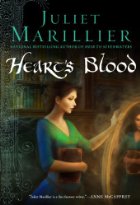
Book Review: Heart’s Blood by Juliet Marillier
 Summary:
This retelling of the classic fairy tale, Beauty and the Beast, is set in a medieval Ireland facing the constant threat of Norman invasion. Caitrin, an Irish lass trained in the trade of a scribe by her now deceased father, runs away from an abusive situation and stumbles upon the mysterious Whistling Tor. The crippled lord of the area lives in Whistling Tor and seeks a scribe. The local villagers warn Caitrin against taking the summer job due to a fear of the host living on the hill, but Caitrin sees no other choice.
Review:
Fantasy is one of those genres that I have never been able to get into, but I do love fairy tales, so I thought maybe a retelling of a classic would work for me. When will I ever learn that I just don’t like fantasy?
Marillier does all the elements of a fantasy book well. She sets up the mysterious, old land of Ireland with just enough description to place the reader there but not so much as to slow down the action. Gothic mystery seeps through every page. The idea of the non-human servants and household members of the castle are creatively handled, as is the lord’s beast-like qualities. The members of the host who could so easily have flowed together are artfully individualized.
Additionally, the romance between Caitrin and the lord of the castle is one I actually approve of for once in a YA book. They both are flawed and have issues to work on, but love each other and have good hearts. Thank you. That’s what a relationship is supposed to look like. I would be entirely comfortable seeing a teenage girl reading this. It’s a healthy, realistic relationship.
Still, though, I had to force myself to slog through the book. I was bored a lot of the time. I don’t like long descriptive passages of a forest. I don’t like reading about dull politics of various areas of Ireland. I’m not interested in explanations of the other-worldly figures. The most interesting part to me was the mirrors all over the household, and they were not addressed fully to my liking. In spite of being able to recognize this as a well-told story, it failed to draw me in. I don’t particularly know why. My best guess is that it is fantasy, and fantasy has always bored me. I was hoping venturing away from the more typical knights in shining armor and dragons style fantasy would solve the problem, but I was wrong.
Thus, this YA fantasy retelling of Beauty and the Beast is creative and well-done. I recommend it to those who know they enjoy a good fantasy story, but those who do not should probably skip it.
3 out of 5 stars
Source: PaperBackSwap

Book Review: Anna and the French Kiss by Stephanie Perkins
 Summary:
Anna Oliphant’s dad totally sold out and started writing crappy books that for some reason became incredibly popular. Now he’s insisting that she spend her senior year at a boarding school–School of America in Paris. Anna knows she should be enjoying her year abroad, after all, it is Paris! But she can’t help but miss her friends and family at home. She slowly starts to find her own new circle of friends and discover the wonderful things in Paris…..and to realize that she may be falling for one of her friends. A boy who is decidedly off-limits for multiple reasons.
Review:
Perkins takes a typical YA storyline–teenage girl sent away to boarding school, complete with teen angst–and puts just the right amount of her own twists and flavors in it to make for a delightful, unique read. I enjoyed this as an adult, but I’m sure 15 year old me would have been in love with it, re-reading it, and sighing over the main interest St. Clair.
The setting of Paris is delightful. Perkins captures the binary of excitement and trepidation at being in another country for the first time enough so that Anna is realistic but not annoying. Similarly, all of the characters act like actual human beings. They are neither perfect nor evil. They are simply doing their best to figure out how to function in the world. I appreciated this, and I’d imagine teen readers would too. Similarly, Perkins describes Paris in such a way that I wanted to move there instantaneously myself if for no other reason than the descriptions of the bread and eating meals in cemeteries. This is what it should be to be young. Angst combined with first-time glorious experiences.
Perkins manages to be both subtly funny:
“Huh?” I have such a way with words. I should write epic poetry or jingles for cat food commercials. (Location 1054-1058)
And perfectly capture what it is to be an adolescent female:
It makes me dizzy. It smells like freshly scrubbed boy. It smells like him. (Location 3100-3104
This is what an ideal YA book should be. Realistic about what young people face, but also about who young people are. Holding out hope that they can become good people, and they can learn and grow and overcome their mistakes. I highly recommend it to teen girls, as well as to adult women who still enjoy YA.
5 out of 5 stars
Source: Amazon

Book Review: Eva by Peter Dickinson
 Summary:
Eva wakes up from a car accident to discover that her scientist, chimp researcher parents have allowed for her to be part of a new experiment. Her brain patterns have been implanted into a chimp’s brain. She is a human brain trapped in a chimp’s body. What will this mean for Eva? For the chimps? For the world?
Review:
This a truly horrifying concept. What would it be like to wake up from a car accident in a body that is not your own? There is much potential for exploration here, but the direction Dickinson took it in fell flat for me.
The setting is a near future in which the world is vastly overpopulated and nearly all animal species have died out except for chimps, who are all kept in captivity. It’s odd in a world that is so overpopulated that the vast majority of people never leave their apartments that scientists have made such an ethically questionable move to save human lives. As Eva herself points out, not only is there the problem of what it means to be a human in a chimp’s body, but also there’s the fact that the chimp essentially had to die for Eva to live. How is that right or fair?
I appreciate that Dickinson has Eva start to identify with the animals and fight for animal rights, yet I simultaneously did not appreciate his depiction of the inner workings of animals and their social groups. In spite of Eva being one of and among them, Dickinson persists in presenting them from a largely disconnected human perspective. I’ve read more sympathetic passages on the inner workings of animal groups on vegetarian websites than I got from Eva’s perspective as, essentially, one of the chimps herself.
*spoiler warning* Some readers will also be disturbed by the fact that Eva goes on to mate with one of the chimps. Although this is not shown, it is shown that a male is interested in Eva when she is in estrus, and it is later shown that she has had multiple chimp babies. Although I am highly sympathetic to animal rights, this is far too close to beastiality for my own comfort. Perhaps if Dickinson had addressed the issue and made it a thought-provoking issue instead of glossing over it I would feel differently. But he truly just makes it happen and tries to skip over the issue. I found this disturbing and was disappointed that this overshadowed the more interesting questions of animal rights versus human welfare. *end spoiler*
Overall, the book is well-written and thought-provoking, but falls far short of what it could have been. I’m sure there must be better YA books out there that address the issue of animal rights in a clearer, less disturbing manner.
2 out of 5 stars
Source: Swap.com

Book Review: Ender’s Game by Orson Scott Card
 Summary:
Humanity survived the second Bugger invasion by pure luck. Now they’re determined to be prepared for a third invasion and actively train children in Battle School, seeking the child who could be the commander to save humanity. They think Ender, with his ability to perceive and understand null gravity spaces, just might be that commander, but Ender isn’t so sure.
Review:
Card has created a rich, complex, entirely believable future where individual sacrifice is vital to the survival of the human species. This goal makes the adults’ treatment of the children in Battle School justifiable and allows Card to create a story where children are simultaneously treated as adults and misled by them. Adults will recognize the feeling of being pawns to those in control of society. Children and young adults will appreciate that the children characters are treated as adults in smaller bodies. It’s a fun narrative set-up.
The world-building is excellent. The complex scenes of the Battle School, Battle Room, and videogames the children play are all so clearly drawn that the reader truly feels as if she is there. Readers who also enjoy videogames will particularly enjoy the multiple videogame sequences in which the narrative action switches focus to the videogame. This isn’t just for fun, either. It’s an important feature that comes to play later in the book. In fact, it’s really nice to see videogaming being featured in a future as something important to society and not just recreational. It’s a logical choice to make in scifi too, as the military is moving increasingly toward using weapons that are manned by soldiers behind the lines with videogame-like controls.
These fantastic scenes are all set against a well-thought-out human society reaction to multiple alien invasions. In spite of the threat of a third invasion, there is still violent nationalism brewing under the surface. Politicians must worry about their image. Dissenting voices can be heard on the internet. The teachers of the Battle School must worry about the retributions for their actions, even as they make the choices that will hopefully save humanity. The people in this future are still people. They act in the sometimes stupid and sometimes brilliant ways people act. They don’t miraculously become super-human in the face of an alien threat. I really enjoyed this narrative choice, as I get really sick of the super-human trope often found in scifi.
The ending….I don’t know if I’ll ever be able to make up my mind on how I feel about the ending. I definitely didn’t guess it ahead of time, which is a nice change, but I can’t decide how I feel about it. The fact is, I liked part of it, and I didn’t like another part of it. I think I may have found the ultimate message a bit too idealistic, and Ender too gullible.
*spoiler warning*
Here’s the thing. The Bugger queen claims that the Buggers didn’t know that humans were sentient creatures, and Ender believes her, but I call bullshit. Humans and Buggers built cities that were similar enough so that humans could live in Bugger buildings. In spite of being drastically different from an evolutionary stand-point, it’s still obvious that humans were sentient enough to build cities and spaceships. That should have been a warning sign. So ultimately, I view the queen larva and message to Ender as a last-ditch effort to come back from the brink of extinction and beat humanity, and Ender fell for it. Of course I don’t want to argue for the extinction of an entire species. I’m a vegetarian. I’m pretty much against the killing of species of any kind, but the fact remains that the Buggers attacked humans twice. What were they supposed to do? Sit back and let themselves get wiped out? I’m not one of these nutters who says don’t kill the polar bear attacking you, and in this case, the polar bear had already attacked twice. I like the message of a possible peaceful coexistence, but I don’t think it was very realistic in that world, and I was left feeling that Ender didn’t really learn anything from his experience.
*end spoilers*
Overall, however, Card has achieved near perfection in telling a unique, scifi story. The world is entrancing and draws the reader in, and the reader is left with multiple philosophical questions to ponder long after finishing reading the book. It is a book I definitely plan on re-reading, and I highly recommend it to scifi and videogaming fans.
5 out of 5 stars
Source: Amazon

Series Review: The Hunger Games Trilogy by Suzanne Collins (spoiler warning)
Introduction:
Since I’m starting to finish up a bunch of series I’ve been reading for quite some time, I decided it’d be nice to reflect on the series as a whole after finishing. I tend to do this in my head anyway, and it’ll be nice to get it out in writing. Needless to say, there will be spoilers for every entry in the series. This is about analysis and reflection and conversation with others who have read the series. If you’re the type who likes spoilers before reading a series, you’re of course welcome as well.
 Summary:
The Hunger Games trilogy is a post-apocalyptic dystopia set in the small nation of Panem, which we assume is what is left of livable land in what used to be the USA. Panem is divided into 12 districts. It is a dictatorship that faced a rebellion previously by the 13th district. Every year each district, except the Capitol, must send one girl and one boy, chosen by lottery, to participate in the Hunger Games–a reality show in which they must fight to the death until only one survivor is left. Katniss lives in District 12 and volunteers to go in place of her younger sister, Prim. She forms an alliance with the boy from her district, Peeta. When they are left the only ones standing, they grab poisonous berries, planning to thwart the Capitol by leaving no survivors. They, of course, are stopped and are paraded around as engaged lovers for a year. The President is angry at them, but they believe themselves to be relatively safe from his wrath as national heroes. The next year, however, it is announced that this year’s Hunger Game will consist of the victors from the previous games. It is believed that this act of violence will help squash the rebellion that is brewing. Some of the victors plot with the rebels, however, and Katniss and some other victors escape with their aid and join in on the revolution, with Katniss the symbol of the rebellion.
Review:
I first stumbled upon this series last summer. I’m not sure how exactly, but given that I love dystopias, and it is one, it’s not too surprising. I loved that for once in YA lit there was a main female character who was interested in something besides the mysterious new boy at school or make-up. She is focused on survival and caring for her family. I also enjoyed how she is presented as powerful, strong, and deadly. It’s a nice change of pace from what generally is out there for teens to read. I thought the teens fighting to death as punishment concept was unique, and was ranting about it one day to someone else who said, “That sounds a lot like Battle Royale.” And that’s when my entire view of the series started to change.
I watched the Battle Royale movie, which is based on the manga series of the same name, and I was flabbergasted to discover the exact same basic concept of a corrupt government forcing teens to battle each other to the death once a year. There was less backstory on the characters, and Battle Royale has the teens actually behaving as sexual beings and is more violent, but the basic driving plot is the same. Battle Royale, the manga and the movie, was released in 2000. The first book of the Hunger Games was released in 2008. I immediately investigated to see if Collins admits an influence or even discusses a similarity between her trilogy and the Japanese series. She does not. She claims her influences were purely from watching reality tv and war coverage, as well as from Greek myths. She never discusses the similarity between her own books and Battle Royale. This is disrespectful at best. Most writers are influenced by other writers, and there’s nothing wrong with that as long as it is acknowledged. Yet Collins refuses to even acknowledge the similarities between her own books and Battle Royale. She doesn’t have to admit to swiping the idea and Americanizing it (although, I personally believe that is what happened). She doesn’t even have to say she was influenced by it (this is what I believe she should do). She should at least talk about how the two are similar and recommend the Battle Royale series to fans of her own series. It’s the only respectful thing to do. Now that that’s out of the way, let’s ignore for the moment the questionable origins of the story and focus on the content.
 Katniss spends the entire series struggling against forces that are bigger than herself. She sides with the rebels only to find herself questioning them as well, and in the end, she causes the death of both President Snow (inadvertently) and President Coin (directly by shooting her). Katniss claims she wants things to be different, yet all she sees is power hungry people all around her. She winds up doubting in humanity as a species, wondering at a species that repeatedly sacrifices its children for their own amusement and gain. I agree that humanity is pretty fucked, although for different reasons than Katniss’, so I enjoyed seeing this viewpoint in print. I was therefore a bit saddened to see in the epilogue that Katniss winds up settling down with Peeta and having babies in District 12 (and apparently doing nothing for the rest of her life?). This sounds to me like she didn’t know what to do with her depression or her accurate viewpoint of the world, so she just decided to hunker down and live it out as quietly as possible. You would think that someone who had seen what she had seen would find comfort and solace in working to improve things for others who suffer instead of living in luxury in the victor’s village. Of course, Collins doesn’t have to provide a positive ending, but the thing is, I believe that she thinks she did. Katniss goes through all of this and winds up with the “American Dream”–the white picket fence, husband, and babies. It feels like a serious cop-out to the critics of her much more realistic first two books to me.
I was similarly disappointed to see a love triangle introduced in the second book. Why must every YA author include a love triangle? What is up with that? I was enjoying Katniss falling for Peeta and realizing Gale might just be her childhood best friend/crush, but then she whips around changing her mind constantly between the two of them. Peeta and Katniss have the bond of the arena, an experience Gale cannot possibly share or understand. Katniss continually behaves in a disloyal manner to Peeta in a way that seriously makes me doubt the quality of her character. She acknowledges this in the third book when Peeta, upon returning from being tortured, tells her all the ways in which she has been cruel to him and to others, and they are true. Gale knows it too, as he tells Peeta in the third book that Katniss will choose whoever helps her survive better. In the end that’s pretty much what she does. Gale failed her by designing the bombs that killed her sister. Peeta is the only one who understands her pain, so Peeta is the one she “falls in love with,” yet everything about Katniss is so self-centered that I was left wondering why she should wind up with anybody at all. That said, I did enjoy that Katniss recognized that herself and Gale were too similar to be together. They both had too many violent tendencies to make a healthy couple, so she went with her opposite–the calm, peaceful Peeta. They balance each other, and that aspect of the romance made me smile.
Katniss’ original selfless love of her sister Prim gradually disappears over the course of the trilogy. When the bombers are coming to District 13, she forgets about her sister entirely, and it is Gale who ensures she gets to the lower levels safely. By the end of the series, Katniss has lost all the beauty of her personality found in the first book. She went from a selfless love to a self-centered, revenge-driven person who will sacrifice almost anyone in her quest to kill Snow. Even though she periodically has glimmers of recognition that everyone has been wronged by the Capitol, and indeed, some people more than herself. Finnick who was forced to give his body away to anyone he was told to in the Capitol. Johanna and Annie who were tortured. Peeta who was brainwashed. She has glimmers of sympathy, but overall she has essentially turned into an automaton, a Terminator, if you will. Yet Collins still writes her with a sympathetic tone. Why?
I have no issue with blood, violence, graphicness, or battle scenes used in the context of a story. That’s not what bothers me about the trajectory of the Hunger Games. What bothers me is that Katniss realizes the hopeless situation the human species is in, something I entirely agree with. She then proceeds to let it turn her into the worst humanity has to offer. She then realizes this and instead of working to change things, she just gives up. She gives up and bows her head and succumbs to a submissive life. The Katniss of the first book would do anything to defy the expectations and mores of society, but in the end, she sees that society has not really changed with the change of rule. Indeed, the most active thing she does is also one of the worst. She votes in favor of having another Hunger Game featuring the children of the Capitol. Maybe this is realistic and most people would either join the evil or give up, but I’d hoped for more in a series so beloved by so many teenage girls. Yes, the world sucks. Yes, it’s a constant struggle. Yes, it hurts and you may never succeed, but never stop trying. That was the message of the first two books, and yet it was entirely tromped on by the final entry in the series. Perhaps I shouldn’t be surprised by that, given the ethics of the author.
3.5 out of 5 stars
Source: library, borrowed, and Amazon
Buy It (Amazon or Bookshop.org)
Books in Series:
The Hunger Games, review
Catching Fire
Mockingjay, review
ETA Note: I wrote this post before the series was a hit or popular and long before a movie was on the horizon. Before most of America had read the books. I didn’t read them or write about them to get blog hits or because they are popular. I read them because they happened to be in my public library. I long ago stopped responding to comments on this post, because I don’t want to spend my time discussing a trilogy that I didn’t even like that much. Note that I made this decision long ago, as I haven’t responded to anything since May of 2011. When leaving a comment, please be sure to see my comment policy.
Book Review: Mockingjay by Suzanne Collins (series, #3) (spoiler-free)
 Summary:
Katniss has been rescued by the rebels and is living in District 13 along with refugees from District 12, Haymitch, Johanna, and Finnick. Peeta and Annie are still in the clutches of the Capitol, and every day Katniss is plagued with thoughts of what torture they must be suffering at the hands of President Snow. The rebellion is sweeping across Panem, and the leader of the rebels, President Coin, wants Katniss to be the symbol of the revolution–the Mockingjay. It is as if the arena has consumed all of Panem, and there is no escape for Katniss.
Review:
This is a better wrap-up to a story than in other trilogies I have seen, but compared to the first two books, it is definitely found a bit wanting. Without the structure of the Hunger Games or the Quarter Quell, Collins struggles a bit at maintaining a consistent storyline and action. She additionally seems to have suffered a bit of a guilt complex over the delicious gore in the first two books, and here spends many pages dwelling on the emotional impact of the violence to the extent that Katniss winds up sounding a lot like Harry Potter in book 5 of that series, and we all know how annoying everyone found him. Granted, Katniss has more reason to be upset than Harry ever did, but one can only take so many emotional breakdowns before it starts to seem as if Katniss is weak, rather than the strong heroine we grew to love in the first two books.
There is a war on, so of course action scenes do exist. They are a bit hit or miss, however. Interestingly, the ones that work the best are the ones that read like battles and are the least similar to the games in the first two books. I believe this is because the battle scenes allow us to see Katniss developing from a victim of traps set by the Capitol to a soldier. The ones that read more like traps feel like a step back from a character development point of view. However, fans will find enough fast-paced action scenes to keep them happy.
The writing continues to be painfully sophomoric, only with the starting and stopping of the action, it is far more noticeable. I know this is being told from Katniss’ point of view, but it could really stand to have at least a few less cliche metaphors and sentence fragments. Challenge the minds of your YA readers at least a little, please, Collins.
Those interested in the series for the love triangle, or who enjoy the love triangle a lot will not be disappointed, no matter whether they are Team Peeta or Team Gale. Although personally I still don’t understand just what is so irresistible about Katniss, beyond that, the emotions are handled in a realistic manner. What impacts the final choice is more than just the emotions of Katniss, and I actually enjoy the final message Collins leaves her teen readers with about relationships in general. Whichever fella you’re in favor of, the moment the final choice is realized is still a tear-jerking one.
Overall, Mockingjay is a satisfying end to the series, but does not live up to the power of the first two books. Fans will by no means regret having started the series, however.
3.5 out of 5 stars
Source: Amazon

 Support my work with a tip or browse my shop for curated book club guides, how to guides, cross-stitch patterns, and more!


This work by Amanda Nevius is licensed under a Creative Commons Attribution-Noncommercial-No Derivative Works 3.0 United States License.
 Opinions of a Wolf