
Archive
Book Review: Hang Wire by Adam Christopher
 Summary:
Ever since his birthday party when a fortune cookie exploded in his face, professional blogger of all things San Francisco, Ted Hall, has been passing out, sleeping 12 hours, and waking up exhausted. It’s disconcerting, especially since there’s a serial killer on the loose.
The circus is in town, and the highwire workers are frustrated with the star of the act, who never rehearses and periodically disappears. And no one understands why the manager isn’t reporting their missing highwire wire to the authorities, especially since the serial killer is stringing up his victims with a strong, thin wire that sounds an awful lot like a highwire wire.
Bob the beach-living, ballroom-dancing attraction, used to be the god Kanaloa, but the immortals have abandoned humans to their own devices, and he’s not supposed to interfere. But he just may be the key to all the mysteries occurring in San Francisco.
Review:
I picked this up because it sounded like an urban fantasy serial killer mystery, which is just my speed. Unfortunately, I found a book with a discombobulated world and plot that builds confusion rather than tension.
If my summary above seems disjointed and confusing that’s because that’s precisely what this book is. Multiple different extremely odd plots are going on that ultimately do have some relation to each other, but the relation takes far too long to establish or understand. The book starts with a flashback to the San Francisco earthquake of 1906 and introduces us to Bob/Kanaloa. It then jumps forward to the completely dull Ted and the exploding fortune cookie. It then jumps backward in time again to an entirely different character, who is tied to the circus, eventually. It takes quite a while to find out what his relation is. These three disparate storylines that seems to have no relation to each other continue throughout the book. Bob/Kanaloa’s journey from immortal god to just immortal beach bum would be an interesting book. But his plot keeps getting abandoned for the other two plots, so all tension and interest is lost. Similarly, the evil circus organizer would be interesting, but only if his plot was handled with more detail and finesse. As it is, what he is doing and why he is evil is just confusing, not interesting. Ted’s plot would not be interesting, even on its own with more detail, because Ted is a two-dimensional, boring character.
Beyond the three disjointed, confusing plots, nothing in this story is ever fully fleshed-out. There’s the vague idea that immortals were once on Earth and involved but now have left, but the details of the hows, whys, and how this has affected Bob/Kanaloa is left out. We’re told the organizer of the circus is evil, but we never see his fall from grace. We see him as a poor pioneer then later as an evil circus worker. The interesting part of how he got sucked into this evil is left out. Similarly, two people ultimately become human hosts for gods, but this is basically just announced and moved on from. The intricacies of how this feels for the human and for the god, why it might be effective or not, etc… is all left out. This is a bare-bones, confusing plot with little development, which ruins all possible tension.
Just as the plot is created in broad, sloppy strokes, so are the characters. The closest any come to being three-dimensional is Bob/Kanaloa, which at least made the story readable. But the rest are quickly laid out with broad character traits, and the story moves on. There is, for instance, no depth to Ted’s relationship with his girlfriend. We’re told she’s his girlfriend and he loves her, but we never truly see them together and functioning as a couple. We get no flashbacks to times prior to the supernatural craziness to see them in a non-stressful situation. Ted’s girlfriend is there as a plot device, nothing more.
I understand that this is an advanced copy and there will be another editing pass, etc…, however this is the most errors I have ever seen in an ARC. It was rife with typos, use of the wrong word, and format issues. Most egregious to me is the Britishisms used by American characters, such as “prawns” for “shrimp.” ARCs should have already had at least one editing pass. A reasonable amount of errors could slip through, but not this many. There were errors on approximately every other page. Hopefully the final version received a heavy final edit. Check reviews of the final version to be certain.
This book reads like an extremely rough first draft that badly needs an editor to come through and fix, not just minor typos and grammar, but also plot and characters problems. It could be an interesting story if it was more fleshed-out, with some storylines dropped in favor of a more solid main one, and with at least a couple of three-dimensional characters the reader can really relate to and root for. As it stands, there are certain scenes that are well-written and engaging, but together they do not make an engaging, readable mystery. I normally love books published by Angry Robot, so I found this particularly disappointing.
If you found this review helpful, please consider tipping me on ko-fi, checking out my digital items available in my ko-fi shop, buying one of my publications, or using one of my referral/coupon codes. Thank you for your support!
2 out of 5 stars
Length: 373 pages – average but on the longer side
Source: NetGalley

Book Review: The Drowning Girl by Caitlin R. Kiernan (Audiobook narrated by Suzy Jackson)
 Summary:
India Morgan Phelps, Imp to her friends, is sure that there were two different Eva Cannings who came into her life and changed her world. And one of them was a mermaid (or perhaps a siren?) and the other was a werewolf. But Imp’s ex-girlfriend, Abalyn, insists that no, there was only ever one Eva Canning, and she definitely wasn’t a mermaid or a werewolf. Dr. Ogilvy wants Imp to figure out for herself what actually happened. But that’s awfully hard when you have schizophrenia.
Review:
I’d heard that this book was a chilling mystery featuring queer characters and mental illness. When I discovered it on Audible with an appealing-sounding narrator, I knew what I was listening to next. This book is an engaging mystery that also eloquently captures the experience of having a mental illness that makes you question yourself and what you know while simultaneously giving a realistic glance into the queer community.
Imp is an unreliable first person narrator, and she fully admits this from the beginning. She calls herself a madwoman who was the daughter of a madwoman who was a daughter of a madwoman too. Mental illness runs in her family. She states that she will try not to lie, but it’s hard to know for sure when she’s lying. This is due to her schizophrenia. Imp is writing down the story of what she remembers happening in journal style on her typewriter because she is trying to figure out the mystery of what exactly happened for herself. The reader is just along for this ride. And it’s a haunting, terrifying ride. Not because of what Imp remembers happening with Eva Canning but because of being inside the mind of a person suffering from such a difficult mental illness. Experiencing what it is to not be able to trust your own memories, to not be sure what is real and is not real, is simultaneously terrifying and heart-breaking.
Imp’s schizophrenia, plus some comorbid anxiety and OCD, and how she experiences and deals with them, lead to some stunningly beautiful passages. This is particularly well seen in one portion of the book where she is more symptomatic than usual (for reasons which are spoilers, so I will leave them out):
All our thoughts are mustard seeds. Oh many days now. Many days. Many days of mustard seeds, India Phelps, daughter of madwomen, granddaughter, who doesn’t want to say a word and ergo can’t stop talking. Here is a sad sad tale, woebegone story of the girl who stopped for the two strangers who would not could not could not would not stop for me. She. She who is me. And I creep around the edges of my own life. Afraid to screw off the mayonnaise lid and spill the mustard seeds. (Part 2, loc 55:35)
The thing that’s great about the writing in the book is that it shows both the beauty and pain of mental illness. Imp’s brain is simultaneously beautiful for its artistic abilities and insight and a horrible burden in the ways that her mental illness tortures her and makes it difficult for her to live a “normal” life. This is something many people with mental illness experience but find it hard to express. It’s why many people with mental illness struggle with drug adherence. They like the ability to function in day-to-day society and pass as normal but they miss being who they are in their own minds. Kiernan eloquently demonstrates this struggle and shows the beauty and pain of mental illness.
Dr. Ogilvy and the pills she prescribes are my beeswax and the ropes that hold me fast to the main mast, just as my insanity has always been my siren. (Part 1, loc 4:08:48)
There is a lot of queer representation in the book, largely because Kiernan is clearly not just writing in a token queer character. Imp is a lesbian, and her world is the world of a real-to-life lesbian. She is not the only lesbian surrounded by straight people. People who are part of the queer community, in multiple different aspects, are a part of Imp’s life. Her girlfriend for part of the book is Abalyn, who is transwoman and has slept with both men and women both before and after her transition. She never identifies her sexuality in the book, but she states she now prefers women because the men tend to not be as interested in her now that she has had bottom surgery. The conversation where she talks about this with Imp is so realistic that I was stunned. I’m not sure I’ve ever seen a conversation about both transitioning and the complicated aspects of dating for trans people that was this realistic outside of a memoir. Eva Canning is bisexual. It’s difficult to talk about Eva Canning in-depth without spoilers, so, suffice to say, Eva is out as bisexual and she is also promiscuous. However, her promiscuity is not presented in a biphobic way. Bisexual people exist on the full spectrum from abstinent to monogamous to poly to promiscuous. What makes writing a bisexual character as promiscuous biphobic is whether the promiscuity is presented as the direct result of being bi, and Kiernan definitely does not write Eva this way. Kiernan handles all of the queer characters in a realistic way that supports their three-dimensionality, as well as prevents any queerphobia.
The plot is a difficult one to follow, largely due to Imp’s schizophrenia and her attempts at figuring out exactly what happened. The convoluted plot works to both develop Imp’s character and bring out the mystery in the first two-thirds of the book. The final third, though, takes an odd turn. Imp is trying to figure out what she herself believes actually happened, and it becomes clear that what she ultimately believes happened will be a mix of reality and her schizophrenic visions. That’s not just acceptable, it’s beautiful. However, it’s hard to follow what exactly Imp chooses to believe. I started to lose the thread of what Imp believes happens right around the chapter where multiple long siren songs are recounted. It doesn’t feel like Imp is slowly figuring things out for herself and has made a story that gives her some stability in her life. Instead it feels like she is still too symptomatic to truly function. I never expected clear answers to the mystery but I did at least expect that it would be clear what Imp herself believes happened. The lack of this removed the gut-wrenching power found in the first two-thirds of the book.
The audiobook narration by Suzy Jackson is truly stellar. There are parts of Imp’s journal that must truly have been exceedingly difficult to turn into audio form, but Jackson makes them easy to understand in audio form and also keeps the flow of the story going. Her voice is perfect for Imp. She is not infantilized nor aged beyond her years. She sounds like the 20-something woman she is. I’m honestly not sure the story would have the same power reading it in print. Hearing Imp’s voice through Jackson was so incredibly moving.
Overall, this book takes the traditional mystery and changes it from something external to something internal. The mystery of what really happened exists due to Imp’s schizophrenia, which makes it a unique read for any mystery fan. Further, Imp’s mental illness is presented eloquently through her beautiful first-person narration, and multiple queer characters are present and written realistically. Recommended to mystery fans looking for something different, those seeking to understand what it is like to have a mental illness, and those looking to read a powerful book featuring queer characters whose queerness is just an aspect of who they are and not the entire point of the story.
If you found this review helpful, please consider tipping me on ko-fi, checking out my digital items available in my ko-fi shop, buying one of my publications, or using one of my referral/coupon codes. Thank you for your support!
4 out of 5 stars
Length: 332 pages – average but on the longer side
Source: Audible

Counts For:

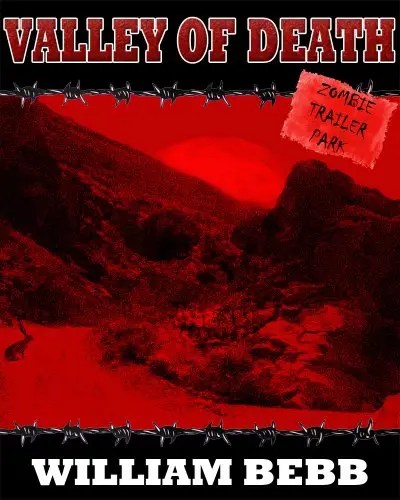
Book Review: Valley of Death, Zombie Trailer Park by William Bebb
Summary:
When Josey arrives a secluded trailer park near Albuquerque to empty their septic tank, it soon becomes apparent that not all is right in the park. In fact, most of the residents have turned to zombies. As Josey’s fight for survival goes on, we meet a quirky cast of survivors, bystanders, perpetrators–and zombies: illegal immigrants who call the valley home, their exploitative factory boss, a WWII veteran and grandpa, his young grandson, a paraplegic Vietnam Vet, a boa constrictor, bicycling missionaries, and many more. Will anyone survive the valley of death?
Review:
I have finally found the exception to my don’t-take-book-recommendations-from-other-people rule: my daddy. My dad texted me and told me he was reading a book about a zombie trailer park and asked if I’d like to borrow it when he was done. I couldn’t turn that down, so he sent his kindle loan to me as soon as he was finished reading it. I knew within the first few pages that my dad had picked a winner. That really shouldn’t surprise me, because, well, it’s my dad, and we’re very similar, but I had been burned a few times with book recommendations recently. Anyway. On to the review!
Bebb’s book is a fresh, engaging take on a zombie outbreak. The origin is a factory error, which is decidedly different from the more usual government experimentation or voodoo approach. It’s great commentary on the exploitative practices of factories, not to mention the exploitation of illegal immigrants, without ever being too heavy-handed or preachy. The zombies are a mix of the rage virus and traditional undead. Before dying they are inexplicably full of rage and will eat almost anything but also when they die they reanimate. It’s a cool mix, and I enjoyed it.
The cast of characters is incredibly imaginative, diverse, and even-handed. People are truly just people (or zombies) regardless of age, gender, or ethnicity. And, really, how many books can say they have a WWII vet, a sewer truck worker, a mechanically talented Latina, a wheelchair-bound obese meth chef, a loyal dog, bicycling missionaries, and a pot-growing paraplegic Vietnam Vet. I mean, really. And none of them are two-dimensional caricatures either. They are all well-rounded and presented with thought and humanity. I also never had that problem I sometimes have in books where you can’t tell the different characters apart. Everyone was entirely unique and easy to remember.
The plot is complex. I honestly did not know how it was going to end, and it maintains a fast pace throughout. I was never bored and was never entirely certain what was going to happen next. That’s coming from a big zombie fan, so I do think that’s saying something significant about the uniqueness of the engaging plot.
What really makes the book, though, is the sprinkling of humor throughout. This type of humor won’t match everyone, but it certainly works for me. I described it to my dad as “Patrick F. McManus with zombies,” but if you don’t get that reference, it’s hard to describe the humor. So, here are a couple of quotes from the book to demonstrate it.
Your average one armed pot growing hermit who just murdered two men might be thinking about a variety of things. (location 2592)
Crazy cop fuckers done bit off my titty! (location 5423)
That second one….oh man. I laugh every time I see it.
So with all this love, why not five stars? Well, much to Bebb’s chagrin, I’m sure, there aren’t enough commas. (His author’s intro states that previous reviews said there were too many and now people will probably think there are too few. Sorry to confirm that suspicion, Bebb!) Compound sentences tend to run on and on with no commas or semi-colons, which can be a bit frustrating to read. Also, the book isn’t quite properly formatted for the kindle. Its display varies from section to section. Similarly, while some sections are clearly divided by a dividing line (such as with tildes “~~~~”), others just have a big gap, which is not what one should use for ebooks. With the variety of ereaders, it’s important to use something besides space as a signal that the reader has entered a new section, since the space can display drastically differently on different readers. It’s best to use something like the tildes between sections. Using empty space is a holdover from print that doesn’t work. Bebb did use the tilde line in some sections, but not all, so there’s also a bit of a consistency problem.
Overall, though, the formatting and comma issues did not distract me from the wonderfully unique and humorous zombie trailer park story. I’m so glad my dad discovered this indie author and passed his work on to me, and I look forward to reading more of it in the future. Highly recommended to all zombie fans, provided you like the type of humor outlined above.
If you found this review helpful, please consider tipping me on ko-fi, checking out my digital items available in my ko-fi shop, buying one of my publications, or using one of my referral/coupon codes. Thank you for your support!
4 out of 5 stars
Length: 363 pages – average but on the longer side
Source: Borrowed
Buy It (Amazon. Not available on Bookshop.org.)
ETA: Had a delightful email convo with the author, and we determined that I read an older version of the book. The current one available should have mostly cleared up editing/layout concerns.
Book Review: The Outside Boy by Jeanine Cummins (Bottom of TBR Pile Challenge)
 Summary:
Christy is a Traveller, what Irish gypsies call themselves, in the 1950s. He’s eleven, and his family is about to stay in one town for a whole 40 days and 40 nights for Lent so he and his cousin, Martin, can get ready for confirmation. Christy has always thought his mam died giving birth to him, but when his grandda dies, he finds a newspaper clipping that shows his mam holding him when he’s months old. Thus begins a quest to find out who he really is.
Review:
The particular copy I read I won on a book blog somewhere (I’m afraid I didn’t write down the name), but I also received an ARC during one of the holiday swaps one year. It’s interesting to me, then, that this book wound up on my tbr pile both because I was interested and because someone else thought I would enjoy it. And of course I did.
It is honestly, immediately abundantly clear that Christy’s mother isn’t a Pavee (a Traveller). I was thus skeptical that the story would hold my interest, since predictable ones don’t tend to. I am pleased to say that I was wrong about this on both counts. Although it’s true that Christy’s mother isn’t a Traveller, everything else about her and Christy’s history is actually quite surprising and moving. I’m glad I stuck with it.
The book examines many different issues, some universal and others specific to Irish history. There of course is the issue of identity. Who we are and what makes us that. Is it nature or nurture? The often tough relationship between fathers and sons during the son’s adolescence is also wonderfully presented. Of course a book about gypsies also addresses prejudice, stereotyping, and the norm. Cummins doesn’t sugar coat things. She shows the positive and negative aspects of Traveller culture, which is as it should be. No culture is all perfect or all bad. What the book does a great job of doing is showing how kids learn prejudice and how multiculturalism can enrich everyone’s lives. Some people are one way and some another, and neither is necessarily bad. The book also touches on the animosity between Protestants and Catholics in Ireland, as well as the very real issue of Irish society stealing babies from single mothers in that time period. I know that sounds like a lot, and honestly I’m surprised now that it’s all listed out at how much was touched upon. Cummins strikes the perfect balance of touching on real issues without ever seeming pushy or forced.
Although the storyline and characters are good, it didn’t 100% draw me in. I think it moves a bit too slowly for me in the first half or so of the book. I also, honestly, struggled to like Christy. I eventually came to understand his viewpoint and choices, but I still find him kind of annoying. His father, on the other hand, is incredibly interesting and wonderful, and I kind of wish we had a book about him instead of about Christy. But, some readers enjoy more slowly paced books and others might relate better to Christy than I did. It just personally is what made it a book I liked but didn’t love.
Overall, this book is an interesting entry in historic Irish fiction. It looks at Ireland in the 1950s through the eyes of a small band of gypsies, which is certainly a unique viewpoint. The writing is fluid, if a bit slow-moving, and the plot is not as predictable as it seems at first. Recommended to fans of historic fiction and works set in Ireland.
4 out of 5 stars
Length: 360 pages – average but on the longer side
Source: Won on a book blog (If it was yours, let me know, and I’ll link to you!)
Buy It
If you found this review helpful, please consider tipping me on ko-fi, checking out my digital items available in my ko-fi shop, buying one of my publications, or using one of my referral/coupon codes. Thank you for your support!
Book Review: Coming of Age in Mississippi by Anne Moody (The Real Help Reading Project)
 Summary:
Anne Moody in her memoir recounts growing up in the Jim Crow law south, as well as her involvement in the Civil Rights movement as a young adult. She was one of the women at the famous Woolworth’s lunch counter sit-in. Here we get to see her first-hand thoughts and memories of the struggle growing up surrounded by institutionalized racism, as well as the difficulties in fighting it.
Discussion:
This project I am co-hosting with Amy truly seems to be flying by! We are already on our fourth read. I was excited that it was my turn to host the discussion, because memoirs are one of my favorite genres (as my followers know). Plus this is a memoir set just before and during the Civil Rights era, which is a time period I must say I don’t know as much about as I should. History classes in the US have a tendency to run out of time in the semester right around the end of WWII.
Throughout the book there is personal, anecdotal evidence of the statistics we read about in Labor of Love, Labor of Sorrow. The harsh life as sharecroppers produces anxiety and stress in the family structure. Anne is left alone all day with an uncle who is only eight years old to watch her and who treats her badly because he resents being stuck with this responsibility. Similarly, early in her life, Anne’s father and mother divorce. The strain on the family of poverty is abundantly clear.
Similarly what we read about black women taking nowhere near enough time off of work to recover after pregnancy and birth is evident in Anne’s observations of her own mother:
She didn’t stop workin until a week before the baby was born, and she was out of work only three weeks. She went right back to the cafe. (page 26)
Although Anne’s mother tried to stay out of serving in white homes as a maid, before long she ended up taking on that kind of work. She and her children would generally live in a two-room shanty out back. At first Anne didn’t notice the difference in privilege, until her mother brought home food for her children:
Sometimes Mama would bring us the white family’s leftovers. It was the best food I had ever eaten. That was when I discovered that white folks ate different from us. (page 29)
Anne was clearly an intelligent child and picked up on the subtle situations going on around her. Early on she remembers wondering about race and what makes someone white versus black, when there were some “high yellow” black people she knew who could easily pass for white.
Now I was more confused than before. If it wasn’t the straight hair and the white skin that made you white, then what was it? (page 35)
In fact, this issue of levels of color in black communities impacted Anne’s early life a great deal. Her mother’s second significant relationship was with a man from a “high yellow” family who didn’t want him with her because she was “too dark.” Anne’s mother put up with Raymond trying to decide between her and another “high yellow” woman that his family did approve of for years. Later when he does choose her, she must put up with the snobbery of his family who refused to even speak to her. Anne cannot understand how black people can be so cruel to each other when the white people in Mississippi are cruel to them all. It is evident that the racism and oppression of the South caused those oppressed to seek out others to oppress, and the easiest way to do so was to be prejudiced against those with a darker skin tone. Anne is right that it’s sad and confusing, but it also seems to be a natural result of such an oppressive system. It’s like we learned from The Book of Night Women: misery begets misery.
Before she is even in middle school, Anne has her first job working for a white woman. She sweeps her porches in exchange for milk and a quarter. This is when she starts contributing to the family economy. It’s interesting how Anne never expresses any resentment about needing to contribute to keeping the family going at a young age. She does not view it as her parents’ fault. It is just the way it is, and she’ll do what it takes to help her family.
This is the part of the book where we truly see through the eyes of “the help.” There are families that Anne works for her treat her like an equal, have her eat dinner with them, and encourage her to go to college. Then there is the family that is an active member of “the guild” (aka the KKK) where Anne is constantly in terror that they are going to try to frame her for a false wrong-doing. Anne shows many signs of constant stress during this time, both in her body (headaches and losing weight) and in her mind (feeling trapped). Being stuck working for someone who you know is going around organizing the murder of people of your own skin tone purely for their skin tone must have been horribly traumatizing.
It is in high school when the activity of the KKK in her hometown ramps up that Anne starts to develop her fighting spirit that will carry her out of white people’s homes and into the Civil Rights movement. She is angry and fed up with the system, with white people, but with black people too.
But I also hated Negroes. I hated them for not standing up and doing something about the murders. In fact, I think I had a stronger resentment toward Negroes for letting the whites kill them than toward the whites. Anyway, it was at this stage in my life that I began to look upon Negro men as cowards. (page 136)
Anne’s passion for doing what is right in the face of terrible danger and pain is remarkable and admirable. She would rather die fighting the system than live under the system. She does not seem to realize it, but this is an unusual level of strength and courage. It takes people like her to make change happen. People like her become the leaders that get people to act in spite of their fear. I understand her frustration, but her lack of understanding of other black people’s viewpoints can be a bit frustrating at times.
Her passion though does lead her to one of the historic black colleges, eventually, Tougaloo College. Tougaloo was at the center of a lot of the Civil Rights movement in the south, and I found this part of the book totally fascinating. It is here that Anne makes her first white friend, a fellow Civil Rights activist. It is here that her famous sit-in at Woolworth’s is organized.
But something happened to me as I got more and more involved in the Movement. It no longer seemed important to prove anything. I had found something outside myself that gave meaning to my life. (page 288)
Anne used her jobs in white people’s homes to get herself to college where she joined in the Civil Rights movement. It is a truly inspirational tale. One can’t help but wonder if the KKK household she worked in became aware of her significant achievements. The woman who once washed their dishes and ironed their clothes entered into history books. How anyone can find kitschy stories like The Help inspirational when there are real ones like Anne Moody’s is beyond me.
I was a bit surprised at the semi-dark ending, so I did a bit of googling and discovered that this book was first published in 1968, far before the drastic improvement in race relations in the United States. Moody at the time had no idea how things were going to turn out. It’s understandable she was feeling a bit down-trodden and wondering if anything good would ever happen.
I also learned through googling that this memoir ends before her involvement in the Black Power movement. There are rumblings that she will join with them, though, because she starts stating that peaceful protest will get them nowhere when they are constantly met with violence. I wish there was a follow-up memoir, but there is not, and Anne Moody has refused all media interview requests ever since the publication of this one. I suppose I will simply have to read one of the many famous Black Power books to satisfy my curiosity.
Source: Library
Length: 424 pages – average but on the longer side
Buy It (Amazon or Bookshop.org)
Discussion Questions:
- How do you think poverty and racism impacted Anne’s mother’s two significant relationships with men?
- Do you think those working in KKK households were at a greater physical risk than those working in regular white households?
- Anne’s employer has her tutor her son in Algebra, because he is failing. This would suggest that on some level the woman realized that black people are not inferior to white people. Why do you think she was than so insistent on the dominance of white people and a member of the KKK?
- What are your thoughts on the various southern whites in Anne’s life who actively helped her and protested and/or fought racism? What do you think made them act against a system that they were raised in when others like them were defending it?
- Anne ends the book waffling between peaceful protests and violent movement. Which do you think ultimately would lead to a better end result?
If you found this review helpful, please consider tipping me on ko-fi, checking out my digital items available in my ko-fi shop, buying one of my publications, or using one of my referral/coupon codes. Thank you for your support!
Book Review: My Life as a White Trash Zombie by Diana Rowland
Summary:
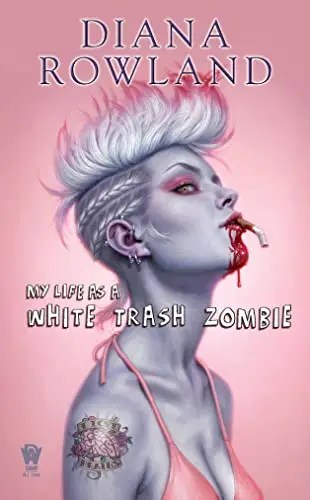
Angel wakes up in the hospital to discover she was found naked and overdosed on drugs on the the side of the road in her small town after a fight with her boyfriend, Randy. Someone mysteriously drops off medicinal energy drinks along with a note that she must work loyally for at least a month at a job newly acquired for her at the city morgue. A high school drop-out living with her alcoholic and periodically abusive father, Angel decides that she should seize this opportunity. It certainly helps that pills and alcohol no longer seem to do anything for her. As her oddly gloppy energy drinks start to run out, though, Angel finds herself having cravings for something found in the morgue–brains.
Review:
I bought the kindle edition of this book the instant it came out as a birthday present to myself for two reasons. First, the title is amazing. Second, look at that cover! Yeah, the whole thing just screamed my named. My instincts were right, too.
It’s been a long time since I read a book that hits all the elements I love in literature like this one–urban fantasy style horror, a setting that rings familiar to me, a completely relatable main character, and a fun love interest. It’s a world that’s simultaneously familiar and special, which is what makes urban fantasy fun. Angel’s world of trailers, beer cans, and nothing to do reminds me a lot of my childhood growing up in Vermont. On the other hand, Angel has cravings for brains. And she somehow manages to keep this a secret in a small town, certainly a monumental task.
Angel’s problems are a combination or fantastical ones (must find brains to survive) and completely real world ones (a history of an abusive mother and a father with alcoholism). Angel has a lot to overcome even before she gets zombified, but the zombification adds an element of distance that allows tough things to be talked about without that dragging down dullness often found in literary fiction.
Rowland reworks the zombie trope without completely removing the essentials of a zombie. Angel can function in day to day life as long as she has brains once every two days or so. If she doesn’t have them though, her senses slowly dull and she gradually turns into the lurching monster simply desiring brains that we all know from the classic zombie movies. This really works, because it allows Angel to be a part of society, yet still be the monster we’ve all grown to know and love.
That said, I will say that I am getting a bit tired of the monsters surviving by working in a morgue trope. I wish Rowland had come up with something a bit more creative for how Angel gets her hands on brains than that. It’s starting to seem like the staff of the morgues in all of urban fantasy consist entirely of monsters and sociopaths. Thinking more outside the box would have made me love the book instead of really liking it.
Overall, this zombie book gave me thrills, chills, and laughs galore, but it also brought me close to tears. It’s genre fiction with a heart, and I highly recommend it to anyone willing to see zombies (or white trash) in a whole new light.
If you found this review helpful, please consider tipping me on ko-fi, checking out my digital items available in my ko-fi shop, buying one of my publications, or using one of my referral/coupon codes. Thank you for your support!
4 out of 5 stars
Length: 320 pages – average but on the longer side
Source: Purchased

Buy It (Amazon or Bookshop.org)

Counts For:

Book Review: Breathers By S. G. Browne

Summary:
Billing itself as a rom-zom-com (romantic zombie comedy), Breathers looks to get into the psyche of those reanimated corpses out to eat your brains, not to mention deep-fry your fingers. Andy is in his 30s and living in his parents’ basement after reanimating from a car crash that left his wife permanently dead. Andy is depressed and slowly decaying, but all that changes when he starts attending Undead Anonymous weekly meetings. There he meets Rita, and together with other members, they stumble upon southern zombie Ray who gives them jars of his venison that tastes remarkably good to Andy and has some interesting affects on him.
Review [spoiler warning]:
Breathers starts out with a bang. Nothing sucks you in quite like a main character waking up from an alcohol-induced blackout to discover he’s killed his parents and stuffed their dismembered bodies in the fridge and freezer. Browne’s dark humor serves the storyline well. It’s not easy to take a repulsive, cannibalistic, walking corpse and make him a sympathetic character instead of the terrifying other, and Browne achieves this…..to a certain extent.
At first Andy and the reader don’t know that the “venison” he’s eating is actually people. Both the reader and Andy see the positive effects of eating humans before they fully realize that’s what he’s eating. (Although, come on, I had my definite suspicions, even in a world where vampires are “vegetarians” and have Tru Blood.) Andy stops decaying and starts protesting for his civil rights to be reinstated, for zombies to be recognized as equal and valid. This is a popular, obvious analogy for various human rights fights going on around the globe. Awesome. It’s great for people who aren’t ordinarily treated as an other to get a first-person account of what that’s like.
This analogy though is why I have a bit of a problem with the twist toward the end whereby we see that eating humans leads to cravings for more humans and eventually we have a full-out blood bash eating a house full of frat boys. Aesthetically, as a horror fan, I love the blood bash. Nothing quite like reading a first-person account of what it’s like to eat another human being alive. However, the lesson learned here is that while the other may seem cute and cuddly, all your suspicions about them are true. Don’t trust them for a minute or they’ll turn full evil on you.
Browne doesn’t seem to have an issue demonizing select groups. The whole frat boys stealing limbs from zombies as pledges followed by the zombies eating the frat boys and their various one-night stands and girlfriends reeks of a weak, geeky boy’s wet dream. Revenge of the nerds zombie-style.
It’s unfortunate that Browne lets his bitterness undermine his enjoyable writing style–a wonderful mix of humor and horror. Hopefully his next effort leaves the personal grudges behind and just gives us the humorous horror we want.
If you found this review helpful, please consider tipping me on ko-fi, checking out my digital items available in my ko-fi shop, buying one of my publications, or using one of my referral/coupon codes. Thank you for your support!
3.5 out of 5 stars
Length: 310 pages – average but on the longer side
Source: Library
Buy It (Amazon or Bookshop.org)
 Support my work with a tip or browse my shop for curated book club guides, how to guides, cross-stitch patterns, and more!


This work by Amanda Nevius is licensed under a Creative Commons Attribution-Noncommercial-No Derivative Works 3.0 United States License.
 Opinions of a Wolf