
Archive
Book Review: A Banquet for Hungry Ghosts by Ying Chang Compestine (Bottom of TBR Pile Challenge)
 Summary:
According to Chinese tradition, those who die hungry or wrongfully come back to haunt the living. Compestine presents here eight different ghost stories, each correlated along with a course in a banquet and richly steeped in Chinese culture and history.
Review:
I picked this up because I had previously read Compestine’s book Revolution Is Not a Dinner Party
The eight short stories are organized into appetizers, main courses, and desserts. The titles are for the food being served that course, such as “Tea Eggs” or “Long-life Noodles.” The food mentioned in the title also appears somewhere in the story as a key part of the plot. It’s a gorgeous way to organize the short stories and makes them also feel like diverse parts of a whole.
The short stories are mostly set in 20th century China, but a couple feature 20th century characters investigating something from the more distant past or being haunted by more ancient ghosts. One story is set in New York City and features a Chinese-American family.
The stories, universally, quickly establish the setting and characters. They all subtly teach some aspect of Chinese culture or history. For instance, one story looks at medicine under Communism in China, while another features preying mantis fights. At the end of each story, a brief blurb gives further details about two to three aspects of Chinese culture or history featured in the story. Most surprising, and incredibly welcome, at the end of each short story, Compestine gives a recipe for the featured food! It reminded me of how cozy mysteries often feature patterns or recipes at the end of the book, only this time the recipes are found in a shorty story horror collection. Brilliant!
What about the horror aspect of the short stories? I found them simultaneously plausible and sufficiently scary. I was a bit on the edge of my seat without being scared out of my wits, which is exactly what I was looking for.
Overall, I immensely enjoyed each of these short stories, from the touch of horror to the settings to the amount I learned about Chinese culture and history to the wonderful recipes. Highly recommended to anyone with even a moderate interest in China, Chinese culture, or Chinese food. Even if horror isn’t usually your genre, give these ghosts a chance. You’ll be glad you did.
If you found this review helpful, please consider tipping me on ko-fi, checking out my digital items available in my ko-fi shop, buying one of my publications, or using one of my referral/coupon codes. Thank you for your support!
5 out of 5 stars
Length: 192 pages – average but on the shorter side
Source: Better World Books

Counts For:

Book Review: The Walking Dead: The Fall of the Governor: Part One by Robert Kirkman and Jay Bonansinga (Series, #3) (Audiobook narrated by Fred Berman)
 Summary:
In the aftermath of her rebellion attempt against The Governor, Lilly Caul is starting to see him as a man who does what it takes to protect the citizens of Woodbury. So when strangers in riot gear and prison suits underneath show up at Woodbury, she believes The Governor that they’re out to get their supplies and that the woman, unprovoked, bit his ear. But not everyone believes The Governor, and The Governor starts to think he can use the doubters to his advantage.
Review:
This non-graphic novel series telling the backstory of the big bad villain of the graphic novel Walking Dead series started off incredibly strong but, unfortunately, each new entry in the series gets worse and worse. Instead of lending new light to the backstory of The Governor and Woodbury, this entry retells scenes readers of the graphic novel have already seen, simply from The Governor and other residents of Woodbury’s perspectives.
While I understand that some things readers of the graphic novel series already know may need to be briefly mentioned again for those who are only reading the print books, a sizable portion of this book features scenes already told once in the graphic novels. Many of these scenes were disturbing enough in the graphic novels, such as the scene in which Michonne is repeatedly raped and beaten by The Governor. Retelling them from the perspective of The Governor just felt unnecessary and was frankly difficult to listen to. It would have been better to have left out showing that scene again and instead showed the, well-told and well-done scene of The Governor after her rapes Michonne back in his apartment where he tries to rationalize his behavior. This lends new insight into the character without forcing the readers to, essentially, re-read.
The characterization of Lilly Caul continued to bother me. First she hates The Governor and leads a rebellion, then turns right around and becomes loyal to him? What? This makes zero sense and is never fleshed out enough to make sense. Similarly, how she handles one particular plot development feels like lazy, cliched writing of women, which bothered me.
Speaking of writing of women, while I understand that the third person narration is supposed to simultaneously be from an evil guy’s perspective, how the narrator talked about Michonne really bothered me. We are constantly reminded that she is black. She is never just “the woman” she is always “the black woman” or “the dark woman.” Her dreadlocks are mentioned constantly. Whereas white characters, Latino characters, and male characters are referred to once with descriptors about how they look, her looks are constantly described. I understand looks need to be described periodically, but this is far too heavy-handed and in such a way that it feels like the narrator feels it necessary to constantly remind the reader that she is “other” and “different from us.” Worse, she is also referred to as a “creature,” etc…, particularly during her rape scenes. I never felt Michonne was mishandled in the graphic novels. She’s a bad-ass woman who just happens to be black in the graphic novels. Here, though, the descriptions of her feel like they are exoticized, which feels entirely wrong for a book in which we mostly just see her being raped. She is depicted so animalistically, it made my stomach turn. Even when she is among her friends, the narrator feels it necessary to constantly refer to her otherness.
So what’s done well in this book? The scenes where we finally learn how the double-cross happens and see it plotted and carried out from the bad guys’ perspective is chilling and enlightening. It’s also really nice to get to actually see the scene where Michonne beats the crap out of The Governor. If other scenes had been left out, the characterization of Lilly Caul and descriptions of Michonne handled better, and the whole book tightened up (and probably part two included here), it could have been a strong book.
Overall, fans of the series will be disappointed by the repetition of scenes they’ve already seen and the overall shortness and lack of new information in this book. Some may be bothered both by how Michonne is presented in this book, far differently from how she is in the graphic novel series, as well as by seeing some of the rapes from The Governor’s perspective. Recommended to hard-core fans who feel they need to complete reading the companion series to the graphic novels.
If you found this review helpful, please consider tipping me on ko-fi, checking out my digital items available in my ko-fi shop, buying one of my publications, or using one of my referral/coupon codes. Thank you for your support!
2 out of 5 stars
Length: 256 pages – average but on the shorter side
Source: Audible

Previous Books in Series:
The Walking Dead: Rise of the Governor, review
The Walking Dead: The Road to Woodbury
Counts For:
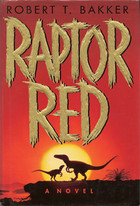
Book Review: Raptor Red by Robert T. Bakker
 Summary:
Raptor Red is one of the utahraptors who’ve newly arrived in what will one day be the western United States. Follow a year of her life as faces being both a predator and, as one of the smaller predator dinosaurs, prey.
Review:
I love dinosaurs. Who doesn’t? When I saw that this book was written by a paleontologist, I immediately was intrigued. Who better to tell a story about dinosaurs than someone who studies them extensively? The book certainly presents a realistic view of dinosaurs based on science, but sometimes the story suffers as a result of the intense attention paid to science.
First I just want to say my absolute favorite part of the book is the beginning of each chapter. Each chapter beginning has a small note in the corner about what month it is, but more importantly, it has a hilarious drawing of a dinosaur (or a few) along with a tongue-in-cheek chapter title.
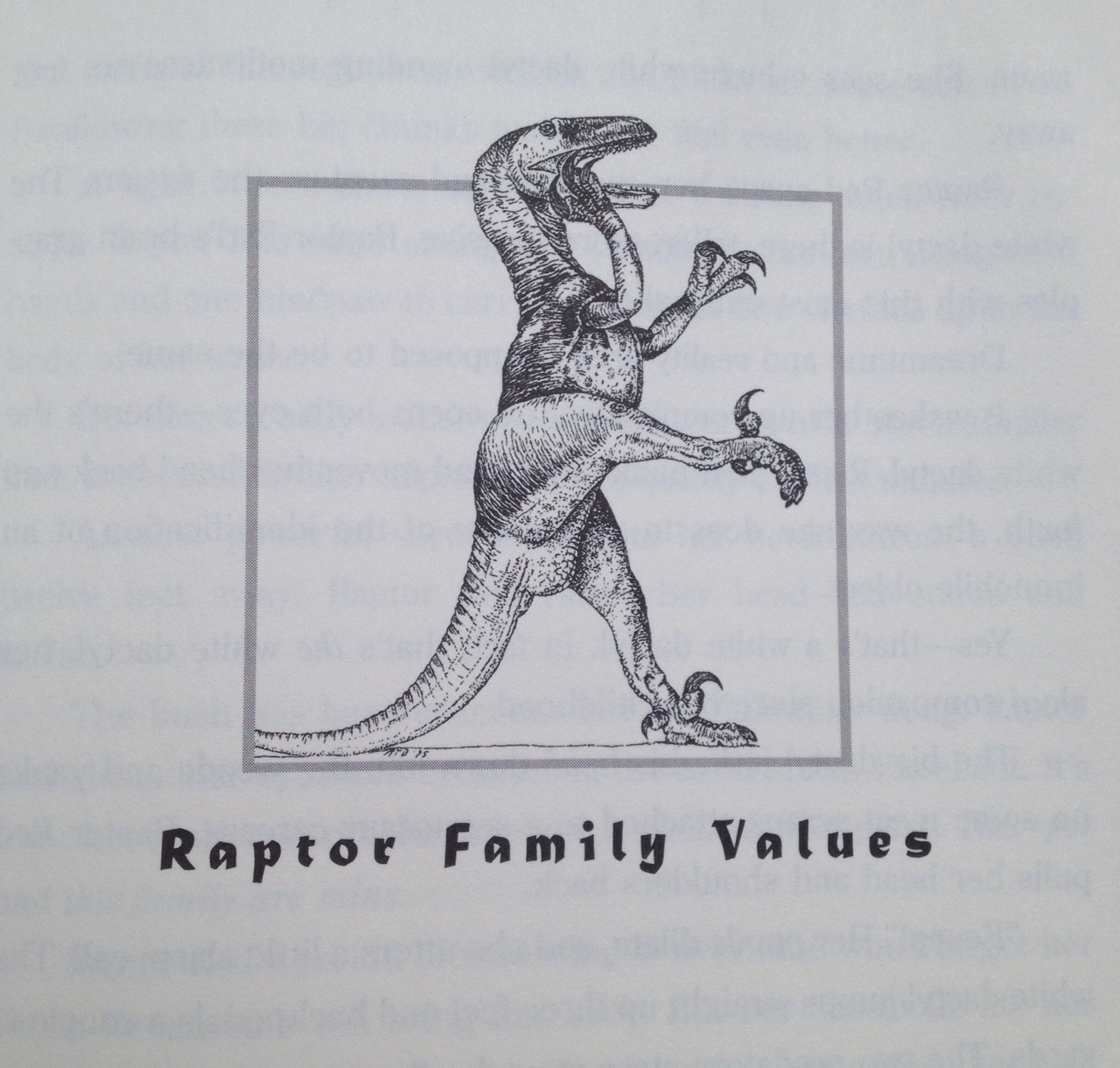
Look at that adorable dinosaur! Just look at him!
I wish that this ability to both present scientifically realistic dinosaurs and be humorous/cartoonish about them simultaneously had carried through to the writing. The overarching story that the book tells is sound. Raptor Red’s mate dies, and she reunites with her similarly widowed sister while simultaneously looking for a new mate. (This is not a spoiler, it is well-established in the first chapter). But the story on the sentence level is belabored by the author’s apparent need to couch everything in speculations. For instance, instead of just saying Raptor Red stamped her foot angrily, he’ll say something like Raptor Red was probably angry because she stamped her foot, and we know that dinosaurs stamping their foot indicated impatience, and if we believe that higher-thinking animals can feel emotions, then it was probably anger she was feeling. Passages like that really gum up the storytelling. The story would have worked better if he had some disclaimer at the beginning regarding emotions in animals, literary license, etc…, and then just ran with putting emotions on the extremely well-researched animal behavior.
The book teaches the reader a lot about dinosaurs in the context of the story, but the storytelling manner makes the reader get bogged down and realize they’re learning, instead of enjoying a story and happening to get some knowledge about dinosaurs in the process. The former makes for a tough read, in spite of enjoyable illustrations.
Overall, dinosaur enthusiasts will enjoy both the illustrations and the high level of science present in the story. Some may be frustrated by the author’s insistence on not personifying the dinosaurs, in spite of telling a very emotional story of being widowed and finding a new mate. Recommended primarily to those with a vested interest in reading everything dinosaur who won’t mind that the story sometimes suffers at the hands of science.
If you found this review helpful, please consider tipping me on ko-fi, checking out my digital items available in my ko-fi shop, buying one of my publications, or using one of my referral/coupon codes. Thank you for your support!
3 out of 5 stars
Length: 246 pages – average but on the shorter side
Source: PaperBackSwap

Book Review: The Running Game by L. E. Fitzpatrick (Series, #1)
 Summary:
Rachel is a doctor in the slums outside of London. It’s not a great place to live, but it’s safer than a lot of the other options available. She’s also a Reacher with telepathic powers. Since she was a young girl, she learned to hide her abilities and always know her exits so she could run at any time. But when two brothers show up, one a wounded Reacher, and tell her a mobster sent them looking for her, she has to decide whether to run again or trust the brothers.
Review:
Near-future dystopias will never cease in their appeal to me, and so I was fairly quick to accept this one when I was choosing ARCs to read for 2014. The book offers a grim dystopia but far less running than one would imagine from the title.
The book establishes the overall dreary setting of a dystopia fairly quickly. Rachel’s work at the hospital and commuting home from it is dirty and grimy. Society is clearly barely functioning, a fact that is smoothly and clearly established. It takes a bit more time to learn more about the over-arching world, and the fact that Rachel is a “Reacher,” a person with some form of telepathic powers. For some reason, the government is seeking to eradicate all Reachers, whereas the church, which is illegal, views them as angels sent from above, metaphorically speaking. It’s an interesting world but our view into it is quite narrow, so there’s a lot of questions left unanswered.
Rachel is a good, strong character who is well-rounded in spite of knowing little of her backstory. The brothers, on the other hand, are kind of annoying and two-dimensional. They and the general crime lords/corrupt cops feel much more cookie cutter than Rachel does. In a way, they drag her down. It’s hard to root for her when she chooses to cast in lots with this bunch.
Similarly, the plot focuses in on what feels more like a standard crime thriller plot, rather than a dystopian one. It’s a good crime plot, but it’s not a dystopian one. The title implies a much more dystopian style book, such as Rachel using her powers to outwit the government and start a new colony or something like that. Instead it feels a bit more like an urban fantasy style crime plot that just so happens to be surrounded by society breaking down, somewhere out there. I think marketing it as a running game, rather than as the crime mystery plot it really is hinders the book a bit. Readers who would like an urban fantasy style futuristic crime novel might miss it, because it sounds so dystopian. The title and summary give the vibe of a Logan’s Run or Maze Runner style book, when that’s not what it is. What it is is a perfectly good futuristic crime novel, but that’s not what it sounds like.
Overall, this is a quick-moving tale of futuristic crime with a dash of telepathic powers and an easily imagined setting. Fans of near future, fantasy, and crime will enjoy seeing the three intertwine. Those looking for more of a scifi or dystopian focus should look elsewhere.
If you found this review helpful, please consider tipping me on ko-fi, checking out my digital items available in my ko-fi shop, buying one of my publications, or using one of my referral/coupon codes. Thank you for your support!
3 out of 5 stars
Length: 228 pages – average but on the shorter side
Source: kindle copy from author in exchange for my honest review

Book Review: Tower of Glass by Robert Silverberg (Audiobook narrated by Stefan Rudnicki)
 Summary:
Simeon Krug, creator of androids, has a new vision. Earth is receiving a transmission from deep space, and he’s determined to answer it. He’s building a tower in the Arctic tundra, a tall tower that reminds many of the Tower of Babel. With this tower he will send a return transmission to whoever is sending the message to Earth. He also has his androids building a spaceship, to be entirely manned by androids, to try to reach those sending the transmission. However, the androids he designed that now outnumber and serve humans have other things on their minds. They want to be recognized as equal to humans, their brothers of the womb. While some seek this politically, others seek it spiritually, worshiping their creator Krug.
Review:
Robert Silverberg wrote one of my all-time favorite books (The World Inside
I loved the idea of this book, and I love books about ai/androids/robots. I thus was horrified when within the first chapter we discover that the “androids” are, in fact, clones. They’re not machines at all. They are genetically engineered humans, created in vats, and whose genetic code is changed enough to give them plasticine skin so that humans can tell themselves apart from them. I like the concept of GMO humans vs non-GMO humans. I like the idea of the vat versus the womb. I cannot, however, tolerate the fact that everyone calls these folks androids. That is not what an android is! (Merriam-Webster definition of android). It really put a sour note on the whole book for me, and the misnomer is never explained. Did Krug just call them androids to make people think of them as robots when they actually aren’t? If that’s the case, he himself would not think of them as androids. But he does. He calls them machines. What scientist would genetically manipulate humans and then call the outcome machines? It just makes no sense, and in a scifi book, it’s something I can’t look past.
The plot is a bit of a bait-and-switch. The reader thinks it’s going to be about the tower, the possible aliens, etc… In fact this is the backdrop to the story of the “androids” fighting to have their humanity recognized. I liked that the book was ultimately not the Tower of Babel retelling I originally thought it was going to be, but potential readers might want to know that the “androids” and their fight for human rights are actually the focus of the book.
Readers should also be ready to have every minute detail of the “android” religion worshiping Krug outlined for them. While that type of scifi book definitely has its audience, it might be different from the one expecting the tower story. The one aspect of the telling of the “android” religion that I found incredibly annoying was how they recite their DNA strands as prayer. Think of it as like a Catholic person saying the rosary. Only instead of words, it’s series like “AAA-ABA-ACA-CCC-BBB-AAA,” and it goes on for a very long time. Perhaps this is less annoying to read in print than to hear in an audiobook, but going on for such long stretches of time each time an “android” prays seems unnecessary.
The characters are all fairly well-rounded. There is Krug, his son, a high-ranking “android,” Krug’s son’s “android” mistress, a couple of “android” politicians, and more. There are enough characters to support the complex plot, and it’s fairly easy to get to know all of them. The “androids” are also given the same amount of characterization as the humans.
The audiobook narrator was somewhere between pleasant and unpleasant to listen to. He has a very deep voice that doesn’t fluctuate much for various characters or narration. It works really well for Krug but not so great for the female characters. If the narrator’s female voices were better and if he emoted more for emotional scenes, his narration would be more enjoyable. Between this fact and the reading of the DNA mentioned earlier, I definitely recommend picking up the print over the audiobook version.
Overall, the book presents an interesting world of GMO humans worshiping their creator and seeking freedom while he is entirely focused on the project of communicating with the stars. The misuse of the term “android” throughout the book will likely bother most scifi readers. Some readers may find some aspects of the “android” religion a bit dull. Recommended to scifi readers more interested in the presentation of future religions than in contacting deep space or hard science.
If you found this review helpful, please consider tipping me on ko-fi, checking out my digital items available in my ko-fi shop, buying one of my publications, or using one of my referral/coupon codes. Thank you for your support!
3 out of 5 stars
Length: 208 pages – average but on the shorter side
Source: Audible

Book Review: My Big Fat Demon Slayer Wedding by Angie Fox (Series, #5)
 Summary:
Lizzie Brown, once preschool teacher turned demon slayer, is extremely excited to be marrying her true love, Dimitri Kallinikos, who just so happens to also be a magical shape-changing griffin. And she’s also fine with letting her adoptive mother run the whole show, even though her mother wants to make the wedding into a week-long event. She’s not so ok with having to tell her mother about being a demon slayer, though. Or about integrating her mother’s posh southern lady lifestyle with her recently discovered blood-related grandmother’s biker witch gang. She’s pleasantly surprised that her mother found a goth-style mansion to rent for the wedding. Maybe the magical and the non-magical can integrate fairly well, after all. But then it becomes evident that someone in the wedding is trying to kill her. Plus, they find demonic images around the property…..
Review:
This remains one of my most enjoyed urban fantasy series. The world Fox has created is bright, witty, imaginative, and a real pleasure to visit, even though sometimes the main character can rub me the wrong way (she’s a bit too straight-laced for me sometimes). Urban fantasy books can either keep the main character perpetually single or have her get married. If they choose to get married, the wedding book winds up with a lot on its plate. It’s hard to integrate the world of urban fantasy with the wedding scene a lot of readers enjoy reading about. Fox achieves this integration eloquently, presenting an intriguing urban fantasy mystery, the clash of urban fantasy magical folks and real world expectations, and manages to show the wedding is about the marriage, not the party.
My main gripe with the previous book was Dimitri and Lizzie’s relationship. Primarily that they don’t appreciate what they have, and how annoying that is. I think the events of the previous book really snapped them out of it, because here, Lizzie and Dimitri have taken their relationship to another level. They have a trust in and intimacy with one another that manages to withstand some pretty tough tests, and is a pleasure to read about. It’s easy to see that this is a couple that is ready for a marriage. It’s a healthy relationship that’s rare to see in urban fantasy. At this point in the series, I can appreciate that Dimitri and Lizzie aren’t perfect in the earlier books. Relationships change and grow with time, and Fox demonstrates that beautifully. Of course, it’s still more fun to read about a happy couple than one bickering with each other over minor things. But those hiccups in the relationship in earlier books helps make it (and the marriage) seem more real.
Similarly, Lizzie has grown with the series. Where at first she’s annoyingly straight-laced, now she is not just starting to break out of that but is enjoying breaking out of it. Seeing her adoptive mother pushes this issue to the forefront. Lizzie is finally coming into her own, and she, and her loving mother, have to confront that.
[Lizzie’s mother] paused, straightened her already squared shoulders. “Is this type of style…” she waved a hand over me, “appealing to you? You look like a hooligan.” I let out a sigh. “Try biker.” (page 16)
Whereas this confrontation between Lizzie and her mother could have led to the mother looking like a bad guy, Fox leaves room for Lizzie’s mom to be different from her but still a good person and a loving parent. They butt heads over different opinions, just as real-life parents and adult children do, but they both strive to work through them and love each other for who they are. It’s nice to see how eloquently Fox handles that relationship, particularly with so many other plot issues going on at the same time.
The plot is a combination of wedding events and demon problems. Both ultimately intertwine in a scene that I’m sure is part of many bride’s nightmares. Only it really happens because this is urban fantasy. How Fox wrote the plots to get to that point is enjoyable, makes sense, and works splendidly. The climax perfectly demonstrates how to integrate urban fantasy and real life situations. Plus, I did not come even close to guessing the ending, which is a big deal to me as a reader.
The wit and sex scenes both stay at the highly enjoyable level that has been present throughout the series. Dimitri and Lizzie are hot because they are so hot for and comfortable with each other. The humor is a combination of slapstick and tongue-in-cheek dry humor that fits the world perfectly. I actually laughed aloud quite a few times while reading the book.
Overall, this is an excellent entry in this urban fantasy series. It tackles the wedding of the main character with a joyful gusto that leaves the reader full of wedding happiness and perhaps breathing a sigh of relief that no matter what may go wrong at their wedding, it couldn’t possibly be as bad as what can go wrong at an urban fantasy wedding. Highly recommended to fans of the series. You won’t be disappointed in Lizzie’s wedding, and you’ll be left eager to see her marriage.
If you found this review helpful, please consider tipping me on ko-fi, checking out my digital items available in my ko-fi shop, buying one of my publications, or using one of my referral/coupon codes. Thank you for your support!
5 out of 5 stars
Length: 270 pages – average but on the shorter side
Source: Gift

Previous Books in Series:
The Accidental Demon Slayer
The Dangerous Book for Demon Slayers
A Tale of Two Demon Slayers
The Last of the Demon Slayers
Book Review: Stinger Stars by Paul Bussard
 Summary:
Maria is working on her thesis at a genetics research lab specializing in looking for ways to get human limbs to regenerate. When the owner’s son brings back a new species from Peru, a tiny worm-like creature with pyramidal tentacles, she discovers that the larger clones made from them are intelligent. But the owner’s son wants to conduct brutal experiments on them, involving cutting off their appendages, which grow back. Can Maria strike the balance between life-changing science for humans suffering from disabled or missing limbs and respecting the lives of an intelligent species?
Review:
Near-future books that question where to draw the line in research are a particular favorite of mine. It’s a gray area in many people’s minds, and scifi lets us explore the myriad possibilities and options at a bit of a distance, which allows for clearer thought. This book does an admirable job setting up a realistic near-future world to explore this issue, although the characters don’t quite live up to the world-building and story.
The near-future world of genetics research is established both clearly and with subtlety early on in the book. There are two competing genetics research organizations, and rather than looking into something monstrous or far-flung, they are looking into regenerating limbs. It’s a logical next-step for a near-future book. The research labs themselves, as well as how they are run, including the field-work, have a real-world, logical feel to them.
At first I was concerned from the book’s official description that the creatures discovered would be aliens, since alien experimentation would be less of a gray area to explore. They are not, in fact, aliens, they are a newly discovered species originating on Earth. The mystery is whether they were always sentient or if something in the modification and cloning process made them sentient. This makes the conflict of how to use the creatures to help humans without harming them better, because exactly what they are is a bit unclear. It’s not as simple as if they were simply aliens or some sort of cute, fuzzy creature. They’re these slightly creepy worm-like things with tentacles, and the conflict is do we still respect these kind of ugly, cloned creatures for their intelligence, or do they need to look cuter or more humanoid to gain that respect?
The plot is complex and keeps the reader guessing. Even though I was fairly certain things would ultimately end up ok, I wasn’t sure how they were going to get there. This made it an engaging and quick read.
Unfortunately, the characters are rather weak and two-dimensional. I never was able to truly connect to any of the characters. If anything, I connected to the creatures a bit more than the main characters. There are also a few instances that feel out of character for the small amount of characterization done. For instance, Maria thinks she can’t date because her family wants her to have an arranged marriage to keep the family Spanish. This type of arranged marriage situation could definitely happen, but I had a hard time believing that a woman so strong in the sciences, with so much agency for her career and for her grandmother’s well-being would actually even think about not seeing someone she cares for in order to have an arranged marriage. It felt out of character and simply forced upon her to add conflict. Similarly, there is an incident that at first is considered a rape and then later brushed off as not a rape. Without giving anything away, I agree it wasn’t a rape, but I also don’t think the character who at first mistook it for a rape would have made that error in judgment. It was out of character for their level of intelligence. This again felt forced to provide extra conflict that wasn’t needed. The main plot had plenty of interest and conflict to keep the book going without these out-of-character moments. I also felt the accent written for one of the characters was badly done and distracting. This character is a scientist with an advanced degree, yet he speaks in an informal, unrealistic accent that primarily consists of him dropping g’s and using a lot of contractions.
In spite of these characterization short-comings, the book still tells a unique near-future genetics research story with a quick-moving, engaging plot. Recommended to those looking for a scifi-style beach read.
If you found this review helpful, please consider tipping me on ko-fi, checking out my digital items available in my ko-fi shop, buying one of my publications, or using one of my referral/coupon codes. Thank you for your support!
3 out of 5 stars
Length: 206 pages – average but on the shorter side
Source: kindle copy from author in exchange for my honest review

Book Review: One Death at a Time by Thomas M. Hewlett (Series, #1)
 Summary:
Jack Strayhorn is a private eye and a member of Alcoholic’s Anonymous. Only, he’s not an alcoholic, he’s one of the vampires who meet in a secret vampire group that exists under the umbrella of AA to learn how to control their urges and feed on humans without killing them. He’s just returned to LA, his death site that he hasn’t been back to since he had to run in 1948 after becoming a vampire. When his current missing person case shows up dead next to a Fae politician, Jack gets dragged into a mixed-up underworld of Faes, werewolves, drugs, and a group of vampires determined to rule the world.
Review:
This is one of the twelve indie books I accepted to be reviewed on my blog in 2014 (complete list). I was immediately intrigued by the summary, due to its delightful urban fantasy/paranormal take on AA. The book delivers exactly what it promises, spiced with a noir writing style.
Jack Strayhorn is the perfect paranormal version of the noir-style hardboiled detective. He’s got a biting, snarky wit, a handsome presence, a sharp mind, and is a bit distant and mysterious. It’s just in this case he’s distant and mysterious because he’s a vampire. Making the private eye a vampire makes his character unique in noir, and, similarly, making the vampire a private eye with his focus primarily on crime solving and not paranormal politics gives the urban fantasy vampire a unique twist. Jack is presented as a complex character, one who we could not possibly get to know fully in just the first entry in the series. It’s easy to see how he will manage to carry the proposed 12 entries in the series.
Supporting Jack is a wide range of characters who accurately portray the diversity in a large town like LA, as well as the diversity one expects in a paranormal world. The characters are multiple races and classes. Whereas some urban fantasy books slowly reveal the presence of more and more paranormal races throughout the series, this book starts out with quite a few, and that is a nice change of pace. Most urban fantasy readers expect there to be more than just vampires, and the book meets the urban fantasy reader where they’re at. Even though the book has a large cast, the secondary characters never blend together. They are easily remembered, and the diversity probably helps with that.
I like the idea of vampires having an AA-like group, but I’m still not sure how I feel about this group existing as some secret under the umbrella of AA itself. The book even goes so far as to say the the founder of AA was a vampire himself, and used the human illness of alcoholism as a cover for the vampire group. I like and appreciate vampirism as a disease that some people just mysteriously have at birth as an analogy for alcoholism, but I feel that having it present in the same group as the real life AA groups dampens the realness of actual AA, weakening the analogy instead of strengthening it. I’ve seen books before have paranormal people get together in AA-style groups (zombies anonymous springs to mind), and in real life AA has spinoffs such as Narcotics Anonymous and Overeaters Anonymous. Prior to reading the book I thought maybe something might be added by having the vampires be a secret organization under AA, but after reading the book, I don’t think it did. I think the analogy would have been stronger if vampires spotted the similarities of their genetic vampirism with alcoholism and formed a “vampires anonymous” group, inspired by AA. Something about vampires creating AA themselves as a cover hits a bit of a sour note and weakens the analogy.
The plot is complex, with just enough twists and surprises. There were parts of the ending that I was unable to predict. The plot contained within the book was wrapped up sufficiently, and the overarching plot intending to cover the whole series was well-established and filled me with the desire to keep reading. Unfortunately, the second book isn’t out yet, so I will just have to wait!
Overall, this is a delightful mix of urban fantasy and noir and is a strong first entry for a new series. Some readers might dislike the paranormal take on Alcoholic’s Anonymous found within the book, but it is secondary to the mystery/noir plot and easy to gloss over if necessary. Recommended to urban fantasy readers looking to venture into noir or vice versa, as well as anyone who enjoys both urban fantasy and noir.
If you found this review helpful, please consider tipping me on ko-fi, checking out my digital items available in my ko-fi shop, buying one of my publications, or using one of my referral/coupon codes. Thank you for your support!
4 out of 5 stars
Length: 216 pages – average but on the shorter side
Source: kindle copy from author in exchange for my honest review

Book Review: Charlotte Sometimes by Penelope Farmer (Series, #3) (Bottom of TBR Pile Challenge)
 Summary:
When Charlotte goes away to boarding school for the first time, she’s very excited to get the bed with the particularly pretty wheels right next to the window. When she wakes up, though, the view from the window looks different, and people are calling her Clare! She discovers she’s traveled back in time to the same bed in the same boarding school, but during World War I. The next morning, though, she wakes up in the present again as Charlotte. This pattern continues, meaning both she and Clare are Charlotte….sometimes.
Review:
I picked this book up because I have an affinity for both boarding school books and time-travel books. This looked like the best of both worlds to me. A fun middle grade book that introduces to the reader to two different past time periods–the late 1960s of Charlotte’s present and the nineteen-teens of Clare’s present.
This book is the third in a series, but it is completely possible to read it as a standalone. No mention is made of the events in the first book, and the second book is actually about what Charlotte’s little sister does while she’s away at boarding school.
The concept is intriguing, because instead of time-travel happening once and landing the person stuck in the past (or future), Charlotte keeps switching, spending every other day in the 60s and every other day in the teens. (I get a migraine when the barometric pressure changes….I can only imagine how I’d feel if I time travelled! Do you think I could bring my green lamp therapy with me?)
In addition to the usual issues time-travel books bring up, such as what stays the same and what is actually different throughout time, it also brings up the key question of identity. What makes Charlotte Charlotte? Is she still Charlotte when she’s being called Clare? Why does hardly anyone notice that Clare has changed? Or Charlotte for that matter? The book thus addresses identity issues that middle grade readers might be going through, but in a subtle way through the time-travel trope.
Were you some particular person only because people recognized you as that? (page 66)
The time-travel itself is left as a fantastical mystery, rather than being given a scientific explanation. There’s something magical about the bed that only makes Charlotte and Clare switch places, but no one else. This works without an explanation because the young girls being subjected to the time-travel just accept it without explanation. This is their reality, and it doesn’t matter why it’s happening, they just have to deal with it. Some readers, though, might struggle with the fact that the time-travel itself is never explained.
The one thing that disappointed me about the book, and that I think would have made it a classic and a five star read, is that the book only explores what happens to Charlotte when the girls switch places. Clare, her experiences, and her perspective are only heard about through third parties. The book, while in third person, is entirely Charlotte’s perspective. Clare, a reserved, proper girl from the nineteen-teens must have been shocked by both the technology and the mores of the 1960s she suddenly found herself in. So much more could have been explored by telling both Charlotte’s and Clare’s story. The book misses an opportunity by only focusing on the modern day girl going back in time. The girl being thrust into the future, a future where she finds out Britain wins the war, and there is suddenly no food rationing or flu epidemic, that is such a cool story in and of itself, and Farmer just never ventures out to tell it.
Interestingly, the British band The Cure released a song called “Charlotte Sometimes” that they admitted was pulled directly from this book. Not just the title, but song lyrics are pulled from the first couple of lines of the book. Even the music video features scenes from the book. It seems to be quite a mystery who the actress was who played Charlotte in the video. She wasn’t credited, and there’s a lot of posts on the internet with people speculating about who she might be. In any case, Penelope Farmer was…not amused by the whole thing. But back to the book.
Overall, this is a book that sets up a fantastical world of time-travel within a boarding school. It utilizes the switching of two girls with each other in time to explore questions of identity in a way that surely will appeal to many middle grade readers. The book does not fully explore the story the way it possibly should have, but the young reader will probably enjoy filling in those gaps themselves. Recommended to all fans of boarding school, time-travel, or historic fiction set during World War I’s homefront.
If you found this review helpful, please consider tipping me on ko-fi, checking out my digital items available in my ko-fi shop, buying one of my publications, or using one of my referral/coupon codes. Thank you for your support!
4 out of 5 stars
Length: 174 pages – average but on the shorter side
Source: Better World Books

Previous Books In Series:
The Summer Birds
Emma in Winter


Edit note: Thanks to Vicky for pointing out it was published in 1969.
Book Review: Limbo: Blue-Collar Roots, White-Collar Dreams by Alfred Lubrano
 Summary:
What do you call the approximately 1 out of 5 working class American kids who go to college and move into the white collar world? Journalist Alfred Lubrano calls them Straddlers, and the world they live in Limbo. Through interviewing experts on social mobility and class, therapists, and Straddlers themselves, Lubrano seeks to establish the unique challenges and triumphs of moving up the social ladder from blue to white in America.
Review:
I picked this up because I happen to be one of the Straddlers Lubrano is talking about, and I was curious to know both what about my experiences are common among all Straddlers and pieces of advice on navigating the interesting experience of being a Straddler. The book brings to light the often overlooked issue of how changing classes impacts a person’s life, as well as real cultural differences among the blue-collar and white-collar classes in America.
Lubrano begins his book by defining blue and white collar. A blue collar person can make more money than a white collar person (think of a successful plumber versus a struggling journalist). Blue versus white collar isn’t about how much income a person generates, according to Lubrano. What really makes the difference is 1) education level and 2) type of work. The blue collar person may have an associate’s degree or a trade degree or certification. The white collar person will have, at minimum, a bachelor’s degree. The blue collar person generally works with their hands or in service industries. The white collar person works in an office or on a computer. Thus, what generally begins the change from blue to white collar is attending a four-year college.
The book next establishes the blue collar background the Straddler comes from, as well as establishing statistics on class mobility and class differences. By establishing firmly the blue collar background the Straddler comes from and how that affects their thought patterns and approaches, Lubrano lays the groundwork for highlighting the unique struggles Straddlers go through in college and later at their white collar jobs and in their white collar surroundings. The blue collar class elements Lubrano highlights include: being taught that working hard will get you what you want (the ideal of a meritocracy at all levels of society), distrust of the boss/upper-levels of management, intense loyalty to community and fellow workers, high value on obedience and conformity to community, patriotism, straight talking, and emotions being close to the surface and easily erupting.
The next section deals with the blue collar kid starting college. Both blue collar families that push college and those that degrade it are discussed, as well as the reasons for both reactions by blue collar parents to college. On the one hand, there are the parents who view college as a straight-shot meritocracy to a better job, better life, and better ability to live your dreams. On the other hand, there are the parents who are afraid that they will lose standing in their own home if their child outsmarts or outshines them. By and large, however, most blue collar parents fall in the former category. Lubrano points out that blue collar parents don’t intimately know or understand the white collar world they are sending their children into, and thus unknowingly often give them bad information or false hopes. To the blue collar parent, a college degree is a golden ticket, and so the blue collar child is pushed into a culture they are unprepared for.
Straddlers’ parents have such plans for their kids. With strong hopes but scant information, many push their progeny toward the vague realm of Something Better–the glorious middle class. Imbued with these dreams, Straddlers lurch awkwardly out of sheltering enclaves into unknown realms. On their sometimes troubled way, they become educated and awaken to class differences between the past and their would-be future. Priorities shift. Some values change, while some remain constant. Unlike many they meet in the new, white-collar world, these people are hybrids. That duality is their strength and their struggle, and will comfort and vex them throughout their days. (loc 611)
Next, the book tackles the blue collar / white collar culture clash that begins to occur when a blue collar person attends college and will continue throughout their life as a Straddler. Lubrano does an eloquent job of addressing both how the Straddler struggles to understand the white collar world she now inhabits, as well as how the Straddler starts to change and no longer fits in among her family and blue collar people she grew up with. The changes that often make a Straddler no longer fit in among her family include: language, leaving religion, and dietary choices. College makes the blue collar kids change, and often their families are not expecting that. Suddenly, the child speaks like a stranger, eats like a stranger, and no longer feels attached to the family religion. The culture clash between the working class college student and her new peers is perhaps a bit more obvious. The monetary differences are clear immediately. Peers often don’t understand the need to work or the high value of a dollar to their blue collar classmate. More subtle and far-reaching than the different approaches to money, though, are the different approaches to life. White collar kids are raised with self-esteem and feelings of entitlement that blue collar kids never knew existed. They navigate campus with a sureness of belonging, and that surety will aid them throughout their careers.
The book next tackles how these class differences affect the Straddler’s career. This is the most fascinating part of the book. Most people probably expect that a blue collar kid going to college will experience some culture clashes and struggles with the family, but the idea that these struggles will continue past college is not obvious. College is supposed to prep everyone for a career, but the fact is, oftentimes colleges leave the Straddler student floundering on their own. There are generally no classes on how to be white collar, you’re just supposed to know. And it’s not always easy for the Straddler to just pick this up on their own. Lubrano highlights the key areas in which the blue collar culture the Straddler was raised with clashes with the expectations of a white collar job and can hurt a career.
If you come from the working class, you haven’t got a clue how to conduct yourself when you first land in an office. You’re lost if you can’t navigate the landscape–if you follow blue-collar mores and speak your mind, directly challenging authority. Without tact and subtlety, without the ability to practice politics amongst the cubicles, an executive with a blue-collar background will not rise. (loc 2473)
Among the issues Lubrano highlights as frequently arising for Straddlers are a tendency to be lacking in tact, an innate disgust for and inability to handle the inauthenticity demanded by office politics, and a lack of understanding of the manner of dress expected in white collar jobs. Additionally, blue collar homes often denigrate the boss or the man, demanding only loyalty to fellow workers. White collar culture, on the other hand, demands loyalty to firm, not your coworkers, as well as an expectation that you will automatically desire to rise up the ladder and become the man. Perhaps the most difficult skill for Straddlers to learn and appreciate is networking. Blue collar homes teach you to leave work at work. Family time is a sacred space. White collar jobs expect extraneous socializing in the form of networking, additionally they expect the white collar workers’ whole family to participate in their career, when needed. (Think of a networking dinner in the worker’s home). This entire concept rubs the Straddler the wrong way. Networking feels inauthentic and wrong, and the family space feels violated. Additionally, the Straddler was raised believing hard work advances you, not who you know. The idea that you advance farther by networking than by working hard can often sicken a Straddler.
I didn’t realize that doing a job well is no guarantee of advancement and opportunity. There are ways to get ahead that have nothing to do with hard work. But blue-collar people are taught that that’s a person’s only currency–you sell your labor and give the boss an honest eight hours….Along with blatant kissing up, networking and socializing with bosses and colleagues also are dirty words to some Straddlers. It all smacks of phoniness and is antithetical to their blue-collar backgrounds, which emphasize honesty in human relations–”real” relationships. (loc 2735)
The book next discusses Straddler’s romantic lives and experiences parenting their own white collar children. Unless a Straddler dates another Straddler, they will end up dating someone who does not communicate the same way they do. If they date a blue collar person, the same issues they have with their own family arise. If they date a white collar (born and raised) person, then issues in communication similar to the ones they experience at work come up. If the Straddler marries a blue collar person, that person will often feel threatened by their academic interests. If the Straddler marries a white collar person, communication is often an issue. White collar people are taught to manage their emotions and shut down when upset. The Straddler was raised with emotions at the surface in a passionate manner. This can freak out the white collar person, and in turn, the relative calm of the white collar partner can drive the Straddler crazy.
When it comes to kids, most Straddlers talk a lot about trying to keep their kids from having a sense of entitlement. They want them to connect to their blue collar roots, to appreciate blue collar work, and to have blue collar values. The Straddler wants their child to have to struggle, because they value the personal growth they themselves got out of it.
The book closes out with a discussion of what makes a successful Straddler. Ideally, the Straddler will become bicultural. Able to navigate both blue and white collar worlds, and appreciate the positive in both. Unashamed of where they came from and unashamed of where they ended up.
The more successful Straddlers–and by this I mean people who are comfortable with their lives–embrace their middle-class reality while honoring their blue-collar roots. Though they live in limbo, they choose to concentrate on the upside and what makes them unique. (loc 4175)
The book addresses a topic that badly needs to be addressed. If one in five working class kids becomes a Straddler, that’s a huge sociological group that is often not discussed. However, there are some weak points in the book. Although Lubrano acknowledges that Straddlers can come from the city or rural areas, since he grew up in Brooklyn, he tends to focus in on those who come from the city. He could have sought out more Straddlers to interview who grew up rural poor to get a firmer grasp on what their life experiences are like. There are some subtle differences between city and rural blue collar. Similarly, Lubrano mostly interviews people of the same generation as himself. He conducts one series of interviews with three people from a younger generation, but primarily he interviews people from the same age-range. Although it’s obvious these issues are consistent across generations, it would be a stronger book with multiple generation’s voices. Similarly, the book came out in 2005, and an updated edition would be nice.
Overall, this is an engaging read that addresses the sociological issue of moving from blue collar to white collar class. Interviews with both Straddlers and experts brighten and enlighten the text, although the book would benefit from a bit more variety in the Straddlers interviewed. Recommended to anyone who is a Straddler themselves, as well as those who may educate or work with Straddlers and those with an interest in class differences.
4 out of 5 stars
Length: 256 pages – average but on the shorter side
Source: Amazon
Buy It (Amazon or Bookshop.org)
If you found this review helpful, please consider tipping me on ko-fi, checking out my digital items available in my ko-fi shop, buying one of my publications, or using one of my referral/coupon codes. Thank you for your support!
 Support my work with a tip or browse my shop for curated book club guides, how to guides, cross-stitch patterns, and more!


This work by Amanda Nevius is licensed under a Creative Commons Attribution-Noncommercial-No Derivative Works 3.0 United States License.
 Opinions of a Wolf