
Archive
Book Review: Eighty Days: Nellie Bly and Elizabeth Bisland’s History-Making Race Around the World by Matthew Goodman
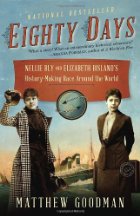 Summary:
In 1889, the world was obsessed with Jules Verne’s fictional work Around the World in 80 Days
Review:
With my interest in women’s history, I was surprised when I saw this title on Netgalley that I had never heard of this race around the world, although I had heard of Nellie Bly, due to her investigative report into Bellevue Hospital (a mental institution). I knew I had to request it, and I’m quite glad I got a review copy. Goodman tells not just the story of these two women but also immerses the reader into the newly global world of the late 1890s, both the good and the bad.
Goodman starts the book by introducing us to the two women who will race around the world. He does an excellent job using primary source materials to give us both how others saw these women and how they saw themselves. For instance, in describing Elizabeth Bisland, Goodman writes:
One of her admirers, the writer Lafcadio Hearn, whom she had befriended in New Orleans, called her “a sort of goddess” and likened her conversation to hashish, leaving him disoriented for hours afterward. Another said, about talking with her, that he felt as if he were playing with “a beautiful dangerous leopard,” which he loved for not biting him. (loc 241)
While introducing the women, Goodman also talks at length about the role of women in journalism in the late 1800s and how hard it was for them to break into real reporting. Jumping off from Bisland and Bly, describes how women were blocked from many journalism positions with excuses such as that the newsroom needed to be free to swear and not worry about a lady’s sensibilities. Women were often barred to what was deemed the ladylike journalism of the society pages. The hardest part of being a hardhitting female journalist at the time wasn’t the actual reporting but instead the reception of women in the newsroom.
The successful female journalist, McDonald suggested, should be composed of “one part nerve and two parts India rubber.” (loc 465)
Bisland and Bly and their race came at the beginning of having women journalists do some form of stunt journalism, which is how they started to break into hardhitting journalism. Editors and owners discovered that readers enjoyed reading about women in stunt situations, such as learning how to stunt ride a horse, so this was their way in. Thus, even if the reader dislikes the personalities of either or both of the racers, they come away with some level of respect for them both breaking into the business.
From here, Goodman starts following the women on their race around the world. He takes the different legs of their journeys as a jumping-off point to discuss something historically relevant to that portion of the journey. For instance, during Bly’s trip on the ocean liner to Europe, he discusses how the steamships worked, from the technical aspects of the steam to the class aspects of first class down to steerage. During Bisland’s railroad trip across the United States, he discusses the railroad barons and the building of the transcontinental railroad. Thus, the reader is getting both the story of the race and historical context. It’s a wonderful way to learn, as the historical explanations flesh out the settings around and expectations of the women, and the women lend a sense of realness to the historical situations and settings being described.
After the completion of the trip (and, no, I won’t tell you who won), Goodman explores the impact of the trip on the women’s lives and follows the rest of their lives to their deaths. This part may feel a bit long and irrelevant to some readers, however often when people become famous for doing something, no one talks about the long-lasting impact of that fame or what the rest of their lives are like. Seeing how both women reacted to the trip, their careers, and others puts them in a more complete light, giving the reader a complete picture of what the race did in their lives. This complete picture of both of their lives is something I really appreciated and that also demonstrated that one shouldn’t judge people too fast. They and their lives may turn out differently than you expect at first.
What would have made me love the book is if I had come away feeling like I could respect or look up to either woman. Unfortunately, by the time I heard the full story of both of their lives, I found them both to be so deeply flawed that I couldn’t do that. I respect them for breaking into the newspaper business, and perhaps if I was a journalist myself that would be enough to make me look up to them. But each had a fatal flaw that made this not be a book about two role models but instead a book about two women. There’s nothing wrong with that, but it does keep it from being a book I would return to over and over again.
Overall, Goodman does an excellent job using the true story of two female journalists’ race around the world in 1889 to 1890 to build a solid picture of the increasingly global world of that time. The reader will come away both with having learned an incredible true story and details about the 1800s they might not have known before, told in a delightfully compelling manner. Some readers might be a bit bothered by how flawed the two women journalists are or by the fact that the book goes on past the race to tell about the end of their lives in detail. However, these are minor things that do not distract too much from the literary qualities of this historical nonfiction. Recommended to those interested in an easy-to-read, engaging historical nonfiction book focusing in on women’s history. Particularly recommended to modern, women journalists.
If you found this review helpful, please consider tipping me on ko-fi, checking out my digital items available in my ko-fi shop, buying one of my publications, or using one of my referral/coupon codes. Thank you for your support!
4 out of 5 stars
Length: 480 pages – chunkster
Source: Netgalley

Book Review: American Science Fiction: Five Classic Novels 1956-58 (Series, #228)
 Summary:
The Library of America collects together great pieces of American literature into themed books. This can be anything from an author, to writing on aviation, to the Harlem Renaissance, to transcendentalism. Clearly this is a collection of classic 1950s scifi, in particular covering the time period from 1956 to 1958. The books included in the collection, in order of publication date, are:
Double Star
The Stars My Destination
A Case of Conscience
Who?
The Big Time
Review:
This is my third Library of America collection and, unfortunately, is the one I’ve liked least so far. Perhaps I have simply discovered that the Red Scare overtakes American scifi of the late 1950s more than I had previously realized, and that is just not to my own personal scifi taste. The collection still does what it purports to, though: it gathers a selection of the best of American scifi in a particular time period, letting the reader immerse herself and truly come to know a particular genre in a particular period.
Since this collection gathers up books written by different authors, I have reviewed the books individually as I read them. Thus, here I will simply summarize my reviews to give you a feeling of the collection as a whole.
Double Star
Similar to The Moon Is a Harsh Mistress, Heinlein presents a delightful mix of wit, Hollywood glamor, and thought-provoking political speeches all in a well-imagined and engaging future society. A fun piece of classic scifi that tosses together acting and politics in outer space with Martians who look like toadstools and a heavy sprinkling of wit. The romance leaves something to be desired, and the tech isn’t particularly predictive or imaginative, but these are minor aspects of the story. Recommended to fans of witty scifi who don’t mind a dash of political intrigue.
4 out of 5 stars
Full Review
The Stars My Destination
The world building is so excellent and gets so much attention from Bester that it overshadows the more average vengeance plot with iffy morals. Readers who enjoy immersing themselves in various possible futures will revel in the uniqueness and richness of the future presented here. Those who believe firmly in punishment for crime as opposed to redemption may not be able to get past the plot to enjoy the setting. Recommended to scifi fans interested in a unique future setting.
4 out of 5 stars
Full Review
A Case of Conscience
Essentially, the book has interesting world-building and what could be a promising plot that get derailed by two-dimensional characters and too many bizarre plot-twists and occurrences. It’s certainly an interesting read, particularly if you are interested in immersing yourself in this odd world Blish has created. However, readers should not expect to connect with the characters on an emotional level and should be prepared for a bizarre plot.
3 out of 5 stars
Full Review
Who?
An interesting concept that wasn’t fully fleshed out nor the possible weaknesses fully addressed. It is definitely a scifi of its time, with its hyper-focus on the Soviets and the Cold War that could almost feel kitschy today. A short read with an interesting premise, albeit a lack of female scientists, soldiers, or government workers. Recommended to scifi fans who enjoy some old-fashioned red scare in their reads and don’t need the science to be perfect.
3 out of 5 stars
Full Review
The Big Time
A thought-provoking whodunit mystery set in an R&R waystation in a time-travel war. Some aspects of the book did not age particularly well, such as the hysterical fear of Communism and the lack of women soldiers, but the heart of the book is timeless. How do you know if those in charge are right or wrong, does love make you see things more or less clearly, and does evolution feel frightening and random when it’s happening. Recommended to scifi fans with an interest in a scifi take on a Clue-like story.
3 out of 5 stars
Full Review
In Conclusion
This is an interesting collection that shows how gradually fear of Communism came to take over American thought by the end of 1958. The two earliest books in the collection are set in a far future with no concerns about the long-reaching impacts of the Cold War. By the last two books, the futures are heavily impacted by the perceived threat of Communism, with one book even having time itself being unraveled and re-written in an attempt to stop the Russians. The most light-hearted, entertaining book in the collection is Double Star
If you found this review helpful, please consider tipping me on ko-fi, checking out my digital items available in my ko-fi shop, buying one of my publications, or using one of my referral/coupon codes. Thank you for your support!
3 out of 5 stars
Length: 835 pages – chunkster
Source: NetGalley

 Support my work with a tip or browse my shop for curated book club guides, how to guides, cross-stitch patterns, and more!


This work by Amanda Nevius is licensed under a Creative Commons Attribution-Noncommercial-No Derivative Works 3.0 United States License.
 Opinions of a Wolf